Packing cubes, compression packing cubes and vacuum bags are often sold as if they do the same job. They do not. A packing cube organises a suitcase; a compression cube organises it and squeezes it a little; a vacuum bag removes the air from soft clothing and shrinks it dramatically. Which one is right depends on whether your problem is a messy bag, a bag that is slightly too full, or a bag that simply cannot hold everything you need to take.
This guide compares the three honestly, answers the common question of whether packing cubes are worth it and whether they actually save space, and explains how many experienced travellers combine them. It is written for travellers and for travel brands deciding what to put in their range, and it draws on over 20 years of making welded airtight bags at our factories in Dongguan, China and Ho Chi Minh City, Vietnam.
What Packing Cubes Do
A standard packing cube is a zipped fabric box, usually with a mesh panel, that holds one category of clothing: tops in one, underwear and socks in another, and so on. Its main job is organisation. Clothes stay folded, you can see what is where, and you can lift a whole cube out of a suitcase or into a hotel drawer without unpacking everything. Because the cube holds clothes tightly in a fixed shape, it also stops a half-empty bag from shifting and wastes less of the space in the corners.
So do packing cubes save space? A little, mainly because tightly rolled or folded clothes in a firm block pack more neatly than loose ones. But a standard cube does not remove air from the clothes, and the fabric and zips take up some room of their own. Travellers who buy cubes expecting to fit much more into the same bag are often disappointed; travellers who buy them to stay organised are usually very happy. That is the honest answer to whether packing cubes are worth it: yes, for organisation, and only modestly for space.If space is the goal, our guide to compression bags for suitcases shows how many bags fit each size of case.
What Compression Packing Cubes Add
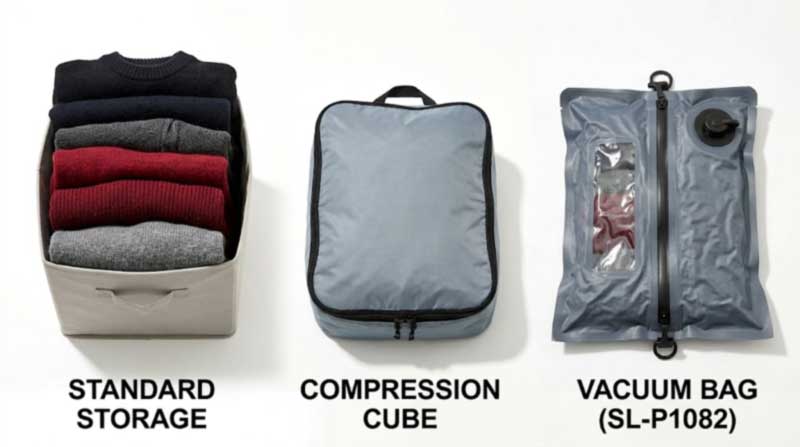
A compression packing cube has a second zip running around its middle. Once the cube is packed and closed, the second zip is pulled shut, pressing the two halves together and squeezing out some of the air. The result is a thinner, firmer cube that takes up noticeably less room than a standard cube with the same contents, while keeping all the organisation benefits.
The limit is that a compression cube can only press the clothes as far as the zip will close. It does not create a vacuum, and its fabric walls are not airtight, so it cannot match the volume reduction of a vacuum bag on bulky items such as jumpers, fleeces or a down jacket. Compression cubes work best with everyday clothes that are already fairly compact, where a moderate squeeze is all that is needed.
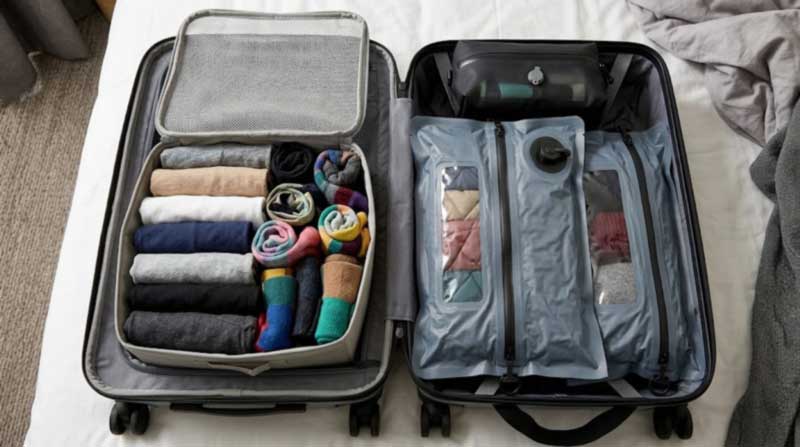
The same clothes in a packing cube, a compression cube and a vacuum bag: only the vacuum bag removes most of the air.
What Vacuum Bags Do Differently
A vacuum bag is sealed. Once the air is drawn out through a one-way valve, either by rolling, with a hand pump or with a built-in electric pump, the bag holds the clothes flat because air cannot get back in. On lofted clothing, that typically means a volume reduction of 60 to 70 percent, far more than a cube can achieve. That is why vacuum bags are the usual answer for winter trips, ski holidays, long trips with several climates, or fitting bedding and bulky layers into a carry-on.If you plan to carry them through the airport, see are vacuum bags allowed on planes.
The trade-offs are real. Vacuum-packed clothes come out more creased, a compressed bag is a hard, flat slab that is less convenient to rummage through, and you need to recompress the bag to pack it again. Vacuum bags also do nothing to reduce weight: packing more into the same suitcase makes it heavier, and an airline's weight limit can bite before its size limit does. Our guide on how to use vacuum bags covers the packing technique, and our comparison of travel vacuum bags with pump explains the three ways to remove the air.
What About Vacuum Packing Cubes?
Vacuum packing cubes try to combine the two ideas: a cube-shaped organiser with an airtight body and a valve. In practice, the more airtight and compressible a bag is, the less it keeps a box shape, so most products sold as vacuum packing cubes are flat vacuum bags with organiser features, such as a clear window to see the contents, a carry handle or a set of sizes for different clothes. These features are worth having. A clear window lets you find a shirt without opening the bag, and a set of small, medium and large bags lets you organise by category just as you would with cubes.For soft bags without corners, our guide to compression bags for duffel bags explains how to pack them on their edge.
Packing Cubes vs Compression Cubes vs Vacuum Bags at a Glance
Packing cube
Compression cube
Vacuum bag
Main job
Organisation
Organisation plus a moderate squeeze
Maximum volume reduction
Space saved
Small
Moderate
Large on bulky clothes, about 60–70%
Airtight
No
No
Yes
Keeps clothes dry
No
No
Yes, if welded and sealed
Creasing
Low
Moderate
Higher
Access during a trip
Easy
Easy
Recompress after opening
Best for
Everyday items you reach for often
Everyday clothes in a tight bag
Bulky layers, bedding, clothes for later in the trip
The Best Answer for Most Trips: Use Both
Many experienced travellers do not choose one system; they combine them. Clothes they will reach for every day, such as underwear, socks and T-shirts, go into ordinary or compression cubes for easy access. Bulky items they will not need until they arrive, or will only wear once or twice, such as a heavy jumper, a down jacket or a spare fleece, go into a vacuum bag. The result is a suitcase that is both organised and much smaller than it would otherwise be.
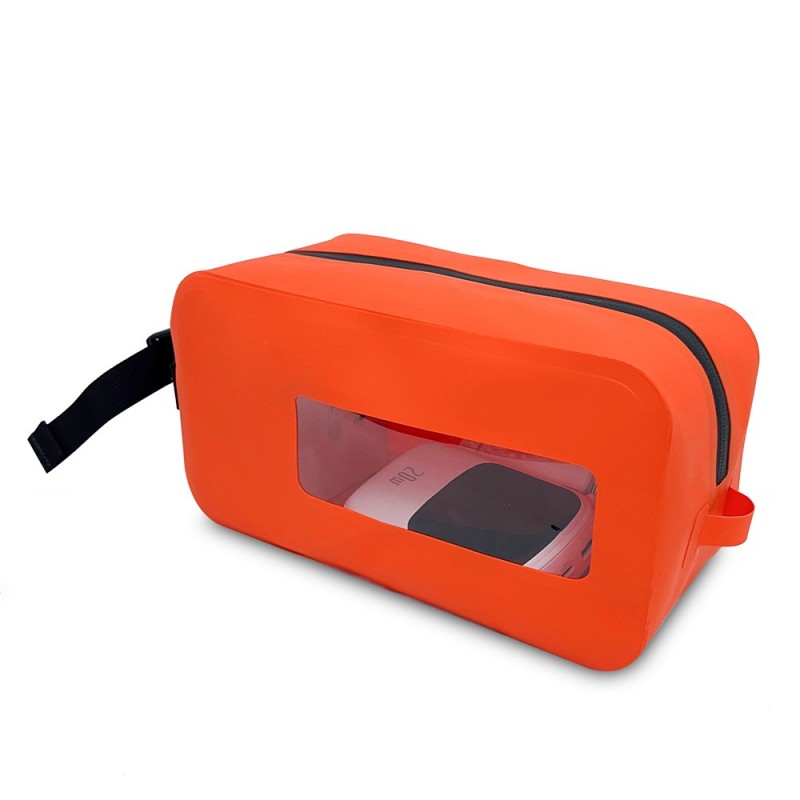
A sealed vacuum bag has one more advantage that cubes cannot offer: it keeps contents dry and separate. Dirty laundry, a damp swimsuit or clothes that must not get wet in a soaked backpack all travel better in a sealed bag. Toiletries are the other item that benefits from a waterproof container, because a leaking bottle can ruin a cube full of clothes.Our guide to building a travel packing system shows how these pieces fit together in one suitcase.
Cubes for things you need every day, vacuum bags for bulky layers, a waterproof bag for toiletries.
For Brands: Which Should Your Travel Range Include?
For a travel brand, packing cubes and vacuum bags are complementary rather than competing products. Cubes are a familiar, organisation-led product, and the category is crowded. Vacuum bags address a different need, space, and give a range a clear upgrade path: a roll-up bag at the entry price, a hand-pump bag in the middle and a built-in electric pump at the top. Welded, sealed vacuum bags also add waterproofing, which ordinary cubes cannot claim. Our guide to vacuum bags for clothes includes the care guidance that helps reduce returns, and our OEM vacuum compression bag supplier guide covers MOQ and factory options.Our guide to the best travel vacuum bags explains what to check in the bags themselves.
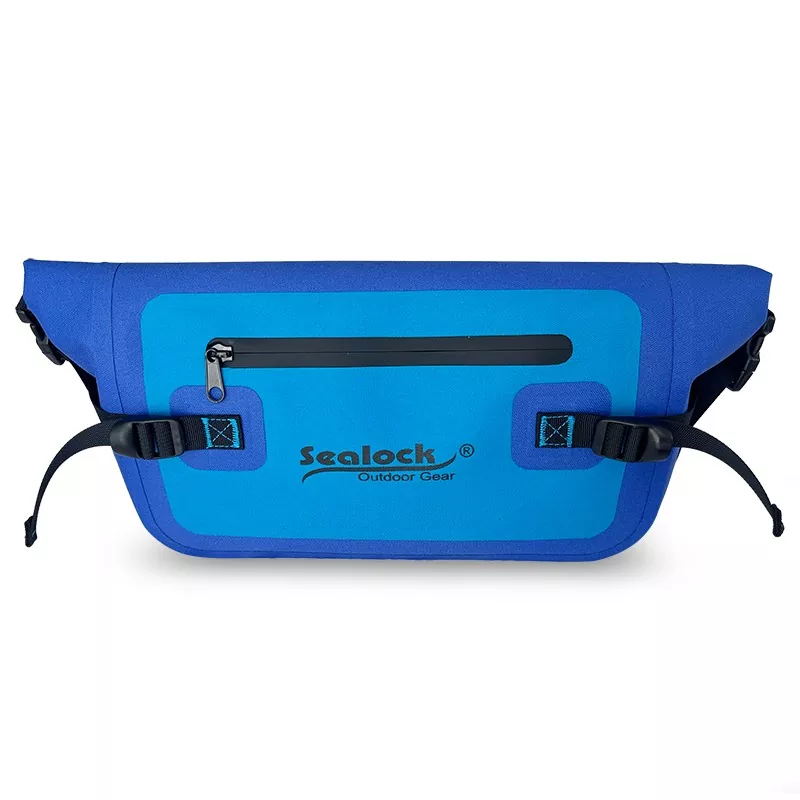
25×15.5×13.5 cm, about 5.2 L, 0.15 kg; TPU laminate, welded, sealed zipper, IPX6
500
All four can be made in your colours and packaging, with your logo by silk screen, heat transfer or a welded patch, or on a custom zipper pull. For the full development process, see our guide to custom vacuum compression bag production.
How We Test Travel Compression and Organisation Bags
Every order passes through IQC on incoming TPU laminate, zippers, valves and pump parts, IPQC during welding and assembly, and OQC on finished bags, with SGS or QIMA third-party inspection available on request. Welded seams are tested for tensile and bonding strength, finished bags go through a load test of 1,500+ cycles, and sealed zippers are opened and closed 3,000 times. Hardware goes through salt spray testing, fabric is tested for abrasion resistance, and colour fastness and colour difference are checked against the approved sample, which matters when a set of different sizes has to match. Bags rated IPX6 pass a heavy rain and water-jet test. For vacuum bags, buyers can follow our customer inspection procedure: unboxing, vacuum extraction, a 24-hour static rest and air-leak determination.
Frequently Asked Questions
Are packing cubes worth it?
Yes, for organisation. They keep clothes sorted, make unpacking quick and stop a bag from shifting. For saving space, they help only a little unless they are compression cubes.
Do packing cubes actually save space?
Slightly, by keeping clothes in neat, tight blocks. Compression cubes save more by squeezing out some air, and vacuum bags save the most because they remove most of the air from soft clothing.
Are vacuum bags better than compression packing cubes?
For bulky clothes and maximum space, yes. For everyday items you need to reach often, cubes are more convenient. Most travellers get the best result by using both.
What is the MOQ for custom travel vacuum bags?
300 pieces per style for the SL-P1133 and SL-P1083, and 500 pieces for the SL-P1082 and SL-P255. Samples take about 7–15 days and bulk production about 30–45 days.
How much do custom vacuum bags cost?
Price depends on the compression method, size, logo method, packaging and quantity. Roll-up bags cost least and bags with a built-in electric pump cost most. Send us your specification and quantity for a quotation.
Can you add our logo to a matching set?
Yes. Your logo can be applied by silk screen, heat transfer, a welded patch or a custom zipper pull, and we colour-match every size in a set to the approved sample.
Add Vacuum Bags to Your Travel Range
Tell us what your range already includes, the price points you need and how your customers travel, and we will recommend vacuum bags and travel organisers to complement it, prepare samples and plan production. Contact us at info@sealock.com.hk or call +86-769-82009361.
We use cookies to offer you a better browsing experience, analyze site traffic and personalize content. By using this site, you agree to our use of cookies.
Privacy Policy
 English
 Español
 Português
 русский
 Français
 日本語
 Deutsch
 tiếng Việt
 Italiano
 Nederlands
 ภาษาไทย
 Polski
 Svenska
 magyar
 Malay
 বাংলা ভাষার
 Dansk
 Suomi
 हिन्दी
 Pilipino
 한국어
 Türkçe
 Gaeilge
 العربية
 Indonesia
 Norsk
 تمل
 český
 ελληνικά
 український
 Javanese
 فارسی
 தமிழ்
 తెలుగు
 नेपाली
 Burmese
 български
 ລາວ
 Latine
 Қазақша
 Euskal
 Azərbaycan
 Slovenský jazyk
 Македонски
 Lietuvos
 Eesti Keel
 Română
 Slovenski
 मराठी
 Srpski језик