Sealock is a custom vacuum compression bag manufacturer and OEM supplier. A waterproof bag has to keep water out for as long as it is in the water. A compression bag has to keep air out continuously, for weeks, against a pressure differential that never relaxes. Air molecules are far smaller than water droplets and a vacuum never stops pulling, which makes this the most demanding sealing problem in our range. This guide covers how these bags are actually built — the valve, the closure, the pump integration, and the inflation test that catches what nothing else does.
The Valve Is the Product
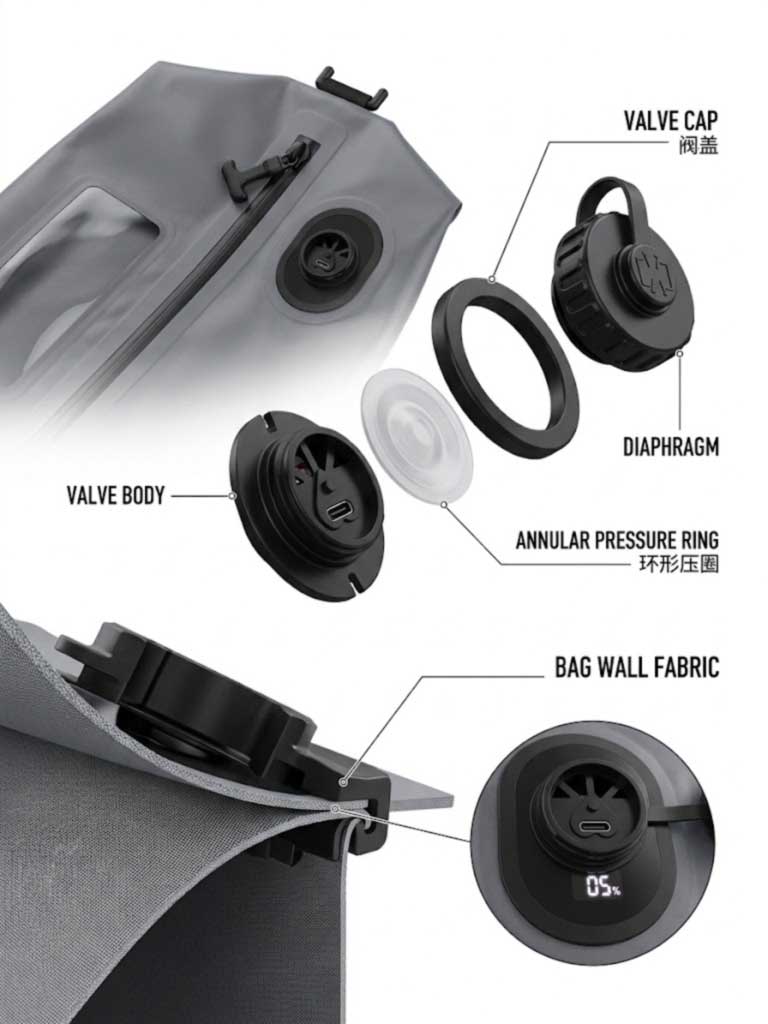
Everything else can be right and a bad valve will still lose the vacuum overnight. A one-way valve assembly on a compression bag has a specific anatomy, and each part does a job:
An inner valve body with a flange, sitting inside the bag, its flange engaging the area around the aperture in the bag wall.
A flexible diaphragm that flexes away from the bag to let air out under suction, then seals when pressure inside is lower than ambient outside. Better designs give the diaphragm areas of varying stiffness rather than uniform flexibility.
A projected annular ring that the diaphragm meets in linear contact — the actual sealing line, and the geometry that decides whether a vacuum holds for a night or a season.
An outer cap or retaining ring mounted on the outside, which snaps or threads over the protruding valve body and traps the bag material between the two components.
That last point is the key manufacturing principle: the valve is mechanically captured through the bag wall as well as bonded to it. Neither alone is sufficient — a bond without capture peels under repeated pump cycles; capture without a bond leaks at the interface.
Body, diaphragm, annular ring, cap — and the bag wall trapped between them.
The Bonding Rule That Decides Valve Reliability
Bonding a rigid valve body to a flexible bag wall can be done by gluing or by thermal bonding, and there is an established principle worth putting into your specification: superior results are obtained when the surfaces bonded are of similar material.
The practical consequence for a TPU compression bag is direct. If the bag's inner surface is TPU, the valve flange should be a compatible weldable polymer so the join is a genuine material fusion rather than an adhesive layer bridging two dissimilar plastics. An adhesive bond is a third material with its own ageing behaviour, and it is exactly the kind of joint that survives a factory test and fails six months into storage.
Specify the valve flange material alongside the bag laminate, not separately. It is the single most useful line a buyer can add to a compression bag tech pack.
The Failure Mode Nobody Specifies Against: Lint
This one deserves more attention than it gets, because the product is used almost exclusively with textiles. Valve designs include vanes to keep bag material and large objects away from the air holes — but vanes do not stop small particles entering the air holes, where they either block the holes or prevent the diaphragm from closing properly once evacuation is complete.
Clothing, bedding and down all shed fibres. A bag packed with a fleece and a down jacket is generating exactly the particles that will sit on a diaphragm sealing face. A bag that evacuates perfectly and then gradually refills over two days is very often a diaphragm held fractionally open by a fibre, not a leaking seam — which is also why users report leaks they cannot locate.
The engineering answers are specifiable:
A filter element across the valve opening, so evacuated air is filtered before it reaches the diaphragm.
Radial air deflectors beneath the valve seat — fins arranged in radial symmetry that sweep bag material, clothing and bedding clear of the air pores during evacuation, so fabric is not drawn hard against the valve.
A screw-down cap with a stop device pressing on the diaphragm, which adds a mechanical seal independent of the diaphragm's own closure. Our SL-P1133 uses a threaded cap with a gasket for exactly this reason: once the pump is removed, the seal no longer depends on the diaphragm alone.
Welding an Electric Pump Into a Panel
A built-in pump is a rigid, powered assembly welded into a flexible sealed wall. The requirements stack up:
An ABS housing with a gasketed interface to the panel, welded in rather than glued on.
A screw-down waterproof cap over the pump, so the electronics are sealed when not in use.
Battery containment — the cell and charging port live inside a sealed housing on a product that is repeatedly compressed and handled.
Auto-stop control, so the motor ends the cycle rather than running against a sealed bag.
The pump weld is a separate process window from the body seams, with its own parameters and its own inspection — and its housing seal is tested independently of the bag's vacuum retention.
The Window Panel and the Closure
The transparent window is a dissimilar-material weld: clear TPU film into a TPU-laminated fabric. The governing rule is that the higher glass-transition-temperature material must heat first and conduct into the lower-Tg one; run it the other way and the film over-melts while the laminate never properly fuses, giving a window that looks fine and delaminates later.
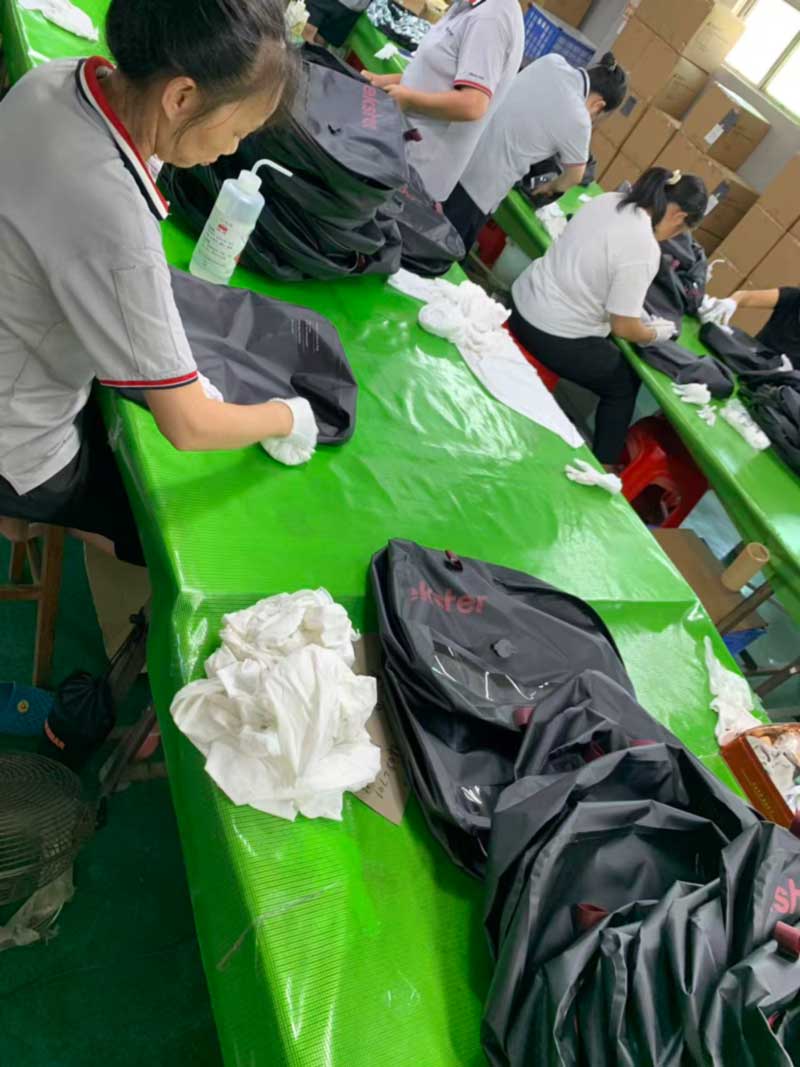
Window panels also need handling discipline on the floor. Our assembly stations work in white gloves with a cleaning solution, wiping each unit down before and after the window and hardware operations — because oil or dust on a clear film is both a cosmetic defect and a weld contaminant.
The closure is a full-length sealed waterproof zipper with a moulded tooth chain, welded to the panel. This is the component that separates a welded compression bag from a conventional one: a gasket-sealed zipper is a compressed seal, where a press-fit zip-lock strip is not. Edge binding in reinforced webbing then protects the perimeter from abrasion inside luggage.
Gloves and solvent on every unit — a clear window shows every fingerprint and welds badly over one.
The Production Sequence
Cutting — body panels, window film and binding cut to tolerance; a welded seam has no allowance to absorb drift.
Window welding — clear film welded into the body panel under dissimilar-material parameters.
Valve and pump installation — aperture formed, valve body seated and flange bonded, retaining cap engaged, or pump housing welded and gasket seated. Each runs its own parameter set.
Zipper welding — the sealed zipper tape welded to the panel with a void-free bond, so the seal is continuous from fabric to zipper.
Body welding — perimeter seams fused at 27.12 MHz, with test welds and peel tests at each run start.
Edge binding — reinforced webbing applied to the perimeter.
Cleaning — gloved wipe-down of window and hardware.
Inflation leak test — every unit, before packing.
Final inspection, labelling and packing with batch identification.
The Inflation Test: Pressure From the Inside
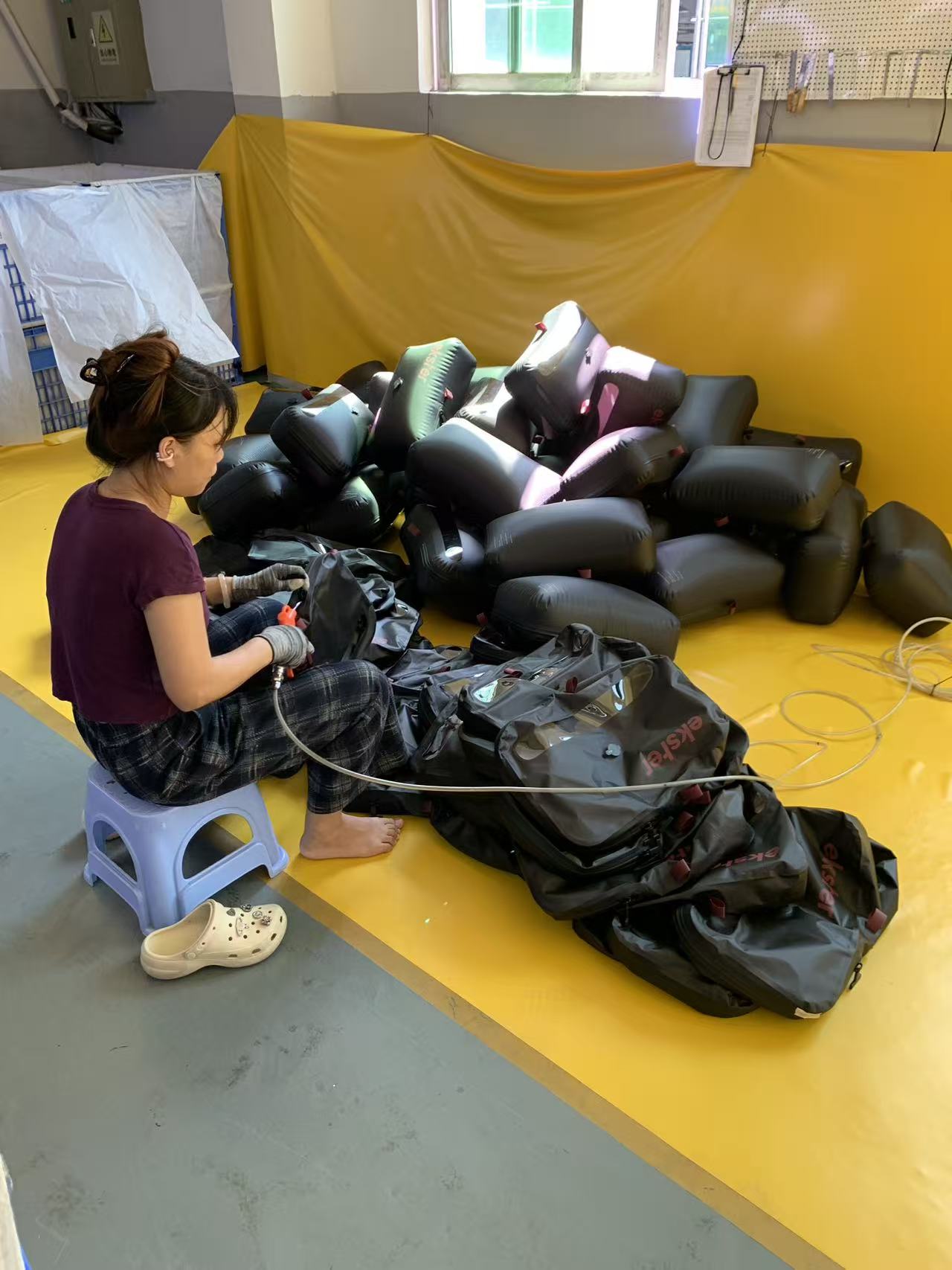
This is the step that distinguishes a compression bag line from a general waterproof line, and it runs on every unit rather than a sample. Each bag is inflated through an air gun until the body is under positive internal pressure, then set aside in a batch and observed.
The logic is worth understanding, because it is the opposite of the vacuum test and catches different faults. Inflation pushes every seam outward from inside, loading the welds, the valve capture, the zipper interface and the window frame in the direction they are weakest. A marginal weld that holds against external water pressure will open under internal pressure. Bags that stay inflated through the observation period pass; any that soften are pulled and traced.
Run alongside it, the customer inspection procedure — unboxing, vacuum extraction, a 24-hour static rest, and air-leak determination — tests the opposite direction, and on this product it is not an analogue for performance: it is exactly what the end user will do with the bag. Between the two, the seal is proven under both positive and negative pressure.
Every unit inflated and held — internal pressure finds what external pressure hides.
The Product Basis
Image
Model & specs
Production capability it shows
MOQ
SL-P1083 Compression Bag with Built-In Pump — 42×29×11 cm, 13.4L; electric pump welded into the body panel; ABS housing with sealed gasket interface; screw-down waterproof cap; USB-C, 1,500 mAh, around 90 cycles per charge; 4,000 Pa, roughly 15 seconds; digital countdown with auto-stop; welded clear TPU window; webbing-bound edges; moulded D-ring on a welded anchor platform.
Powered assembly welded into a sealed wall — the most complex build in the range
300
SL-P1133 Compression Bag with Hand Pump — 48×29×10 cm, 13.9L; screw-seal air valve with threaded cap and gasket; ABS valve housing with silicone gasket seal; matched piston hand pump; moulded TPU grip tabs; welded clear TPU window; up to 70% volume reduction.
Mechanical seal independent of the diaphragm — the most robust valve architecture
300
SL-P1082 Travel Vacuum Compression Bag — three sizes, 14L / 20L / 33L; TPU-laminated fabric; high-frequency welded seams; full-length sealed waterproof zipper; centre-mounted one-way valve; IPX6; pump-free hand compression.
Valve integration at three sizes on shared tooling logic
500
Valve architecture, filter and deflector provision, pump type, window panel, zipper, edge binding, hanging hardware, sizes, colourway and branding are all specifiable per order, or a bag can be developed from a sketch.
Quality Control
Quality is gated in three tiers. IQC covers incoming TPU laminate for coating thickness, adhesion and weldability, plus valve assemblies, diaphragms, gaskets, pump units, batteries, sealed zippers and binding webbing against the signed standard, with colour difference and fastness. IPQC covers cutting tolerance, window weld parameters, valve seating and capture, pump housing seal, zipper weld continuity and perimeter weld integrity, with peel tests on sample welds at each run start. OQC covers ISO 2859 AQL sampling, vacuum retention testing and gold-sample comparison, with SGS or QIMA inspection available.
Between them sit the two directional tests: 100% inflation leak testing under positive internal pressure, and the customer inspection procedure of unboxing, vacuum extraction, a 24-hour static rest, and air-leak determination under negative pressure. The lab additionally runs weld bond and peel strength, zipper fatigue cycling, valve cycling, pump cycle and battery charge-cycle testing, pump housing seal testing, puncture and tear resistance, tensile and burst, window flex and clarity, abrasion and colour fastness.
FAQ: Compression Bag Production
Q: Why do compression bags lose vacuum when the seams look fine?
A: Frequently it's the diaphragm rather than a seam. Fibres shed by clothing and bedding can enter the valve's air holes and hold the diaphragm fractionally open, so the bag refills slowly — which is why users report leaks they cannot locate. A filter element, radial air deflectors and a screw-down cap all address it.
Q: How is the valve attached to the bag?
A: By mechanical capture and bonding together — the bag wall is trapped between an inner valve body flange and an outer retaining cap, and the flange is bonded to the wall. Bonding alone peels under repeated pump cycles; capture alone leaks at the interface.
Q: What material should the valve be?
A: Compatible with the bag's inner surface. Bonds between similar materials are substantially more reliable than adhesive joints between dissimilar plastics, so on a TPU bag the valve flange should be a compatible weldable polymer. Specify it alongside the laminate.
Q: Why inflate the bags rather than just vacuum test them?
A: Because the two find different faults. Inflation loads every seam, the valve capture, the zipper interface and the window frame outward from inside — the direction they're weakest. We inflation-test every unit, and vacuum-test with a 24-hour hold as well.
Q: Is a built-in pump harder to manufacture?
A: Considerably. A powered assembly welded into a flexible sealed wall needs its own weld parameters, a gasketed ABS housing, a screw-down waterproof cap, and independent testing of the housing seal, the motor cycle life and the battery charge cycle.
Q: What are the MOQ and lead times?
A: From 300 pieces on the pump models and 500 on the three-size travel set, with samples in 7–15 days and production 30–45 days after approval.
Talk to the Factory
To put a custom vacuum compression bag into production, contact Sealock at info@sealock.com.hk or +86-769-82009361. Over twenty years of high-frequency welding and industrial sewing under one roof, valve and pump integration, 100% inflation leak testing, dual China–Vietnam production, and a full customer inspection procedure on every shipment.
We use cookies to offer you a better browsing experience, analyze site traffic and personalize content. By using this site, you agree to our use of cookies.
Privacy Policy
 English
  Español
  Português
  русский
  Français
  日本語
日本語  Deutsch
  tiếng Việt
  Italiano
  Nederlands
  ภาษาไทย
  Polski
  Svenska
  magyar
  Malay
Malay  বাংলা ভাষার
  Dansk
Dansk  Suomi
Suomi  हिन्दी
  Pilipino
  한국어
한국어  Türkçe
  Gaeilge
  العربية
  Indonesia
  Norsk
Norsk  تمل
تمل  český
český  ελληνικά
  український
  Javanese
  فارسی
فارسی  தமிழ்
தமிழ்  తెలుగు
  नेपाली
  Burmese
  български
  ລາວ
ລາວ  Latine
  Қазақша
  Euskal
  Azərbaycan
  Slovenský jazyk
  Македонски
  Lietuvos
  Eesti Keel
  Română
  Slovenski
  मराठी
मराठी  Srpski језик