
Real Evacuation, No Electronics
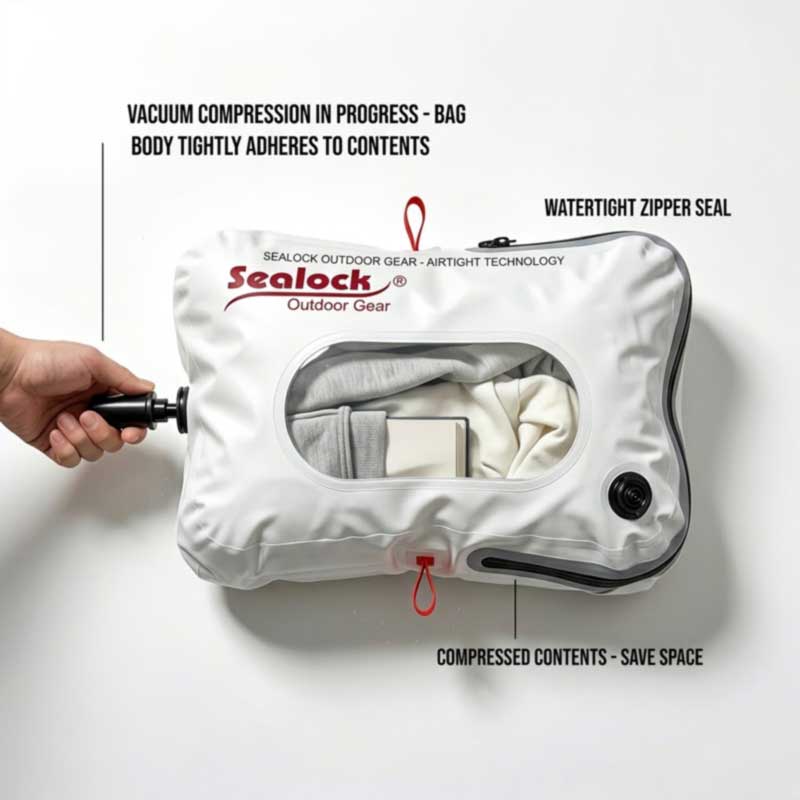
A pump draws air out of the folds, where hand pressure cannot reach. Around fifteen to twenty percent more compression on lofted items than press-to-compress bags achieve.
 English
  Español
  Português
  русский
  Français
  日本語
日本語  Deutsch
  tiếng Việt
  Italiano
  Nederlands
  ภาษาไทย
  Polski
  Svenska
  magyar
  Malay
Malay  বাংলা ভাষার
  Dansk
Dansk  Suomi
Suomi  हिन्दी
  Pilipino
  한국어
한국어  Türkçe
  Gaeilge
  العربية
  Indonesia
  Norsk
Norsk  تمل
تمل  český
český  ελληνικά
  український
  Javanese
  فارسی
فارسی  தமிழ்
தமிழ்  తెలుగు
  नेपाली
  Burmese
  български
  ລາວ
ລາວ  Latine
  Қазақша
  Euskal
  Azərbaycan
  Slovenský jazyk
  Македонски
  Lietuvos
  Eesti Keel
  Română
  Slovenski
  मराठी
मराठी  Srpski језик
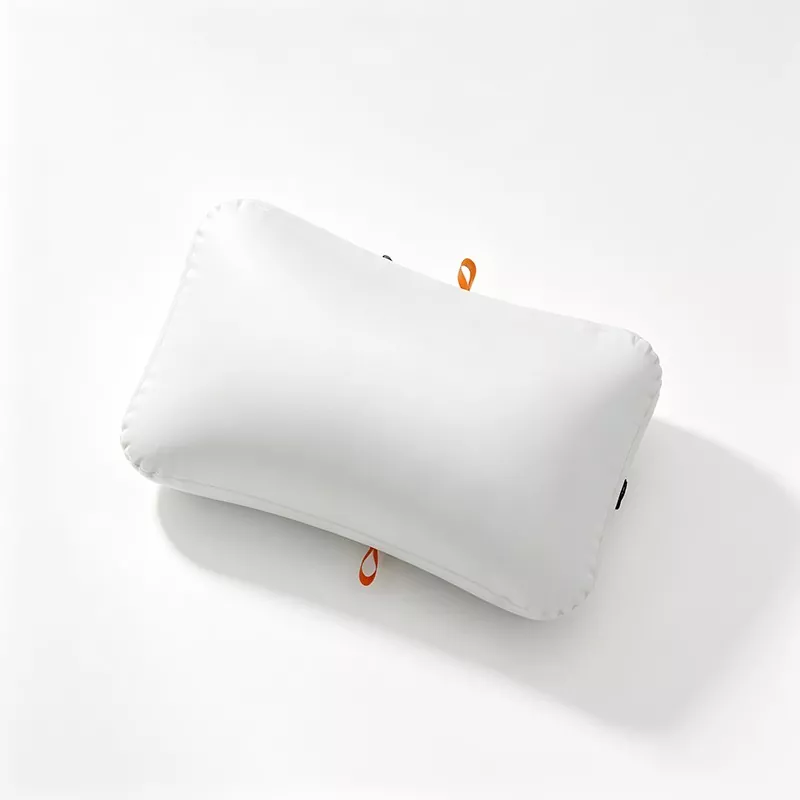


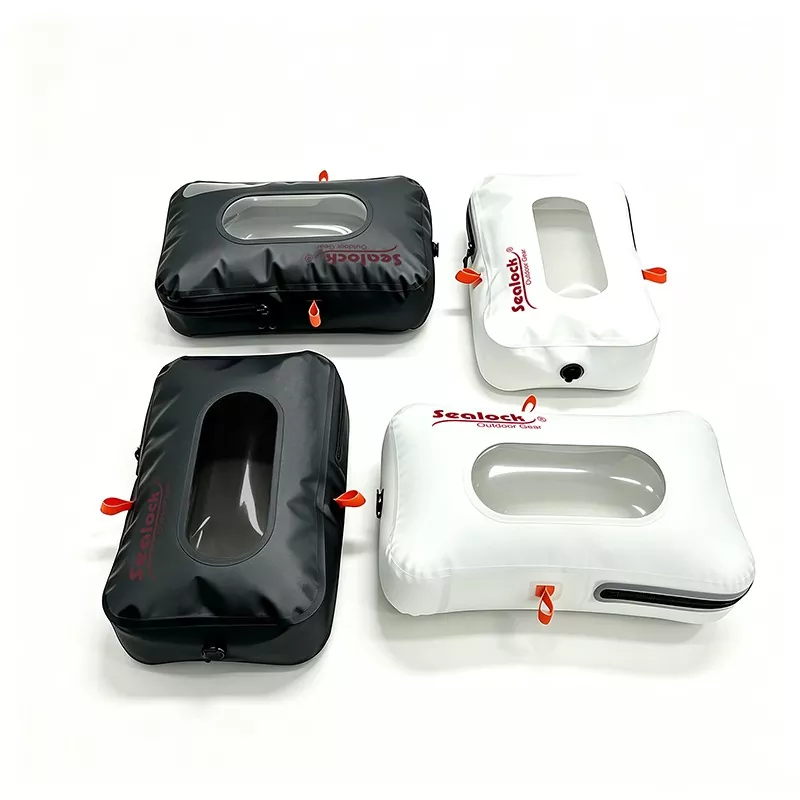


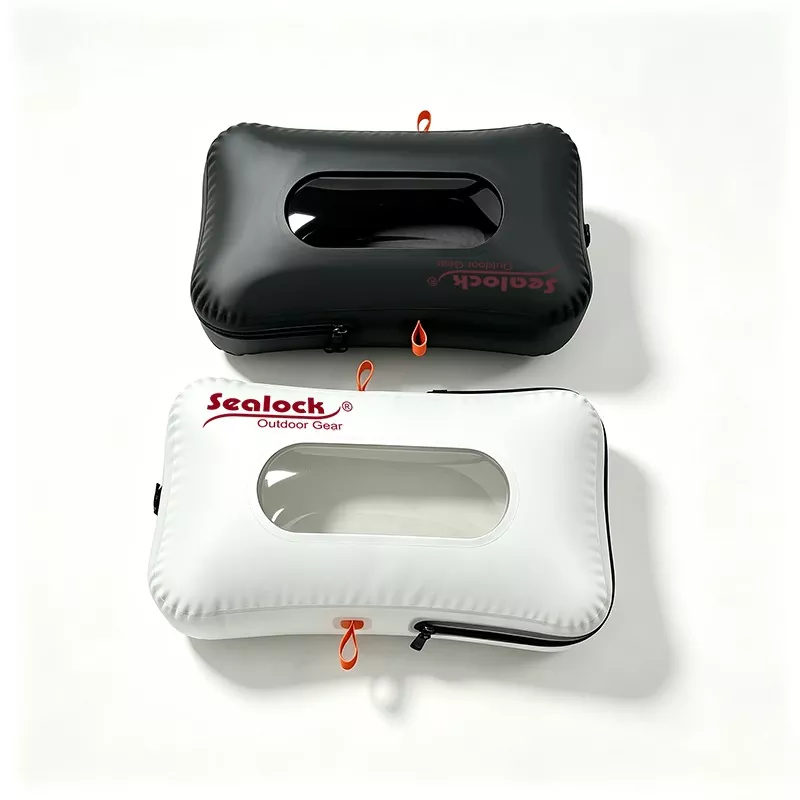
Manual vacuum compression packing bag with a screw-type air valve and an included hand pump. Occupies the position between press-by-hand and battery-powered compression: full evacuation performance with no electronics, no charging cycle, and no lithium battery to declare or certify for air freight. High-frequency welded TPU body, full-length sealed waterproof zipper, welded transparent viewing window, and moulded grip tabs on both sides for holding the bag steady during evacuation. 48 × 29 × 10 cm, approx. 13.9 L, 0.18 kg, in white or black. Splash, dust, and damp resistant; not rated for submersion. MOQ 300 pcs FOB Guangdong, samples in 7–15 days.
Press-to-compress bags work by forcing air through a one-way valve under body weight. They are simple, they need nothing, and they compress a load noticeably. What they do not do is remove the air trapped inside folded fabric — kneeling on a bag flattens the outside while pockets of air stay locked between layers of a fleece or inside the loft of a down jacket.
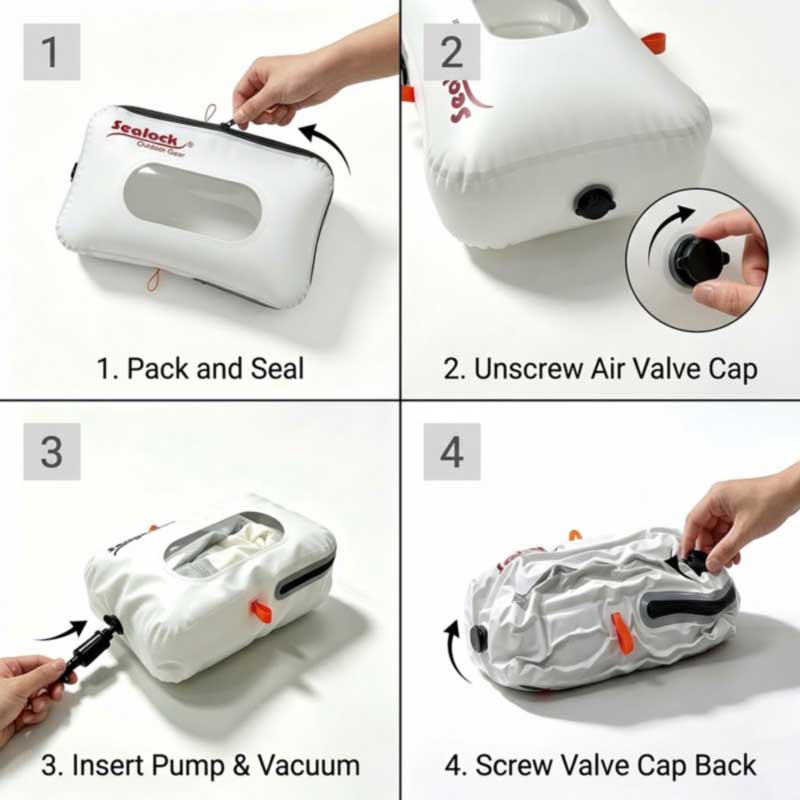
A pump acts differently. Instead of pushing air out from one side, it draws air out from the whole volume, so the pressure difference reaches into the folds and pulls the trapped air with it. The result is a bag that continues to shrink after hand pressure has stopped producing any change — typically another fifteen to twenty percent on lofted items, which is exactly the category people buy compression bags for in the first place.
This is why the pump is worth the thirty seconds it takes. On dense contents the difference is small. On a down jacket, a fleece, or bedding, it is the difference between a bag that looks compressed and one that actually is.
Powered compression bags are convenient, and we make one. But a motor and a battery introduce four things a manual pump does not have: a charge state that can be flat when you need it, a battery that degrades over years, a lithium cell that has to be declared and carried in the cabin, and UN38.3 certification and MSDS documentation that add cost and complexity to every shipment.
For a great many buyers none of that is worth the convenience. Promotional programmes, hotel and cruise amenity lines, retail sets at accessible price points, and anyone shipping by air in volume all benefit from a product that is simply a bag and a pump. The SL-P1133 has no service life limited by a battery, no charge cycle to manage, and ships as ordinary cargo.
It also does not stop working. A powered bag with a dead battery reverts to being a sealed bag; a manual bag with a pump remains a manual bag with a pump, indefinitely.
Around thirty seconds in total, and it works anywhere — no power source, no vacuum cleaner, and no dependency on a hotel having anything in particular. Recompression on the return leg, which is where most compression systems quietly fail their owners, is exactly as easy as the first compression at home.
Two moulded tabs sit on opposite sides of the bag. They exist because evacuating a bag is a two-handed operation on an object that wants to move: one hand works the pump, and the other needs something to hold that is not the slippery welded panel. A tab gives that purchase.
They earn their place a second time in a packed suitcase. A compressed bag wedged between other items is difficult to extract by its smooth surface — a tab lets it be pulled out with one finger, which is the sort of detail that determines whether a product gets used on every trip or abandoned after two.
Their high-visibility colour is deliberate on both colourways, including the white. A tab that blends into the panel is a tab nobody finds.
Most compression bags are PA+PE composite film, heat-sealed at the seams. That construction fails predictably: the seam is weaker than the material either side of it, compression puts every seam under tension, and after enough cycles a seam splits. For a traveller using the bag a few times a year that is several seasons. For a frequent traveller it is often less than one.
This bag uses high-frequency welded TPU. Welding fuses the layers at a molecular level rather than tacking them together with heat, producing a joint as strong as the panel. TPU carries no plasticiser that can migrate out, so it does not embrittle with cold or age — which matters on a product whose whole function is repeated folding and tensioning.
The same construction has a consequence worth stating on a retail listing, because buyers comparing this against a travel-brand equivalent will not otherwise know the difference exists: a welded body and a sealed zipper keep water out as well as air in. Wet swimwear and a used towel can travel home in this bag without soaking the rest of the luggage.

| Model No. | SL-P1133 |
|---|---|
| Product Type | Vacuum Compression Packing Bag with Hand Pump |
| Dimensions | 48 × 29 × 10 cm |
| Volume | Approx. 13.9 L |
| Weight | 0.18 kg (bag), 0.05 kg (pump) |
| Seam Construction | High-Frequency Welded |
| Closure | Full-Length Sealed Waterproof Zipper |
| Compression System | Screw-Seal Air Valve with Manual Hand Pump |
| Valve Sealing | Threaded Cap with Gasket |
| Compression Cycle Time | Approx. 30 seconds |
| Volume Reduction | Up to approximately 70% on lofted goods |
| Handling | Moulded Grip Tabs, Both Sides |
| Main Body | TPU Laminated Waterproof Fabric |
|---|---|
| Viewing Window | Welded Clear TPU Film |
| Zipper | Sealed Waterproof Zipper, Moulded Tooth Chain |
| Valve Assembly | ABS Housing with Silicone Gasket Seal |
| Hand Pump | ABS Body, Compact Piston Type |
| Grip Tabs | Moulded TPU, High-Visibility Orange |
| Colourways | White / Black |
| Power Source | None — manual pump |
|---|---|
| Battery | None |
| Air Travel | No restrictions, no declaration required, cabin or hold |
| Air Freight | Ships as ordinary cargo — no UN38.3 or MSDS documentation |
| Water Resistance | Splash, Dust, and Damp Resistant — not rated for submersion |
| Vacuum Retention | Holds through a normal trip; production standard is 24-hour static rest with no measurable loss |
| Reusable | Yes — designed for repeated compression cycles |
| Secondary Function | Functions as a sealed damp-resistant bag for wet kit when uncompressed |
| OEM / ODM | Supported |
|---|---|
| MOQ | 300 pcs |
| Sample Lead Time | 7–15 Days |
| Production Lead Time | 30–45 Days |
| Custom Sizes | Available |
| Custom Colours | Pantone Matching Available, Including Grip Tabs |
| Logo Application | Silk Screen, Welded Patch, Heat Transfer, Custom Zipper Pull |
| Pump Supply | One per bag, or one per multi-bag set |
| Trade Terms | FOB Guangdong |
| Standard Packaging | Individual Poly Bag with Hand Pump |
|---|---|
| Retail Packaging | Colour Box, Header Card, or Gift Set Box |
| Unit Weight | 0.23 kg including pump |
| Carton Quantity | 60 pcs |
| Carton Size | 60 × 44 × 38 cm |
| Gross Weight | Approximately 15 kg |
| Shipping Methods | Sea Freight, Railway Transport, Air Freight, Express |
| Application | Why It Fits |
|---|---|
| Air Travel & Luggage | Recompression on the return leg with no power source and nothing to declare at security. |
| Down & Insulation Layers | Pump evacuation reaches the air trapped in loft, where hand pressure stops working. |
| Camping & Sleeping Bags | Compresses bulk insulation and keeps it damp-resistant in the same operation. |
| Beach & Pool Wet Kit | The welded body and sealed zipper contain wet swimwear and towels on the way home. |
| Off-Season Clothing Storage | Full evacuation and no battery to degrade over a year in a cupboard. |
| Van, Boat & Cabin Storage | Damp-resistant welded construction suits environments where storage bags usually degrade. |
| Hotel, Cruise & Amenity Programmes | No electronics means no charging infrastructure, no battery disposal, and no liability. |
| Promotional & Corporate Gifting | Ships as ordinary air cargo, which materially simplifies bulk logistics. |
Compression acts on trapped air, so the saving scales with loft. Down, fleece, knitwear, and bedding compress dramatically. Denim, tailored garments, and anything already dense compress very little.
Inspection runs at three stages — IQC on incoming materials, IPQC through welding, valve installation, and assembly, and OQC before the container is sealed. SGS or QIMA third-party inspection is available on request. Our standard customer inspection procedure is executed in full and is directly relevant here: unboxing, vacuum extraction, 24-hour static rest, and air-leak determination — which is precisely the performance this product is bought for.
| Test | What It Establishes |
|---|---|
| Vacuum Retention (24-hour static) | That compression holds overnight and beyond — the one test that separates a working compression bag from a novelty. |
| Air-Leak Determination | Location and rate of any leakage across the valve seat, cap seal, zipper line, and welded seams. |
| Valve Seal Cycle Test | Gasket sealing performance retained after repeated pump insertion and cap threading. |
| Pump Function Test | Suction output and piston seal integrity across sustained operation. |
| Compression Cycle Test | Seam and valve integrity retained across repeated compression and release — the failure mode that ends most compression bags. |
| Bonding Strength Test | Weld integrity at seams, window frame, valve mounting, grip tabs, and zipper interface under peel load. |
| Zipper Fatigue (3,000 cycles) | Sealing performance of the zipper retained across a full service life. |
| Tensile & Burst Test | Material and seam strength under the tension an over-packed bag generates. |
| Window Flex & Clarity Test | Film durability and optical clarity after repeated compression and flexing. |
| Colour Fastness & Colour Difference | UV retention on the white colourway, where discolouration shows first, and batch consistency on reorders. |
A pump draws air out of the folds, where hand pressure cannot reach. Around fifteen to twenty percent more compression on lofted items than press-to-compress bags achieve.
No battery means no flat charge at the wrong moment, no capacity degradation over years, no cabin-only restriction, and no lithium documentation on export shipments.
High-frequency welded TPU produces seams as strong as the panels. PA+PE film bags split at the seam after enough compression cycles; this construction does not have that failure mode.
A gasketed screw cap seals the valve mechanically rather than relying on a flap, and keeps lint and grit out of the valve seat between uses.
Loads flat like a case rather than through a narrow slot, and is what makes holding a vacuum possible — a coil zipper leaks air regardless of the valve.
Identify contents without decompressing. The window perimeter is welded into the shell rather than being a separate joint.
Somewhere to hold while pumping, and a way to pull a compressed bag out from between other items in a packed case.
Welded body and sealed zipper contain damp swimwear and towels — a function almost no travel-brand compression bag can offer.
| Method | Best Suited To |
|---|---|
| Silk Screen Printing | Single or two-colour logos on the body panel; the most economical at volume, and the method used on the stock colourways. |
| Welded Logo Patch | A tonal, dimensional mark that adds no leak path to the sealed shell. |
| Heat Transfer | Full-colour artwork, gradients, and photographic detail — strongest on the white colourway. |
| Custom Zipper Pull | A branded detail the user handles every time the bag is opened. |
| Coloured Grip Tabs | Tabs moulded in a brand colour; a distinctive signature at no added tooling cost once specified. |
| Printed Instruction Panel | Compression steps printed beside the valve; reduces support enquiries on a product with a short learning curve. |
The clear window and the valve housing area should be kept free of print. Everything else on the body is available as branding surface, with the white colourway giving the widest artwork latitude.
Beyond logo and colourway work, this platform supports ground-up development: additional sizes and nested set configurations, a larger or repositioned viewing window, a fully opaque body, alternative valve types, a carry handle or hanging loop, internal compression straps, and pump specification changes including a dual-action pump that both evacuates and inflates.
Two configurations we are asked for most often are worth flagging. A graduated set supplies three or four sizes with a single shared pump, which keeps the set price competitive while giving the buyer a complete system. And a mixed-technology set pairs this pump bag with press-to-compress bags or a powered bag, letting a range span several price points from one tooling family.
It is worth noting that our capability is not limited to welding. Sewn and stitched construction is an equally established in-house discipline, and a number of programmes combine the two — a welded sealed chamber with sewn and bound external structure, for example. If your specification calls for fabric panels, bound edges, or sewn attachment points alongside a welded core, that is standard work here rather than an exception.
Ground-up structural development runs longer than branding work. We quote a schedule you can plan a launch around rather than an optimistic one you have to work back from later.
For compression with no pump at all — hand pressure through a one-way valve — see our Vacuum Compression Bag with One-Way Valve, available in three sizes and often specified as the companion pieces in a graduated set.
For powered evacuation with the pump built into the bag itself, see the Vacuum Compression Bag with Built-In Electric Pump.
For genuine immersion protection rather than damp resistance, our Roll Top Dry Bag uses a welded body with a roll-top closure rated for full submersion.
You can press, and it works. The pump does something pressing cannot: it draws air out of the folds and out of the loft inside insulated items, typically another fifteen to twenty percent on a down jacket or a fleece. On dense contents the difference is minor.
Nothing to charge, nothing to degrade, nothing to declare at security, and no lithium documentation on export shipments. A powered bag with a flat battery is just a bag; this one works the same way in year five as in week one.
The bag still compresses by hand pressure through the valve, so you lose some performance rather than the product. Replacement pumps are available, and buyers specifying retail sets should consider supplying a spare in the box.
Through a normal trip. Our production standard is a 24-hour static rest followed by air-leak determination with no measurable loss. In practice the most common cause of a bag going soft is a zipper not run fully into its end stop, or the valve cap not screwed down — not a leak.
Three causes, in order of frequency: the zipper is not completely closed; the bag is over-packed, leaving no room for the fabric to draw in; or the contents are already dense. Compression works on trapped air, not on mass.
Yes, with no restrictions and nothing to declare. Compression bags are not restricted items and there is no battery involved. Note that a security inspection may require unpacking, after which you reload, close, and pump again.
Base layers, knitwear, and casual clothing usually arrive better than they would loose, because compression stops them shifting and rubbing. Structured items — dress shirts, tailored jackets — will crease, and no vacuum bag avoids this. Keep those uncompressed in a separate part of the case.
The welded TPU body and sealed zipper resist splashes, dust, and damp, and the bag genuinely contains wet items. It is not rated for submersion. For submersion, a roll-top dry bag is the correct product.
Yes, and it is one of the more useful things about it. Empty and air dry the bag afterwards — a sealed container holds moisture as effectively as it excludes it.
No. Compression bags reduce volume, not mass. The most commonly reported disappointment is arriving at check-in overweight because the freed space got filled. On cabin allowances where weight is the binding constraint, use it to fit a bulky jacket into a small case rather than to carry more.
Construction. Budget sets use PA+PE film with heat-sealed seams, which split after enough compression cycles — usually within a season of regular use. This body is high-frequency welded TPU, where the seam is as strong as the panel.
300 pieces, FOB Guangdong. For graduated sets, mixed-technology sets, or project-specific requirements, contact our team.
Compression bags sell on one thing a photograph cannot show: whether the bag is still tight the next morning. We suggest testing a sample against whatever you currently source — compress both, leave them 24 hours, and compare. Samples ship in 7–15 days and we can supply both colourways.
Send us your target quantity, set configuration, and branding requirement, and we will return pricing and a realistic production schedule.