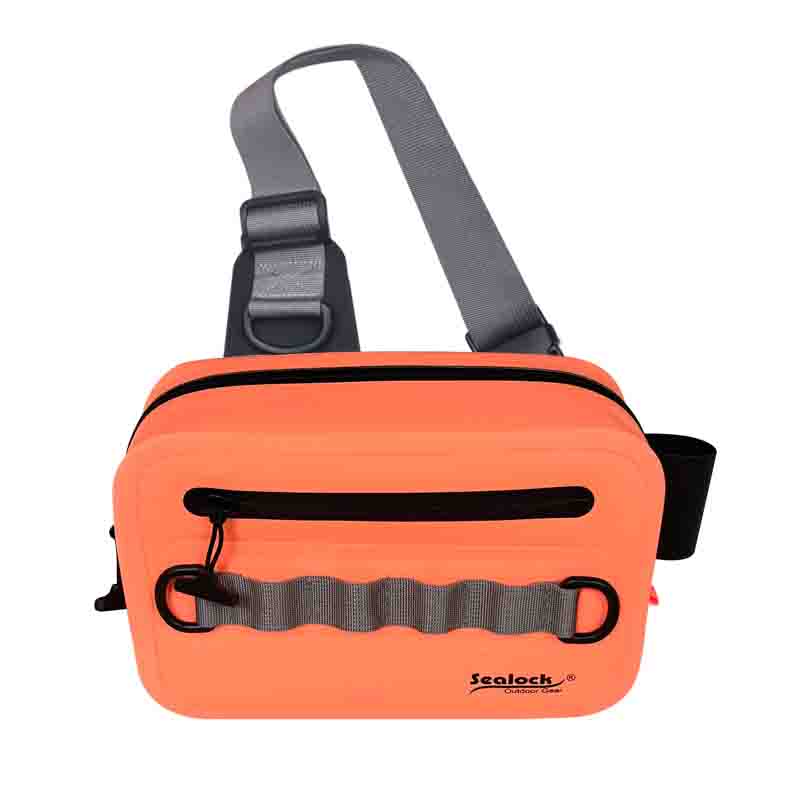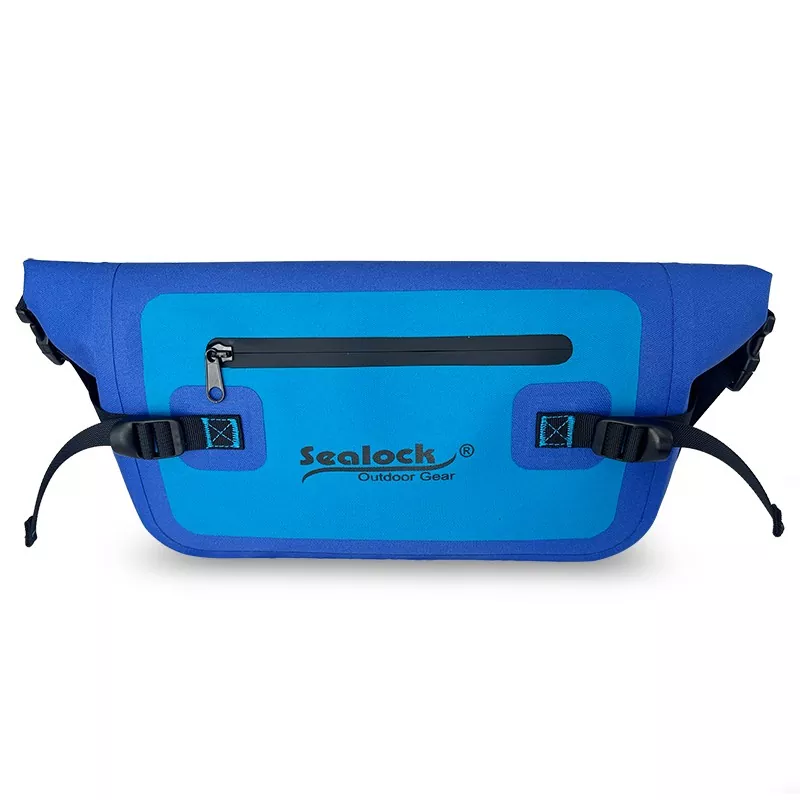
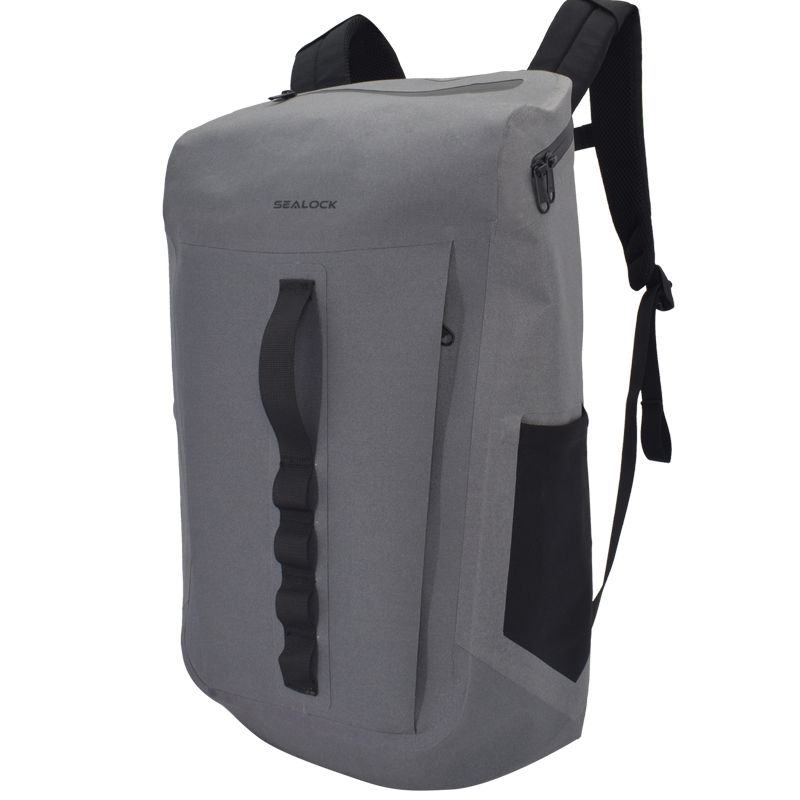

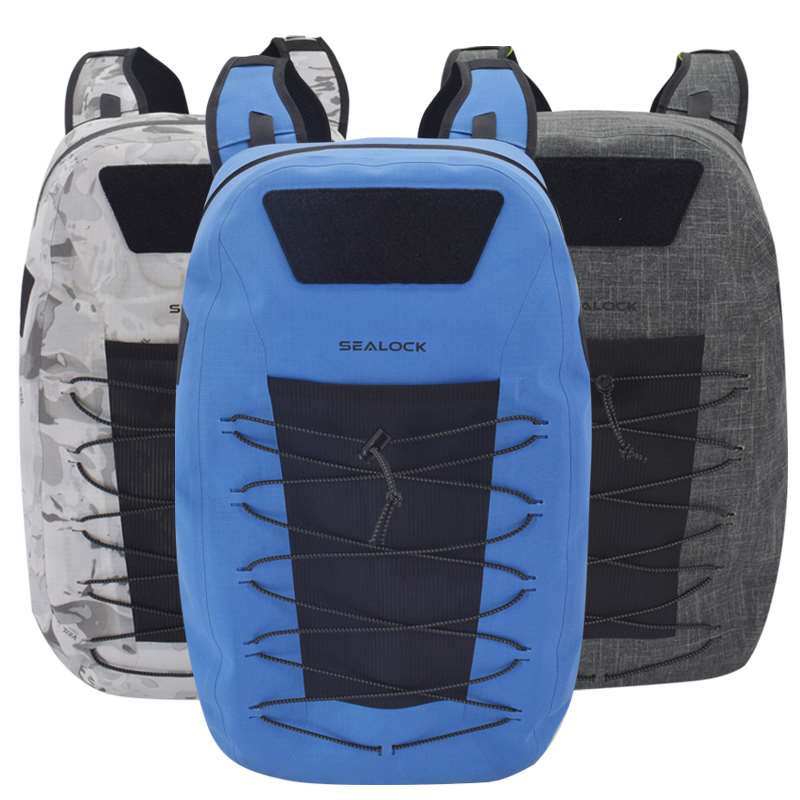
Structured Base
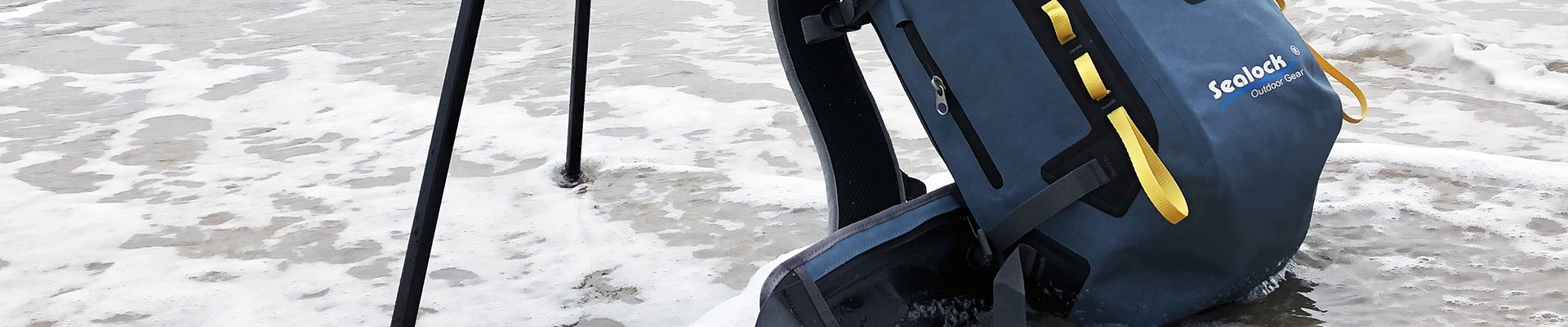
Reinforced flat base holds the pack upright when set down, keeping contents accessible and the body from collapsing under a partial load.
 English
  Español
  Português
  русский
  Français
  日本語
日本語  Deutsch
  tiếng Việt
  Italiano
  Nederlands
  ภาษาไทย
  Polski
  Svenska
  magyar
  Malay
Malay  বাংলা ভাষার
  Dansk
Dansk  Suomi
Suomi  हिन्दी
  Pilipino
  한국어
한국어  Türkçe
  Gaeilge
  العربية
  Indonesia
  Norsk
Norsk  تمل
تمل  český
český  ελληνικά
  український
  Javanese
  فارسی
فارسی  தமிழ்
தமிழ்  తెలుగు
  नेपाली
  Burmese
  български
  ລາວ
ລາວ  Latine
  Қазақша
  Euskal
  Azərbaycan
  Slovenský jazyk
  Македонски
  Lietuvos
  Eesti Keel
  Română
  Slovenski
  मराठी
मराठी  Srpski језик
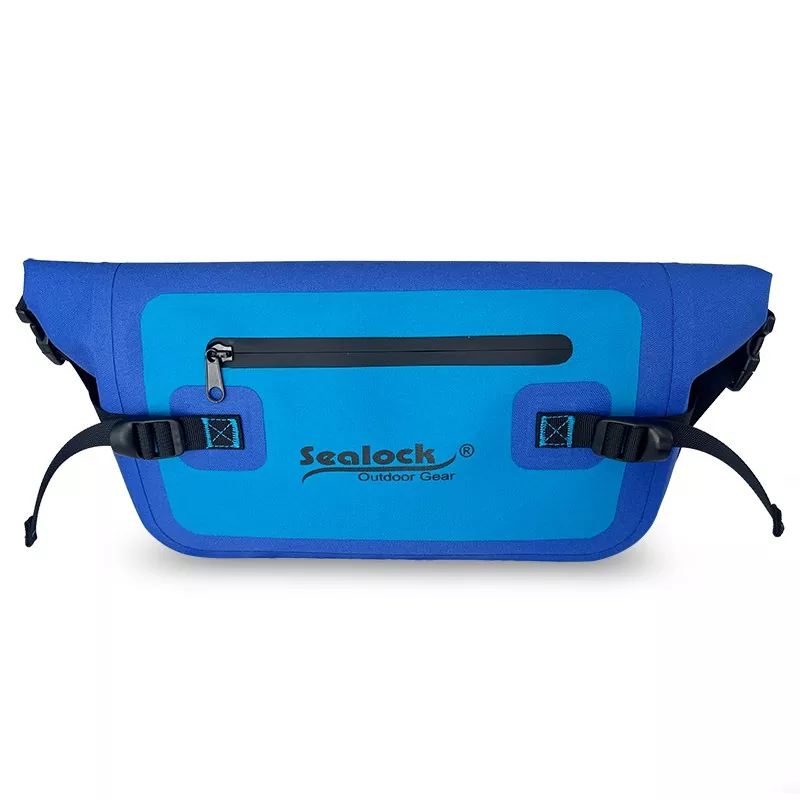
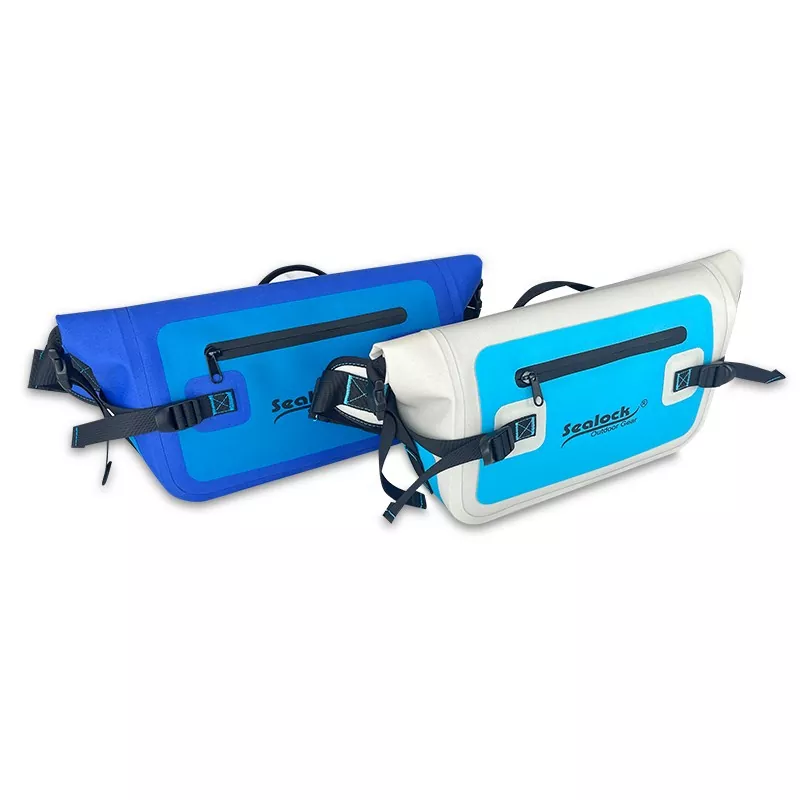
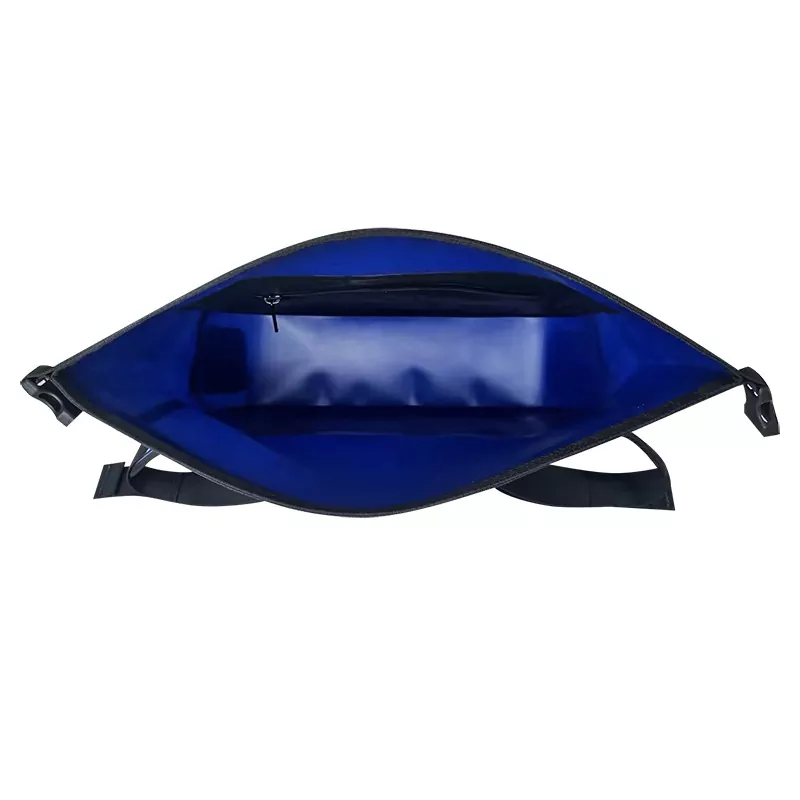
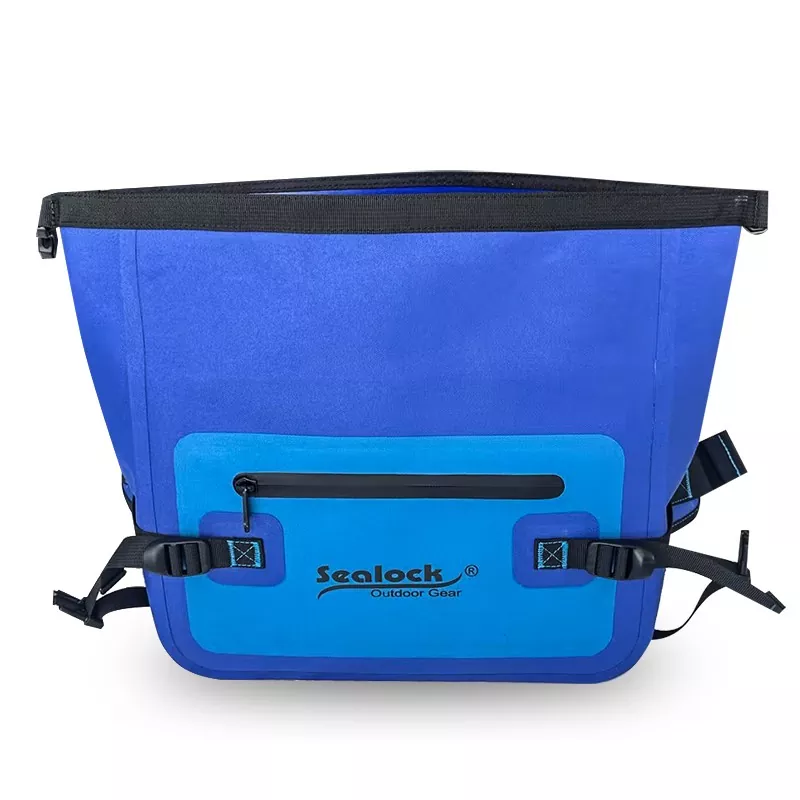
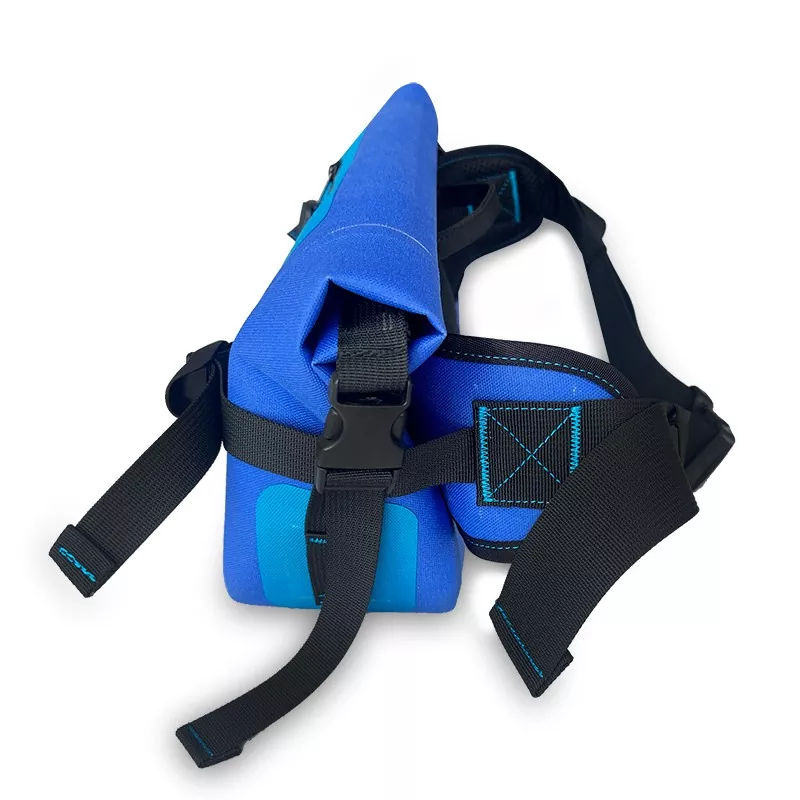
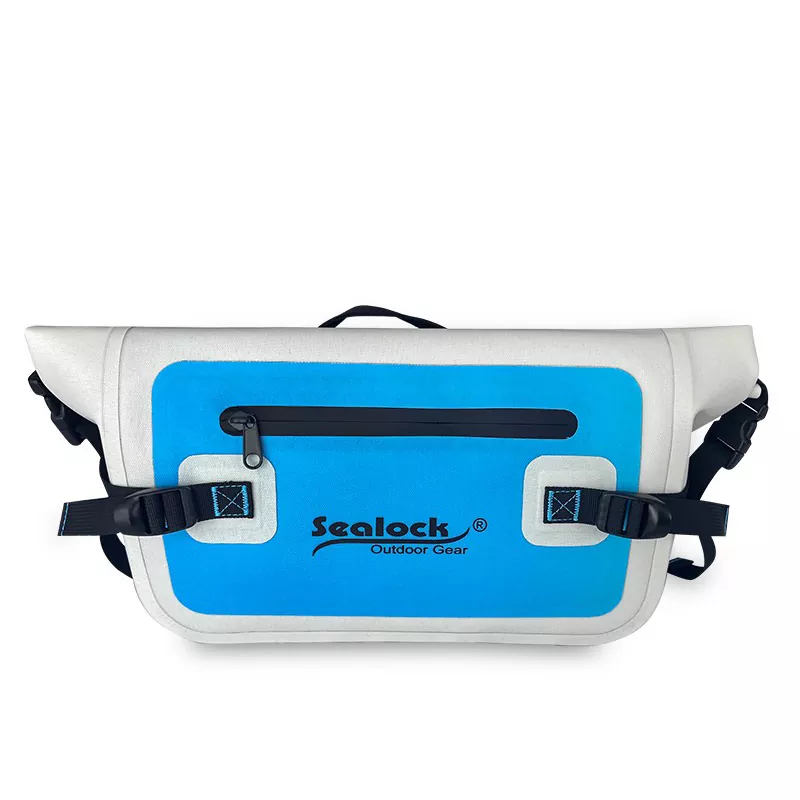
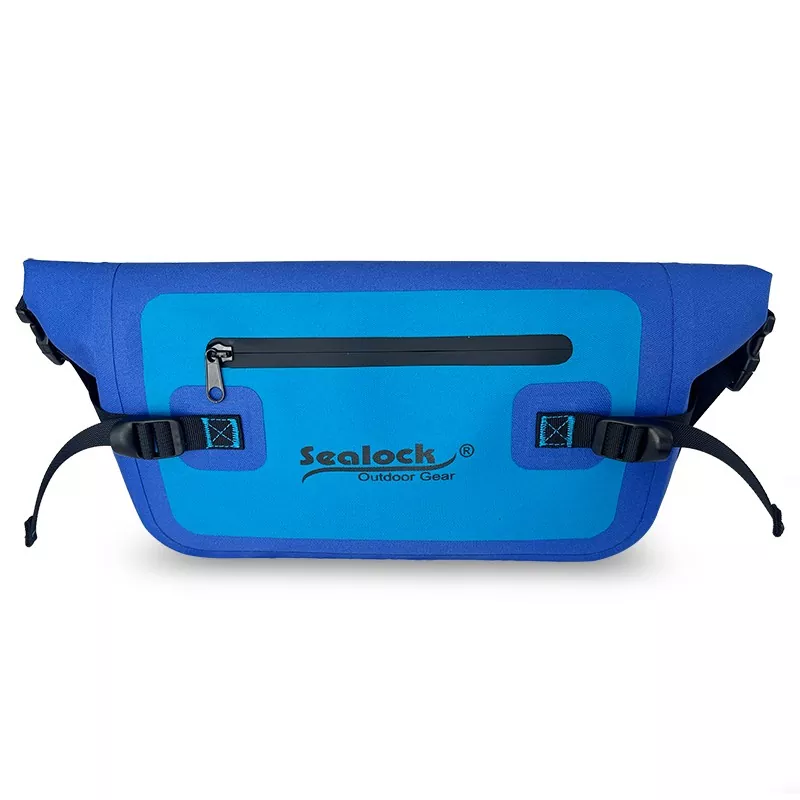
The SEALOCK SL-F047 changes size with the load. Unrolled it stands 31 cm tall and holds around eight litres; rolled three turns it drops to 21 cm and about five and a half. Roll further and it shrinks again. That single property solves the problem every fixed-volume hip pack has — a bag sized for the morning is the wrong bag by afternoon, and the contents rattle around in the space they no longer fill.
Underneath the adjustable closure is a pack built to carry properly. A wide padded belt with a contoured mesh lumbar panel puts the load on the hips instead of hanging off a strap. A structured base keeps the pack standing when you set it down and stops it collapsing around its contents. Two front compression straps pull everything tight against the back panel, and a welded zip pocket on the front face handles the items you reach for without unrolling anything.
At 500 grams in welded 500D PVC tarpaulin, the SL-F047 suits paddling, wading and bank fishing, coastal walking, cycling, and beach and water park use — anywhere the load changes through the day and the gear still has to stay dry.
Most waterproof hip packs are a fixed box. You size them for the biggest load you expect to carry, and then you carry that volume all day whether it is full or not. A half-empty pack is not just wasted space — the contents slide, the pack loses its shape against the body, and it starts swinging on every step.
A roll-top closure sidesteps this entirely because the sealing mechanism and the volume adjustment are the same action. Load the pack full in the morning, roll three turns, and you have 8 litres sealed at 31 cm. Eat the food and shed a layer by lunch, roll two more turns, and the pack is 5 litres at 21 cm, tight and stable, with the seal just as good — better, in fact, since more turns means more compression.
| Configuration | Height | Approximate Capacity |
|---|---|---|
| Unrolled (maximum fill) | 31 cm | 8 L |
| Rolled three turns (sealed) | 21 cm | 5.5 L |
| Rolled five turns (compact) | 17 cm | 4 L |
Three turns is the minimum for a reliable seal. Everything past that is capacity adjustment, and it costs nothing in waterproof performance.
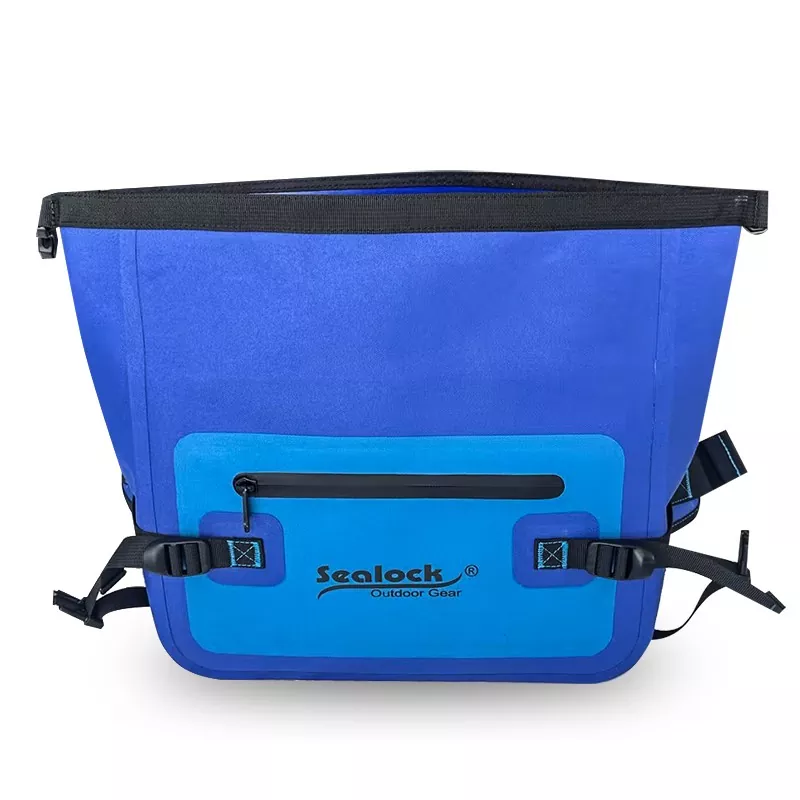
A roll-top seals by compression: the rolled material presses against itself, and that pressure is the waterproof barrier. The same pack will pass or fail entirely on how it was closed, which makes the closing technique worth communicating to end users rather than assuming.
Two things determine the result. Roll at least three full turns — one or two produce something that looks shut but generates almost no sealing pressure, and water walks in at the corners. And roll evenly across the full width: a roll that is tight in the middle and slack at one end leaks at that end, every time.
Closed this way the pack handles rain, spray, and immersion incidents — a slip while wading, a swamped cockpit, a pack that goes over the side and is recovered.
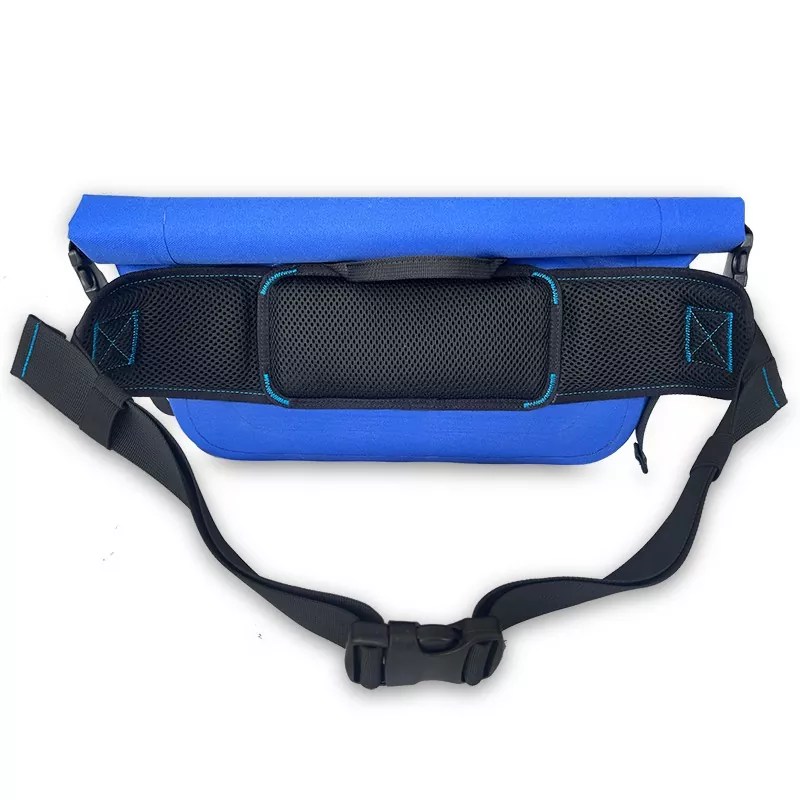
A hip pack that carries badly gets left at home, however waterproof it is. The SL-F047 uses a wide contoured belt with a padded mesh lumbar panel, which spreads load across the pelvis and stops the pack rotating when you twist to cast, reach behind you, or paddle.
The open mesh backing is a deliberate choice over solid foam. A waterproof pack has no breathability by definition — the only place air can move is between the pack and the body. Open-cell mesh over contoured padding creates that channel and, just as importantly, dries fast after a wade instead of holding water against clothing for the rest of the day.
Load-bearing anchor points are bar-tack reinforced where the belt and handle meet the body, using the standard box-and-cross stitch that resists pull-out under repeated loaded carry. These sit outside the waterproof shell, on welded mounting platforms, so no stitching penetrates the sealed compartment.
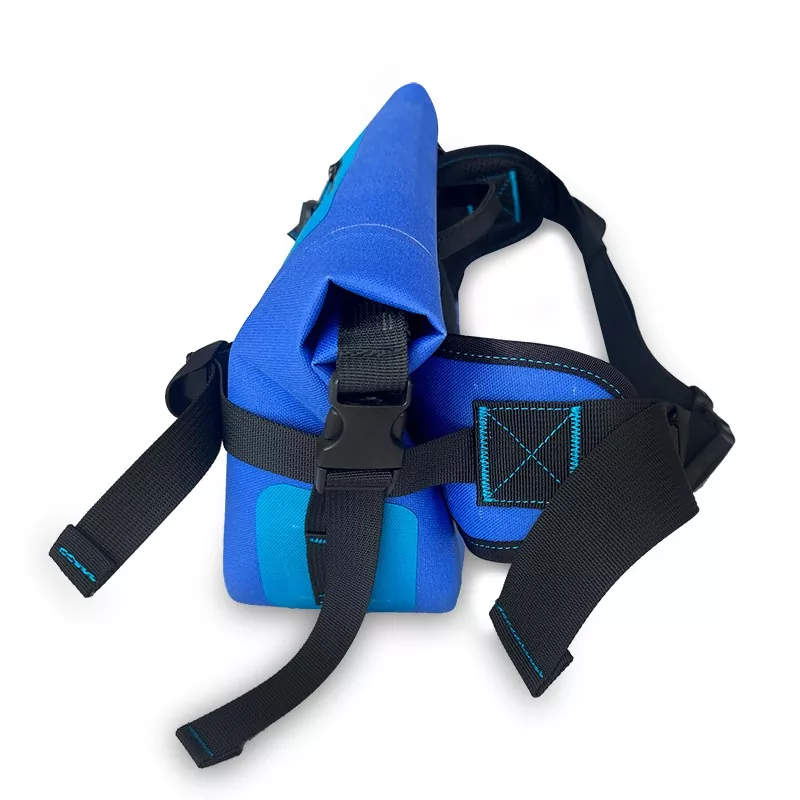
Two features work together to keep the pack behaving like a pack rather than a sack.
The base is structured, so the SL-F047 stands upright when set down on a bank, a deck, or a tailgate. A soft-bottomed hip pack tips over and lies on its side, which means everything inside shifts to one end and you are digging through a heap of gear to find anything. A pack that stands open is a pack you can see into.
The two front compression straps then do the opposite job — they pull the load in and hold it flat against the back panel. This matters most on a partly-filled pack, where contents would otherwise sit forward and pull the pack away from the body. Cinched down, the mass rides close to the hips where it belongs.
Reinforced flat base holds the pack upright when set down, keeping contents accessible and the body from collapsing under a partial load.
Quick-release straps across the front face pull the load against the back panel and stabilise the pack at any fill level.
A flat pocket on the front face with its own weather-resistant zipper for the items you reach for constantly, so the roll-top stays rolled.
Two clips draw the rolled top down flat against the body rather than letting it stand proud and catch on a paddle shaft or jacket hem.
A webbing handle at the top for lifting the pack in and out of a boat or vehicle without dragging on the belt.
The contrast front panel is welded onto the body, not sewn through it — a stitched panel on a waterproof shell is a row of holes you then have to seal again.
The 500D specification describes the denier of the fabric scrim laminated between PVC layers. Higher denier means thicker yarn, and thicker yarn means the material resists abrasion and tearing rather than depending on the coating alone. It is the difference between a pack that survives being dragged across a gunwale or set down on gravel and one that develops pinholes in its first season.
PVC tarpaulin can also be high-frequency welded, which is why the waterproof shell of this pack has no stitch holes in it. Welding fuses the two layers into continuous material rather than joining them with thread, so there is no seam tape to peel, no stitch line to wick water, and no gradual leakage as an adhesive ages. On a stitched-and-taped bag the tape is the weakest component and the first thing to fail; on a welded body that failure mode does not exist.
High-frequency welding closes every seam of the waterproof shell, producing joints as watertight as the panels themselves.
The front pocket, contrast panel, and strap mounting platforms are welded to the outer face, keeping all stitching outside the sealed compartment.
Additional material at the roll-top opening resists the repeated creasing that eventually cracks an unreinforced closure — the one area a roll-top pack is worked hardest.
Belt, handle, and compression strap anchor points use box-and-cross reinforcement stitching rated for repeated loaded carry.
Side-release buckles and closure clips specified to hold at low temperature and after salt exposure rather than to hit a price point.
| Model No. | SL-F047 |
|---|---|
| Product Name | Roll Top Waterproof Waist Pack |
| Product Type | Waist Pack / Hip Pack |
| Dimensions (Unrolled) | 31 × 9 × 31 cm |
| Dimensions (Rolled 3 Turns) | 31 × 9 × 21 cm |
| Capacity | Approx. 8 L unrolled / 5.5 L sealed |
| Weight | 0.5 kg |
| Main Material | 500D PVC Laminated Tarpaulin |
| Seam Construction | High-Frequency Welded Body |
| Main Closure | Roll Top with Side Clip Buckles |
| Waterproof Rating | IPX7 |
| External Pocket | Welded Zip Pocket (Weather-Resistant) |
| Compression | Two Front Quick-Release Straps |
| Base | Structured Flat Base |
| Back Panel | Contoured Padded Mesh Lumbar Panel |
| Belt | Wide Padded Adjustable Belt, Side-Release Buckle |
| Carry Options | Waist / Hand Carry |
| Hardware | Side-Release Buckles, Closure Clips, Reinforced Handle |
| Floating Capability | Yes, when rolled with air retained |
| Colors | Blue / Light Blue Two-Tone (Custom Colours Available) |
| OEM / ODM | Supported |
| Logo | Customized |
| MOQ | 300 pcs |
| Sample Lead Time | 7–15 Days |
| Production Lead Time | 30–45 Days |
| Country of Origin | Guangdong, China |
| Use Case | Typical Sealed Load |
|---|---|
| Paddling & Kayak Day Trip | Phone, wallet, keys, snacks, compact first aid kit, windproof shell, water bottle |
| Wading & Bank Fishing | Two or three fly boxes, leader wallet, tippet, licence, phone, packable layer |
| Beach & Water Park | Towel, sunscreen, phone, cash and cards, spare tee, sandals |
| Cycling & Commuting | Notebook, charger and cables, lunch, rain shell, tool roll |
| Coastal Walking | Water, food, map, headlamp, insulation layer, camera |
The 9 cm depth is what makes the shape work. A deeper pack of the same volume buries everything at the bottom; a flat one lets you see the whole compartment when it opens, and sits closer to the body when worn.
Because the rolled chamber traps air, a correctly closed SL-F047 floats with normal soft-gear loading. This is a recovery property rather than a flotation device — it buys the seconds needed to reach a pack that has gone over the side instead of watching it sink.
It is conditional on how the pack was rolled. Packed dense and rolled with all air expelled, it will not float. If buoyancy forms part of your product claim, brief end users to leave headspace above the contents before rolling. The blue colourway helps here too — a dark pack on moving water is genuinely hard to spot, and buyers supplying rental fleets or guided operations should weigh visibility alongside aesthetics.
If external tool carry matters more than adjustable volume — pliers, forceps, a rod tube, a landing net — our Waterproof Fishing Waist Pack uses a sealed zipper with two rows of MOLLE webbing and adjustable rubber tool straps.
For a lighter, softer pack in TPU with elasticated side compression and a cross-body sling option, see the TPU Roll Top Waterproof Waist Pack.
The SL-F047 is the one to specify when the load varies through the day and the pack needs to carry a full 8 litres and a half-empty 4 litres equally well.
SEALOCK has manufactured waterproof gear for over 20 years, with production in Dongguan, China and Ho Chi Minh City, Vietnam, giving buyers a sourcing and tariff route that suits their market. In this category we build for OSPREY, KAILAS, CHUMS, and snow peak — brands whose specifications tend to be exacting, which is the standard our tooling and inspection processes are set up around.
Most requirements brought to our engineering team can be met. Beyond logo and colourway work, we develop structure from the ground up: altered proportions and capacity, a taller or shorter roll extension, repositioned or additional pockets, a padded device divider, MOLLE or daisy-chain panels, D-rings and lash points, alternative belt widths and padding, and a detachable shoulder strap for sling carry. Ground-up structural development runs longer than branding work, and we quote a schedule you can plan a launch around rather than an optimistic one you have to work back from later.
Tarpaulin rolls are checked for coating consistency and colour against the approved standard; buckles, webbing, mesh, and zippers are verified to specification before release to the line.
Body panels, contrast facing, and the closure band are cut to fixed tooling. Dimensional consistency is what makes the roll fold evenly across a full production run.
The contrast front panel, zip pocket, and strap mounting platforms are welded onto flat panels before assembly, while every weld line is fully accessible and inspectable.
Side seams, structured base, and closure band reinforcement are high-frequency welded, producing a continuous waterproof shell with no stitch penetrations.
Mesh lumbar panel, padded belt, compression straps, buckles, and handle are fitted with bar-tack reinforcement and load-checked at every anchor point.
Batch samples go to immersion testing; the balance is inspected for appearance, closure fold, strap adjustment, and hardware function before packing.
Inspection runs at three stages — IQC on incoming materials, IPQC through welding and assembly, and OQC before the container is sealed. SGS or QIMA third-party inspection is available on request, and buyers running their own protocol are welcome to execute it in full on site: unboxing, vacuum extraction, 24-hour static rest, and air-leak determination.
| Test | What It Establishes |
|---|---|
| Full Water Immersion (2+ hours) | Sealing performance of the rolled closure and welded shell under sustained submersion. |
| Bonding Strength Test | Weld integrity at body seams, base, contrast panel, and pocket platform under peel load. |
| Load Test (1,500+ cycles) | Belt anchor, handle, and compression strap durability under repeated loaded carry. |
| Bar-Tack Pull-Out Test | Reinforcement stitching strength at every harness anchor point. |
| Zipper Fatigue (3,000 cycles) | Front pocket zipper operation across a full service life. |
| Tensile Strength | Webbing and buckle strength at and beyond rated load. |
| Salt Spray | Hardware and laminate resistance to sustained saltwater exposure. |
| Abrasion Resistance | Surface durability at the closure fold, base, and contact areas. |
| Colour Fastness & Colour Difference | UV retention and consistency between the two body colours across batches and reorders. |
About 5.5 litres at three turns, which is the minimum for a reliable seal. The full 8 litres is the unrolled figure and is not a sealed capacity. Size your specification against 5.5 litres, not 8.
The opposite — more turns means more compression and a better seal. The only cost is capacity. This is why a roll-top handles a variable load better than any fixed closure.
In nearly every case, fewer than three turns, or a roll that was tighter at one end than the other. Water enters at the corner of a slack roll. The next most common cause is over-packing, which leaves too little material above the contents to fold properly.
It is weather-resistant and sits outside the sealed chamber. That is deliberate — it takes the items you reach for constantly so the main compartment stays rolled. Anything that must stay dry goes inside.
Not in the stock configuration; the belt is designed for waist carry and the pack has no shoulder strap attachment points as standard. A detachable shoulder strap with corresponding D-rings is a straightforward ODM addition if your programme needs it.
The closure band is reinforced for exactly that reason, and it is the area we test hardest. Varying the roll line slightly between uses, and storing the pack unrolled rather than compressed, extends closure life considerably.
With normal soft-gear loading and air retained before rolling, yes. Packed dense and fully compressed, no.
Yes. Capacity changes, roll extension length, pocket layout, and Pantone-matched colourways are all standard ODM work. Send your target specification and we will quote tooling and schedule.
300 pieces. For mixed-colour orders or project-specific requirements, contact info@sealock.com.hk.
A roll-top pack has very few things that can fail, and almost all of them relate to the closure band. Protect that and the pack outlasts several zippered equivalents.
| Standard Packaging | Individual Poly Bag |
|---|---|
| Retail Packaging | Hang Tag, Header Card, or Custom Colour Box |
| Unit Weight | 0.5 kg |
| Carton Quantity | 30 pcs |
| Carton Size | 64 × 48 × 42 cm |
| Gross Weight | Approximately 16 kg |
| Shipping Methods | Express, Air Freight, Sea Freight, Railway Transport |
| Export Markets | North America, Europe, Australia, Southeast Asia |
If you are building a paddle, fishing, or outdoor accessory line, the SL-F047 is worth handling in person — how the roll folds and how the belt sits are the two things a specification sheet will not tell you. Samples ship in 7–15 days.
Email info@sealock.com.hk with your target quantity, colourways, and branding requirement, and we will return pricing and a realistic production schedule.