
Nothing Separate to Lose
The pump is welded into the panel. No separate unit to charge, pack, misplace in a hotel room, or leave behind — the failure point that makes most electric compression sets stop working.
 English
  Español
  Português
  русский
  Français
  日本語
日本語  Deutsch
  tiếng Việt
  Italiano
  Nederlands
  ภาษาไทย
  Polski
  Svenska
  magyar
  Malay
Malay  বাংলা ভাষার
  Dansk
Dansk  Suomi
Suomi  हिन्दी
  Pilipino
  한국어
한국어  Türkçe
  Gaeilge
  العربية
  Indonesia
  Norsk
Norsk  تمل
تمل  český
český  ελληνικά
  український
  Javanese
  فارسی
فارسی  தமிழ்
தமிழ்  తెలుగు
  नेपाली
  Burmese
  български
  ລາວ
ລາວ  Latine
  Қазақша
  Euskal
  Azərbaycan
  Slovenský jazyk
  Македонски
  Lietuvos
  Eesti Keel
  Română
  Slovenski
  मराठी
मराठी  Srpski језик
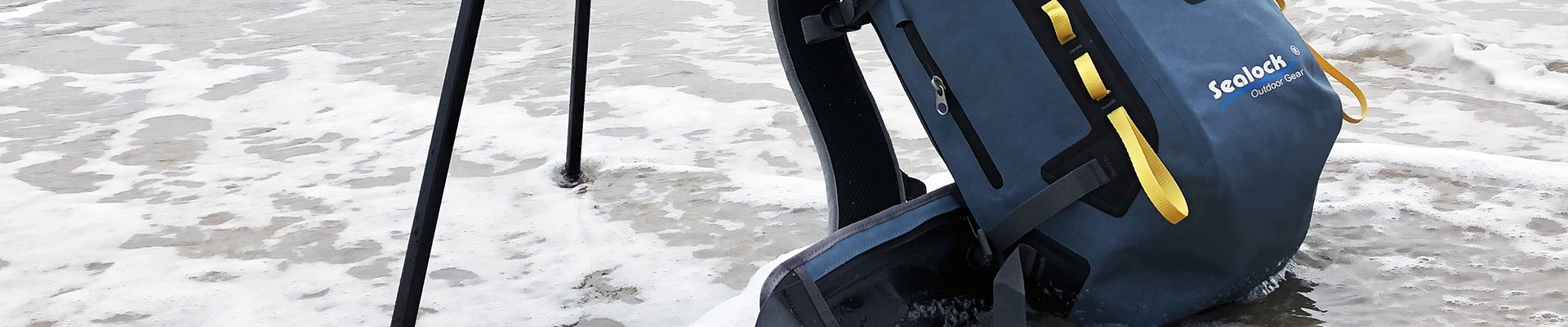
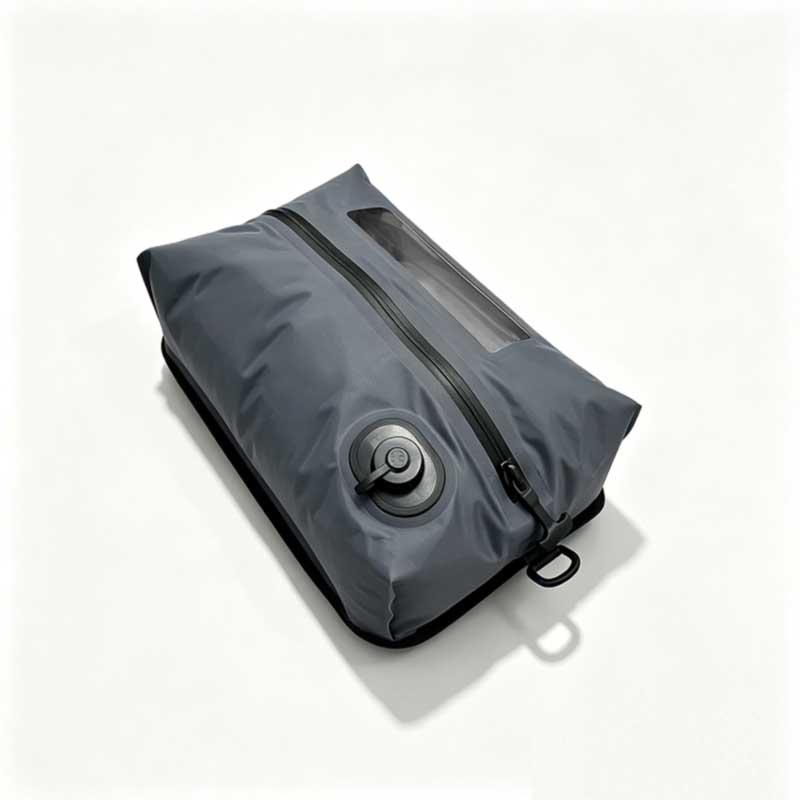
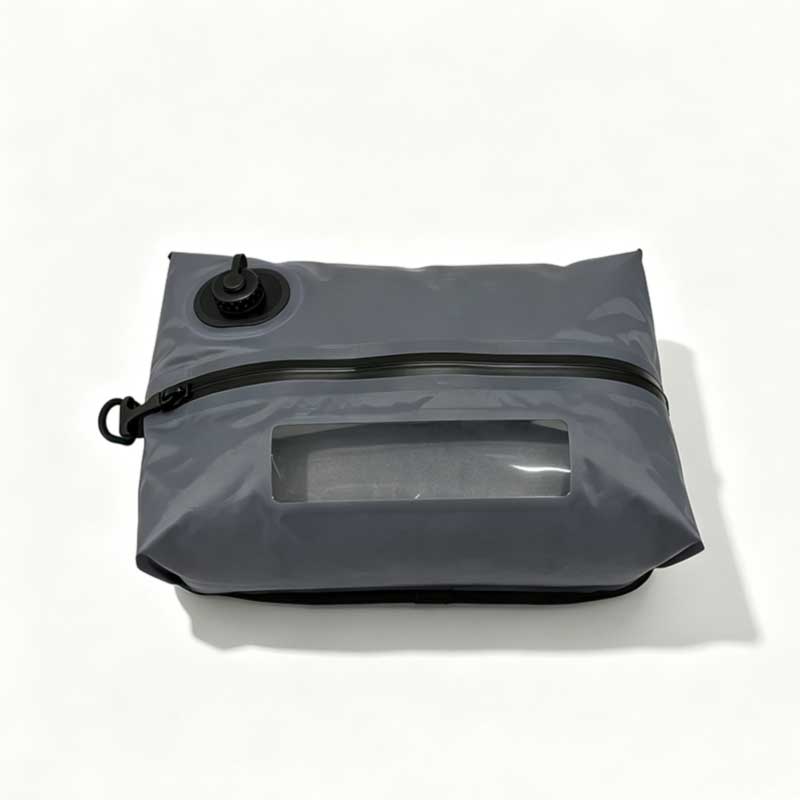
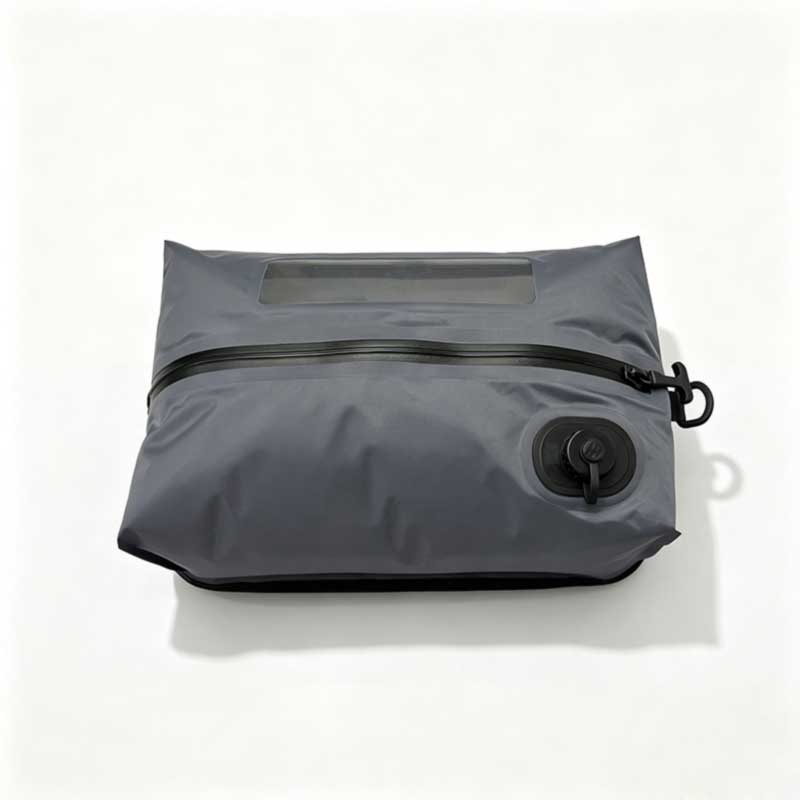
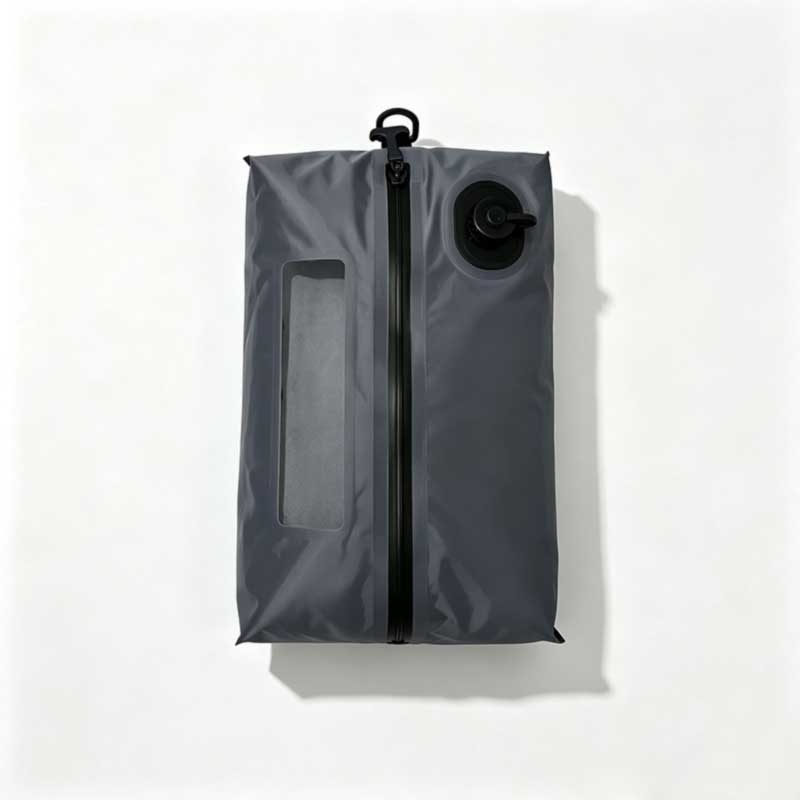
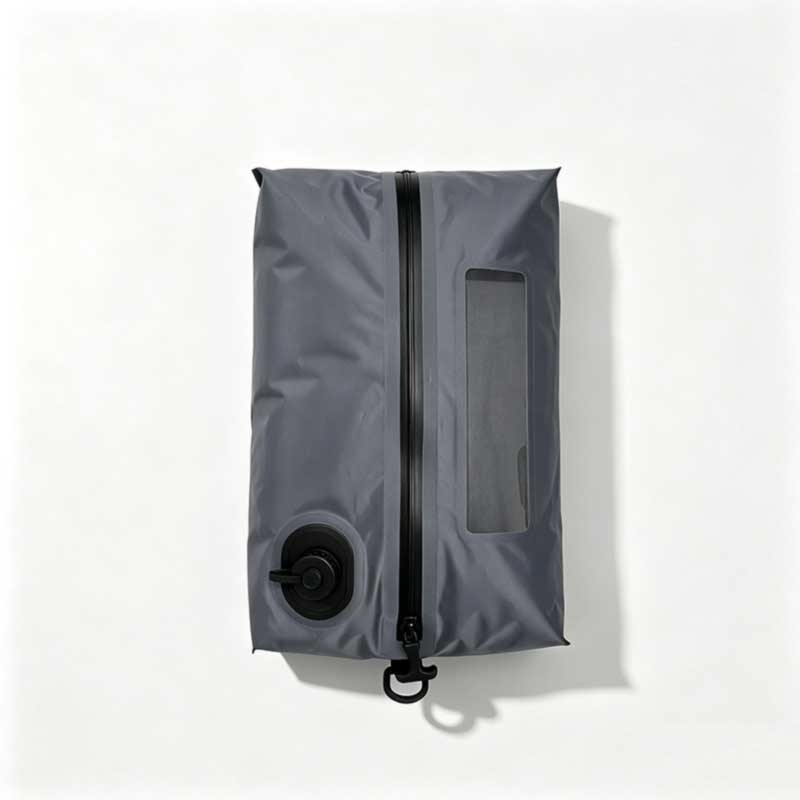
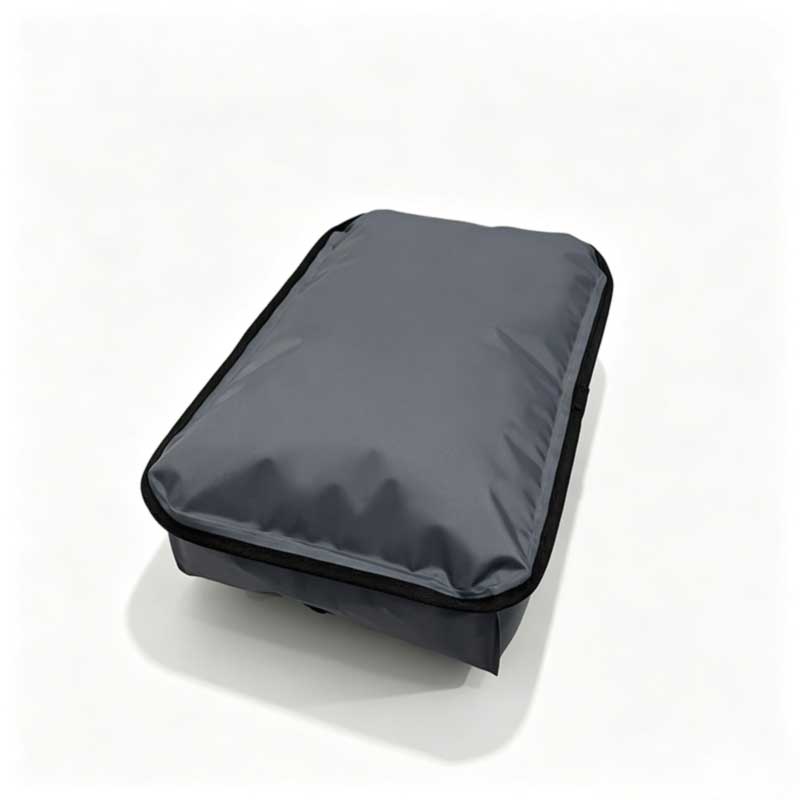
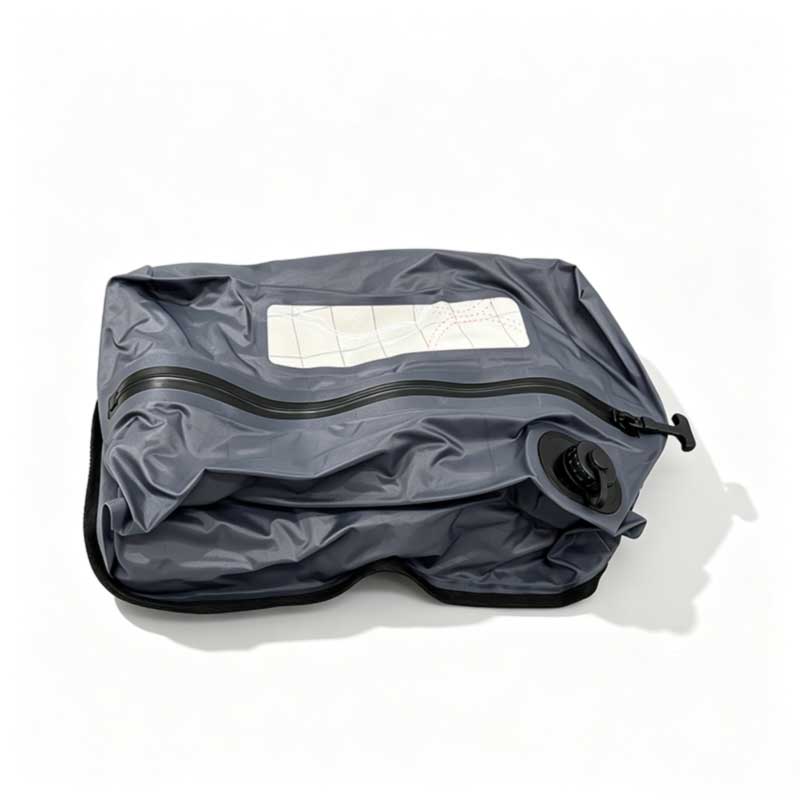
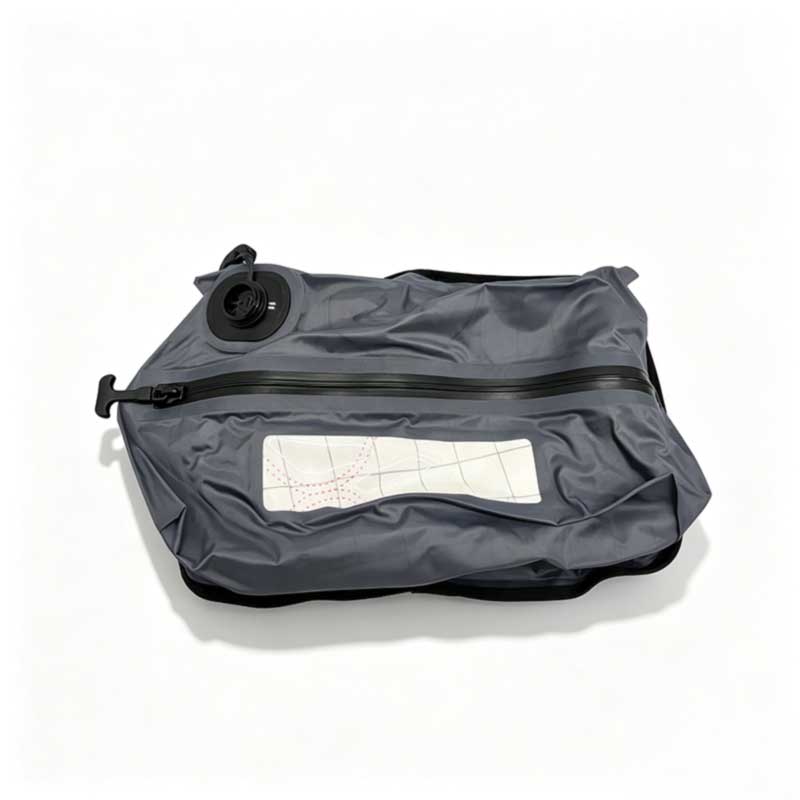
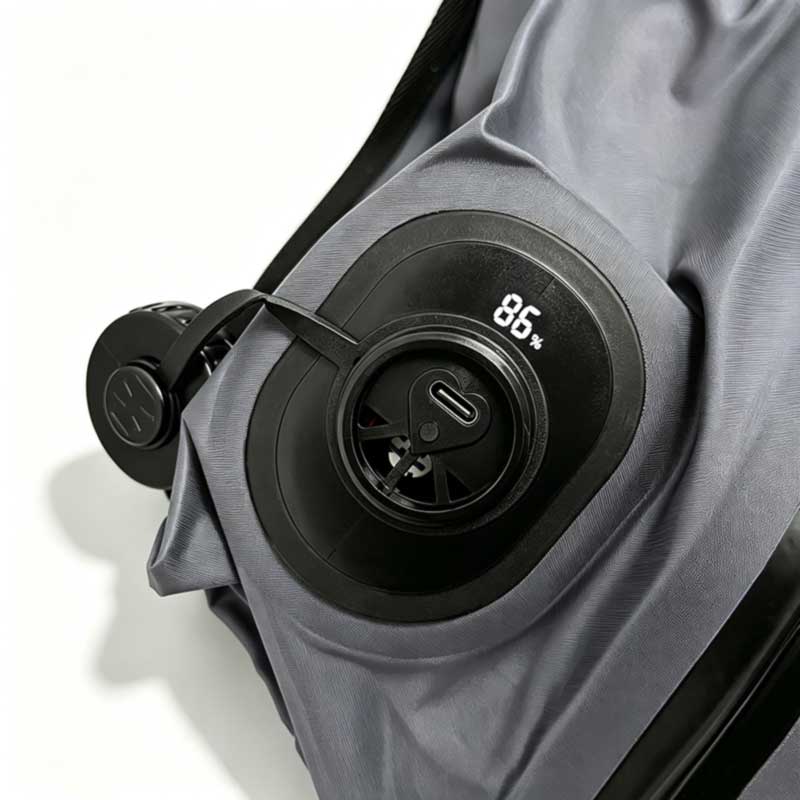
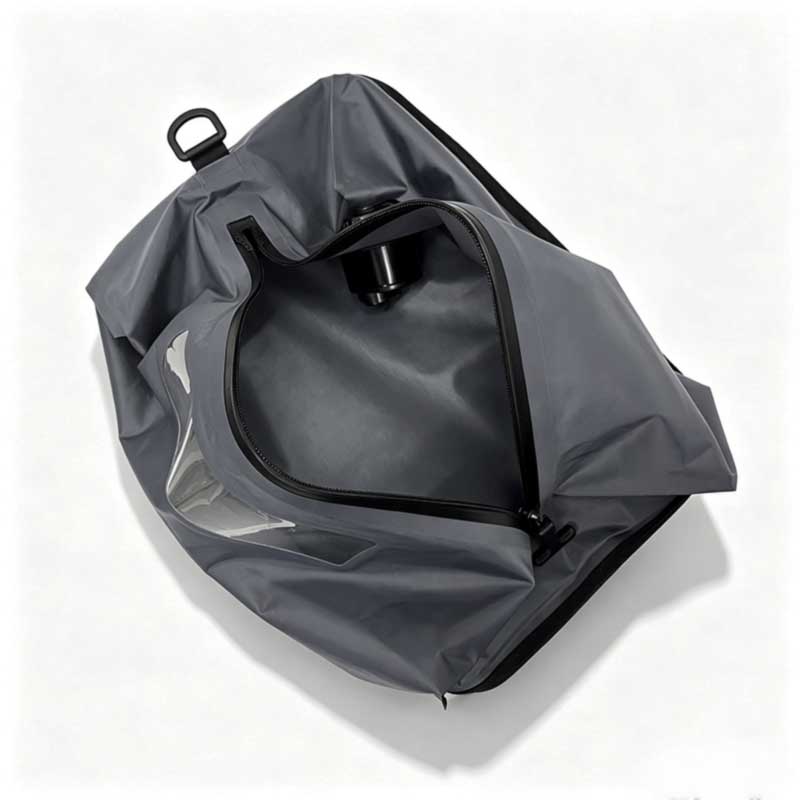
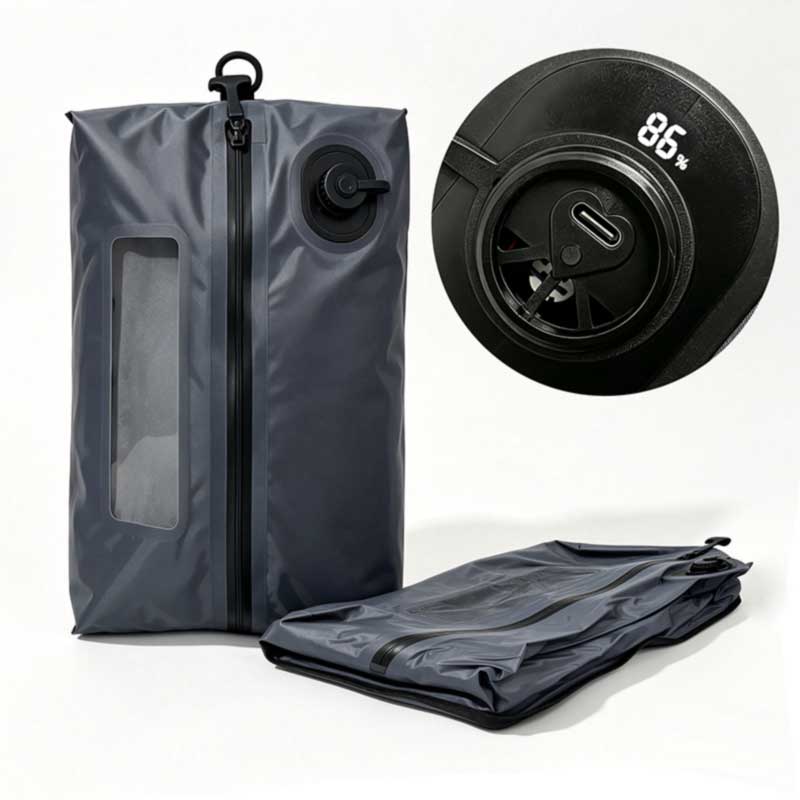
Vacuum compression packing bag with an integrated USB-C rechargeable electric pump — no separate pump unit to lose or forget, which is the single most common failure point in this category. High-frequency welded TPU body with a full-length sealed waterproof zipper, transparent viewing window, D-ring hanging loop, and bound edge finishing. Digital display shows compression countdown; screw-down waterproof cap seals the pump housing when not in use. 42 × 29 × 11 cm, approx. 13.4 L, 0.2 kg. Splash, dust, and damp resistant; not rated for submersion. MOQ 300 pcs FOB Guangdong, samples in 7–15 days. -->
Every electric compression bag currently on the market shares one design: a set of bags plus a separate pump unit. That pump is a small object that has to be charged before a trip, packed alongside the bags, kept track of in a hotel room, and remembered on the way home. It is the part that gets left in a drawer, and when it does, the entire set stops working.
This bag puts the pump inside the panel. There is nothing to lose because there is nothing separate. Charge the bag itself over USB-C, press the button, and the bag draws its own air out — at home when packing, in a hotel room mid-trip, and at the end of the return leg when luggage is fullest and the space matters most.
The integration also removes the second failure point in separate-pump systems: the seal between pump nozzle and valve. A hand-held pump has to be held against a valve at the right angle for the whole cycle, and any gap means air being drawn from the room instead of the bag. An integrated pump is welded into the panel with a permanent seal, so the suction path is closed by construction.

Compression takes about fifteen seconds and needs no preparation beyond a charged bag.
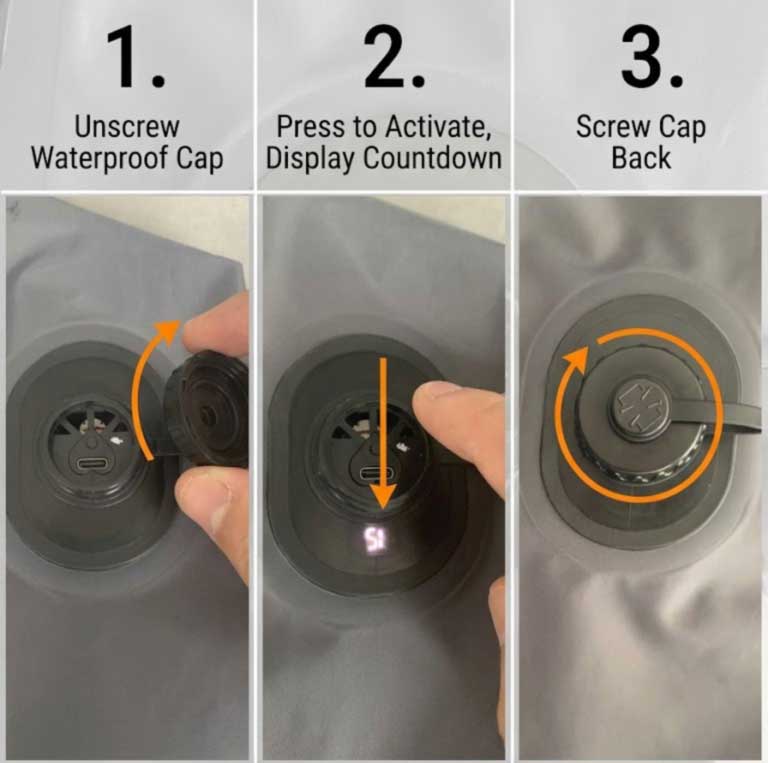
The screw-down cap is doing two jobs. It holds the vacuum, and it keeps water, dust, and lint out of the pump intake — which is what allows an electronic module to live on the outside of a bag that gets packed into wet luggage, thrown into a van, or stored in a garage.
Most compression bags are PA+PE composite film, heat-sealed at the seams. That construction works, and it fails in a predictable way: the seam is weaker than the material either side of it, compression puts every seam under tension, and after enough cycles a seam splits. For a traveller using the bag four or five times a year that is several seasons. For a frequent traveller it is often less than one.
This bag uses high-frequency welded TPU. Welding fuses the layers at a molecular level rather than tacking them with heat, producing a joint as strong as the panel itself. TPU also carries no plasticiser that can migrate out, so it does not embrittle with cold or age — which matters on a product whose entire function is repeated folding and tensioning.
The edges are bound with webbing rather than left as raw welded flange. On a bag that is repeatedly pulled tight against its contents, the edge is where abrasion concentrates; binding takes that wear on a replaceable-feeling sacrificial layer instead of the weld line.
Three details that determine whether the bag gets used past the first trip.
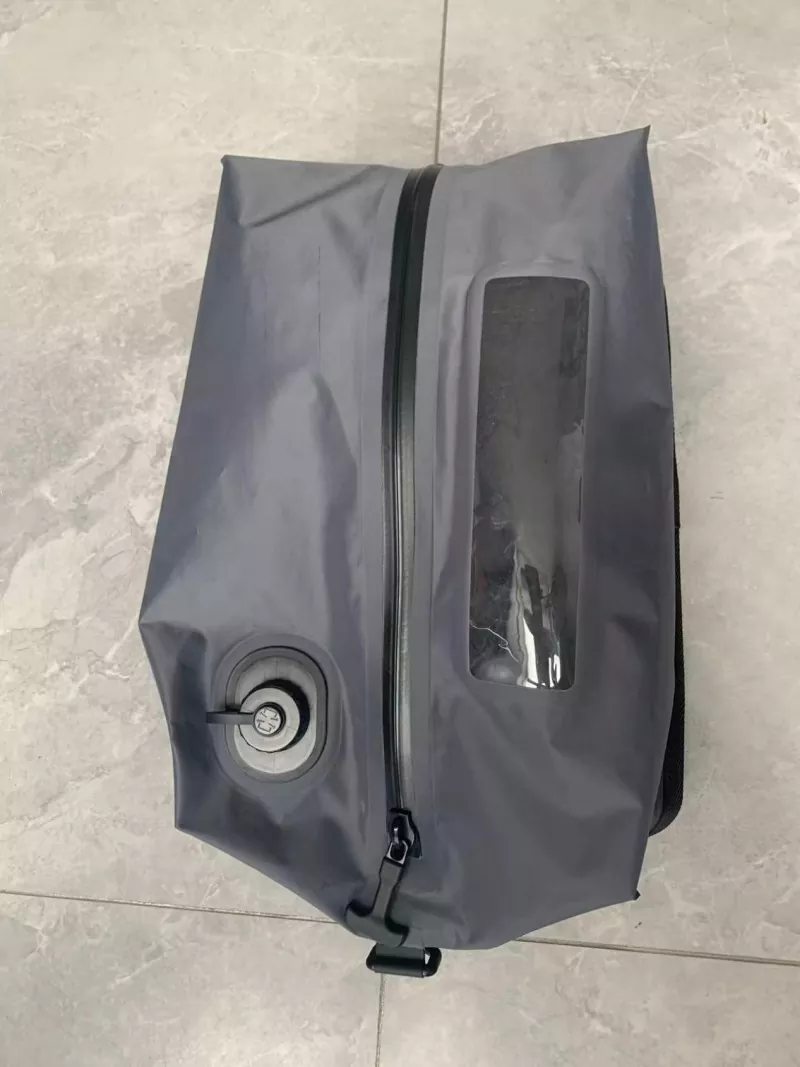
The sealed waterproof zipper runs the full length of the bag. This is what makes the vacuum possible at all — a conventional coil zipper leaks air continuously regardless of how good the pump is. It carries a moulded T-bar pull, which can be operated with cold or gloved hands and gives enough leverage to close a sealed zipper properly. It must be run completely into the end stop; a sealed zipper stopped short holds neither air nor water.
The transparent window is welded into the body panel so its perimeter is part of the sealed shell rather than a separate joint. Once a traveller owns more than one compressed bag, they look identical from the outside — the window is what stops you decompressing the wrong one to find a shirt.
The D-ring loop at the top allows the bag to be hung rather than stacked. For off-season storage this is the difference between clothing that stays flat and compressed and a bag that gets crushed under whatever is stored on top of it.
| Model No. | SL-P1083 |
|---|---|
| Product Type | Vacuum Compression Packing Bag with Integrated Pump |
| Dimensions | 42 × 29 × 11 cm |
| Volume | Approx. 13.4 L |
| Weight | 0.2 kg |
| Seam Construction | High-Frequency Welded |
| Edge Finishing | Webbing Bound |
| Closure | Full-Length Sealed Waterproof Zipper with T-Bar Pull |
| Compression System | Integrated Electric Pump, Welded Into Body Panel |
| Pump Sealing | Screw-Down Waterproof Cap |
| Compression Cycle Time | Approx. 15 seconds |
| Volume Reduction | Up to approximately 60% on soft goods |
| Main Body | TPU Laminated Waterproof Fabric |
|---|---|
| Viewing Window | Welded Clear TPU Film |
| Zipper | Sealed Waterproof Zipper, Moulded Tooth Chain |
| Edge Binding | Reinforced Webbing |
| Pump Housing | ABS with Sealed Gasket Interface |
| Hanging Loop | Moulded D-Ring on Welded Anchor Platform |
| Colour | Matte Graphite |
| Power Source | Built-In Rechargeable Battery |
|---|---|
| Charging | USB-C |
| Battery Capacity | 1500 mAh |
| Compressions Per Charge | Approx. 90 |
| Suction Power | Approx. 4000 Pa |
| Display | Digital Countdown Readout |
| Auto Stop | Yes — pump stops at cycle completion |
| Water Resistance | Splash, Dust, and Damp Resistant — not rated for submersion |
| Reusable | Yes — designed for repeated compression cycles |
| Air Travel | Battery is within standard cabin allowance; carry in hand luggage |
| OEM / ODM | Supported |
|---|---|
| MOQ | 300 pcs |
| Sample Lead Time | 7–15 Days |
| Production Lead Time | 30–45 Days |
| Custom Sizes | Available |
| Custom Colours | Pantone Matching Available |
| Logo Application | Silk Screen, Welded Patch, Heat Transfer, Custom Zipper Pull |
| Trade Terms | FOB Guangdong |
| Standard Packaging | Individual Poly Bag with USB-C Cable |
|---|---|
| Retail Packaging | Colour Box, Header Card, or Gift Box |
| Unit Weight | 0.2 kg |
| Carton Quantity | 40 pcs |
| Carton Size | 58 × 46 × 34 cm |
| Gross Weight | Approximately 10 kg |
| Shipping Methods | Sea Freight, Railway Transport, Air Freight (battery declaration required) |
| Application | Why It Fits |
|---|---|
| Air Travel & Luggage | Recompression on the return leg without a pump to pack or a vacuum cleaner to find. |
| Long-Stay & Multi-Stop Trips | Repack and recompress at every stop; the integrated pump makes daily use realistic. |
| Business Travel | Compresses base layers and knitwear; keep structured shirts uncompressed elsewhere in the case. |
| Off-Season Clothing Storage | D-ring hanging keeps compressed garments flat instead of crushed under a stack. |
| Van, Boat & Cabin Storage | Damp-resistant welded body suits environments where storage bags usually degrade. |
| Camping & Sleeping Bag Storage | Compresses bulk insulation; window identifies contents without opening. |
| Student & Relocation Moves | High-volume soft goods reduced to a fraction of their packed size. |
| Retail & Gifting Programmes | The integrated pump is a visible point of difference on a shelf full of separate-pump sets. |
Compression acts on trapped air, so the saving scales with loft. Down, fleece, knitwear, and bedding compress dramatically. Denim, tailored garments, and anything already dense compress very little.
Inspection runs at three stages — IQC on incoming materials, IPQC through welding, pump installation, and assembly, and OQC before the container is sealed. SGS or QIMA third-party inspection is available on request. Our standard customer inspection procedure is executed in full and is directly relevant here: unboxing, vacuum extraction, 24-hour static rest, and air-leak determination — which is precisely the performance this product is bought for.
| Test | What It Establishes |
|---|---|
| Vacuum Retention (24-hour static) | That compression holds overnight and beyond — the one test that separates a working compression bag from a novelty. |
| Air-Leak Determination | Location and rate of any leakage across the pump housing, cap seal, zipper line, and welded seams. |
| Pump Cycle Test | Motor and battery performance sustained across repeated compression cycles. |
| Battery Charge Cycle Test | Capacity retention and charging behaviour across the rated service life. |
| Pump Housing Seal Test | Water and dust exclusion at the cap and gasket interface with the cap closed. |
| Bonding Strength Test | Weld integrity at seams, window frame, pump mounting, and zipper interface under peel load. |
| Zipper Fatigue (3,000 cycles) | Sealing performance of the zipper retained across a full service life. |
| Tensile & Burst Test | Material and seam strength under the tension an over-packed bag generates. |
| Window Flex & Clarity Test | Film durability and optical clarity after repeated compression and flexing. |
| Abrasion & Colour Fastness | Edge binding durability inside luggage and print retention across the product life. |
The pump is welded into the panel. No separate unit to charge, pack, misplace in a hotel room, or leave behind — the failure point that makes most electric compression sets stop working.
A hand-held pump held against a valve leaks at the interface. An integrated pump is sealed into the panel by construction, so all suction acts on the bag.
High-frequency welded TPU produces seams as strong as the panels. PA+PE film bags split at the seam after enough compression cycles; this construction does not have that failure mode.
Seals the pump housing against water, dust, and lint between uses — what allows an electronic module to survive on the outside of a bag packed into wet luggage.
The display shows the cycle running and stopping, so there is no guessing whether compression finished or the battery gave out.
Loads flat like a case rather than through a narrow slot, with a T-bar pull that gives leverage to close a sealed zipper properly.
Identify contents without decompressing. The window perimeter is welded into the shell, not a separate joint.
Hang for off-season storage instead of stacking, keeping compressed garments flat rather than crushed.
| Method | Best Suited To |
|---|---|
| Silk Screen Printing | Single or two-colour logos on the matte body panel; the most economical at volume. |
| Welded Logo Patch | A tonal, dimensional mark that suits the matte finish and adds no leak path. |
| Heat Transfer | Full-colour artwork, gradients, and photographic detail. |
| Custom Zipper Pull | Branded T-bar pull — a detail the user handles every time they open the bag. |
| Printed Instruction Panel | Compression steps printed beside the pump; reduces support enquiries on a product with a learning curve. |
The clear panel and the pump housing area should be kept free of print. Everything else on the body is available as branding surface.
Beyond logo and colourway work, this platform supports ground-up development: additional sizes and nested set configurations, a larger or repositioned viewing window, a fully opaque body, alternative pump specifications including higher suction or larger battery capacity, an inflate function for travel pillows and pool floats, a carry handle or shoulder strap, and internal compression straps.
Two configurations we are asked for most often are worth flagging. A mixed set pairs one pump-equipped bag with two or three manual-valve bags — the powered bag does the work, the others cost less, and the set retails at a competitive price point. And an inflate/deflate variant reverses the pump, which broadens the product from a packing accessory into travel and camping use.
Ground-up structural or electronic development runs longer than branding work. We quote a schedule you can plan a launch around rather than an optimistic one you have to work back from later.
For a manual alternative with no battery to charge and no electronics to fail, our Vacuum Compression Bag with One-Way Valve compresses by hand pressure in three sizes — often specified as the companion pieces in a set alongside this one.
For genuine immersion protection rather than damp resistance, see our Roll Top Dry Bag, which uses a welded body with a roll-top closure rated for full submersion.
For a structured organiser that stands upright and stays open, see the Waterproof Toiletry Bag with Viewing Window.
No — that is the point of this design. The pump is welded into the bag. There is nothing separate to charge, pack, misplace, or leave behind, which is the most frequently reported problem with electric compression sets.
Around 90 on a full charge, over USB-C. In practice that is several trips before the bag needs charging again, and it charges from any phone charger, laptop, or power bank.
Yes, in hand luggage. The battery is within standard cabin allowance. As with any lithium battery, it should travel in the cabin rather than in checked baggage — a point worth printing on retail packaging.
Through a normal trip. Our production standard is a 24-hour static rest followed by air-leak determination with no measurable loss. In practice the most common cause of a bag going soft is a zipper that was not run fully into its end stop, or the pump cap not screwed down — not a leak.
Three causes, in order of frequency: the zipper is not completely closed; the bag is over-packed, leaving no room for the fabric to draw in; or the contents are already dense. Dense items simply have little air to remove — compression works on loft, not on mass.
The bag still functions as a sealed packing bag; you lose the compression, not the bag. Charging from any USB-C source restores it. This is worth stating plainly, because "what if the electronics die" is the main hesitation buyers have about powered compression bags.
Base layers, knitwear, and casual clothing usually arrive better than they would loose, because compression stops them shifting and rubbing. Structured items — dress shirts, tailored jackets — will crease, and no vacuum bag avoids this. Keep those uncompressed in a separate part of the case.
It resists splashes, dust, and damp — the welded body, sealed zipper, and screw-down pump cap all contribute. It is not rated for submersion, and an electronic module should not be immersed. For submersion, a roll-top dry bag is the correct product.
No. Compression bags reduce volume, not mass. The most common disappointment reported by travellers is arriving at check-in overweight because the freed space got filled. On cabin allowances where weight is the binding constraint, use it to fit a bulky jacket into a small case rather than to carry more.
Two differences. The pump is integrated rather than separate, so the set cannot be broken by losing one component. And the body is welded TPU rather than PA+PE film, so the seams do not split after repeated compression cycles — which is where budget sets typically fail, usually within a season of regular use.
300 pieces, FOB Guangdong. For set configurations, mixed powered and manual sets, or project-specific requirements, contact our team.
Compression bags sell on one thing a photograph cannot show: whether the bag is still flat the next morning. We suggest testing a sample against whatever you currently source — compress both, leave them 24 hours, and compare. Samples ship in 7–15 days.
Send us your target quantity, set configuration, and branding requirement, and we will return pricing and a realistic production schedule.