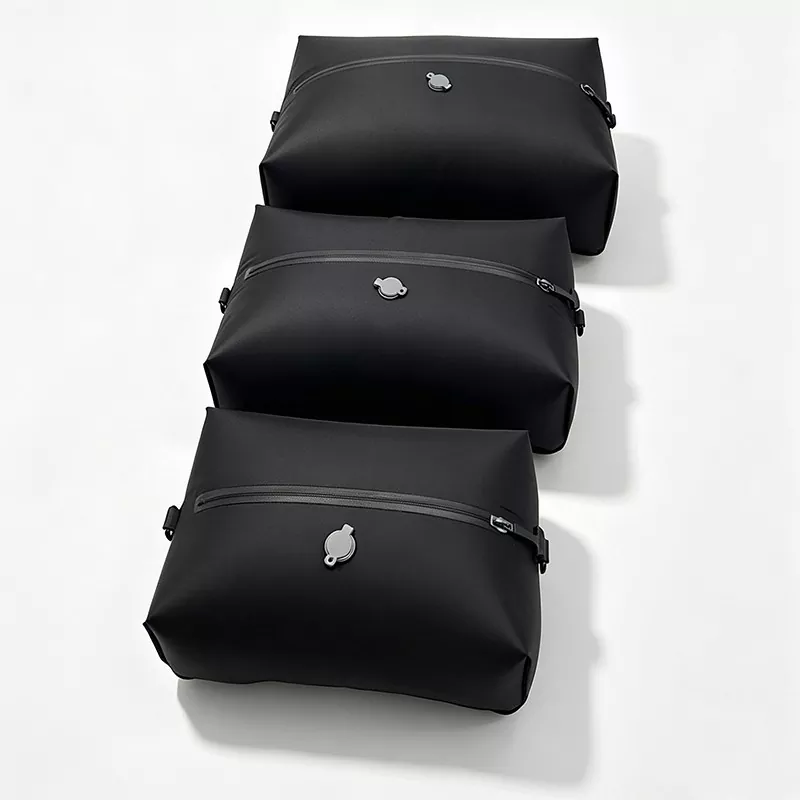
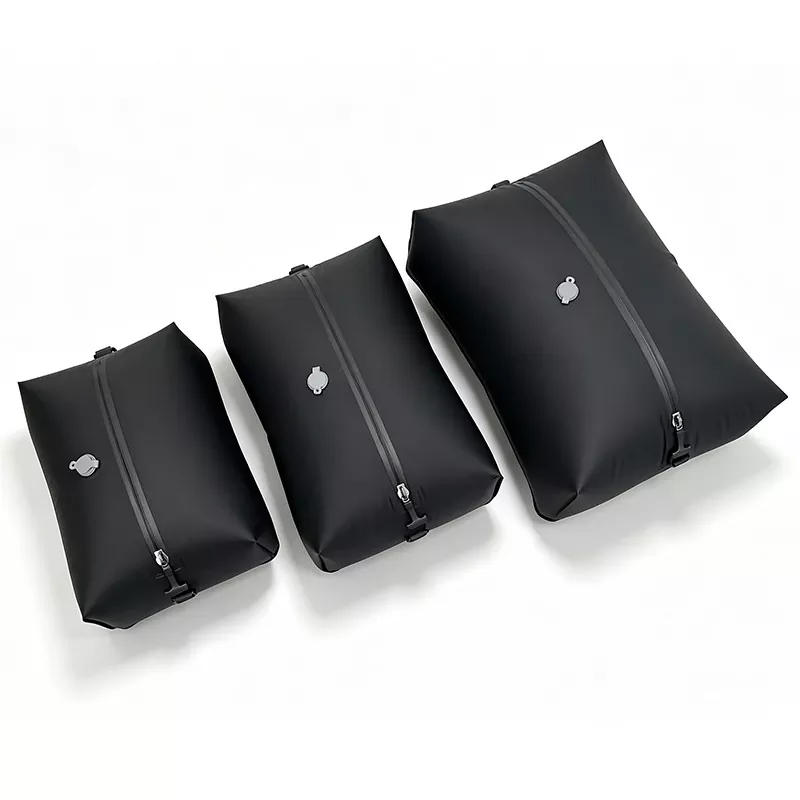
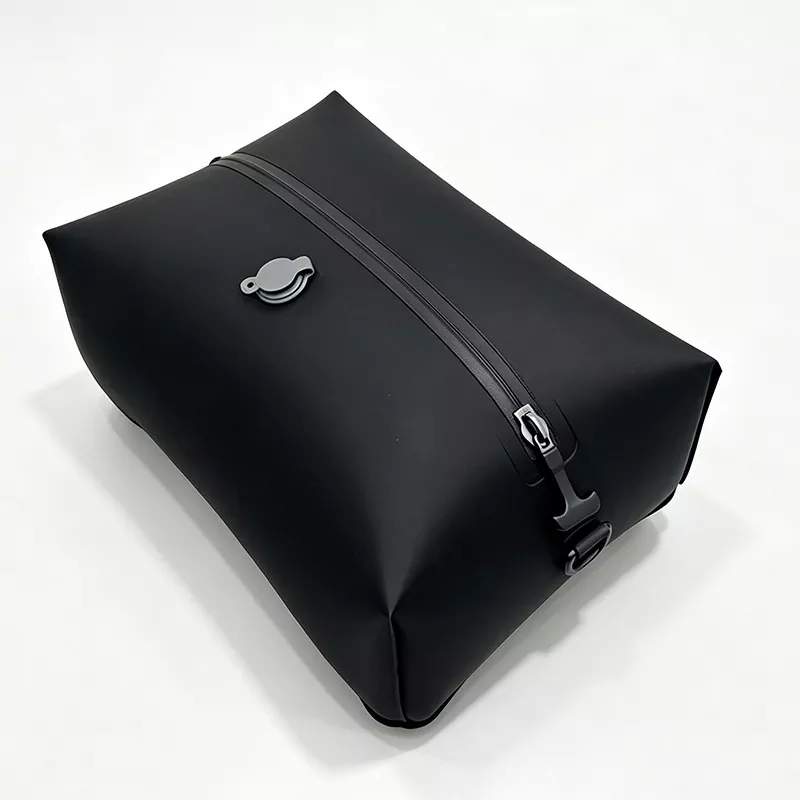
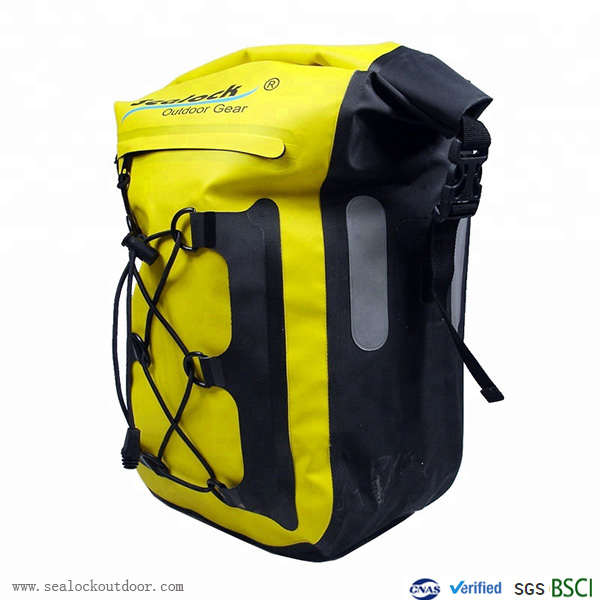
Reusable vacuum compression bag in high-frequency welded TPU with a full-length sealed waterproof zipper and a centre-mounted one-way valve. No pump or power required — hand pressure compresses, and the valve holds. Welded seams rather than heat-sealed film give the cycle life that cheap compression bags lack, and the sealed construction means the bag also functions as a dry bag for wet kit. Three sizes: 38 × 27 × 14 cm (14L), 46.5 × 31.5 × 14 cm (20L), 53.5 × 38.5 × 16 cm (33L), 150g each, black. Verified by 24-hour vacuum retention and air-leak determination. Nested retail sets, colour-coded sizing, and transparent panels available as ODM. MOQ 500 pcs, samples in 7–15 days.
Vacuum Compression Bag for Travel — Welded TPU with One-Way Valve
The SEALOCK SL-P1082 compresses a packed load by pressing the air out through a one-way valve, then holds it compressed for the length of the trip. No pump, no vacuum cleaner, no power source — kneel on the bag or roll it and the valve does the rest, which means you can recompress in a hotel room on day six exactly as easily as you did at home on day one.
It is built the way we build dry bags rather than the way compression bags are usually built. The body is high-frequency welded TPU, not heat-sealed polyethylene film, and the closure is a genuine waterproof zipper. That construction is why it survives repeated compression cycles instead of splitting at a seam after a dozen trips — and it has a side effect worth knowing about: this bag keeps water out as well as air. Uncompressed, it works as a dry bag.
Three sizes from 14 to 33 litres, 150 grams each, in black. Suitable for luggage, backpacking, boat and van storage, and off-season storage at home.
The Only Specification That Matters Is Cycle Count
Almost every compression bag on the market works on day one. The complaints that fill review pages are all about what happens later: the valve stops holding, the bag is flat again by the second morning, a seam splits, the film cracks along a fold line. The product did not fail at sealing — it failed at doing it repeatedly.
That is a materials and construction problem, not a design one. Most compression bags are made from heat-sealed polyethylene or PVC film, a process that produces a joint weaker than the material either side of it. Compression puts every seam under tension and every fold under strain, and a heat-sealed film seam is exactly where that stress concentrates. Ten cycles is fine. Fifty is where cheap bags start failing, which for a frequent traveller is one year.
The SL-P1082 uses high-frequency welding on TPU, which fuses the layers at a molecular level rather than tacking them together with heat. The joint is as strong as the panel. TPU also has no plasticiser to migrate out, so it does not embrittle with age or cold the way PVC film does — relevant on a product whose entire function is repeated flexing and folding.
Three sizes in welded TPU — 14L, 20L, and 33L, at 150 grams each.
No Pump Required, and Why That Matters on Day Six
The most common practical failure of vacuum packing is not the bag — it is the return journey. Travellers compress at home with a vacuum cleaner, arrive, unpack, and then discover there is no vacuum cleaner in the hotel. Everything that was compressed on the way out goes home loose, and the space saving that justified the purchase disappears exactly when the luggage is fullest.
The one-way valve on the SL-P1082 removes the dependency. Air exits under hand pressure and cannot return, so the compression method is simply pressing: lay the bag flat and lean on it, roll it from the closed end, or kneel on it. It takes about twenty seconds and works anywhere on earth.
The valve sits in the centre of the panel rather than at one end. This is a small detail with a real consequence — a corner-mounted valve evacuates the air nearest it first and leaves pockets trapped at the far end, so the bag compresses unevenly and springs partially back. A centre valve draws from the whole panel at once and compresses flat.
Load the bag through the full-length zipper and close it completely into the end stop.
Lay it flat with the valve facing up.
Press from the far end toward the valve — kneel, lean, or roll — forcing air out through the centre.
Keep pressure on until the fabric draws tight around the contents.
Release. The valve closes on its own; there is no cap to remember.
Full-Length Zipper Instead of a Top Slot
The zipper runs the full length of the bag rather than across a short top opening. Loading a compression bag through a narrow slot means stuffing garments down and then working them into the corners by hand, and it is the reason so many people give up on vacuum packing after two trips — it is simply annoying.
With a full-length opening the bag lies open like a case. Folded clothing goes in flat, in the order you want it, and comes out in the same order. Mid-trip access is realistic rather than theoretical: unzip, take out what you need, close, press, and you are compressed again in under a minute.
The zipper itself is a sealed waterproof type — a moulded, rubberised tooth chain that compresses against itself. It is what allows the bag to hold a vacuum at all, since a conventional coil zipper leaks air continuously no matter how good the valve is. It must be closed completely into its end stop; a sealed zipper stopped a centimetre short holds neither air nor water.
A sealed zipper is what makes the vacuum possible; a coil zipper leaks regardless of the valve.
It Is Also a Dry Bag
This is not a marketing angle bolted onto a travel product — it is a consequence of how the bag is built. A welded TPU body and a sealed zipper are the same components we put into our waterproof dry bags. Sealed and uncompressed, the SL-P1082 keeps water out as effectively as it keeps air in.
The practical value shows up outside the suitcase. Wet swimwear and a used towel can go in on the way home from the beach without soaking the rest of the luggage. On a boat or in a van, it stores bedding, spare clothing, and electronics in a genuinely dry container. On a canoe trip it compresses a sleeping bag and keeps it dry in the same operation — two pieces of equipment replaced by one.
Very few compression bags can make this claim, because very few are made by a factory whose main business is waterproof gear. It is worth stating plainly on a retail listing, since buyers comparing this against a travel-brand equivalent will not otherwise know the difference exists.
Product Specifications
Model No.
SL-P1082
Product Name
Vacuum Compression Bag
Product Type
Travel Compression Bag / Dry Bag
Available Sizes
Small / Medium / Large
Weight
0.15 kg
Main Material
TPU Laminated Waterproof Fabric
Seam Construction
High-Frequency Welded
Closure
Full-Length Sealed Waterproof Zipper
Compression System
Centre-Mounted One-Way Valve
Pump Required
No — hand pressure only
Waterproof Rating
IPX6
Compression Ratio
Up to approximately 60% volume reduction on soft goods
Reusable
Yes — designed for repeated compression cycles
Color
Black (Custom Colours Available)
OEM / ODM
Supported
Logo
Customized
MOQ
500 pcs
Sample Lead Time
7–15 Days
Production Lead Time
30–45 Days
Country of Origin
Guangdong, China
Sizes and What They Hold
Size
Dimensions
Volume
Typical Contents
Small
38 × 27 × 14 cm
Approx. 14 L
Underwear, socks, t-shirts, sleepwear — a weekend's base layers
Medium
46.5 × 31.5 × 14 cm
Approx. 20 L
A week of clothing, or two or three knitwear layers
Large
53.5 × 38.5 × 16 cm
Approx. 33 L
A down jacket and fleece, bedding, a sleeping bag, bulk winter layers
Compression works on air, so the saving scales with how much air an item traps. Down jackets, fleece, knitwear, and bedding compress dramatically. Denim, tailored garments, and anything already dense compress very little — packing them in a vacuum bag adds a step without adding space.
The Weight Trap Buyers Should Know About
One caution that belongs on any honest compression bag listing: these bags save volume, not mass. The most common disappointment reported by travellers is not a failed bag — it is arriving at check-in overweight because the freed-up space got filled.
On airlines with a 7 or 8 kilogram cabin allowance, volume is rarely the binding constraint; weight is. A vacuum bag is genuinely useful there for fitting a bulky jacket into a small case, and genuinely useless for carrying more. The travellers who benefit most are those with a hold allowance, those packing bulky cold-weather clothing, and those who need the space on the return leg for purchases.
Retailers and brand owners get fewer returns when this is stated up front rather than discovered at an airport.
Wrinkling — What to Expect
Compression flattens fabric and holds it still, which has two opposite effects depending on the garment. Items that were already folded stay folded, and often arrive in better condition than they would loose in a suitcase, because compression prevents the shifting and rubbing that causes most travel creasing.
Structured garments are the exception. Dress shirts, tailored jackets, and anything with a collar or a pressed line will crease under compression, and no vacuum bag avoids this. The practical answer is to keep those items in a separate uncompressed area of the case and use the compression bag for base layers, knitwear, and bulk — which is what most experienced users converge on anyway.
Compression is pressure, not heat, so it does not damage fibres for normal trip durations. For long-term storage of silk or delicate structured pieces, uncompressed storage remains the better choice.
Where It Gets Used
Air Travel & Luggage
Backpacking & Hostel Travel
Cruise & Coach Tours
Camping & Sleeping Bag Storage
Boat & Van Storage
Beach & Pool Wet Kit
Off-Season Clothing Storage
Student & Dorm Moves
Business Travel
Promotional & Corporate Gifting
Customization for Brands and Buyers
SEALOCK has manufactured waterproof gear for over 20 years, with production in Dongguan, China and Ho Chi Minh City, Vietnam. Among the brands we build for are MUJI, CHUMS, snow peak, and F/CE. — companies operating where technical construction and retail design standards meet, which is the brief a travel compression range has to satisfy.
Beyond logo and colourway work, we develop structure from the ground up: additional sizes and nested set configurations, a transparent or half-transparent panel for content visibility, an internal compression strap, alternative valve types including pump-compatible fittings, a carry handle or strap, hanging loops for storage use, and printed size or category labelling for retail sets. Sets of three or four sizes in matched branding are the most common retail configuration and tool easily from one platform. Ground-up development runs longer than branding work, and we quote a schedule you can plan a launch around.
Branding
Silk Screen Printing
Welded Logo Patch
Heat Transfer
Custom Zipper Pulls
Printed Size Labelling
Colour
Black
Pantone Matching
Colour-Coded Size Sets
Contrast Zipper & Valve
Structure
Additional Sizes & Nested Sets
Transparent Viewing Panel
Valve Type & Pump Compatibility
Carry Handle or Strap
Internal Compression Strap
Packaging
Poly Bag
Hang Tag & Header Card
Retail Set Box
Barcode & Care Label
How It Is Built
01
Material Verification
TPU laminate rolls are checked for coating consistency and thickness; sealed zippers and valve assemblies are verified to specification before release to the line.
02
Panel Cutting
Body panels, gussets, and the valve aperture are cut to fixed tooling across all three sizes.
03
Valve Installation
The one-way valve is welded into the centre panel while it is flat, then function-tested for one-way flow and seal-back before the panel enters assembly.
04
Body Welding
Seams and gussets are high-frequency welded into a continuous airtight shell with no stitch penetrations and no heat-sealed film joints.
05
Zipper Bonding
The sealed zipper is bonded along the full opening and checked for complete engagement end to end.
06
Test, Inspect, Pack
Batch samples go to vacuum retention and water testing; the balance is inspected for appearance, valve function, and zipper operation before packing.
Testing and Inspection
Inspection runs at three stages — IQC on incoming materials, IPQC through welding and assembly, and OQC before the container is sealed. SGS or QIMA third-party inspection is available on request. Our standard customer inspection procedure is executed in full and is directly relevant to this product: unboxing, vacuum extraction, 24-hour static rest, and air-leak determination — which is precisely the performance a compression bag is bought for.
Test
What It Establishes
Vacuum Retention (24-hour static)
That compression holds overnight and beyond — the single test that separates a working compression bag from a novelty.
Air-Leak Determination
Location and rate of any leakage across the valve, zipper line, and welded seams.
Compression Cycle Test
Valve function and seam integrity retained across repeated compression and release cycles — the failure mode that ends most compression bags.
Heavy Rain & Water-Jet Test
Waterproof sealing performance of the zipper line, valve mounting, and welded shell.
Bonding Strength Test
Weld integrity at seams, gussets, valve mounting, and zipper interface under peel load.
Zipper Fatigue (3,000 cycles)
Sealing performance of the zipper retained across a full service life.
Tensile & Burst Test
Material and seam strength under the tension an over-packed bag generates.
Abrasion & Colour Fastness
Surface durability inside a suitcase and print retention across the product life.
Questions Buyers Actually Ask
Do I need a pump or a vacuum cleaner?
No. The one-way valve releases air under hand pressure and closes by itself, so kneeling, leaning, or rolling is enough. This is the point of the design — it means you can recompress mid-trip and on the way home, which is where pump-dependent bags fail their owners.
How long does the compression hold?
Through a normal trip. Our production test is a 24-hour static rest followed by air-leak determination, and batch samples must show no measurable loss. In practice the most common cause of a bag going soft is a zipper that was not closed fully into its end stop, not a leaking valve.
How is this different from a cheap vacuum bag?
Cycle life. Almost any bag seals once. This one is welded TPU rather than heat-sealed film, so the seams are as strong as the panels and survive repeated compression. Cheap bags typically fail at a seam or a valve within a season of regular use.
Will it fit in carry-on and pass security?
Yes to both. Compression bags are not restricted, and there is no pump or battery to declare. Note that a security inspection may require unpacking, after which you simply reload, close, and press again.
Will my clothes be wrinkled?
Base layers, knitwear, and casual clothing usually arrive better than they would loose, because compression stops them shifting. Dress shirts and tailored items will crease — keep those uncompressed in a separate part of the case.
Is it really waterproof, or just water-resistant?
The body is welded TPU and the closure is a sealed waterproof zipper, so it genuinely keeps water out. It handles rain, spray, and splashes, and it is not rated for sustained submersion — for that, a roll-top dry bag is the correct product.
Can I put wet items in it?
Yes, and it is one of the more useful things about it — wet swimwear and towels can travel home without soaking the rest of the luggage. Empty and air dry the bag afterwards; a sealed container holds moisture as well as it excludes it.
Can you supply it as a retail set?
Yes, and nested sets of three or four sizes in matched branding are the most common configuration we produce for retail. Colour-coded sizes and printed category labelling are both standard options.
What is the minimum order quantity?
500 pieces. For set configurations, mixed sizes, or project-specific requirements, contact info@sealock.com.hk.
Explore More Waterproof Storage
For sustained submersion rather than rain and splash protection, our Roll Top Dry Bag uses a welded body with a roll-top closure rated for full immersion.
The SL-P1082 is the one to specify when the objective is volume reduction inside luggage, with waterproof protection as a bonus rather than the primary purpose.
Keeping It Serviceable
Close the zipper fully into its end stop every time. This is the single most common cause of a bag losing compression, and it is entirely avoidable.
Keep the zipper tooth chain clean. Grit and lint prevent full compression of the sealing surfaces and accelerate wear.
Apply zipper lubricant periodically; a dry sealed zipper gets progressively harder to close and wears its own sealing faces.
Do not over-pack. A bag stuffed past its rated volume puts the seams under tension before compression even begins, and that is where a burst starts.
Wipe the valve clean if fibres or powder residue collect around it; debris in the valve seat is the second most common cause of slow leakage.
Air dry fully after storing anything damp, and store the bag empty and open rather than compressed.
Store flat and out of direct sunlight; UV is the main long-term threat to any laminate.
Clean with mild soap and water only — solvents and alcohol-based cleaners attack the laminate and the valve seal.
Safety Notes
These bags reduce volume, not weight. Check your airline's weight allowance before filling the space you have freed.
Do not compress anything that must not be crushed — electronics, cosmetics in glass, structured items, or anything with a rigid frame.
Do not use for long-term storage of delicate or structured garments; extended compression sets creases that may not fully recover.
Keep away from infants and small children. Any sealable bag of this size is a suffocation hazard.
Store items fully dry for long-term storage. Sealing damp fabric encourages mildew inside a container designed to exclude air exchange.
Do not use the bag if the valve is damaged, the zipper is deformed, or any weld has separated.
Packaging & Shipping
Standard Packaging
Individual Poly Bag
Retail Packaging
Hang Tag, Header Card, or Nested Set Box
Unit Weight
0.15 kg
Carton Quantity
100 pcs
Carton Size
60 × 42 × 40 cm
Gross Weight
Approximately 17 kg
Shipping Methods
Express, Air Freight, Sea Freight, Railway Transport
Export Markets
North America, Europe, Australia, Southeast Asia
Request a Sample or a Quotation
Compression bags sell on one thing customers cannot judge from a photograph: whether the bag is still flat the next morning. We recommend testing a sample against whatever you are currently sourcing — compress both, leave them 24 hours, and compare. Samples ship in 7–15 days and we can send all three sizes.
Email info@sealock.com.hk with your target quantity, set configuration, and branding requirement, and we will return pricing and a realistic production schedule.
We use cookies to offer you a better browsing experience, analyze site traffic and personalize content. By using this site, you agree to our use of cookies.
Privacy Policy
 English
  Español
  Português
  русский
  Français
  日本語
日本語  Deutsch
  tiếng Việt
  Italiano
  Nederlands
  ภาษาไทย
  Polski
  Svenska
  magyar
  Malay
Malay  বাংলা ভাষার
  Dansk
Dansk  Suomi
Suomi  हिन्दी
  Pilipino
  한국어
한국어  Türkçe
  Gaeilge
  العربية
  Indonesia
  Norsk
Norsk  تمل
تمل  český
český  ελληνικά
  український
  Javanese
  فارسی
فارسی  தமிழ்
தமிழ்  తెలుగు
  नेपाली
  Burmese
  български
  ລາວ
ລາວ  Latine
  Қазақша
  Euskal
  Azərbaycan
  Slovenský jazyk
  Македонски
  Lietuvos
  Eesti Keel
  Română
  Slovenski
  मराठी
मराठी  Srpski језик