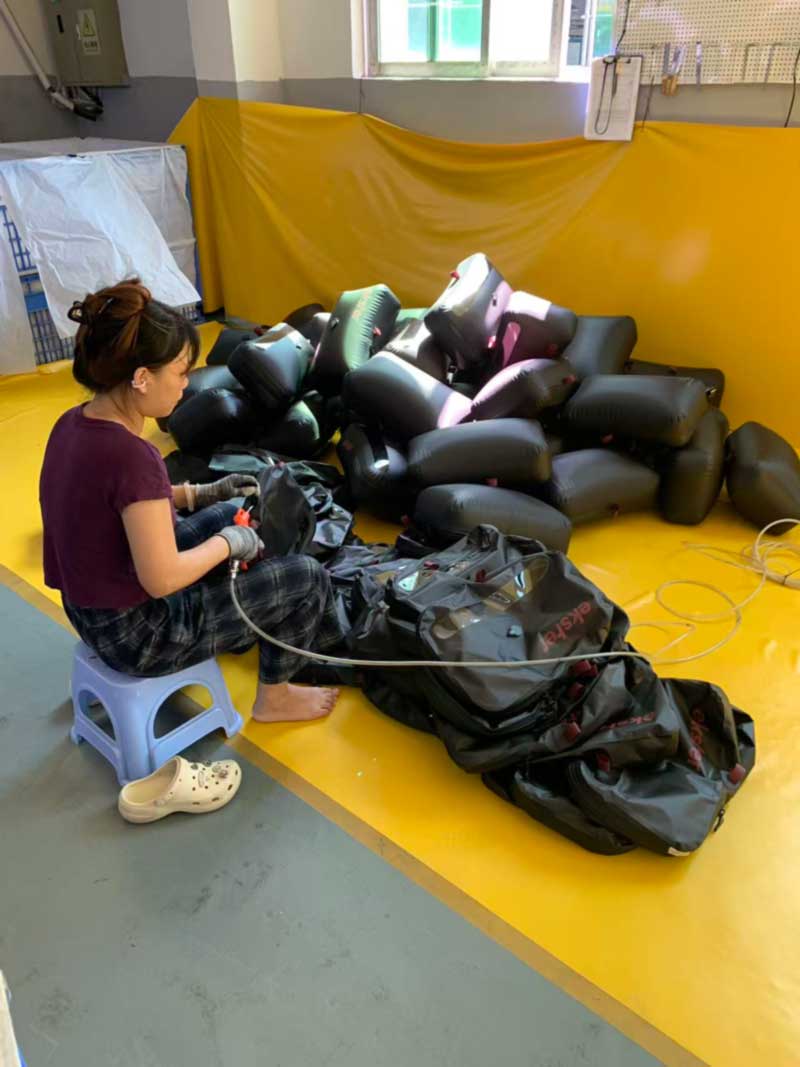
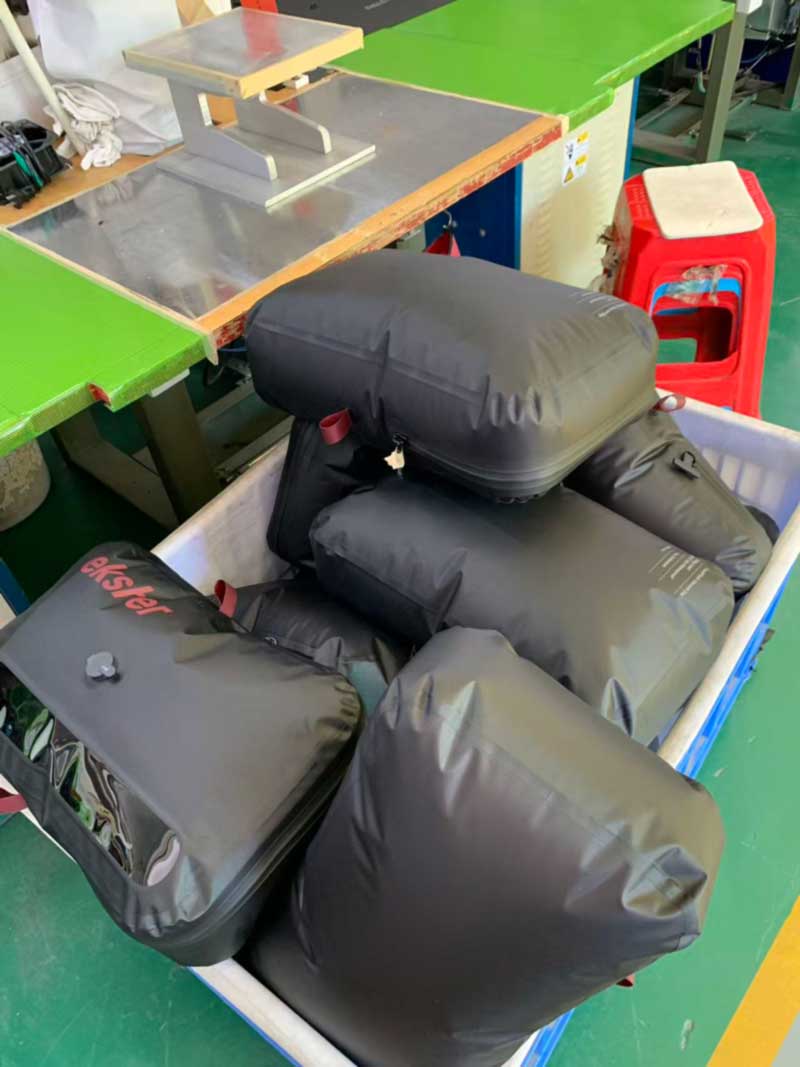
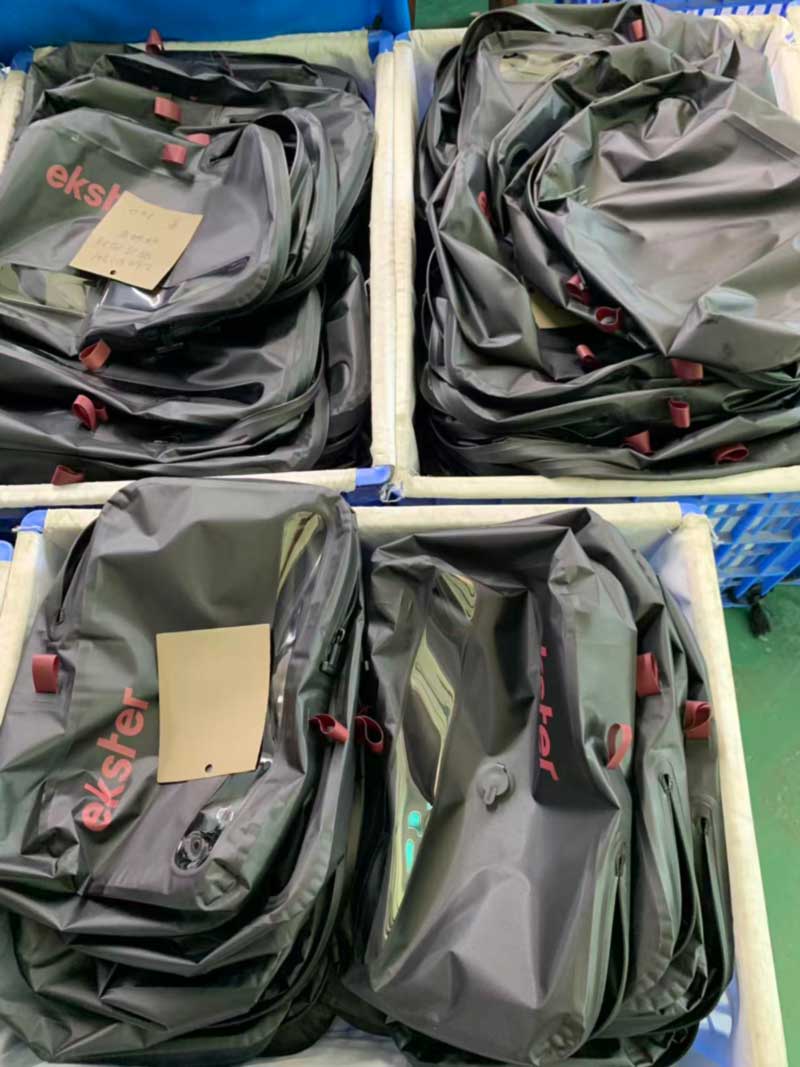
Walk past the test area on our Dongguan floor this month and the first thing you see is a waist-high pile of black bags blown up like balloons, each one taut, each one with a small grey valve on the face. An operator sits beside them with an air gun, working through a stack of flat bags on the floor and adding to the pile.
It looks odd. It is the most important inspection in the building.
The order is a fully welded airtight travel bag for Ekster, the Netherlands-based brand that moved from smart wallets into travel gear. The bag runs a welded shell, an airtight zipper and an integrated air valve, and it is rated IPX7. That combination is what makes the inflation test necessary rather than decorative.
Inflation test in progress. Every unit is pressurised through its own valve before it can move to finishing.
An airtight bag is a harder build than a waterproof one
Most waterproof bags only have to stop liquid water arriving from outside. This one has to hold air in, because the valve exists so the user can compress the contents and because the airtight zipper is what carries the IPX7 claim.
Those are different engineering problems, and the air version is strictly harder. A weld that has fused across ninety-eight percent of its width will keep rain out for years. The same weld will bleed air through the remaining two percent, slowly and invisibly, and the customer discovers it when the bag they compressed on Sunday is soft again on Monday. Water has surface tension and needs a path of a certain size; air does not. Anywhere a panel seam, a valve mount, a strap patch or a zipper end-stop is marginally under-welded, air finds it.
So on this construction the air test is not a proxy for the water test. It is a stricter test that happens to be faster and cheaper to run on every single unit, and a bag that holds air will comfortably hold out water.
What the test actually catches
Each bag is inflated through its own valve and left in the pile while the operator works through the batch. That dwell matters. A gross defect — an unwelded corner, a valve seated wrong — shows up in seconds. The defects that cost money show up over minutes: the bag that is still firm at the top of the stack and noticeably softer twenty minutes later.
The specific failure points we watch on this shape are the ones welded construction always concentrates stress into: the corners where three panels converge and the electrode has the least even contact; the valve mount, where a rigid component meets a flexible shell; the zipper terminations, where a linear seal has to transition into a welded seam; and any strap or handle patch welded onto a face that also carries a seam underneath.
Units that fail go back to the welding bench with the leak point marked rather than being scrapped, which is one of the practical advantages of high-frequency welding over adhesive construction — a short re-weld on an identified seam is a legitimate repair, not a patch.
Inflated units staged beside the welding station. A bag that holds air will hold out water.
The verification the buyer can run themselves
We tell buyers of airtight constructions to run the same check on arrival, because it needs no equipment and it is not something a factory can talk its way around:
Open a carton at random. Take a bag, evacuate the air through the valve until the shell collapses onto itself, close it, and leave it standing somewhere out of the way for twenty-four hours. Come back the next day. If it is still collapsed, the welds, the valve and the zipper are all doing their job. If it has relaxed back toward its original shape, something on that unit leaks, and the sample size question becomes the next conversation.
Twenty-four hours is deliberately generous. A bag that passes a five-minute squeeze can still fail overnight, and overnight is closer to how the product is actually used — packed the night before a flight, not inflated and inspected on a bench.
Upstream: why the welding has to be right the first time
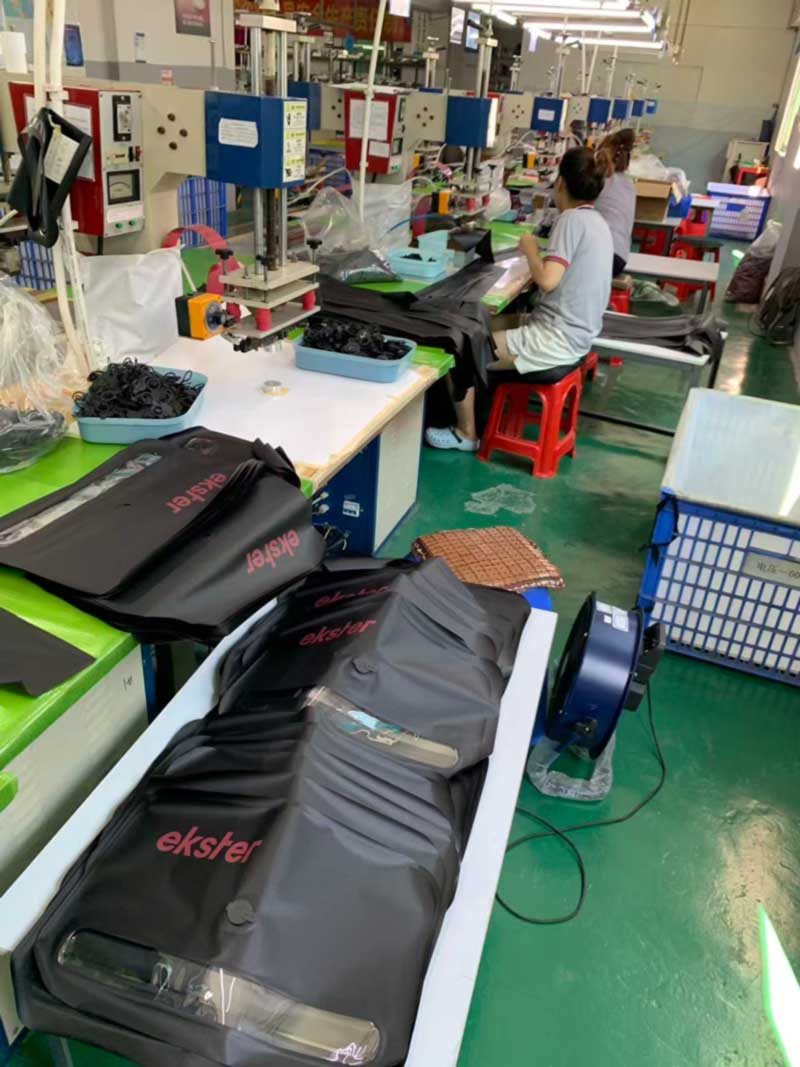
The test area only works because the welding floor is set up to make consistent seams rather than acceptable ones. Each part on this program has its own die. Valves, zipper panels and hardware patches are welded in on dedicated stations with their own tooling, and the tooling is checked against a first-piece approval before a run opens rather than adjusted by feel once output starts drifting.
High-frequency welding fuses the material through its own molecular response to the field rather than gluing two surfaces together, which is why a correct weld is as strong as the parent material and why an incorrect one is not marginally weaker but categorically different. There is no middle state that passes inspection and fails in service — which is exactly why a 100% air test is affordable. Most of the line's output is either clearly good or clearly not.
The welding line. Dedicated dies per part, hardware kitted at the station, first-piece approval before the run opens.
White gloves on gloss black
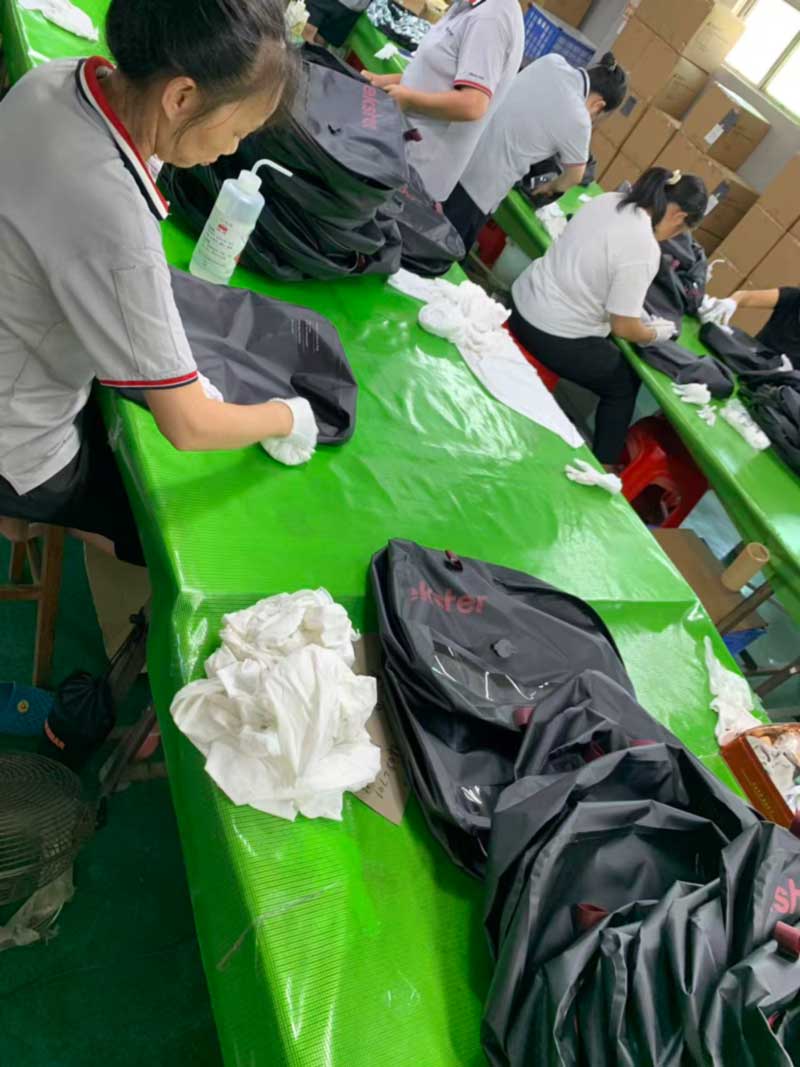
After the air test the bags move to cleaning. Operators work in white cotton gloves with solvent bottles and lint-free cloths, wiping every panel before the bag goes anywhere near packing.
This is not fussiness. A high-gloss welded black shell shows everything: fingerprints from handling, faint residue from tooling contact, the dull patch where a panel rested against a bench. None of it affects performance and all of it reads as a defect under retail lighting or in a customer's unboxing photo. On a product this dark and this glossy, surface cleaning is a larger share of finishing labour than on any other colourway we run, and it is the difference between an arrival inspection that passes and one that generates a discussion.
The same logic drives the rest of the handling discipline: cloth-lined turnover bins so the shells never touch moulded plastic ribs, protective sleeves on hardware, and bags laid flat rather than stacked during inspection.
Cleaning bench. White gloves, solvent, lint-free cloth — gloss black hides nothing.
Counts, separation and a second program on the same floor
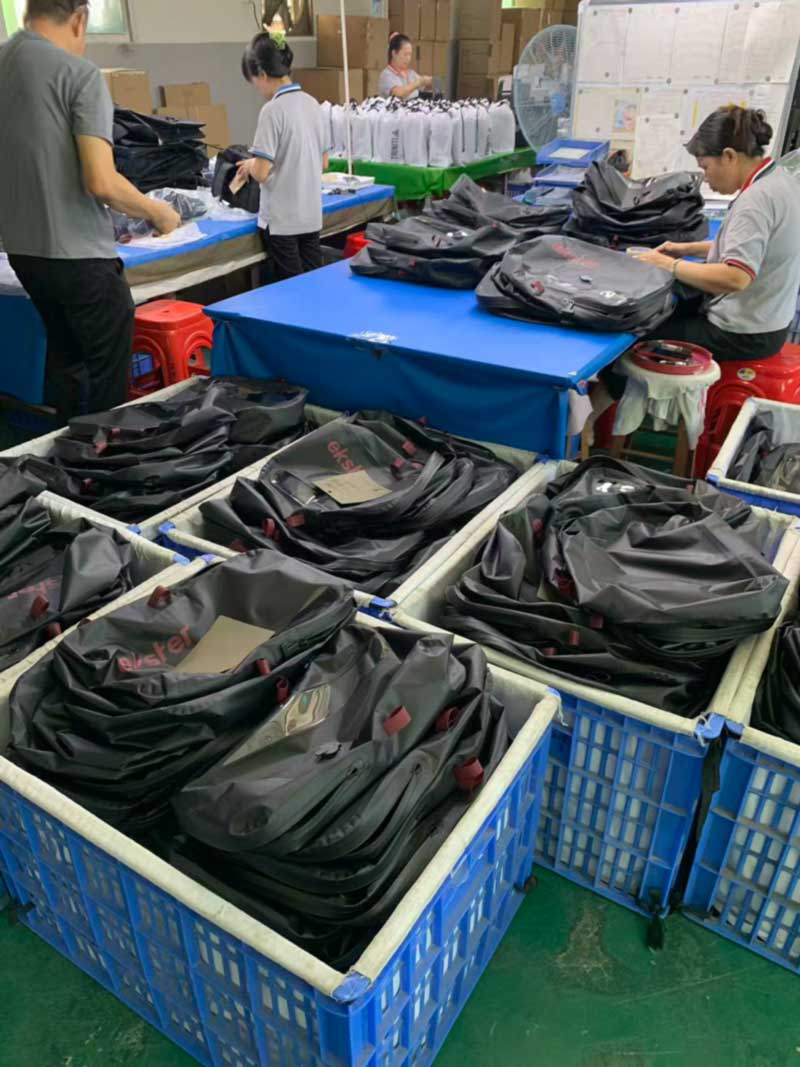
Finished units are sorted into cloth-lined bins, one model to a bin, each with a hand-written count card sitting face-up on the goods. The cards travel with the bags to OQC and are reconciled against the packing list before cartons close. A separate program — white drawstring bags for another customer — was running on the adjacent benches at the same time, which is exactly the situation where bin labelling and per-model kitting stop being bureaucracy and start being the reason nothing ends up in the wrong carton.
Inline checks on this run covered valve function and seating, zipper travel and seal engagement, strap and handle security, print position and adhesion, colour difference against the approved standard, and general appearance under bench lighting — on top of the 100% air-retention test.
One model to a bin, count card face-up, a second customer's program running on the next bench.
On the rating, and on what we will not claim
This construction — fully welded shell, airtight zipper, valve — is verified against a full water-immersion test of two hours or more, consistent with IPX7. We will say that here because the build supports it.
We are equally specific in the other direction. Our own travel vacuum compression bag is a fully welded TPU body with a sealed zipper and a one-way valve, and it is rated IPX6 — not IPX7 — because it is built to survive rain, damp and spillage inside luggage rather than to be submerged. The same applies to our compression bag with an integrated electric pump and our hand-pump version: both hold a vacuum overnight, both are splash, dust and damp resistant, and neither carries a submersion claim, because a pump housing and a screw cap are a different sealing problem from a welded panel. Roll-top bags, daypacks with water-resistant rather than airtight zippers, and frame bags get a heavy rain and water-jet protocol for the same reason. The rating follows the weakest element in the closure chain, not the strongest element in the marketing copy.
The twenty-four hour check described above is not something we reserve for customer programs. It is the production standard on our own compression line, where vacuum retention is the entire value of the product rather than a side benefit.
The hand-pump version is the clearest case: a screw-seal valve, a piston pump, up to roughly 70% volume reduction on lofted goods, and no electronics at all — which also means it ships as ordinary air cargo with no battery documentation. The integrated-pump version welds an ABS pump housing directly into the body panel and runs a fifteen-second cycle from a USB-C rechargeable battery, which adds a pump housing seal test and a battery charge cycle test to the inspection set. The valve-only travel version drops the pump entirely and compresses on hand pressure, in three sizes from a weekend of base layers up to a down jacket or a sleeping bag.
All three are high-frequency welded with a full-length sealed zipper, and all three go through unboxing, vacuum extraction, twenty-four hour static rest and air-leak determination before a container is sealed — the one test that separates a working compression bag from a novelty.
For buyers developing airtight or compression products
Airtight constructions are a different quoting conversation from ordinary waterproof bags. They need dedicated tooling per part, a valve or closure system selected before the pattern is locked, a longer first-sample cycle, and 100% rather than sampled leak testing — and they are worth it only where the product genuinely uses the air seal, for compression, for buoyancy, or for an immersion rating.
Sealock has built waterproof gear for over 20 years, with high-frequency welding and in-house sewing running side by side in Dongguan and at our facility in Ho Chi Minh City, so buyers can choose the origin that suits their tariff position without renegotiating the specification. Standard terms are FOB Guangdong, 7–15 days for sampling, 30–45 days for mass production, and MOQ from 300 pieces on most models — 500 on the three-size valve-only compression bag — with IQC, IPQC and OQC checkpoints as standard and SGS or QIMA inspection available on request.
We develop from a sketch, a competitor sample or a target spec sheet as routine work, and we will tell you when the rating you want is not one your closure can carry. For drawings, samples or a quotation, contact us at info@sealock.com.hk.
We use cookies to offer you a better browsing experience, analyze site traffic and personalize content. By using this site, you agree to our use of cookies.
Privacy Policy
 English
  Español
  Português
  русский
  Français
  日本語
日本語  Deutsch
  tiếng Việt
  Italiano
  Nederlands
  ภาษาไทย
  Polski
  Svenska
  magyar
  Malay
Malay  বাংলা ভাষার
  Dansk
Dansk  Suomi
Suomi  हिन्दी
  Pilipino
  한국어
한국어  Türkçe
  Gaeilge
  العربية
  Indonesia
  Norsk
Norsk  تمل
تمل  český
český  ελληνικά
  український
  Javanese
  فارسی
فارسی  தமிழ்
தமிழ்  తెలుగు
  नेपाली
  Burmese
  български
  ລາວ
ລາວ  Latine
  Қазақша
  Euskal
  Azərbaycan
  Slovenský jazyk
  Македонски
  Lietuvos
  Eesti Keel
  Română
  Slovenski
  मराठी
मराठी  Srpski језик