Sealock is an OEM vacuum compression bag manufacturer and supplier. Before specifying one, there is a question worth answering honestly, because it determines whether the product succeeds for your customer at all: is your buyer constrained by volume, or by weight? Compression bags solve one of those problems completely and the other not at all. This guide covers that distinction, where vacuum bags genuinely beat the alternatives, which buyer segments they suit, and how the specification should change for each.
Volume and Weight Are Different Problems
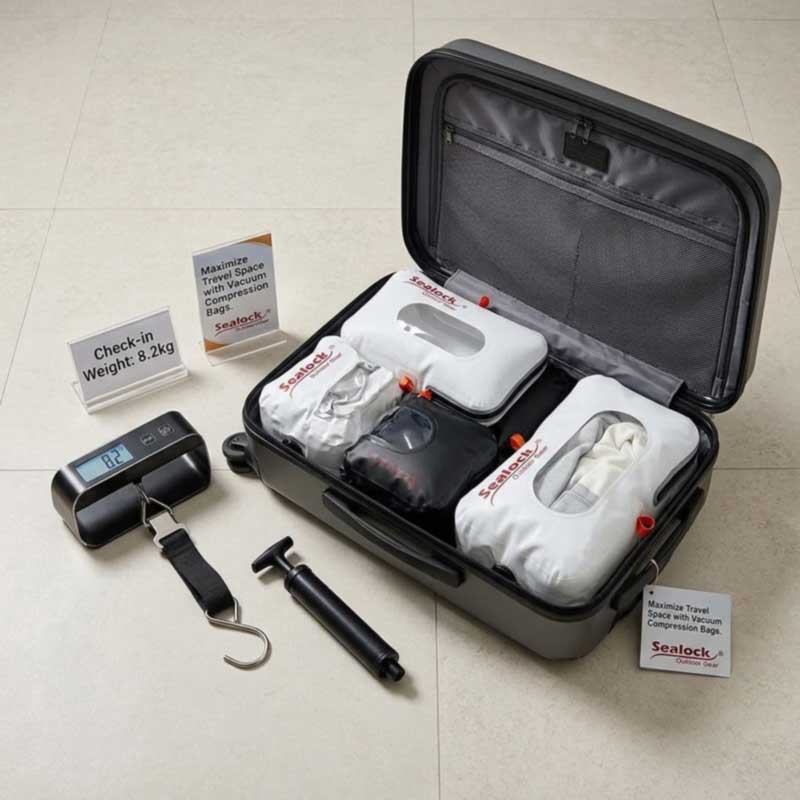
A vacuum compression bag reduces the space a load occupies. It does not reduce its mass by a single gram. That sounds obvious written down, and it is the single most common misunderstanding in the category.
The consequences show up in real traveller behaviour. Experienced travellers warn each other that compression enables overpacking — freeing space invites filling it, and airline charges are levied on weight, not on volume. The advice that circulates is to monitor total luggage weight rather than how much space has been saved, and to use compression to fit existing items into smaller luggage rather than to carry more.
For a brand, that is a positioning decision, not a disclaimer. A compression bag sold as "fit more in your case" attracts customers who will then hit a weight limit. Sold as "fit the same into a smaller case", it delivers exactly what it promises.
Compression buys space, never weight — and airlines charge for the second one.
Vacuum Bags or Compression Cubes? An Honest Comparison
The main competitor in travel retail is not another vacuum bag — it is the double-zipper compression cube, which squeezes air out mechanically without any valve or pump. A brand should know where each wins, because travellers have clear and vocal preferences.
Vacuum compression bag
Compression cube
Volume reduction
60–70%
Typically around 50%, some claim less
Wrinkling
More — an inherent trade-off of full compression
Less; controlled pressure keeps clothes from shifting
Waterproofing
Sealed — a genuine second function
None; mesh panels are common
Wet / dirty separation
Yes — airtight also means odour-tight
No
Long-term storage
Yes — dust, insects, moisture excluded
Not suited to it
Weight added
Higher if heavy material is specified
Very light
Ease of use
Requires a valve action or pump
Zip and go
Two conclusions follow. First, for pure business travel with shirts and suits, a cube is often the better product — and a brand selling both can position them honestly rather than competing with itself. Second, vacuum bags own three jobs a cube cannot do at all: sealing out water, isolating wet or dirty items, and long-term storage. Those are the applications worth building the product around.
The Weight Discipline That Protects Your Reviews
Travellers are explicit on this point: avoid packs made of heavier fabric, because you don't want more weight. It's a direct instruction to the specifier.
The tension is real, because material thickness is also what resists puncture. The resolution is the one covered elsewhere in this category: vacuum retention comes from welded seams and a gasket-sealed closure, not from heavy film. A TPU-laminated fabric with welded construction holds vacuum better than a thick bare-film bag, at lower weight. Specify the seam method first, then take the lightest material that meets the puncture requirement — rather than defaulting to heavier film and paying for it in traveller weight allowance.
Larger sizes, maximum compression, hand pump, temperature tolerance
Marketplace sellers
Beating a category with documented quality complaints
Welded seams and airtight zipper as the review differentiator; consistency across the run
Hotel, airline & promotional
Brand exposure, cost per unit, shippability
Simple valve models, bold branding, and no battery in the product
That last cell is worth expanding, because it catches buyers out. A built-in electric pump contains a lithium battery, which brings air freight declaration requirements and marketplace listing implications. For promotional programmes, airline amenity kits and any channel where battery paperwork is a friction point, the hand-pump model delivers the highest compression in our range with none of those consequences.
Three builds, three channels — and one of them decides your shipping paperwork.
What to Specify
Seam method — high-frequency welded, not glued or heat-sealed film. This is the vacuum-retention decision.
Closure — a gasket-sealed airtight zipper rather than a press-fit zip-lock strip.
Air removal — pump-free hand press, built-in electric pump, or hand pump, chosen against your channel's shipping constraints.
Material and weight — the lightest TPU laminate that meets the puncture requirement.
Size set — sized against your target luggage dimensions rather than to round litre numbers.
Window panel — a transparent section so contents are identifiable without opening.
Waterproof rating — state it if the construction supports it; it is a second selling point a cube cannot match.
Packaging copy — contents must be fully dry before sealing, and expect some creasing. Both prevent avoidable returns.
Luggage brands and outdoor — a three-size set with nothing to carry or charge
500
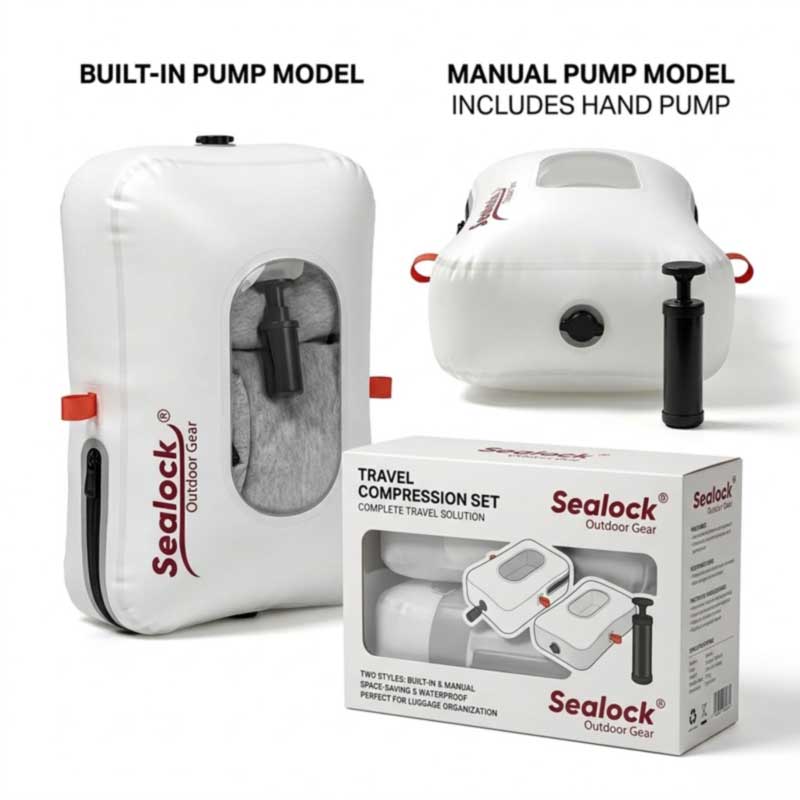
SL-P1083 Compression Bag with Built-In Pump — 42×29×11 cm, 13.4L; electric pump welded into the panel; USB-C, 1,500 mAh, around 90 cycles per charge; 4,000 Pa, roughly 15 seconds per bag; digital display with auto-stop; transparent TPU window; webbing-bound edges; D-ring hanging platform.
Premium retail and marketplace — the feature-led hero, subject to battery shipping rules
300
SL-P1133 Compression Bag with Hand Pump — 48×29×10 cm, 13.9L; screw-seal air valve with matched hand pump; orange non-slip grip; up to 70% volume reduction.
Home storage, promotional and any battery-free channel — highest compression in the range
300
Size, capacity, closure, valve and pump configuration, window panel, edge binding, hanging hardware, colourway, branding and retail packaging are all specifiable per order, or a bag can be developed from a sketch. Sampling runs 7–15 days and production 20–45 days after approval, from Dongguan or Ho Chi Minh City.
A bag that loses vacuum overnight fails here, not in a customer's cupboard.
Quality Control
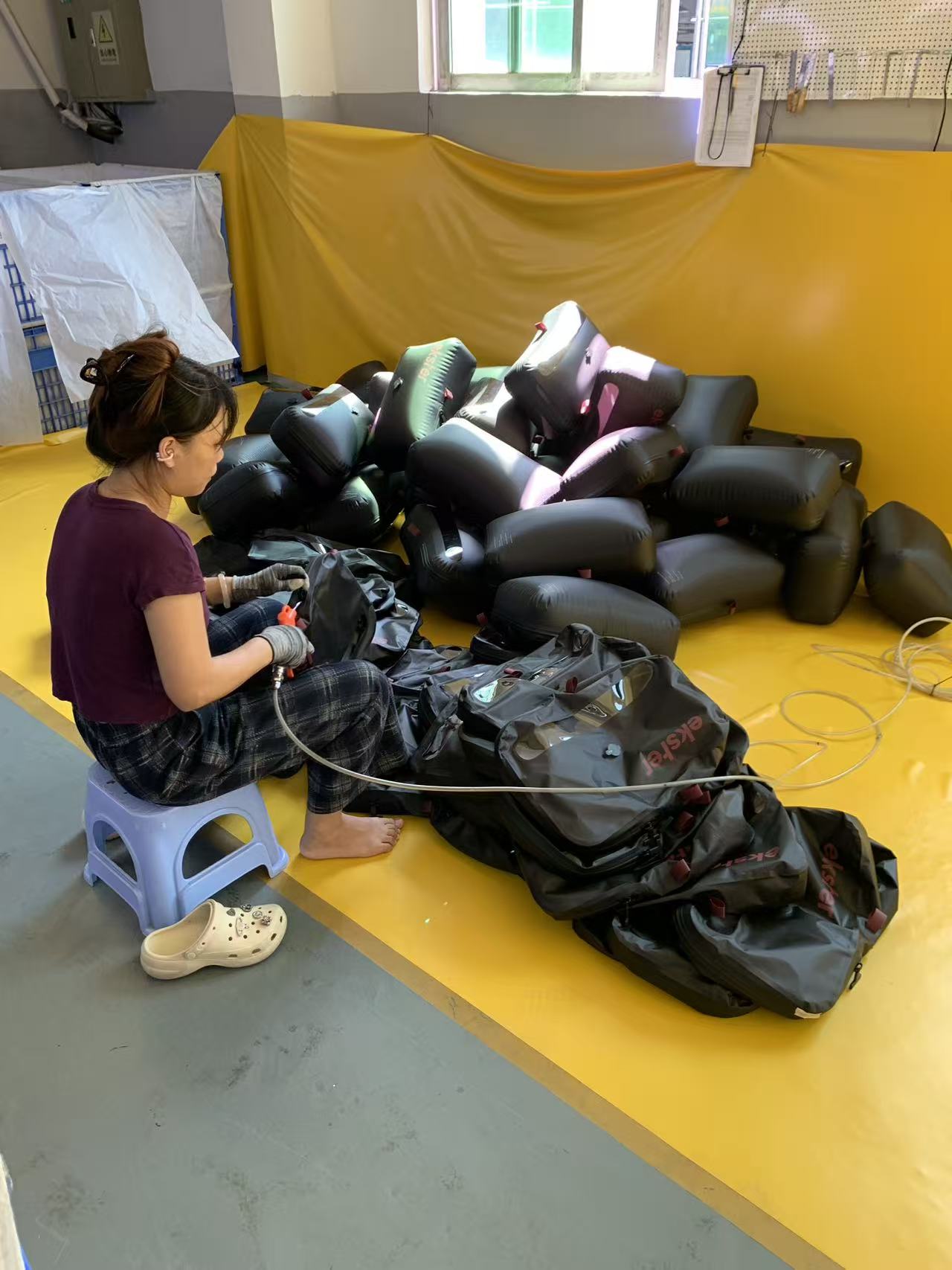
For compression bags the inspection and the performance claim are the same test. Sealock strictly executes the complete customer inspection procedure on finished goods — unboxing, vacuum extraction, a 24-hour static rest, and air-leak determination — which is literally what the end user does with the product. Given that the category's defining complaint is vacuum lost overnight, that is the single most relevant check available.
Around it sits the three-tier system: IQC (incoming TPU laminate for coating thickness, adhesion and weldability, plus airtight zippers, valves, pump units and webbing against the signed standard), IPQC (cutting tolerance, weld integrity, zipper and valve installation, pump housing seal, with peel tests on sample welds at each run start), and OQC (ISO 2859 AQL sampling, vacuum retention testing, and gold-sample comparison, with SGS or QIMA available). The lab additionally runs weld bond and peel strength, zipper and valve cycling, puncture and tear resistance, tensile, temperature cycling, and colour fastness and difference.
FAQ: OEM Compression Bag Programmes
Q: Do compression bags save weight?
A: No — they save volume only. Airlines charge by weight, so a product positioned as "pack more" can lead customers straight into an excess charge. Positioning it as "pack the same into smaller luggage" is both accurate and what the product actually delivers.
Q: Should we sell vacuum bags or compression cubes?
A: Depends on the job. Cubes wrinkle less and weigh less, which suits business travel. Vacuum bags compress substantially more and do three things cubes cannot: seal out water, isolate wet or dirty items, and store long-term. Many brands carry both and position them separately.
Q: Does heavier material mean better vacuum retention?
A: No. Vacuum retention comes from welded seams and a gasket-sealed closure; thickness governs puncture resistance. Specify the seam method first, then the lightest material that meets the puncture requirement — travellers actively avoid heavy packing accessories.
Q: Which model for a promotional or amenity programme?
A: The hand-pump or pump-free models. A built-in lithium battery adds air freight declaration requirements and marketplace listing complications, and the hand-pump model actually delivers the highest compression in our range.
Q: Can the bags be sized to our luggage?
A: Yes, and it's worth doing. Sizing to the internal dimensions of your cases rather than to round litre figures is a real differentiator for a luggage brand, and costs nothing extra at the pattern stage.
Q: What are the MOQ and lead times?
A: From 300 pieces on the pump models and 500 on the three-size travel set, with samples in 7–15 days and production 20–45 days after approval.
Talk to the Factory
For quotations, samples, and OEM/ODM proposals on vacuum compression bags, contact Sealock at info@sealock.com.hk or +86-769-82009361. Over twenty years of high-frequency welding and industrial sewing under one roof, welded TPU construction with airtight zippers, dual China–Vietnam production, and a full customer inspection procedure on every shipment.
We use cookies to offer you a better browsing experience, analyze site traffic and personalize content. By using this site, you agree to our use of cookies.
Privacy Policy
 English
  Español
  Português
  русский
  Français
  日本語
日本語  Deutsch
  tiếng Việt
  Italiano
  Nederlands
  ภาษาไทย
  Polski
  Svenska
  magyar
  Malay
Malay  বাংলা ভাষার
  Dansk
Dansk  Suomi
Suomi  हिन्दी
  Pilipino
  한국어
한국어  Türkçe
  Gaeilge
  العربية
  Indonesia
  Norsk
Norsk  تمل
تمل  český
český  ελληνικά
  український
  Javanese
  فارسی
فارسی  தமிழ்
தமிழ்  తెలుగు
  नेपाली
  Burmese
  български
  ລາວ
ລາວ  Latine
  Қазақша
  Euskal
  Azərbaycan
  Slovenský jazyk
  Македонски
  Lietuvos
  Eesti Keel
  Română
  Slovenski
  मराठी
मराठी  Srpski језик