Sealock is a vacuum compression bag manufacturer and OEM supplier. Material selection for this product is governed by a fact most specifications never acknowledge: every flexible material is permeable to gas. All flexible packaging provides a barrier — some materials just provide a better one than others. No compression bag holds a vacuum forever; the engineering question is the rate, and how that rate survives being folded, creased and stored for a season. This guide covers the three properties that actually decide a compression bag material, and why they pull against each other.
Property One: Barrier, Which Is a Number
Gas barrier performance is measurable, not assertable. It is expressed as a transmission rate — typically in cc per square metre per 24 hours, or the imperial equivalent — and, critically, always stated at defined conditions of temperature and relative humidity, because diffusion rates change with both. For reference, materials classed as genuine gas-barrier films sit at oxygen transmission rates below roughly 1 cm³/m²/day at 20°C and 65% RH.
Two practical consequences for a buyer:
Ask for the number and the conditions. A barrier figure without a stated temperature and humidity is not a specification.
Storage environment changes the result. A bag that holds a vacuum for months in a bedroom wardrobe will perform differently in an unheated garage or a hot attic. Retention claims should be framed against realistic storage conditions rather than laboratory ones.
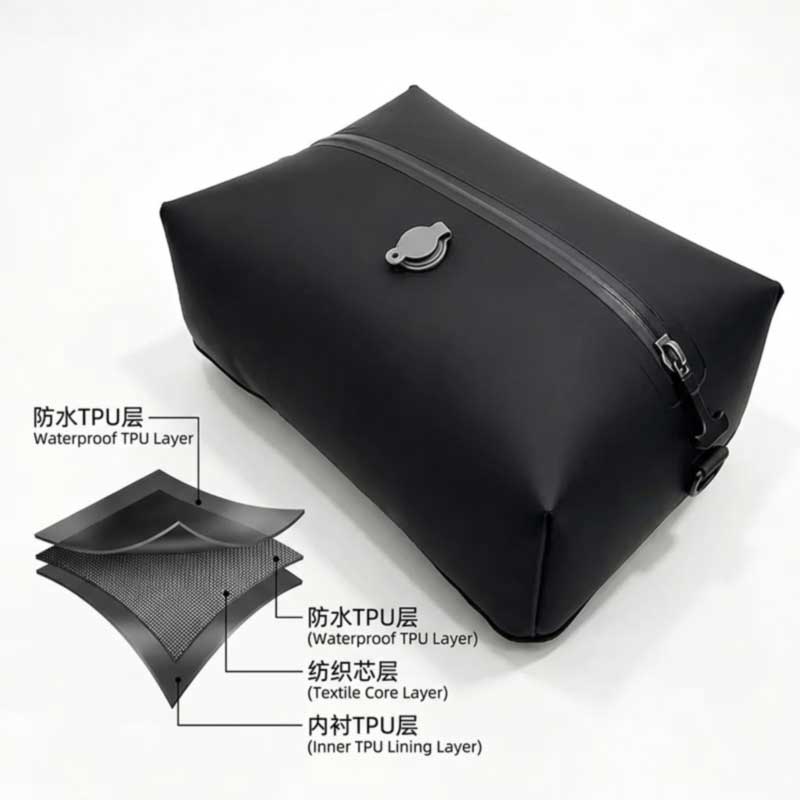
Every layer has a job — and only one of them is the barrier.
Property Two: Flex-Crack Resistance, Which Rules Out the Best Barriers
This is the property that makes compression bags different from food packaging, and it eliminates several materials that look ideal on a barrier chart.
The highest-barrier flexible structures rely on metallised layers or aluminium foil. Foil is genuinely excellent against gas, moisture and light — and it has a well-documented weakness: poor flex-crack resistance. Fold it repeatedly and the barrier layer cracks, opening microscopic pathways that defeat it entirely.
Now consider how a compression bag is used. It is stuffed, evacuated, creased hard along random lines, unpacked, folded flat, and stored — every single cycle. A compression bag is a flex-crack machine. A barrier that degrades at fold lines fails precisely where this product is stressed most, and the failure is invisible: the bag looks perfect and stops holding.
That is why textile-backed TPU laminate is the correct construction for a reusable compression bag even though a foil laminate would post a better barrier figure on day one. Retention over a hundred cycles beats retention over one.
Property Three: Weldability, Which Decides Whether the Seams Hold
The third property is the one that connects material choice to the category's dominant failure. As covered elsewhere in this category, most compression bags lose vacuum at the seams and the closure rather than through the film. Which means the material has to be weldable — a polar thermoplastic that can be fused at 27.12 MHz into a continuous seam, rather than glued or heat-sealed film that relies on an adhesive layer.
TPU welds cleanly and predictably. Many high-barrier specialist films do not, or weld poorly enough that seam consistency across a production run becomes the limiting factor. A material that offers a superb barrier and a marginal weld produces a worse bag than a material with a good barrier and an excellent weld.
The Trade-Off, in One Table
Construction
Barrier
Flex-crack
Weldability
Puncture
TPU-laminated textile
Good
Excellent — elastic recovery at folds
Excellent
Excellent — textile core resists tearing
Bare PE/PA co-extruded film
Moderate
Moderate
Heat-sealable, not RF weldable
Poor — the common complaint in the category
Metallised or foil laminate
Excellent on day one
Poor — cracks at folds
Difficult
Poor
Thick bare film
Moderate
Moderate
Heat-sealable
Better, at real weight cost
The pattern is clear: no single material wins all four columns, and the best barrier material is the worst at the property this product stresses hardest. TPU-laminated textile is the compromise that holds up over a service life rather than a lab test.
Reading the Layers
A compression bag laminate is a stack, and each layer should be specified separately:
Outer face — abrasion resistance, since the bag lives inside luggage against zips and hard-shell interiors, and colour and print carrier.
Textile core — tear and puncture resistance. This is where thickness legitimately helps, and it is what bare-film bags lack. Buyers routinely report bags holed by nothing more than being pushed onto a shelf.
Barrier and inner weldable surface — the gas barrier and the surface that fuses at the seams, the valve flange and the zipper tape.
Two specification notes that follow. First, the valve flange material should be compatible with the inner surface, because bonds between similar materials are substantially more reliable than adhesive joints between dissimilar plastics. Second, thickness is not the barrier specification. Thickness governs puncture resistance; barrier is a property of the polymer and the layer structure. Buyers have reported thinner bags outlasting thicker ones for exactly this reason.
The Window Is a Material Decision Too
A transparent panel has to do three jobs at once — stay clear, stay flexible through repeated compression, and match the body laminate closely enough to weld reliably. Clear TPU film is the answer on a TPU bag, for the same similar-materials reason that governs the valve.
It also brings a specific test requirement: window flex and clarity after repeated compression, since a film that clouds, crazes or stiffens after fifty cycles undermines the feature it was added for.
Temperature: The Storage Case
Long-term storage is a major use case, and it is often in an attic, a garage, a van or a boat — environments with wide temperature swings and high humidity. Two effects matter:
Permeation rate rises with temperature and humidity, so vacuum retention in a hot loft is genuinely worse than in a wardrobe. This belongs in your product copy as guidance, not as a hidden limitation.
Material flexibility at low temperature decides whether a bag can be handled at all in a cold store. TPU stays pliable where stiffer coatings do not.
Specifying the Material
Gas transmission rate, with the temperature and humidity at which it was measured.
Weld method — high-frequency welded seams, not glued or heat-sealed film.
Flex-crack performance — retention verified after repeated compression cycles, not only on a new bag.
Puncture and tear — the legitimate role of the textile core.
Valve flange and zipper tape compatibility with the inner surface.
Window film — clarity and flex retention after cycling.
Temperature range the product is claimed for.
The Product Basis
Image
Model & specs
Material construction
MOQ
SL-P1082 Travel Vacuum Compression Bag — three sizes, 14L / 20L / 33L; high-frequency welded seams; full-length sealed waterproof zipper; centre-mounted one-way valve; IPX6; around 60% volume reduction; 0.15 kg.
TPU-laminated waterproof fabric — textile-backed for puncture resistance at low weight
500
SL-P1133 Compression Bag with Hand Pump — 48×29×10 cm, 13.9L; screw-seal air valve with threaded cap and gasket; moulded TPU grip tabs; up to 70% volume reduction; white / black.
TPU-laminated body with welded clear TPU film window and ABS valve housing with silicone gasket
300
SL-P1083 Compression Bag with Built-In Pump — 42×29×11 cm, 13.4L; electric pump welded into the body panel; USB-C, 1,500 mAh; 4,000 Pa; digital display with auto-stop; matte graphite.
Laminate specification, textile core, barrier layer, window film, valve and zipper materials, edge binding, colourway and branding are all specifiable per order, or a bag can be developed from a sketch.
Verifying the Material
Quality is gated in three tiers — IQC (incoming TPU laminate for coating thickness, adhesion and weldability, window film clarity, plus valve assemblies, gaskets, sealed zippers and binding webbing against the signed standard, with colour difference and fastness), IPQC (cutting tolerance, window and body weld integrity, valve seating and capture, zipper weld continuity, with peel tests on sample welds at each run start), and OQC (ISO 2859 AQL sampling, vacuum retention testing and gold-sample comparison, with SGS or QIMA available).
Both directional tests run on this product: 100% inflation leak testing under positive internal pressure, and the customer inspection procedure of unboxing, vacuum extraction, a 24-hour static rest, and air-leak determination under negative pressure. The material-specific lab work covers puncture and tear resistance, tensile and burst, window flex and clarity after cycling, temperature cycling, alongside weld bond and peel strength, zipper fatigue cycling, valve cycling, abrasion and colour fastness.
FAQ: Compression Bag Materials
Q: Can a compression bag hold a vacuum indefinitely?
A: No material is completely impermeable — all flexible materials transmit gas at some rate. The engineering goal is a low enough rate that the bag holds for the storage period the customer needs, and that the rate doesn't degrade as the bag is folded and reused.
Q: Why not use a foil or metallised barrier?
A: Foil has excellent barrier properties and poor flex-crack resistance. A compression bag is creased hard every time it is used, so a barrier that cracks at folds fails exactly where this product is stressed — invisibly, and after the first few cycles.
Q: Does a thicker material hold vacuum better?
A: Not meaningfully. Thickness governs puncture resistance; barrier is a function of the polymer and layer structure, and retention is mostly decided by seams and closure. Buyers have reported thinner bags outperforming thicker ones for this reason.
Q: What barrier figure should we ask for?
A: A gas transmission rate in cc per square metre per day, with the temperature and relative humidity at which it was measured. A figure without conditions attached isn't comparable between suppliers.
Q: Will the bag perform the same in a hot attic?
A: No — permeation rates rise with temperature and humidity, so retention in a loft or garage is genuinely shorter than in a wardrobe. It's worth stating in product copy rather than leaving customers to discover it.
Q: Why does the valve material need to match the bag?
A: Because bonds between similar materials are substantially more reliable than adhesive joints between dissimilar plastics. On a TPU bag, the valve flange should be a compatible weldable polymer so the join is a fusion rather than a glue line with its own ageing behaviour.
Talk to the Factory
To specify materials for your compression bag programme, contact Sealock at info@sealock.com.hk or +86-769-82009361. Over twenty years of high-frequency welding and industrial sewing under one roof, TPU-laminated welded construction, 100% inflation leak testing, dual China–Vietnam production, and a full customer inspection procedure on every shipment.
We use cookies to offer you a better browsing experience, analyze site traffic and personalize content. By using this site, you agree to our use of cookies.
Privacy Policy
 English
  Español
  Português
  русский
  Français
  日本語
日本語  Deutsch
  tiếng Việt
  Italiano
  Nederlands
  ภาษาไทย
  Polski
  Svenska
  magyar
  Malay
Malay  বাংলা ভাষার
  Dansk
Dansk  Suomi
Suomi  हिन्दी
  Pilipino
  한국어
한국어  Türkçe
  Gaeilge
  العربية
  Indonesia
  Norsk
Norsk  تمل
تمل  český
český  ελληνικά
  український
  Javanese
  فارسی
فارسی  தமிழ்
தமிழ்  తెలుగు
  नेपाली
  Burmese
  български
  ລາວ
ລາວ  Latine
  Қазақша
  Euskal
  Azərbaycan
  Slovenský jazyk
  Македонски
  Lietuvos
  Eesti Keel
  Română
  Slovenski
  मराठी
मराठी  Srpski језик