Vacuum bags for clothes are one of the simplest ways to make space, whether that space is in a carry-on or a wardrobe. Take the air out of a pile of jumpers and it shrinks to a fraction of its size. But not every garment should go into a vacuum bag, and not every vacuum bag is built to hold a vacuum for long. Most disappointing results, from crushed jackets to bags that puff back up in a week, come from putting the wrong clothes in the wrong bag for the wrong length of time.
This guide explains which clothes compress well, which are better left out, how long clothes can safely stay compressed, and what to look for in the bag itself. It is written for travellers and for the travel and outdoor brands who sell vacuum bags to them, and it draws on over 20 years of making welded airtight bags at our factories in Dongguan, China and Ho Chi Minh City, Vietnam.
Clothes That Compress Well
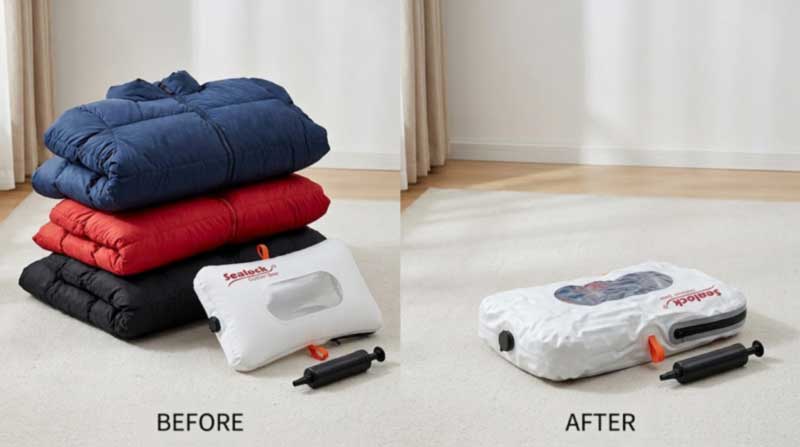
The clothes that gain the most from a vacuum bag are the ones that contain the most air. Knitwear, fleece, sweatshirts, puffer and down jackets, thermal layers and bulky winter accessories can shrink by 60 to 70 percent of their volume. Bedding travels in the same category: a spare duvet, a travel blanket or a sleeping bag liner all compress dramatically. Soft cotton items such as T-shirts, pyjamas, socks and underwear compress too, though by less, because a thin, tightly woven fabric holds less air to begin with.
For a trip, a good rule is to vacuum-pack the bulky, soft items that you will not need until you arrive, and keep the things you will reach for on the way, such as a light layer or a change of clothes for the flight, outside the bag. Grouping clothes by day or by type in separate, smaller bags also makes it easier to find something without unpacking everything.
Lofted clothes such as knitwear and down hold the most air, so they shrink the most.
Clothes to Leave Out of a Vacuum Bag
Some clothes are damaged or spoiled by compression. Tailored jackets, blazers and coats with structured shoulders or interfacing can lose their shape and come out with creases that are hard to remove. Leather and suede need air around them and can crease, mark or dry out when pressed tightly in plastic. Garments with sequins, beads, stiff embellishments or delicate lace can snag the bag or be damaged against each other. Anything with a hard part, such as a belt buckle, a zip with a large metal pull or a hanger hook, can press into the bag wall and, over time, wear through it.
Down and wool deserve a closer look. Both compress beautifully and are safe to vacuum-pack for a journey. What harms them is long-term compression: the fibres and clusters that give them their warmth need to recover their loft, and leaving them flattened for months can make that recovery slow or incomplete. For travel, compress them freely; for storage between seasons, compress them gently or not at all.
How Long Can Clothes Stay in a Vacuum Bag?
For a trip of a few days to a few weeks, there is no practical limit. Clothes come out creased but otherwise as they went in, and most creases fall out after hanging for a while or a quick steam. For seasonal storage of several months, synthetic and cotton clothes generally fare well, while down, wool and other natural lofted fibres benefit from being taken out, shaken and aired every few months, or stored lightly compressed rather than fully flat.
The single most important rule for any length of time is to pack only clean, completely dry clothes. A vacuum bag seals in whatever moisture is already in the fabric. Damp clothes, or clothes that still carry sweat and body oils, can develop odours, mildew or staining in a sealed bag, and the effect is worse in a warm climate. Washing and fully drying clothes before packing them is the easiest way to avoid this.
Travel Vacuum Bags vs Storage Vacuum Bags
Vacuum bags for clothes come in two broad types. Large storage bags, the kind sold for under-bed and wardrobe storage, are usually made from thin plastic film, sealed with a press-together track and emptied with a household vacuum cleaner. They are cheap and roomy, but the film and the heat-sealed edges are designed to sit still in a cupboard, not to be folded, stuffed into luggage and recompressed again and again.
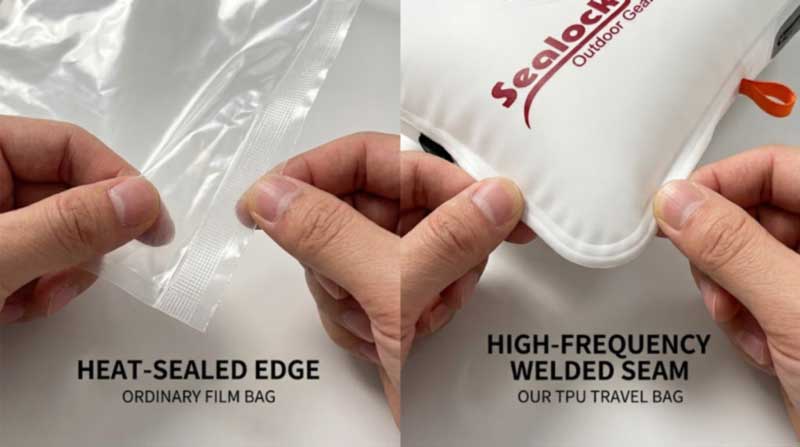
Travel vacuum bags are smaller and have to cope with far more handling. That changes what they should be made of. Our travel compression bags use TPU-laminated fabric rather than plain film, joined with high-frequency welded seams so that the edges are fused into one airtight piece. They close with a sealed zipper rather than a press track, and they are emptied without a vacuum cleaner, either by rolling against a one-way valve, with a small hand pump or with a pump built into the valve. We compare those three methods in our guide to travel vacuum bags with pump, and the material choices in our article on compression bag materials.
A thin-film storage bag next to a welded TPU travel bag: the seam is where repeated folding takes its toll.
How to Pack Clothes in a Vacuum Bag
Start with clean, dry clothes and empty the pockets. Fold or loosely roll each item and lay the clothes flat in the bag, with the bulkiest pieces in the centre and nothing hard pressing against the walls. Leave a few centimetres clear below the zipper or seal so it can close without catching fabric. Close the zipper fully and run a finger along it to check, because a closure that is not completely shut is the most common reason a bag will not stay flat. Then remove the air by rolling, pumping or using the built-in pump, and close the valve cap.
Do not overfill. A bag stuffed to bursting puts strain on the seams and the closure, and it compresses less, because there is no room for the clothes to settle. If the bag will travel in luggage, compress it inside the case or lay it in flat, so it is not bent sharply at the edges once it is hard.
Frequent repacking on multi-stop trips; one-button compression in about 15 s
42×29×11 cm, 13.4 L; USB-C, 1500 mAh, auto stop; clear TPU window
300
Each bag can be made in your colours and sizes, with your logo by silk screen, heat transfer or a welded patch, or on a custom zipper pull, and supplied in retail packaging with care instructions such as which clothes to keep out of the bag. For the full development process, see our guide to custom vacuum compression bag production, and for MOQ and production in China or Vietnam, our OEM vacuum compression bag supplier guide.
How We Test Vacuum Bags for Clothes
Every order passes through IQC on incoming TPU laminate, zippers, valves and pump parts, IPQC during welding and assembly, and OQC on finished bags, with SGS or QIMA third-party inspection available on request. Welded seams are tested for tensile and bonding strength, finished bags go through a load test of 1,500+ cycles, and the sealed zipper is opened and closed 3,000 times, which reflects how often a travel bag is packed and unpacked over its life. Hardware goes through salt spray testing, fabric is tested for abrasion resistance, and colour fastness and colour difference are checked against the approved sample. Bags rated IPX6 pass a heavy rain and water-jet test.
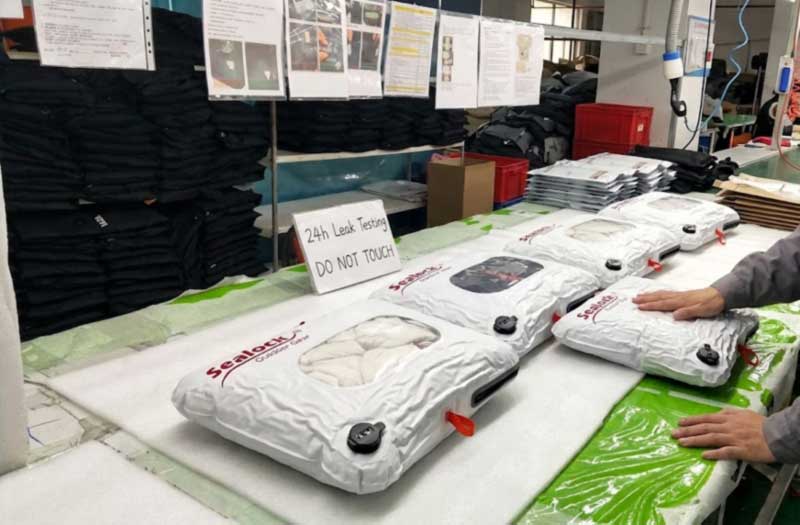
Holding a vacuum is the test that matters most to the person using the bag. Buyers can check any shipment with our customer inspection procedure: unboxing, vacuum extraction, a 24-hour static rest and air-leak determination. A bag that is still flat after 24 hours has a sound closure, valve and seams.
Filled and compressed bags rest for 24 hours; any bag that refills with air is rejected.
Frequently Asked Questions
Do vacuum bags ruin clothes?
Not when used for the right clothes. Knitwear, fleece, cotton and synthetics are fine. Structured tailoring, leather and embellished pieces are better left out, and down and wool should not stay fully compressed for months.
Can I put a down jacket in a vacuum bag?
Yes, for travel. Take it out when you arrive and shake it to restore the loft. For long-term storage, keep it loosely compressed or uncompressed.
Why do my clothes smell after vacuum storage?
Usually because they were packed slightly damp or unwashed. A sealed bag traps moisture and odour, so pack only clean, completely dry clothes.
What is the MOQ for custom vacuum bags for clothes?
300 pieces per style for the SL-P1133 and SL-P1083, and 500 pieces for the SL-P1082. Samples take about 7–15 days and bulk production about 30–45 days.
How much do custom vacuum bags cost?
The price depends on the size, the compression method, the logo method, packaging and quantity. One-way valve roll bags cost least, hand-pump bags sit in the middle and electric-pump bags cost most. Send us your specification and quantity for a quotation.
Can you print our logo and care instructions?
Yes. Your logo can be applied by silk screen, heat transfer, a welded patch or a custom zipper pull, and we can print packing and care guidance on the bag or its packaging.
Build a Vacuum Bag Range for Your Customers
Tell us who you sell to, the sizes and compression methods you want, and the price points you need to hit, and we will recommend a range, prepare samples and plan production. Contact us at info@sealock.com.hk or call +86-769-82009361.
We use cookies to offer you a better browsing experience, analyze site traffic and personalize content. By using this site, you agree to our use of cookies.
Privacy Policy
 English
 Español
 Português
 русский
 Français
 日本語
 Deutsch
 tiếng Việt
 Italiano
 Nederlands
 ภาษาไทย
 Polski
 Svenska
 magyar
 Malay
 বাংলা ভাষার
 Dansk
 Suomi
 हिन्दी
 Pilipino
 한국어
 Türkçe
 Gaeilge
 العربية
 Indonesia
 Norsk
 تمل
 český
 ελληνικά
 український
 Javanese
 فارسی
 தமிழ்
 తెలుగు
 नेपाली
 Burmese
 български
 ລາວ
 Latine
 Қазақша
 Euskal
 Azərbaycan
 Slovenský jazyk
 Македонски
 Lietuvos
 Eesti Keel
 Română
 Slovenski
 मराठी
 Srpski језик