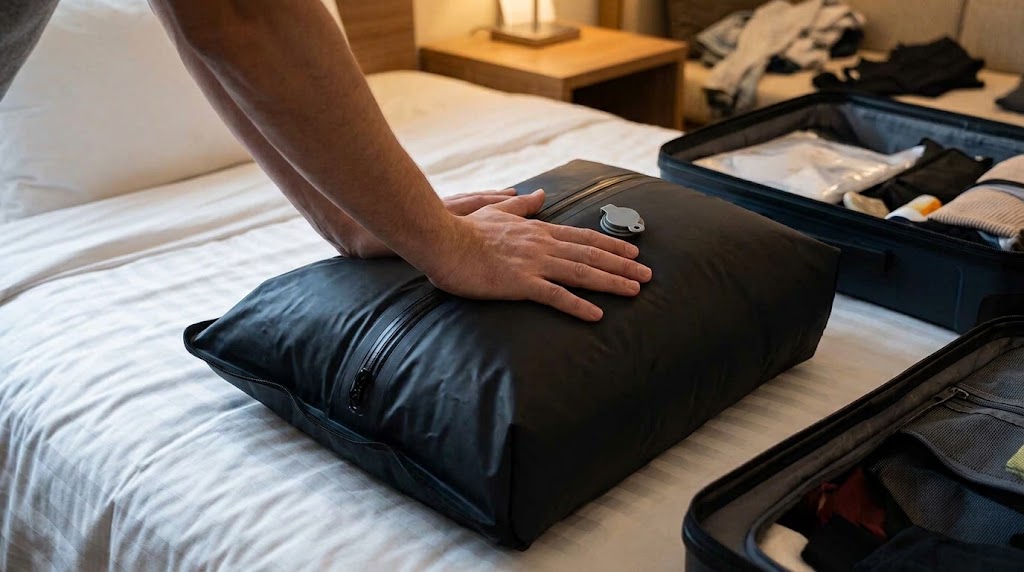
Using a vacuum bag looks simple: put things in, take the air out, close it. In practice, the small details decide whether the bag ends up flat and stays flat, or slowly puffs back up overnight. Most problems with vacuum bags are not defects in the bag at all. They come from a zipper that was not fully closed, a bag that was overfilled, or a valve cap that was not seated properly.
This guide walks through how to use the three common types of vacuum bag: bags with a built-in electric pump, bags with a hand pump, and roll-up bags with a one-way valve, as well as the classic storage bag emptied with a household vacuum cleaner. It also covers how to reuse vacuum seal bags, how to fix a bag that will not stay sealed, and how to open one without damaging it. It draws on over 20 years of making welded airtight bags at our factories in Dongguan, China and Ho Chi Minh City, Vietnam.
Before You Start: Three Steps for Any Vacuum Bag
Whatever kind of bag you use, the preparation is the same. First, use only clean, completely dry items. A vacuum bag seals in moisture along with the air, and damp clothes or bedding can develop odours or mildew. Second, empty pockets and remove anything hard or sharp, such as buckles, keys or hangers, which can press into the bag wall once it is compressed. Third, do not overfill. Leave a few centimetres clear below the zipper or seal so it closes without catching fabric, and leave enough room for the contents to settle as the air comes out. An overstuffed bag strains the seams, compresses less and is the most common reason a closure fails to seal.
Lay clothes flat or roll them loosely, with bulky items such as jumpers and fleeces in the middle. Our guide to vacuum bags for clothes explains which garments compress well and which are better left out.If you are still choosing between bag types, our comparison of vacuum bags vs packing cubes may help.
How to Close the Bag Properly
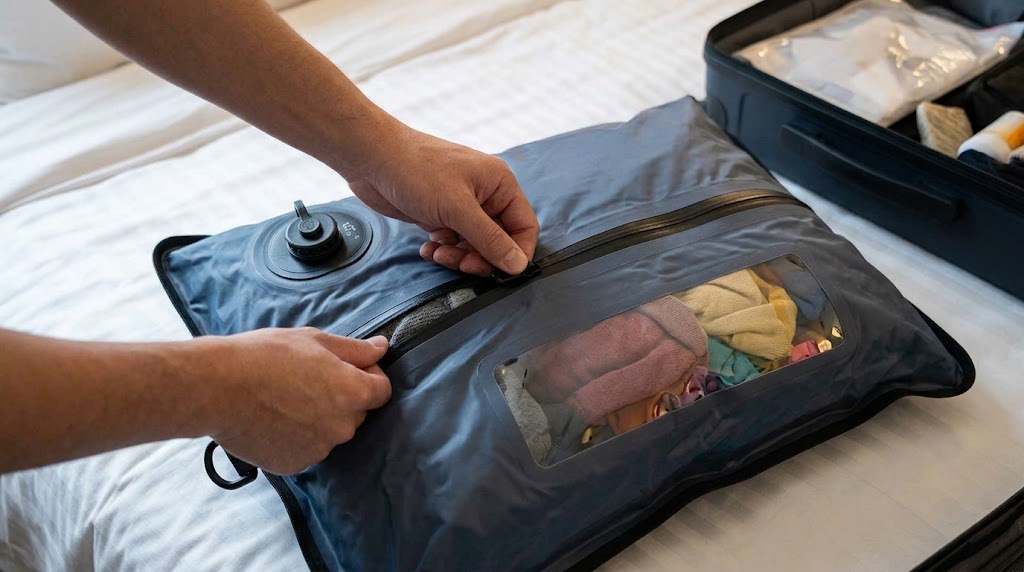
The closure is where most air leaks begin, so it deserves a moment of care. On a bag with a press-together double track, press the track closed from one end to the other, using the slider if one is provided, then run your fingers along it a second time. On a bag with a sealed zipper, such as our travel compression bags, pull the zipper fully to the end stop and check that no fabric is caught in the teeth. In both cases, look along the closure before you remove any air. Once the bag is compressed, a small gap is hard to see but easy to hear, and it is far quicker to fix before you start.
Close the zipper to its end stop and check it along its length before removing any air.
Using a Vacuum Bag With a Built-In Electric Pump
A bag with a pump built into the valve is the easiest to use, because nothing else is needed. Charge the pump before your trip; on our SL-P1083, a USB-C charge powers roughly 90 compressions. Pack and close the bag, then press the pump button. The pump draws the air out, a digital countdown shows its progress, and it stops by itself after about 15 seconds when the bag is flat. Screw the valve cap down to seal it, and the bag is ready to pack.
To repack on the return journey, simply repeat the process. This is the main advantage of a built-in pump: compression works the same in a hotel room as it does at home, with no vacuum cleaner needed. If the battery is low, top it up from a phone charger or power bank before packing.Before flying with a pump bag, check our guide on whether vacuum bags are allowed on planes, which covers the battery rules.
Using a Vacuum Bag With a Hand Pump
With a hand pump, the steps are almost the same, with a few strokes of effort. Close the bag, unscrew the valve cap and fit the pump firmly over the valve. Pump steadily until the bag is tight and the pump becomes hard to push, which on our SL-P1133 takes about 30 seconds. Remove the pump and screw the cap down straight away, making sure it seats evenly against its silicone gasket. A hand pump can keep pulling until the bag is very tight, so it achieves some of the strongest compression on bulky items, at around 70 percent volume reduction on lofted clothing.
The one thing to remember with a hand pump is the pump itself. It is small and light, so keep it in the same place in your luggage every time, ideally clipped to the bag or in an outer pocket, so it does not get left behind.
Using a Roll-Up Vacuum Bag Without a Vacuum Cleaner
A roll-up compression bag has a one-way valve and needs no pump at all, which is how most people vacuum seal clothes without a vacuum cleaner. Close the zipper, then start at the end opposite the valve. Fold or roll the bag towards the valve, pressing down as you go, so the air is pushed out through it. The valve lets air out but not back in, so the bag stays compressed as you roll. When you reach the valve, give the bag a final press and it is done. Our SL-P1082 works this way and reduces volume by about 60 percent.
Kneeling gently on the bag as you roll helps, especially with bulky clothes. Roll bags will not get quite as flat as pumped bags, but there is nothing to charge, carry or forget.
Roll from the closed end towards the one-way valve; the valve lets air out but not back in.
Using a Storage Vacuum Bag With a Vacuum Cleaner
Large storage bags for wardrobes and under-bed storage are usually emptied with a household vacuum cleaner. Close the track, open the valve cap, and place the vacuum hose over the valve, without a brush or other attachment, so it forms a seal. Run the vacuum until the bag is tight, then remove the hose and close the cap quickly. This method gives strong compression but depends on having a vacuum cleaner, which is why storage bags are rarely practical for travel.
How to Open a Vacuum Bag
On most bags, opening the valve cap lets air back in slowly, which is the gentlest way to release the vacuum. Once the bag has softened, open the zipper or track. Avoid pulling the closure open while the bag is still hard, because that puts strain on the zipper or track and can damage it. Shake out lofted items such as down and fleece after unpacking, and hang anything creased for a while before wearing it.
Can You Reuse Vacuum Seal Bags?
Yes, reusable vacuum seal bags are designed to be used again and again, and a well-made bag will last for many trips. How long it lasts depends on what it is made of and how it is treated. Thin film bags with heat-sealed edges tend to crack along folds and edges after repeated use. Bags made from a tougher laminate with welded seams last much longer; ours use TPU-laminated fabric joined with high-frequency welded seams, so the edges are fused into a single airtight piece. Our guide to compression bag materials explains why the material decides how a bag ages.
To get the most from any reusable bag, wipe the zipper or track clean of sand and lint, let the bag dry fully if it gets wet, and store it flat or loosely rolled rather than folded sharply. Do not bend a fully compressed bag at a hard angle, and keep the valve and its gasket clean, because a single hair or grain of sand under the cap can let air in.Once your bags are working well, our guide to a travel packing system shows how they fit together with a toiletry bag and small pouches.
Why a Vacuum Bag Won't Stay Sealed
If a bag fills with air again after compression, the cause is almost always one of four things. The first and most common is the closure: a track that was not fully pressed, or fabric or sand caught in a zipper. The second is the valve: a cap that was not screwed down evenly, or dirt on the gasket. The third is overfilling, which pulls the closure under strain until it lets go. The fourth is damage: a pinhole from a sharp object, or a crack along a fold or edge on a worn film bag.
To find the leak, compress the bag again and leave it for a few hours. If it refills quickly, check the closure and the valve first, because these are the easiest to fix. If it refills slowly from a particular spot, look for a puncture or a worn edge. A good bag that is closed properly should stay flat for days; we test our own bags by leaving them compressed for 24 hours before they pass inspection.If your bags keep leaking, our guide to the best travel vacuum bags explains which closures, valves and seams hold up.
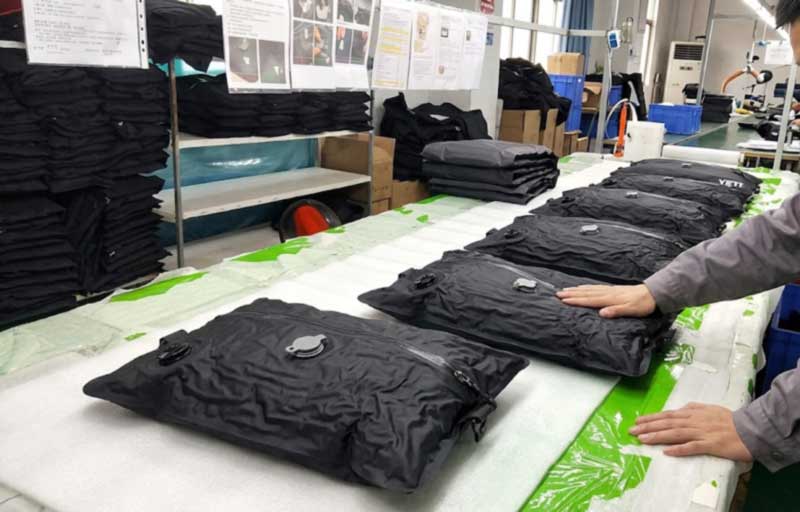
Every order passes through IQC on incoming TPU laminate, zippers, valves and pump parts, IPQC during welding and assembly, and OQC on finished bags, with SGS or QIMA third-party inspection available on request. Welded seams are tested for tensile and bonding strength, finished bags go through a load test of 1,500+ cycles, and the sealed zipper is opened and closed 3,000 times to reflect years of packing and unpacking. Hardware goes through salt spray testing, fabric is tested for abrasion resistance, and colour fastness and colour difference are checked against the approved sample. Bags rated IPX6 pass a heavy rain and water-jet test.
Buyers can check any shipment with our customer inspection procedure: unboxing, vacuum extraction, a 24-hour static rest and air-leak determination. It is the same check described above for a bag that will not stay sealed, carried out on a sample from every batch.
Compressed bags rest for 24 hours; any bag that refills with air is rejected.
Frequently Asked Questions
How do you vacuum seal clothes without a vacuum cleaner?
Use a roll-up bag with a one-way valve and roll it towards the valve, or use a bag with a hand pump or a built-in electric pump. All three work anywhere, with no vacuum cleaner.
How long do vacuum bags stay compressed?
A well-made bag that is closed properly should stay flat for days or weeks. If it refills within hours, check the closure, the valve cap and whether the bag is overfilled.
Do vacuum bags reduce weight?
No. They reduce volume only. Check your airline's weight limit as well as its size limit when packing compressed clothes.
What is the MOQ for custom vacuum bags?
300 pieces per style for the SL-P1083 and SL-P1133, and 500 pieces for the SL-P1082. Samples take about 7–15 days and bulk production about 30–45 days.
How much do custom vacuum bags cost?
Price depends on the compression method, size, logo method, packaging and quantity. Roll-up bags cost least, hand-pump bags sit in the middle and electric-pump bags cost most. Send us your specification and quantity for a quotation.
Can you print our logo and usage instructions?
Yes. Your logo can be applied by silk screen, heat transfer, a welded patch or a custom zipper pull, and we can print step-by-step usage instructions on the bag or its packaging, which helps cut down on returns from users who have not closed the bag properly.
Make Vacuum Bags That Are Easy to Use
Tell us who your customers are, which compression method suits them and the price points you need, and we will recommend a range, prepare samples and help you write the usage instructions that go in the box. Contact us at info@sealock.com.hk or call +86-769-82009361.
We use cookies to offer you a better browsing experience, analyze site traffic and personalize content. By using this site, you agree to our use of cookies.
Privacy Policy
 English
 Español
 Português
 русский
 Français
 日本語
 Deutsch
 tiếng Việt
 Italiano
 Nederlands
 ภาษาไทย
 Polski
 Svenska
 magyar
 Malay
 বাংলা ভাষার
 Dansk
 Suomi
 हिन्दी
 Pilipino
 한국어
 Türkçe
 Gaeilge
 العربية
 Indonesia
 Norsk
 تمل
 český
 ελληνικά
 український
 Javanese
 فارسی
 தமிழ்
 తెలుగు
 नेपाली
 Burmese
 български
 ລາວ
 Latine
 Қазақша
 Euskal
 Azərbaycan
 Slovenský jazyk
 Македонски
 Lietuvos
 Eesti Keel
 Română
 Slovenski
 मराठी
 Srpski језик