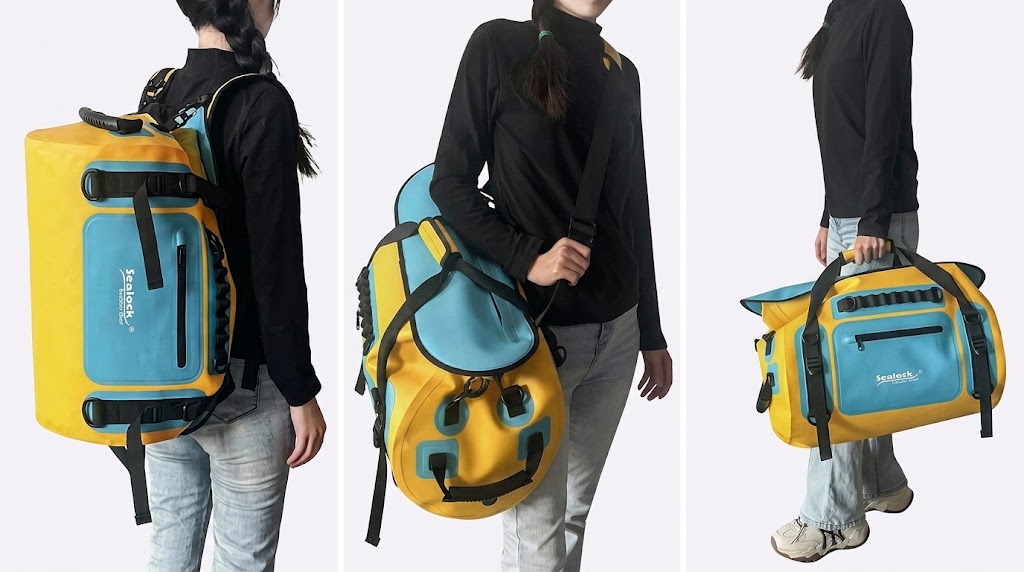
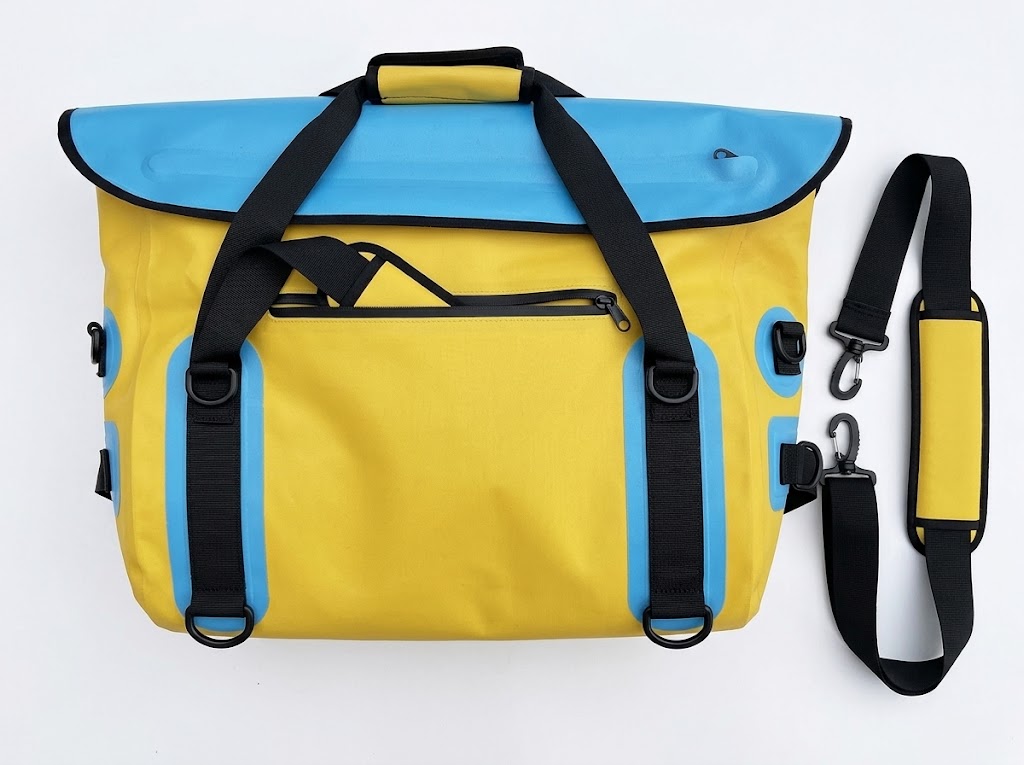
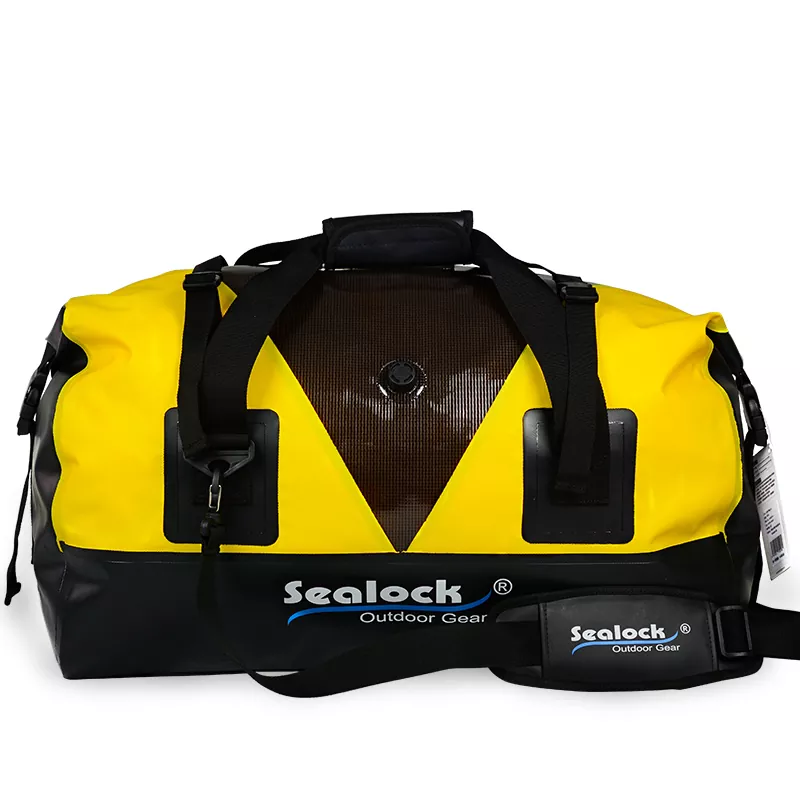
A waterproof duffel with backpack straps solves a real problem. Duffels are the easiest bags to pack, load into a boat or strap onto a motorcycle, but they are awkward to carry any distance by the handles. Adding shoulder straps lets the user walk from the car park to the dock, through an airport or along a trail with both hands free. It is one of the most requested upgrades we see from travel, boating and adventure brands.
It is also a compromise, and the way it is engineered decides whether customers love the bag or leave reviews about sore shoulders and straps they cannot stow. This guide explains what changes when a waterproof duffel gains a harness, which design choices matter, and how to specify a convertible duffel that works in all its carry modes. It is based on over 20 years of making welded and sewn waterproof bags at our factories in Dongguan, China and Ho Chi Minh City, Vietnam.
A Duffel Is the Wrong Shape for a Backpack, So the Design Has to Compensate
A backpack is tall and narrow, so its weight sits close to the spine. A duffel is long and horizontal, so when it is worn on the back its weight sits further out and spreads across the width of the shoulders. The load levers away from the body, and the straps have to work harder to hold it in. This is why a convertible duffel carries comfortably for a walk through a terminal or from a vehicle to a campsite, but becomes tiring over several kilometres with a full load.
Good design reduces the problem rather than ignoring it. A padded, slightly stiffened back panel stops the bag from rounding against the back and keeps the load flatter. Strap anchors positioned so the bag sits high and close to the shoulders shorten the lever. A sternum strap keeps the shoulder straps from sliding apart under a wide load. And a realistic load rating, stated on the product, keeps customers from expecting expedition-pack performance from a travel duffel. Our 25-litre SL-C261 convertible duffel, for example, is rated for a 15-kilogram load, which is a sensible upper limit for this format.How the bag is packed matters as much as the harness; our guide to compression bags for duffel bags explains where the weight should go.
A padded back panel and a sternum strap keep a wide duffel close to the body.
Fixed Harness or Clip-On Straps
There are two main ways to add backpack straps to a waterproof duffel. The first is a fixed harness: a padded back panel with shoulder straps permanently attached to the bag. It carries better and gives the most stable fit, but it adds weight and the straps are always there, which is inconvenient when the bag is checked in or packed into a hold.
The second is clip-on straps that attach to welded D-rings or loops with metal or engineering-plastic hooks. The bag stays a clean duffel until the user needs to carry it, and the straps can be removed completely for check-in. The trade-off is a less stable carry, because the straps can move on their attachment points, and more hardware that can be lost.
Many of the best convertible duffels combine the two: a fixed padded back panel with detachable shoulder straps. That is the construction we use on the SL-C261, and it gives the user a proper back panel when carrying the bag and a clean, strap-free duffel when it goes into a boot or a baggage hold.
Where the Straps Go When They Are Not in Use
The most common complaint about convertible duffels has nothing to do with waterproofing. It is about what happens to the straps when the bag is not being worn. Straps left hanging catch on conveyor belts and baggage handling equipment, and straps that have to be unthreaded and rethreaded every time are a constant annoyance. Reviews of even well-regarded waterproof duffels repeatedly ask for quick-release straps that can be stowed inside the bag.
There are simple solutions, and they should be decided at the design stage. Quick-release buckles at the strap ends let the straps come off in seconds. A stow pocket or flap over the back panel lets fixed straps be tucked away flat. And if the straps are designed to be removed, a small internal pocket or loop to store them stops them from being lost. Each adds a little cost and saves a large number of complaints.
Quick-release ends and a stow pocket solve the most common complaint about convertible duffels.
Keeping the Shell Waterproof Where the Harness Attaches
Every harness attachment is a potential leak point. On a waterproof duffel, shoulder straps and back panels cannot simply be stitched through the body, because each stitch creates a hole. We attach the harness to reinforcing patches that are welded to the body with high-frequency welded seams, or to welded D-rings and webbing loops, so the waterproof shell is never pierced. The harness itself, with its padding, mesh and webbing, is built on our sewing lines, where stitch density and bar-tack reinforcement can be controlled to carry the load.
The closure also changes how the bag behaves as a backpack. An airtight zipper gives quick access along the top of the bag and stays sealed when the bag is worn, which suits travel and boating. A roll-top is simpler and very reliable against rain, but it is harder to open while wearing the bag. Our article on TPU versus PVC for waterproof duffels covers the material side of this decision, and the same harness principles are discussed for smaller bags in our guide to dry bag backpacks.
Which Sizes Should Convert
Not every duffel needs backpack straps. In our experience, convertible carry is most valuable between about 25 and 60 litres, where the bag is still small enough to carry comfortably on the back when full. Above that, a fully loaded waterproof duffel becomes heavy enough that most users will not want to carry it on their back for long, and a sturdy shoulder strap and well-placed end handles are often a better use of budget. For large expedition and boating duffels, two handles at each end so two people can lift it together are often more useful than a harness.If you are still deciding on capacity, our guide to what size duffel bag you need explains how to choose the right capacity.
Waterproof Duffels in Our Range
The products below include convertible duffels with backpack straps and handle-carry duffels that can be developed with a harness for your brand. All are available for OEM and ODM development with your logo, colours and modifications.
A convertible duffel has to pass as a duffel and as a backpack. Every order goes through IQC on fabric, webbing, buckles and hooks, IPQC during welding and sewing, and OQC on finished bags, with SGS or QIMA third-party inspection available on request. Tensile and bonding strength tests confirm that harness anchors, D-rings and welded patches hold under pull, and a load test of 1,500+ cycles simulates repeated lifting and carrying in every carry mode. Airtight and pocket zippers are tested to 3,000 cycles, hooks and metal hardware go through salt spray testing, and fabrics are checked for abrasion resistance, colour fastness and colour difference against the approved sample.
Waterproofing is verified against the rating on the label: a heavy rain and water-jet test for roll-top and IPX6 bags, and a full water-immersion test of 2+ hours for compartments rated IPX7. For airtight-zipper duffels, buyers can follow our standard customer inspection procedure on arrival: unboxing, vacuum extraction, a 24-hour static rest and air-leak determination. Our article on how to choose a waterproof duffel bag manufacturer explains what else to look for when auditing a supplier.
Frequently Asked Questions
What is the MOQ for a custom convertible duffel?
Most of our waterproof duffels start at 300 pieces per style, and the SL-C261 is 300 pieces per colour. Some large PVC duffels start at 500 pieces. Samples take about 7–15 days and bulk production about 30–45 days.
How much do backpack straps add to the price?
Clip-on straps attached to welded D-rings add the least. A fixed padded back panel with detachable straps and a stow pocket adds more, because it involves more materials, padding and sewing time. We quote both options so you can compare them against your retail price.
Can you add our logo?
Yes. Screen printing, heat transfer, welded patches and high-frequency embossing all work on the body of the duffel, and embroidery can be added to the shoulder straps and back panel, which sit outside the waterproof shell.
Can the backpack straps be removed for airline check-in?
Yes. We recommend quick-release strap ends or a stow pocket so the straps do not catch on baggage equipment. Removable straps should come with a place to store them inside the bag.
How heavy a load can a duffel backpack carry comfortably?
It depends on size and harness, but around 15 kilograms is a sensible upper limit for a 25- to 45-litre convertible duffel carried on the back. Heavier loads are better carried by the handles or shoulder strap over short distances.
Can the bag be fully submerged?
Only compartments rated IPX7 and closed with an airtight zipper are suitable for submersion. Roll-top duffels are designed for heavy rain and spray. External pockets are usually splash-proof only, so valuables belong in the main compartment.
Develop a Convertible Waterproof Duffel With Us
Tell us where your customers will carry the bag, how far, and how it will travel when it is not being worn, and we will recommend a harness, closure and size for your range and prepare samples. Contact us at info@sealock.com.hk or call +86-769-82009361.
We use cookies to offer you a better browsing experience, analyze site traffic and personalize content. By using this site, you agree to our use of cookies.
Privacy Policy
 English
 Español
 Português
 русский
 Français
 日本語
 Deutsch
 tiếng Việt
 Italiano
 Nederlands
 ภาษาไทย
 Polski
 Svenska
 magyar
 Malay
 বাংলা ভাষার
 Dansk
 Suomi
 हिन्दी
 Pilipino
 한국어
 Türkçe
 Gaeilge
 العربية
 Indonesia
 Norsk
 تمل
 český
 ελληνικά
 український
 Javanese
 فارسی
 தமிழ்
 తెలుగు
 नेपाली
 Burmese
 български
 ລາວ
 Latine
 Қазақша
 Euskal
 Azərbaycan
 Slovenský jazyk
 Македонски
 Lietuvos
 Eesti Keel
 Română
 Slovenski
 मराठी
 Srpski језик