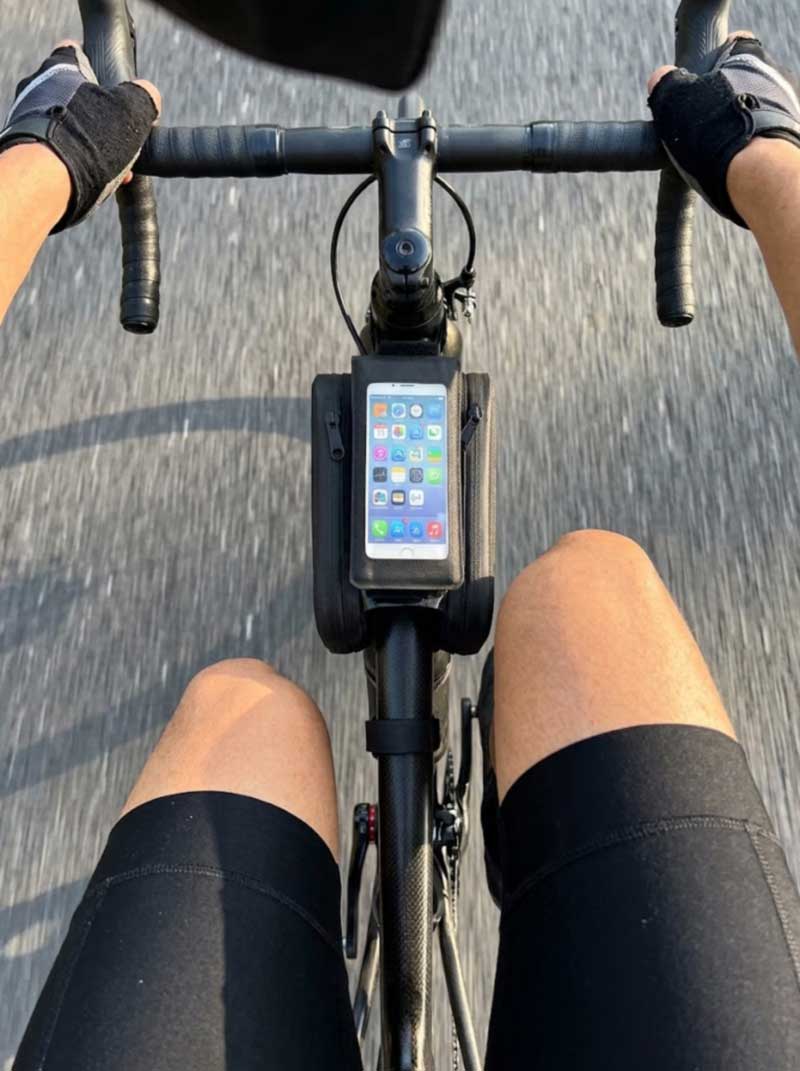
A top tube bag is the small bag that sits on top of the bike's top tube, just behind the stem. It holds what a rider wants within reach without stopping: a phone, snacks, a gel or two, keys, a power bank. Because it is small and cheap compared with a frame bag or a handlebar bag, it is often the first bag a rider buys, and also the one most often sent back. The reasons are almost always the same three: it rubs the rider's knees, it wobbles or slides on the tube, or water gets in the first time it rains.
This guide explains what decides whether a top tube bag works on the bike, from width and mounting to closures and phone windows, and how to choose between a water-repellent and a fully waterproof build. It is written for riders and for cycling brands developing their own bags, and draws on over 20 years of making bike bags and welded waterproof gear at our factories in Dongguan, China and Ho Chi Minh City, Vietnam.
Width Decides Whether It Rubs Your Knees
The most common complaint about top tube bags is knee contact. The bag sits exactly where the knees pass on every pedal stroke, and a bag that is only a centimetre too wide will brush them hundreds of times an hour. Cycling reviewers repeatedly name this as the main fault of otherwise well-made phone bags. A narrow bag that is taller or longer carries the same volume without the problem, which is why most well-designed top tube bags are slim and capacity is usually under one litre.
Two other points matter. A bag that tapers towards the rear, where the knees come closest, gives more clearance than a box shape. And soft sides that bulge when the bag is overfilled widen it in exactly the wrong place; a structured or stiffened shell holds its shape. For riders with a narrow stance or a small frame, the safest choice is the slimmest bag that holds the essentials.
A slim, tapered bag leaves room for the knees on every pedal stroke.
Mounting: Three Straps, Not Two
Top tube bags are held by hook-and-loop straps. Two straps around the top tube stop the bag lifting, but on rough roads or gravel it can still twist sideways or slide back. A third strap around the steerer or the head tube anchors the front of the bag and stops it moving. Strap position also matters on modern frames: carbon and aero tubes come in many shapes, so straps need enough length and adjustability to fit round, oval and flattened tubes, and wide enough that they do not dig into a carbon frame.
Bikepacking riders sometimes prefer a bolt-on top tube bag, which screws into threaded bosses on the top tube. It cannot slip, but only fits frames that have the bosses. For a brand selling to a wide range of riders, a strap mount with an optional bolt-on version covers the most bikes. Our handlebar bag vs frame bag guide explains how the different bike bags share the load on a full setup.
Phone Windows: Useful, With Limits
Many top tube bags include a clear touchscreen window on top, so the phone can be used for navigation while riding. Reviewers like being able to see and use maps without stopping. The limits are worth knowing. Phone sizes vary, so a window that fits a 6.1 inch phone may not take a 6.7 inch one; always check the maximum phone size. Clear film can reflect sunlight, so some windows are angled or slightly matt. In hot sun, a phone sealed under a clear window can warm up, so a flap that covers the window when the screen is not needed helps. A cable port lets a power bank in a side pocket charge the phone on long rides.
Water-Repellent or Waterproof?
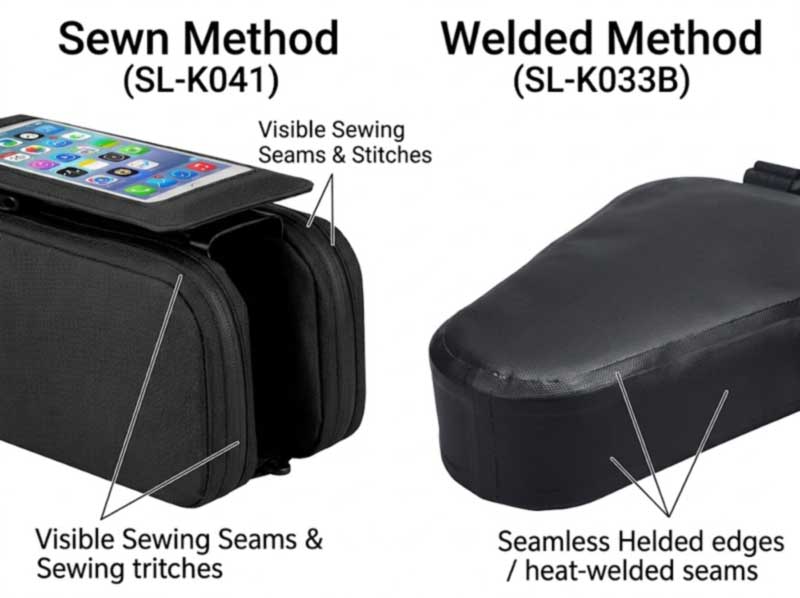
This is where most top tube bags are misunderstood. A great many are made from coated polyester with stitched seams and ordinary zips. They shed light rain, but in a downpour water gets in through the stitch holes and along the zip. Reviewers often describe such bags as water-resistant and suggest a plastic bag inside for heavy rain. That is fine for road riders who mostly ride in dry weather and want a structured phone bag.
A waterproof top tube bag is built differently. It uses a waterproof fabric such as TPU-laminated nylon, high-frequency welded seams instead of stitching, and a waterproof zip or roll closure. It costs more, but it is the right choice for commuters, bikepacking and anyone riding in all seasons. Whichever type it is, the label should say so clearly. A bag described as waterproof that is only water-repellent is one of the fastest ways for a brand to collect bad reviews. Our article on what makes a bike bag truly waterproof covers the construction in detail.
Most top tube bags hold between about 0.5 and 1.5 litres. Under a litre is enough for a phone, keys, a few gels and a card, and keeps the bag narrow. Larger bags of 1 to 1.5 litres suit bikepacking, where a power bank, a snack supply and small tools need to ride within reach, but they are more likely to touch the knees. For anything bigger, a frame bag in the main triangle or a handlebar bag carries more without getting in the way.
We make top tube bags in both builds: sewn and stitched bags with structured shells and phone windows, and welded TPU bags for riders who need full rain protection. Sewing is as much a core skill in our factories as welding, so brands can choose the construction that fits their price point. Shapes, strap layouts, window sizes, colours and logos can all be developed to your specification. See our full bike bags range, our guide to frame bags for long-distance cycling, and our article on bikepacking bags for OEM.
How We Test Bike Bags
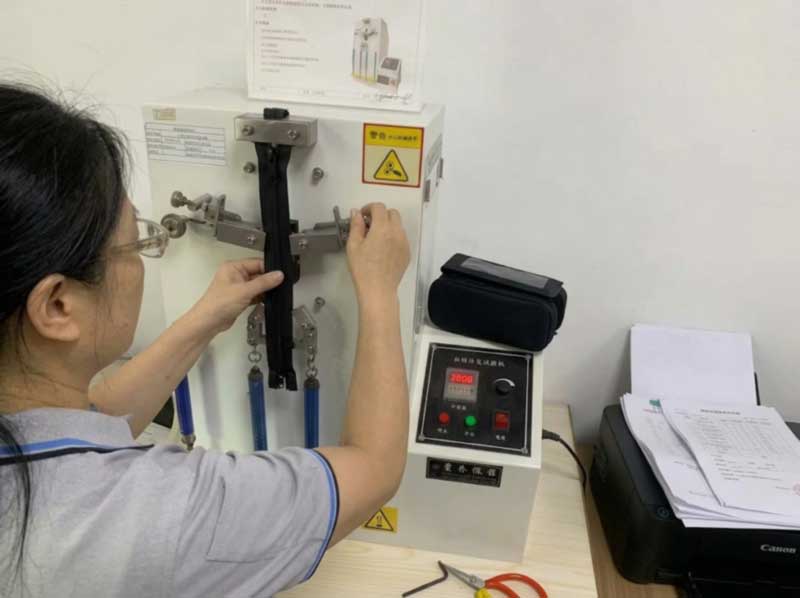
Every order passes through IQC on incoming fabric, zips, hook-and-loop and webbing, IPQC during sewing and welding, and OQC on finished bags, with SGS or QIMA third-party inspection available on request. Strap anchors and seams are tested for tensile and bonding strength, bags go through a load test of 1,500+ cycles, and zips are opened and closed 3,000 times. Buckles and metal parts go through salt spray testing, fabrics are tested for abrasion where they touch the frame, and colour fastness and colour difference are checked against the approved sample. Waterproof models are verified against their rating with a heavy rain and water-jet test.
Zips are cycled 3,000 times, because a top tube bag is opened on almost every ride.
Frequently Asked Questions
Will a top tube bag rub my knees?
It can if it is too wide. Choose a slim or tapered bag, keep it under about a litre, and do not overfill soft-sided bags.
Are top tube bags waterproof?
Many are only water-repellent: stitched seams and ordinary zips let water in during heavy rain. A waterproof bag needs waterproof fabric, welded seams and a waterproof closure. Check the description and rating.
Can I use my phone through the window?
Yes, on most touchscreen windows. Check the maximum phone size, and use a cover flap in hot sun.
What is the MOQ for custom top tube bags?
From 300 pieces per style for welded TPU bags and 500 for structured phone-window bags. Samples take about 7–15 days and bulk production about 30–45 days.
How much does a custom top tube bag cost?
Price depends on the construction (sewn or welded), materials, window, size, logo method and quantity. Send us your specification or a reference bag for a quotation.
Can you add our logo?
Yes. Screen printing, heat transfer, welded patches, woven labels and custom zip pulls are all available, with colours matched to your brand.
Develop Your Top Tube Bag With Us
Tell us who rides your bikes, how they ride and in what weather, and we will recommend a shape, mounting and construction, and prepare samples. Contact us at info@sealock.com.hk or call +86-769-82009361.
We use cookies to offer you a better browsing experience, analyze site traffic and personalize content. By using this site, you agree to our use of cookies.
Privacy Policy
 English
 Español
 Português
 русский
 Français
 日本語
 Deutsch
 tiếng Việt
 Italiano
 Nederlands
 ภาษาไทย
 Polski
 Svenska
 magyar
 Malay
 বাংলা ভাষার
 Dansk
 Suomi
 हिन्दी
 Pilipino
 한국어
 Türkçe
 Gaeilge
 العربية
 Indonesia
 Norsk
 تمل
 český
 ελληνικά
 український
 Javanese
 فارسی
 தமிழ்
 తెలుగు
 नेपाली
 Burmese
 български
 ລາວ
 Latine
 Қазақша
 Euskal
 Azərbaycan
 Slovenský jazyk
 Македонски
 Lietuvos
 Eesti Keel
 Română
 Slovenski
 मराठी
 Srpski језик