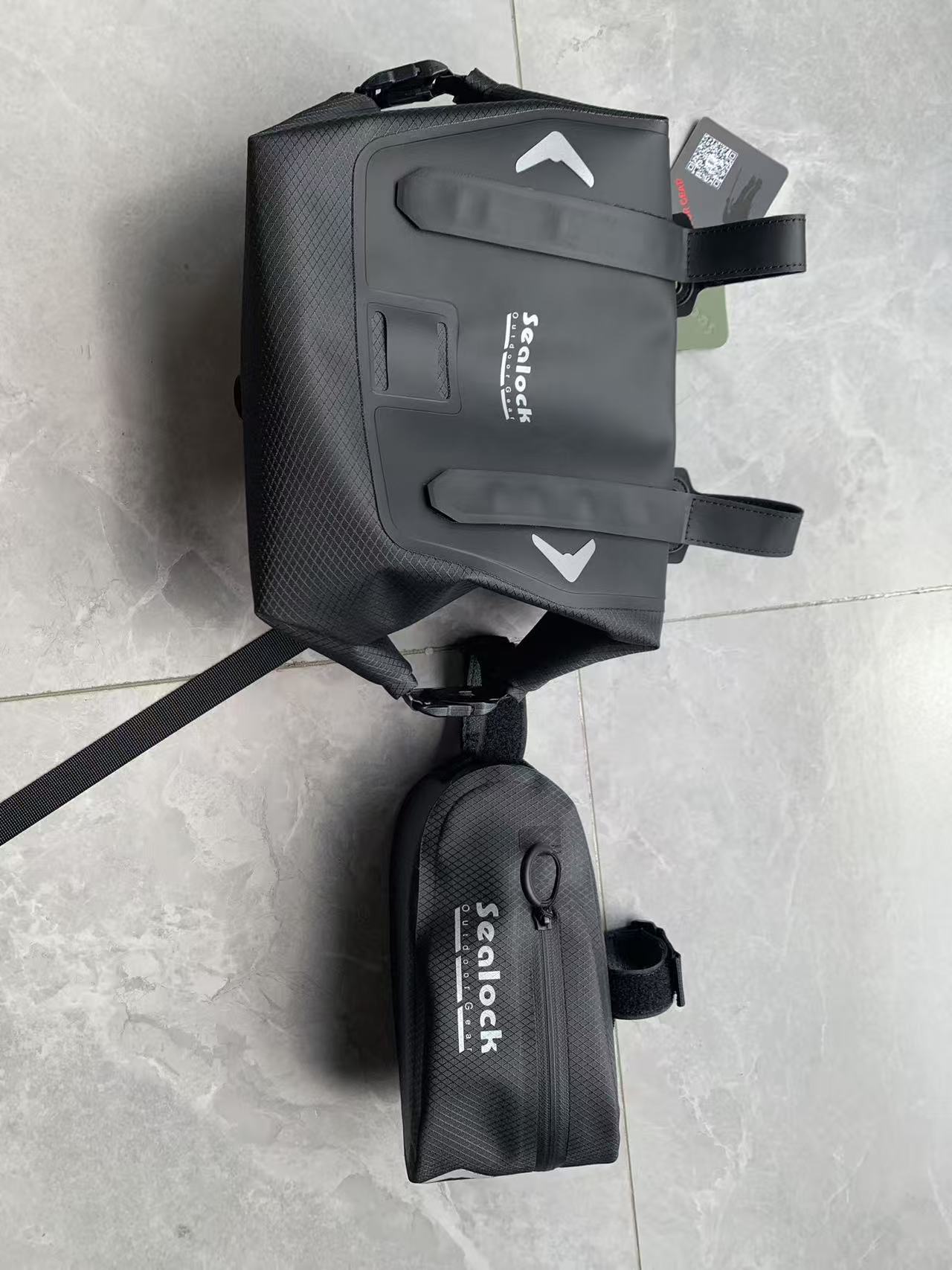
Sealock is a waterproof bike bag manufacturer. "Waterproof" is probably the most abused word on a bike-bag label — it isn't printed on, it's engineered and proven. Truly waterproof comes down to four things together: the fabric and coating, how the seams are joined, how the opening is closed, and the load-bearing transition points nobody mentions; then it has to be proven by real immersion, not by a number on a spec sheet. This piece takes "truly waterproof" apart, layer by layer, from the factory's side.
"Waterproof" vs "Water-Resistant": Reading the Label Honestly
"Waterproof" is an unregulated marketing word — with no IPX rating or hydrostatic-head value behind it, it guarantees nothing. The real difference:
Water-resistant — a DWR finish or a thin PU coating; it holds off light rain and splashes but seeps under sustained wet or immersion.
Waterproof — an engineered, impervious barrier that survives brief immersion. It's defined by IP ratings: IPX7 = 1m depth for 30 minutes; IPX8 = deeper and longer, with the maker stating the actual depth/duration tested.
One trap people miss: hydrostatic head (mm) measures the fabric only, not the whole bag. A fabric rated 10,000mm still leaks through a stitched seam within minutes of immersion. On a bike, that's the difference between a dry sleeping bag and a soaked one in the backcountry.
The Four Things That Actually Decide It
1. Fabric & Coating: The Barrier Itself
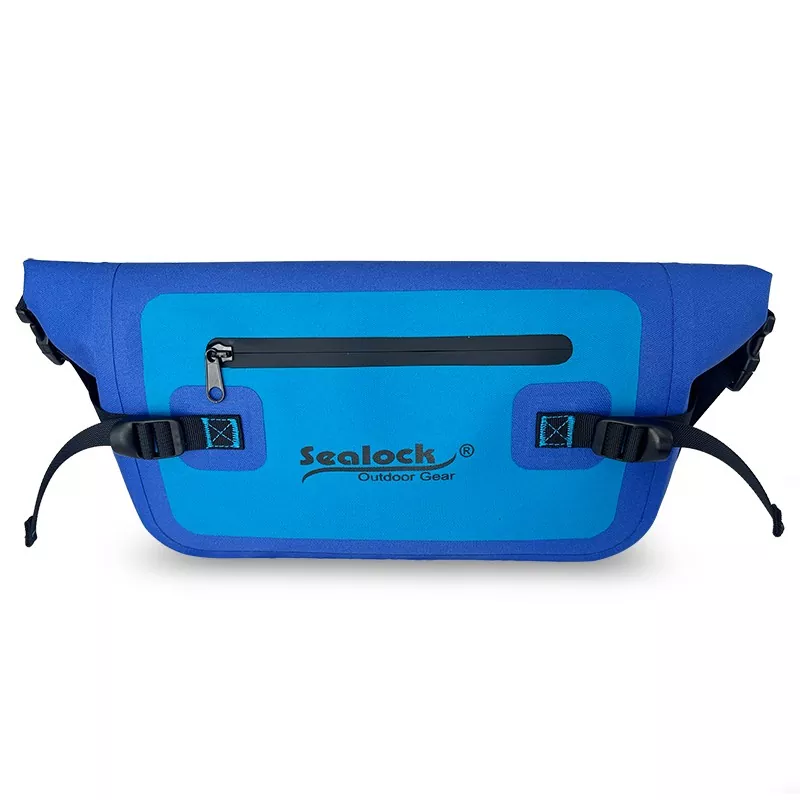
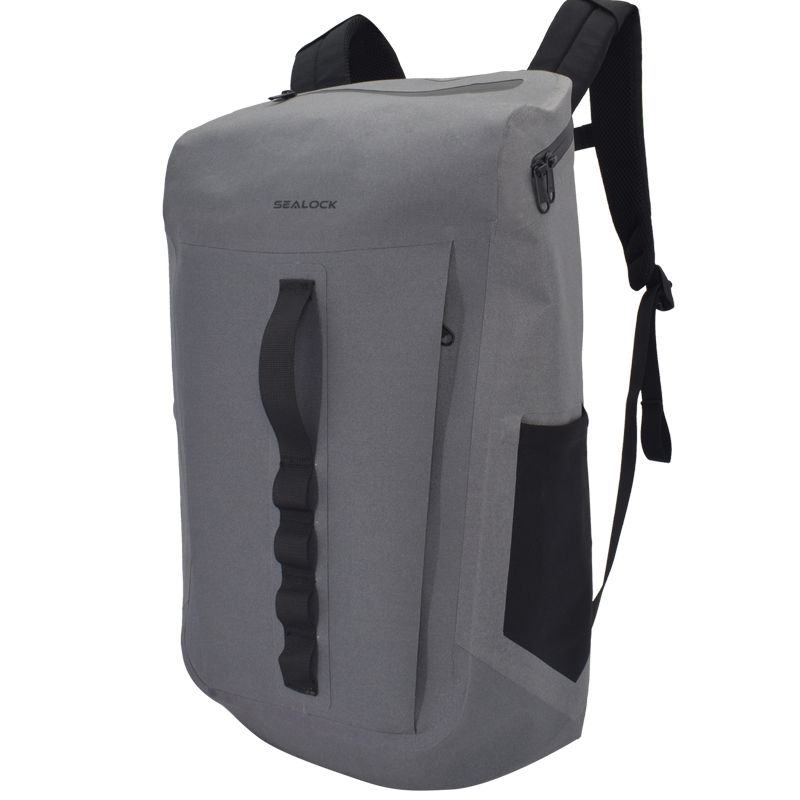
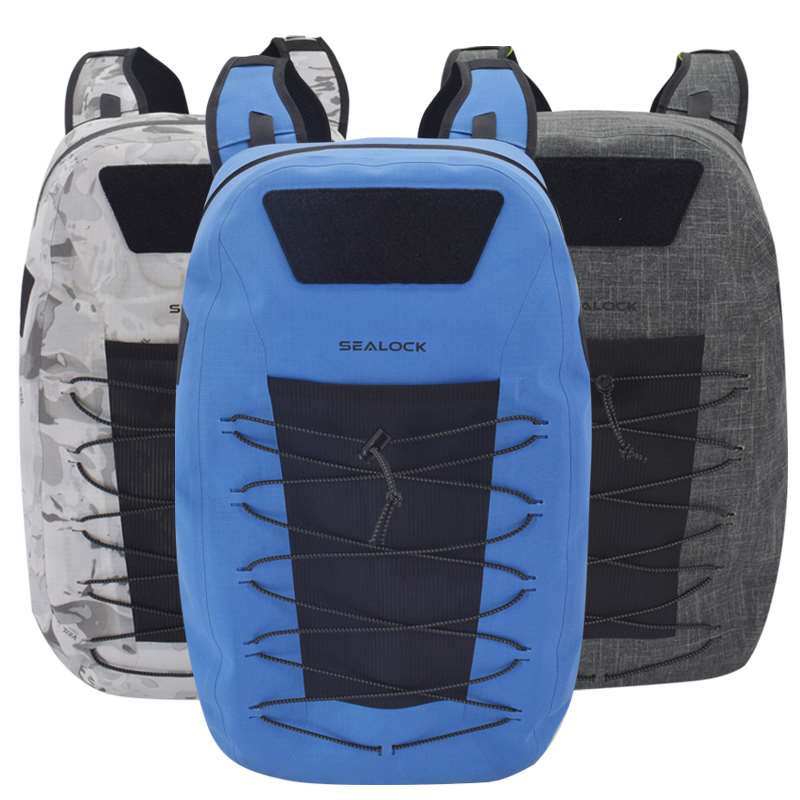
What blocks water is the coating, not the denier. Denier (D) is just thread thickness, not waterproofness. The continuous barrier comes from TPU-laminated fabric, PVC tarpaulin, or thick coated nylon. The coating matters: a thin PU film only sheds light rain and cracks in the cold, while TPU stays flexible and durable across hot and cold. Sealock picks the fabric to the job — 420D polyester-coated TPU (light handlebar bags), 600D nylon-coated TPU (frame bags), and 840D double-sided TPU (heavy-duty, seamless bodies).
2. Seams: Where Cheap Bags Leak First
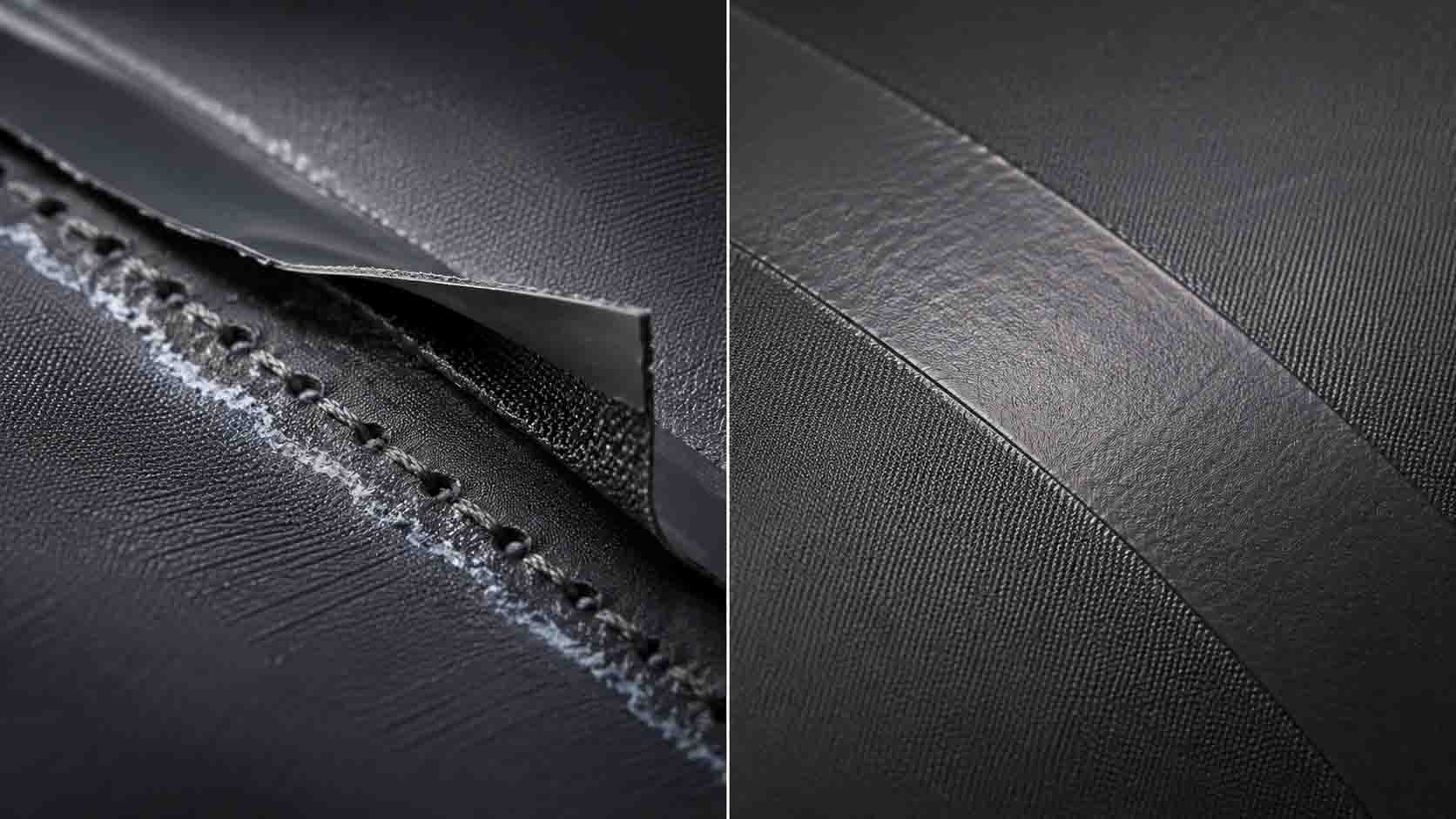
Great fabric still leaks if the joins are wrong, and the three methods are worlds apart. Stitching punches needle holes through the barrier and seeps on immersion. Seam tape is a middle ground, but the adhesive lifts over time, temperature, and repeated folding — it can peel after roughly a month of heavy use. High-frequency welding fuses the coating at 27.12 MHz at the molecular level: no needle holes, a seam stronger than the parent fabric, "as waterproof as the material itself," and permanent. The hard conclusion: for immersion-grade waterproofing at IPX7 and above, welding isn't optional.
A sewn-and-taped seam (left) vs HF-welded seam (right, no needle holes).
3. The Closure: How the Opening Is Sealed
The opening is where water looks first, and reliability falls off across three types. A roll-top is the most secure, but it must be rolled 3–4 full turns before clipping; too few rolls and water wicks in through the fold. A waterproof zipper seals through a rubber gasket along the slider path; it feels stiff and takes more force to work, which is a trade-off, not a fault. A standard or splash zipper is essentially an open channel, leaning entirely on the fabric. Sealock matches the closure to the bag: a welded folding body on the handlebar bag, and a true waterproof zipper on the frame bag.
A roll-top rolled 3–4 turns (left) vs a waterproof zipper's rubber gasket (right).
4. The Transition Points Nobody Mentions
Most field failures aren't in the main fabric — they're at the transitions: strap anchors, the junction where a buckle meets the body, the base corners, the zipper tape edge. By observation, around 80% of leaks happen at these puncture and load points. Bike bags carry one hidden killer of their own: straps creeping loose under constant vibration, which lets the closure slacken and wick water. The fix is two-fold — reinforce the load points and strong-stitch the anchors, and seal or weld those junctions too, rather than only minding the main seam.
How a Real Factory Proves It: The Submersion Test
Until it's proven, "waterproof" is only a promise. One distinction gets blurred: hydrostatic head tests the fabric; an IPX rating tests the finished, sealed bag. A supplier can hand over a passing fabric spec and claim the bag is IPX7 — then the sealed bag goes into a dunk tank and the zipper leaks in seconds.
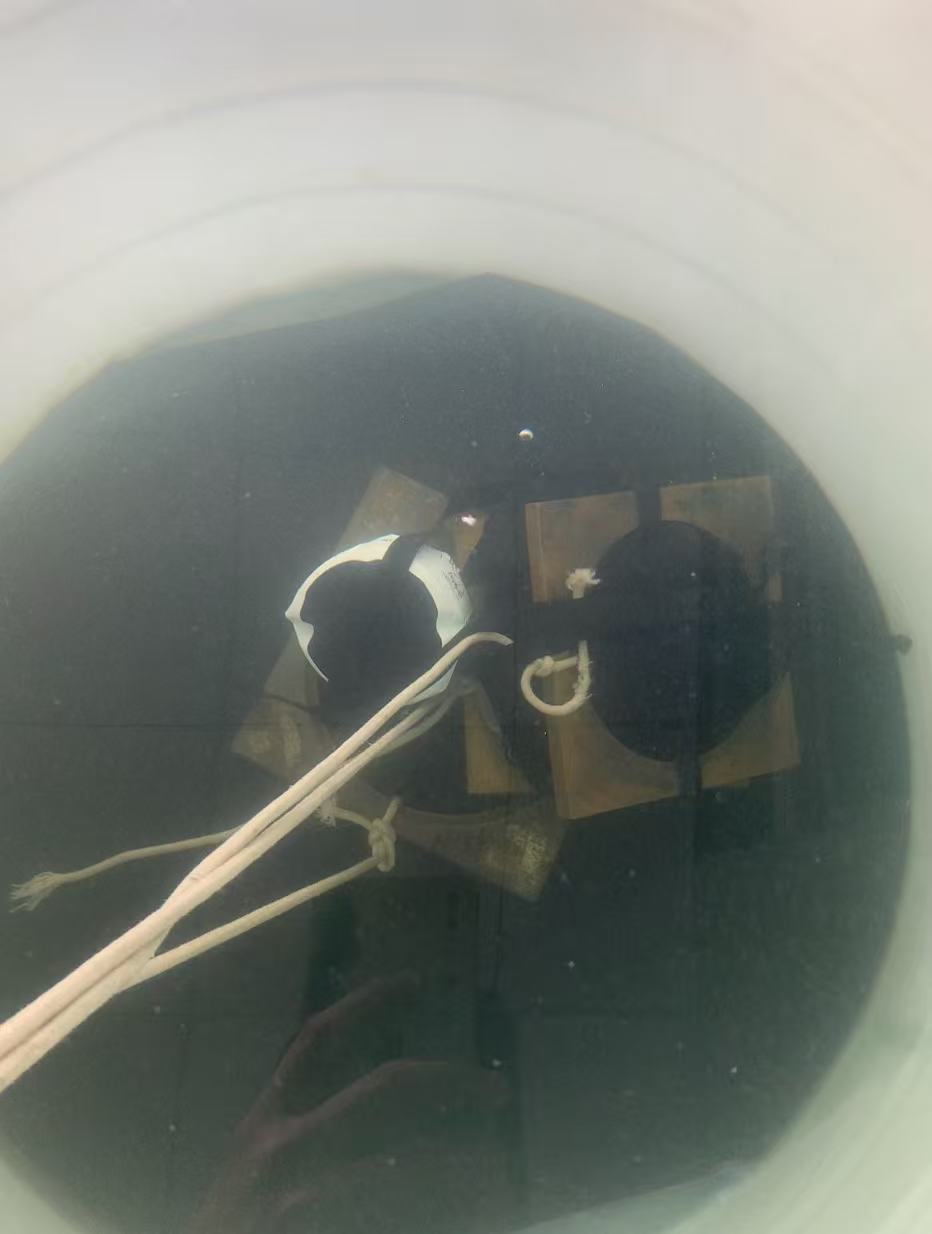
So Sealock's evidence is a real water-submersion test: the whole finished bag is immersed to verify that body, seams, closure, and transition points keep water out as one system; at OQC a submersion batch test runs again. The point is finished-product proof, not a paper IPX claim. Test footage or a third-party inspection report can be provided on request.
A finished bag fully submerged in the real water-submersion test.
Who Builds It: The Manufacturer
These bags come from Sealock Outdoor Gear Co., Ltd., a factory with over twenty years in welded waterproof bags, exports to 40-plus countries, 20-plus waterproofing patents, and OEM work for outdoor names including Helly Hansen, Osprey, and KAILAS. What makes "truly waterproof" repeatable is welding lines and verifiable testing — not a line of label copy.
Dongguan: 12,000 m², 400+ staff, nine HF welding lines, ~100,000 units/month; two Ho Chi Minh City plants (a tariff hedge).
Bike Seat Bag — seat; 3D shell + wave cushion; seamless fused body; wipe-clean.
840D TPU/nylon (welded)
Roll / waterproof zip
300
The three cover bars–frame–seat, each with the closure chosen for its position; capacity, colour, straps, and dividers are all customizable.
QC & Inspection: IQC / IPQC / OQC
Inspection runs three tiers: IQC (incoming) — fabric/zipper/hardware against the signed colour card, with a first pass on colour difference and fastness; IPQC (in-process) — cutting tolerance, visual and sampled seam checks, sewing on the line; OQC (outgoing) — AQL sampling, a real water-submersion batch test, and golden-sample comparison, with SGS/QIMA optional. Around "truly waterproof," the lab suite focuses on:
Real water-submersion test — the whole bag immersed to verify the seal (the core evidence).
Weld bond/peel strength — the weld won't delaminate (where tape would lift).
Zipper cycling, 3,000 times — the waterproof zipper stays sealed and smooth.
Load test, 1,500+ cycles — straps and anchors don't creep loose (the transition-point failure).
Abrasion — bar and paint contact zones don't wear through the coating.
Colour fastness / difference — no bleeding or transfer, batch variance controlled; plus tensile and salt spray.
IQC + IPQC + OQC (incl. real water-submersion batch test)
Trade terms
FOB Guangdong; China or Vietnam origin
FAQ: Real Pain Points
Q: My bike bag claims waterproof but leaks after a while — why?
A: Usually it's not the fabric tearing; it's the seams, closure, or transition points. Three common causes: stitched or taped seams (needle-hole seepage or lifted tape), a closure that's only a splash zipper, or straps creeping loose and slackening the closure. Truly waterproof needs welded seams, a real closure, and reinforced load points — all three.
Q: Is a higher IPX always better, and is IPX8 needed for riding?
A: For rainy commutes and gravel, IPX7 (1m/30min) is usually enough; IPX8 matters for frequent or longer immersion, and the maker should state the depth/duration tested. Don't read the number alone — at the same IPX, a welded-seam bag with a real closure outperforms a stitched one by a wide margin.
Q: Do waterproof zippers really seal, and how do they compare with a roll-top?
A: A true waterproof zipper seals through a rubber gasket along the slider; it works, but feels stiff and takes more force (a trade-off). A roll-top, rolled 3–4 turns, gives the most secure seal with the fewest failure points. Each fits a job: a waterproof zipper for quick side access on a frame bag, a welded fold or roll-top where a handlebar bag needs maximum sealing.
Q: Does a high hydrostatic-head number guarantee waterproofing?
A: Not on its own. Hydrostatic head tests the fabric only; whether the whole bag is waterproof depends on the seams, zipper, and transition points. A 10,000mm fabric with stitched seams still leaks within minutes. What you want is finished-product evidence — a real submersion test, not just a fabric number.
Q: Does a truly waterproof bike bag still need a dry-bag liner inside?
A: A welded body with a real closure needs no extra liner for normal riding. A liner is only a backup when the closure isn't used properly (too few roll turns, a zipper not fully closed) or for long, deep immersion. Choosing the right construction beats patching it afterward.
Talk to the Factory
For quotes, samples (with submersion-test footage), or an OEM/ODM proposal on a truly waterproof bike bag, reach Sealock at info@sealock.com.hk or +86-769-82009361. Over twenty years in welded waterproof bags and dual China–Vietnam production — specify the IPX level and welded zones, and put a sample through the dunk tank.
We use cookies to offer you a better browsing experience, analyze site traffic and personalize content. By using this site, you agree to our use of cookies.
Privacy Policy
 English
  Español
  Português
  русский
  Français
  日本語
日本語  Deutsch
  tiếng Việt
  Italiano
  Nederlands
  ภาษาไทย
  Polski
  Svenska
  magyar
  Malay
Malay  বাংলা ভাষার
  Dansk
Dansk  Suomi
Suomi  हिन्दी
  Pilipino
  한국어
한국어  Türkçe
  Gaeilge
  العربية
  Indonesia
  Norsk
Norsk  تمل
تمل  český
český  ελληνικά
  український
  Javanese
  فارسی
فارسی  தமிழ்
தமிழ்  తెలుగు
  नेपाली
  Burmese
  български
  ລາວ
ລາວ  Latine
  Қазақша
  Euskal
  Azərbaycan
  Slovenský jazyk
  Македонски
  Lietuvos
  Eesti Keel
  Română
  Slovenski
  मराठी
मराठी  Srpski језик