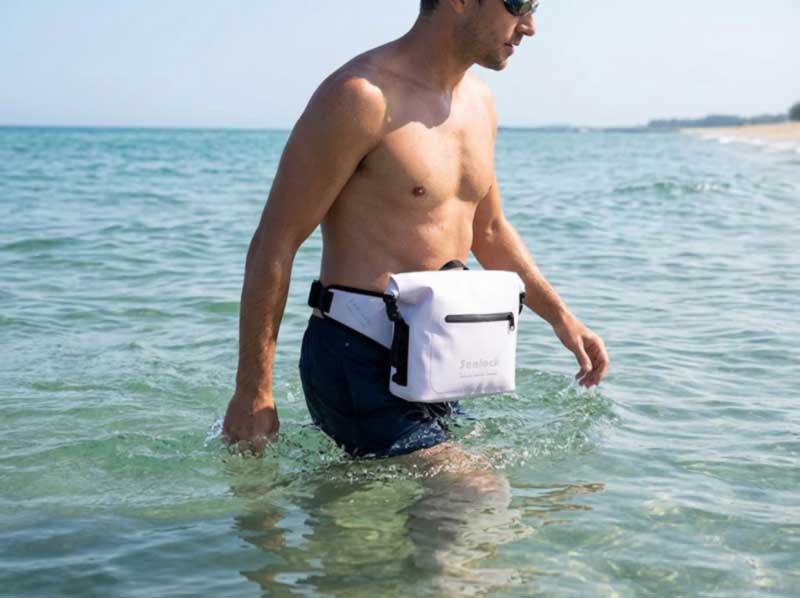
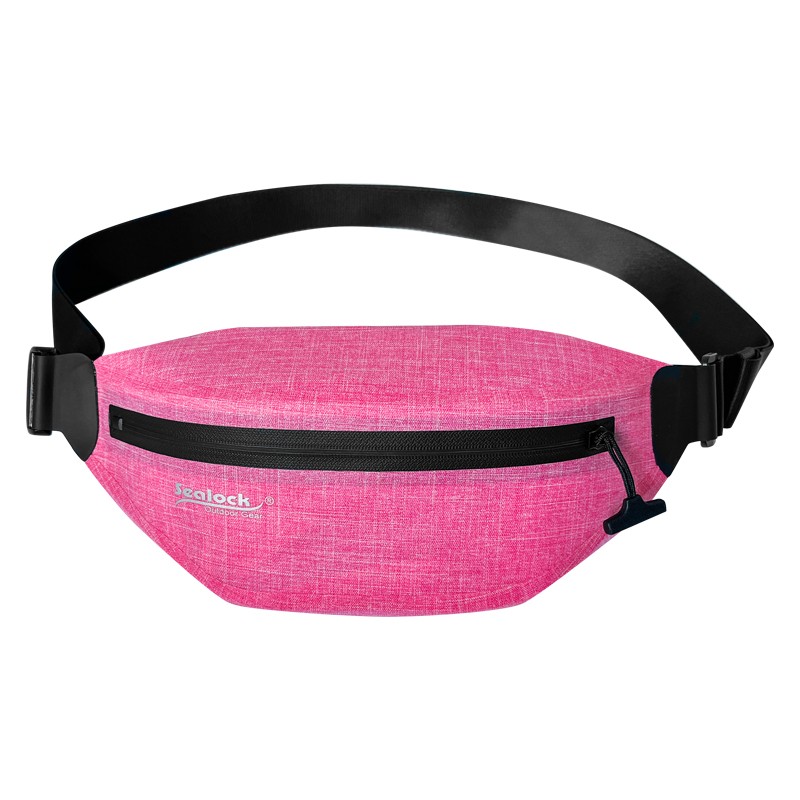
Yes, you can swim with a waterproof fanny pack, but only with the right one. Most waist packs sold as "waterproof" are built for rain: they shrug off a downpour on a run or a hike, but water gets in through the zip or the seams as soon as they go under. A fanny pack for swimming has to be rated for immersion, closed properly, and worn so it stays put while you move through the water.
This guide explains which waterproof rating a swimming fanny pack needs, how roll-top and airtight-zip packs differ in the water, how to wear and test one, and what to carry in it. It is written for swimmers, snorkellers, paddlers and beachgoers, and for the water-sports and travel brands who sell to them. It draws on over 20 years of making welded waterproof bags at our factories in Dongguan, China and Ho Chi Minh City, Vietnam.
The Rating Decides Whether You Can Swim With It
Waterproof ratings for bags follow the IPX scale. The two numbers that matter here are 6 and 7. A pack rated IPX6 is protected against powerful jets of water, which in practice means heavy rain, spray from a boat and splashes at the water's edge. It is not designed to go under. A pack rated IPX7 is protected against temporary immersion, and IPX8 against continuous immersion under conditions the maker specifies. For swimming, snorkelling or wading above the waist, an IPX7 or IPX8 pack is the minimum.
The rating also tells you how the pack was tested. At our factories, packs rated IPX6 pass a heavy rain and water-jet test, and packs rated IPX7 or IPX8 pass a full water-immersion test of 2+ hours before they ship. Our guide to IPX7 vs IPX8 waist packs explains the difference between the two immersion ratings in more detail.
A rating only holds if the whole pack is built for it. The fabric must be waterproof, such as PVC tarpaulin or TPU-laminated fabric, the seams must be welded rather than stitched, and the closure must seal. A pack with a waterproof shell but sewn seams or an ordinary zip will leak in the water, whatever the label says about the fabric.
For swimming, choose a pack rated IPX7 or IPX8, with welded seams and a closure that seals.
Roll-Top or Airtight Zip?
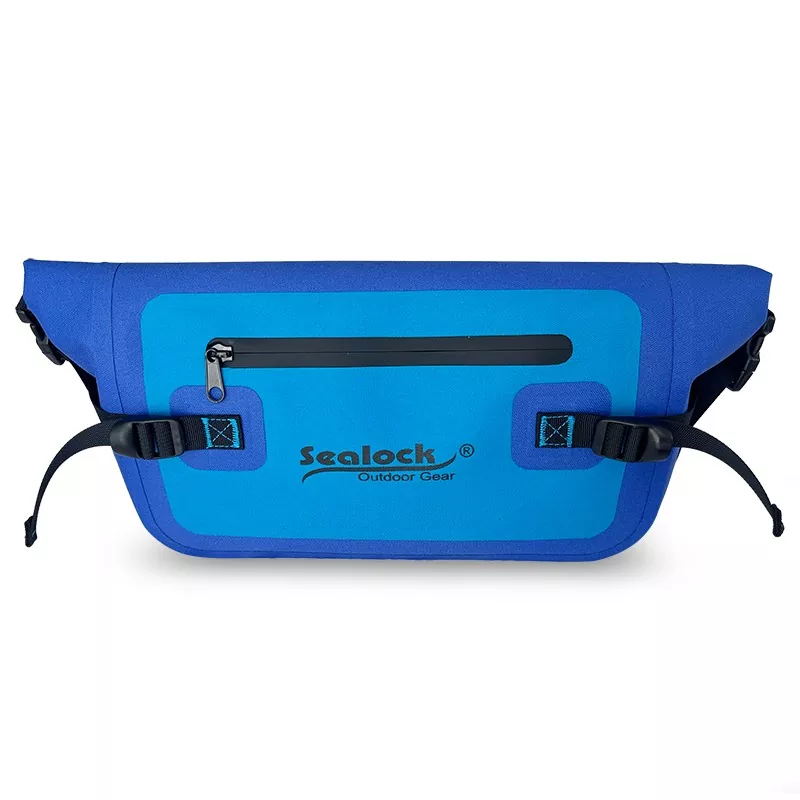
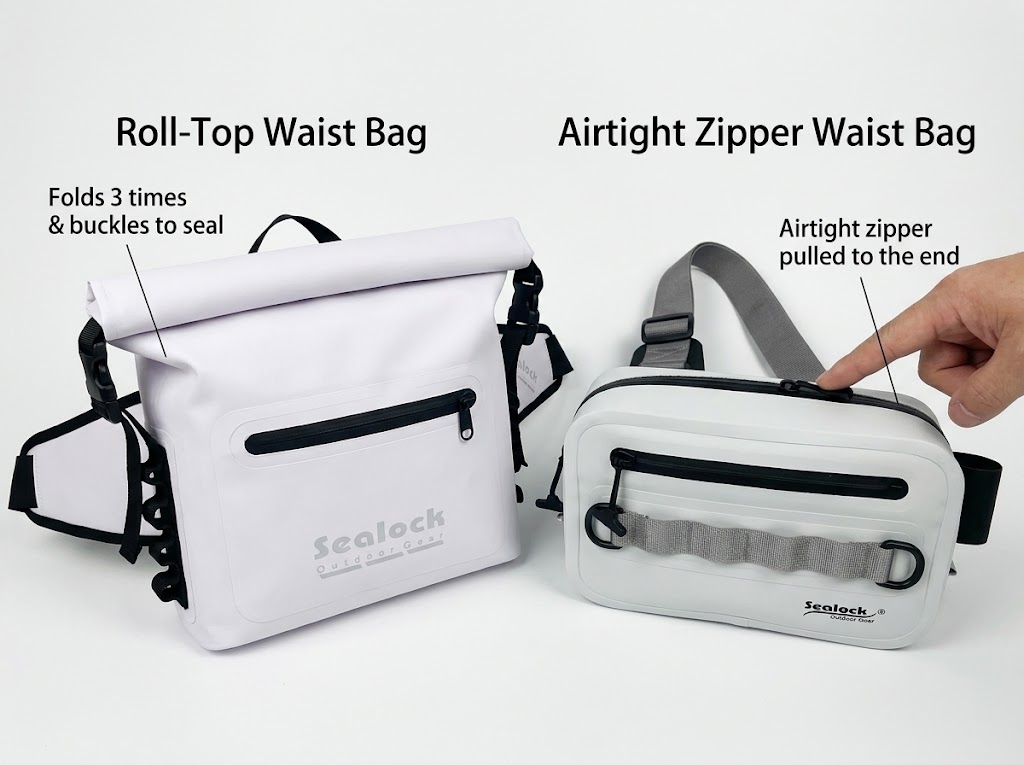
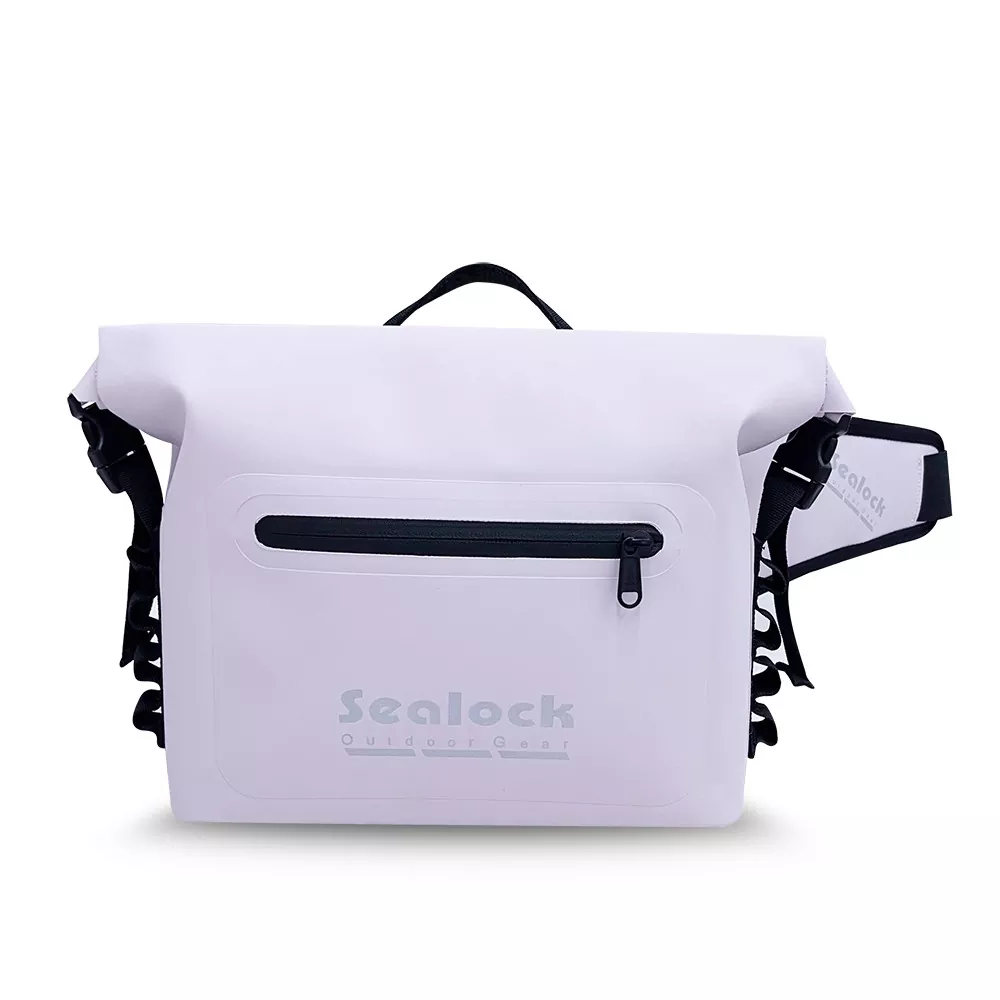
Swimming fanny packs close in one of two ways. A roll-top is folded down over itself and clipped shut. It is simple, has no zip to wear out, and is fully sealed when rolled at least three times before the buckles are clipped. Our roll-top waterproof waist pack works this way, made from TPU-laminated fabric with high-frequency welded seams and rated IPX7. The trade-off is access: you have to unroll it to reach anything inside.
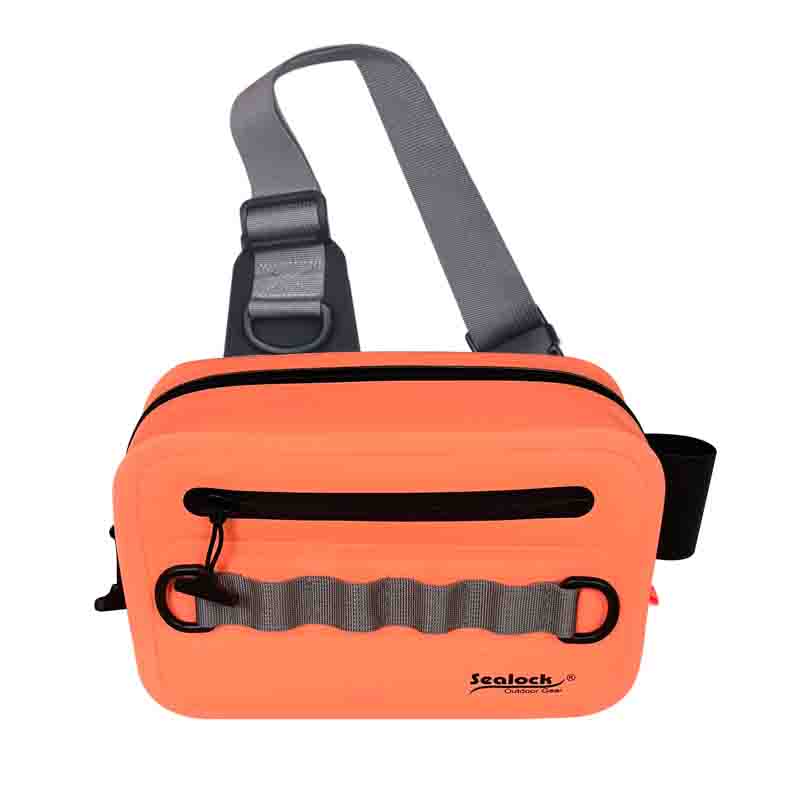
An airtight zipper is a sealed zip with interlocking teeth and a rubberised seal, closed against an end stop. It is quicker to open and close and gives a slimmer shape. Our sling waist pack with airtight zipper uses one, in 500D PVC with welded seams, rated IPX7. The trade-off is care: an airtight zip only seals when it is pulled fully into its end stop, and it needs rinsing after salt water and an occasional application of zip lubricant to keep sealing well.
How to Wear a Fanny Pack While Swimming
In the water, a pack that sits loosely will slide, twist and drag. Tighten the belt so the pack sits snugly against your body; worn at the front or the side, it is easier to check and less likely to catch on a board or a kayak. Squeeze out most of the air before you close it. A pack full of air floats, which is useful if it comes off, but it also pulls against the belt and makes swimming awkward. A small amount of air is a good compromise.
Keep the load small and dense: keys, a card, some cash and a phone. Heavy or bulky items make the pack ride up and pull on the belt. For long open-water swims, a fanny pack is not the best choice at all. A tow-behind swim buoy with a dry bag carries the same essentials, makes you visible to boats and other water users, and gives you something to hold if you need a rest, although it is not a life-saving device.
A roll-top seals after three full rolls; an airtight zip seals only when pulled fully into its end stop.
Test It Before the First Swim
Before trusting a new pack with a phone, test it. Put a sheet of dry paper towel inside, close the pack as you would for swimming, and hold it under water in a sink, bath or bucket for several minutes, squeezing it gently. Open it and check the paper. If it is dry, the pack and your closing technique work. If it is damp, check whether the roll-top was rolled enough times or the zip was fully closed, and test again. Repeat the check at the start of each season, because closures wear.
Salt and chlorine dry into closures and buckles and gradually stop them sealing. After each swim, rinse the pack inside and out with fresh water, open the closure and let it dry fully before storing it. Do not store a roll-top tightly rolled for months, and keep airtight zips clean of sand. A pack that is cared for this way keeps its seal for many seasons.
Water-repellent, not immersion-rated; full-length zip
About 2.5 L, 0.15 kg; sewn polyester
No; for running in light rain
500
We include the running pack deliberately: it is a good product for its job, but it is the kind of pack that should never go into the water, and labelling the difference clearly is the best way for a brand to avoid returns. Every model can be made in your colours with your logo, applied by welded patch, silk screen or heat transfer, or carried on a custom zipper pull. See the full waterproof fanny pack and waist pack range, our custom waist pack buying guide, and, for swim bags that carry wet kit home, our guide to wet bags and swim bags.
How We Test Waterproof Waist Packs
Every order passes through IQC on incoming fabric, zips, buckles and webbing, IPQC during welding and assembly, and OQC on finished packs, with SGS or QIMA third-party inspection available on request. Welded seams are tested for tensile and bonding strength, belt anchors and buckles for load with a test of 1,500+ cycles, and zips through 3,000 open-and-close cycles. Buckles and zip pulls go through salt spray testing, fabrics are tested for abrasion, and colour fastness and colour difference are checked against the approved sample. Waterproofing is verified against the label: a heavy rain and water-jet test for IPX6 models and a full water-immersion test of 2+ hours for IPX7 and IPX8 models.
Frequently Asked Questions
Can you swim with a waterproof fanny pack?
Yes, with a pack rated IPX7 or IPX8, with welded seams and the closure fully sealed. A pack rated IPX6 or only water-repellent is for rain and spray, not swimming.
Will a waterproof fanny pack float?
A sealed pack with air inside usually floats, which helps if it comes off. For swimming, squeeze out most of the air so the pack does not drag.
Can I take my phone swimming in a fanny pack?
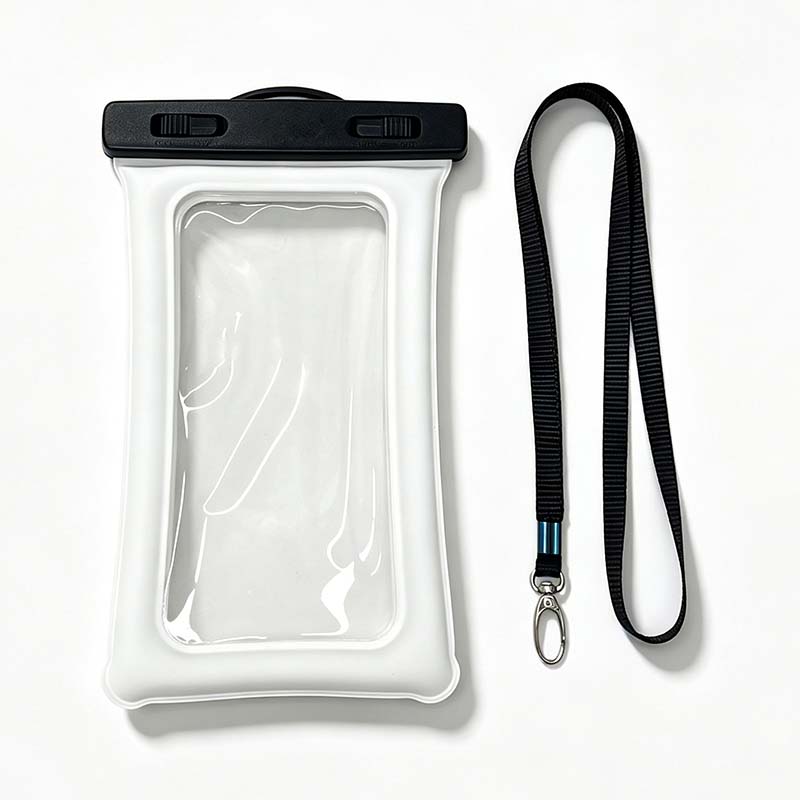
Yes, in an immersion-rated pack. For extra security, put the phone in a sealed IPX8 phone pouch inside the pack, and test the pack with paper towel before the first swim.
What is the MOQ for custom swimming waist packs?
300 pieces per style for our IPX7 waist packs and phone pouches. Samples take about 7–15 days and bulk production about 30–45 days.
How much does a custom waterproof fanny pack cost?
Price depends on the material, closure, size, features and logo method, and on the order quantity. Send us your specification or a reference pack and target quantity for a quotation.
Can you add our logo and colours?
Yes. Welded logo patches, silk screen and heat transfer all work on PVC and TPU, and we can match your brand colours for the fabric, webbing and zip pulls.
Develop a Swimming Waist Pack With Us
Tell us how your customers will use the pack, from pool and beach to snorkelling, paddling or open water, and we will recommend a closure, rating and size, and prepare samples. Contact us at info@sealock.com.hk or call +86-769-82009361.
We use cookies to offer you a better browsing experience, analyze site traffic and personalize content. By using this site, you agree to our use of cookies.
Privacy Policy
 English
 Español
 Português
 русский
 Français
 日本語
 Deutsch
 tiếng Việt
 Italiano
 Nederlands
 ภาษาไทย
 Polski
 Svenska
 magyar
 Malay
 বাংলা ভাষার
 Dansk
 Suomi
 हिन्दी
 Pilipino
 한국어
 Türkçe
 Gaeilge
 العربية
 Indonesia
 Norsk
 تمل
 český
 ελληνικά
 український
 Javanese
 فارسی
 தமிழ்
 తెలుగు
 नेपाली
 Burmese
 български
 ລາວ
 Latine
 Қазақша
 Euskal
 Azərbaycan
 Slovenský jazyk
 Македонски
 Lietuvos
 Eesti Keel
 Română
 Slovenski
 मराठी
 Srpski језик