Sealock is a waterproof frame bag manufacturer and OEM supplier. On a long ride, the frame bag is the workhorse of the setup — it carries the dense, heavy essentials in the one spot on the bike where weight costs the least, so the bike stays planted and the rider stays fresher after hour twelve. The catch is that "long distance" raises the bar: the bag has to stay waterproof through multi-day weather, survive thousands of kilometres of vibration and rub, and still fit the frame cleanly. This guide covers what actually matters and which build holds up.
Why the Frame Bag Is the Long-Distance Workhorse
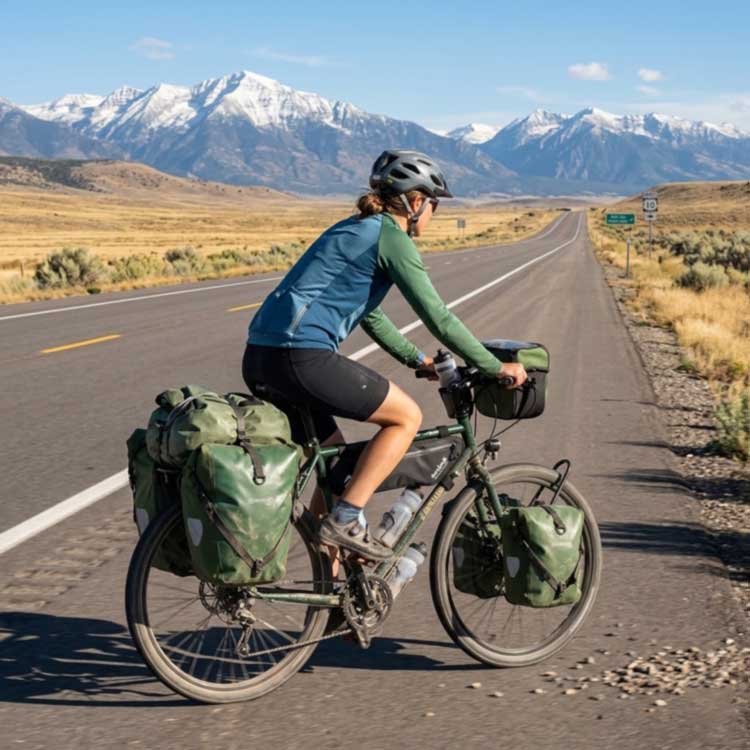
The frame triangle sits low and central, shielded by the frame — the position that disturbs handling least. Load the heaviest items here (tools, food, a water bladder, a battery pack, spares) and the bike keeps its natural balance instead of pitching at the front or tail. Over a single afternoon that's a convenience; over a 200 km day or a week-long tour it's the difference between a bike that fights you and one that disappears underneath you. Weight in the frame is close to "free," which is exactly why endurance and bikepacking riders make the frame bag the anchor of the load and keep the bars and saddle for light, bulky kit.
What a Long-Distance Frame Bag Must Get Right
Distance is a stress test. A bag that looks fine on a shop shelf can fail three days into a tour, so the criteria that count are the ones that show up late:
Truly waterproof, all weather — a multi-day ride will meet rain it can't outrun; a soaked battery or food stash ends the day, so the body and closure must keep water out, not merely shrug off a shower.
Durability over thousands of kilometres — constant vibration loosens straps, rubs paint, and works the zipper; the build has to resist seam delamination, abrasion at contact points, and strap creep.
A clean fit to the frame — a frame bag is dimension-dependent (it lives inside the triangle), so a custom-fit shape stops sag and sway; a full-frame bag also catches more crosswind, worth planning for on exposed routes.
A hydration plan — a full-frame bag takes the in-frame bottle cages, so long-distance riders run a bladder inside the bag, move bottles to the fork or top tube, or choose a half-frame that keeps one cage.
Frame protection — where straps touch paint over big distances, a protective film prevents wear.
The frame bag as the long-distance workhorse — weight low and central.
Who Builds It: The Manufacturer
The bag comes from Sealock Outdoor Gear Co., Ltd., a factory with over twenty years in welded waterproof bags, exports to 40-plus countries, 20-plus waterproofing patents, and OEM production for outdoor names including Osprey, KAILAS, and Helly Hansen. Long-distance gear is unforgiving of shortcuts, and a real welding factory with verifiable testing is what keeps a frame bag dry and intact deep into a tour.
Dongguan: 12,000 m², 400+ staff, nine HF welding lines, ~100,000 units/month; two Ho Chi Minh City plants (a tariff hedge for US buyers).
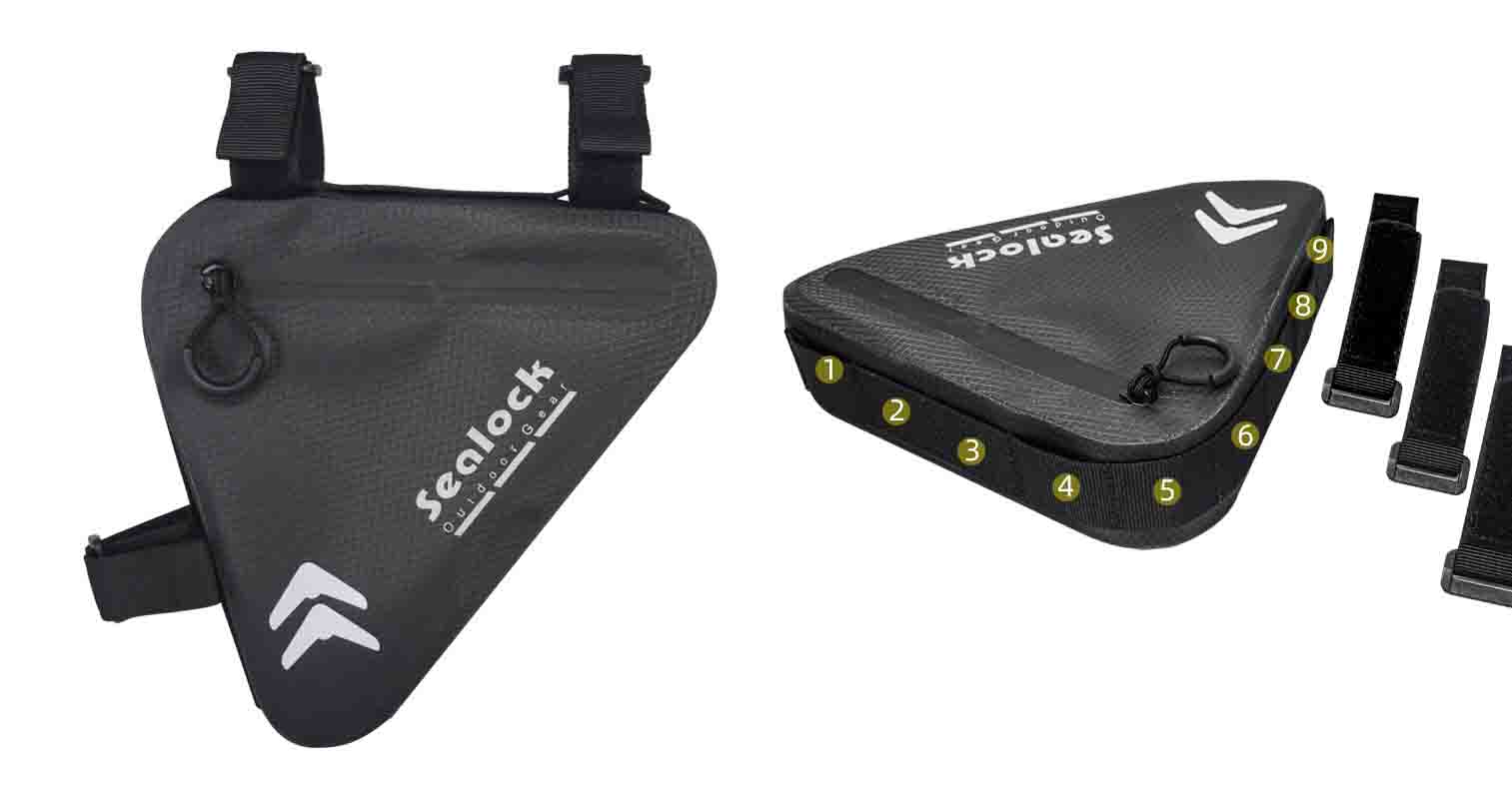
The hero for long distance is the Waterproof Bicycles Frame Bag, a dedicated triangle bag built for the demands above. Its detailed specs and what each does for the long-haul rider:
600D nylon-coated TPU — a tough, continuous waterproof barrier that stays flexible across hot and cold and takes daily abrasion.
HF-welded seams — fused with no needle holes, so the joins stay sealed for the life of the bag instead of peeling like taped seams.
Waterproof zipper — a gasket-sealed closure that opens for side access while riding, then seals back tight.
Dimension-dependent, custom-fit — shaped to the frame triangle so it doesn't sag or sway under a full load.
Organized compartments — tailored pockets keep tools, food, a phone, and keys each in their place, so the heaviest items sit low and stable.
Waterproof, rainproof, dustproof; webbing-and-velcro mount — straps to the frame on different bikes and wipes clean after a muddy day.
Welded seam, gasket-sealed zipper, and a paint-protection patch at the strap.
Build & Waterproofing
Waterproofing on a long tour is decided by construction, not a label. The body is high-frequency welded at 27.12 MHz, fusing the coated fabric into one wall stronger than the parent material and free of stitch holes — the failure point that sinks cheaper bags after a season. The closure is a true waterproof zipper, sealing through a rubber gasket rather than relying on a flap. And because the most common field failure on a bike isn't the fabric but straps creeping loose under vibration, the load points are reinforced and the anchors strong-stitched. The whole bag is then proven by a real water-submersion test, not a paper rating.
Pair It Up: The Long-Haul Luggage System
For a multi-day setup, the frame bag anchors a three-piece system — dense weight to the frame, light bulk to the bars, compressibles to the saddle. All three are welded on the same lines for a matched, single-brand kit:
Bike Handlebar Bag — HF-welded body; PU impact pad; anti-deflection straps; mountain/road bars.
420D Poly + TPU (welded)
Light, bulky kit (sleeping bag, layers)
300
Bike Seat Bag — 3D shell + wave cushion; seamless fused body; wipe-clean.
840D TPU/nylon (welded)
Compressibles (spare clothing, shell)
300
QC & Inspection: IQC / IPQC / OQC
Inspection runs three tiers: IQC (incoming) — fabric, zipper, and hardware against the signed colour card, with a first pass on colour difference and fastness; IPQC (in-process) — cutting tolerance, visual and sampled seam checks, sewing on the line; OQC (outgoing) — AQL sampling, a real water-submersion batch test, and golden-sample comparison, with SGS/QIMA optional. For a bag meant to last a long tour, the lab suite focuses on:
Real water-submersion test — the whole bag immersed to verify the seal.
Weld bond/peel strength — seams won't delaminate over thousands of kilometres.
Zipper cycling, 3,000 times — the waterproof zipper stays sealed and smooth after repeated daily use.
Load test, 1,500+ cycles — straps and anchors resist the creep that vibration causes.
Abrasion — frame and paint contact zones don't wear through the coating.
Colour fastness / difference — no bleeding or transfer, batch variance controlled; plus tensile and salt spray.
IQC + IPQC + OQC (incl. real water-submersion batch test)
Trade terms
FOB Guangdong; China or Vietnam origin
FAQ: Real Long-Distance Pain Points
Q: Does a frame bag block the bottle cages on a long ride, and how do I stay hydrated?
A: A full-frame bag usually takes the in-frame cages. Long-distance riders run a water bladder inside the frame bag (with a hose port), move bottles to the fork or top tube, or choose a half-frame that keeps one cage. The Sealock frame bag can be sized full or half and fitted with a bladder port.
Q: Will a frame bag really survive thousands of kilometres?
A: It comes down to the failure points. Welded seams don't delaminate the way taped seams do, the waterproof zipper is cycled-tested 3,000 times, the load points are reinforced against strap creep, and abrasion testing covers the frame-contact zones. That's the build that lasts a tour, not just a season.
Q: Does putting weight in the frame actually help over long distances?
A: Yes, noticeably. Low, central weight keeps the bike balanced and predictable, so it doesn't wander or pitch as you tire. Over a big day that stability translates into less correction and less fatigue than the same weight carried high on the bars or out at the tail.
Q: Is a full-frame bag a problem in crosswinds?
A: Its larger flat side catches more wind than a half-frame, which can be felt on exposed routes. If your tours run open and windy, a half-frame or a slimmer custom shape trims the sail area while keeping the low, central load.
Q: Will the straps rub the frame paint over a long tour?
A: Constant vibration can wear paint where straps sit. A protective film at the contact points prevents it, and the Sealock frame bag can be sized so straps land cleanly rather than dragging across tubes.
Talk to the Factory
For quotes, samples (with submersion-test footage), or an OEM/ODM proposal on a waterproof frame bag for long-distance cycling, reach Sealock at info@sealock.com.hk or +86-769-82009361. Over twenty years in welded waterproof bags, dual China–Vietnam production, and frame-specific sizing — full or half frame, with a bladder port if you need one.
We use cookies to offer you a better browsing experience, analyze site traffic and personalize content. By using this site, you agree to our use of cookies.
Privacy Policy
 English
  Español
  Português
  русский
  Français
  日本語
日本語  Deutsch
  tiếng Việt
  Italiano
  Nederlands
  ภาษาไทย
  Polski
  Svenska
  magyar
  Malay
Malay  বাংলা ভাষার
  Dansk
Dansk  Suomi
Suomi  हिन्दी
  Pilipino
  한국어
한국어  Türkçe
  Gaeilge
  العربية
  Indonesia
  Norsk
Norsk  تمل
تمل  český
český  ελληνικά
  український
  Javanese
  فارسی
فارسی  தமிழ்
தமிழ்  తెలుగు
  नेपाली
  Burmese
  български
  ລາວ
ລາວ  Latine
  Қазақша
  Euskal
  Azərbaycan
  Slovenský jazyk
  Македонски
  Lietuvos
  Eesti Keel
  Română
  Slovenski
  मराठी
मराठी  Srpski језик