Sealock is a comprehensive manufacturer of outdoor waterproof bags. First-time buyers tend to treat this as a "which is better" choice; a few rides in, the real difference becomes clear — it isn't the bag itself, it's where the weight sits on the bike and what belongs in each. The same 3 kg on the bars wags the front wheel out of a standing climb; the same 3 kg in the frame triangle and the bike rides almost like it's empty. This piece settles the difference from the factory bench and from real riding experience.
Quick Answer
They solve two different problems and aren't an either/or. The frame bag sits low and central, the spot on the bike that affects handling least, so it carries the heaviest, densest items (tools, water, food, spares). The handlebar bag sits high and forward, where weight tugs at the steering, so it suits light, bulky, compressible items (sleeping bag, puffy, clothing, rain shell). Most serious setups run both — the right thing in the right place.
Factor
Handlebar Bag
Frame Bag
Position
High & forward
Low & central (frame triangle)
Effect on handling
Tugs the steering
Barely felt
Best contents
Light & bulky, compressible
Dense & heavy
Access while riding
Awkward (often remove to open)
Side-zip access
Main friction
Cables, sag, sway
Bottle cages, paint rub
Closure
Welded, folding body
Waterproof zipper
Handlebar bag (high, forward) vs frame bag (low, central) on one bike.
The Real Difference: Where the Weight Sits
Frame Bag: Low, Central, "Free" Weight
The frame triangle is the most handling-friendly spot on the bike — low, central, and shielded by the frame. Put the dense, heavy items here (tools, battery, food, water, a spare tube), load 4–5 kg, and the bike barely rides differently. That's why experienced riders stuff the heaviest gear into the frame bag: weight here is almost "free." The two trade-offs: a full-frame bag takes the in-frame bottle cages (a half-frame keeps one bottle but holds less), and the larger flat side catches more crosswind.
Handlebar Bag: High, Forward, Tugs the Steering
A handlebar bag lifts weight to the front and forward of the axle, so it tugs at the steering — most obvious on a standing climb or in slow, technical handling. Its strength is "light but bulky" kit: sleeping bag, puffy, spare layers, rain shell — things that compress and don't swing like a pendulum. The key lesson: keep tools and tins out of the bars, or the front end goes vague. It's also the place for "needed overnight, untouched by day" gear, since access while riding is awkward — most bags must be unclipped and removed to open.
Why Most Riders Run Both
A five-minute test says it all: load the bike, grab the top tube and shake hard, then ride two laps of the car park. With heavy gear on the bars you'll hear the clunk and feel the wag; move the same weight into the frame and both vanish. The takeaway is simple — dense weight to the frame, light bulk to the bars. The two bags are partners, not rivals.
Who Builds Them: The Manufacturer
Both bags come from Sealock Outdoor Gear Co., Ltd., a factory with over twenty years in welded waterproof bags, exports to 40-plus countries, 20-plus waterproofing patents, and OEM production for outdoor names including Osprey, KAILAS, snow peak, and Helly Hansen. Running multiple closure methods (welded-fold and waterproof zipper / Roll-top buckle seal / Hot Air Welding / RF High-Frequency Seamless Heat Pressing / HF High-frequency seamless welding / Magnetic Closure) under one roof means it can match the right closure to the right bag, instead of forcing one construction onto two jobs.
To optimize our global supply chain, we operate two modern manufacturing bases in Ho Chi Minh City, Vietnam, forming a powerful dual-engine production matrix:Phase I Facility (Robust Mass Production): Our established overseas hub, fully operational with a mature supply chain and skilled workforce, dedicated to high-efficiency, stable mass production.Phase II Facility (Advanced & Upgraded Smart Plant): Our newly launched facility that significantly multiplies our total capacity. It integrates advanced high-frequency welding and lean manufacturing to handle high-barrier, high-value-added production.The Advantage: Under unified management and stringent quality control, these twin facilities complement each other seamlessly. This dual-plant setup effectively eliminates single-line capacity risks, guaranteeing cost-competitive, reliable, and on-time delivery for large-scale international orders.
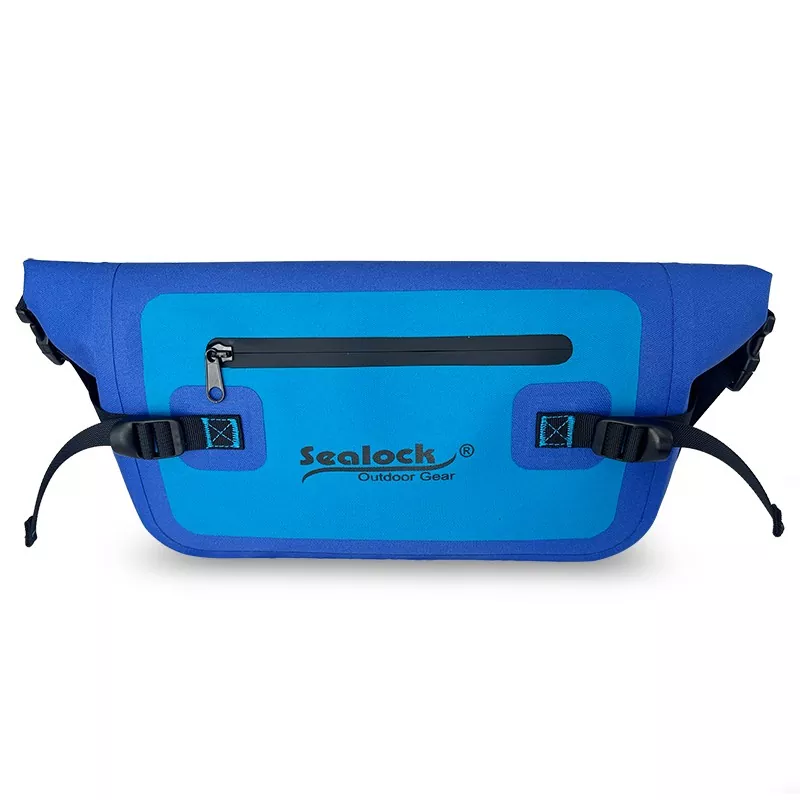
Fabric: 420D polyester-coated TPU; HF-welded body, no needle holes.
Inside: a PU impact pad cushions a phone, wallet, or camera.
Mount: upgraded anti-deflection straps with a double-sided folding structure to stop sag and sway; tool-free velcro-and-strap fit that also spaces the bag off the bar and cables.
Fit: mountain and road handlebars.
Frame Bag (detailed specs)
Fabric: 600D nylon-coated TPU; HF-welded seams, superior to glued or sewn construction.
Fit: a dedicated triangle frame bag and dimension-dependent — it sits inside the frame triangle and can be sized to the frame geometry.
Storage: tailored compartments and pockets so a phone, keys, water, and tools each have a place.
Closure & mount: a waterproof zipper; webbing-and-velcro straps to the frame triangle of different bikes; waterproof, rainproof, dustproof, and wipe-clean.
What Fails First Is the Strap, Not the Fabric
Waterproofing on a bike bag is decided by closures and seams, not a spec sheet. A counter-intuitive truth: the most common failure isn't the main fabric tearing — it's straps slowly creeping loose under constant vibration, and stitching pulling at load points. Sealock's answer is reinforced load points and strong-stitched anchors, verified with a 1,500+ cycle load test so straps and anchors hold under a full load; the body then clears a real water-submersion test. Where a frame-bag strap touches paint, a protective film is worth adding to prevent rub.
Model & specs
Material
Closure & mount
MOQ
Bike Handlebar Bag — front; PU impact pad; anti-deflection straps; double-sided folding; mountain/road bars.
420D Poly + TPU (welded)
Welded folding body + velcro/strap
300
Waterproof Bicycles Frame Bag — a dedicated triangle frame bag sized to the frame triangle (dimension-dependent, custom-fit); HF-welded seams; organized compartments; waterproof, rainproof, dustproof.
600D nylon-coated TPU
Waterproof zipper + webbing/velcro
300
To build a full luggage set, add the 3D seat pack (for compressibles) and small seatpost/top-tube pockets, forming a balanced bars–frame–seat system. Capacity, colour, straps, and dividers above are all customizable.
QC & Inspection: IQC / IPQC / OQC
Inspection runs three tiers: IQC (incoming) — fabric/zipper/hardware against the signed colour card, with a first pass on colour difference and fastness; IPQC (in-process) — cutting tolerance, weld and stitch sampled on the line; OQC (outgoing) — AQL sampling, a real water-submersion batch test, and golden-sample comparison, with SGS/QIMA optional. For bike bags the lab suite focuses on:
Load test, 1,500+ cycles — aimed straight at the number-one failure, strap creep.
Real water-submersion test — the whole bag immersed to verify the seal.
Zipper cycling, 3,000 times — the frame bag's waterproof zipper stays smooth and sealed.
Abrasion — bar and paint contact zones don't wear through.
Colour fastness / difference — no bleeding or transfer; batch variance controlled.
Plus tensile/bond and salt spray.
Which to Stock or Choose
Lead with the handlebar bag — for weekend/warm-season day trips, sleeping-bag-and-shell loads, and buyers who want a quick, simple setup.
Lead with the frame bag — for riders carrying heavy kit (tools/water/food) who want stable handling on longer and gravel routes; note whether bottle cages are kept (full vs half frame).
Stock both (recommended) — most bikepacking buyers end up wanting both; a single-brand bars–frame–seat set lifts order value and repeat rate. Tell end users to add a protective film where the frame straps touch paint, and to clear the cables when fitting the handlebar bag.
IQC + IPQC + OQC (incl. real water-submersion batch test)
Trade terms
FOB Guangdong; China or Vietnam origin
FAQ: Real Pain Points From the Saddle
Q: Should heavy items go in the handlebar bag or the frame bag?
A: The frame bag. Its low, central position affects handling least, so tools, water, and food ride best there and the bike stays planted. Keep the handlebar bag for light, bulky things like a sleeping bag or puffy — heavy weight up front makes the front end vague and wags on a standing climb.
Q: Does a frame bag block the bottle cages, and will it rub the paint?
A: A full-frame bag usually takes the in-frame cages; a half-frame or custom bag can keep one bottle, and you can move bottles to the fork or top tube. For paint, a protective film where the straps touch prevents rub. Sealock can size the frame bag and strap positions to the frame.
Q: Does a handlebar bag affect steering and rub the brake/shifter cables?
A: Weight up front does tug the steering, which is why it should hold only light, bulky gear, not heavy items. On cables, direct-strap mounts are the worst offenders; the Sealock handlebar bag's mount holds the bag forward and off the bar and cables — just fine-tune to the cable routing when fitting.
Q: Many bike bags claim waterproof but still leak over time — why?
A: Most failures aren't the fabric tearing; they're straps creeping loose under vibration, stitching pulling at anchors, or a closure that was only splash-resistant. Sealock counters creep with reinforced load points, strong-stitched anchors, and a 1,500-cycle load test, and proves the body with a real water-submersion test — a welded handlebar-bag body and a waterproof-zip frame bag, truly waterproof rather than splash-only.
Q: Can I use both, and how do I split the load?
A: Yes, and it's recommended. Dense weight (tools/water/food) to the frame bag, light bulk (sleeping bag/puffy/shell) to the handlebar bag, compressibles to the seat pack. Load it, shake it, ride two laps — no clunk or wag means it's right. Sealock can build the full set under one brand, with matched colours and logo.
Talk to the Factory
For quotes, samples, or an OEM/ODM proposal on a handlebar bag, a frame bag, or a full bike-luggage set, reach Sealock at info@sealock.com.hk or +86-769-82009361. Over twenty years in welded waterproof bags, dual China–Vietnam production, and frame-specific sizing and straps — samples and comparisons welcome.
We use cookies to offer you a better browsing experience, analyze site traffic and personalize content. By using this site, you agree to our use of cookies.
Privacy Policy
 English
  Español
  Português
  русский
  Français
  日本語
日本語  Deutsch
  tiếng Việt
  Italiano
  Nederlands
  ภาษาไทย
  Polski
  Svenska
  magyar
  Malay
Malay  বাংলা ভাষার
  Dansk
Dansk  Suomi
Suomi  हिन्दी
  Pilipino
  한국어
한국어  Türkçe
  Gaeilge
  العربية
  Indonesia
  Norsk
Norsk  تمل
تمل  český
český  ελληνικά
  український
  Javanese
  فارسی
فارسی  தமிழ்
தமிழ்  తెలుగు
  नेपाली
  Burmese
  български
  ລາວ
ລາວ  Latine
  Қазақша
  Euskal
  Azərbaycan
  Slovenský jazyk
  Македонски
  Lietuvos
  Eesti Keel
  Română
  Slovenski
  मराठी
मराठी  Srpski језик