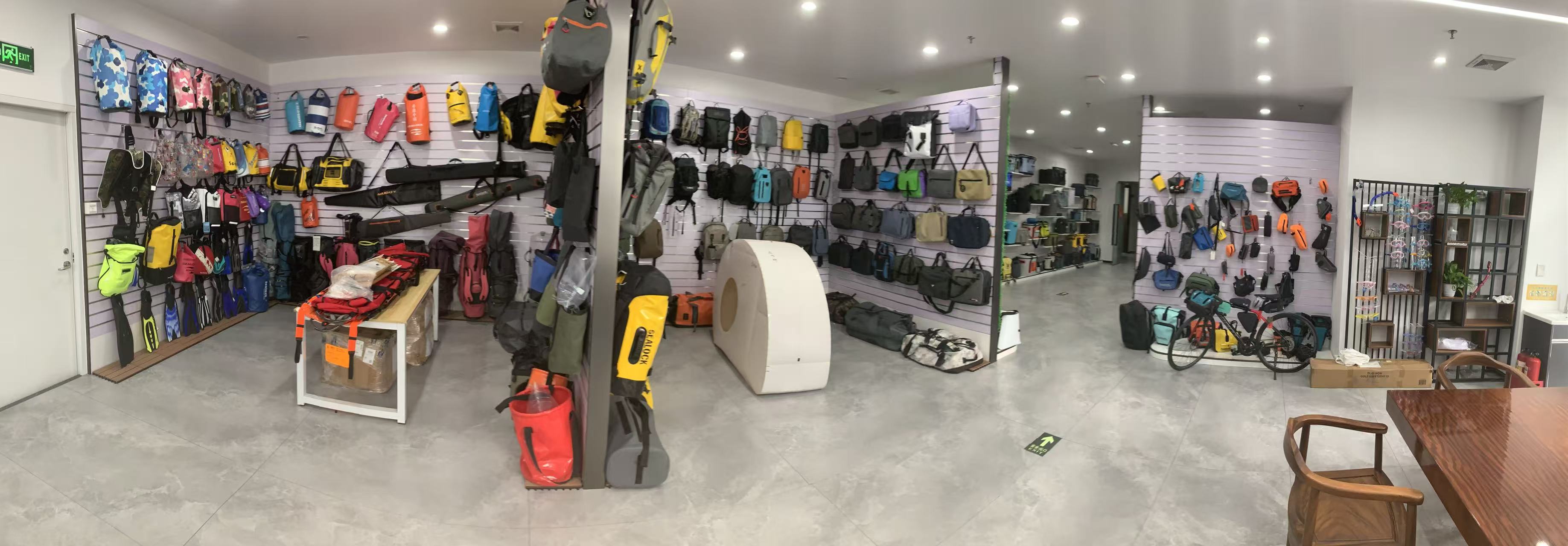
Sealock is a waterproof bag manufacturer in China offering the full span of OEM and ODM service, from a simple relabel to a ground-up original build. Turning an idea into a shelf-ready product runs through inquiry, sampling, tooling, mass production, quality control, inspection, and customs; any gap left open becomes a cost or a return months later. This guide skips the generalities and walks each stage with concrete steps, specs, timelines, and cost logic, so a brand can see the whole OEM chain before a deposit is wired.
The Factory Behind the Guide
Sealock Outdoor Gear Co., Ltd. has over twenty years in welded waterproof bags, exports to 40-plus countries, holds 20-plus waterproofing patents, and has run OEM and licensed production for brands including Osprey, Stanley, Helly Hansen, Simms, and Disney. That means the plant can hold a major brand's bar on structure, compliance, and batch consistency. The capacity in numbers:
Dongguan HQ: 12,000 m², 400+ staff; nine HF welding lines with roughly 150 HF machines plus 140 sewing machines; ~100,000 units a month.
Two Ho Chi Minh City plants (about 10,500 m² and 7,000 m²), 200,000+ units a month combined, giving US buyers a tariff-hedged origin.
A ~2,000 m² Dongguan R&D centre, 10 designers plus 10 sales; around 400 samples a month at a 7–15 day sample lead.
Certifications on file are independently verifiable, not screenshots: SMETA P4, HIGG, SCAN, GRS, BSCI, ISO9001, plus an IP-protection process. SMETA P4 and BSCI mean the plant stays open to third-party social-compliance audits — a layer a trading company cannot provide.
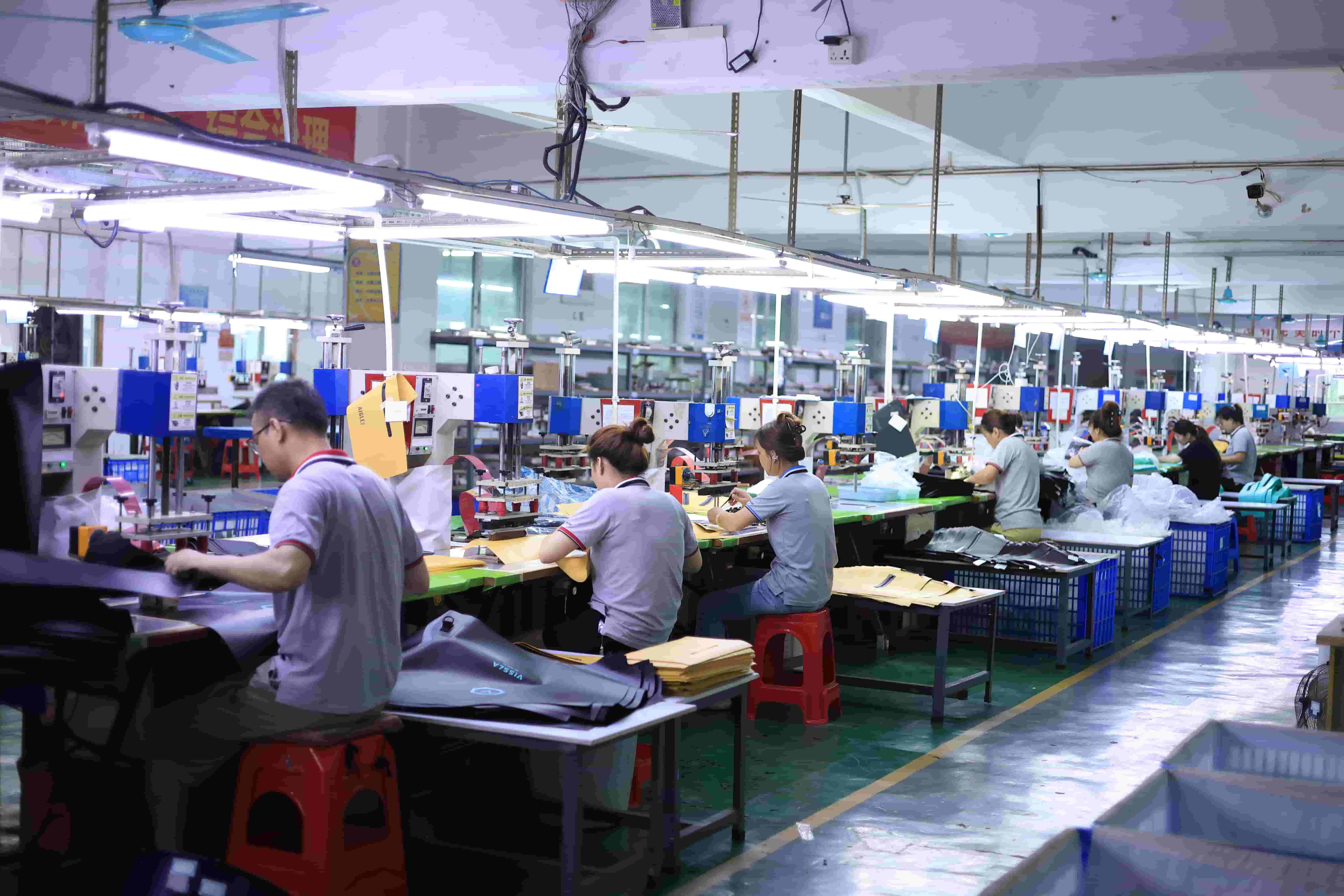
The Dongguan welding floor, with a 27.12 MHz HF machine pressing a seam.
Manufacturing Capability: How the Waterproofing Is Actually Made
High-Frequency Welding vs Sew-and-Tape
True waterproofing comes from welding, not stitching. 27.12 MHz high-frequency (dielectric) welding uses a high-frequency field to fuse the TPU/PVC coating at the molecular level, melting two panels into one seamless wall whose seam is stronger than the parent fabric, with no needle holes anywhere. Against the "sew-and-tape" method, taped seams lift and delaminate over time, temperature cycles, and repeated folding — the usual starting point of a cheap bag's leak. Weld geometry is set by the tooling die, so it is repeatable batch to batch rather than dependent on an operator's touch. Every finished bag clears a real water-submersion test (the whole bag is immersed to verify the seal), not just a number on paper.
The Fabric Matrix (with real specs)
420D TPU — the light-weight workhorse; a full bag can hit ~300g (e.g. a 25L backpack), UV-resistant and cold-flexible.
840D TPU, double-sided lamination — heavy-duty and fishing models; a seamlessly fused body with the best airtightness.
500D PVC tarpaulin (~0.5mm) — the mainstay for dry bags and heavy duffels; brute abrasion resistance at a low cost.
600D TPU — the middle ground for bike and commuter bags.
Closures run from roll-top (double-overlap fold) to an IPX8 airtight zipper or an airtight tube mouth with an inflation/deflation valve; the waterproof target can reach IPX8 (brief submersion), not just splash resistance.
The Full OEM Range (with detailed specs, MOQ and lead time)
Range breadth is itself proof of capacity and consistency. Each category's example model with detailed specs, MOQ, and production lead time follows (lead time counted from order/material readiness, flexing with quantity and customization depth):
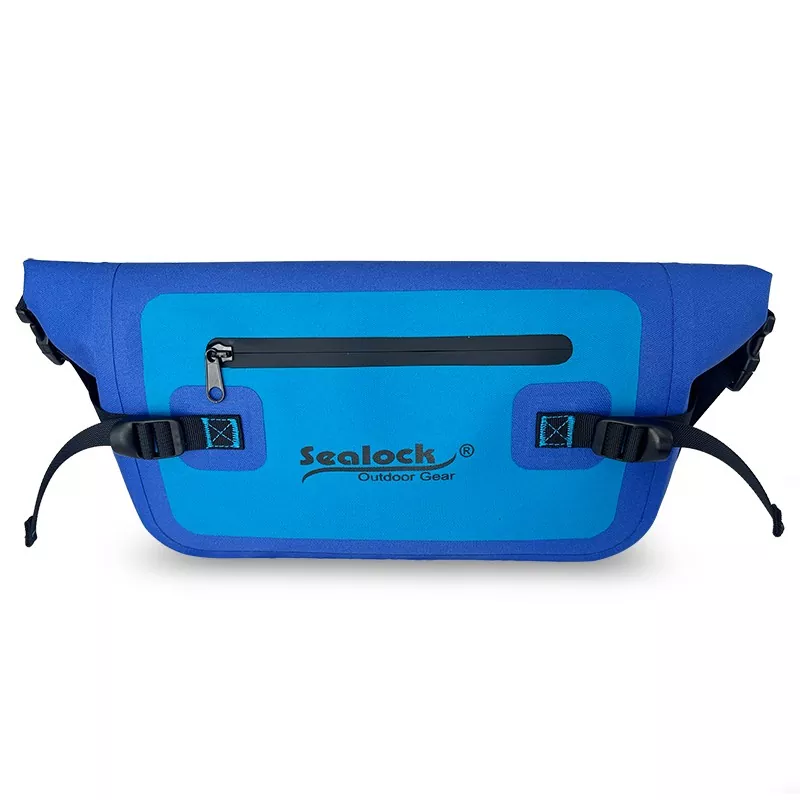
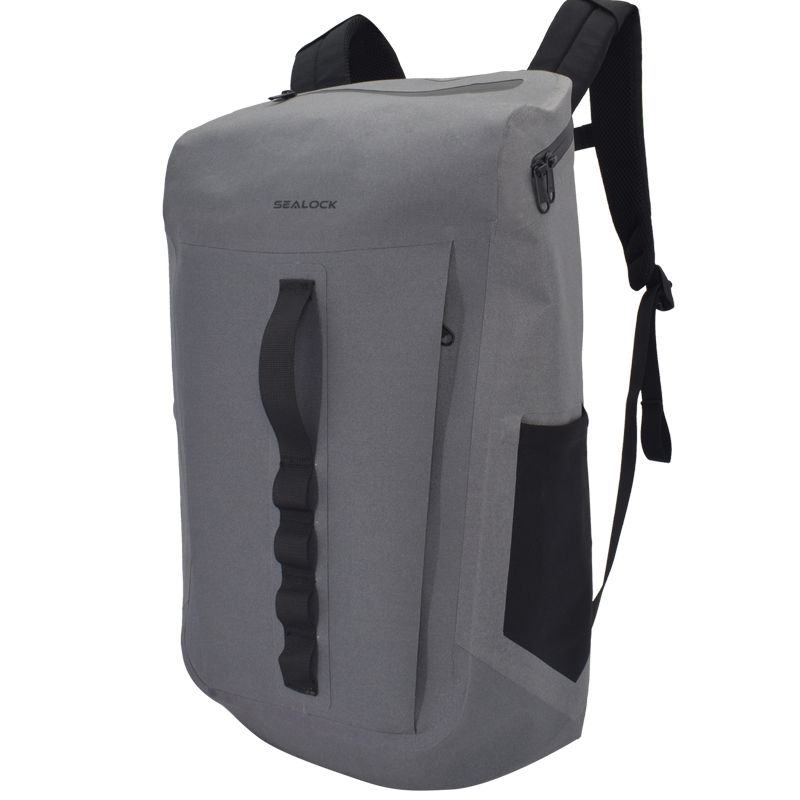
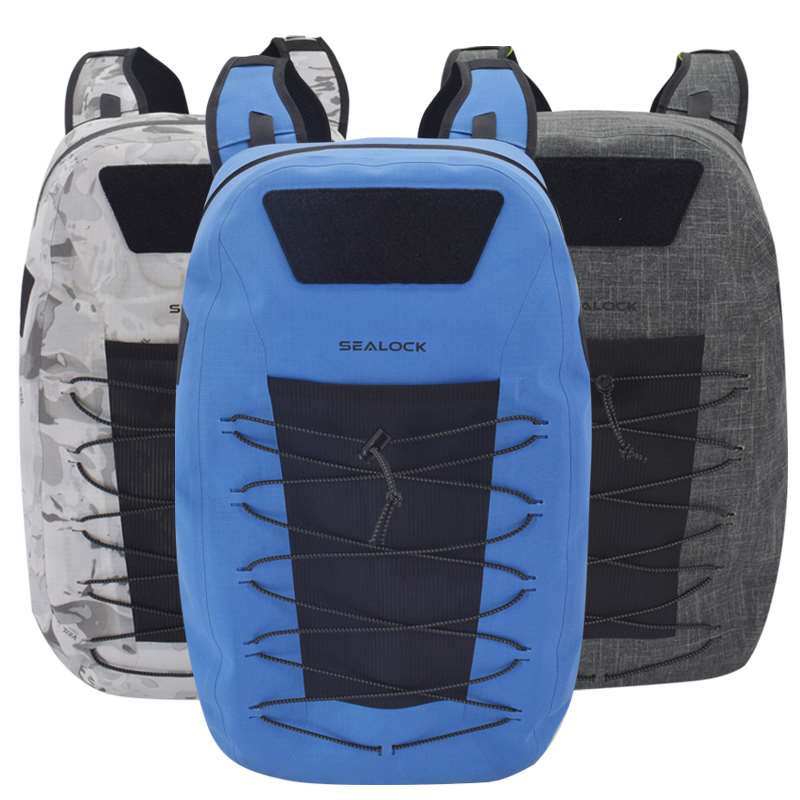
One bag from each category, in multiple colours — the OEM range breadth.
Every category is welded on the same lines under one QC system — one process spanning many categories is what makes it possible to take on a full brand range (an outdoor three-piece set, a complete marine line) with consistent results. All specs above are customizable (capacity, colour, size, closure, lining, hardware).
Quality Control & Inspection: IQC / IPQC / OQC
The OEM nightmare is "beautiful golden sample, different bulk run." Inspection gates in three tiers:
IQC (incoming) — fabric thickness/coating, hardware, zippers, and lining checked against spec and the signed colour card, including a first pass on colour difference and colour fastness.
IPQC (in-process) — cutting tolerance, visual plus sampled seam checks, and assembly/sewing sampled alongside the line.
OQC (outgoing) — AQL sampling (commonly 2.5 major / 4.0 minor for bags), a real water-submersion batch test, and item-by-item comparison against the signed golden sample; third-party inspection by SGS or QIMA when required.
The lab test suite, sampled to spec:
Load testing, 1,500+ cycles — handles and anchor points hold under a full load without cracking.
Zipper cycling, 3,000 times — a sealed zipper stays tight and smooth after repeated use.
Real water-submersion test — the whole bag is immersed to verify the seal.
Tensile / bond strength — fabric and weld resist pulling and peeling.
Salt spray — hardware corrosion resistance for marine use.
Abrasion — the coating survives long-term rubbing.
Colour fastness — no bleeding or transfer under rubbing, light, and perspiration.
Colour difference — bulk matched to the signed colour card to control batch variance.
Three Customization Paths: Which to Pick, and Who Owns the Design
Relabel (fastest) — change colour, logo, and packaging on an existing model. Lowest MOQ, no tooling, a sample in 2–4 weeks; good for a market test. The design stays the factory's base model; what you own is the brand layer (trademark, logo, packaging).
OEM (your design) — built from your drawings/tech pack, with structure and look owned by you. Custom hardware needs a mold; set exclusivity and mold ownership in the contract.
Full ground-up custom — from a sketch, a sample, or target specs, the China base develops an original bag end to end — structure, pattern, materials, hardware — not a tweak of an existing model. Development and tooling take longer, so back-schedule from the launch or campaign date. The original design can be assigned to you exclusively.
Remember: a logo does not equal ownership. Without exclusivity and IP assignment in the contract, the factory can legally sell the same design to others.
The OEM Journey: Eight Steps in Detail
1. Inquiry & tech pack (RFQ) — how fast and accurate the quote is depends on the input. A solid tech pack carries: material and denier (e.g. 420D TPU), dimensions with tolerance, capacity, closure type, IPX target, colour Pantone codes, logo method and placement, hardware and lining, quantity and target price, and destination port. With complete input, a quote typically comes back in 24–48 hours.
2. Quotation & sampling — custom samples usually carry a fee (often credited against bulk). Sealock samples in 7–15 days, with ~400 samples a month of R&D capacity. A "structure sample" first to prove the build, then a "colour/confirmation sample," is the safer sequence.
3. Spec lock & signed golden sample — sign an NDA/NNN before sharing files; on sign-off, both sides sign and seal the golden sample, locking the material swatch, Pantone, and hardware as the acceptance baseline for bulk.
4. Tooling & materials — custom zipper pulls, buckles, EVA parts, and injection pieces carry a one-time mold fee; agree "whoever pays owns the mold," and the brand/model can be engraved inside it. Fabric is bought to colour and quantity, one of the main lead-time variables.
5. Mass production — lines are allocated by category, welding and sewing run in parallel, and IPQC samples alongside the run. Production lead times are in the table above (7–60 days from material readiness, by category and quantity).
6. Pre-shipment inspection (OQC) — AQL sampling, a real water-submersion batch test, and comparison against the signed golden sample; the buyer can inspect or hire a third party, and clearing inspection before the balance payment keeps leverage on their side.
7. Print, packaging & shipping — logo by silk-screen or heat transfer; packed 1 pc/PE bag plus a master carton, with carton dimensions and net/gross weights provided for container planning. FOB Guangdong; US orders can choose the Vietnam origin to hedge tariffs. Plan around Chinese New Year and Golden Week shutdowns.
8. Reorder & scaling — treat the first order as a trial of sell-through and quality; reorders reuse the mold, lock in price breaks, and unit cost drops as volume rises.
Costs & Payment: Where the Money Goes, and How to Pay
Sample fee — one-time, set by build complexity, usually credited against bulk.
Mold fee — only for custom hardware/injection parts, one-time; mold ownership written into the contract.
Unit price — drops with volume; custom packaging/printing raises both MOQ and unit cost (worth asking "what's the MOQ without custom packaging?").
Payment — the common pattern is a T/T deposit plus the balance against the bill of lading or before shipment; larger orders can use a sight L/C. Always use a verifiable company account, avoid large upfront payments, never pay to an unverifiable account, and never use cryptocurrency (banned in China).
Protecting Your Design: Making IP Stick
Manufacturing carries a sizeable share of global IP theft, and neglect is expensive. The practical moves:
Register before you share — file your trademark and design with China's CNIPA before sharing drawings or samples (China's trademark system is first-to-file, so late filing risks a squatter).
Use an NNN, not a plain NDA — an NNN (non-disclosure, non-use, non-circumvention) is enforceable under Chinese law and better prevents a factory from using your design to compete.
Exclusivity and mold clauses — spell out design exclusivity, a no-resale clause, and that the mold is yours and can be pulled at any time.
Trace the shipment — check hangtags/packaging against the approved mockup, and keep line and bulk photos.
Sealock runs an IP-protection process and can sign confidentiality, exclusivity, and mold-ownership terms.
NDA/NNN, exclusivity, mold ownership, IP-protection process
Trade terms
FOB Guangdong; China or Vietnam origin
FAQ: Real OEM Pain Points
Q: How exactly do OEM, ODM, and relabel differ, and which do I need?
A: Relabel changes colour and logo on an existing model — fastest and cheapest; OEM builds to your design, with look and structure owned by you; full ground-up develops an original model from your sketch or sample. The key is that a logo does not equal ownership, so exclusivity and assignment must be in the contract. Sealock does all three, so a buyer can start with a relabel trial and step up to ground-up custom.
Q: Will the factory copy my design or sell the same one to competitors?
A: It's a genuine risk. The defence is threefold: register your trademark and design with China's CNIPA before sharing (first-to-file); sign an enforceable NNN rather than a plain NDA; and write exclusivity, a no-resale clause, and mold ownership into the contract. Sealock runs an IP-protection process and can sign all of these.
Q: How do I make sure bulk colour matches the approved sample?
A: Through a colour card plus testing. IQC checks incoming material against the signed colour card, production runs a colour-difference comparison, and a colour-fastness test (rub, light, perspiration) guards against bleeding or transfer. OQC then compares item-by-item against the signed golden sample to keep batch variance within an accepted range.
Q: How do I verify the waterproofing is real, not just splash-resistant?
A: Look at the test method. Every Sealock bag clears a real water-submersion test — the whole bag is immersed to verify the seal — with a submersion batch test again at OQC, rather than a paper IPX claim alone. Test footage or a third-party inspection report can be requested.
Q: What's the production lead time, and how do I avoid seasonal delays?
A: Roughly 7–60 days by category (from material readiness; see the table). The front-loaded time is mostly fabric procurement and tooling. Scheduling orders 2–3 months ahead of Chinese New Year and Golden Week, with a late-delivery clause in the contract, is the safest approach. US orders can also route through Vietnam to balance lead time and tariffs.
Q: How are payment terms usually set, and how do I lower financial risk?
A: Commonly a T/T deposit plus the balance against the bill of lading or before shipment, with a sight L/C for larger orders. To lower risk: clear OQC inspection before paying the balance; use a verifiable company account; avoid large upfront payments; never pay to an unverifiable account; and never use cryptocurrency.
Talk to the Factory
To verify capacity, request samples and swatches, or scope OEM/ODM and ground-up custom in any category, reach Sealock at info@sealock.com.hk or +86-769-82009361. Over twenty years in welded waterproof bags, dual China–Vietnam production, and contracts that protect your design — audits welcome, bring your drawings.
We use cookies to offer you a better browsing experience, analyze site traffic and personalize content. By using this site, you agree to our use of cookies.
Privacy Policy
 English
  Español
  Português
  русский
  Français
  日本語
日本語  Deutsch
  tiếng Việt
  Italiano
  Nederlands
  ภาษาไทย
  Polski
  Svenska
  magyar
  Malay
Malay  বাংলা ভাষার
  Dansk
Dansk  Suomi
Suomi  हिन्दी
  Pilipino
  한국어
한국어  Türkçe
  Gaeilge
  العربية
  Indonesia
  Norsk
Norsk  تمل
تمل  český
český  ελληνικά
  український
  Javanese
  فارسی
فارسی  தமிழ்
தமிழ்  తెలుగు
  नेपाली
  Burmese
  български
  ລາວ
ລາວ  Latine
  Қазақша
  Euskal
  Azərbaycan
  Slovenský jazyk
  Македонски
  Lietuvos
  Eesti Keel
  Română
  Slovenski
  मराठी
मराठी  Srpski језик