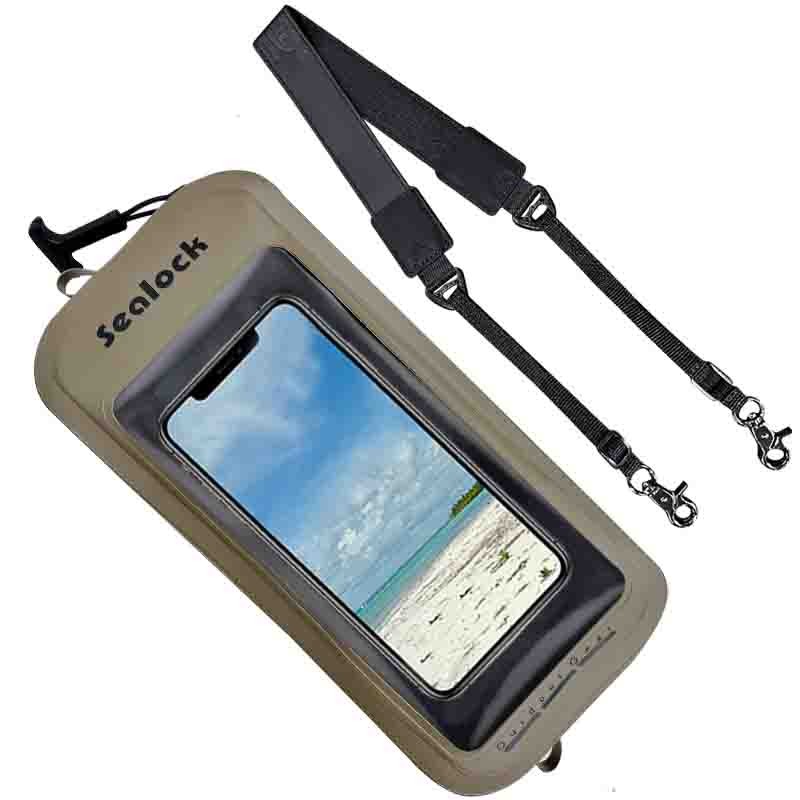
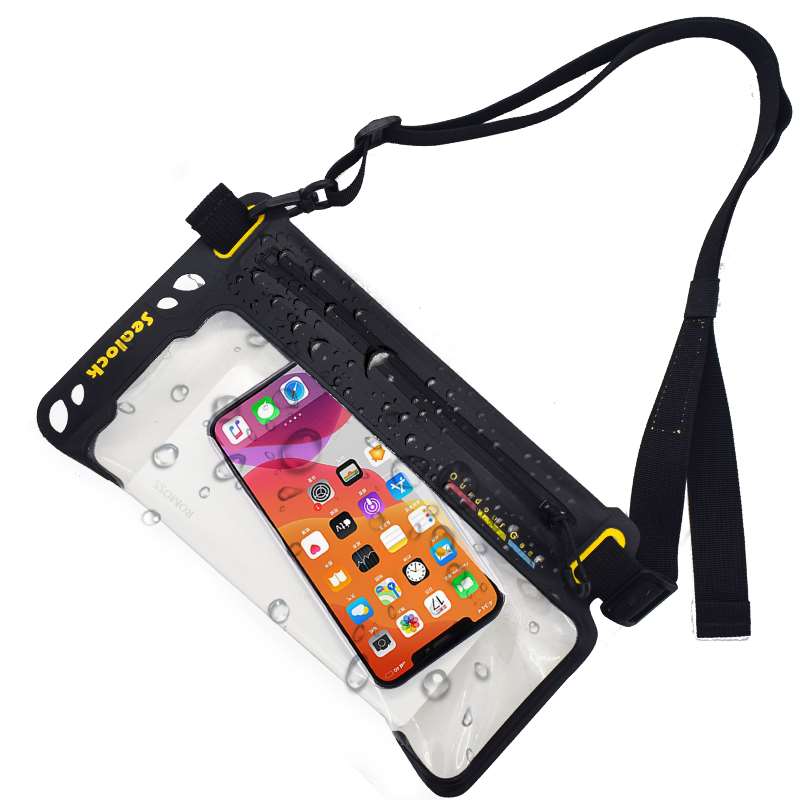
Sealock is a waterproof phone pouch manufacturer and OEM supplier. A phone pouch is not made of one material — it's a body film, a transparent window, a gasket, and lock hardware, and each is chosen separately. Buyers usually ask "PVC or TPU?" as if that settles it, when the questions that actually decide the outcome are film thickness, clarity retention, gasket elasticity, and compliance. This guide covers each component, what the real trade-offs are, and where the commercial risk sits.
The Body Film: PVC or TPU
Both work, both seal, and both are used in production pouches. They differ in feel, ageing, and cost.
Property
PVC
TPU
Feel
Firmer, more “plastic”; holds shape
Softer, slightly rubbery, premium in hand
Clarity
Good; takes printing well
Higher clarity, more natural gloss
Folding
Less natural to fold; creases
Folds and recovers cleanly
Cold flexibility
Stiffens in cold
Stays flexible far below freezing
Odour
Can smell on unboxing
Low odour
Abrasion
Good
Better, thanks to elasticity
Cost
The value baseline
Typically 30–50% higher
The nuance most sourcing guides miss: PVC's reputation problems come from its additives, not the base polymer. PVC needs plasticizers to stay flexible, and if the type and dosage aren't controlled you get odour, a tacky surface, or premature stiffening as plasticizer migrates out. Well-formulated PVC avoids all three. Treat it as a controlled material with a specified formulation — not a generic commodity — and it performs reliably, which is why it remains the basis of high-volume and promotional programmes.
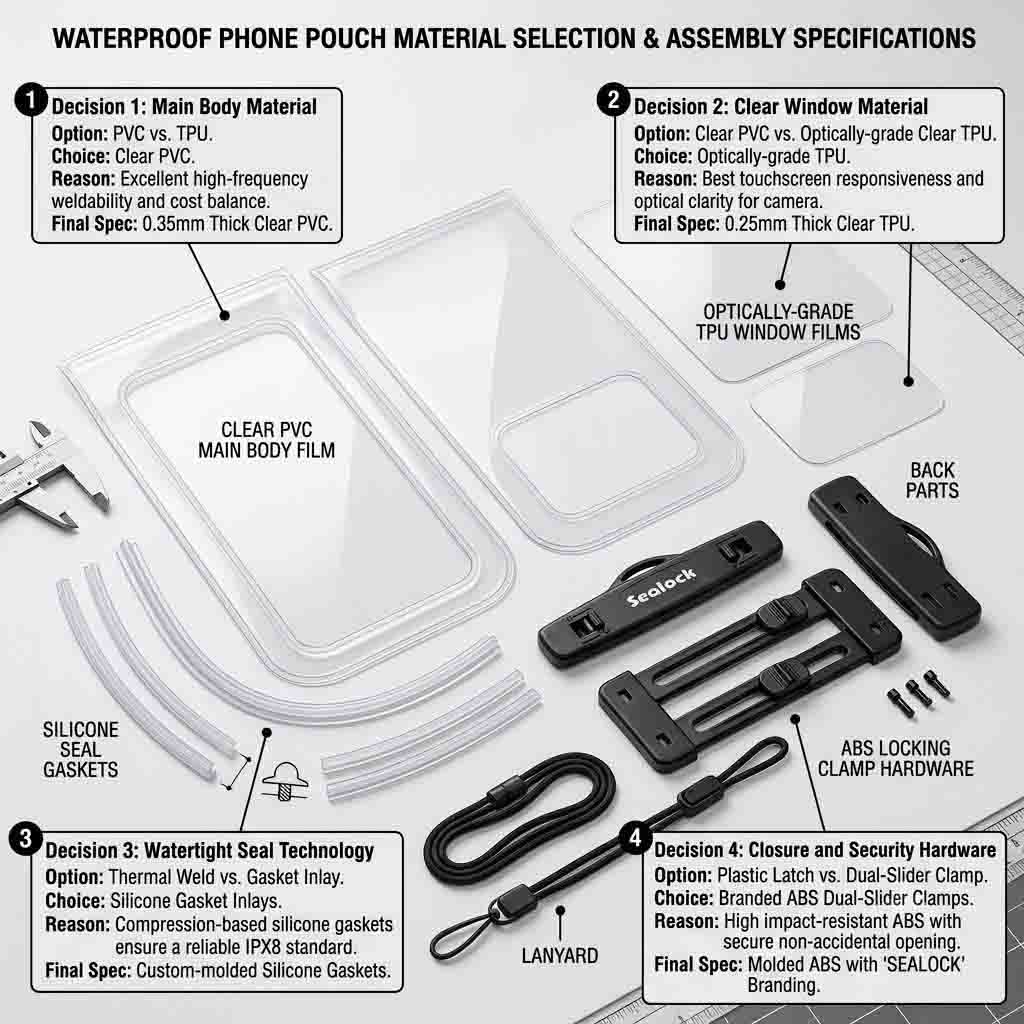
Four materials, four decisions — a pouch is specified component by component.
The Window: Clarity Now, and Clarity in a Year
The transparent window is the part customers judge hardest, because they look through it every time they use the pouch. Two specifications control it:
Thickness
Thinner film gives better touchscreen response and clearer photographs; thicker film resists puncture and lasts longer. Our lock-seal pouches run 0.30–0.35 mm, which sits deliberately at the balance point — noticeably more substantial than the thin films used on economy pouches, without deadening the touchscreen. Specify the number, don't leave it to the floor.
Yellowing — and an honest warning about TPU
A yellowed, brittle pouch damages a brand every day the customer looks at it. Yellowing has two causes: UV photo-oxidation from sunlight and chemical oxidation from skin oils, sunscreen, and heat — which is exactly the environment a phone pouch lives in.
Here's what most material guides won't tell a buyer: TPU is not immune. Clear TPU is well known for developing a yellow tint, and standard grades can show it within a few months of daily use. What matters is the grade:
Aliphatic TPU — the best clarity stability; removes the chemistry that accelerates the yellowing reaction.
UV-stabilised grades — whether PVC or TPU, a stabilised formulation substantially delays the effect.
So the honest brief is not "use TPU so it won't yellow" — it's "specify a UV-stabilised or aliphatic grade, and set customer expectations at a realistic clarity window rather than promising permanent transparency." Recommending a rinse and mild-soap clean after saltwater and sunscreen genuinely extends that window, and it belongs on the care card.
The Gasket: Where the Seal Actually Lives
The film keeps water off; the gasket keeps water out at the opening. Two systems are used across our IPX8 builds:
Silicone sealing strip — compressed by dual slide locks, as on the SL-A064. Silicone is chosen for rebound elasticity: it must spring back after every closure, because a gasket that takes a permanent set stops sealing.
Press-seal strip plus a fold-over foam compression bar — as on the SL-A101, where the seal is made twice by two different mechanisms.
The buyer-relevant point is that gasket condition, not film thickness, is what usually ends a pouch's life. Seal integrity degrades with UV, temperature cycling, and repeated use, and once compromised the elasticity doesn't come back. Specify gasket material and have it cycle-tested; details are in our IPX8 waterproof phone pouch manufacturing guide.
The Hardware: Why ABS
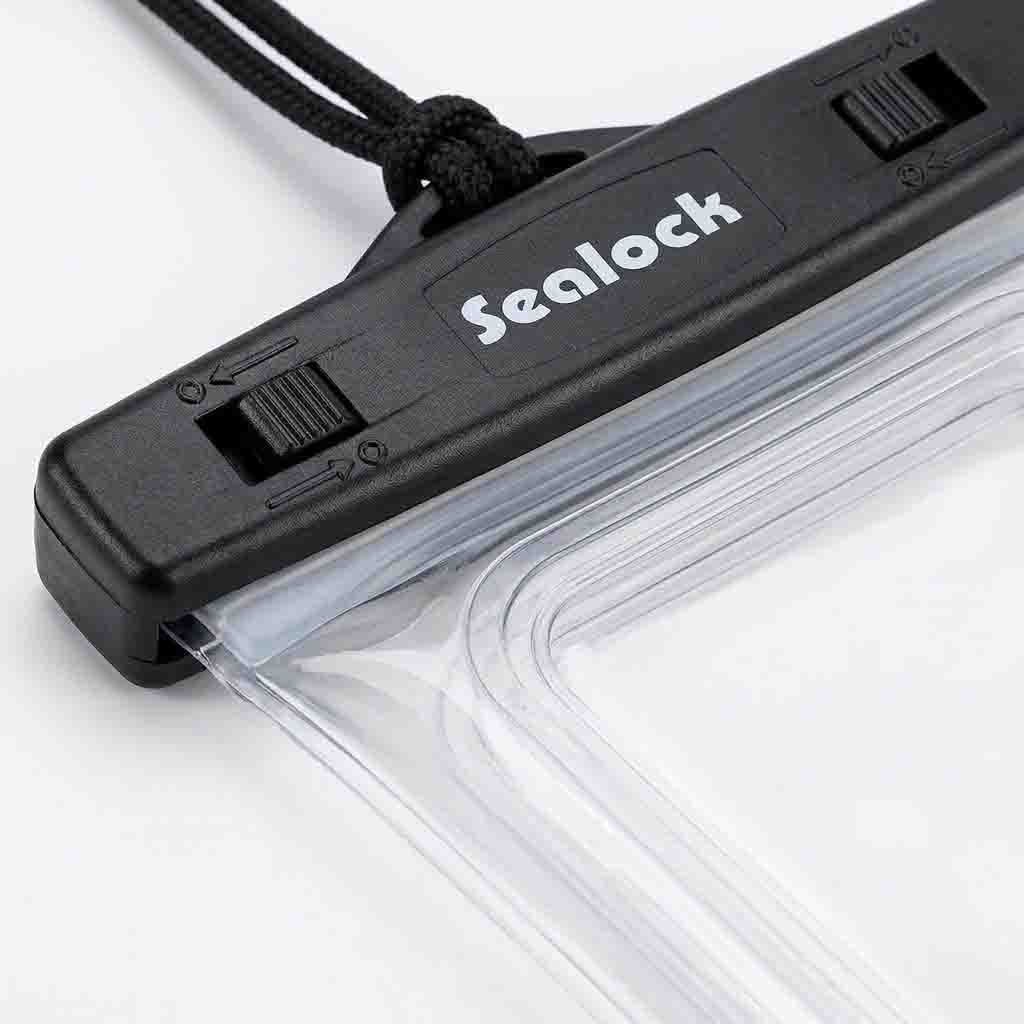
The locks are ABS engineering plastic for two reasons: stiffnes s, so clamping force on the gasket doesn't relax over time, and toughness, so the lock survives repeated closing without cracking. A lock that flexes under pressure lets the gasket lift at one end — the classic uneven-clamping failure that passes a casual dunk and leaks at depth.
Stiff hardware, elastic gasket — the pairing that holds a seal at depth.
Compliance: The Risk That Costs More Than the Material
This is the part of the material decision with real commercial consequences, and it's routinely underestimated. Standard PVC formulations may contain phthalate plasticizers — DEHP and DBP among them — that are restricted under EU REACH and California's Proposition 65. If you sell into the EU, UK, or California, a non-compliant formulation can mean a rejected shipment, a retailer delisting, or a recall. One rejected shipment erases the savings from a cheaper film many times over.
The practical brief:
Specify phthalate-free, REACH-compliant PVC in writing — don't assume it. Ask for the test report, not a verbal assurance.
Or switch to TPU — chlorine-free and free of the migrating plasticizers that cause the problem, which is why it's the smoother compliance path for regulated markets.
State your destination markets in the brief — the compliance requirement follows where the product is sold, not where it's made.
Ask for existing certifications — our pouches are produced in a factory holding SMETA P4, BSCI, ISO9001, GRS and related audits, with SGS or QIMA testing available per programme.
TPU, or PVC with a documented compliant formulation
Cold-climate or winter sports
TPU for low-temperature flexibility
Deep submersion, snorkelling
Lock-seal build with silicone gasket, declared depth
Larger contents — phone plus cards and cash
Welded TPU body with a waterproof zipper
The Product Basis
These pouches, from Sealock's waterproof phone pouch line, show each material combination in production and serve as equal starting points for an OEM order — none is ranked above another:
Image
Model & specs
Materials & why
MOQ
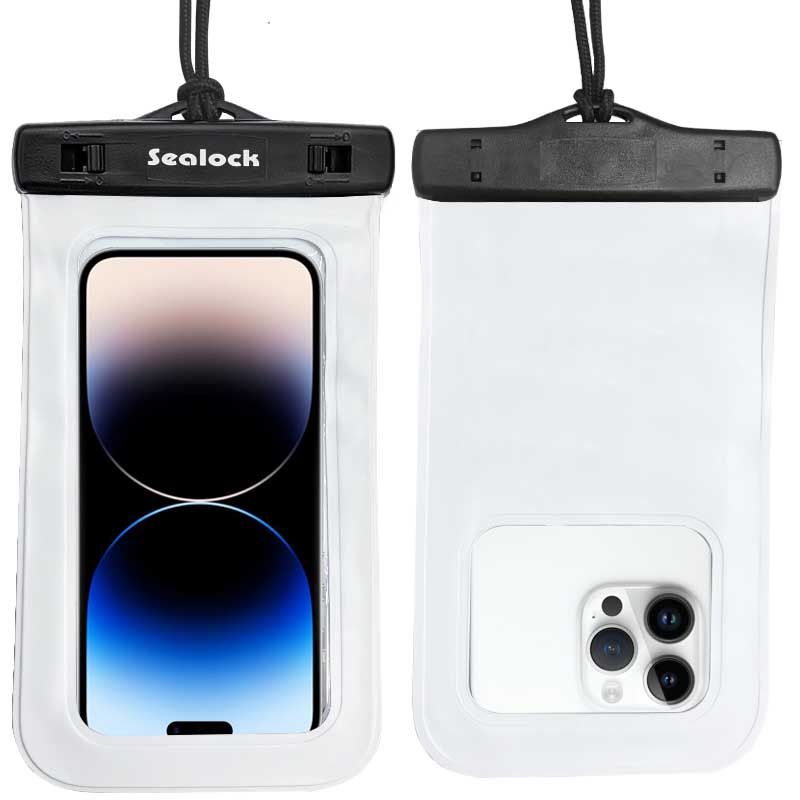
SL-A064 Universal IPX8 Phone Pouch with Camera Window — external approx. 22×11.5 cm, internal usable approx. 18.5×9 cm; fits up to 7.0″; touchscreen window + independent rear camera window; Face ID supported; 60–70 g.
Premium PVC + ABS locks, waterproof silicone strip — stiff hardware on an elastic gasket
Material specification only holds if incoming stock is checked against it. At IQC, film is verified for thickness, clarity, and adhesion against the signed standard; gaskets are checked for rebound elasticity; and ABS hardware for dimension and toughness — because a batch variation changes both the optics and the way the body seals. IPQC then monitors seal and weld integrity, window alignment, closure installation, and lanyard-anchor assembly in line, and OQC covers AQL sampling, immersion testing, and gold-sample comparison, with SGS or QIMA available. Sealock additionally executes the complete customer inspection procedure on finished goods — unboxing, vacuum extraction, a 24-hour static rest, and air-leak determination — which is how a marginal seal caused by an out-of-spec film or a tired gasket is caught before it ships. The full test regime is set out in our guide to how waterproof phone pouches are tested.
FAQ: Phone Pouch Materials
Q: PVC or TPU — which should we choose?
A: TPU for premium retail, cold climates, low odour, and smoother compliance; PVC for value and volume where the formulation is controlled and verified. TPU typically costs 30–50% more per unit. Both seal properly when built correctly.
Q: Will a TPU pouch stay clear forever?
A: No — that's an overclaim you'll see in this category. Clear TPU can yellow from UV and skin oils, and standard grades may show it within months. Specify an aliphatic or UV-stabilised grade, and set expectations at a realistic clarity window rather than promising permanent transparency.
Q: Is PVC inherently bad quality?
A: No. Odour, tackiness, and premature stiffening come from uncontrolled plasticizers, not from the base polymer. Treat PVC as a specified, controlled formulation rather than a commodity and it performs reliably — which is why it's still the basis of most high-volume programmes.
Q: What compliance issues should we worry about?
A: Phthalate plasticizers such as DEHP and DBP are restricted under EU REACH and California Prop 65. Specify phthalate-free, REACH-compliant material in writing and ask for the test report — or choose TPU, which is chlorine-free and avoids the issue. State your destination markets in the brief.
Q: How thick should the film be?
A: Thinner improves touch response and photo clarity; thicker resists puncture. Our lock-seal pouches run 0.30–0.35 mm as the balance point. Specify the figure rather than leaving it open.
Q: What actually ends a pouch's life?
A: Usually the gasket, not the film. Seal integrity degrades with UV, heat cycling, and repeated use, and a compromised gasket doesn't recover its elasticity. Recommend rinsing and drying after saltwater, and retiring any pouch that shows dampness in a self-test.
Talk to the Factory
To specify the right materials for your waterproof phone pouch programme, contact Sealock at info@sealock.com.hk or +86-769-82009361. Over twenty years in welded and heat-sealed waterproof products, PVC and TPU construction, documented compliant formulations on request, and a full customer inspection procedure on every shipment.
We use cookies to offer you a better browsing experience, analyze site traffic and personalize content. By using this site, you agree to our use of cookies.
Privacy Policy
 English
  Español
  Português
  русский
  Français
  日本語
日本語  Deutsch
  tiếng Việt
  Italiano
  Nederlands
  ภาษาไทย
  Polski
  Svenska
  magyar
  Malay
Malay  বাংলা ভাষার
  Dansk
Dansk  Suomi
Suomi  हिन्दी
  Pilipino
  한국어
한국어  Türkçe
  Gaeilge
  العربية
  Indonesia
  Norsk
Norsk  تمل
تمل  český
český  ελληνικά
  український
  Javanese
  فارسی
فارسی  தமிழ்
தமிழ்  తెలుగు
  नेपाली
  Burmese
  български
  ລາວ
ລາວ  Latine
  Қазақша
  Euskal
  Azərbaycan
  Slovenský jazyk
  Македонски
  Lietuvos
  Eesti Keel
  Română
  Slovenski
  मराठी
मराठी  Srpski језик