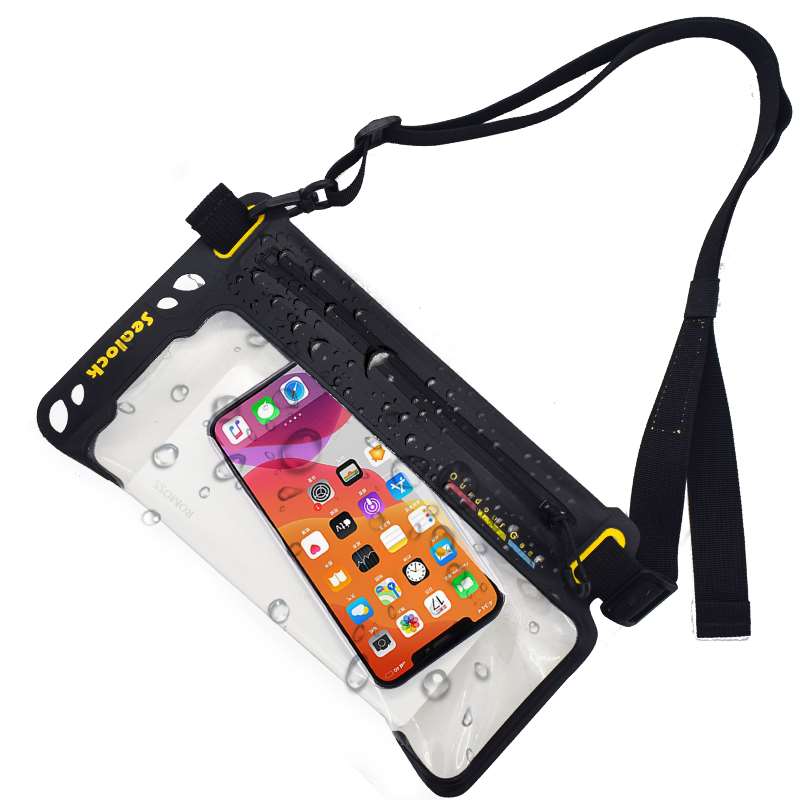
Sealock is an IPX8 waterproof phone pouch manufacturer and OEM supplier. IPX8 is the highest water-ingress class in common use, and on a phone pouch it carries a weight no other product does: the pouch guards a device worth many times its own price, and a single pinhole destroys it. This guide explains what IPX8 actually demands, the sealing architectures that reach it, and the manufacturing discipline that makes the rating repeatable across a hundred thousand units rather than true of one good sample.
What IPX8 Means — and What It Doesn't
Under IEC 60529, IPX8 means continuous immersion beyond one metre, to a depth and duration the manufacturer specifies. There is no single fixed number: a rating is only meaningful stated as "IPX8 to 30 metres" or similar. IPX7, by contrast, is a defined test — one metre for thirty minutes. So an IPX8 claim with no declared depth tells a buyer nothing verifiable, and that ambiguity is heavily abused in this category.
The physics is what makes the depth figure matter. Hydrostatic pressure rises with depth, and it works continuously against every sealing surface. A housing rated to great depth is holding back serious pressure — a 60-metre enclosure is sealed against roughly 87 psi. At 30 metres the load is proportionally lower but still far beyond anything a splash-proof closure would survive, and it is sustained, driving water through any imperfection by permeation and capillary action. Building to IPX8 means engineering every interface for that constant push, then proving it.
The Three Sealing Architectures That Reach IPX8
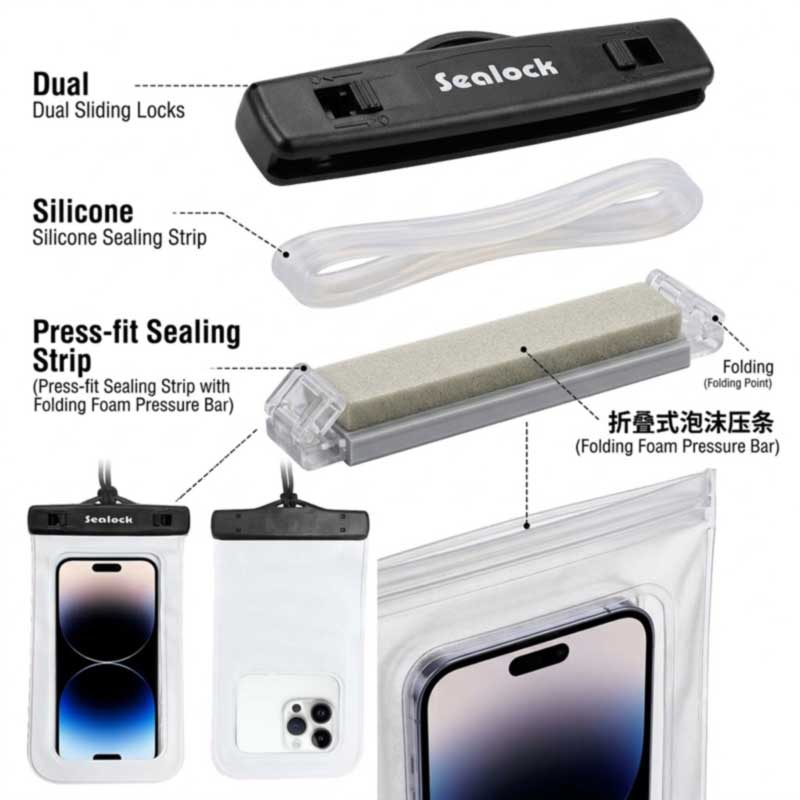
Zip-style closures alone don't get there under pressure; gasket-sealed lock systems do. Sealock builds three, each a different answer to the same problem:
1. Dual Slide Lock with a Silicone Sealing Strip
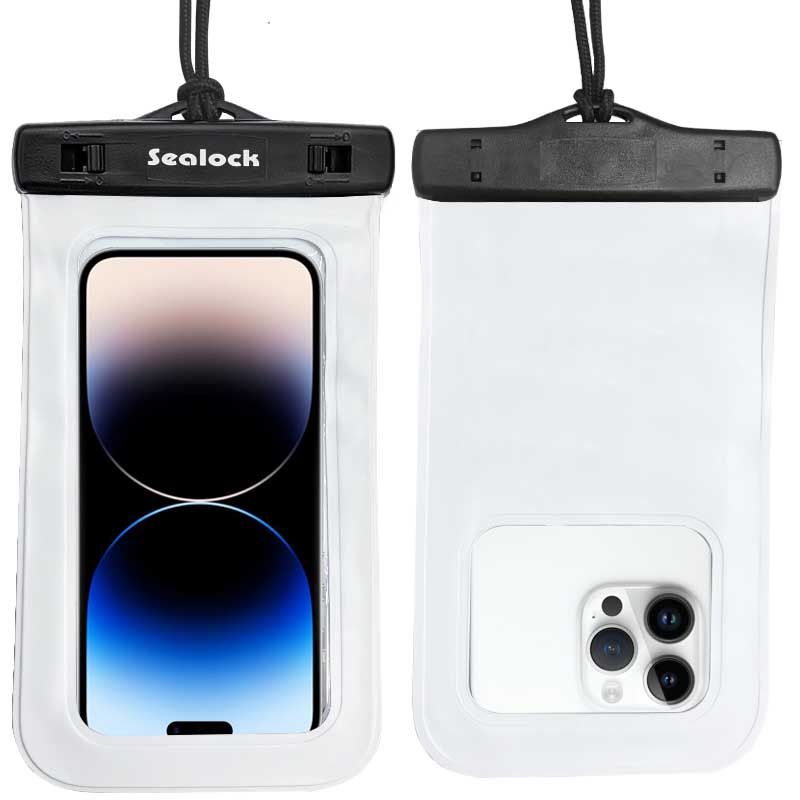
Two independent sliding locks clamp the mouth against a waterproof silicone strip, compressing the gasket evenly across the full width. The silicone provides the sealing elasticity; the ABS engineering-plastic locks provide the clamping force and hold it. This is the architecture of the SL-A064, and its advantage is redundancy — two locks mean no single point of release.
2. Press-Seal Strip plus a Fold-Over Foam Compression Bar
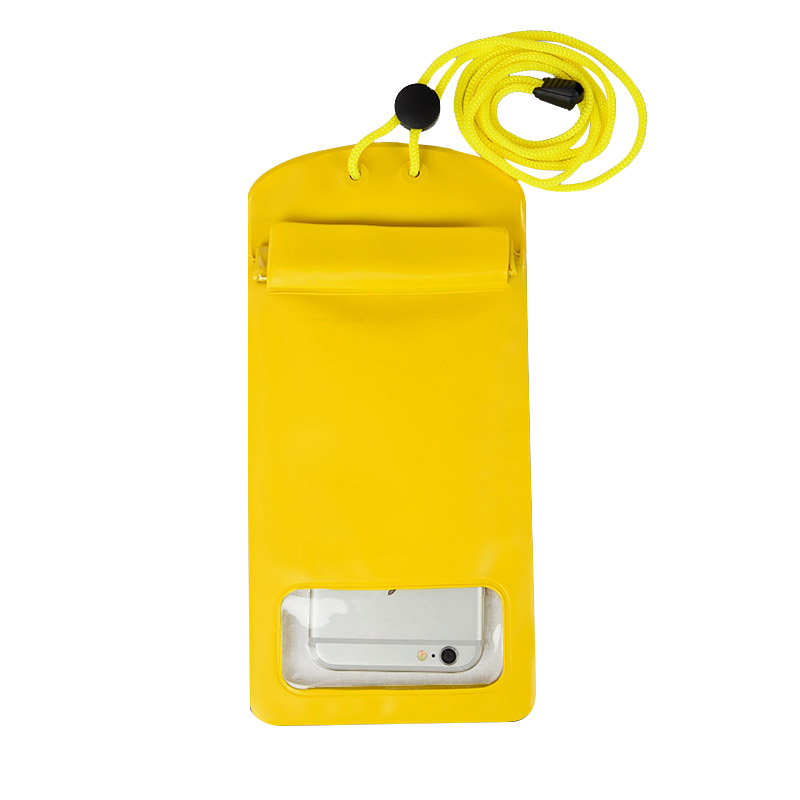
A press-together sealing strip closes the opening, then the top folds over and a foam compression bar clamps down on the fold. The seal is therefore made twice, by two different mechanisms, so a marginal press-seal is still backed by mechanical compression on the fold. This is the SL-A101 design, and it's a genuinely dual seal rather than a single closure described as one.
3. Dual Sliding Lock with a Fold Seal
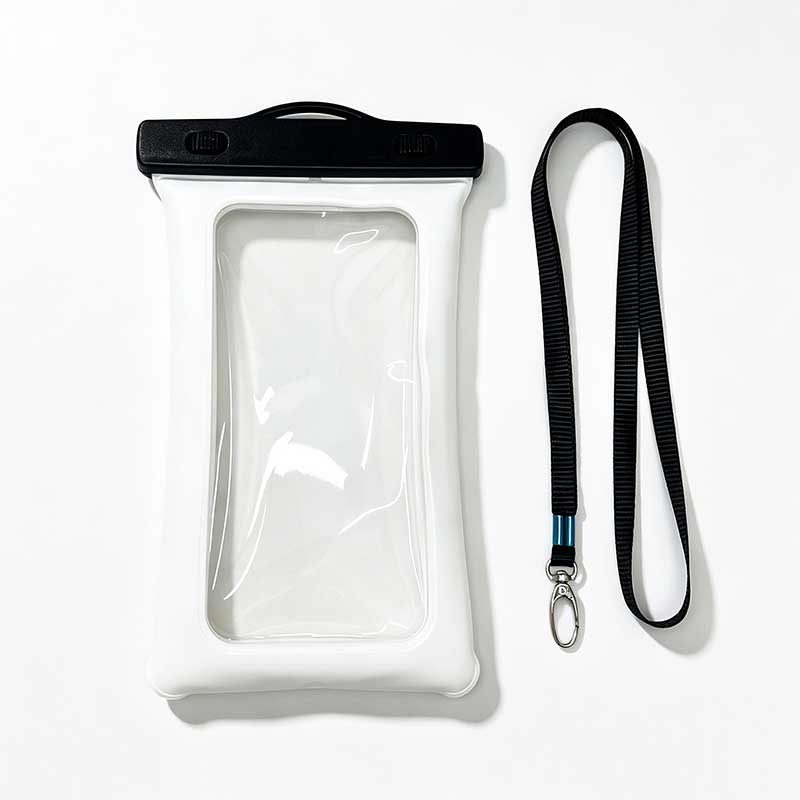
Sliding locks combined with a folded closure on a heat-sealed premium PVC body, the construction used on the SL-A082 and SL-A083, rated to 30 metres.
The common principle: a compliant gasket plus sustained, evenly distributed clamping force. Uneven clamping is the classic failure — a seal that holds at the centre and gapes at one end will pass a casual dunk and fail at depth.
Materials: Clarity, Thickness, and Hardware
Body film — high-clarity PVC gives optical quality and a stable, weldable/heat-sealable body; our lock-seal pouches run 0.30–0.35 mm, thin enough for touch response and thick enough to resist puncture.
Window film — high-sensitivity transparent film on the front for the touchscreen, and an independent rear window so the camera shoots through clean film rather than through the screen face. Underwater photography is only usable with a dedicated rear window.
Lock hardware — ABS engineering plastic, chosen for stiffness so clamping force doesn't relax, and for toughness so the lock doesn't crack under repeated closing.
Gasket — silicone or foam, selected for rebound elasticity, because a gasket that takes a permanent set stops sealing.
Temperature range — materials qualified across a working range of −20°C to 60°C, since a gasket that stiffens in cold water is a leak.
A compliant gasket and even clamping force — the whole of IPX8 in one interface.
The Dimension Problem Nobody Declares
Here is a manufacturing reality that quietly causes returns across this category: the internal usable cavity is smaller than the external dimensions, because the seal structure consumes space at the top and the compression takes width. Buyers routinely see an external figure on a listing, order to it, and find the phone doesn't fit — and independent guidance now tells shoppers to demand cavity dimensions before buying rather than trusting the outside measurement.
Sealock publishes both. The SL-A101 is 11×17.5 cm externally with an internal usable area of about 9.5×14.5 cm; the SL-A064 is about 22×11.5 cm externally with about 18.5×9 cm usable. Stating both is the honest way to specify a pouch, and for an OEM buyer it's the number that should drive the brief — write the spec against the internal cavity and the target device envelope, not the outside of the bag. Sizing decisions are covered further in our OEM waterproof phone pouch customization guide.
Buoyancy by Design
A sealed pouch traps air, and that trapped volume is what makes it float with a phone inside. Designed deliberately — rather than left to chance — it means a dropped phone stays at the surface instead of sinking. Buoyancy should be demonstrated on the sample with the target device loaded, not claimed from an empty pouch, because this is a feature buyers check and a claim the market frequently gets wrong.
What Actually Determines Consistency
Reaching IPX8 once is a design achievement; reaching it on every unit is a process achievement. Four things decide it:
Seal and weld stability — heat-seal and welding parameters held constant, with test seals before each run. A rushed cycle leaves a bond that looks finished and peels later.
Film formulation control — incoming film checked for thickness, clarity, and adhesion against the signed standard, since a batch variation changes both optics and seal behaviour.
Dimensional tolerance management — the gasket, the lock, and the mouth have to meet within a tight band for clamping to be even.
Repeatable process discipline — documented SOPs so the hundred-thousandth pouch is built the way the approved sample was.
How the Rating Is Proven
Quality is gated in three tiers — IQC (film, gaskets, and lock hardware against the signed standard), IPQC (seal integrity, window alignment, lock installation and lanyard-anchor assembly in line), and OQC (AQL sampling, immersion testing, and gold-sample comparison, with SGS or QIMA certification available — third-party IPX8 certification is what buyers increasingly ask to see).
On top of that, Sealock strictly executes the complete customer inspection procedure on finished goods: unboxing, vacuum extraction, a 24-hour static rest, and air-leak determination. This is the decisive test for an IPX8 product. A pinhole too small to fail a brief dunk will still lose vacuum over a full day, and negative-pressure testing finds the marginal seals that immersion alone lets through — which on a phone pouch is precisely the difference between a satisfied customer and a destroyed device. The lab additionally runs seal bond and peel strength, closure cycling, jerk-loading on the lanyard anchor, film clarity and abrasion, tensile, salt spray, and UV.
Honest Limits Worth Printing on the Box
A well-made IPX8 pouch still has boundaries, and stating them protects both the customer and the brand:
Seals age — gasket integrity degrades with UV exposure, temperature swings, and repeated use, and a gasket that has been compromised loses rebound elasticity permanently. Pouches are a replaceable item, not a lifetime one.
Don't dive to the rated limit — sensible guidance is to stay well inside the rated depth rather than treating it as a target.
Rinse and dry after saltwater — particles left on the sealing strip are what break the next seal.
Fingerprint unlocking doesn't work through film — touchscreen, Face ID, and calls do on our lock-seal builds.
Users should self-test — a tissue inside, sealed, submerged briefly, is a three-minute check worth recommending on the packaging.
The Product Basis
These pouches, from Sealock's waterproof phone pouch line, cover the sealing architectures above and serve as equal starting points for an OEM order — none is ranked above another:
Image
Model & specs
Seal architecture & rating
MOQ
SL-A064 Universal IPX8 Phone Pouch with Camera Window — premium PVC + ABS; external approx. 22×11.5 cm, internal usable approx. 18.5×9 cm; fits phones up to 7.0″; full touchscreen front window + independent rear camera window; Face ID supported; 60–70 g; black / frost white; 45 cm adjustable nylon lanyard.
Dual slide lock + silicone sealing strip; IPX8
300
SL-A101 Dual-Seal IPX8 Phone Pouch with Rear Camera Window — high-clarity PVC; external 11×17.5 cm, internal usable approx. 9.5×14.5 cm; fits phones up to 6.5″; high-sensitivity touch window + independent camera window; underwater photography supported; 50–60 g; yellow / black / frost white; adjustable braided lanyard.
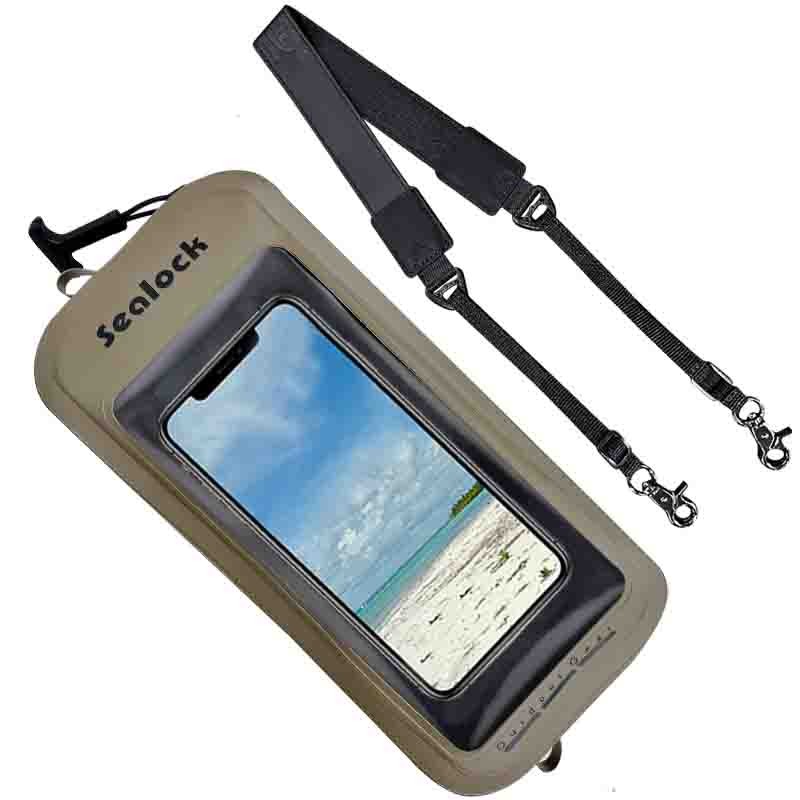
SL-A059 Waterproof Phone Pouch for Swimming — TPU composite fabric on 500D waterproof base, seamlessly welded; custom sizes; for swimming, rain, seaside, river tracing, surfing, paddleboarding and sailing.
IPX7 waterproof zipper
500
Sampling runs 7–15 days and production 30–45 days after approval, with silk-screen or UV logo printing, custom colours, and OEM/ODM development supported across all builds.
FAQ: IPX8 Pouch Manufacturing
Q: What exactly does IPX8 guarantee?
A: Continuous immersion beyond one metre, to a depth and duration the manufacturer declares. Always ask for the declared depth — an IPX8 claim without one isn't verifiable, and unstated depth is the standard overclaim in this category.
Q: Why can't a zipper alone reach IPX8?
A: Under sustained pressure a gasket-sealed lock system distributes clamping force far better than a zip-style closure. Our IPX8 builds use silicone or foam gaskets clamped by ABS locks or a fold-over compression bar; the zipper builds are rated IPX7.
Q: Why is the internal space smaller than the external size?
A: Because the seal structure and its compression consume space at the top and sides. That's why we publish both figures — the SL-A101 is 11×17.5 cm outside with about 9.5×14.5 cm usable. Always specify against the internal cavity.
Q: How do you keep the rating consistent across a large order?
A: Seal parameter stability with test seals each run, incoming film control for thickness and adhesion, tight dimensional tolerance on the gasket and lock, and documented SOPs — then vacuum-and-hold leak determination on finished goods.
Q: Can we get third-party certification?
A: Yes — SGS or QIMA inspection and certification can be arranged, and buyers increasingly expect an IPX8 claim to come with a test report they can see.
Q: How long does an IPX8 pouch last?
A: Seals degrade with UV, heat cycling, and use, and a compromised gasket doesn't recover its elasticity. Treat pouches as replaceable, recommend rinsing and drying after saltwater, and put a simple tissue-and-dunk self-test on the packaging.
Talk to the Factory
To develop or manufacture an IPX8 waterproof phone pouch, contact Sealock at info@sealock.com.hk or +86-769-82009361. Over twenty years in welded and heat-sealed waterproof products, three IPX8 sealing architectures, published internal cavity dimensions, and a full customer inspection procedure on every shipment.
We use cookies to offer you a better browsing experience, analyze site traffic and personalize content. By using this site, you agree to our use of cookies.
Privacy Policy
 English
  Español
  Português
  русский
  Français
  日本語
日本語  Deutsch
  tiếng Việt
  Italiano
  Nederlands
  ภาษาไทย
  Polski
  Svenska
  magyar
  Malay
Malay  বাংলা ভাষার
  Dansk
Dansk  Suomi
Suomi  हिन्दी
  Pilipino
  한국어
한국어  Türkçe
  Gaeilge
  العربية
  Indonesia
  Norsk
Norsk  تمل
تمل  český
český  ελληνικά
  український
  Javanese
  فارسی
فارسی  தமிழ்
தமிழ்  తెలుగు
  नेपाली
  Burmese
  български
  ລາວ
ລາວ  Latine
  Қазақша
  Euskal
  Azərbaycan
  Slovenský jazyk
  Македонски
  Lietuvos
  Eesti Keel
  Română
  Slovenski
  मराठी
मराठी  Srpski језик