Second in a series from the Sealock lab: the small machine that rubs a white cloth against your bag and grades what comes away
DONGGUAN, China — [August], 2026 — Here's a complaint no factory wants to receive. The bag is fine. It's welded, it's sealed, it holds water out exactly as promised. The problem is the customer's white t-shirt, which now has a faint stripe of the bag's colour across the back — and the passenger seat of their car, which has a matching one.
Colour transfer is a small failure with a long tail. It doesn't stop the product working, so it never shows up in a waterproof test or a load test, and it's almost never specified in a purchase order. It just quietly turns a good product into a returned one. The machine in this article exists to catch it before it ships.
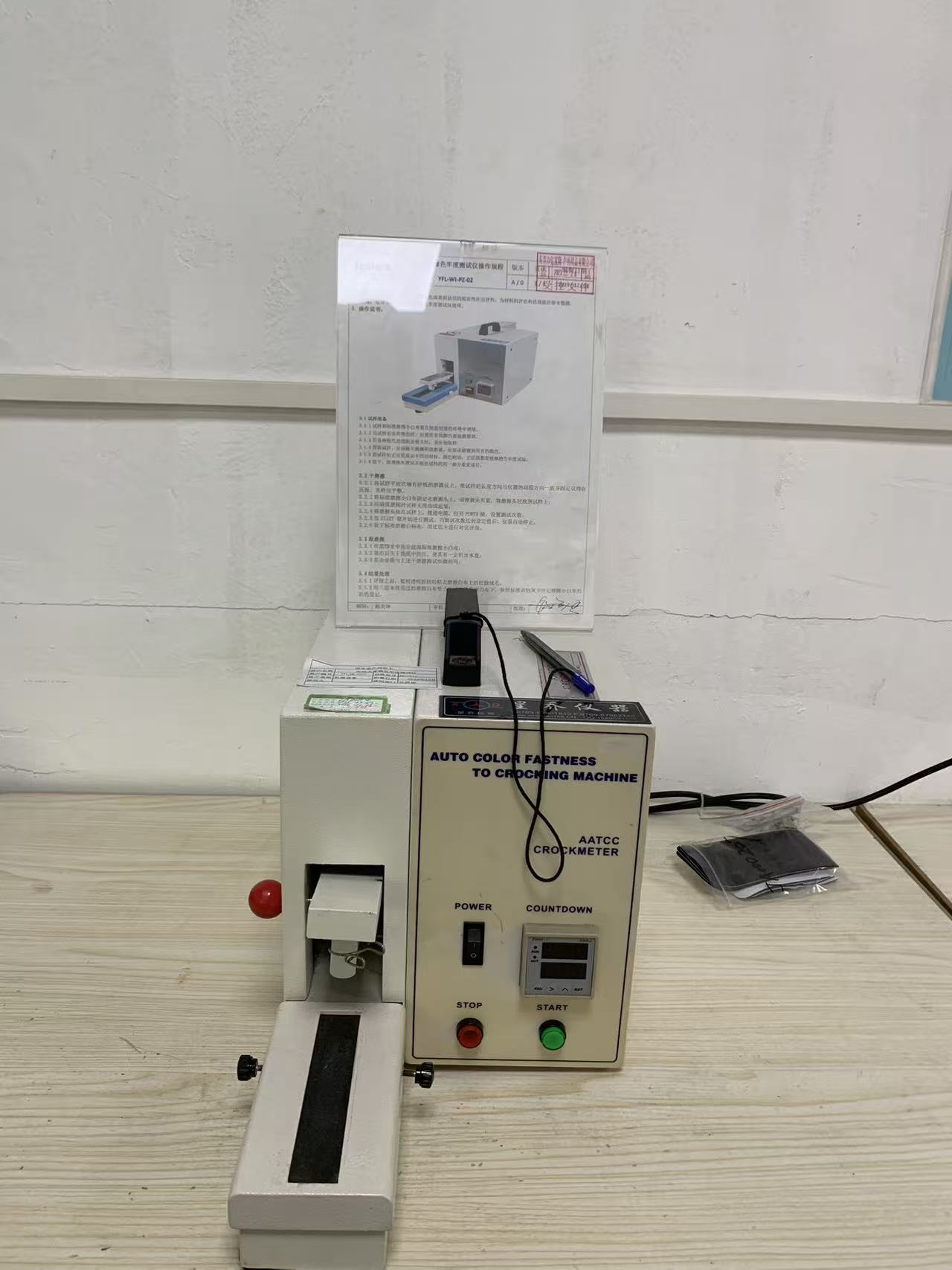
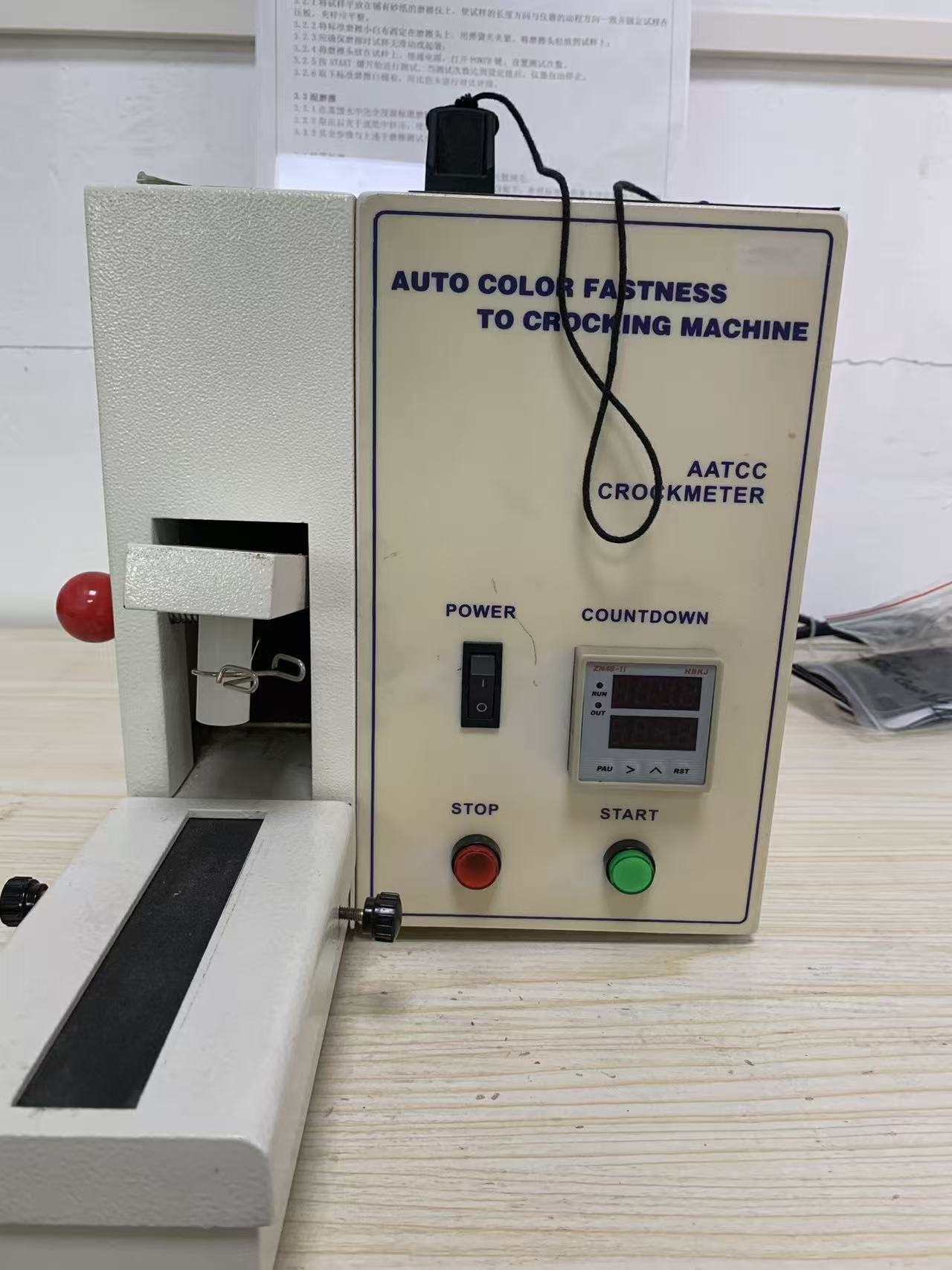
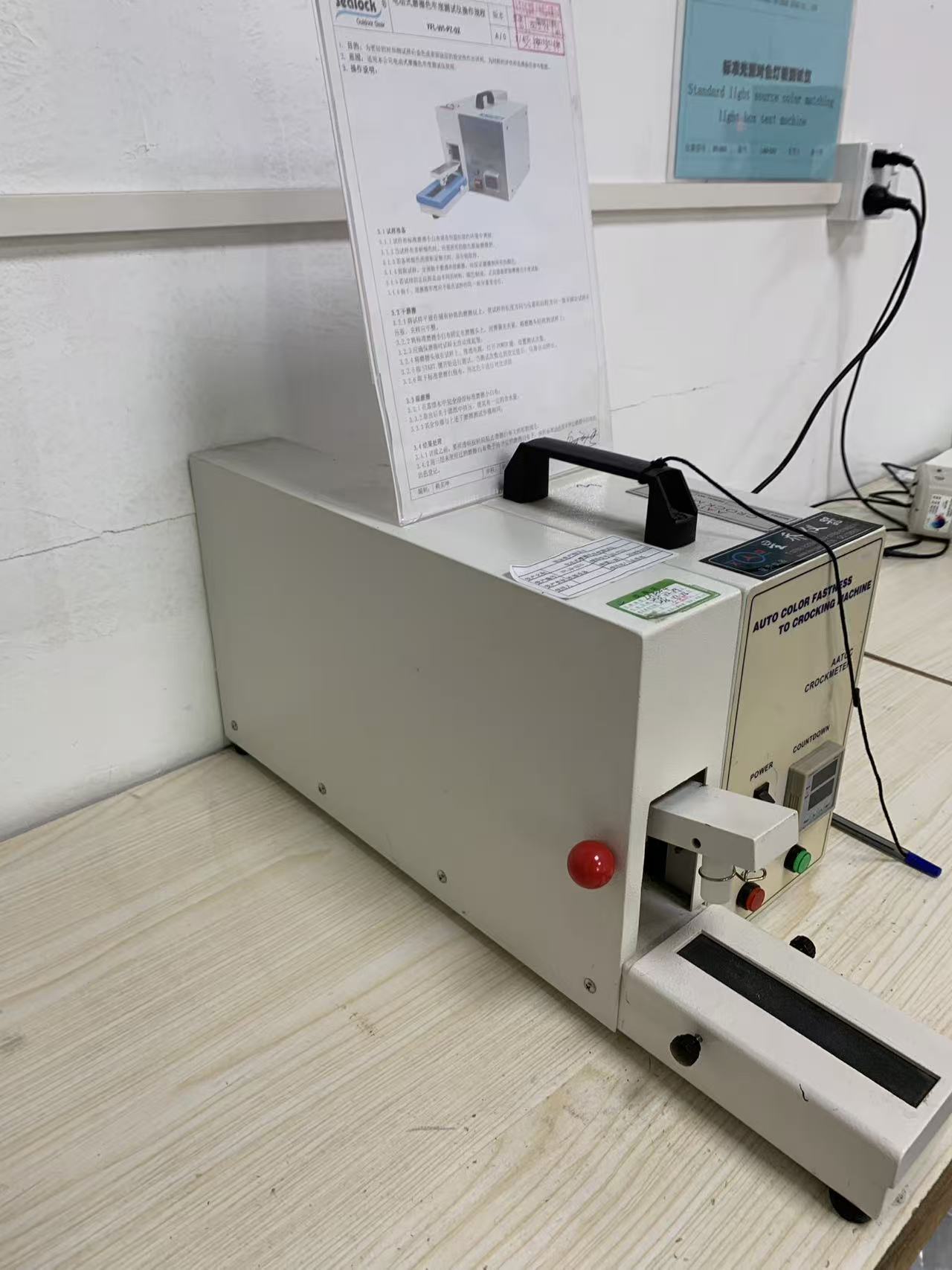
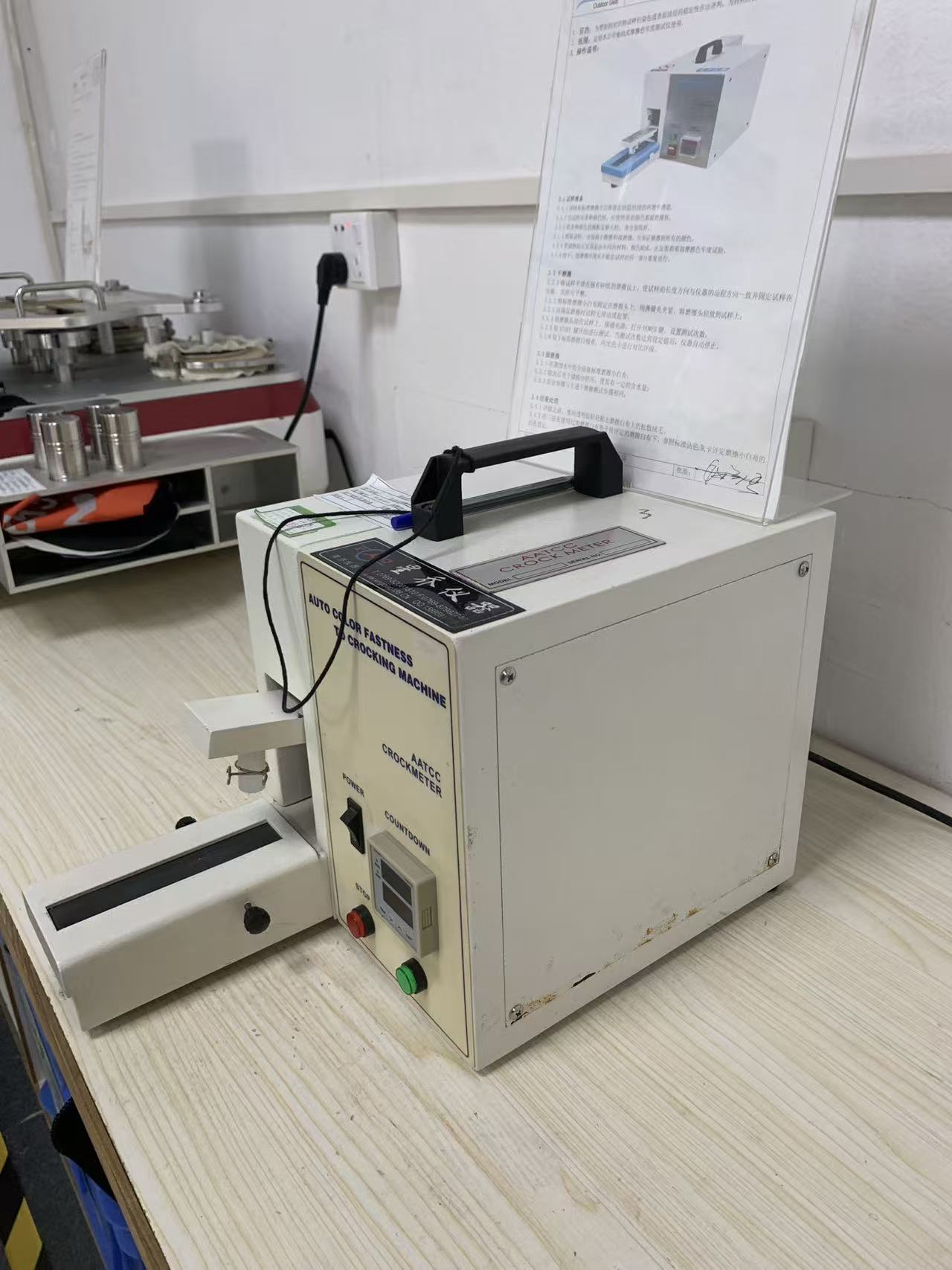
The motorized crockmeter in Sealock's lab, with its controlled operating procedure posted at the machine.
What crocking actually is
"Crocking" is the industry word for colour rubbing off a surface onto something else through friction. It's distinct from fading, which is what light does over time, and from bleeding, which is what water and washing do. Crocking is purely mechanical: contact plus movement equals pigment on the other object.
It matters more for our products than people expect, for three reasons. First, waterproof gear lives against other things — a dry bag rides against a jacket, a cooler sits on a car seat, a swim buoy trails against a swimsuit, a shoulder strap rubs one spot on a shirt for an entire hike. Second, this category loves saturated colour: high-visibility neons, bold camo prints, deep blacks. High pigment load is exactly where crocking problems live. Third, coated fabrics behave differently from woven textiles here — the colour may sit in a surface coating or a printed layer rather than being dyed into a fibre, and a surface layer has a much shorter path to somebody's clothing.
So we test it, on the material and on the finished surface, before a colour is approved for a program.
How the test works
The method is disarmingly simple, which is why it's trusted. A specimen is laid flat and clamped on a bed lined with sandpaper — the sandpaper is there to stop the fabric sliding, not to abrade it. A standard white cotton crock cloth is mounted on a weighted rubbing finger and lowered onto the specimen. The machine then strokes that finger back and forth along a fixed path for a set number of cycles and stops itself automatically.
Then you take off the little white cloth and look at it. Whatever colour has come away from the product is now sitting on that white square, and the amount of it is the result. Grading is done against a standard grey scale for staining, from 5 (no transfer, indistinguishable from clean) down to 1 (heavy transfer). No sensors, no data logging — a human eye against a calibrated reference, which for colour remains the most reliable instrument there is.
The rubbing finger and the sandpaper-lined bed — the sandpaper grips the specimen, it doesn't abrade it.Cycle count is set on the counter; the machine stops itself at the number rather than when someone decides it's enough.
Dry, then wet — and wet is the honest one
Every colour gets tested twice. Dry crocking uses the white cloth as it is. Wet crocking soaks that cloth in distilled water, squeezes it between filter paper to a controlled moisture content, and then runs the identical test.
Wet results are almost always worse, sometimes dramatically so, and that's precisely why the wet test is the one that matters for our category. A dry-crocking pass tells you how the product behaves in a showroom. Our products are used wet by definition: a cooler sweating with condensation against a car seat, a dry bag dragged out of a river onto someone's lap, a swim buoy against skin and swimwear, a strap soaked with rain and body heat pressing on a shirt for hours. If a colour only survives dry, it hasn't survived anything a customer will actually do to it.
The procedure also insists that dry and wet tests are never run on the same part of a specimen. Sounds pedantic. It isn't: the first rub removes the loosest surface pigment, so a second test in the same spot would report a flatteringly clean result that no customer will ever experience.
The details that make the result real
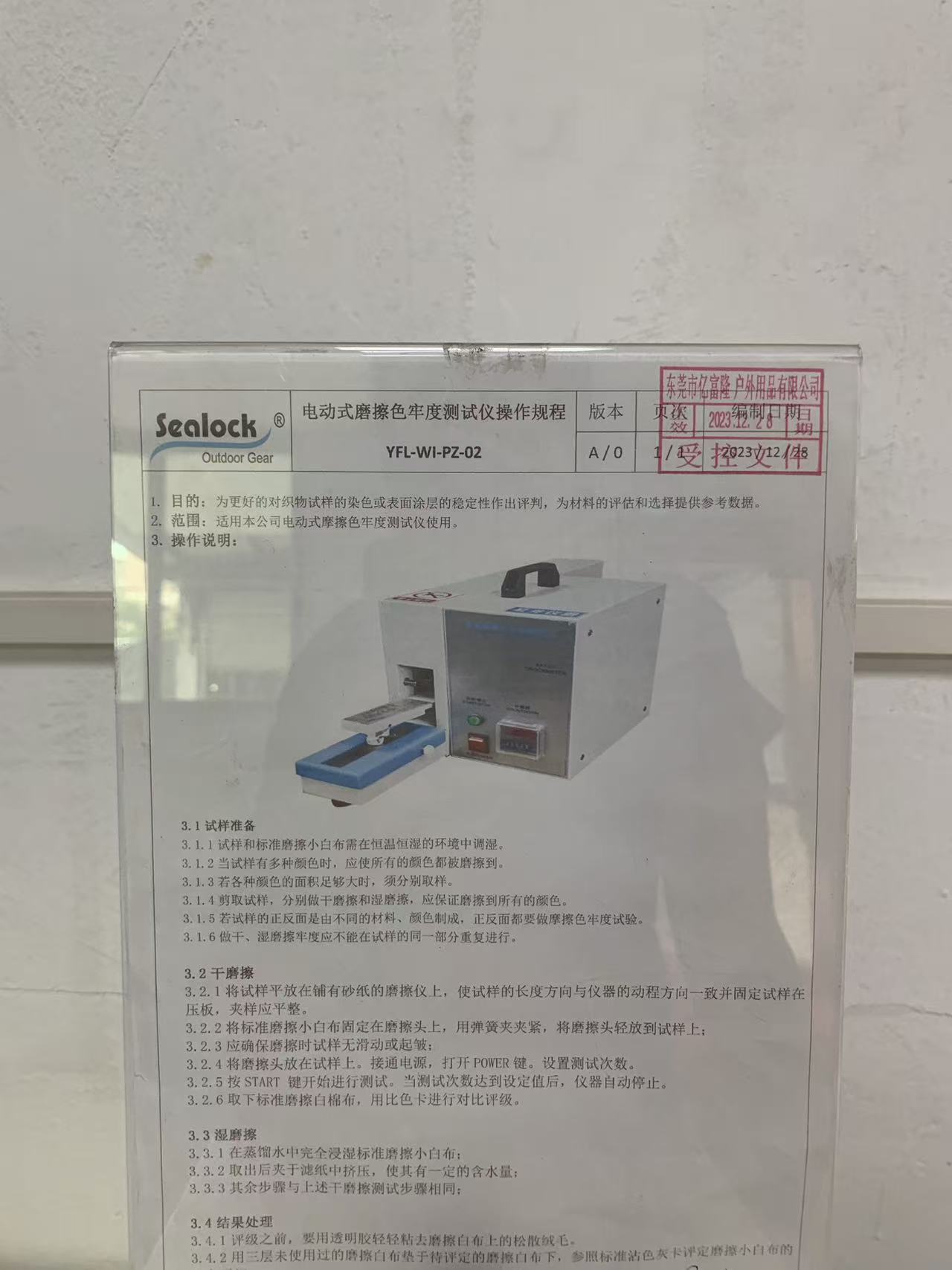
Like the abrasion tester in the first article of this series, this machine runs to a controlled procedure — document YFL-WI-PZ-02, revision A/0 — with a named author, reviewer and approval. A few of its rules are worth reading closely, because each one exists to close a specific way of accidentally lying to yourself:
Condition the specimen and the crock cloth first. Both are held in a controlled temperature and humidity environment before testing. Fabric and cotton both pick up moisture from the air, and moisture changes how pigment transfers. Testing straight off a hot shelf gives you a number about the weather.
Test every colour, not the convenient one. On a multi-colour print, all colours must be rubbed — and where a colour block is large enough, it gets its own separate specimen. It is very easy to test a camo print's dominant background, pass it, and ship a product whose bright accent colour is the one that bleeds.
Test both faces when they differ. If the front and back of a material are different materials or different colours, both get crocked. On a lined bag, the inner face is the one that spends its life against the customer's belongings.
Clean up the cloth before grading. Loose fibres are lifted off the crock cloth with clear tape first, so you're grading colour transfer rather than fluff.
Back the cloth with three unused layers when grading. A thin white cloth over a dark bench reads darker than the same cloth over white. Standardising what's underneath is the difference between grading the stain and grading the table.
None of these are clever. All of them are the difference between a number and a guess.
The sticker that makes the number mean anything
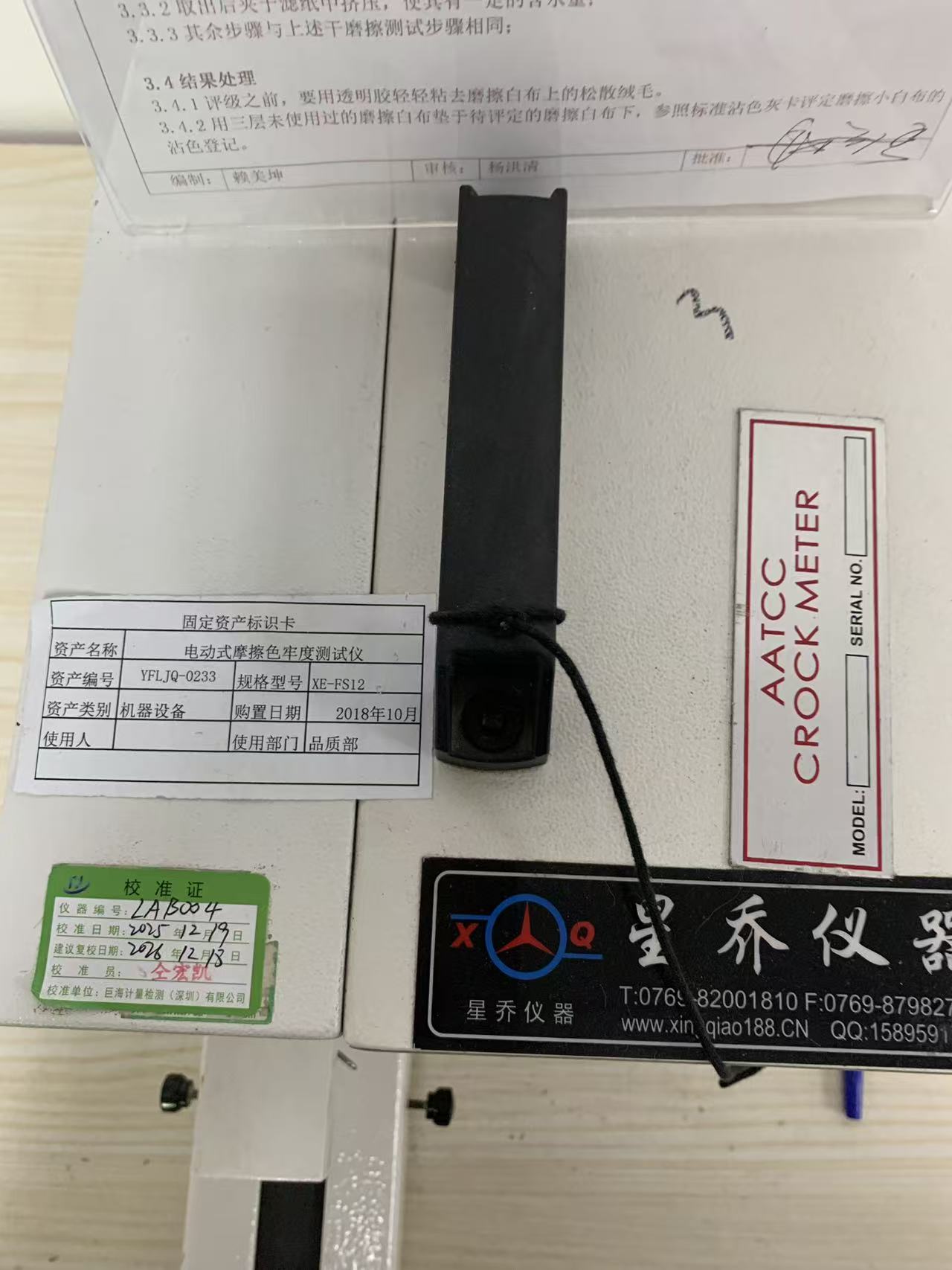
On the side of this machine are two small labels most visitors walk straight past, and they are arguably the most important thing in this article.
The first is an asset card: the instrument is registered as company asset YFLJQ-0233, model XE-FS12, purchased in October 2018, assigned to the quality department. It has an owner and a history.
The second is a calibration certificate label. This unit is lab instrument LAB004; it was calibrated by an independent calibration house on 19 December 2025, with the next calibration due 18 December 2026. In other words: an outside party verified that this machine applies the load it's supposed to apply and moves the distance it's supposed to move, on a documented annual cycle, and the certificate is currently in date.
This is the part of a testing programme that's easy to skip and impossible to fake convincingly. Any workshop can buy a crockmeter and produce a grade-4 result. A calibrated instrument, with an asset number, a scheduled recalibration date and an external certificate behind it, is what turns that grade-4 into something a customer can rely on — and what makes it comparable to the grade-4 their third-party lab reports next quarter. Uncalibrated equipment doesn't produce wrong answers loudly. It produces confident ones.
Asset card and calibration label: registered, owned, externally calibrated and dated for recalibration.The controlled procedure covering specimen conditioning, dry crocking, wet crocking and grading.
What we do with a bad result
A poor crocking grade isn't automatically a rejected material — it's information, and it usually points somewhere specific. Excess surface pigment that was never properly fixed can often be resolved by the mill. A print layer that transfers may need a different ink system or a topcoat. A deep saturated colour may simply carry a floor below which it cannot practically go, in which case the honest move is to tell the customer that before production rather than after, and let them decide between the colour they want and the performance they need.
Occasionally the answer is a design change instead of a material change: move the untested-but-worst colour off the shoulder strap and the back panel, where a bag spends its life pressed against clothing, and the same material becomes perfectly acceptable in a location that doesn't rub against anyone.
What we try never to do is find out from a customer's photograph.
Why it sits in our building
A crockmeter is not an expensive machine. That's rather the point. For the cost of a single returned shipment, a factory can own one, write a procedure for it, have it calibrated annually and run every new colour through it as a matter of course — which is exactly why it's telling when a supplier doesn't. Colour approval is one of the fastest-moving parts of a development program: samples land, the customer picks a shade, production is waiting. A test you can run this afternoon gets run. A test that means couriering swatches to a third-party lab and waiting ten days gets skipped, quietly, by someone under deadline pressure.
Next in this series: the standard light source colour-matching box sitting a metre from this machine — because before you can judge whether two colours match, or how badly a white cloth has stained, you have to agree on what light you're looking at them under.
One small machine, one white cloth, and a question worth asking before the customer does.
About Sealock
Sealock (Dongguan Yifulong Outdoor Products Co., Ltd.), founded in 2003, is a manufacturer of high-frequency welded waterproof bags, soft-sided cooler bags and inflatable water gear, with production bases in Dongguan, China and Ho Chi Minh City, Vietnam. The company operates an in-house testing laboratory with externally calibrated instruments and controlled operating procedures, supporting material approval, product development and production quality control for OEM and ODM programs worldwide. Its systems and certifications include ISO 9001, BSCI, SMETA and GRS.
We use cookies to offer you a better browsing experience, analyze site traffic and personalize content. By using this site, you agree to our use of cookies.
Privacy Policy
 English
  Español
  Português
  русский
  Français
  日本語
日本語  Deutsch
  tiếng Việt
  Italiano
  Nederlands
  ภาษาไทย
  Polski
  Svenska
  magyar
  Malay
Malay  বাংলা ভাষার
  Dansk
Dansk  Suomi
Suomi  हिन्दी
  Pilipino
  한국어
한국어  Türkçe
  Gaeilge
  العربية
  Indonesia
  Norsk
Norsk  تمل
تمل  český
český  ελληνικά
  український
  Javanese
  فارسی
فارسی  தமிழ்
தமிழ்  తెలుగు
  नेपाली
  Burmese
  български
  ລາວ
ລາວ  Latine
  Қазақша
  Euskal
  Azərbaycan
  Slovenský jazyk
  Македонски
  Lietuvos
  Eesti Keel
  Română
  Slovenski
  मराठी
मराठी  Srpski језик