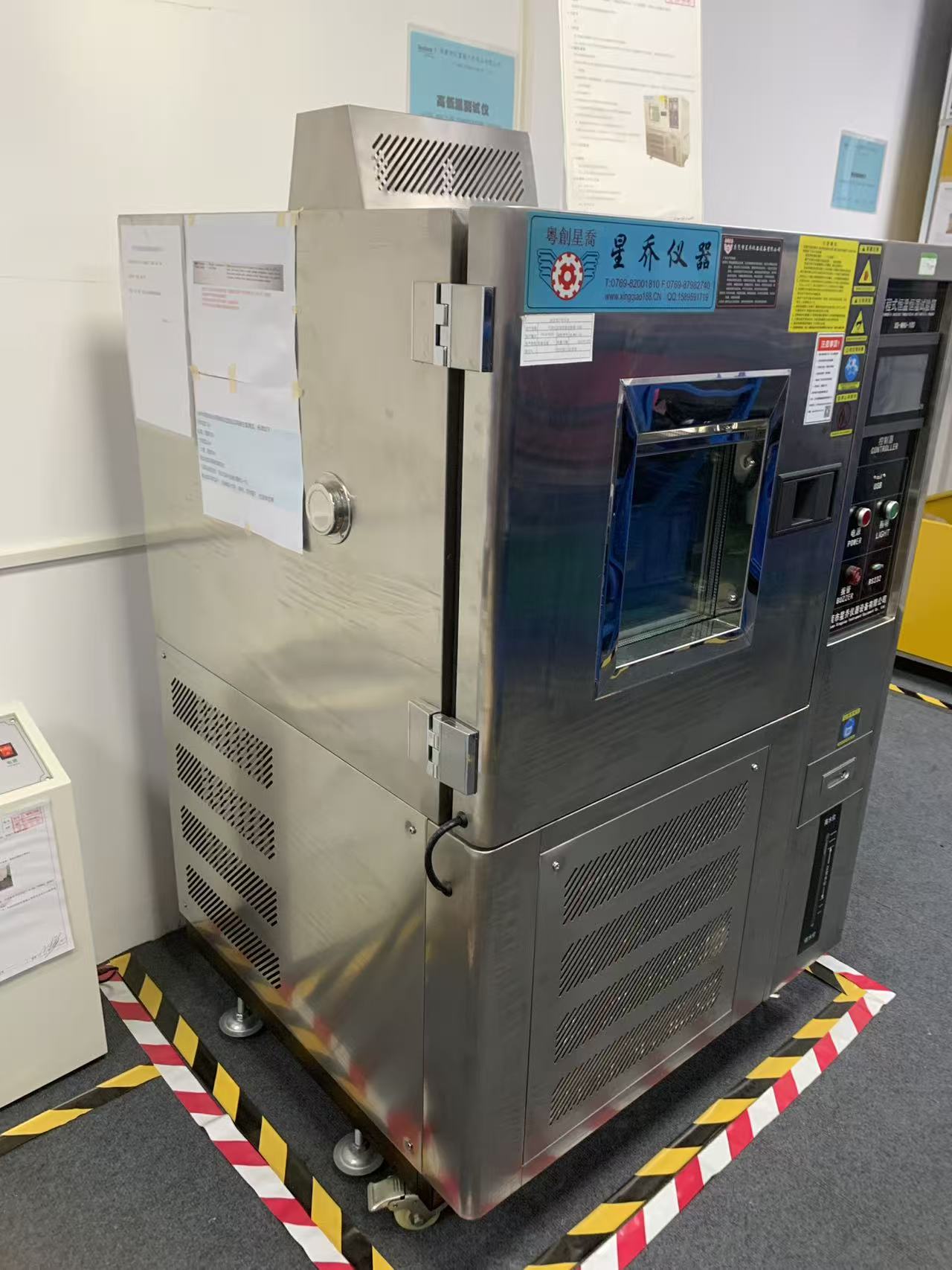
Fifth in a series from the Sealock lab: the temperature and humidity chamber, where a product lives through a brutal year in three days
DONGGUAN, China — [August], 2026 — Every test in this series so far has attacked a product in a single, obvious way: rub it, pull it, cycle it, peel it apart. Each answers a mechanical question, and each gives you an answer the same afternoon.
This machine is different. It doesn't touch the product at all. It just puts it in a stainless steel box, seals the door, and then changes the weather — hot and humid, hot and dry, then cold — and leaves it there for three days. Nothing visibly happens. That's the point. What it's testing for is the class of failure that never announces itself, and that no mechanical test will ever find.
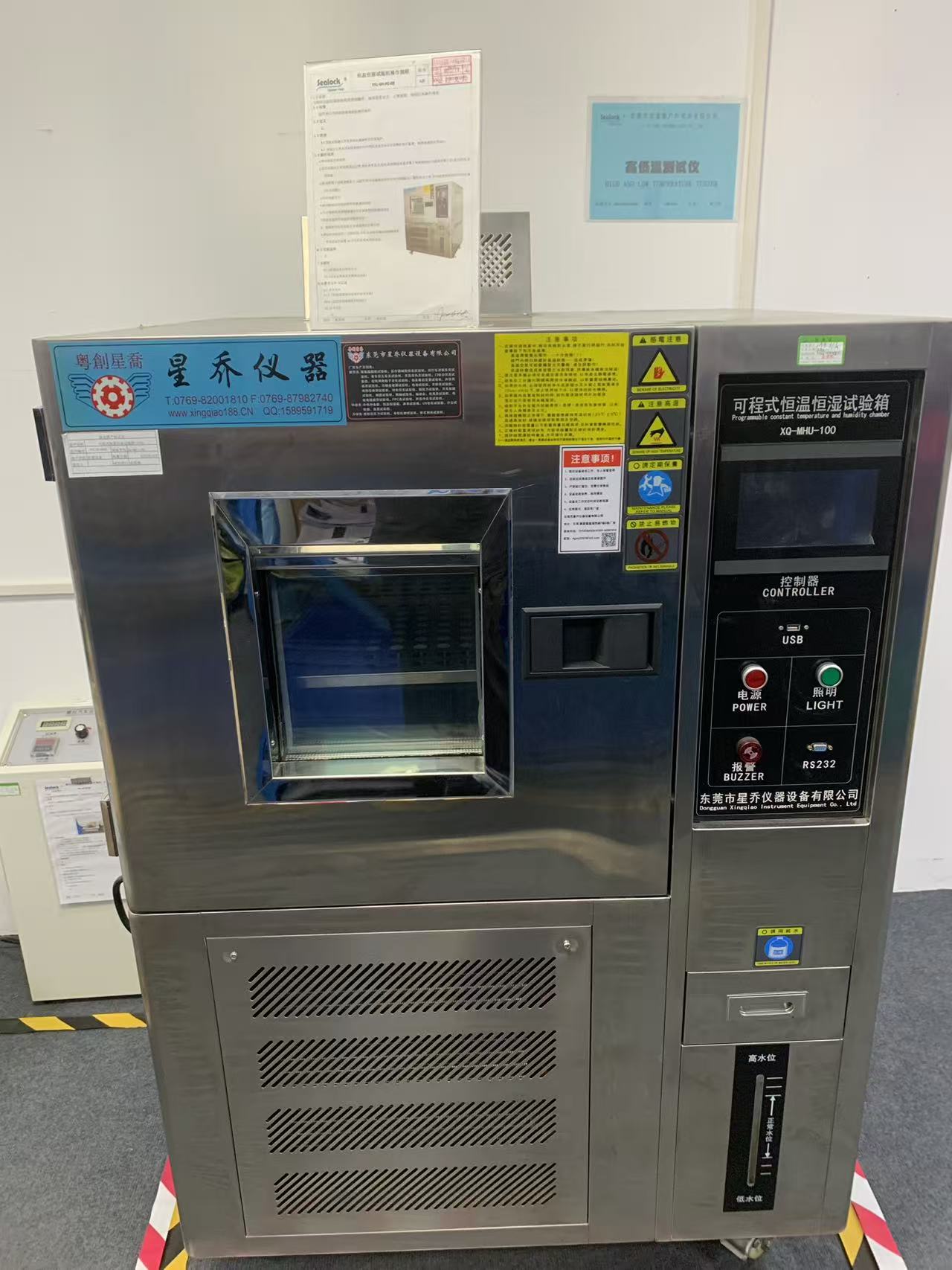
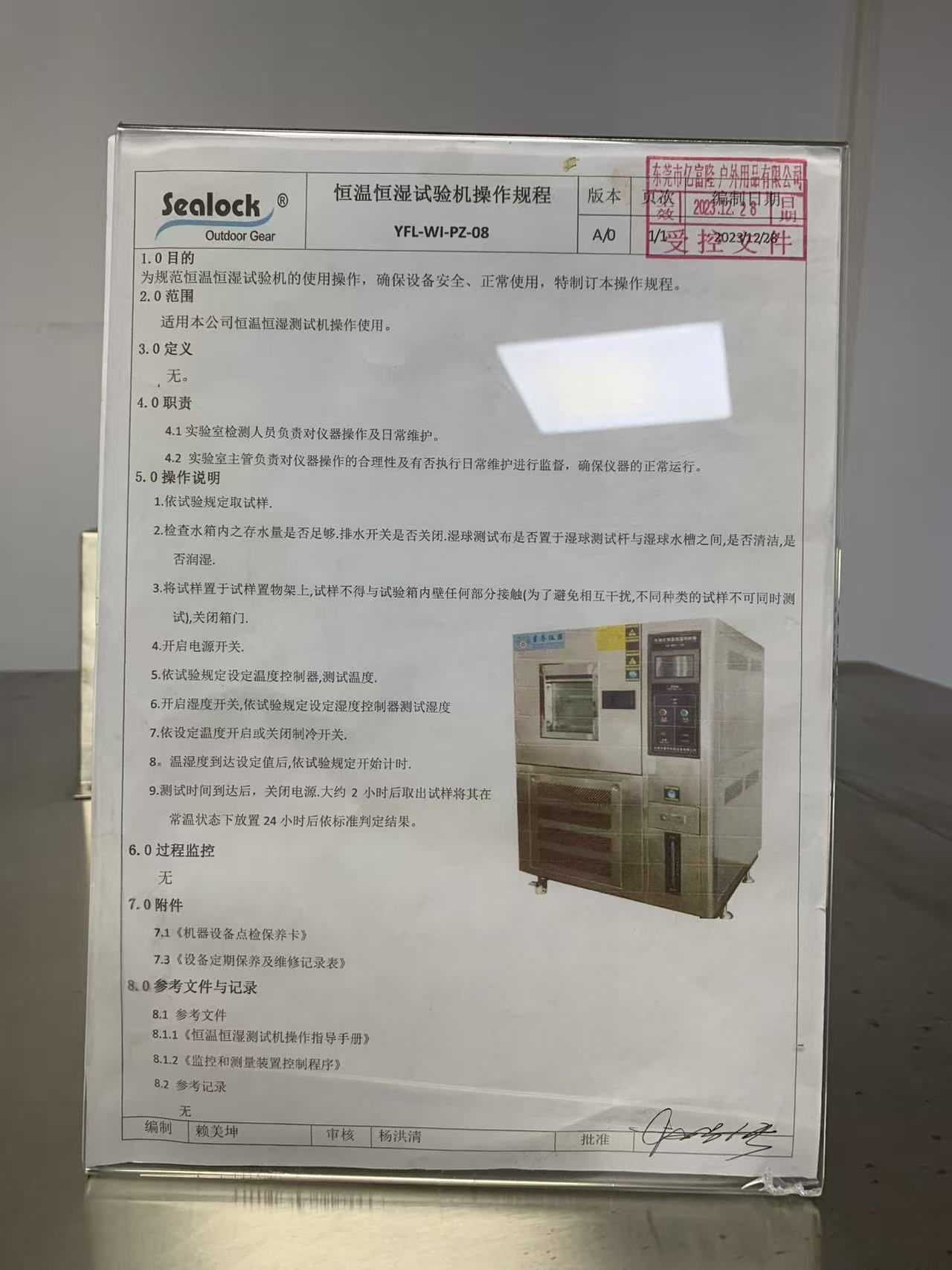
The programmable temperature and humidity chamber, with its controlled procedure posted above.
The failure mode nobody tests for
Here is how a waterproof bag actually reaches a customer. It's welded in Dongguan in summer. It's packed and sealed into a steel container. That container sits on a wharf in the sun — where internal temperatures routinely run far above ambient — then spends weeks crossing an ocean, then sits in another yard, then in a warehouse, then possibly in a retail stockroom, before anyone opens it. Along the way it goes through repeated heating and cooling cycles, and the humidity inside a sealed container swings wildly as the air heats, holds moisture, then condenses on cooling.
Then it gets used: left in a car in August, taken onto a boat in the tropics, thrown in a garage over a freezing winter, packed away damp.
Not one of those conditions rubs, pulls or cycles anything. And yet this is where a distressing share of real-world failures come from — because heat, moisture and cold don't attack a product mechanically. They attack it chemically and dimensionally, at exactly the joints and interfaces our products depend on:
Adhesive and bond degradation. Heat plus humidity is the classic accelerant for hydrolysis in polyurethane systems. A bond that measured perfectly on the peel tester can weaken over weeks in a hot, wet container — and the customer opens a box of bags whose seams have quietly lost their strength.
Differential expansion. A welded seam joins two materials; a zipper joins a rigid component to a flexible one; a window joins a clear film to a coated fabric. Every one of these interfaces experiences stress when the parts either side expand and contract at different rates. Cycle that enough times and stress becomes separation.
Cold embrittlement. Coatings and plasticised films that are supple at 25 °C can stiffen at 0 °C and below. A zipper coating that cracks in the cold, or a fold line that goes brittle, is a leak that only exists in winter — and only shows up after the product has shipped.
Blocking and print transfer. Heat plus pressure plus time is how surfaces stick to each other. A bag folded against itself in a hot container can emerge with its print marked, its coating tacky, or its faces bonded where they touched.
Colour and gloss shift. Heat alone will move some colours over time — which becomes a matching problem when the customer compares the shipment against the approved sample.
All of these are invisible on day one and expensive on day ninety. The chamber's job is to move day ninety forward to this week.
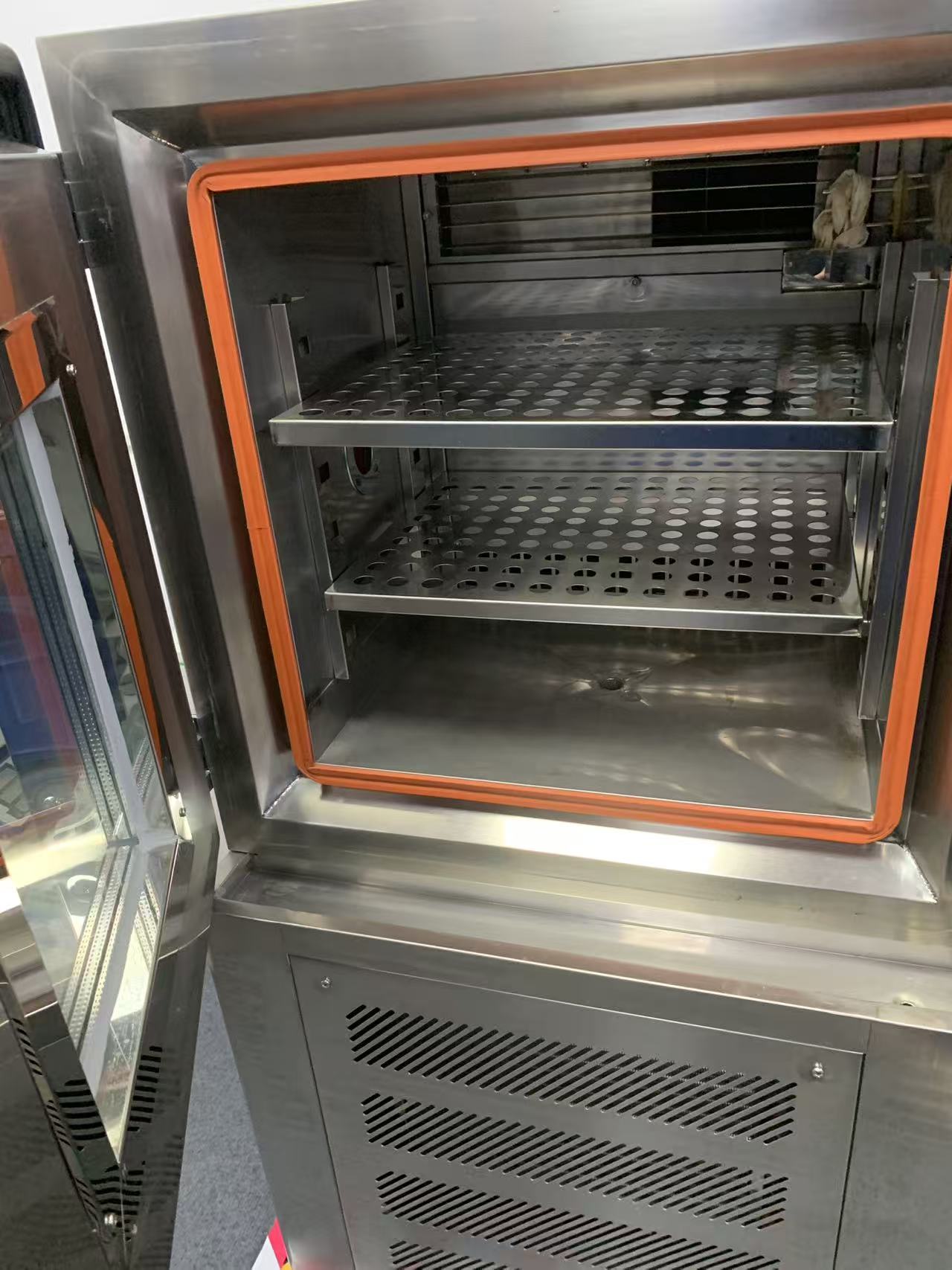
Inside: perforated shelves and a gasketed door, so conditioned air circulates freely around the specimen.A programmable controller runs the profile automatically — including the overnight and weekend hours nobody is here for.
A real profile: 72 hours, three conditions
Chamber testing is only meaningful if someone has decided what conditions to run and for how long. Those decisions usually come from the customer, and the more demanding the brand, the more specific they get.
One standard we run — set by a major global drinkware brand and posted at the machine — is a 72-hour combined high- and low-temperature sequence:
24 hours at 54 °C, 95 % RH — hot and saturated. This is the container-in-the-tropics condition, and the one that goes after adhesives and laminations.
24 hours at 54 °C, 30 % RH — hot and dry. Same heat, almost no moisture. This isolates thermal effects from humidity effects, and reproduces a desert warehouse or a car interior.
24 hours at 0 °C — cold. Where coatings stiffen, plasticisers migrate and brittle failures show up.
Running hot-wet and hot-dry as separate 24-hour blocks rather than one combined soak is a deliberately good piece of test design: if the product fails, you know whether moisture or heat did it, which tells you whether to change the adhesive system or the material. A single mixed condition would tell you only that something went wrong.
Other customers specify their own envelopes — some considerably harsher, running three days hot at 65 °C and a day at −15 °C. The chamber is programmable, so it runs whichever standard the program calls for. A house standard is our floor; the customer's specification is the one we test to.
The 24 hours after the door opens
The most easily overlooked line in the controlled procedure — YFL-WI-PZ-08, revision A/0 — is the last one, and it's the one that separates a real chamber test from theatre:
When the test time is complete, switch off the power. After approximately two hours, remove the specimen, leave it at room temperature for 24 hours, and only then judge the result against the standard.
Two waiting periods, both mandatory, both about not fooling yourself. The first — two hours before opening — lets the chamber return toward ambient rather than dumping hot saturated air into the room or thermally shocking the specimen on the way out. The second, and more important: you do not grade a specimen while it is still hot or still cold.
A material fresh out of 54 °C is soft, and a bond that's about to fail may still feel fine while warm. A specimen straight from 0 °C is stiff, and will look worse than it really is. Both mislead. Twenty-four hours at room temperature lets the material recover whatever it's going to recover — and what's left after that recovery is the permanent damage, which is the only thing worth reporting. Judge it early and you'll pass products that shouldn't pass and reject ones that should.
It's the same discipline as the wet-felt rule in the abrasion article and the three-layer backing rule in the crocking one. The pattern across this whole lab is the same: the procedures aren't mainly about operating machines. They're about the specific ways a test can produce a confident, plausible, wrong number.
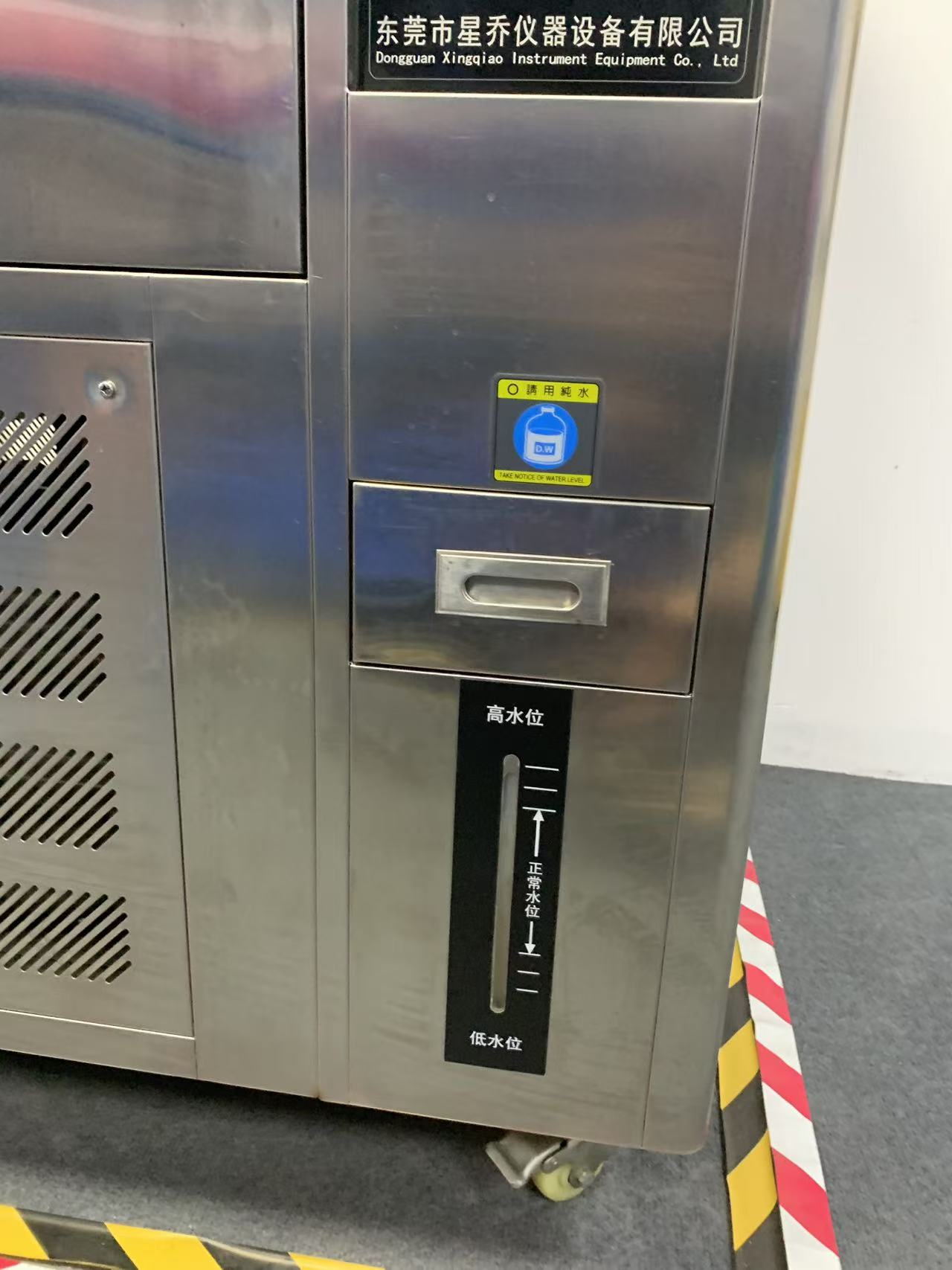
The controlled procedure — including the two-hour and 24-hour waiting periods before a result may be judged.The humidity system runs on pure water only — tap or ground water would scale the system and corrupt the readings.
The details that keep the conditions honest
A chamber is only as good as the conditions it actually holds, and several procedural rules exist purely to protect that:
Check the water and the wet-bulb wick before starting. Humidity here is measured by the wet-bulb method: a gauze wick runs from a water trough to the sensor, and evaporation from it gives the reading. If that wick is dry, dirty or badly seated, the chamber will confidently control to a humidity that isn't the humidity in the box.
Pure or distilled water only, with conductivity below the specified threshold. Tap or ground water scales the humidification system and shifts its behaviour over time.
Specimens must not touch the chamber walls, and different types of specimen must not be tested together. Contact with a wall means the specimen is being conditioned by conduction rather than by the controlled air; mixed specimens can outgas and contaminate each other.
Don't overfill the chamber. Loading affects airflow, and airflow is what makes the set point true at every point in the box rather than only at the sensor.
Don't open the door mid-test. Beyond the safety issue — hot saturated air escaping, hot interior surfaces, and at low temperature, ice forming on the evaporator — every door opening is a discontinuity in a profile that's supposed to be continuous.
Keep the lab itself at 25 ± 5 °C with good ventilation. A chamber fighting an uncontrolled room is a chamber with less margin than its specification suggests.
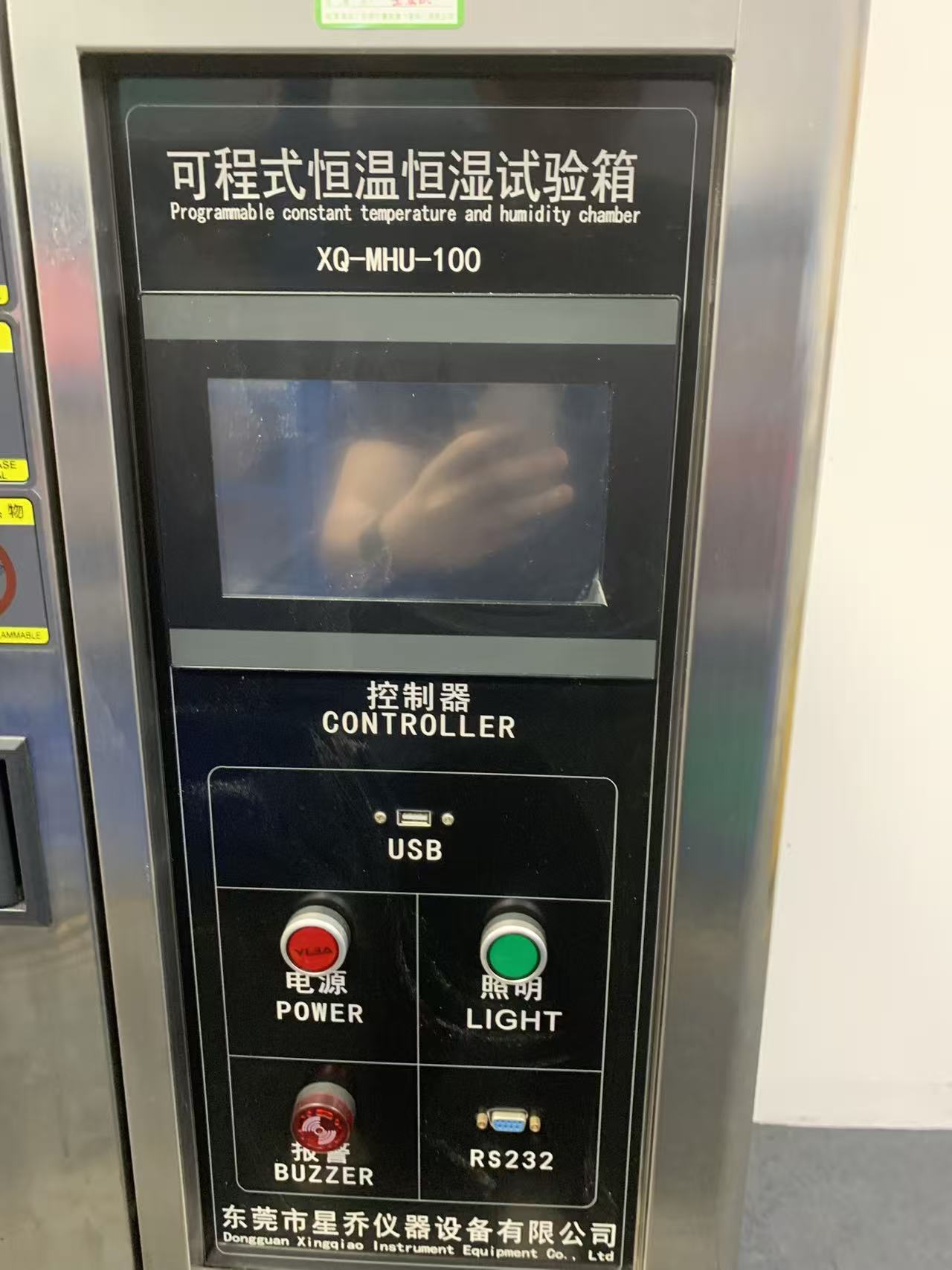
The machine is registered as company asset YFLJQ-0250, a 100-litre programmable temperature and humidity chamber, model XQ-MHU-100, purchased in December 2023 and assigned to the quality department, and carries lab instrument number LAB-012 with a calibration label on the panel.
What it's actually used for
Day to day, this chamber answers questions that would otherwise only be answered by a shipment:
Pre-shipment validation. Before a program goes into mass production, sample units run the customer's profile so we know the design survives transit and storage — not just the showroom.
Adhesive and material qualification. When a bonding system or a coated fabric is a candidate, heat-humidity ageing is the honest test of whether it holds up. Peel strength measured before and after a chamber cycle is a far more useful number than peel strength alone.
Cold-weather claims. If a product is sold for winter or alpine use, the 0 °C leg is where a zipper coating or a flexible panel gets to prove it.
Failure investigation. When something comes back from the field, reproducing the conditions is how you separate "the material was wrong" from "the design was wrong."
It's the least dramatic machine in the lab. It produces no curve, no grade, no counter reading — just a specimen that either looks and behaves the same after three simulated seasons, or doesn't. But of everything here, it's the one that most directly answers the question a buyer actually cares about, which was never "is it good today?" but "will it still be good when it gets there?"
Next in this series: the standard light source colour-matching box, and the surprisingly difficult question of whether two things are the same colour.
Three days, three conditions, and a door that stays shut.
About Sealock
Sealock (Dongguan Yifulong Outdoor Products Co., Ltd.), founded in 2003, is a manufacturer of high-frequency welded waterproof bags, soft-sided cooler bags and inflatable water gear, with production bases in Dongguan, China and Ho Chi Minh City, Vietnam. The company operates an in-house testing laboratory with registered, externally calibrated instruments, controlled operating procedures and documented acceptance standards, supporting material approval, environmental and durability validation, and production quality control for OEM and ODM programs worldwide. Its systems and certifications include ISO 9001, BSCI, SMETA and GRS.
We use cookies to offer you a better browsing experience, analyze site traffic and personalize content. By using this site, you agree to our use of cookies.
Privacy Policy
 English
  Español
  Português
  русский
  Français
  日本語
日本語  Deutsch
  tiếng Việt
  Italiano
  Nederlands
  ภาษาไทย
  Polski
  Svenska
  magyar
  Malay
Malay  বাংলা ভাষার
  Dansk
Dansk  Suomi
Suomi  हिन्दी
  Pilipino
  한국어
한국어  Türkçe
  Gaeilge
  العربية
  Indonesia
  Norsk
Norsk  تمل
تمل  český
český  ελληνικά
  український
  Javanese
  فارسی
فارسی  தமிழ்
தமிழ்  తెలుగు
  नेपाली
  Burmese
  български
  ລາວ
ລາວ  Latine
  Қазақша
  Euskal
  Azərbaycan
  Slovenský jazyk
  Македонски
  Lietuvos
  Eesti Keel
  Română
  Slovenski
  मराठी
मराठी  Srpski језик