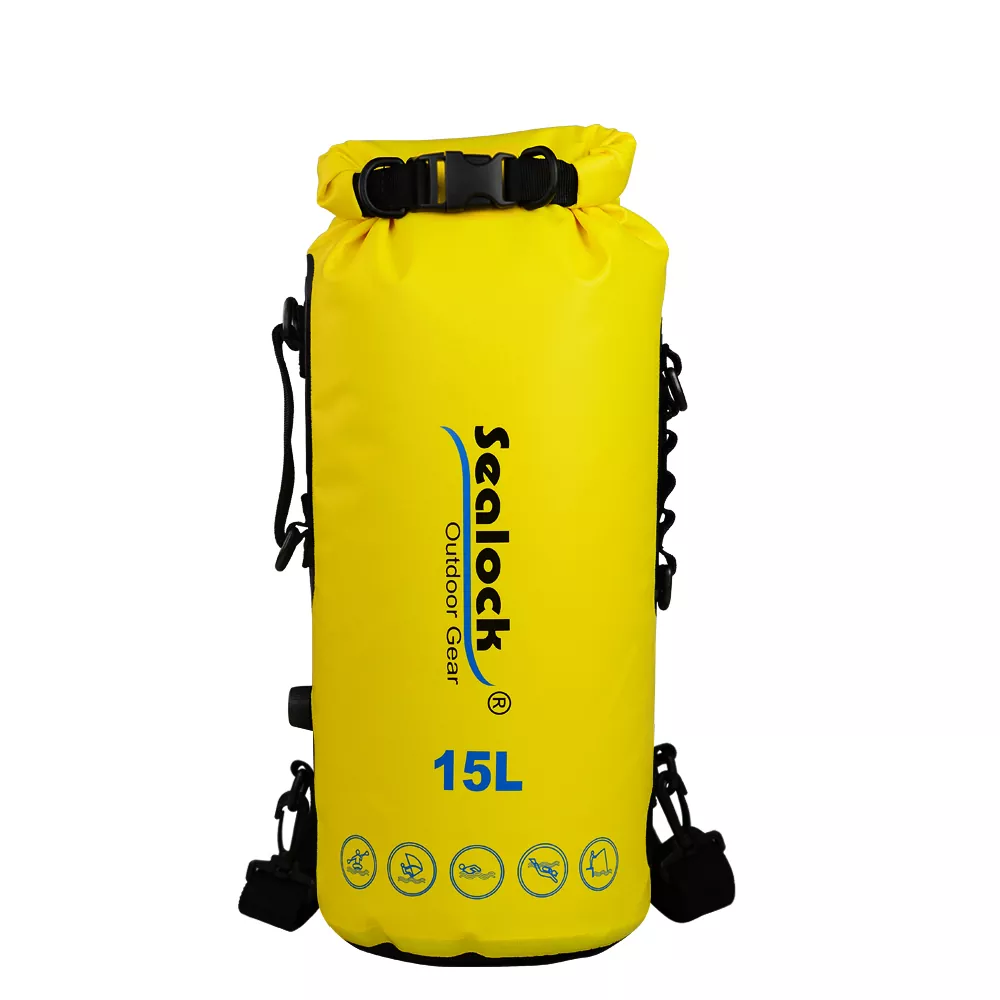
Sealock is a custom kayak bag manufacturer and OEM supplier. A plain dry bag is a welded tube: two panels, a round base, a roll-top. A kayak bag is the harder version of that problem, because the features paddlers actually want — an inflation valve, a phone window, a contoured shell that sits against the back, a lock point, a padded back panel — all require deliberately interrupting a waterproof barrier and then sealing it again. This guide covers what that takes on the factory floor, and what it means for a brand writing a kayak bag brief.
Why a Kayak Bag Is Harder to Build
Every added feature is an added sealing problem. A tube dry bag has one continuous weld path and nothing penetrating the skin. A kayak dry backpack may have a curved shell, a transparent window welded into opaque fabric, a valve flange penetrating the wall, a moulded lock housing, a foam back panel bonded on, and harness anchors carrying the full loaded weight. Each of those is a place where the barrier could fail, and each has its own process window.
That is why kayak bags separate specialist factories from general ones. Anyone can weld a tube. Integrating hardware into a sealed curved shell, repeatably, across thousands of units, is a different capability.
Every feature is a hole in a waterproof barrier that has to be sealed again.
Welding a Curved Shell
Several of our kayak packs use a semi-circular shell rather than a straight cylinder, because a contoured body sits better against the back and stows more predictably in a boat. Conventional wisdom in RF welding held that curved surfaces were poor candidates for the process. In practice they are workable, but the control variable changes: on a curved weld the critical factor is precise control of the gap between the upper and lower die rather than control of clamping pressure. Get the die spacing right and a curved seam welds as reliably as a flat one; rely on pressure alone and the weld quality varies along the curve.
Two related constraints shape what geometry is practical:
The RF field only works across a small gap. A field strong enough to melt the material requires the electrode and the part to be within roughly 1.5 mm, which is why the process suits films and coated fabrics rather than thick rigid sections — and why die design has to follow the shell contour closely.
Panels are cut oversize. Cut pieces run at least about 6 mm larger than the weld pattern, because the material has to fully cover the tool's weld area or the weld itself is compromised. Excess can be trimmed offline afterwards.
Welding Dissimilar Materials: The Window Panel
A transparent phone window or viewing panel means welding clear film into a coated fabric shell — two different materials with different thermal behaviour. The rule that governs this is worth knowing, because it explains why some suppliers' windows delaminate:
When bonding two different materials, the process must be set up so the higher glass-transition-temperature material heats first and conducts heat into the lower-Tg material. Run it the other way and the softer material over-melts and thins while the harder one never properly fuses — producing a join that looks acceptable and fails later. Getting this right is a matter of electrode design and parameter setup, not effort.
For coated fabrics there is also a material floor: the coating needs a minimum thickness of roughly 0.003–0.005 in (3–5 mil) to weld properly. A fabric with too thin a coating will not produce a reliable bond no matter how well the machine is set.
Integrating a Valve
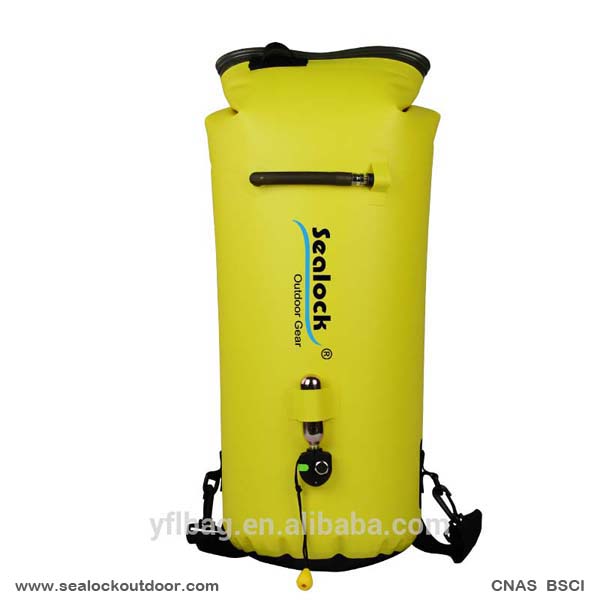
The inflation and deflation valve on our kayak packs lets a paddler purge air to compress the bag into a hatch, or add air for temporary flotation support. Manufacturing it means putting a deliberate port through the wall of a sealed bag. There are two proven approaches:
A flanged valve welded mid-panel. Ports and valves are supplied with a weldable flange specifically so they can be installed at a mid-point in a panel — RF welding seals coated fabric to the port without damaging either material.
A tube welded into a seam. Positioning a valve body directly on a seam is difficult, so the common practice is to weld a tube into the seam and attach a compression-fit valve to the tube.
Either way, the valve weld is a separate process window from the body seams and gets its own parameter set and its own inspection. It is also the feature most worth pressure-testing specifically, for the reason in the next section.
The Failure Mode Buyers Should Know About
This one matters on any bag with a valve or an air-holding function: a weak seam can pass an initial leak check and still fail after repeated inflation cycles, transport vibration, or cold-weather use. A single pass/fail dunk at the end of the line does not prove durability of the seal — it proves the seal existed on the day.
Which is why QC on this kind of product has to include visual inspection, peel testing, pressure retention, and delamination inspection, rather than a water test alone. It is also the reason we run vacuum extraction with a 24-hour hold on finished goods: sustained negative pressure over a full day surfaces the marginal seals that a brief immersion lets through.
Load Points: Why the Harness Is Sewn Before the Body Is Welded
A loaded 38L kayak pack puts its entire weight through the shoulder harness anchors, and a paddler clipping and unclipping deck lash points cycles those anchors constantly. Welded-only attachments can peel under sustained shear, so harnesses, D-ring patches, lash cord anchors and haul handles are stitched to the flat panels at high tension before the shell is welded. The stitched footprint spreads the load; the subsequent welding and reinforcement covers the perforations. Anchors are then load- and jerk-tested rather than judged by eye.
This is also where the paddlesports guidance matters — deck gear should attach at a minimum of two points, so the anchors have to be built for repeated, shock-loaded use rather than static weight.
Bonding the Back Panel
The one-piece EVA back panel on our kayak packs cuts weight and reduces heat build-up on the walk to the put-in. EVA is itself RF-weldable, which allows the panel to be integrated into the build rather than glued on — and welding is preferable to adhesive here for the same reason it is elsewhere: welded joins avoid adhesive ageing and reactivation risks, which are exactly the failure modes a bag stored wet in a hot garage will find.
A Different Sealing System: The Rubber-Strip Closure
Not every kayak bag closes with a roll-top. Our expedition construction seals with a compressed natural rubber sealing strip under a fold-over flap, clamped by a central compression strap — a mechanically different system that reaches IPX8. Manufacturing it adds steps a roll-top doesn't have: the rubber strip has to be bonded true along the full opening, the flap geometry has to fold onto it squarely, and the compression strap has to clamp evenly across the width. Uneven clamping is the classic failure — a seal that holds in the middle and gaps at one end will pass a casual dunk and leak under pressure.
Branding: Print Before You Weld
A useful sequencing point for brands: screen printing or hot stamping can be incorporated into the film layers before the welds are completed. Applying graphics while panels are still flat gives better registration and avoids working around a finished three-dimensional shell. Reflective printing is worth specifying here too — paddlers are frequently on the water at dawn and dusk, and a reflective mark makes a bag findable in low light while doubling as brand real estate.
What This Means for Your Brief
Specify weldable materials — PVC, TPU, TPU-coated nylon or EVA. Non-polar plastics such as PP and PE cannot be RF welded at all.
Decide the penetrations early — valve, window, lock and pocket positions all affect die design and tooling cost, and are expensive to move after the mould exists.
Keep the shell geometry weld-friendly — gentle curves and clean seam runs are more repeatable than tight radii and converging seams.
Detail every load point — harness, D-rings, lash cords, haul handle, and how each is anchored.
Ask for the right tests — peel strength, pressure retention and delamination inspection, not just a pass/fail immersion check.
Budget for tooling — a custom shell shape needs a custom copper die, quoted separately, with lead time before the first sample.
The Product Basis
These welded bags, from Sealock's dry bag line, are equal starting points for a custom kayak project — none is ranked above another; each demonstrates a different production capability described above:
Image
Model & specs
Production capability it shows
MOQ
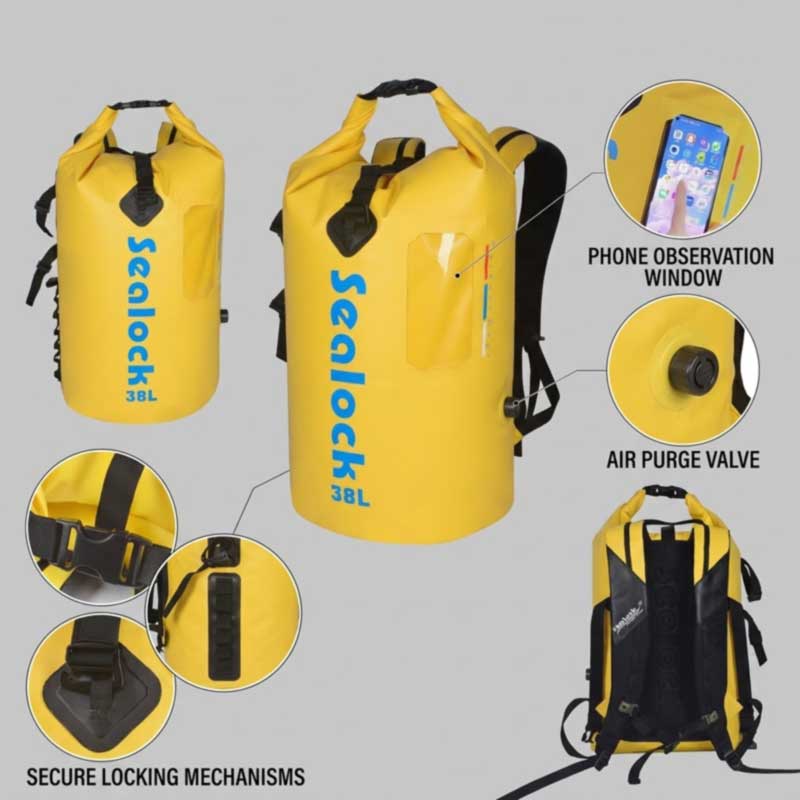
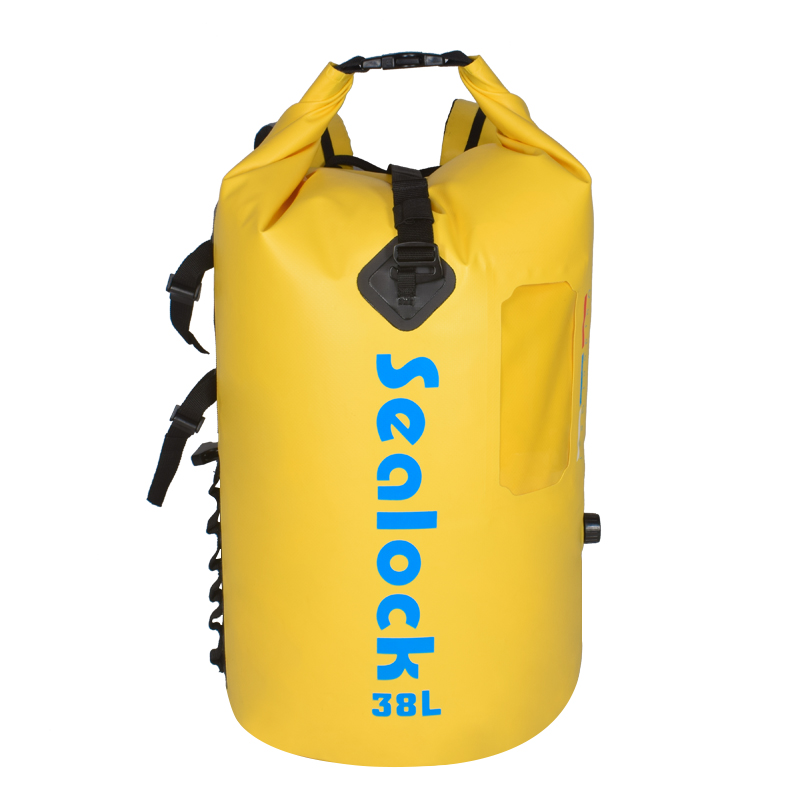
38L Waterproof Dry Backpack for Kayak — 500D PVC, 0.5 mm; semi-circular shell; front window pocket for a phone; multi-function lock for a paddle board; side inflation/deflation valve; one-piece EVA back panel.
Curved-shell welding, valve integration, window panel, EVA bonding — all in one build
300–500
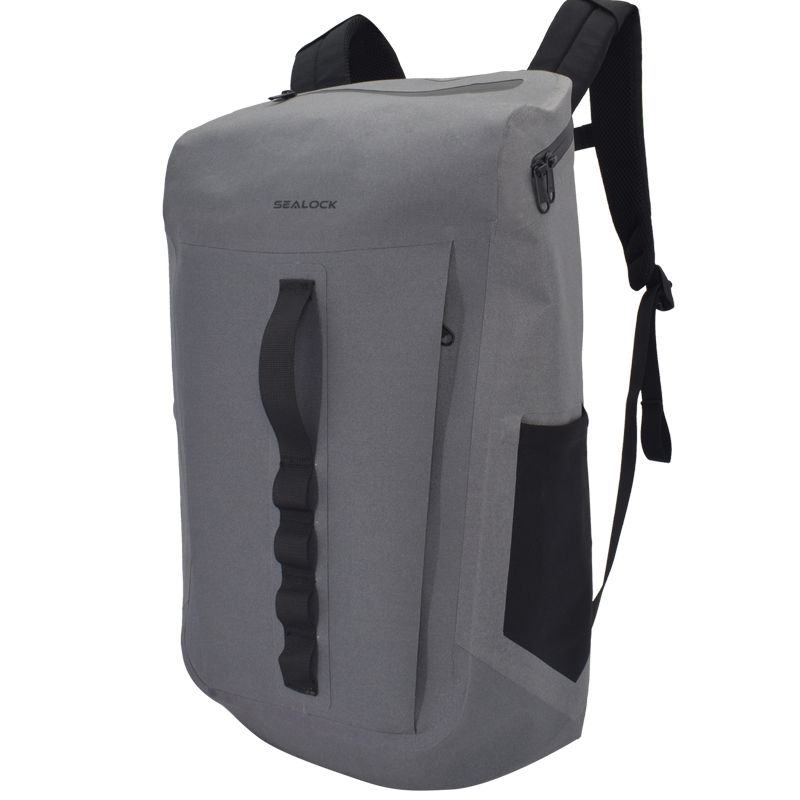
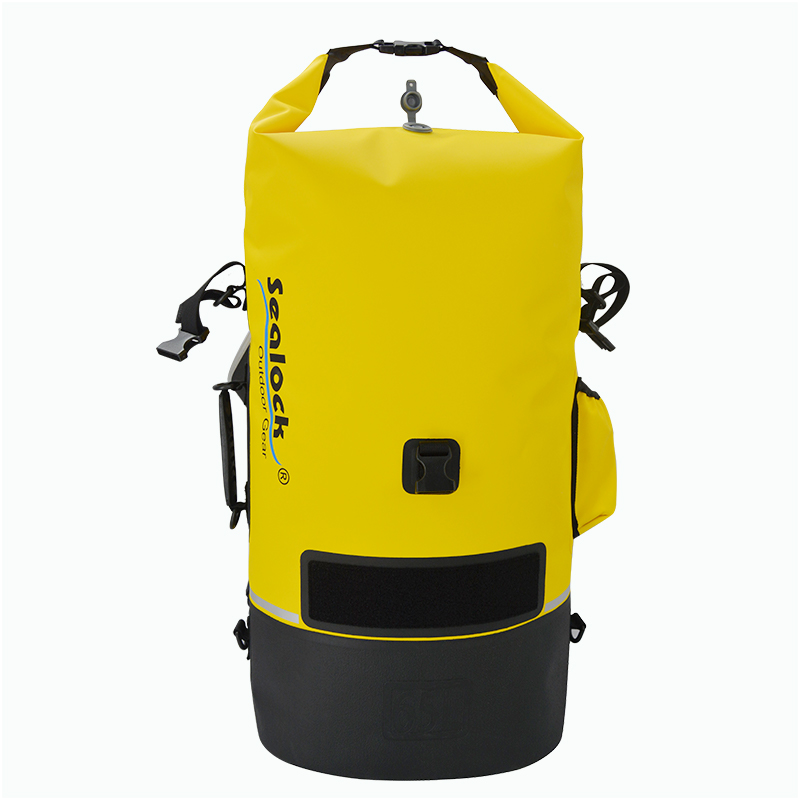
SL-E977 Kayak Dry Backpack — 28L; 500D PVC, 0.5 mm; semi-circular shell; phone window; multi-function lock; side inflation/deflation valve; EVA back panel.
Rubber-strip sealing system and a full load-bearing harness
300–500
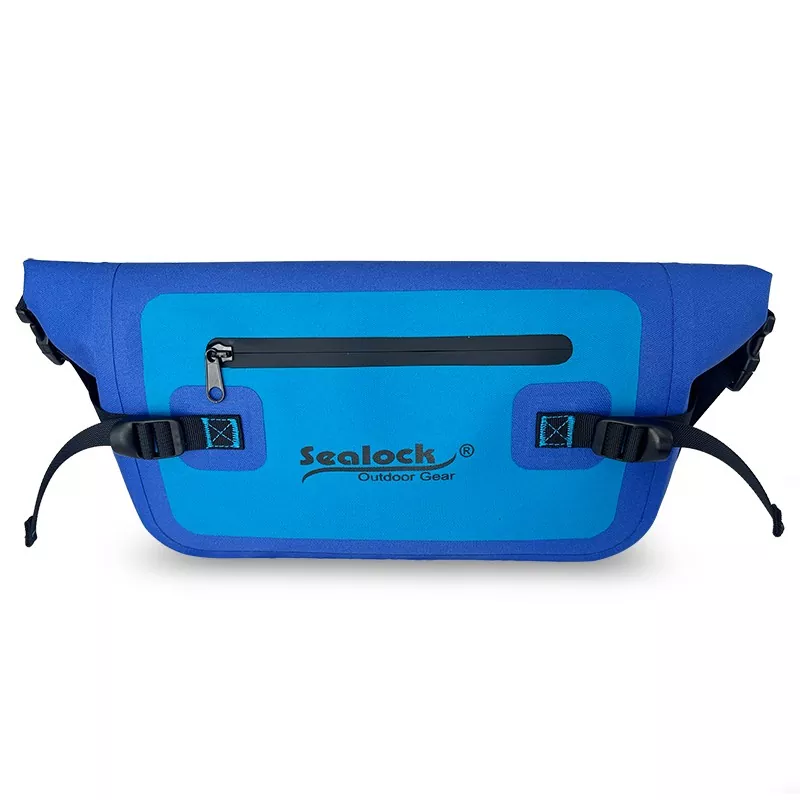
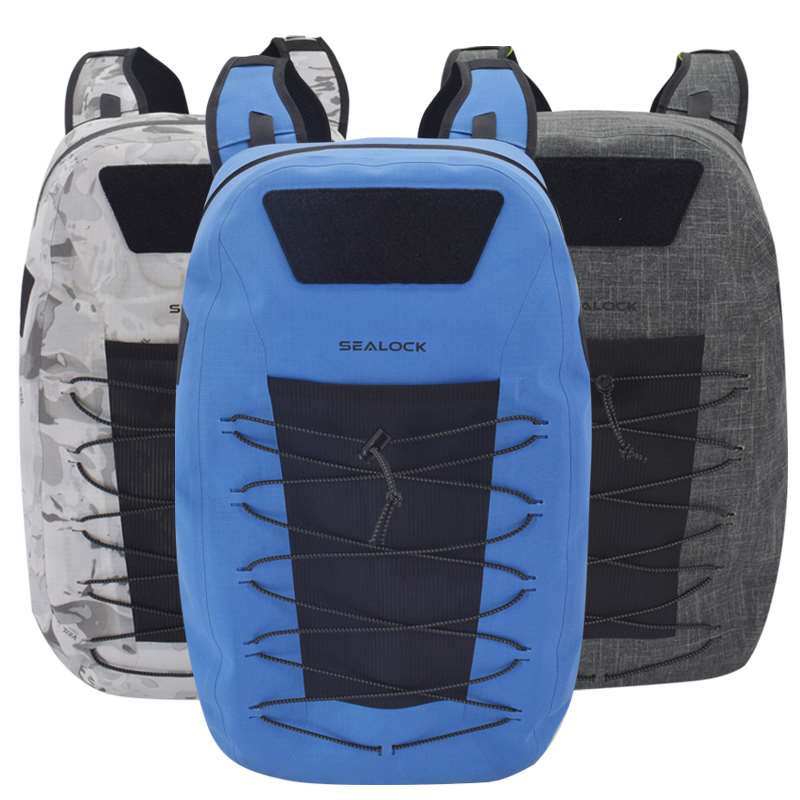
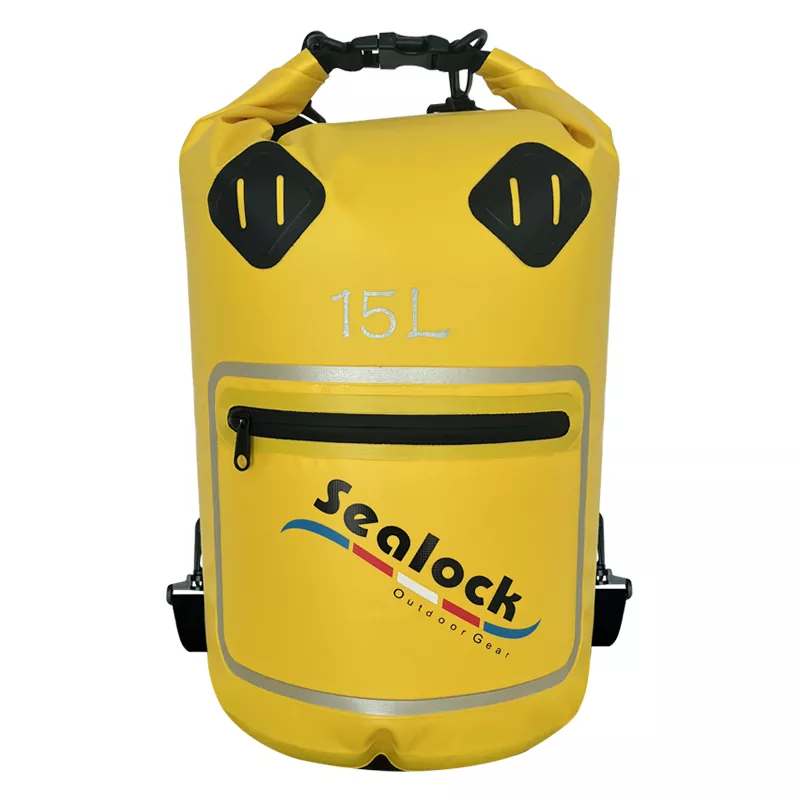
SL-E102 Dry Backpack — 15L / 20L / 30L with published dimensions per size; 500D PVC mesh; custom colours and sizes.
Three capacities on shared tooling — efficient die amortisation
300
Production Terms and Quality Control
Item
Detail
MOQ
300–500 pcs per model
Tooling
Custom copper die per shell geometry, quoted separately; reused on repeat orders
Sampling
3–10 days per round after tooling; typically two rounds
Production
20–45 days after sample approval
Capacity
Nine HF welding lines at 27.12 MHz; around 100,000 units/month
Rating options
Verified IPX7 on welded roll-top builds; IPX8 on rubber-seal construction
Quality is gated in three tiers — IQC (incoming fabric checked for coating thickness, adhesion and weldability, plus valves, lock hardware, buckles and webbing against the signed standard), IPQC (cutting tolerance, weld integrity on both body seams and penetrations, valve and window installation, harness and lash-point assembly, with peel tests on sample welds at each run start), and OQC (ISO 2859 AQL sampling, real water-submersion batch testing, pressure retention on valved builds, delamination inspection, and gold-sample comparison, with SGS or QIMA available). Sealock also strictly executes the complete customer inspection procedure on finished goods: unboxing, vacuum extraction, a 24-hour static rest, and air-leak determination. The lab additionally runs weld bond and peel strength, a 1,500+ cycle load test with jerk-loading on harness anchors and lash points, buoyancy checks, abrasion, tear, tensile, salt spray, UV, colour fastness and colour difference.
FAQ: Kayak Bag Production
Q: Can you weld a curved or contoured shell?
A: Yes. Curved welds are workable when the die spacing between upper and lower tool is precisely controlled — that, rather than clamping pressure, is the governing variable on a curve. It requires die design specific to the shell contour.
Q: How is an inflation valve integrated without compromising the seal?
A: Either a flanged valve welded mid-panel — ports and valves come with weldable flanges for exactly this — or a tube welded into a seam with a compression-fit valve attached. The valve weld has its own parameter set and its own inspection.
Q: Why do some clear windows delaminate over time?
A: Usually because the dissimilar-material weld was set up wrong. The higher-Tg material must heat first and conduct heat into the lower-Tg one; run the other way, the softer film over-melts while the other never properly fuses, giving a join that looks fine and fails later.
Q: Is a single water test enough to sign off a valved bag?
A: No. A weak seam can pass an initial leak check and still fail after repeated inflation cycles, transport vibration or cold-weather use. Ask for peel testing, pressure retention and delamination inspection alongside immersion.
Q: Can our logo go on before assembly?
A: Yes, and it's better — screen printing and hot stamping are applied to the film layers while panels are flat, before welding, which gives cleaner registration. Reflective printing is worth specifying for dawn and dusk visibility.
Q: What determines whether our design is buildable?
A: Material weldability (PVC, TPU, coated nylon or EVA — never PP or PE), coating thickness of at least roughly 3–5 mil, shell geometry that a die can follow, and the position of every penetration. We review a drawing for weldability before tooling and suggest changes that improve both quality and yield.
Talk to the Factory
To put a custom kayak bag into production, contact Sealock at info@sealock.com.hk or +86-769-82009361. Over twenty years of in-house high-frequency welding, nine welding lines, valve and window integration, custom die tooling, and a full customer inspection procedure on every shipment.
We use cookies to offer you a better browsing experience, analyze site traffic and personalize content. By using this site, you agree to our use of cookies.
Privacy Policy
 English
  Español
  Português
  русский
  Français
  日本語
日本語  Deutsch
  tiếng Việt
  Italiano
  Nederlands
  ภาษาไทย
  Polski
  Svenska
  magyar
  Malay
Malay  বাংলা ভাষার
  Dansk
Dansk  Suomi
Suomi  हिन्दी
  Pilipino
  한국어
한국어  Türkçe
  Gaeilge
  العربية
  Indonesia
  Norsk
Norsk  تمل
تمل  český
český  ελληνικά
  український
  Javanese
  فارسی
فارسی  தமிழ்
தமிழ்  తెలుగు
  नेपाली
  Burmese
  български
  ລາວ
ລາວ  Latine
  Қазақша
  Euskal
  Azərbaycan
  Slovenský jazyk
  Македонски
  Lietuvos
  Eesti Keel
  Română
  Slovenski
  मराठी
मराठी  Srpski језик