
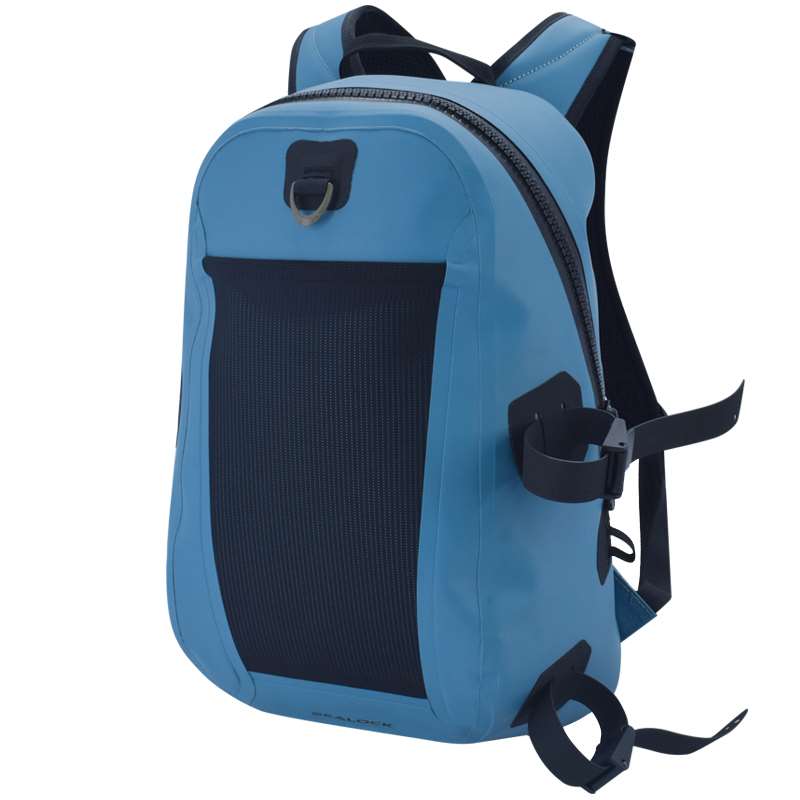
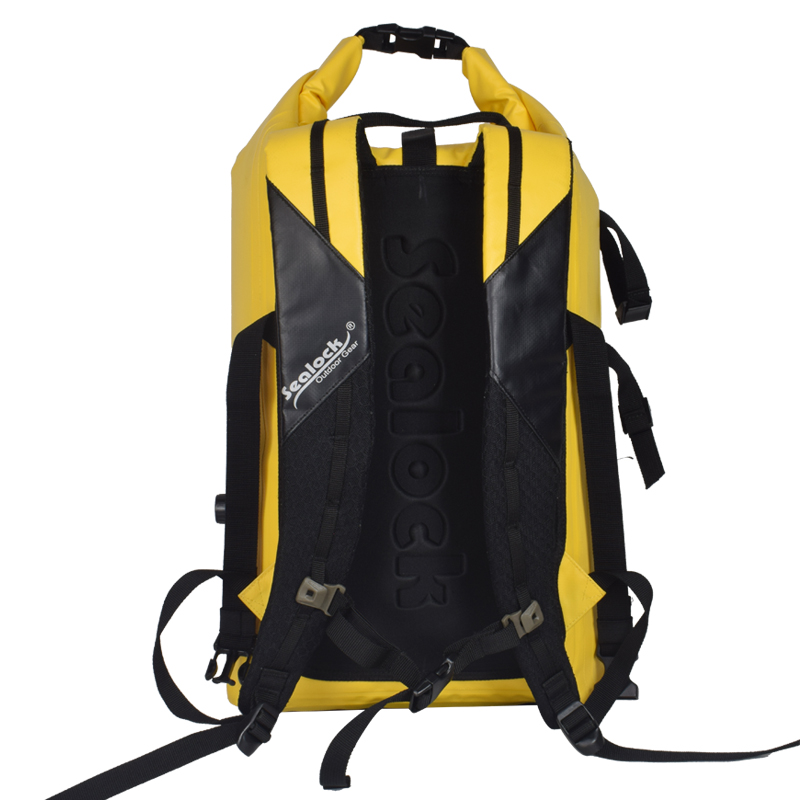
Moulded EVA Back Panel
One-piece construction transfers load off the spine and maintains a ventilation channel — the only route for moisture to escape from a shell with no breathability.
 English
  Español
  Português
  русский
  Français
  日本語
日本語  Deutsch
  tiếng Việt
  Italiano
  Nederlands
  ภาษาไทย
  Polski
  Svenska
  magyar
  Malay
Malay  বাংলা ভাষার
  Dansk
Dansk  Suomi
Suomi  हिन्दी
  Pilipino
  한국어
한국어  Türkçe
  Gaeilge
  العربية
  Indonesia
  Norsk
Norsk  تمل
تمل  český
český  ελληνικά
  український
  Javanese
  فارسی
فارسی  தமிழ்
தமிழ்  తెలుగు
  नेपाली
  Burmese
  български
  ລາວ
ລາວ  Latine
  Қазақша
  Euskal
  Azərbaycan
  Slovenský jazyk
  Македонски
  Lietuvos
  Eesti Keel
  Română
  Slovenski
  मराठी
मराठी  Srpski језик
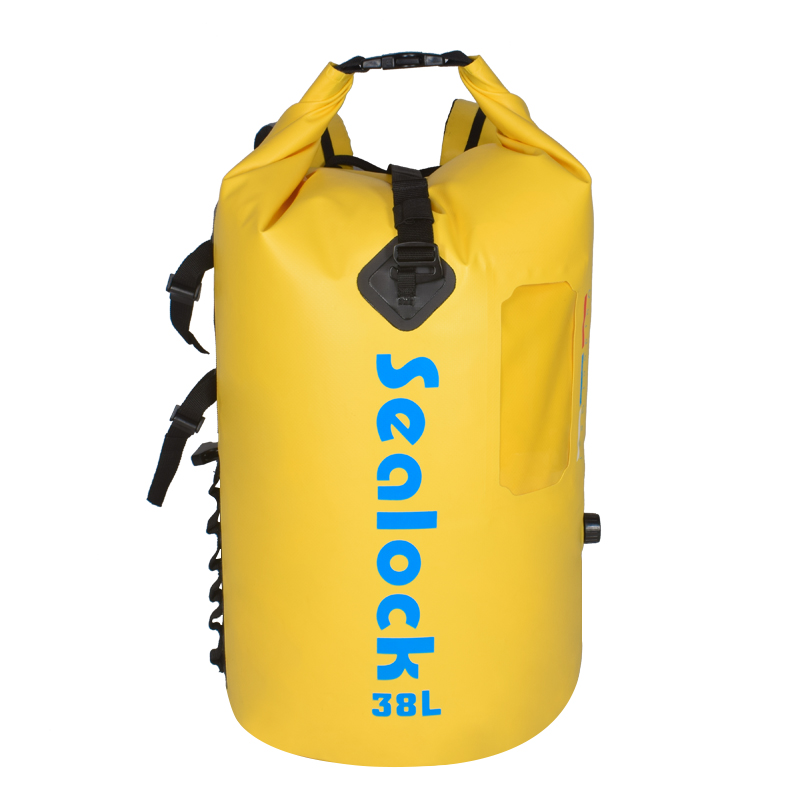
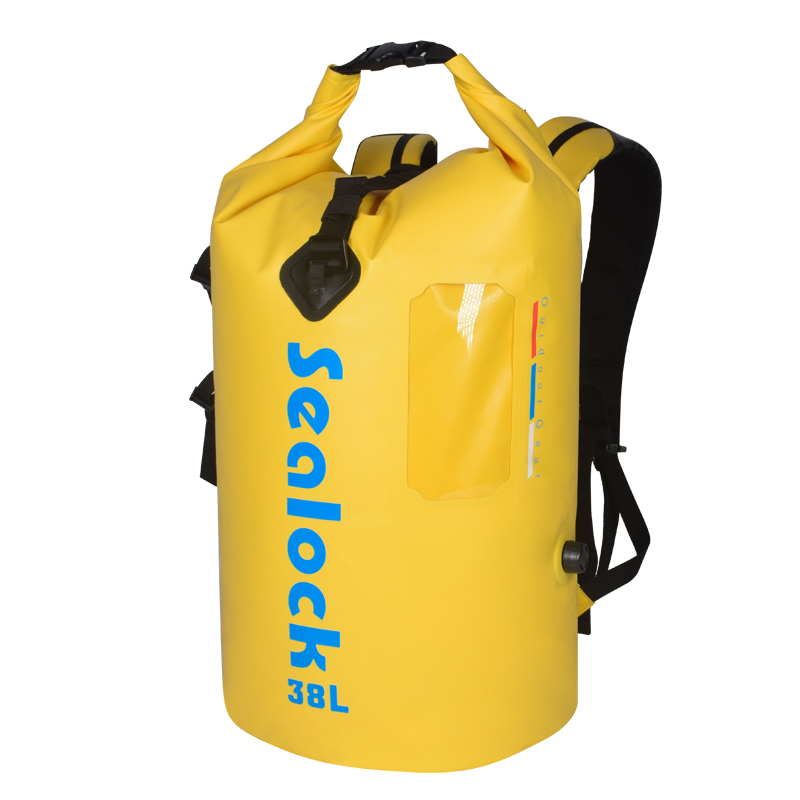
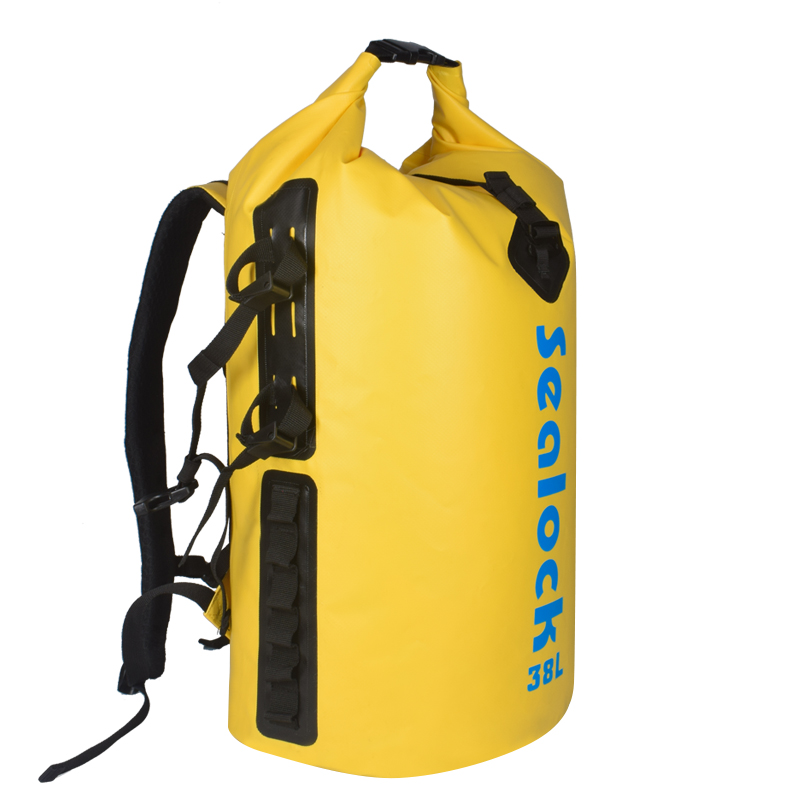
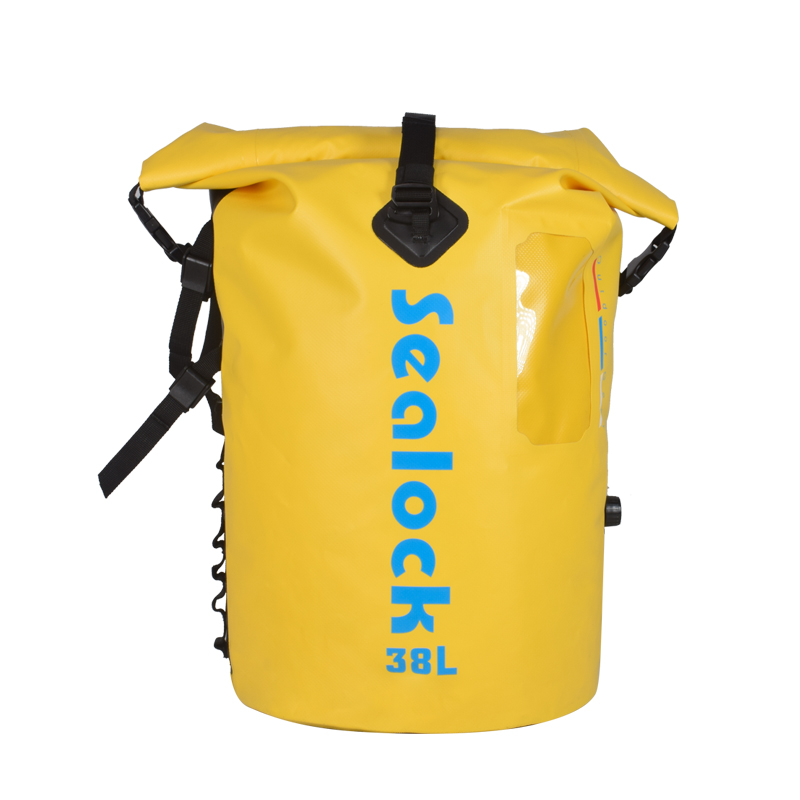
38L roll-top waterproof dry backpack in 0.5mm 500D PVC tarpaulin, high-frequency welded with no stitch penetrations in the waterproof shell. One-piece moulded EVA back panel for load transfer and ventilation, padded harness with sternum and waist straps, welded front window pocket, welded cable-lock anchor point, side inflation/deflation valve for pack-down and in-water buoyancy, side compression webbing. IPX7 with the roll-top closed three full turns, verified by 2+ hour immersion testing on batch samples. High-visibility yellow stock; Pantone matching available. Embossed EVA panel branding available — a permanent mark competitors using flat back panels cannot offer. MOQ 300 pcs FOB Guangdong, samples in 7–15 days.
Most products sold as waterproof backpacks are cylindrical dry bags with a pair of webbing straps welded to the back. They keep gear dry and they are miserable to carry — the load sits in a soft tube that changes shape with every step, the straps pull directly on a flat panel, and the whole thing rides against the back with no airflow at all.
The SL-E977 addresses the carry side properly. A one-piece moulded EVA panel forms the back of the pack, giving the load something rigid to transfer through rather than letting it press into the spine. The panel is contoured with a raised channel down the centre, so air can move between the pack and the body — which matters more here than on a conventional rucksack, because a welded waterproof shell has precisely zero breathability. Every gram of moisture the wearer produces has to escape somewhere, and the only route available is that channel.
The harness above it is a real one: padded shoulder straps, a sternum strap to stop them spreading under load, and a waist strap to transfer weight to the hips on a longer approach. On a 38-litre pack that can be loaded to twenty kilograms, that harness is the difference between a portage you can walk and one you endure.
Two figures describe this material, and both matter for different reasons.
500D is the denier of the fabric scrim laminated between the PVC layers. Higher denier means thicker yarn, and thicker yarn means the material resists tearing and abrasion through the scrim rather than depending on the coating alone. This is what lets a pack survive being dragged across a gunwale, set down on a gravel launch, or stuffed into a kayak hatch against a bulkhead.
0.5 mm is the total laminate thickness, and it puts this pack at the heavy end of the category. Lighter dry packs run 0.3 to 0.4 mm; the extra material costs weight and buys puncture resistance and weld strength. For a pack intended to be inflated — which puts the whole shell under internal pressure rather than just holding a load — the heavier gauge is not optional.
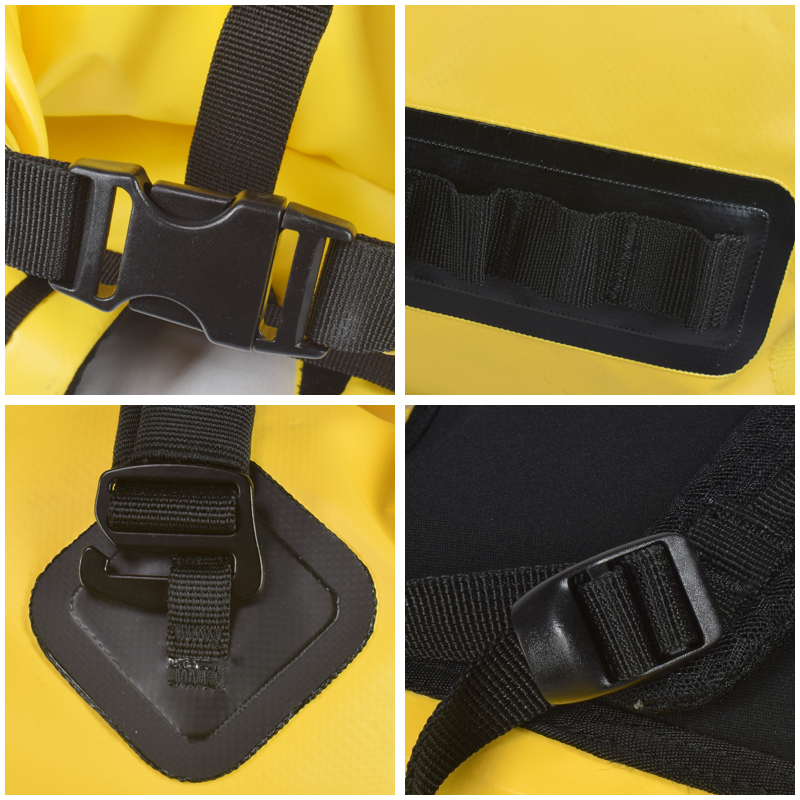
Every seam is high-frequency welded, fusing the layers into continuous material. There are no needle holes anywhere in the waterproof shell, so there is no seam tape to lift and no stitch line to wick. Harness components mount on welded anchor platforms bonded to the outside of the shell, with bar-tack reinforcement stitching that never penetrates the sealed chamber.
A valve on the side panel connects to the sealed main chamber. It does two distinct things, and the second one is the more interesting.
Deflation is the everyday function. Sealed roll-top packs trap air, which is fine on the water and inconvenient everywhere else — a part-loaded pack stays balloon-shaped, takes more room than its contents warrant, and will not pack flat for storage or transport. Opening the valve after rolling lets the shell draw down onto the load.
Inflation is the water-specific function. Air blown in through the valve after the roll-top is closed pressurises the chamber, and a pressurised pack floats high with a large portion of its volume above the surface rather than wallowing at the waterline. If the pack goes overboard, it stays visible and reachable instead of sitting flush with the chop, and it takes far longer to work its way under a hull or into a strainer. On a loaded pack of 38 litres this is a meaningful margin.
One thing this is not: the pack is not a personal flotation device and must never be used as one. An inflated dry pack provides buoyancy for itself and its contents. It has no righting moment, it does not keep an airway clear, and an unconscious or exhausted person cannot hold onto it. Wear a proper PFD. What the valve genuinely gives you is a pack that is easier to see, easier to reach, and easier to recover — a gear-retention feature, not a safety device.
Two details on the front of the pack that solve problems specific to being on the water.
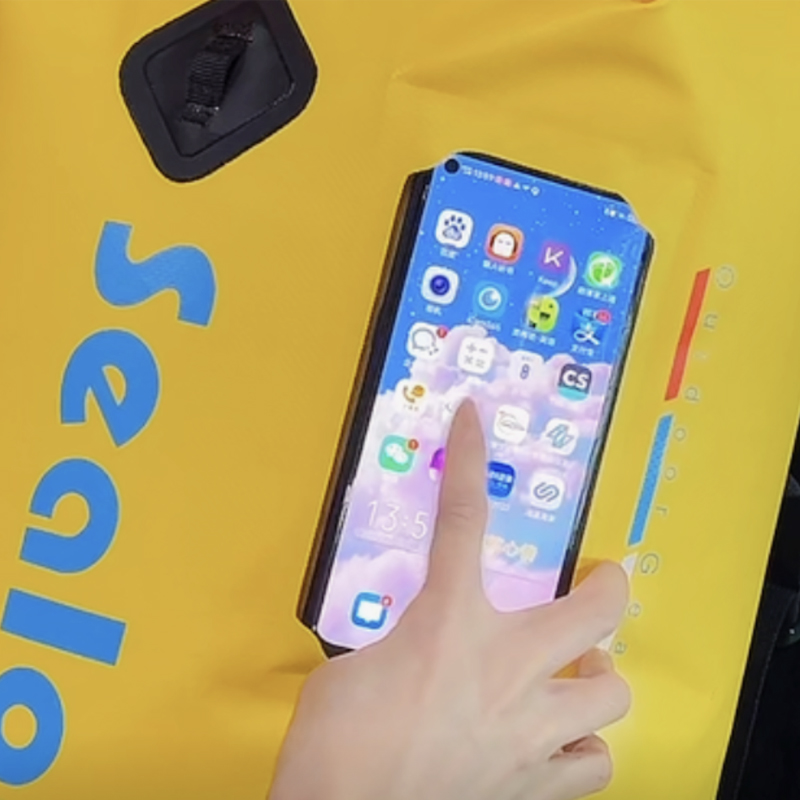
The welded window pocket holds a phone flat against the front panel, visible and dry, with the window perimeter welded into the shell so it is part of the sealed structure rather than a joint in it. The point is not to operate the phone through it — it is to see the screen. Checking a time, a tide table, or a notification without breaking a roll-top seal on a wet deck is the whole benefit, and it removes the most common moment at which water actually gets into a dry pack: opening it unnecessarily.
The lock-through point is a welded, reinforced anchor sized to pass a cable lock. Paddle boarders, kayakers, and surfers all face the same problem — the pack has to be left somewhere while you are on the water, and a dry pack full of car keys, a wallet, and a phone is an obvious target on a public beach. Running a cable through the lock point and around a board, a rack, or a fixed object is not high security, but it removes the opportunistic theft that accounts for nearly all of it.
A roll-top is a compression seal — the rolled material pressing against itself is the waterproof barrier, and the same pack passes or fails entirely on how it was closed.
Roll at least three full turns. One or two produce something that looks shut but generates almost no sealing pressure, and water enters at the corners. Roll evenly across the full width: a roll tight in the middle and slack at one end leaks at that end, every time.
| Model No. | SL-E977 |
|---|---|
| Product Type | Roll Top Waterproof Dry Backpack |
| Capacity | 38 L |
| Material Thickness | 0.5 mm |
| Seam Construction | High-Frequency Welded |
| Closure | Roll Top with Buckle |
| Waterproof Rating | IPX7 at three full turns |
| Back Panel | One-Piece Moulded EVA with Central Ventilation Channel |
| Harness | Padded Shoulder Straps, Sternum Strap, Waist Strap |
| Compression | Side Webbing Ladders with Buckles |
| Air Valve | Side-Mounted, Inflate and Deflate |
| Front Pocket | Welded Transparent Window Pocket |
| Security | Welded Lock-Through Anchor Point |
| Carry Handle | Reinforced Top Handle |
| Buoyancy | Floats when sealed; floats high when inflated |
| Main Body | 500D PVC Laminated Tarpaulin, 0.5 mm |
|---|---|
| Back Panel | Moulded EVA |
| Window Pocket | Welded Clear PVC Film |
| Shoulder Straps | Padded Webbing with Foam Core and Mesh Facing |
| Webbing | Reinforced Polyester |
| Hardware | Side-Release Buckles and Ladder Adjusters |
| Anchor Platforms | Welded PVC with Bar-Tack Reinforcement |
| Valve | Threaded Cap with Gasket Seal |
| Colour | High-Visibility Yellow (Custom Colours Available) |
| Water Protection | IPX7 — withstands immersion incidents with the roll-top correctly closed |
|---|---|
| Verification | Full water immersion testing, 2+ hours, on batch samples |
| Flotation | Gear buoyancy and recovery aid — not a personal flotation device |
| Phone Visibility | Screen readable through the welded window without opening the pack |
| Security | Accepts a standard cable lock through the welded anchor point |
| Pack-Down | Valve deflation draws the shell onto the load for transport and storage |
| Ventilation | Central channel in the EVA panel maintains airflow against the back |
| Visibility | High-visibility yellow shell aids recovery on open water |
| OEM / ODM | Supported |
|---|---|
| MOQ | 300 pcs |
| Sample Lead Time | 7–15 Days |
| Production Lead Time | 30–45 Days |
| Custom Capacities | Available |
| Custom Colours | Pantone Matching Available |
| Logo Application | Silk Screen, Welded Patch, Heat Transfer, Embossed EVA Panel |
| Structural Options | Window layout, harness specification, valve type, external pockets, MOLLE panels |
| Trade Terms | FOB Guangdong |
| Standard Packaging | Individual Poly Bag |
|---|---|
| Retail Packaging | Hang Tag, Header Card, or Custom Colour Box |
| Carton Quantity | 10 pcs |
| Carton Size | 62 × 46 × 56 cm |
| Gross Weight | Approximately 14 kg |
| Shipping Methods | Sea Freight, Railway Transport, Air Freight, Express |
| Export Markets | North America, Europe, Australia, Southeast Asia |
| Application | Why It Fits |
|---|---|
| Kayaking & Canoeing | Sealed 38L capacity for a full day, with buoyancy and high visibility if it goes in. |
| Paddle Boarding | Lock point secures the pack to the board on the beach; deflated it lies flat on the deck. |
| Rafting & White Water | 0.5 mm gauge and welded seams handle abrasion against rock and hull. |
| Boat & Sailing | Stows in a locker deflated; carries a full change of clothing and electronics dry. |
| Surfing & Beach | Cable-lock security while in the water; phone visible through the front window. |
| Wet-Weather Hiking & Approach | EVA panel and full harness make a loaded carry sustainable over distance. |
| Fishing | Full-day capacity with dry storage for electronics, documents, and spare layers. |
| Rental Fleets & Guided Trips | High-visibility colour and heavy gauge suit equipment used by inexperienced hands daily. |
Inspection runs at three stages — IQC on incoming materials, IPQC through welding and harness assembly, and OQC before the container is sealed. SGS or QIMA third-party inspection is available on request, and buyers running their own protocol are welcome to execute it in full on site: unboxing, vacuum extraction, 24-hour static rest, and air-leak determination.
| Test | What It Establishes |
|---|---|
| Full Water Immersion (2+ hours) | IPX7 sealing performance of the rolled closure, window frame, valve mounting, and welded shell. |
| Air Retention Test | That the inflated chamber holds pressure — the property the buoyancy function depends on. |
| Bonding Strength Test | Weld integrity at body seams, base, window frame, valve, and every anchor platform under peel load. |
| Load Test (1,500+ cycles) | Harness anchor, handle, and lock point durability under repeated loaded carry. |
| Bar-Tack Pull-Out Test | Reinforcement stitching strength at shoulder, waist, and compression anchor points. |
| Tensile Strength | Webbing, buckle, and lock point strength at and beyond rated load. |
| Salt Spray | Hardware and laminate resistance to sustained saltwater exposure. |
| Abrasion Resistance | Surface durability at the base, closure fold, and contact areas against deck, rock, and hull. |
| Colour Fastness & Colour Difference | UV retention on a high-visibility colour, where fade is both cosmetic and functional, and batch consistency on reorders. |
One-piece construction transfers load off the spine and maintains a ventilation channel — the only route for moisture to escape from a shell with no breathability.
Heavy gauge at the top of the category. Necessary on a pack designed to be inflated, since internal pressure loads the whole shell rather than just the base.
No stitch penetrations anywhere in the waterproof chamber. Harness components mount on welded platforms bonded outside the seal.
Deflate to pack flat for transport and storage; inflate to float high and stay visible if the pack goes in the water.
Check a screen without breaking the roll-top seal — removing the single most common moment at which water gets into a dry pack.
Secure the pack to a board, rack, or fixed object while you are on the water. Defeats the opportunistic theft that accounts for nearly all beach losses.
Padded shoulders, sternum strap, and waist strap — a real carry system on a pack that can hold twenty kilograms.
Recovery colour, not a styling choice. A dark pack on moving water is genuinely difficult to locate.
| Method | Best Suited To |
|---|---|
| Silk Screen Printing | Large-format logos and capacity markings on the body panel; the method used on the stock colourway. |
| Welded Logo Patch | A dimensional tonal mark that adds no leak path to the sealed shell. |
| Embossed EVA Panel | A moulded logo in the back panel tooling — permanent, wear-proof, and unavailable to competitors using flat panels. |
| Heat Transfer | Full-colour artwork and gradients on the body. |
| Woven Label | Harness and strap branding at the contact points a user sees while wearing the pack. |
The window pocket and valve area should be kept free of print. The large flat body panel gives generous artwork latitude, and the high-visibility base colour makes most logo colours read strongly.
Beyond logo and colourway work, this platform supports ground-up development: alternative capacities, harness specification changes including a ventilated frame sheet or a heavier hip belt, additional external pockets, MOLLE or daisy-chain panels, a hydration port, alternative valve types, repositioned or resized windows, and reflective trim packages for rental and guided-trip programmes.
It is worth noting that our capability is not limited to welding. Sewn and stitched construction is an equally established in-house discipline, and this pack already combines the two — a fully welded waterproof chamber with a sewn and bar-tacked harness mounted on welded platforms. If your specification calls for fabric panels, bound edges, padded structures, or sewn attachment systems alongside a welded core, that is standard work here rather than an exception.
Ground-up structural development runs longer than branding work. We quote a schedule you can plan a launch around rather than an optimistic one you have to work back from later.
For dry storage without a harness — stowed in a hatch, lashed to a deck, or carried by hand — see our 15L and 20L Roll Top Dry Bag, which uses the same welded construction with a transparent viewing panel.
For small items that need to stay dry and organised inside the pack, the Waterproof Toiletry Bag with Viewing Window is a structured welded organiser that stands upright and stays open.
For a phone that needs to be operated rather than only seen, a dedicated Universal Waterproof Phone Pouch gives IPX8 protection with full touchscreen use.
No. An inflated dry pack floats itself and its contents, but it has no righting moment, does not keep an airway clear, and cannot be held by someone exhausted or unconscious. Wear a proper PFD. The buoyancy function is for keeping the pack visible and recoverable, not for keeping a person afloat.
In nearly every case, fewer than three turns on the roll-top, or a roll tighter at one end than the other — water enters at the corner of a slack roll. The next most common cause is over-packing, which leaves too little material above the contents to fold properly. Check the valve cap is threaded down as well.
Comfortably. A full change of clothing, an insulation layer, food and water, a first aid kit, and electronics all fit with room to spare. Bear in mind that the three turns needed to seal consume roughly the top fifth of the height, so pack to about 30 litres of contents.
It is a visibility window rather than a touch window — the point is checking a screen without breaking the seal. For full touchscreen operation on the water, use a dedicated waterproof phone pouch, which fits inside the main compartment or clips to the harness.
It is a welded, reinforced anchor that takes a standard cable lock. Realistically it defeats opportunistic theft, which is nearly all beach theft. Anyone with a cutting tool will get through a cable — do not leave irreplaceable items in a pack left unattended.
Yes, with normal soft-gear loading and air left in the chamber before rolling. Inflating raises it much higher in the water and makes it far easier to spot and reach. Packed dense with all air expelled, it will not float.
The moulded EVA panel and the sternum and waist straps are what make a loaded 38-litre pack carryable over distance. What no waterproof pack can offer is breathability — the shell has none by construction, and the central channel is the only ventilation route. Expect a damp back on a warm day; that is physics, not a defect.
No. Machine washing stresses the welded seams and the EVA panel bonding. Rinse with fresh water, wipe with mild soap if needed, and air dry — that is all a welded PVC pack requires.
Yellow is stock. Pantone matching is available for OEM orders, though for on-water use we would encourage buyers to keep a high-visibility option in the range — recovery colour has a functional purpose that a dark colourway gives up.
Three differences that show up in service: 0.5 mm gauge against the 0.3 mm typical at lower price points, a fully welded shell rather than stitched-and-taped seams that lift, and a moulded back panel and real harness instead of two straps welded to a flat tube.
300 pieces, FOB Guangdong. For custom capacities, colourways, or project-specific requirements, contact our team.
Dry packs are judged on two things a specification sheet cannot convey: how the harness sits under load, and whether the roll-top still holds after a season. We suggest loading a sample to twenty kilograms, walking it, then immersing it. Samples ship in 7–15 days.
Send us your target quantity, capacity range, and branding requirement, and we will return pricing and a realistic production schedule.