Forty-Eight Hours in Salt Fog: How We Test the Hardware on Marine Waterproof Gear
A dry bag that has been on a boat for two seasons rarely fails because the fabric gave up. It fails because a D-ring has bloomed white and seized, a slider will no longer run cleanly along a waterproof zipper, a snap hook has left a rust streak down a pale panel, or a rivet has swollen and split the material around it. Salt does not attack the parts of a bag that manufacturers like to talk about. It attacks the small metal components that get specified late in development, bought on price, and never tested — and it does so in a way that turns a functional failure into an appearance failure and then into a sealing failure, usually in that order.
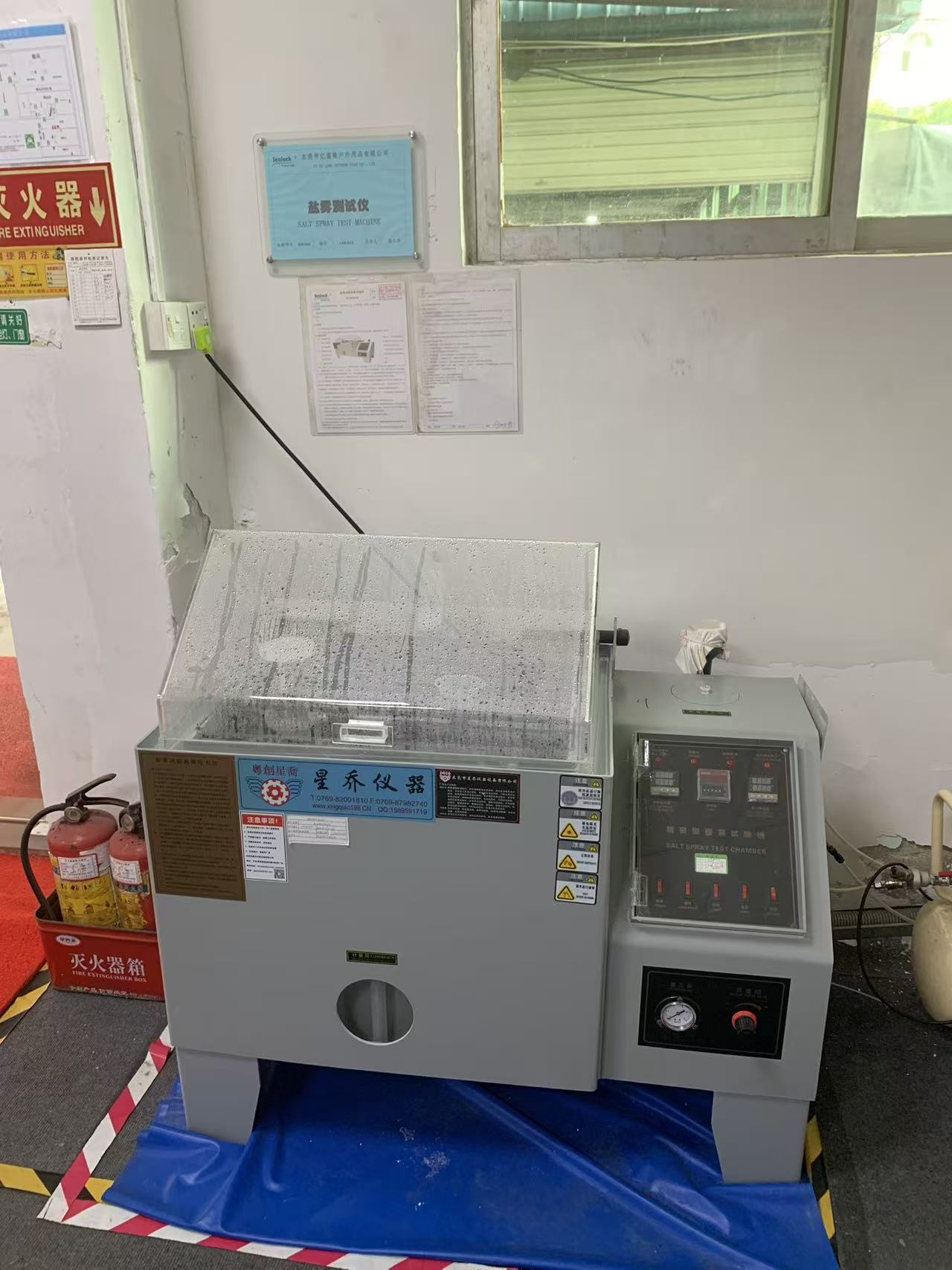
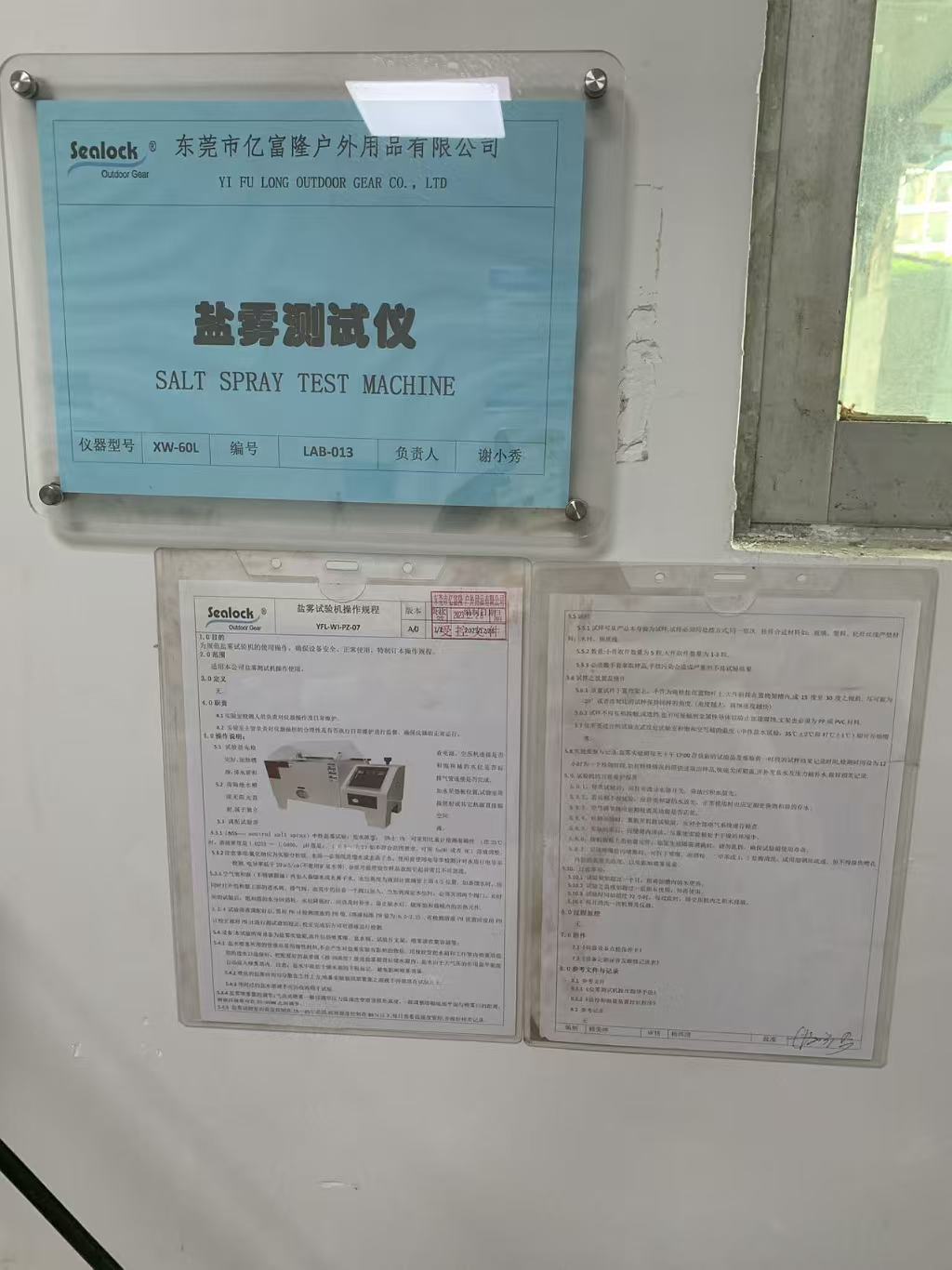
The instrument that finds this before a customer does is a salt spray chamber: model XW-60L, instrument number LAB-013, operated under controlled procedure YFL-WI-PZ-07, revision A/0, dated 28 December 2023, calibrated externally on 19 December 2025 with recalibration due 18 December 2026. It runs a neutral salt spray test, and it is the least ambiguous instrument in our laboratory. Either the coating held for the specified number of hours or it did not.
The salt spray chamber in our quality lab, with its identification placard and controlled operating procedure posted alongside. The acrylic lid is water-sealed in a channel around its rim so that fog cannot escape into the room.
What a salt spray test actually is
Neutral salt spray, usually written NSS, is the most widely applied accelerated corrosion test in manufacturing. It exposes materials and coatings to a continuously atomised salt fog at a controlled chamber temperature of 35°C, using a 5% sodium chloride solution with pH held between 6.5 and 7.2. The two governing documents are ASTM B117 and ISO 9227, with GB/T 10125 as the equivalent Chinese standard. Fog is generated continuously, settles onto the specimens, and runs off. There is no wet-dry cycling, no temperature swing, and no ultraviolet component. It is a single, relentless condition.
That simplicity is both the strength and the limitation of the method. NSS is not a simulation of the sea. Nothing in nature holds a component at 35°C in saturated salt fog without a single dry interval, and the correlation between chamber hours and years of real service is loose enough that no serious laboratory will publish a conversion factor. What NSS does superbly is discriminate. Two zinc-plated buckles that look identical, cost within a few cents of each other and come from different suppliers will separate cleanly in a salt spray chamber: one shows white rust at 24 hours, the other is clean at 72. That comparison is repeatable, it is defensible, and it is the basis on which a component gets approved or rejected.
The conditions we hold
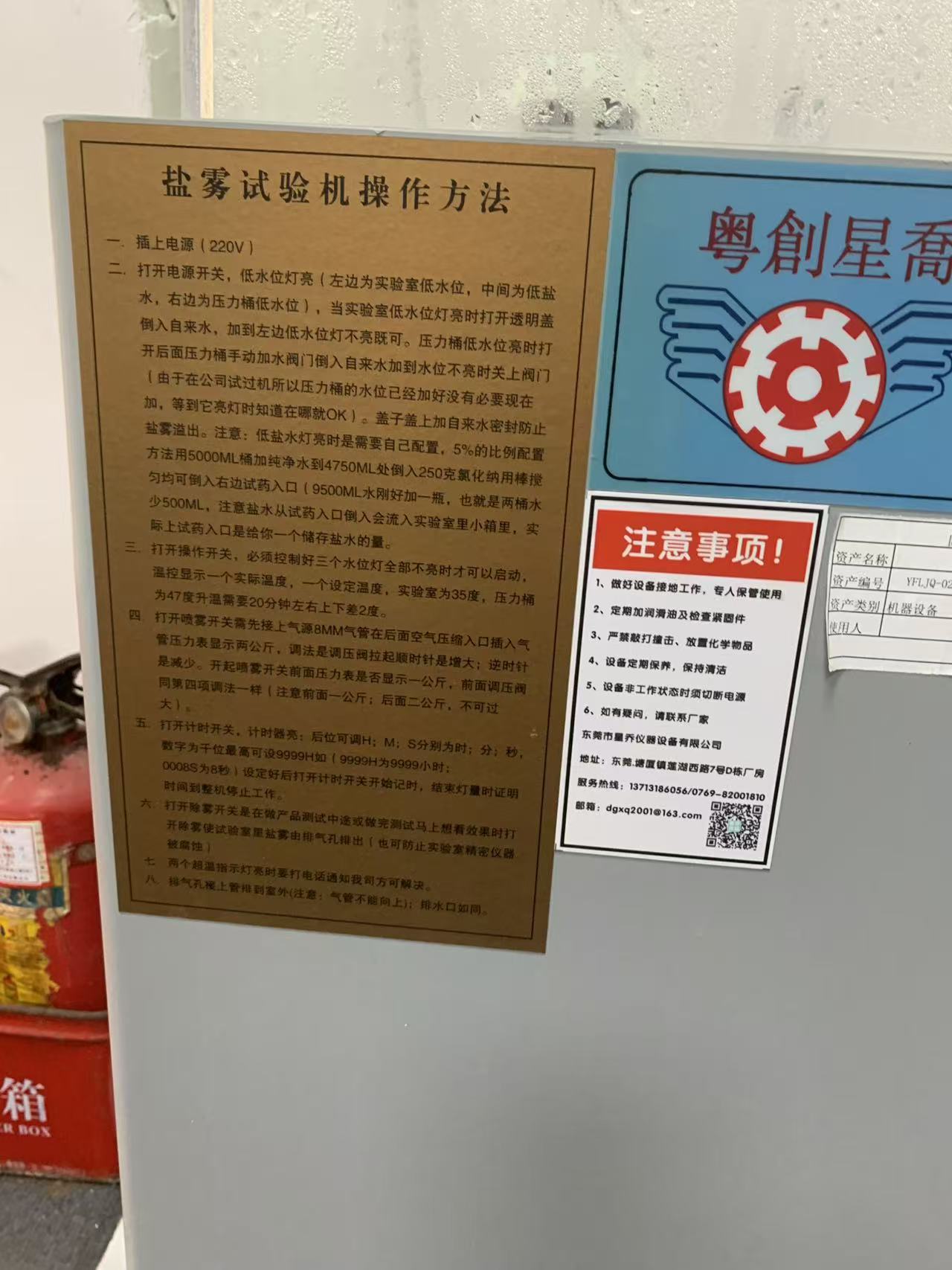
The operating parameters are posted on the machine itself, in a plate that has more practical detail in it than most equipment manuals.
Brine is mixed by the operator, not bought ready-made: 250 grams of sodium chloride dissolved into purified water made up to 4,750 millilitres in a 5-litre vessel, stirred to a uniform 5% solution and poured in through the reagent inlet. The chamber runs at 35°C. The saturated-air pressure drum runs hotter, at 47°C, and takes roughly twenty minutes to come up to temperature; the two controllers on the panel show set and actual values independently, and a two-degree spread between them is the working tolerance. Compressed air enters through an 8mm line at the rear, regulated to about 2 kg/cm² at the back gauge and around 1 kg/cm² at the front — and the plate warns explicitly against going higher, because over-pressurising the atomiser destroys the fog quality without any obvious symptom at the panel.
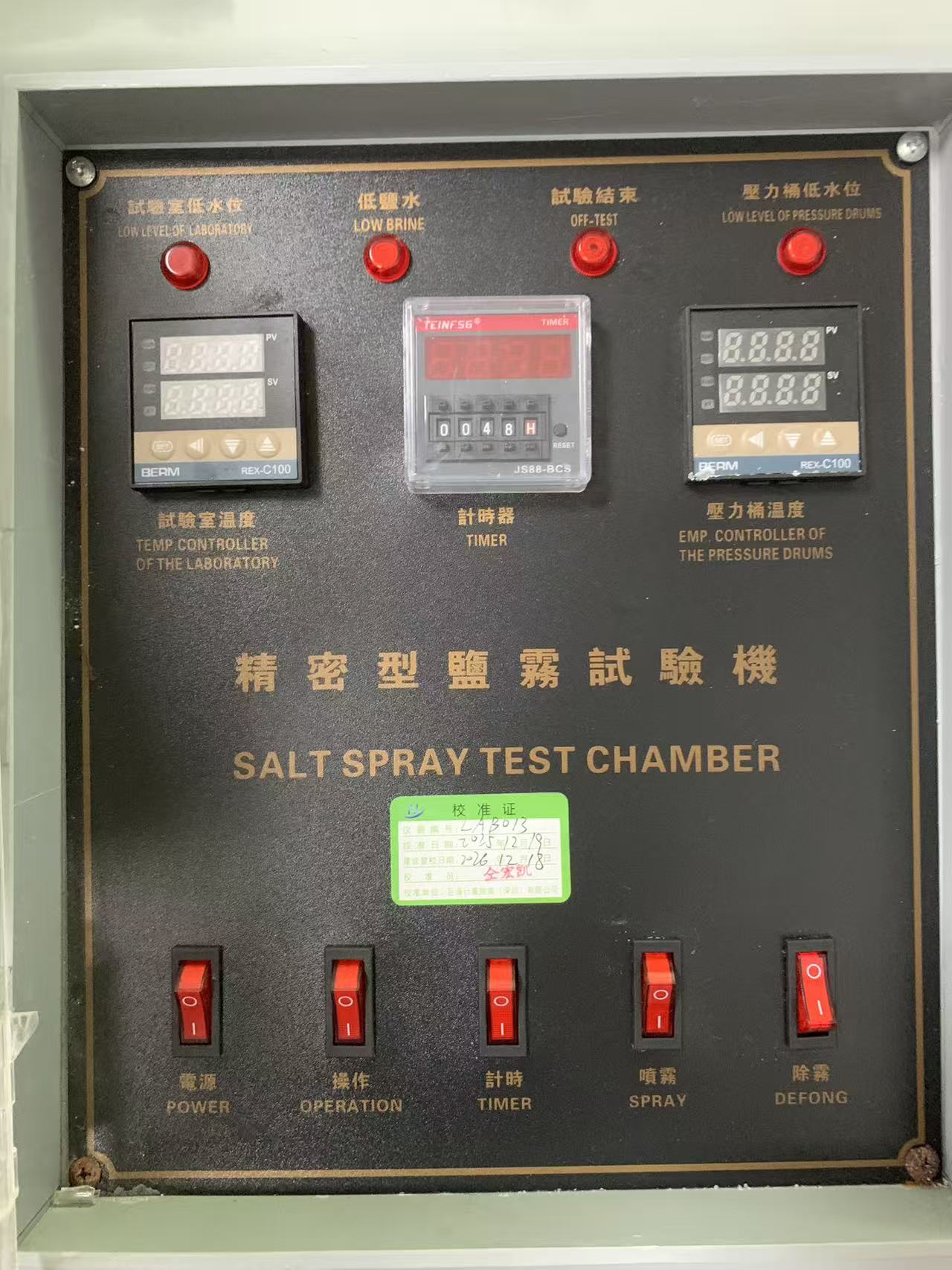
The control panel: low-level warning lamps for the chamber, the brine reservoir and the pressure drum; independent temperature controllers for the chamber and the saturation drum; a timer settable in hours, minutes or seconds; and switches for power, operation, timing, spray and defogging.
Three low-level lamps guard the chamber water, the brine and the pressure drum, and the procedure is unambiguous: the machine may not be started until all three are dark. Running an atomiser dry, or running the humidifying chamber without water, damages the machine and silently invalidates whatever test is in progress. The timer accepts up to 9,999 hours and shuts the machine down at the set point, which is what makes an unattended 48- or 96-hour run possible.
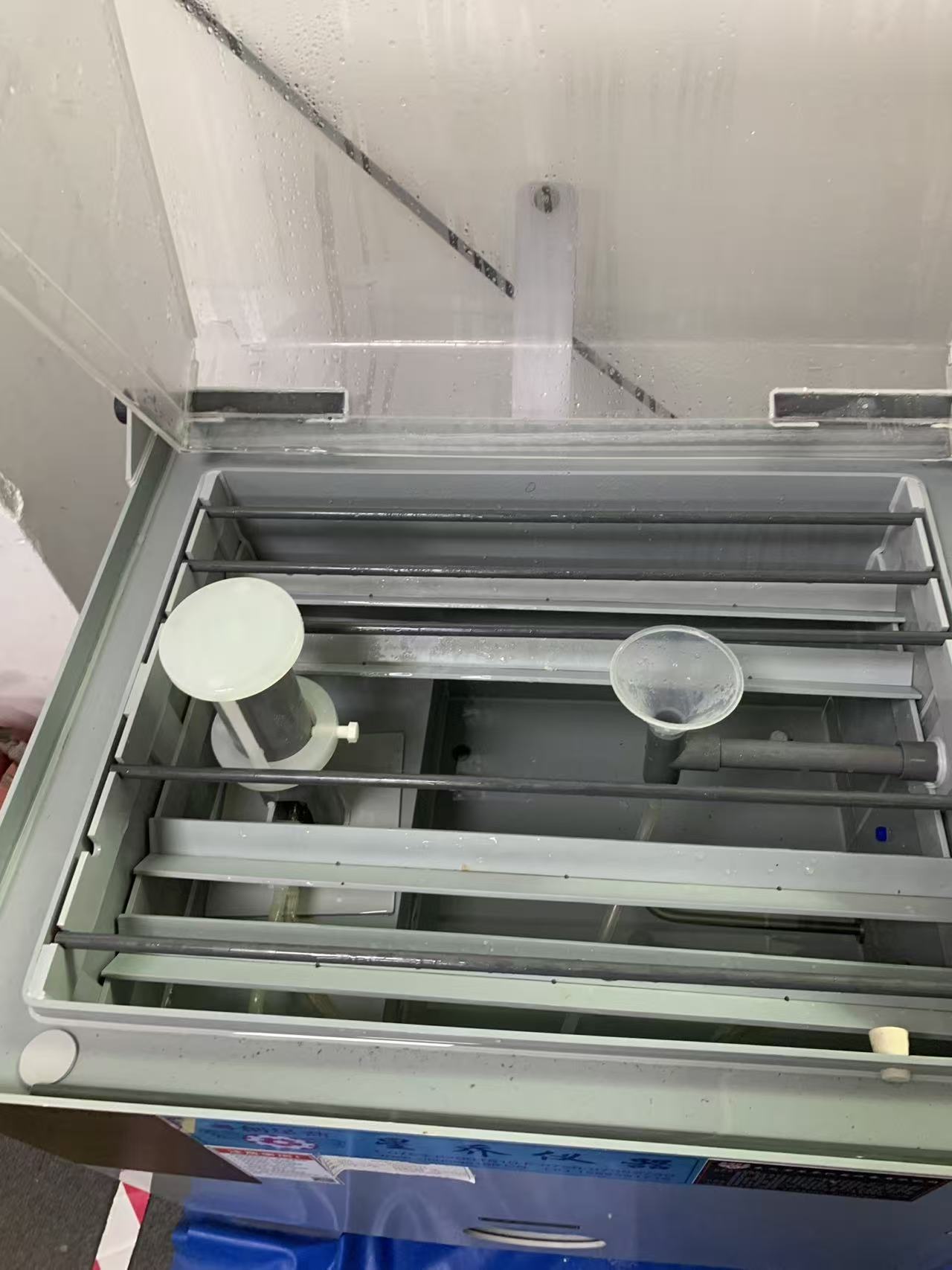
Fog quality itself is verified rather than assumed. A collection funnel and graduated cylinder stand inside the chamber during runs, and the settled volume is measured against the standard requirement of roughly 1 to 2 millilitres per 80 square centimetres per hour, averaged over an extended collection period. A chamber that is at temperature, at pressure and at concentration but delivering the wrong fall-out rate is producing numbers that mean nothing, and the funnel is the only thing that catches it.
Inside the chamber: the atomising tower at the centre, the collection funnel and measuring cylinder used to verify fog fall-out rate, and the V-shaped supports that hold specimens at the required angle.
How specimens go in
Placement is not a detail. It is most of the test.
Specimens are mounted facing the fog and tilted roughly 15 to 30 degrees from vertical, so that condensate runs off rather than pooling. A component lying flat collects a puddle of concentrated brine in every depression, which produces localised attack that has nothing to do with the coating's real performance and everything to do with how it was laid down. Supports and hangers are non-metallic — glass, plastic or PVC — because a metal hanger in contact with a plated specimen sets up a galvanic couple and corrodes the specimen at the contact point long before the coating would have failed on its own.
Specimens do not touch each other, and they are arranged so that runoff from one cannot drip onto another. Salt-laden condensate carrying dissolved copper or iron from an upstream part will attack a downstream part with impressive speed, and the resulting report is a fiction. Small components go in at a few pieces per lot so a single anomalous part does not decide the result; large assemblies go in singly.
The operating instruction plate mounted on the machine covers brine mixing ratio, temperature set points, air pressure limits and timer use — the parameters an operator needs at the moment of use rather than in a filing cabinet.
When a run ends, the defogging function is switched on before the lid is opened. This vents the chamber through the exhaust rather than releasing salt fog into the laboratory, where it would find every other instrument in the room. It is worth being blunt about why this matters: a salt spray chamber vented carelessly will slowly corrode the precision equipment around it, and the damage shows up months later as drifting calibration on machines nobody connected to the salt spray work.
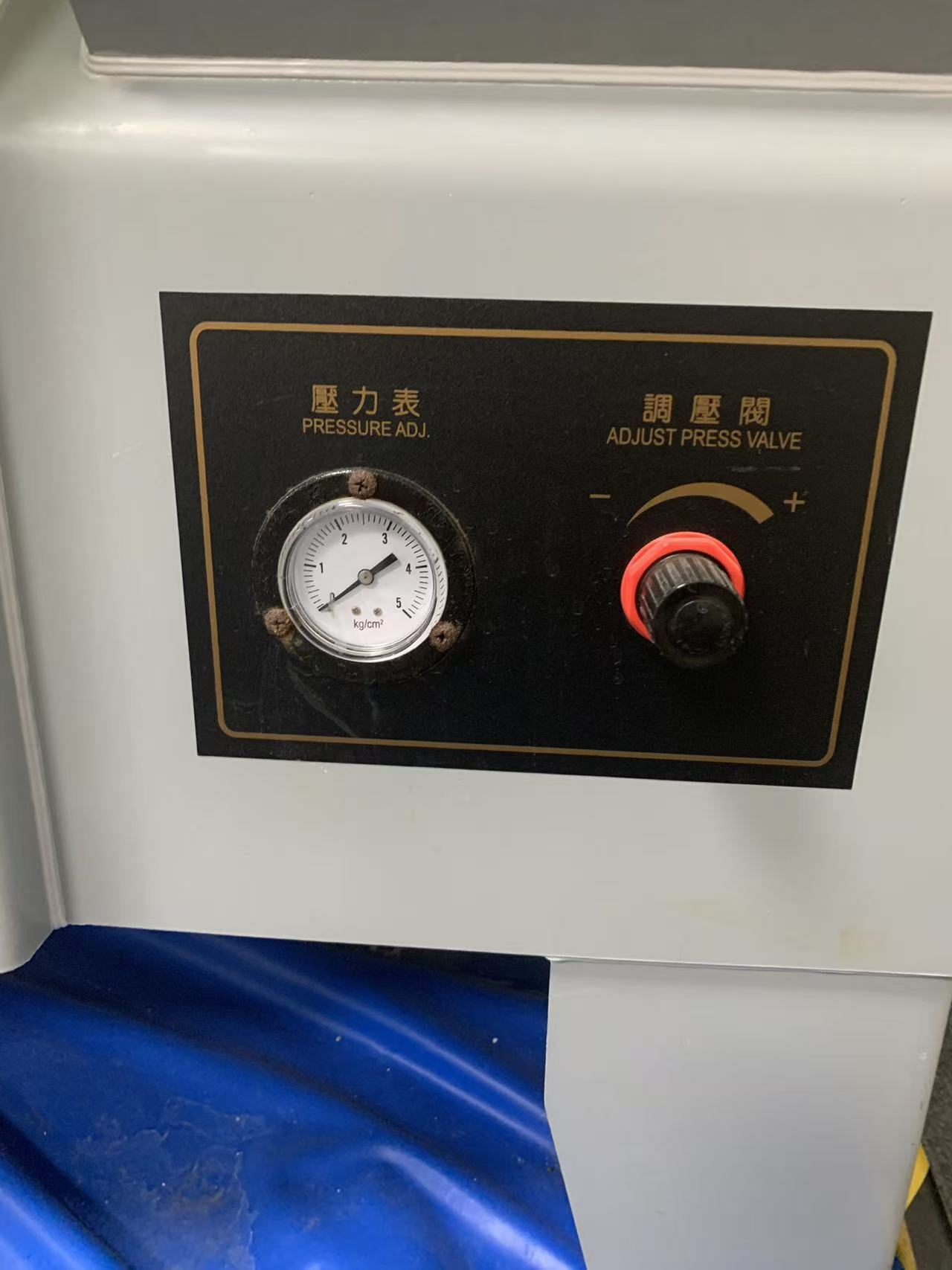
Compressed air pressure gauge and regulating valve. Fog quality depends on this setting as much as on brine concentration, and the operating plate specifies limits in both directions.
What we test, and for how long
Everything metallic that goes onto a waterproof bag passes through here at incoming inspection: buckles and their metal pins, D-rings and O-rings, tri-glides, snap hooks and carabiners, rivets and eyelets, magnetic and mechanical closures, zipper sliders and pulls, and the metal teeth on non-waterproof zippers. Hardware is qualified by supplier and by lot, not once at development and never again.
Duration is set by the surface treatment and the intended environment, and the industry conventions are well established. Ordinary blue-white zinc plating is typically required to show no white rust at 48 hours and no red rust at 72; colour-passivated zinc is held to 72 hours without white rust and 96 without red; black zinc to 96 and 120 respectively. Marine-grade stainless components are run far longer, into the hundreds of hours, and assessment is by protection and appearance rating on a 0 to 10 scale, where a demanding specification calls for a rating of 9 or better.
For general outdoor products we run 24 to 48 hours as a screening condition. For programmes destined for fishing, sailing and marine retail — the category where the most demanding buyers sit — the qualification runs longer and the acceptance criteria tighten, because those products live in salt permanently rather than encountering it occasionally.
Appearance grading is only half of the assessment. For threaded parts, hinges and any moving component, function is verified after the test as well: the part must still engage, thread or articulate without seizing or binding. This is the clause that matters most for our category. A zipper slider that shows only faint corrosion but has developed enough surface roughness to drag on a waterproof zipper's polymer sealing lips has failed, whatever its appearance rating says, because on a welded waterproof bag the closure is the seal. A buckle that latches stiffly after 48 hours is a warranty claim waiting eighteen months.
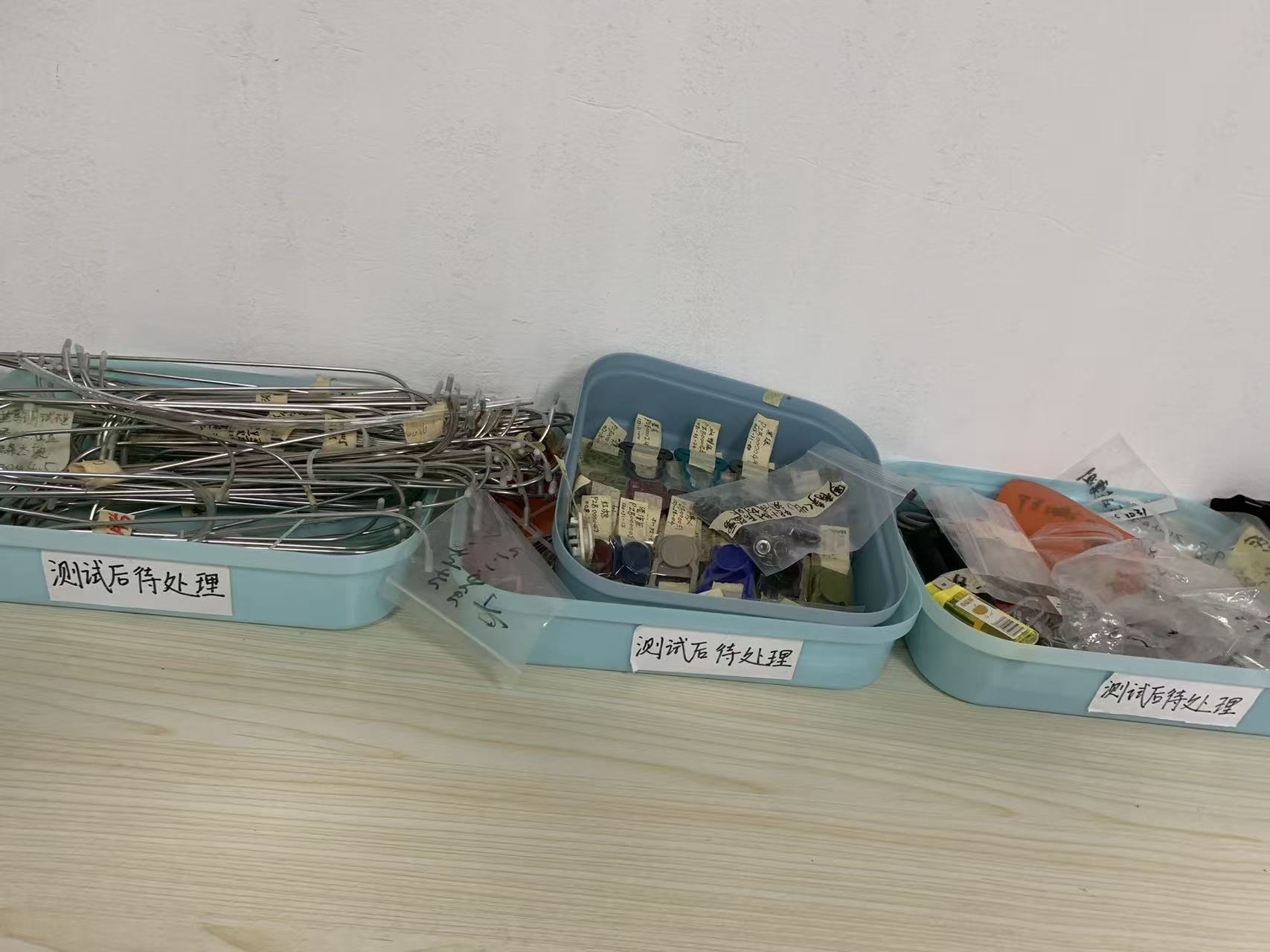
Tested components are labelled, boxed and held for post-test disposition rather than returned to stock. Salt spray is destructive even when a part passes.
The failure that matters most on welded bags
There is a corrosion mode specific to our construction that a hardware-only view of salt spray misses entirely.
On a high-frequency welded bag, metal hardware is frequently attached through the waterproof membrane — a rivet through a panel, an eyelet through a welded patch, a D-ring on a webbing anchor bonded to a TPU face. When that metal corrodes, it does not just look bad. Corrosion products are bulkier than the metal they replace, so a corroding rivet expands in its hole and stresses the material around it, and the corrosion salts themselves migrate into the interface between the metal and the polymer. That interface is a sealing interface. What began as a cosmetic complaint about a rusty rivet becomes a slow leak through a penetration that was watertight when the bag shipped.
Corrosion products also stain. Iron oxide bleeding across a light-coloured welded panel is permanent, and on pale or white products it is the single most common cosmetic return reason in marine categories. Where staining is a risk, the tested specimens go straight from the chamber to our standard light source colour cabinet, because a stain judged under workshop lighting and a stain judged under D65 are two different assessments.
The instruments that follow are equally relevant. Corroded sliders go onto the zipper reciprocating life tester so that post-corrosion operating force can be measured rather than judged by feel. Where a marine programme requires it, hardware is aged in the temperature and humidity chamber before salt exposure, which is closer to the real sequence a component experiences on deck than salt fog alone. And where a metal component is bonded rather than mechanically fixed, the joint is peel-tested afterwards on the tensile and peel tester, because salt penetration at a bond line reduces adhesion long before it becomes visible.
Instrument placard and controlled procedure: model XW-60L, instrument LAB-013, with a named person responsible for operation and routine maintenance.
What a buyer should specify
A hardware specification that says "salt spray tested" is worth nothing. Four items make it enforceable.
Name the standard and the version — ASTM B117 or ISO 9227, and if the latter, which variant, since neutral, acetic acid and copper-accelerated salt spray are not interchangeable and produce results that cannot be compared to one another. Name the duration in hours. Name the acceptance criterion separately for white rust and red rust, and state whether functional verification after the test is required. And name which components are covered, because "hardware" in a specification and "hardware" in a bill of materials are rarely the same list; sliders and pulls in particular are often assumed to be included and often are not.
Buyers who supply their own approved hardware should still ask for lot-level salt spray data rather than a one-time certificate. Plating thickness and passivation quality vary between production lots at the plating shop, and a component approved eighteen months ago on a certificate is not evidence about the lot in this container.
Frequently asked questions
Does 48 hours of salt spray equal a particular number of years in service?
No, and any supplier who offers a conversion is overstating what the method can do. Salt spray is a comparative and screening tool: it ranks coatings against each other and against a defined threshold under identical conditions. Real-world life depends on wet-dry cycling, UV, mechanical wear, rinsing habits and temperature, none of which are present in the chamber.
Is stainless steel hardware immune?
No. Austenitic stainless grades resist general corrosion well but remain vulnerable to pitting and crevice corrosion in chloride environments, particularly where a component sits against fabric or webbing and stays wet. Grade matters considerably here, and it is one of the areas where a specification that simply says "stainless" invites substitution.
Can whole finished bags be tested, or only components?
Both, subject to chamber capacity. Component testing at incoming inspection is where most decisions are made because it is faster and isolates the variable. Assembly-level testing is run when the concern is an interaction — a metal fitting against a specific coated fabric, or hardware in contact with a dissimilar metal elsewhere on the product.
Are tested samples reused?
Never. Salt spray is destructive whether or not a part passes, and exposed components are labelled and held for disposition rather than returned to production stock. This is standard practice across our destructive testing and is auditable.
Can you run to a customer's own corrosion protocol?
Yes. Duration, brine concentration, angle, acceptance grading and post-test functional checks are all set by the procedure rather than fixed by the machine. Where a brand's protocol requires acetic acid or copper-accelerated conditions that fall outside our in-house scope, we run the neutral salt spray screen internally and route the specified variant to an accredited third-party laboratory.
Where this sits in the series
Salt spray is the only test in our laboratory that examines a part of the bag most people never think about until it stops working. Fabric, welds and stitching get the attention; the buckle, the slider and the D-ring decide whether the product is still usable in year three. On marine and fishing programmes in particular, they are the components a brand's customers will judge it by.
Sealock has been building high-frequency welded waterproof gear for over twenty years from Dongguan, China and Ho Chi Minh City, Vietnam, for marine and outdoor brands including AFTCO, West Marine, SIMMS, PENN, attwood and Musto. If you would like our corrosion test protocol, or want hardware qualification written into your own quality agreement before tooling is committed, write to info@sealock.com.hk.
We use cookies to offer you a better browsing experience, analyze site traffic and personalize content. By using this site, you agree to our use of cookies.
Privacy Policy
 English
  Español
  Português
  русский
  Français
  日本語
日本語  Deutsch
  tiếng Việt
  Italiano
  Nederlands
  ภาษาไทย
  Polski
  Svenska
  magyar
  Malay
Malay  বাংলা ভাষার
  Dansk
Dansk  Suomi
Suomi  हिन्दी
  Pilipino
  한국어
한국어  Türkçe
  Gaeilge
  العربية
  Indonesia
  Norsk
Norsk  تمل
تمل  český
český  ελληνικά
  український
  Javanese
  فارسی
فارسی  தமிழ்
தமிழ்  తెలుగు
  नेपाली
  Burmese
  български
  ລາວ
ລາວ  Latine
  Қазақша
  Euskal
  Azərbaycan
  Slovenský jazyk
  Македонски
  Lietuvos
  Eesti Keel
  Română
  Slovenski
  मराठी
मराठी  Srpski језик