Third in a series from the Sealock lab: the zipper life tester, and why cycling a zipper without tension tells you almost nothing
DONGGUAN, China — [Month Day], 2026 — Ask any bag factory where the warranty claims come from and you'll get the same answer, delivered with a sigh. Not the fabric. Not the seams. The zipper.
It makes sense when you think about what a zipper is: the only part of a bag with dozens of moving components, operated several times a day, every day, usually with one impatient hand, often while the bag is stuffed past the point of reason. Everything else on a bag sits still. The zipper works for a living.
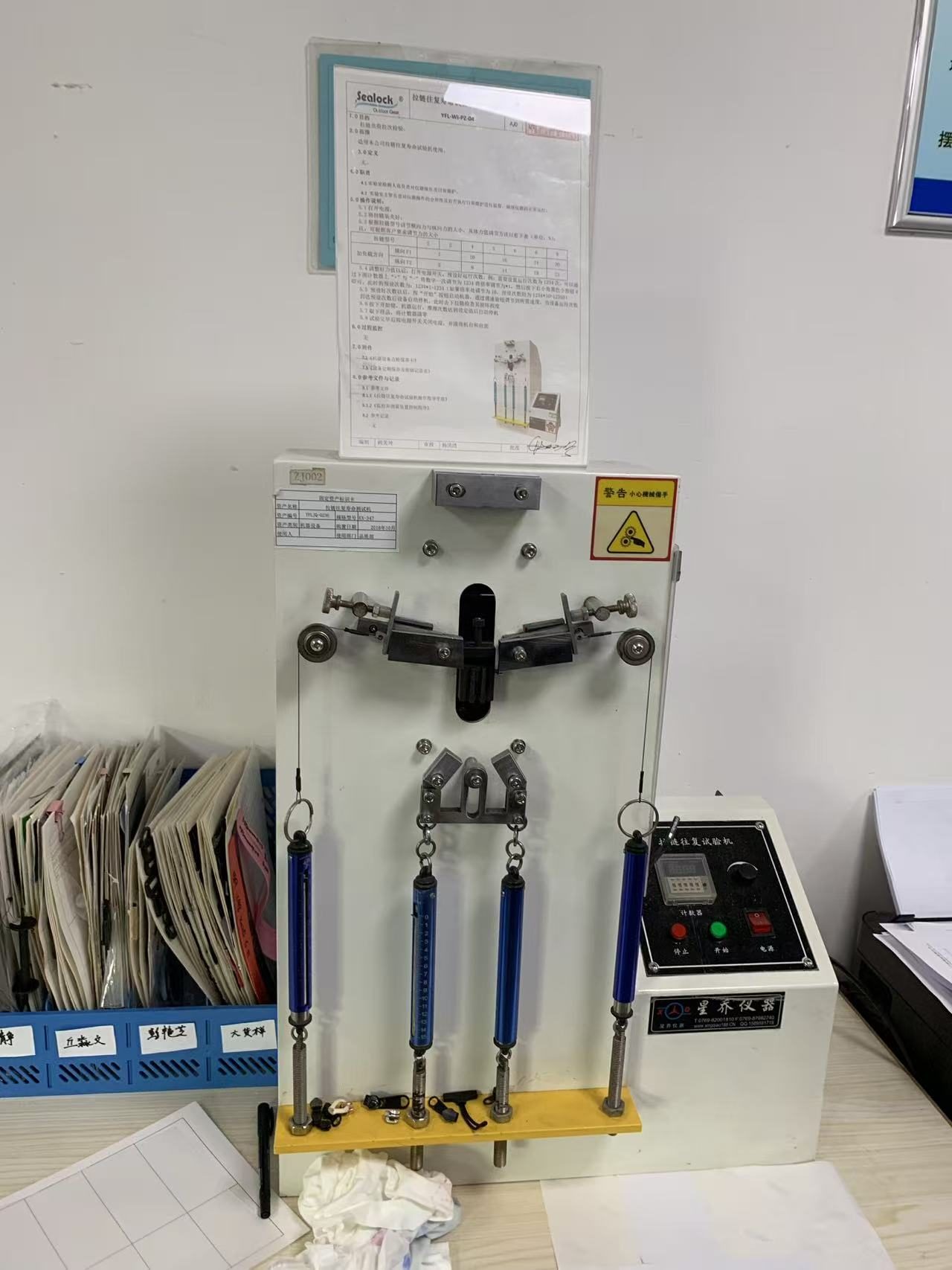
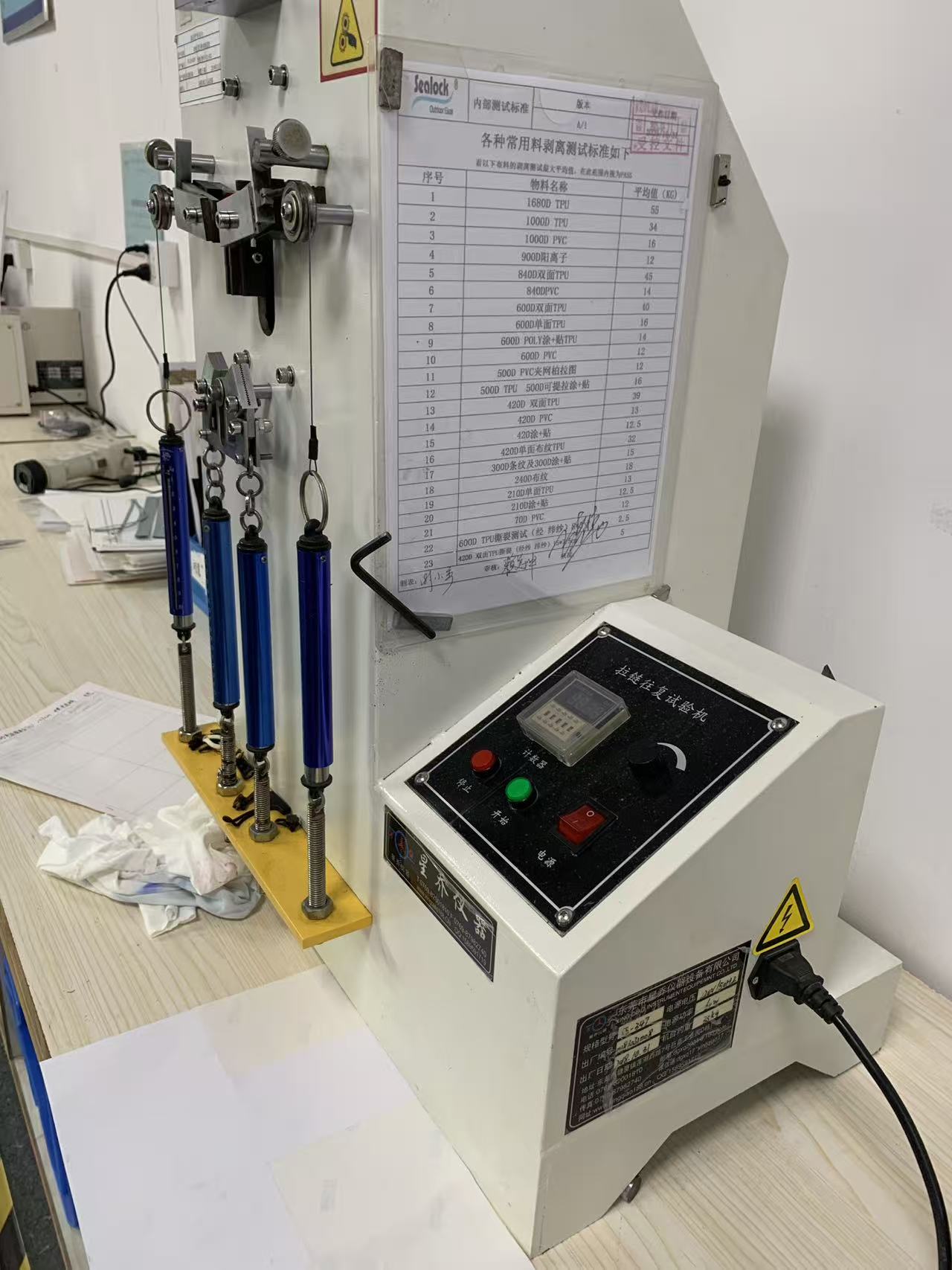
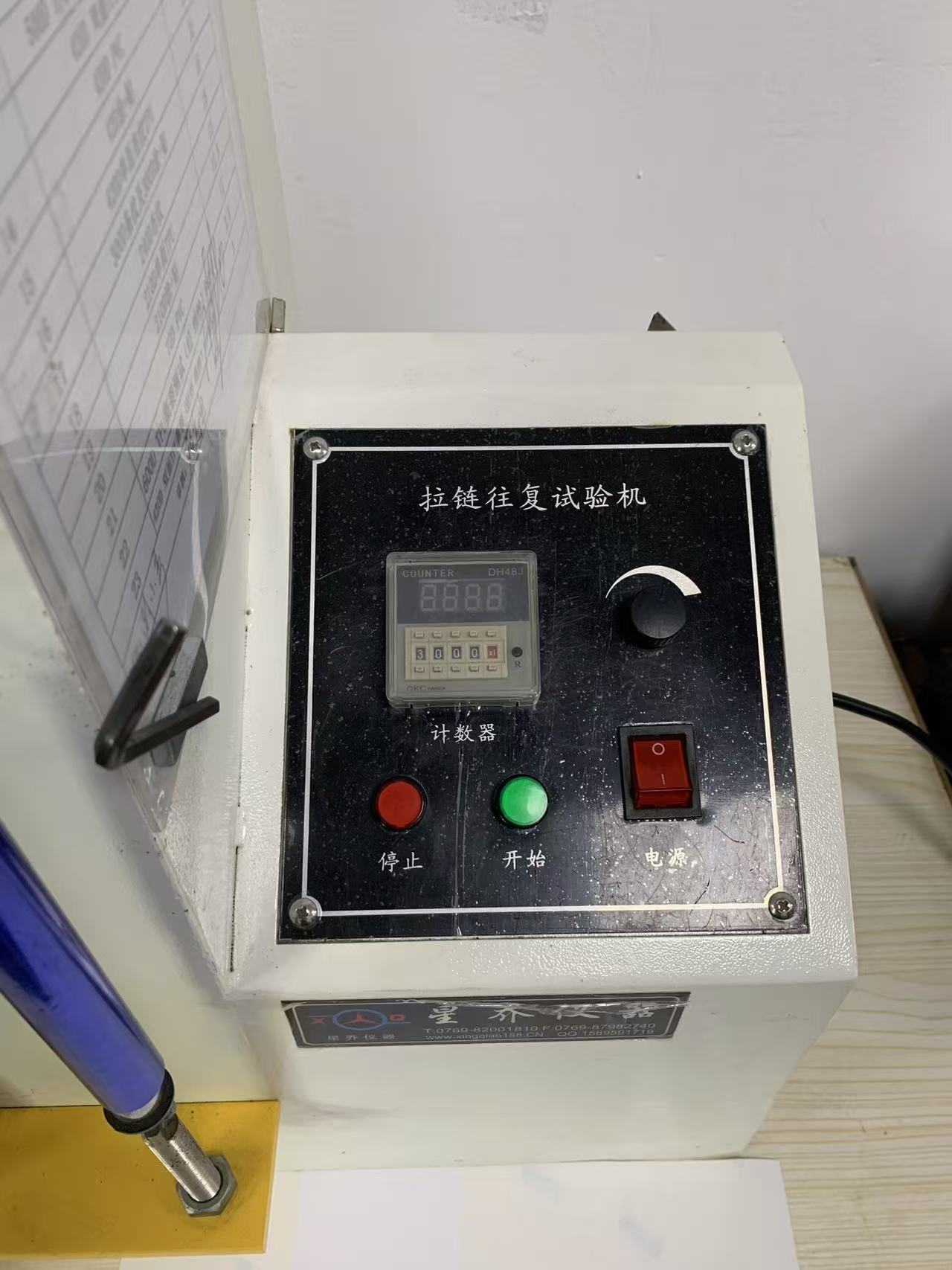
So in our lab there's a machine whose entire job is to open and close zippers until something gives. In the photograph its counter is set to 3,000 cycles. It will run all of them, under measured load, and then stop by itself.
The zipper life tester: specimen clamped at the top, calibrated spring gauges hanging below, counter and speed control on the right.
The mistake most zipper "tests" make
Here's the thing that separates a real zipper test from a demonstration: load.
It's easy to build a rig that slides a puller back and forth on a zipper lying flat and relaxed. Run it 5,000 times, film it, put it in a brochure. The trouble is that no zipper on earth lives that way. A real zipper is under tension every time it's used — because the bag is full. The contents push outward, the chain is being forced apart sideways while you drag the slider along it, and the harder the bag is packed the worse both of those get.
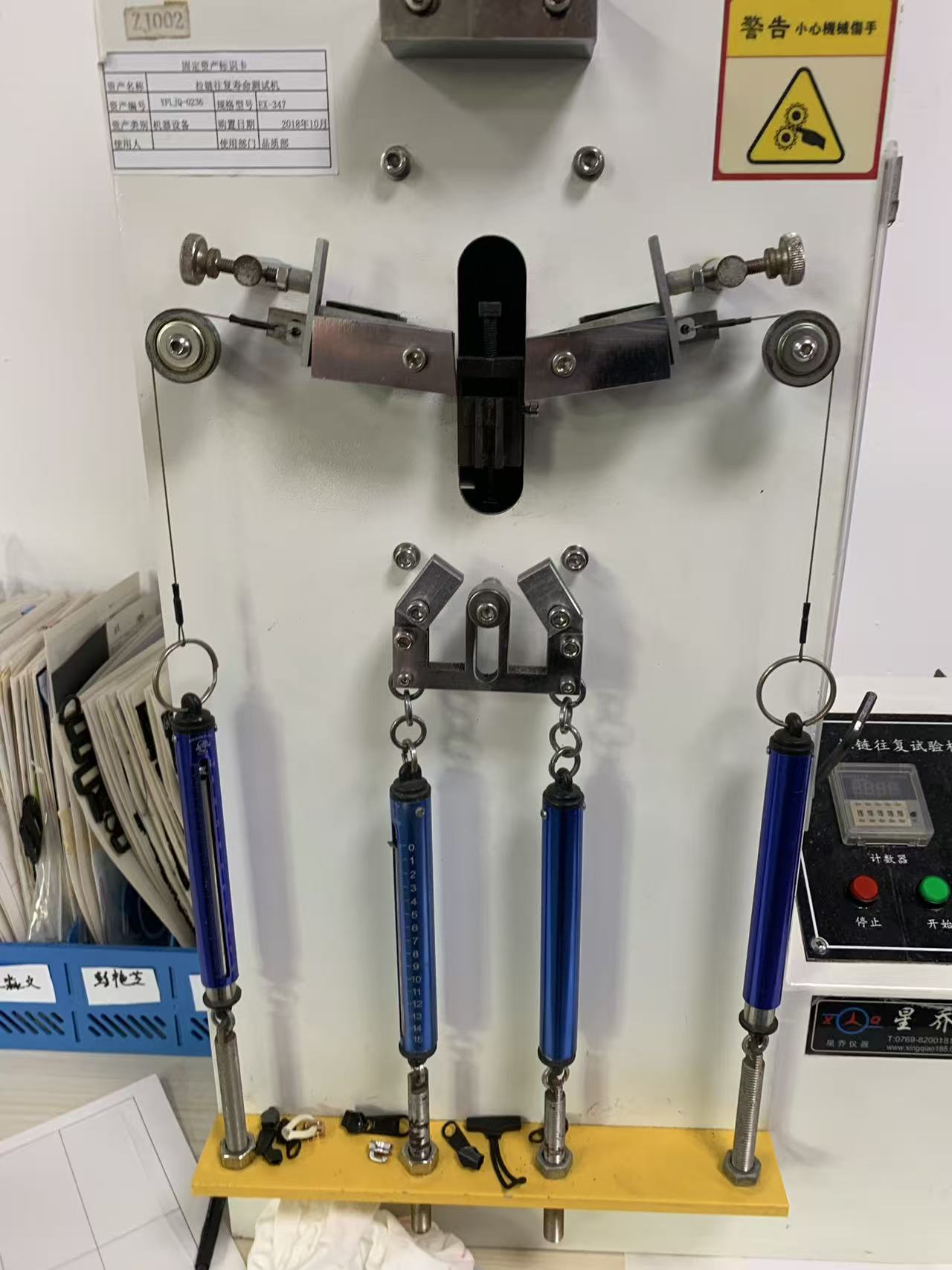
That's why this machine hangs weight on the specimen in two directions at once. A lateral force (F1) pulls the two halves of the chain apart, simulating a stuffed bag trying to burst its own zipper open. A longitudinal force (F2) works along the line of travel, loading the slider as it's dragged. Four calibrated spring gauges apply and display those forces. Only then does the machine start cycling.
The difference is not academic. A zipper cycled unloaded will run happily for tens of thousands of cycles and tell you nothing. The same zipper cycled under lateral load will show you exactly how it's going to fail in the field: teeth that start to separate behind the slider, a slider that widens and stops locking the chain, a pull tab that fatigues at its attachment, a tape that tears away from where it's anchored.
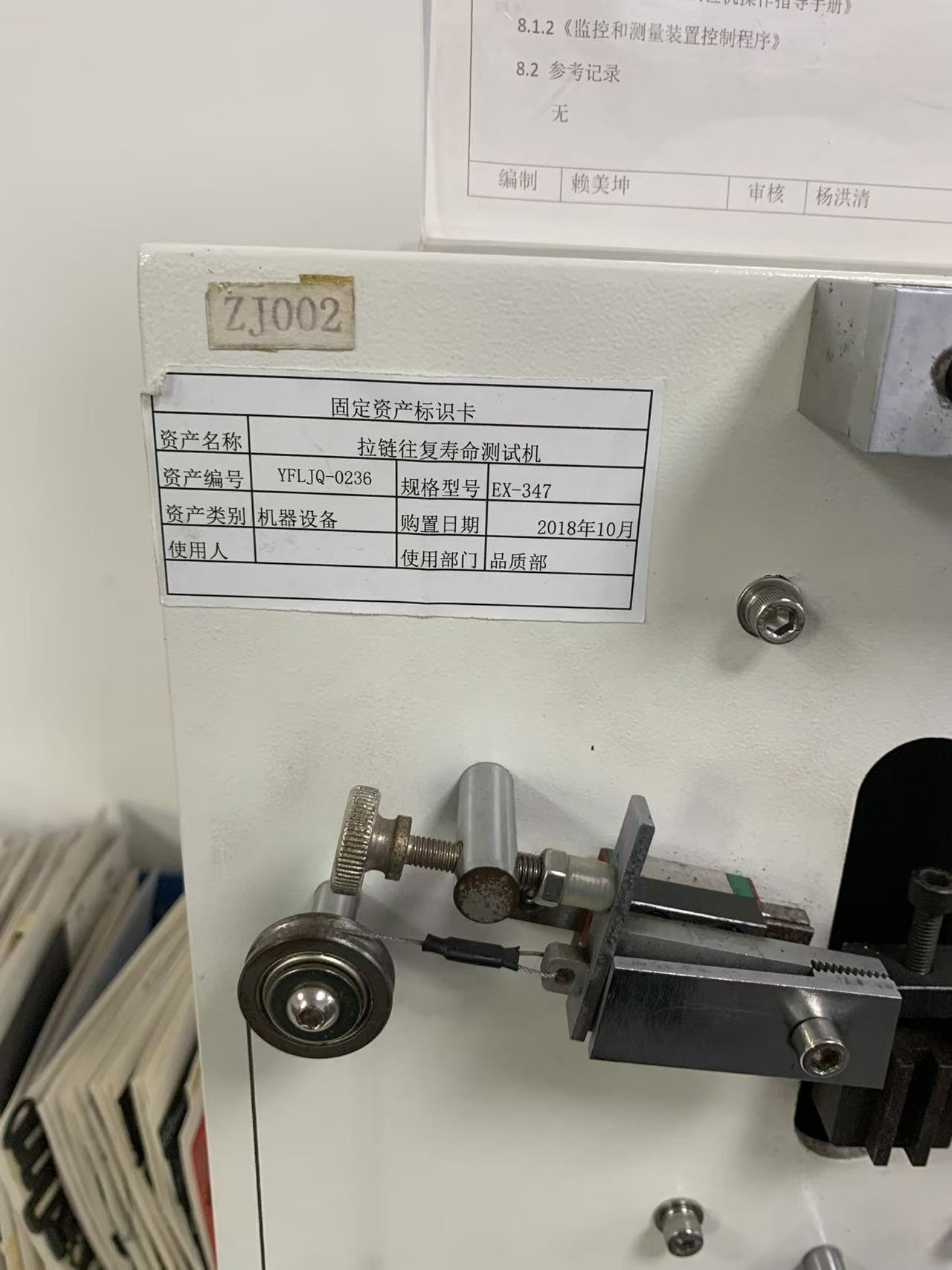
The specimen fixture: the chain is clamped either side, with cables running over pulleys to the load gauges below.Lateral and longitudinal loads are applied and read off calibrated gauges before the cycling starts.
The loads aren't guessed — they're tabled by zipper size
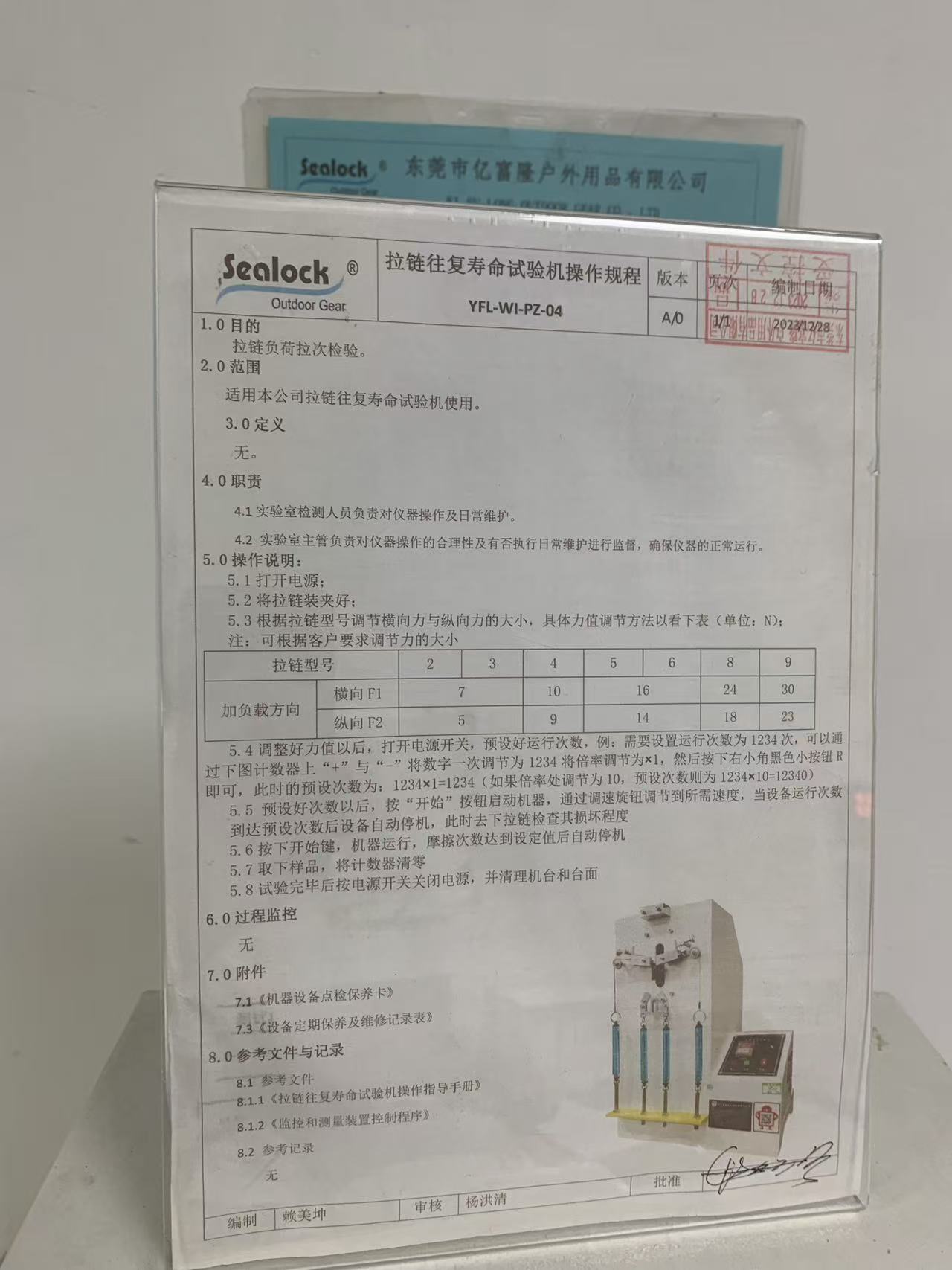
The machine runs to controlled procedure YFL-WI-PZ-04, revision A/0, and the heart of that document is a small table. It sets the lateral force (F1) and longitudinal force (F2), in newtons, for each zipper gauge — because a #3 zipper on a document pouch and a #9 zipper on a heavy-duty duffel have no business being tested at the same load:
Size 2–3: F1 7 N, F2 5 N
Size 4: F1 10 N, F2 9 N
Size 5–6: F1 16 N, F2 14 N
Size 8: F1 24 N, F2 18 N
Size 9: F1 30 N, F2 23 N
Two things worth noticing about that table. First, the loads scale with the zipper, so the test is proportionate rather than one-size-fits-all — a heavier chain is expected to take more, and is tested as such. Second, the procedure carries an explicit note: the force values may be adjusted to the customer's requirement. If a brand's own specification calls for a different load, or a heavier one because their end use is brutal, the machine is set to their number rather than ours. A house standard should be a floor, not a ceiling.
How a run actually goes
The procedure is short enough to read in a minute, which is the sign of a test that gets run rather than admired:
Power on and clamp the zipper into the fixture.
Set the lateral and longitudinal forces per the table for that zipper size — or per the customer's spec.
Set the cycle count on the counter, using its multiplier: 1234 at ×1 is 1,234 cycles; the same setting at ×10 is 12,340. It's a small mechanical detail that has ruined more than one test at more than one factory, which is exactly why it's spelled out in the document rather than left to memory.
Press start and set the speed on the dial. The machine cycles and stops itself automatically when it reaches the preset count.
Remove the zipper and examine the damage — this is the actual result, not the fact that it survived.
Zero the counter, power down, clean the machine and the bench.
That last line looks like housekeeping. It isn't only housekeeping: a counter left un-zeroed is how the next person's 3,000-cycle test quietly becomes a 300-cycle one.
Counter, speed dial, start and stop. In this photo the count is set to 3,000.The controlled procedure, including the load table by zipper size.
Why this matters more for waterproof gear than for luggage
A standard nylon coil zipper is a forgiving thing. The waterproof and airtight zippers we weld into dry bags and coolers are not, and the reasons are structural.
They're stiffer by design — the tight, coated tooth engagement that keeps water and cold air out is the same thing that makes them heavy to pull. That resistance means every cycle transmits more force into the slider, the tape and the pull tab than a soft coil zipper ever would. They also carry a polymer coating on the tape, and coatings can crack at a fold or a stress point after enough cycles — and a crack in a waterproof zipper's coating isn't a cosmetic issue, it's a leak. Finally, on our products the zipper tape is usually welded directly into the body, so the interface between a moving component and a sealed structure is itself a place that has to survive fatigue.
All of which means the honest version of a waterproof zipper claim isn't "it seals." It's "it still seals after a season of being yanked open with a wet hand." The only way to know that before shipping is to cycle it under load and then go look.
What we're looking for when it stops
The cycle count is the setup; the inspection afterwards is the result. On a completed specimen we're checking whether the chain still closes fully and locks behind the slider, whether the slider has widened or begun to skip, whether teeth have deformed or pulled away from the tape, whether the pull tab and its attachment are intact, and — for coated waterproof chains — whether the coating shows cracking or wear along the fold line where the slider passes.
A failure here isn't automatically a rejected zipper. Often it's a specification conversation: a heavier gauge for a bag that's going to be overstuffed, a different slider or locking type, a reinforcement at the end stop where the load concentrates, or a design change that stops the zipper being the part of the bag that carries the load in the first place. What it should never be is a discovery made by the customer.
Registered, calibrated, and boring on purpose
Like the other instruments in this series, this one carries its paperwork on its body: an asset card identifying it as company asset YFLJQ-0236, model EX-347, purchased in October 2018 and assigned to the quality department, and a machine ID — ZJ002 — stencilled on the panel. Beside it sits a calibration label, calibrated in December 2025 with recalibration due in December 2026.
That combination — a named owner, a documented procedure, a load table with real numbers, and an external calibration on a scheduled cycle — is what allows a sentence like "this zipper passed 3,000 cycles under 16 N lateral load" to mean something to a customer's engineer. Without it, the same sentence is just a nice round number.
Asset card and machine ID: registered equipment, assigned to the quality department.
One more sheet on the wall
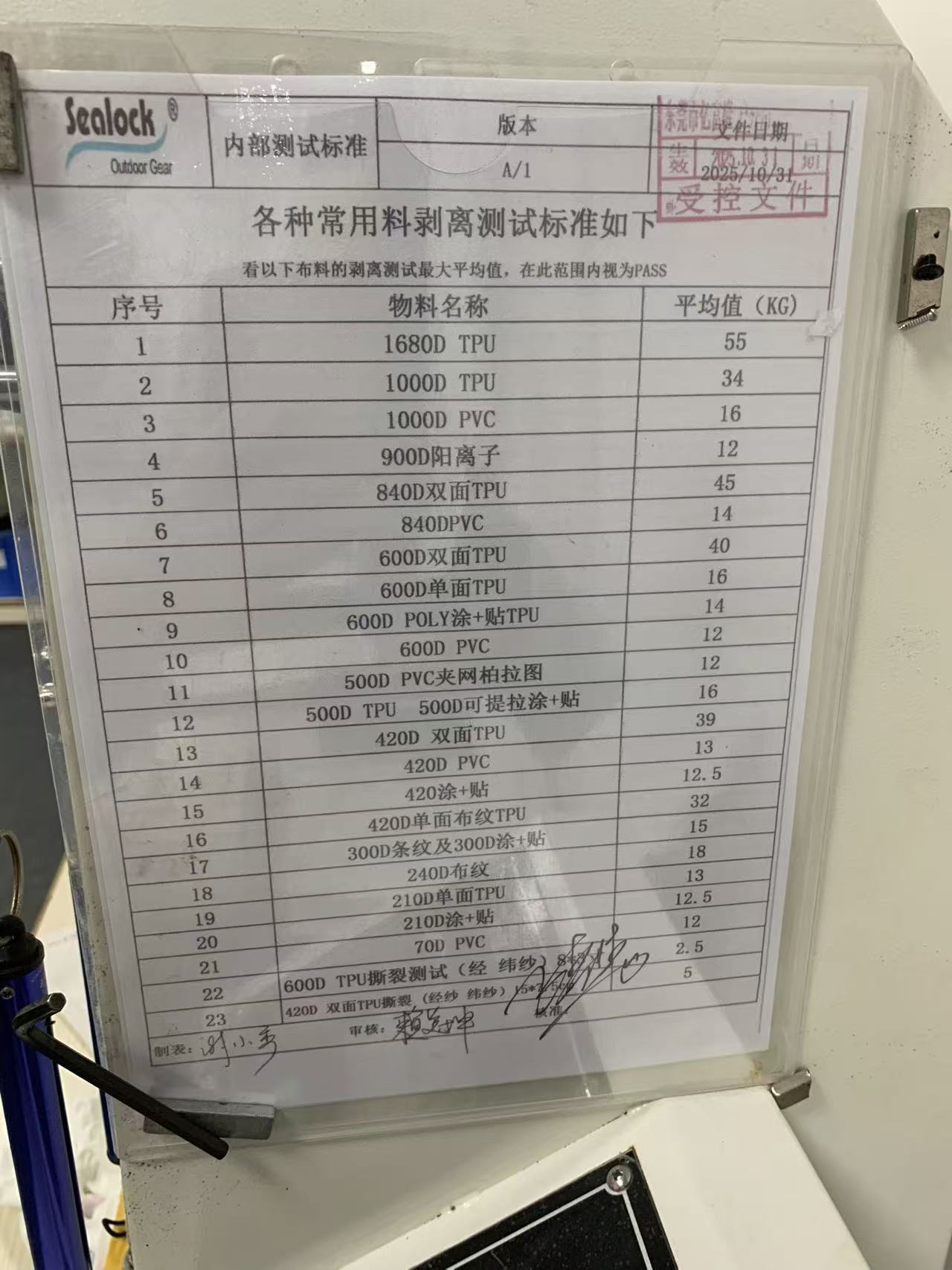
If you look past this machine in the photographs, there's another controlled document mounted beside it: an internal test standard listing the acceptance values, in kilograms, for peel and bond strength across more than twenty of the materials we use routinely — 1680D TPU, 840D double-sided TPU, 600D single- and double-sided TPU, PVC and coated laminates, each with its own pass threshold, plus tear-strength criteria at the bottom. It belongs to a different instrument, and it's the subject of the next article in this series.
But it's worth flagging here, because it answers a question people rarely ask a factory: what number counts as a pass? Testing is only half of quality control. Having written, revision-controlled acceptance criteria — so that a result gets compared against something agreed in advance rather than against whatever the person holding the specimen was hoping for — is the other half.
An internal, revision-controlled standard: acceptance values by material, agreed before the test rather than after it.
About Sealock
Sealock (Dongguan Yifulong Outdoor Products Co., Ltd.), founded in 2003, is a manufacturer of high-frequency welded waterproof bags, soft-sided cooler bags and inflatable water gear, with production bases in Dongguan, China and Ho Chi Minh City, Vietnam. The company operates an in-house testing laboratory with registered, externally calibrated instruments, controlled operating procedures and documented internal acceptance standards, supporting material approval, product development and production quality control for OEM and ODM programs worldwide. Its systems and certifications include ISO 9001, BSCI, SMETA and GRS.
We use cookies to offer you a better browsing experience, analyze site traffic and personalize content. By using this site, you agree to our use of cookies.
Privacy Policy
 English
  Español
  Português
  русский
  Français
  日本語
日本語  Deutsch
  tiếng Việt
  Italiano
  Nederlands
  ภาษาไทย
  Polski
  Svenska
  magyar
  Malay
Malay  বাংলা ভাষার
  Dansk
Dansk  Suomi
Suomi  हिन्दी
  Pilipino
  한국어
한국어  Türkçe
  Gaeilge
  العربية
  Indonesia
  Norsk
Norsk  تمل
تمل  český
český  ελληνικά
  український
  Javanese
  فارسی
فارسی  தமிழ்
தமிழ்  తెలుగు
  नेपाली
  Burmese
  български
  ລາວ
ລາວ  Latine
  Қазақша
  Euskal
  Azərbaycan
  Slovenský jazyk
  Македонски
  Lietuvos
  Eesti Keel
  Română
  Slovenski
  मराठी
मराठी  Srpski језик