First in a series from the Sealock lab: how a four-station abrasion tester tells us, in advance, how long a bag's surface will actually last
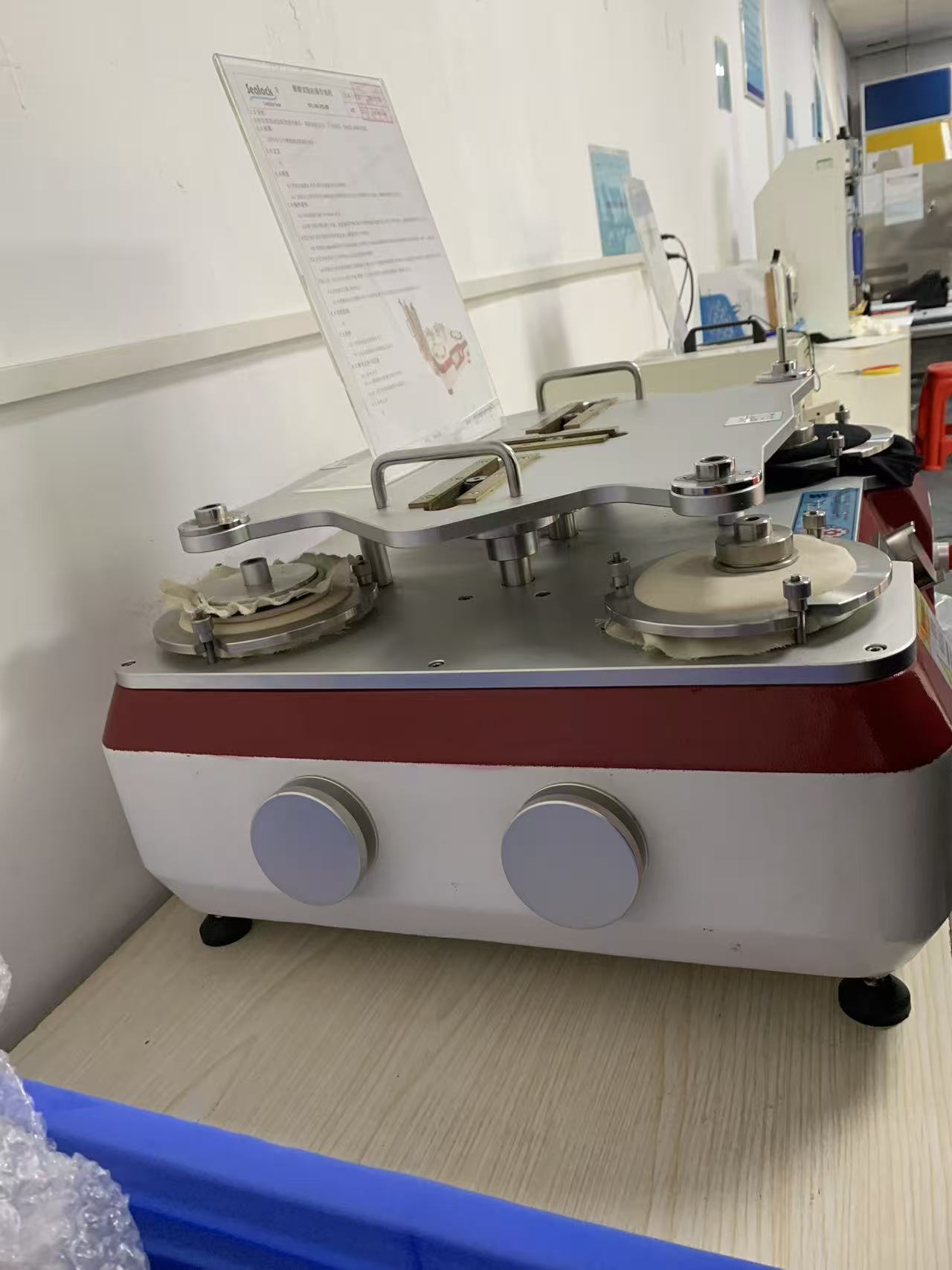
DONGGUAN, China — [Month Day], 2026 — In a quiet room down the hall from the welding floor, a squat red-and-white machine spends its days destroying small circles of fabric. Four discs, 44 millimetres across, are clamped face-down against abrasive cloth and rubbed — thousands upon thousands of times, under a measured load, in a looping figure-eight path — until the surface gives up. Then someone takes them out, looks closely, and writes down what happened.
It isn't glamorous, and no customer will ever see it in a product photo. But this machine answers a question that almost every buyer forgets to ask and almost every user eventually cares about: how long does the outside of this bag survive contact with the real world?
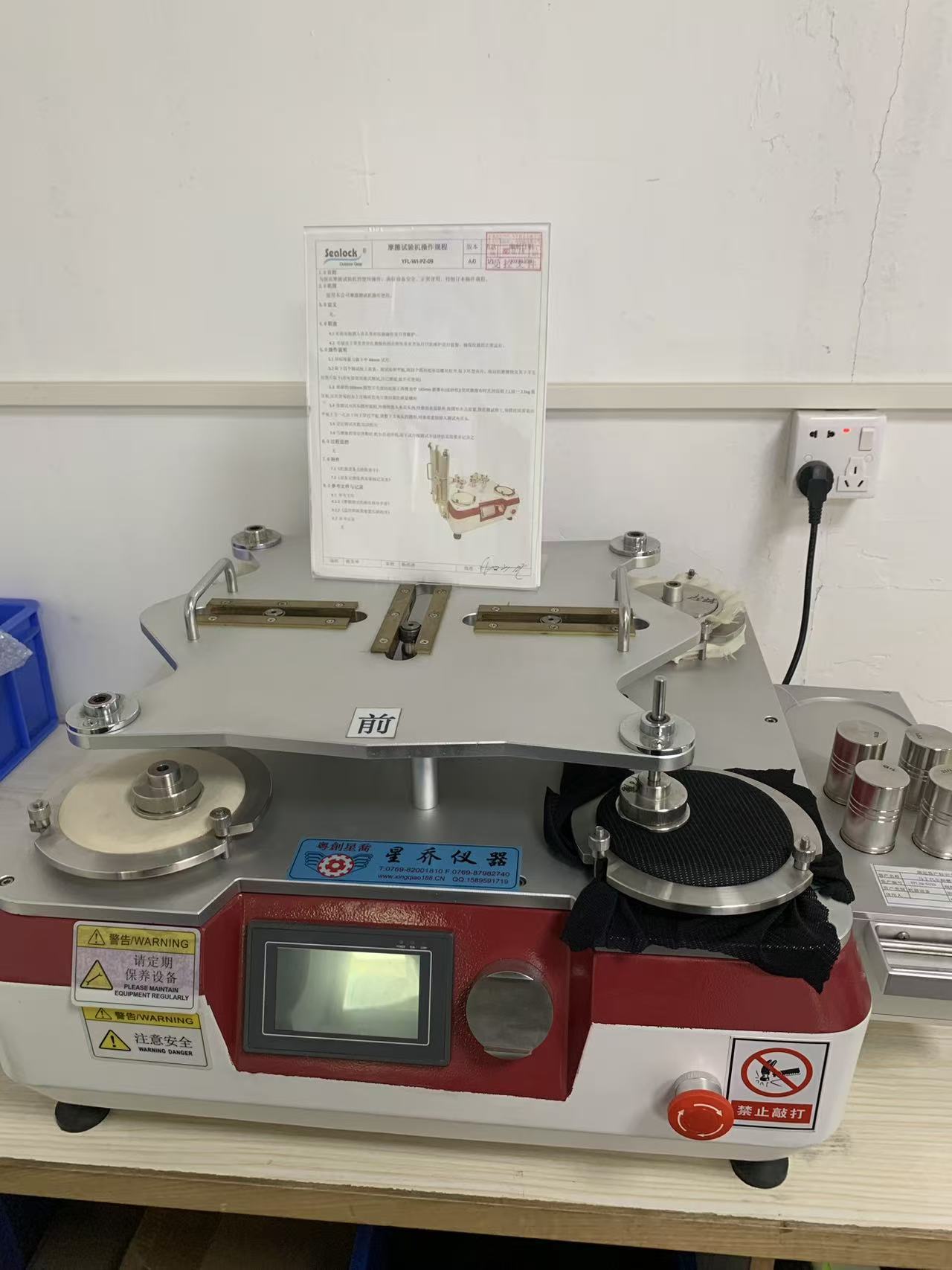
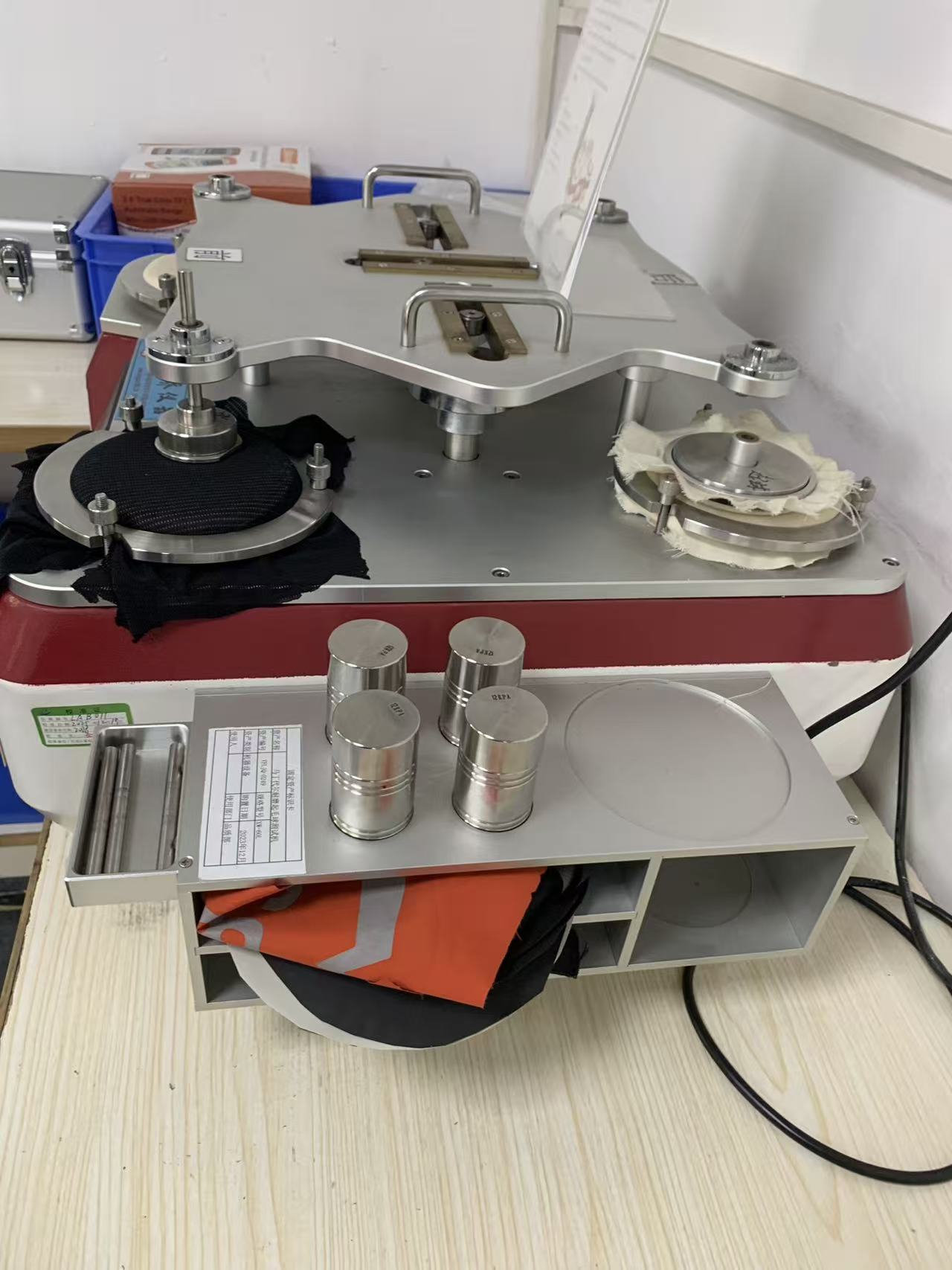
The four-station abrasion tester in Sealock's in-house lab, with its operating procedure posted at the machine.
Abrasion is how gear actually dies
Ask what kills a waterproof bag and most people picture something dramatic: a seam splitting, a zipper blowing out, a puncture. In practice the ending is far more boring. The bag gets set down on concrete, dragged across a truck bed, shoved under a boat seat, rubbed against a rock, scuffed by a backpack strap in the same spot for two seasons. Nothing tears. The surface just slowly wears.
For coated technical fabrics — the TPU and PVC-coated materials we weld into dry bags, coolers and cases — that slow wear is not cosmetic. The coating is the waterproof barrier. Rub it thin enough and you haven't just dulled the finish; you've opened a path. A bag can be perfectly welded, perfectly sealed, pass an immersion test on day one, and still start letting water through in year two because the fabric surface has been sanded away by ordinary use. That failure won't trace back to a seam or a zipper. It traces back to a material choice nobody stress-tested.
So we test it. Before a material goes into a production program, and whenever a customer or a supplier proposes a substitution, a sample goes onto this machine and gets rubbed until we know its number.
What the machine does
The principle is the one behind the classic Martindale-type abrasion test, and it's clever in a way worth explaining. A specimen is clamped face-down against an abradant and moved against it — but not in a circle and not back and forth in a line. It travels a continuously changing looping path, a Lissajous figure, so that no two passes wear the fabric in exactly the same direction. That matters because most fabrics are anisotropic: they have a warp and a weft, a grain, sometimes a directional coating or print. Rub one axis only and you get an answer that flatters or punishes the material depending on how you loaded it. The looping path abrades from every direction in turn, which is the closest a lab can get to the indifferent, multi-directional scuffing a bag gets in the back of a vehicle.
Ours runs four stations at once. That's not just throughput — it's how you get an answer you can trust. Four specimens under identical load and identical cycle count let you see whether a result is the material's behaviour or one specimen's fluke. Cut four, run four, compare four.
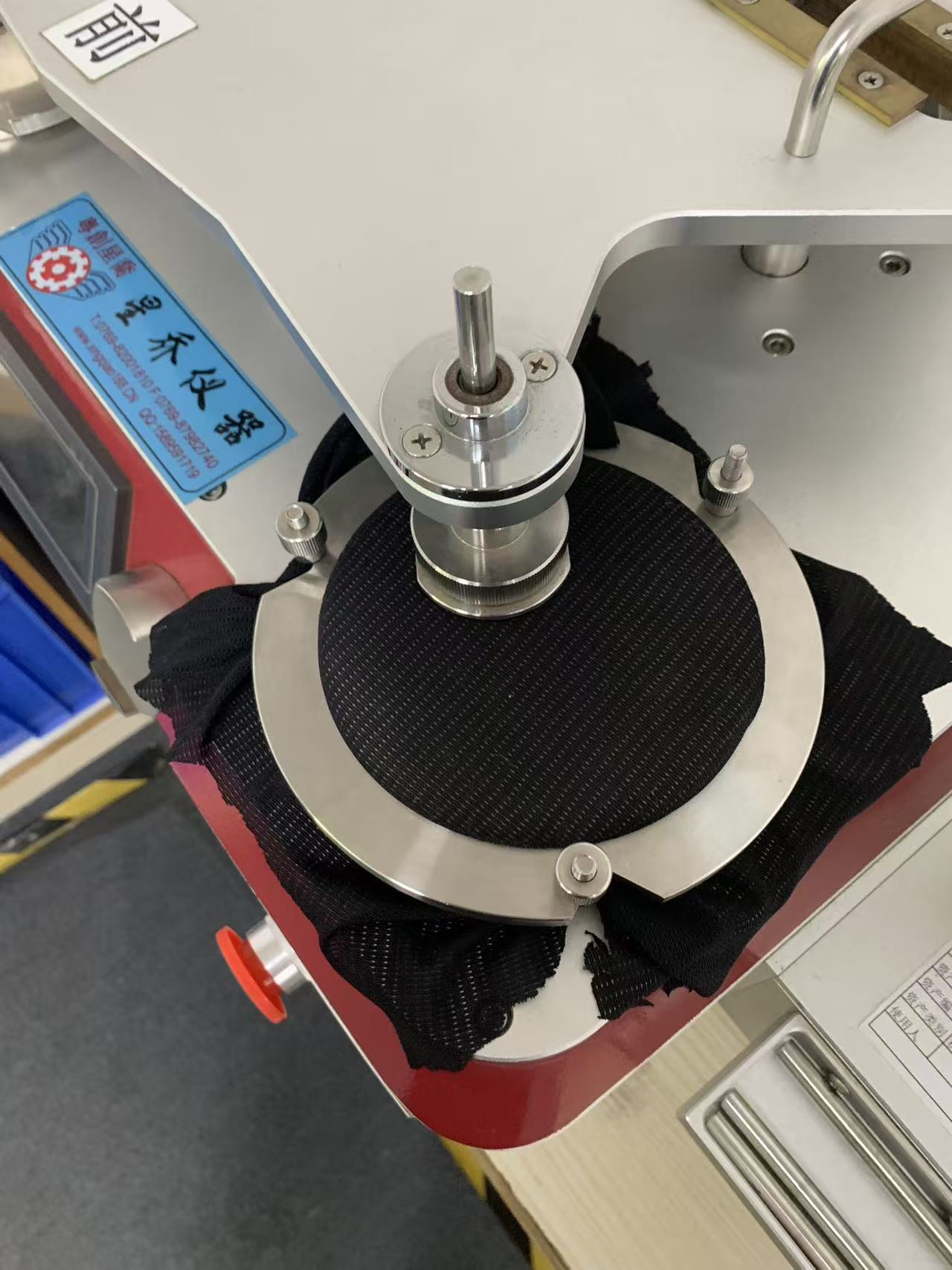
A specimen clamped at one station, abraded face out, ready to take the load.Calibrated weights, wool felt, abradant and the standard cutting die — the test is only as repeatable as its consumables.
The procedure, as it's actually written down
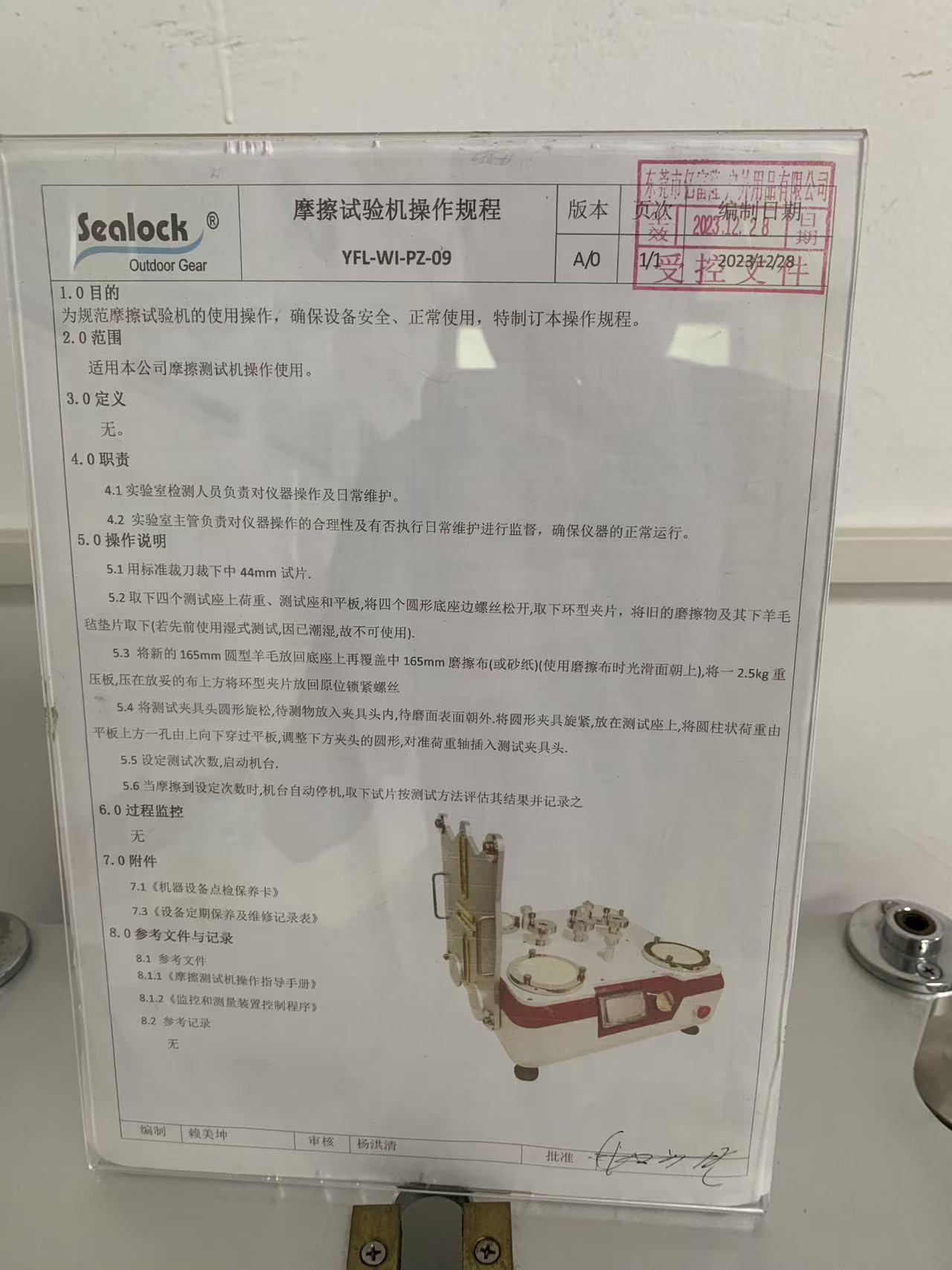
What makes a lab result mean anything is that the same test is run the same way every time, by whoever is on shift. That's why this machine has a controlled operating procedure posted on it — document YFL-WI-PZ-09, revision A/0 — with a named author, a named reviewer and an approval signature. It reads less like marketing and more like a recipe, which is the point:
Cut the specimen to 44 mm using the standard cutting die — not scissors, not by eye. A specimen that isn't round and isn't the right diameter loads unevenly and gives a number that means nothing.
Strip each of the four stations: remove the weights, the test base and the flat plate, loosen the four screws around the base, lift the ring clamp, and take out the used abradant and the wool felt beneath it.
Lay a fresh 165 mm wool felt on the base, cover it with fresh 165 mm abradant cloth (or sandpaper, depending on the method) — smooth side up when using abradant cloth — press it flat with a 2.5 kg plate, then refit the ring clamp and lock the screws.
Loosen the round clamp head, seat the specimen inside it with the face to be abraded outward, tighten it, and set it on the test base. Drop the cylindrical weight through the hole in the plate from above so it seats squarely on the clamp head.
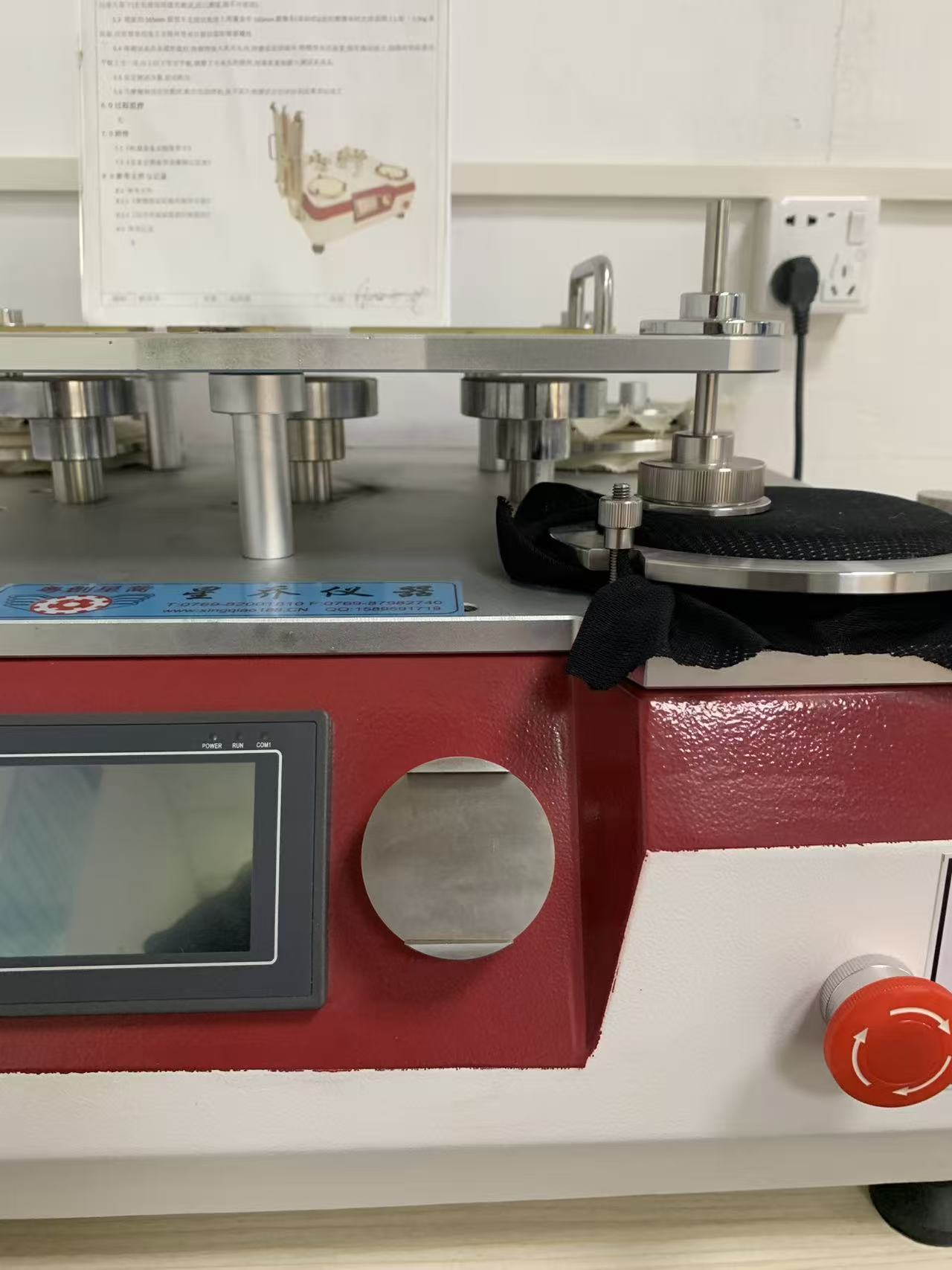
Set the cycle count and start. The machine stops itself when the count is reached.
Remove the specimens, assess them against the test method, and record the result.
One line in that procedure is worth pulling out, because it's the kind of detail that separates a lab from a room with a machine in it: if the felt was used in a wet test, it is damp, and it cannot be reused. A damp felt gives a different friction than a dry one. It would still produce a number. The number would just be wrong — and nobody downstream would ever know. Writing that rule down, and following it when no one is watching, is most of what quality control actually is.
The controlled procedure at the machine — authored, reviewed, approved and dated.Cycle count is set on the panel; the machine stops itself at the number, not when someone decides it's enough.
What we're reading when the machine stops
A cycle count on its own is meaningless without knowing what you were watching for. Depending on the material and what it has to do in the finished product, the endpoint might be any of these:
Coating wear-through. The one that matters most for us. At what point does the abrasion start taking the coating off the base fabric — the moment the material stops being waterproof, whatever the label says.
Surface appearance. Gloss loss, scuffing, whitening, and the greying or fading of a printed or colored surface. A cooler that looks beaten after one season is a warranty conversation even if it still holds ice.
Print and reflective durability. Printed graphics and reflective elements sit on top of the surface, so they take the abrasion first. This is exactly where a customer's branding lives, which is why we'd rather find a weak print here than in a returns report.
Structural breakdown. Yarn breakage, pilling or fuzzing on textile faces, and eventually a hole.
The result feeds a decision, not a certificate: approve this material for the program, ask the supplier for a different coating weight, move the reflective panel off the base of the bag where it drags, or tell a customer honestly that the fabric they've fallen in love with will not survive the use case they've described.
Why we own the machine instead of renting the answer
Any of this can be outsourced. Send swatches to a third-party lab, wait a week or two, get a report. We use third-party testing too, and for customer-facing certification that's exactly the right route.
But an in-house machine changes what testing is for. When the tester is thirty seconds' walk from the sampling room, abrasion stops being a final exam and becomes part of development. A supplier sends three candidate fabrics on Monday and we know by Tuesday which one survives. A customer asks mid-program whether a cheaper coating would hold up, and the answer comes back the same day with specimens they can hold. A production lot arrives looking subtly different from the approved standard, and we can rub it against a retained sample rather than argue about it over email. Testing you can run cheaply and immediately is testing you'll actually run — and the tests that get run are the only ones that prevent anything.
That's the real argument for a factory owning its own lab: not a certificate on a wall, but the ability to be curious about your own materials at no cost, on any Tuesday, before a decision is locked.
A suggestion for anyone sourcing gear
Since we're being direct: next time a supplier tells you a fabric is durable, ask them what that means in numbers. Ask which abrasion method, under what load, to how many cycles, and what the endpoint was — wear-through, appearance change, or breakage. Ask whether they ran it themselves or are quoting a mill's datasheet. Ask what the fabric looked like at the end.
You'll learn a lot from the answer, and not only about the fabric. A supplier who can answer that question has a lab, a procedure and a habit of checking. A supplier who can't is telling you that "durable" is a word they chose, not a thing they measured.
This is the first in a series on the equipment in our lab. Next up: the machines that test what happens when a bag is loaded, soaked, pulled and left in the sun.
Four stations, one procedure, and a very patient machine.
About Sealock
Sealock (Dongguan Yifulong Outdoor Products Co., Ltd.), founded in 2003, is a manufacturer of high-frequency welded waterproof bags, soft-sided cooler bags and inflatable water gear, with production bases in Dongguan, China and Ho Chi Minh City, Vietnam. The company operates an in-house testing laboratory supporting material approval, product development and production quality control, and produces OEM and ODM programs for outdoor, marine and lifestyle brands worldwide. Its systems and certifications include ISO 9001, BSCI, SMETA and GRS.
We use cookies to offer you a better browsing experience, analyze site traffic and personalize content. By using this site, you agree to our use of cookies.
Privacy Policy
 English
  Español
  Português
  русский
  Français
  日本語
日本語  Deutsch
  tiếng Việt
  Italiano
  Nederlands
  ภาษาไทย
  Polski
  Svenska
  magyar
  Malay
Malay  বাংলা ভাষার
  Dansk
Dansk  Suomi
Suomi  हिन्दी
  Pilipino
  한국어
한국어  Türkçe
  Gaeilge
  العربية
  Indonesia
  Norsk
Norsk  تمل
تمل  český
český  ελληνικά
  український
  Javanese
  فارسی
فارسی  தமிழ்
தமிழ்  తెలుగు
  नेपाली
  Burmese
  български
  ລາວ
ລາວ  Latine
  Қазақша
  Euskal
  Azərbaycan
  Slovenský jazyk
  Македонски
  Lietuvos
  Eesti Keel
  Română
  Slovenski
  मराठी
मराठी  Srpski језик