Inside a production run where the final check isn't a glance — it's air, unit by unit, until the factory is sure nothing leaks
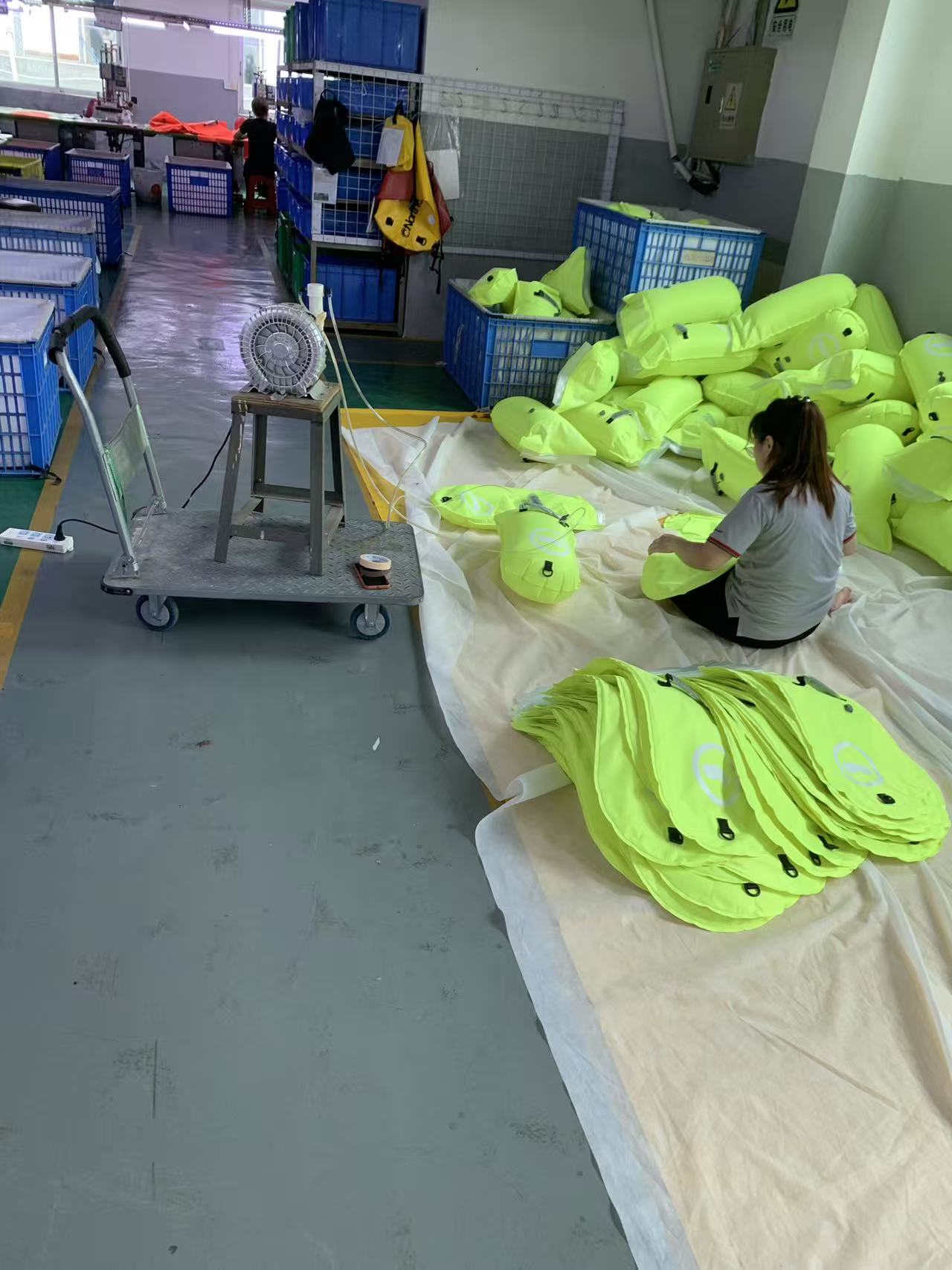
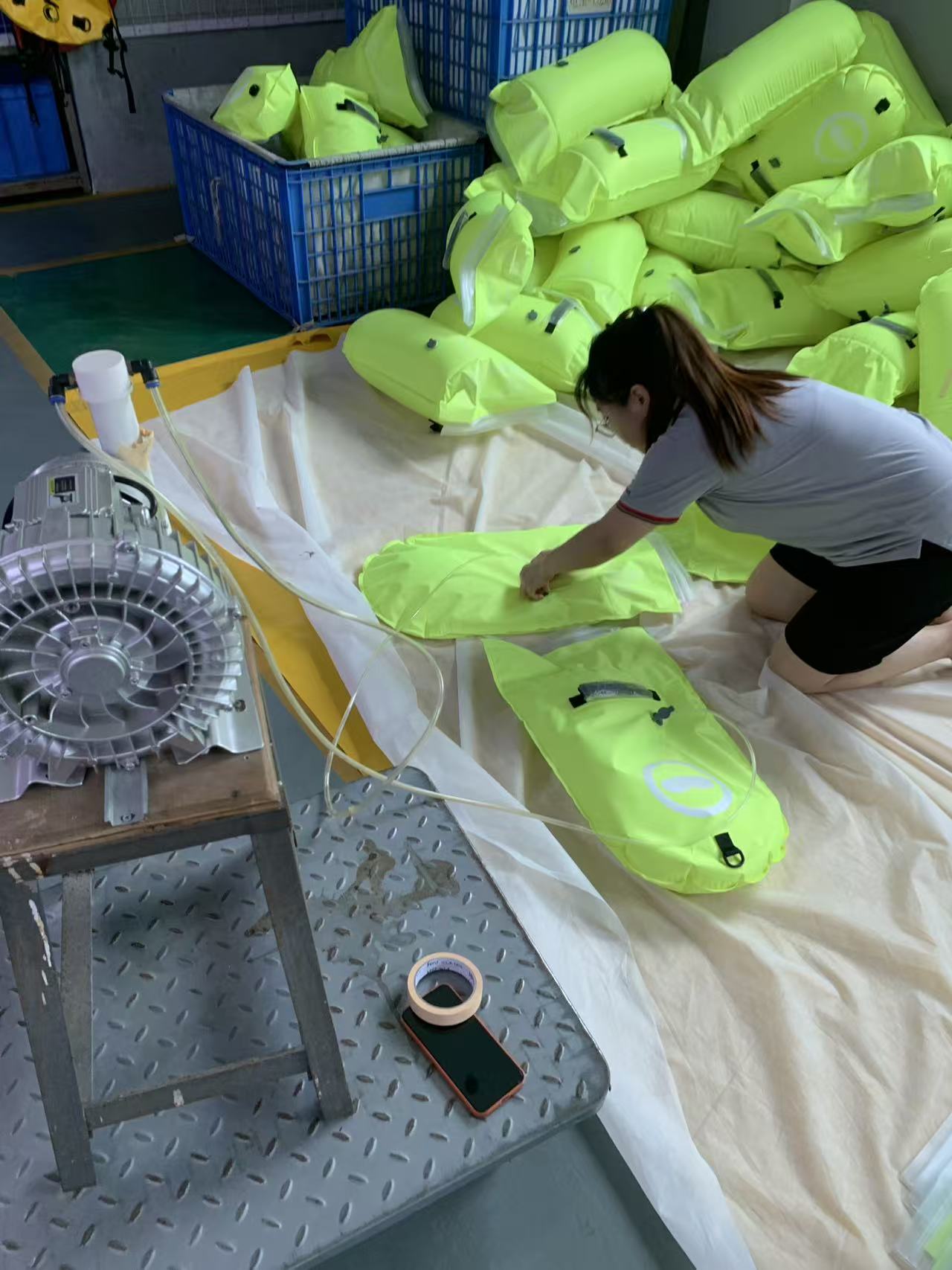
DONGGUAN, China — [Month Day], 2026 — A run of fluorescent yellow-green swim buoys is moving through the lines at Sealock (Dongguan Yifulong Outdoor Products Co., Ltd.) this week, built for a brand customer's open-water swim range. Down one aisle a worker sits on a groundsheet with an air blower beside her, filling buoy after buoy, feeling each one, setting it aside. Behind her the finished ones are piled shoulder-high, all of them holding air.
That scene is the point of this article. For most bags a leak is an inconvenience. For an inflatable swim buoy, the air is the product — so the last thing that happens on this line is that every single unit gets blown up and checked before it's allowed to be deflated, folded and packed.
Every buoy is inflated and checked before it can be folded and packed.Filled, felt by hand, then set aside — the check no spec sheet can replace.
What the product has to do
An open-water swim buoy has an unglamorous but serious job. It trails behind a swimmer on a waist leash, and it exists first to be seen — by boat traffic, by paddlers, by the safety crew on shore. That's why the body is fluorescent yellow-green: in chop, in glare and in low light, high-visibility color is the difference between a swimmer being spotted early and not being spotted at all. Second, it gives the swimmer something buoyant to hold if they need to stop, rest or wait. Third, it keeps a phone, keys and a dry layer with them instead of on a beach.
It's worth being precise about the boundary, because the product itself is printed with it: a swim buoy is a visibility and support aid, not a certified life-saving device and not a substitute for a personal flotation device. Sealock builds and describes these for exactly what they are — which is also why the warning and usage text is printed onto the body rather than tucked into a manual that gets thrown away with the packaging.
An air chamber is a harder brief than a dry bag
A dry bag has to keep water out. An inflatable buoy has to keep air in — and air is the more demanding of the two. Water will find a needle hole eventually; air finds it immediately, and keeps finding it for the whole life of the product. A seam that would pass as waterproof can still bleed air slowly enough to leave a swimmer with a soft, half-collapsed buoy an hour into a session.
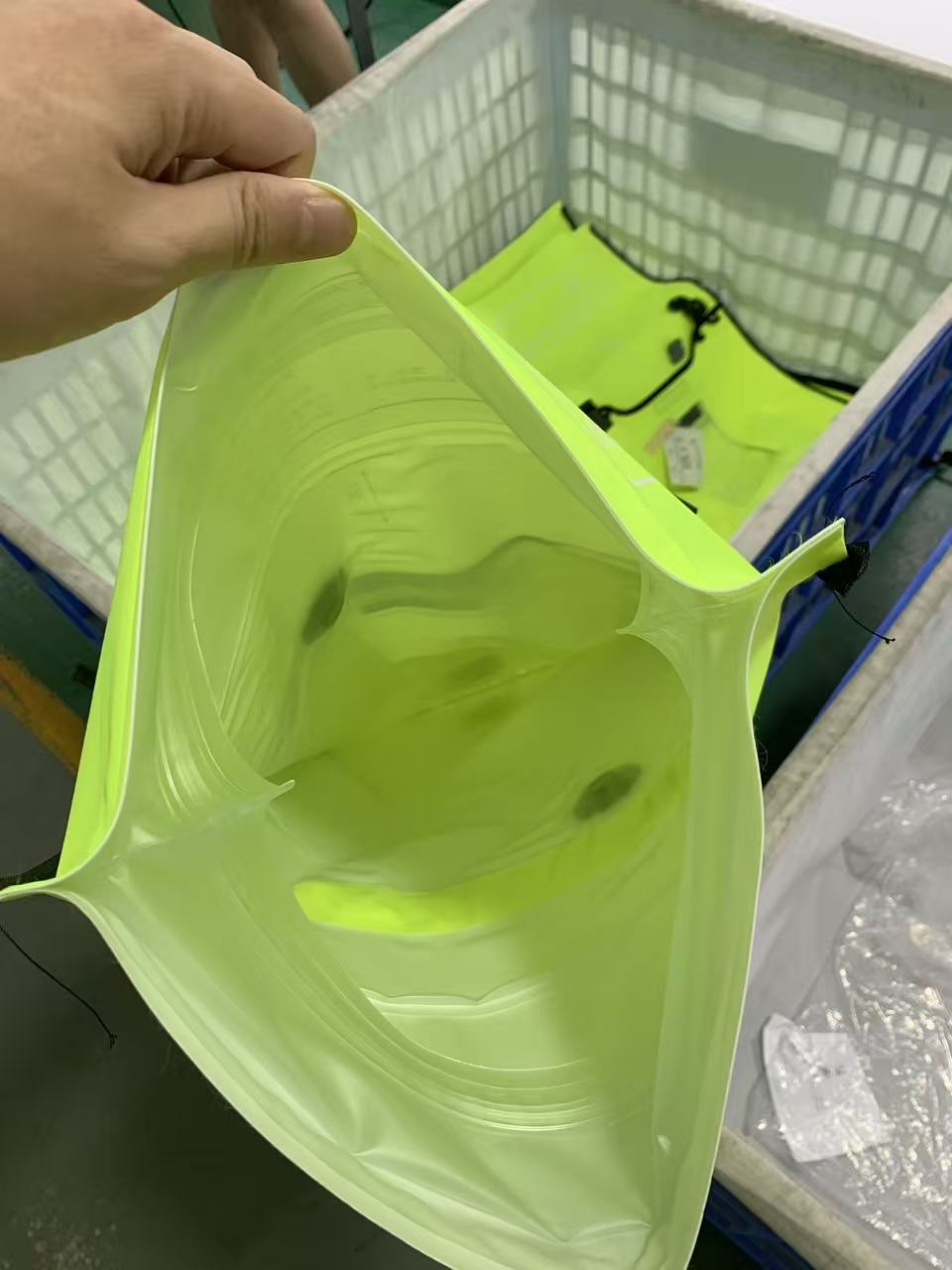
So the chamber is welded, not sewn. High-frequency welding fuses the coated panels into a single continuous mass at the joint — no thread, no puncture, no separate adhesive that can peel later. Turn a finished body inside out and you can see what that produces: a smooth, uninterrupted inner surface with clean welded corners and no stitching anywhere in the air path. Every stitch you can see on the outside of this product — the black binding around the edges, the webbing anchors, the leash and D-ring attachments — sits outside the sealed chamber, where a needle can't compromise it.
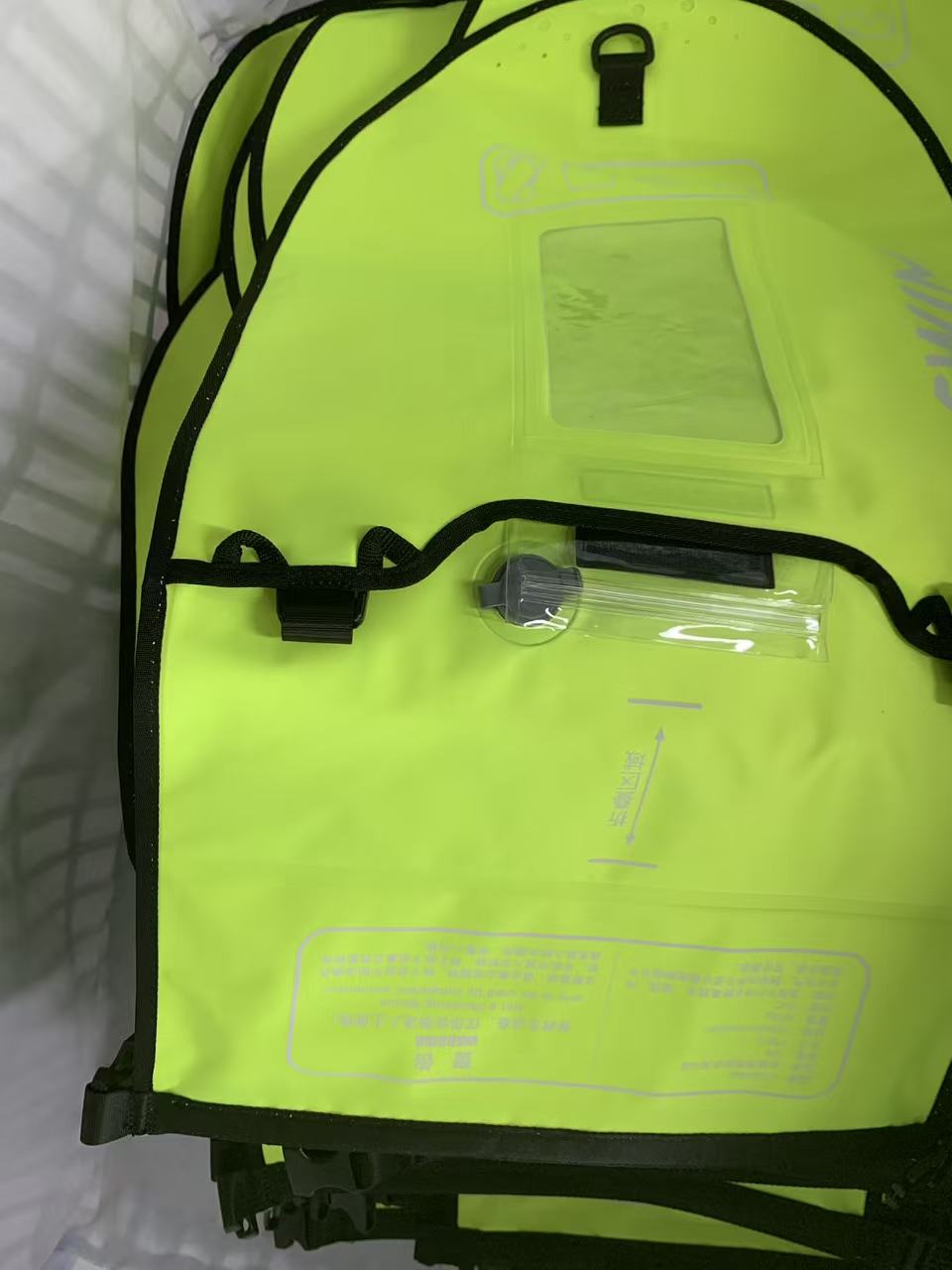
Inside the chamber: a continuous welded surface with no stitching in the air path.The clear window pocket, cord guides and D-ring — detailing that has to seal as well as it looks.
The window: a second material, welded in
The clear pocket on the front is the detail swimmers actually use — it holds a phone visible and operable through the film — and it's also the detail that gives the factory the most trouble. It means joining a transparent panel to a colored body, two different materials that have to fuse into one leak-free surface with no bubble, no scorch and no misalignment. Clear material hides nothing: on the fluorescent body a slightly uneven weld disappears, but on the window every flaw is visible at arm's length. It has to pass a cosmetic bar and a sealing bar at the same time, which is why the window is welded as a controlled step of its own rather than rushed in with the body.
Sewing, hardware and the parts that take the load
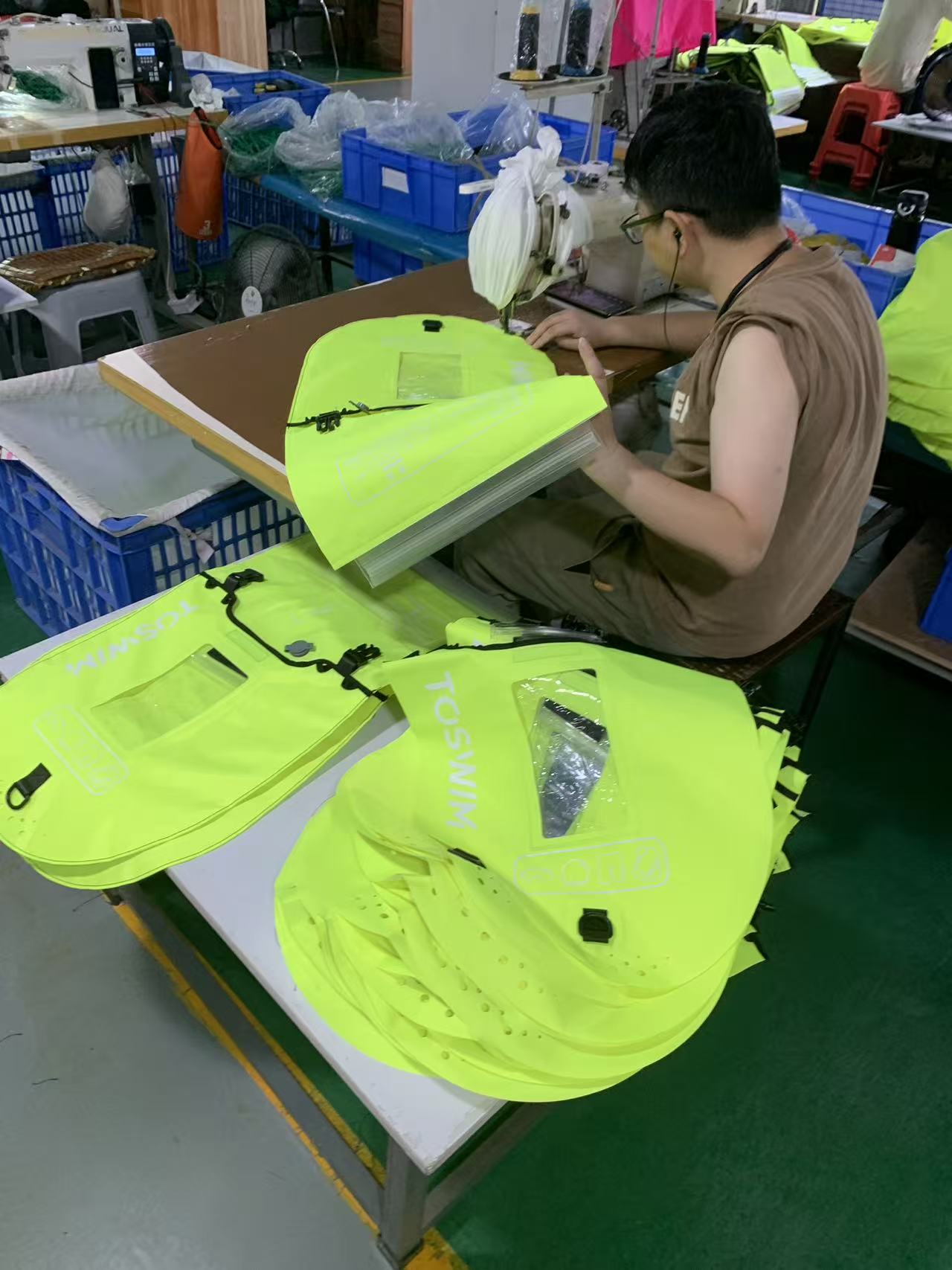
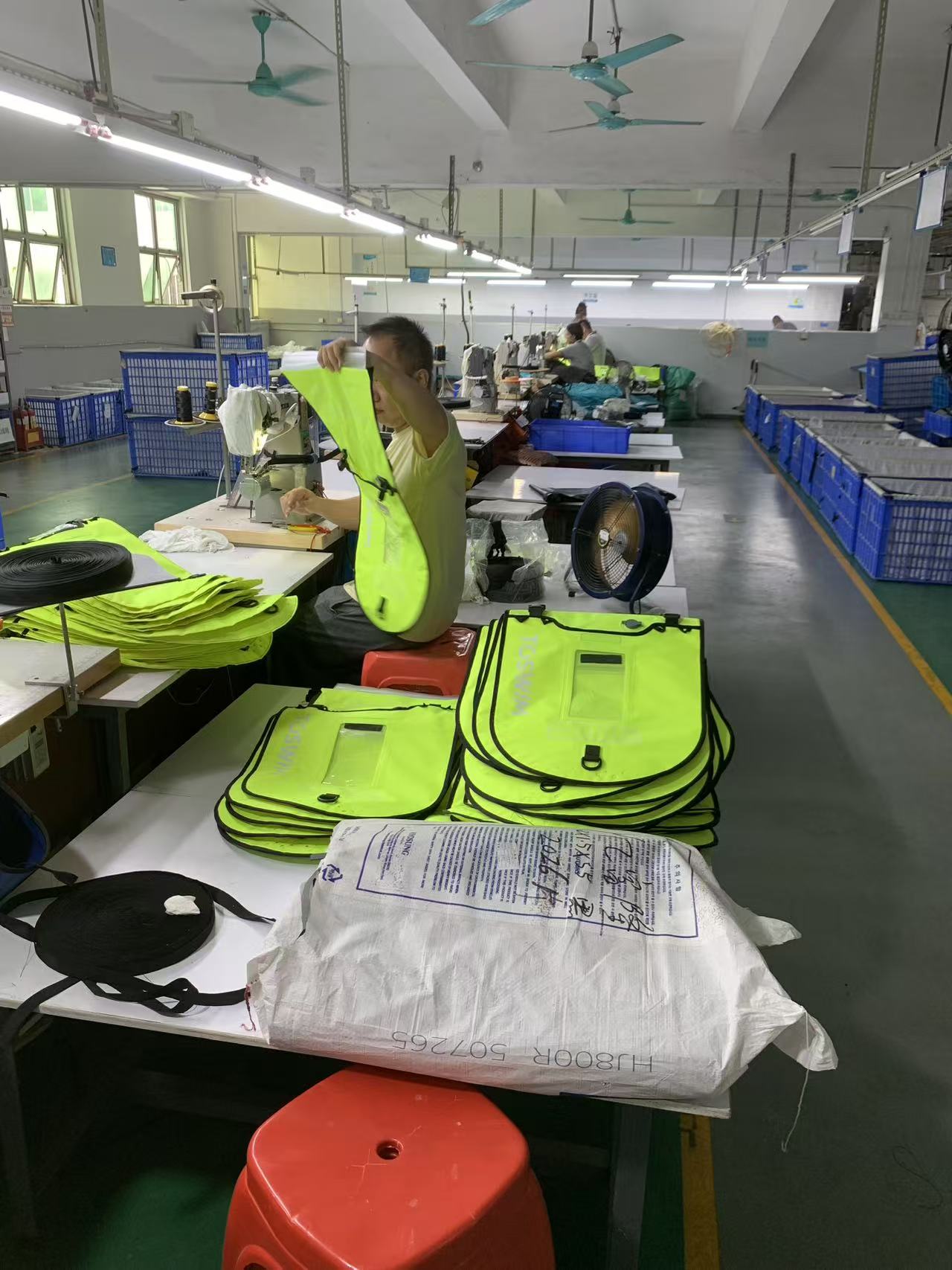
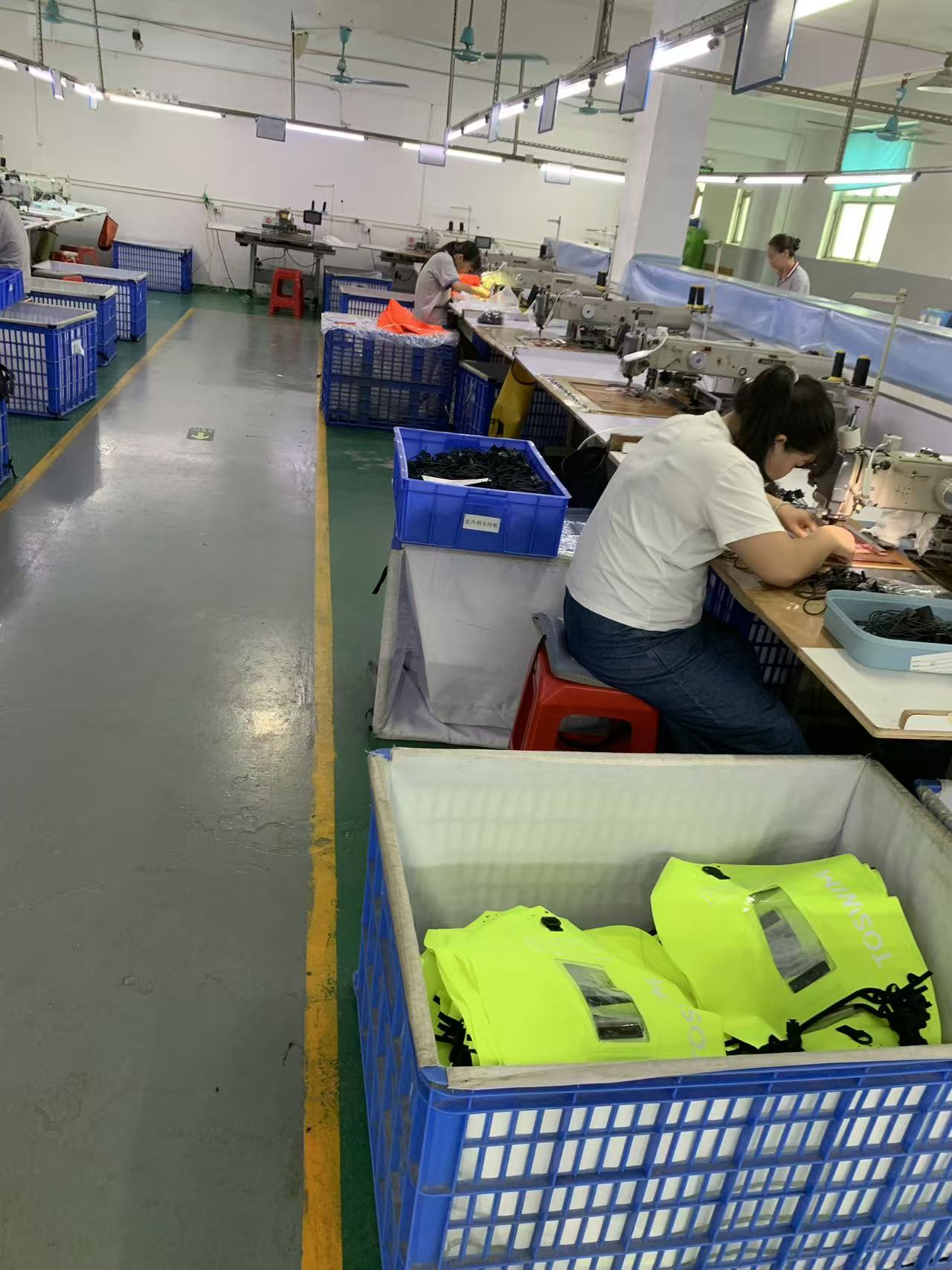
Beyond the chamber, this is still a piece of technical gear that gets yanked, dragged and packed wet. Down the sewing lines the edges are bound with black tape, the drawcord and cord locks are fitted, and the webbing loops, buckles and D-rings that carry the tow leash are anchored — each of these a point where the product will actually be pulled in use. Getting them placed and stitched consistently is what keeps a buoy tracking behind a swimmer instead of rolling, and what keeps an attachment from tearing out on a hard tug.
Edges bound and hardware anchored on the sewing lines.Components staged between operations, one crate per step.
Why inflate all of them, and not a sample
Sampling works when a defect is random and rare. A leak isn't reliably either: it can come from one weld that ran cool, one misplaced window, one pinhole in a panel — faults that hit a specific unit rather than the batch, and that no visual inspection will catch, because a pinhole looks like nothing at all. The only test that finds them is air.
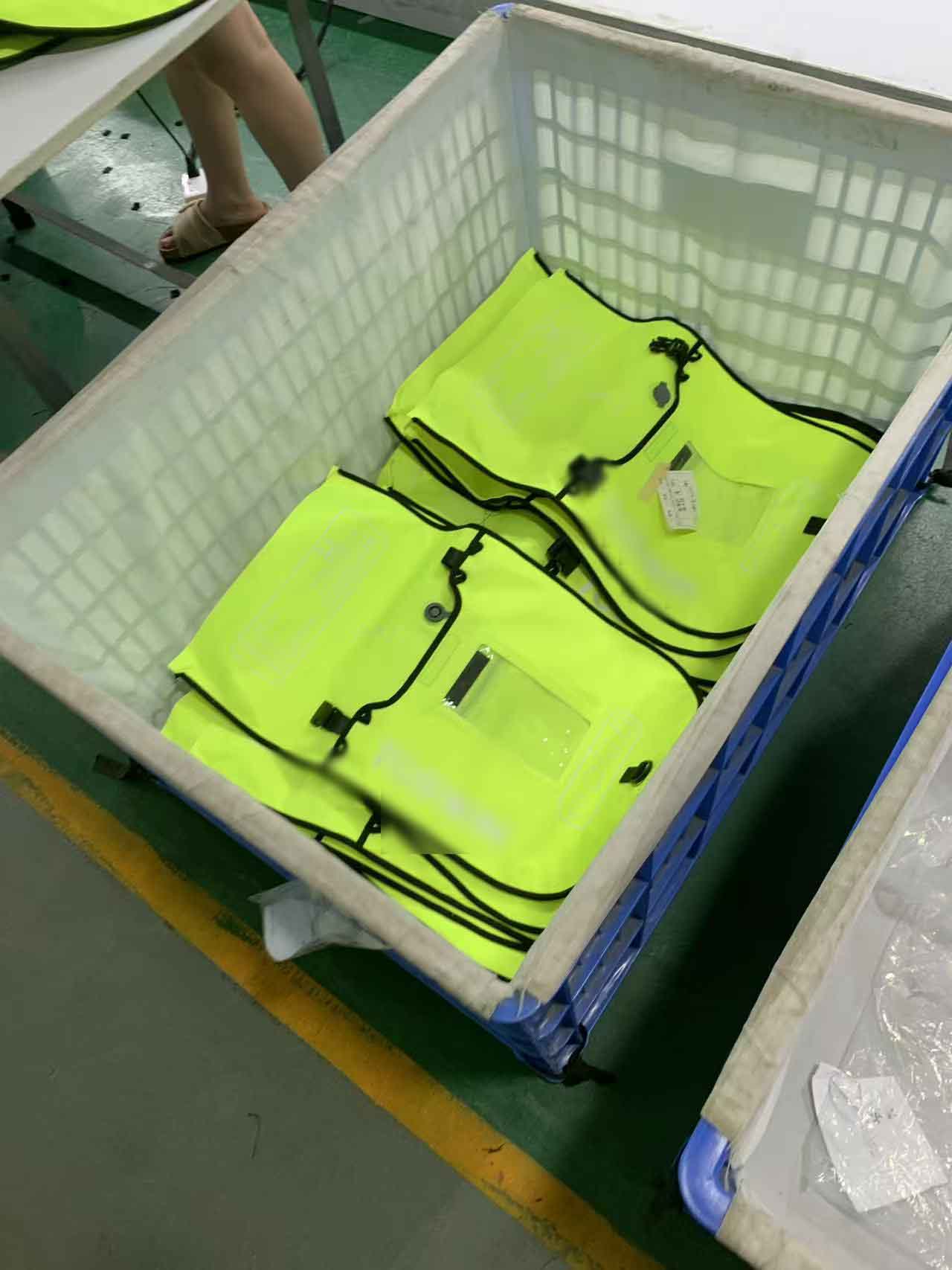
So on this run the buoy is inflated, held under hand pressure, and checked for softness, for a seam that creeps, for a valve or closure that doesn't hold. Anything that doesn't hold air goes back rather than forward. Units that pass are deflated, folded flat and crated by the batch for packing. Around that, the standard inspection flow still applies — incoming material, in-process checks at welding and sewing, and outgoing inspection before packing — along with the durability testing the factory runs on this class of product, including bonding strength on welded seams and pull testing on the attachment points that take the tow load.
None of it is dramatic. The plant's standard is posted on the wall in plain language: don't accept, don't make, and don't pass on a defect. On an inflatable, that principle just has a very literal test attached to it.
Passed units, deflated and folded flat for packing.Crated by batch and staged for outgoing inspection.
Built in-house, by the people who weld and test it
What makes a run like this repeatable is that no part of it is handed off. Sealock has built waterproof and inflatable gear for over 20 years from its own lines in Dongguan, China and Ho Chi Minh City, Vietnam, and because the factory welds, sews, assembles and tests under one roof, it can answer for the product end to end — chamber, window, hardware, print and final air check are all decisions it owns rather than hopes a subcontractor got right.
For brands developing swim, paddle or open-water safety gear, that matters more here than in most categories. A swim buoy is a product a customer trusts in deep water, and the difference between one that holds and one that softens is a single weld nobody can see from the outside. It's better when the factory that made that weld is also the one that inflates it, checks it and signs it off.
About Sealock
Sealock (Dongguan Yifulong Outdoor Products Co., Ltd.), founded in 2003, is a manufacturer of high-frequency welded waterproof and inflatable gear, with production bases in Dongguan, China and Ho Chi Minh City, Vietnam. Its product range spans roll-top dry bags, waterproof backpacks and duffels, swim buoys and other inflatable water gear, and soft cooler bags, produced for outdoor, marine and lifestyle brands worldwide under OEM and ODM programs. The company's systems and certifications include ISO 9001, BSCI, SMETA and GRS.
We use cookies to offer you a better browsing experience, analyze site traffic and personalize content. By using this site, you agree to our use of cookies.
Privacy Policy
 English
  Español
  Português
  русский
  Français
  日本語
日本語  Deutsch
  tiếng Việt
  Italiano
  Nederlands
  ภาษาไทย
  Polski
  Svenska
  magyar
  Malay
Malay  বাংলা ভাষার
  Dansk
Dansk  Suomi
Suomi  हिन्दी
  Pilipino
  한국어
한국어  Türkçe
  Gaeilge
  العربية
  Indonesia
  Norsk
Norsk  تمل
تمل  český
český  ελληνικά
  український
  Javanese
  فارسی
فارسی  தமிழ்
தமிழ்  తెలుగు
  नेपाली
  Burmese
  български
  ລາວ
ລາວ  Latine
  Қазақша
  Euskal
  Azərbaycan
  Slovenský jazyk
  Македонски
  Lietuvos
  Eesti Keel
  Română
  Slovenski
  मराठी
मराठी  Srpski језик