Sealock is a waterproof bike bag manufacturer and OEM supplier. Cycling attacks a bag in ways that rain alone does not, and it is worth being precise about the mechanisms, because they explain why a bag that performs perfectly on a wet walk starts losing the battle on a wet ride. This guide covers what actually gets water into a bike bag, why mounting position determines the protection a product needs, and the three construction tiers in our range — including an honest account of which one your programme should use.
Four Mechanisms, None of Them "Rain"
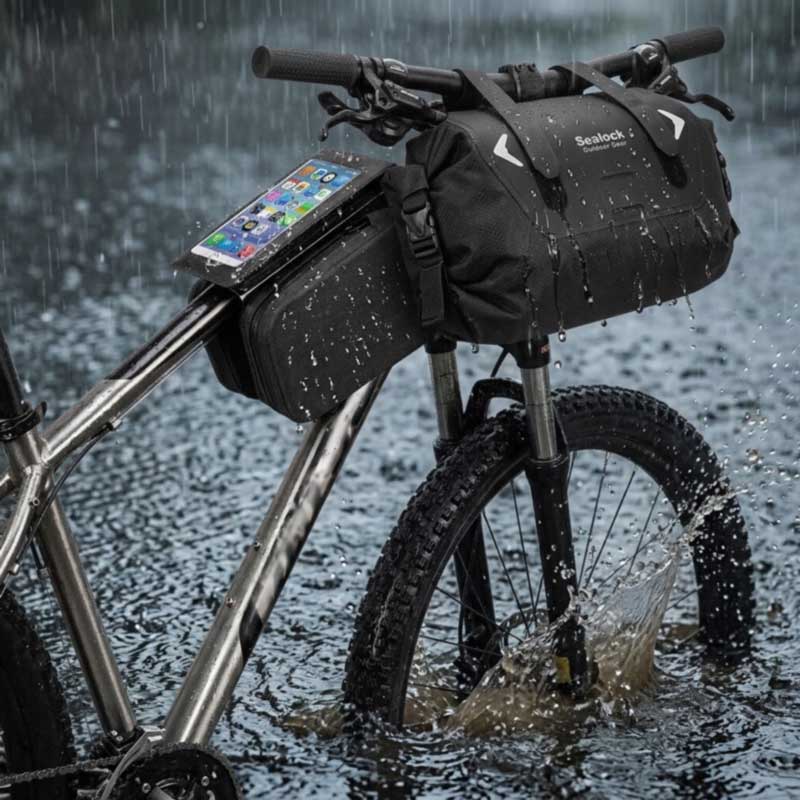
Tire spray hits from below and in front. Road spray blasts upward and forward, loading a bag from angles falling rain never reaches — which is why a mounting position matters more here than in almost any other category.
Wind adds pressure. Moving air pushes moisture into small gaps that would be harmless in still conditions. A closure that is adequate at rest can be inadequate at 30 km/h.
Grit and water become an abrasive slurry that works into zipper tracks and seam edges, degrading exactly the components the seal depends on.
Vibration pumps moisture along stitching. This is the mechanism most buyers have never heard of and the one that matters most for construction: sustained road and gravel vibration works water along a stitch line over time. A stitched seam is a row of needle holes, and vibration is what turns them into a pathway.
The summary a cycling buyer should hold onto: a bag rarely leaks through the middle of a panel. It leaks where the compromises live — seams, zippers, mounting ports and closures.
Spray comes upward and forward — the angle rain never uses.
Mounting Position Sets the Requirement
Before specifying material or rating, place the bag on the bike. Exposure varies enormously by position:
Position
Exposure
Construction it justifies
Handlebar / front
Front wheel spray, direct wind pressure, full rain exposure
Welded construction, sealed closure — the most demanding position
Seat pack / tail
Rear wheel spray directly onto the underside — the classic soaking position
Welded or sealed construction; the bag doubles as a fender
Frame triangle
Slurry from both wheels, low mounting
Sealed fabric with a waterproof zipper as a minimum
Top tube
Highest and most sheltered; mostly falling rain
Water-repellent is often genuinely sufficient
Three Tiers, and Which One You Actually Need
Our bike range spans three construction levels, and we would rather explain the ladder than pretend every product sits at the top of it.
Water-repellent. Coated fabric that sheds rain and spray, not rated for immersion. Appropriate for sheltered positions and cost-sensitive programmes. Our top tube bag is built this way, and it is the right answer for that position.
Waterproof fabric with a sealed zipper, stitched construction. The body resists water and the zipper is taped, but the stitching is not fully waterproof — so prolonged submersion will eventually admit water through the seams. Most of the market sits here, including many bags marketed simply as "waterproof".
RF welded, sealed closure. Seams fused at 27.12 MHz with no needle holes, which removes the vibration-pumping pathway entirely. This is the construction our handlebar bag uses, rated IPX6.
The rating cyclists actually need
Here is a place where restraint is more credible than escalation. For most commuters and everyday riders, a fully waterproof fabric with sealed seams and a roll-top or well-sealed zipper — roughly IPX5 to IPX6 in real use — is enough for steady rain and road spray. Higher ratings such as IPX8 are rare in this category and usually unnecessary, because a bike bag is not going to be submerged; it is going to be sprayed, pressurised and vibrated for hours.
Which is why our handlebar bag is specified at IPX6 rather than carrying a bigger number: IPX6 is a water-jet test, and a water jet is a far better model of road spray than a still-water dunk. We rate to the load case the product actually faces.
Vibration Is the Real Test, and It Isn't a Load Test
The most important quality question on a bike bag is not how much it carries. It is whether the mount holds.
A handlebar bag does not fail gradually. It holds, and then it does not, and the consequence is a bag in a front wheel. That failure mode sets the engineering: retention hardware is specified independently of the hook-and-loop rather than relying on a single system, and both are tested to a standard set by the consequence rather than by the rated load.
So the tests that matter on this category are different from the rest of our range:
Vibration testing — mount retention and shell integrity under sustained road and gravel vibration, which is the load case this product lives in.
Hook-and-loop cycle testing — grip retained after repeated fitting, including with contamination present, because a strap that works clean and fails with grit in it has not been tested properly.
Salt and road grime exposure — winter roads attack shell, hardware and hook-and-loop together.
Reflective retention — retroreflective performance after abrasion, washing and UV, since a reflective element that stops reflecting is a safety feature that quietly expired.
Cold flex — whether the shell and closure still work in winter, when a rider has numb hands.
Two independent retention systems — specified by the failure mode, not by the load.
Frame Bags Are a Fit Problem Before They Are a Bag
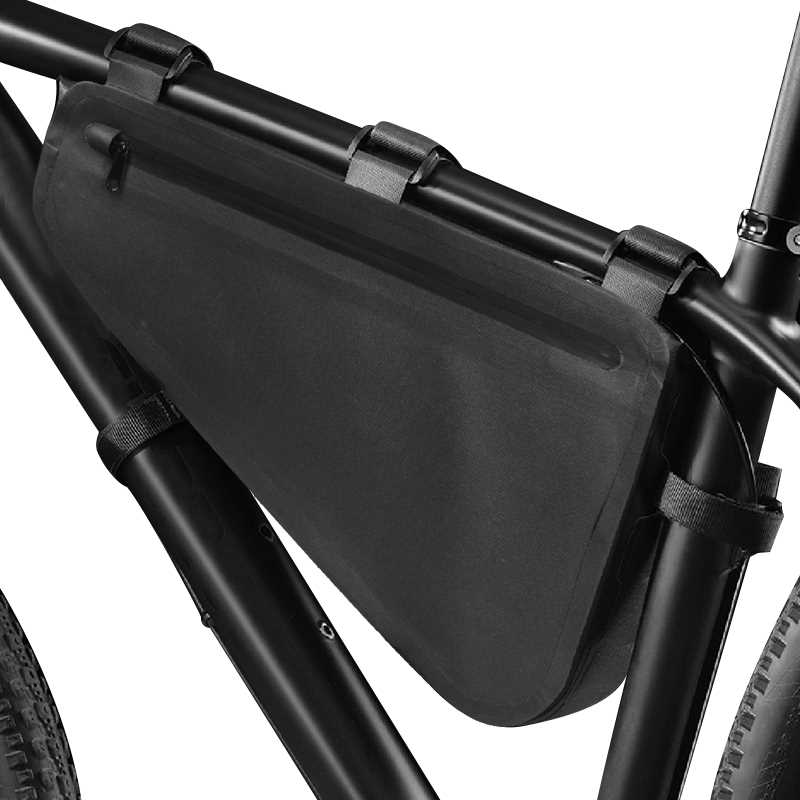
One constraint is specific to the frame triangle and catches brands designing a range: unlike panniers, seat packs or handlebar bags, frame bags are dimension-dependent, because they sit inside the triangle of the bike. Frame geometry and tube length determine which pack fits at all.
For an OEM programme this has two consequences. First, a single frame bag cannot serve every bike, so a range needs either multiple sizes or a deliberately compact design that fits broadly. Second, adjustable strap positions matter more than in any other mounting position — removable and repositionable straps let one bag fit a wider spread of frames, which is the difference between one SKU and three.
The Range, by Mounting Position
Handlebar and front
Image
Model & specs
Construction
MOQ
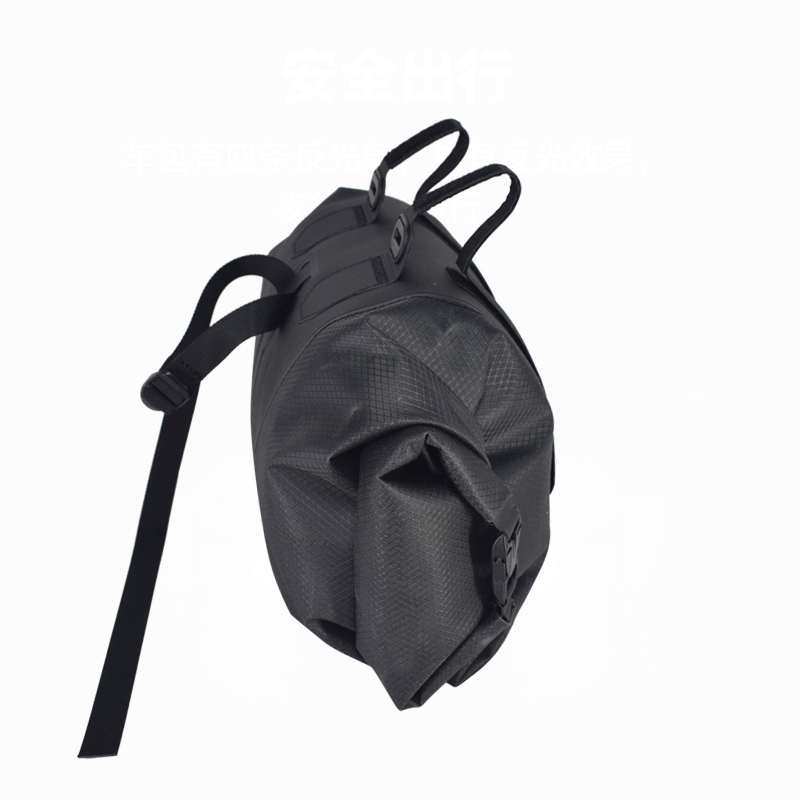
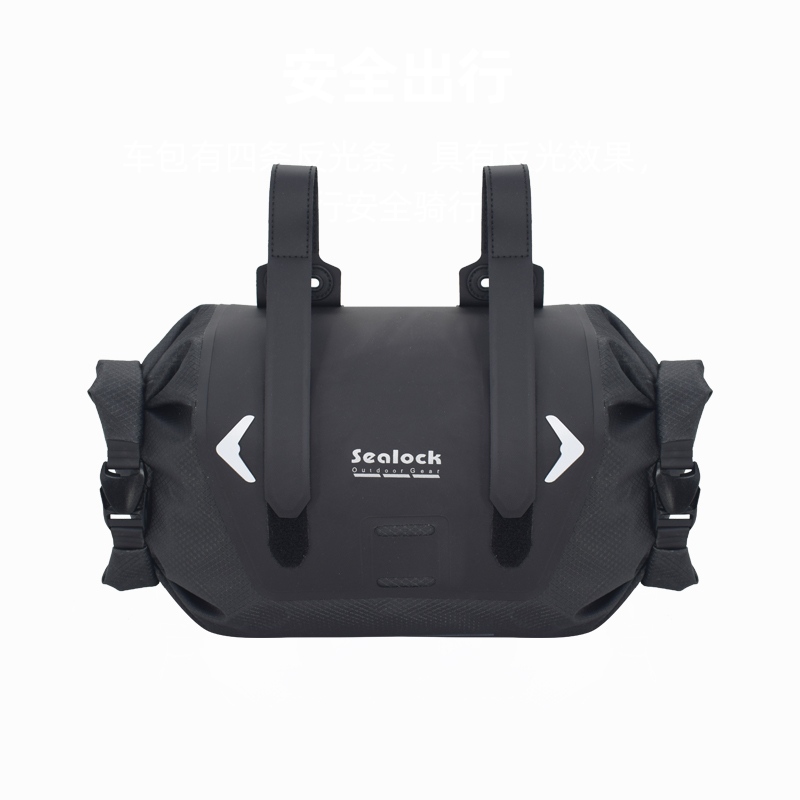
SL-K060B Roll-Top Handlebar Bag — 7L, 39×25 cm; TPU-laminated ripstop; roll-top at both ends, each opening independently; threaded air purge valve with gasket; side compression straps both ends; two hook-and-loop bar straps through welded ports plus an independent retention buckle; four retroreflective elements; fits drop, flat and riser bars; black / grey.
RF welded, IPX6 — the top tier
300
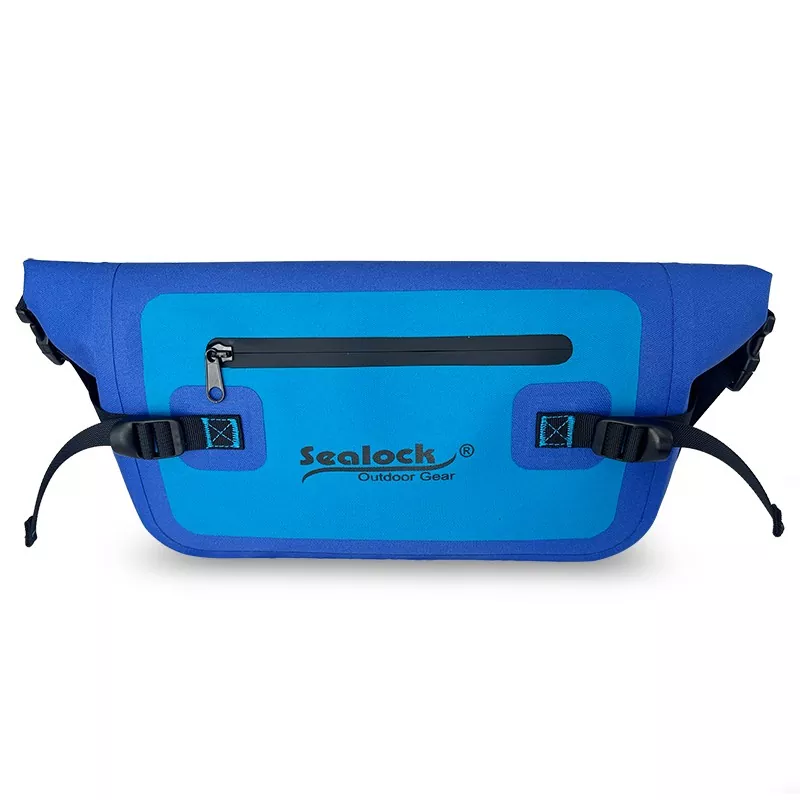
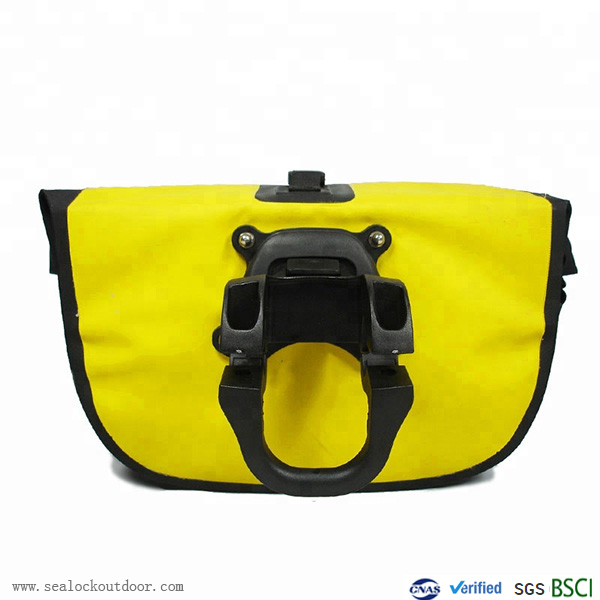
SL-K001 Welded Bicycle Front Bag — 10L (L32×W14×H44 cm open, 29 cm closed); 500D PVC mesh with ABS; waterproof inner pocket; custom colours; BSCI, ISO 9001; sample 7–10 days.
High-frequency welded seams, IPX6
200
Frame and top tube
Image
Model & specs
Construction
MOQ
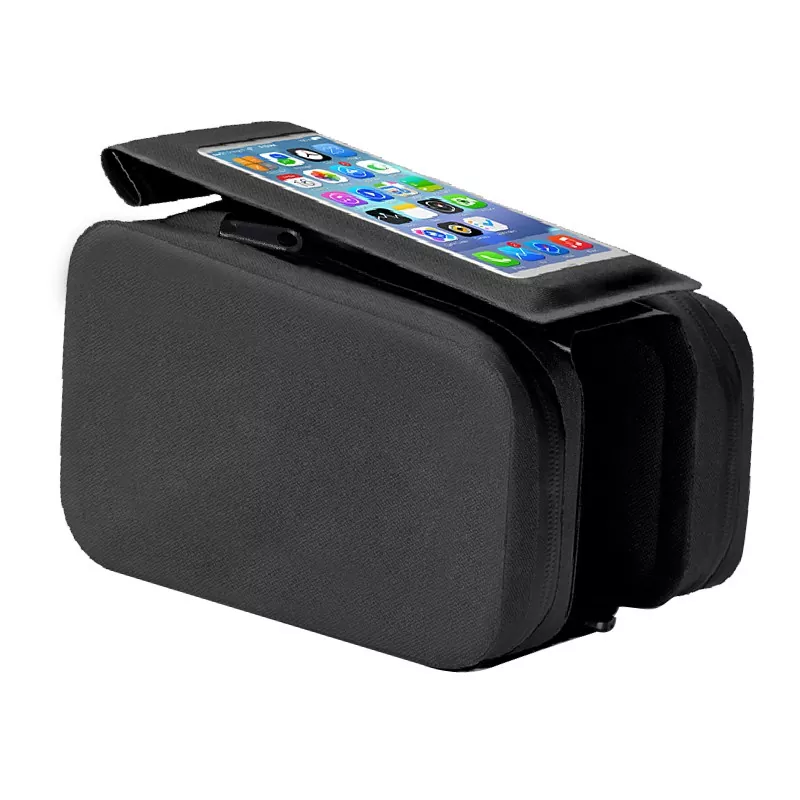
SL-K041 Top Tube Bag with Phone Window — double-sided frame bag, 7.5×4.5×10.5 cm per side, approx. 0.7L total, 0.25 kg; moulded EVA hard shell; transparent touch window with flip-over flap for phones to 6.5″; two zippered side pockets; cable port; three hook-and-loop straps, tool-free; fits round, aero and carbon top tubes.
Water-repellent coated polyester — the sheltered position, honestly rated
500
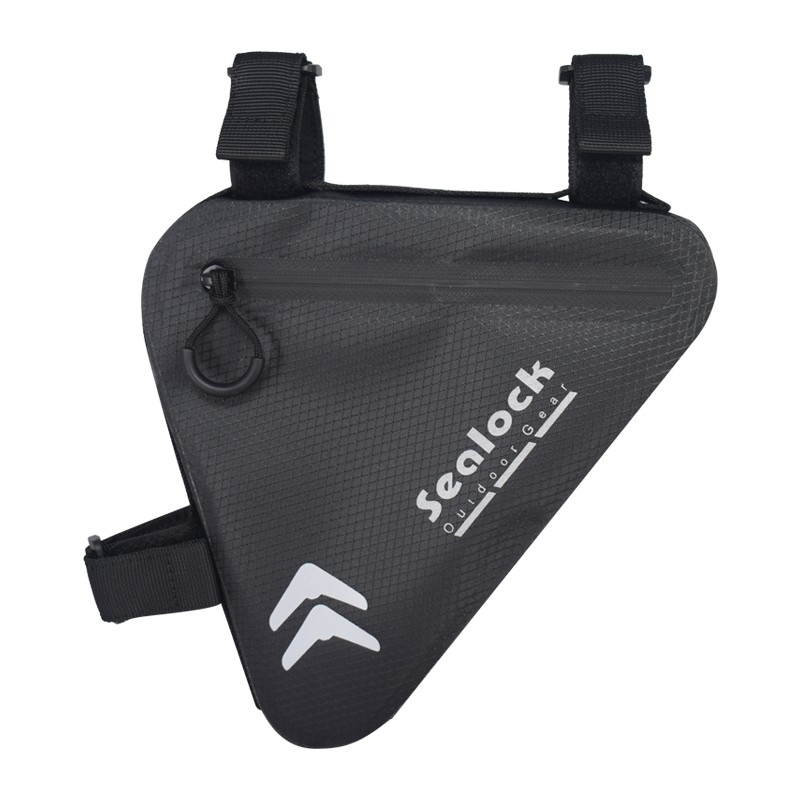
Waterproof Bicycle Frame Bag — 0.8L, 80 g; 800D TPU, scratch resistant; waterproof zipper; three adjustable straps, one removable, repositionable (two on the top tube, one on the seat tube); holds phone, gloves, sunglasses, mini pump, tools.
800D TPU with waterproof zipper — not for full immersion
300
SL-K036 Bicycle Triangle Bag — 600D waterproof nylon fabric; waterproof zipper; sized to sit inside the frame triangle.
Waterproof by craftsmanship with a sealed zipper
300
Saddle and tail
Image
Model & specs
Construction
MOQ
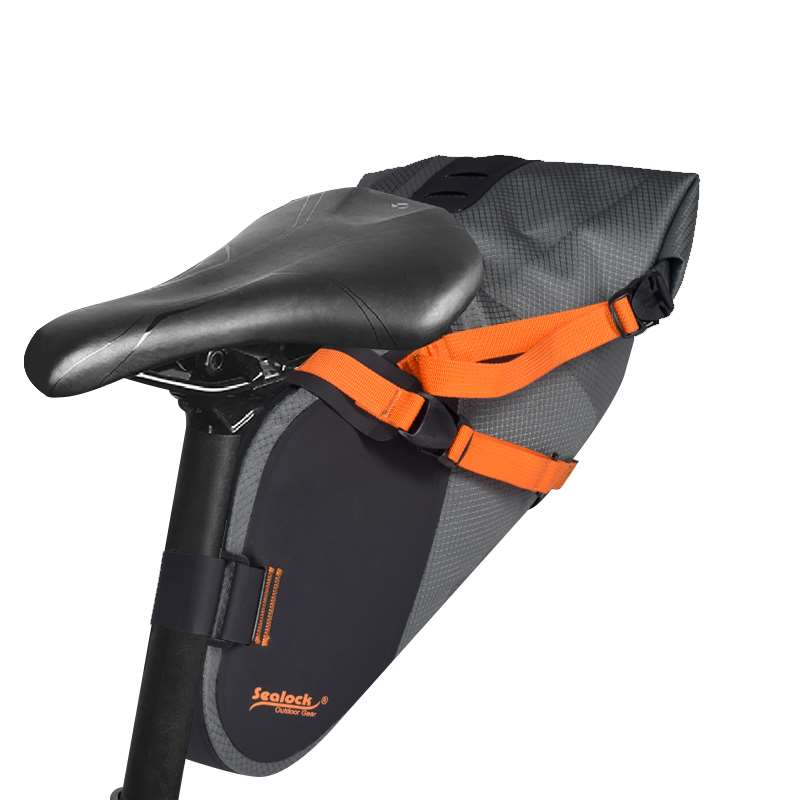
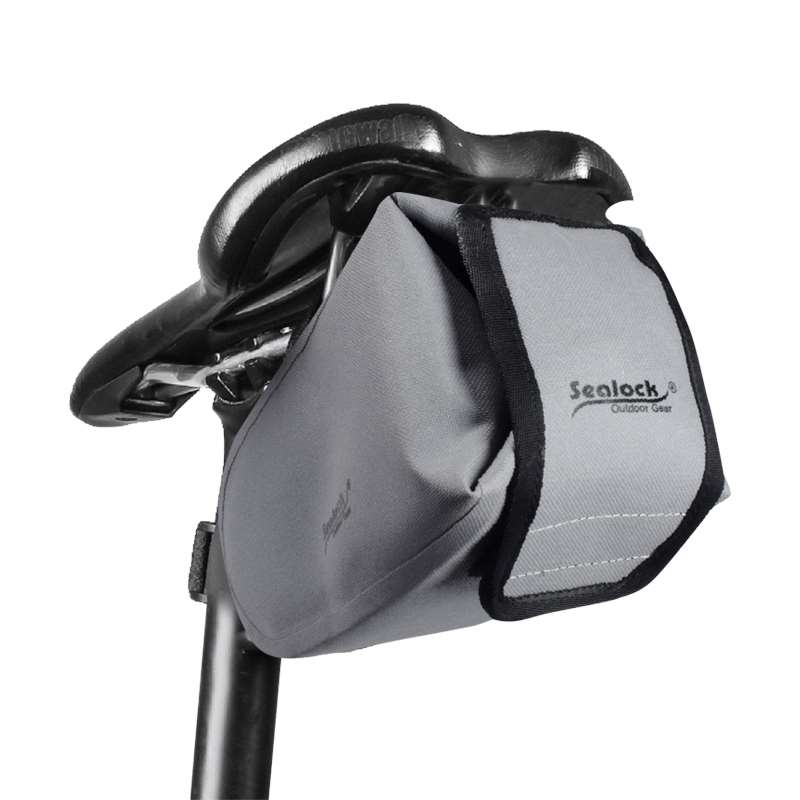
SL-K069 Bicycle Tail Bag — waterproof TPU film on 600D nylon; roll-style closure; acts as a fender, keeping back and clothing clean; wipes clean.
Roll closure — the strongest option for the rear spray zone
300
SL-K032 Cycling Back Seat Bag — 840D TPU / nylon; seamless bonding process across the body; waterproof zipper; adjustable size; cold resistant, ageing resistant, easy to clean.
Seamless bonded body plus sealed zipper
300
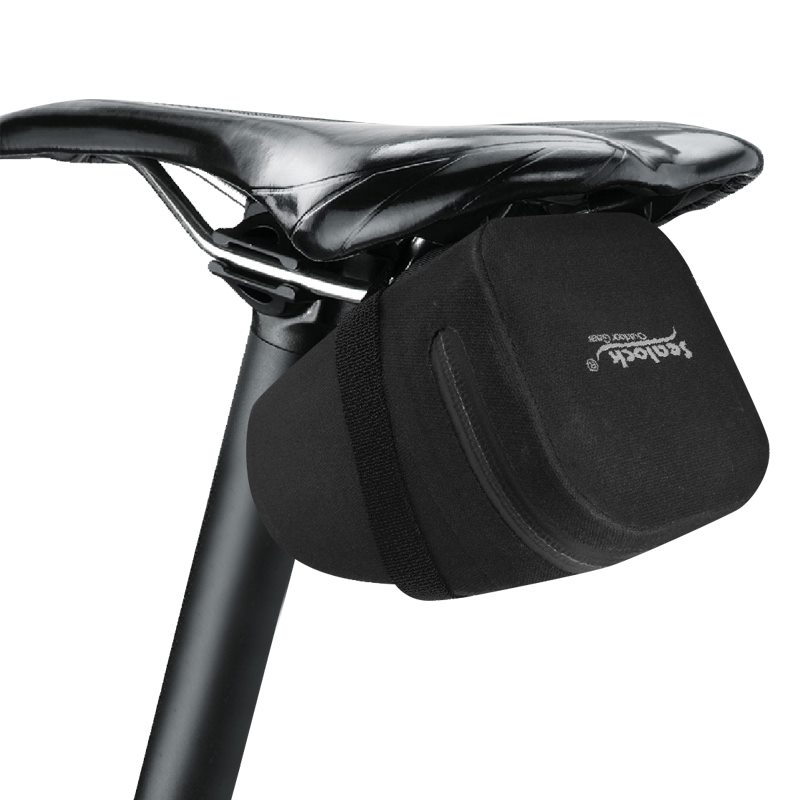
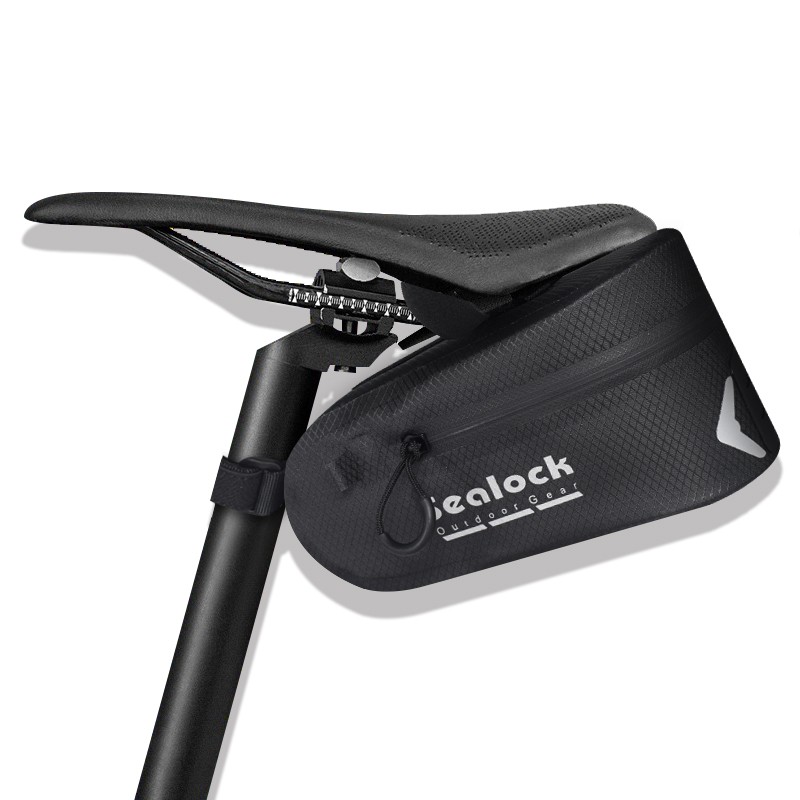
SL-K054 3D Shell Saddle Bag — 1L (W21.7×L8×H10 cm); TPU; 3D moulded shell with an internal wave-shaped shock-absorbing cushion; upgraded straps engineered against deflection; two stick-up straps plus a rubber buckle; reflective strap and taillight hook on the seat post; structured interior; black / grey; ISO 9001.
Waterproof fabric with taped zipper — stitching is not fully waterproof, so not for immersion
300
SL-K055 Strap-On Wedge Pack — TPU, wipes clean of mud; waterproof non-slip zipper; aerodynamic shape; two straps wrapping the aero seatpost; reflective logos both sides; holds CO2 cylinders, tubes, tools, keys; fits most road, mountain and commuter bikes.
TPU with a sealed zipper — the compact under-saddle tier
Welded body, roll-top — ventilated carry for commuting
300–500
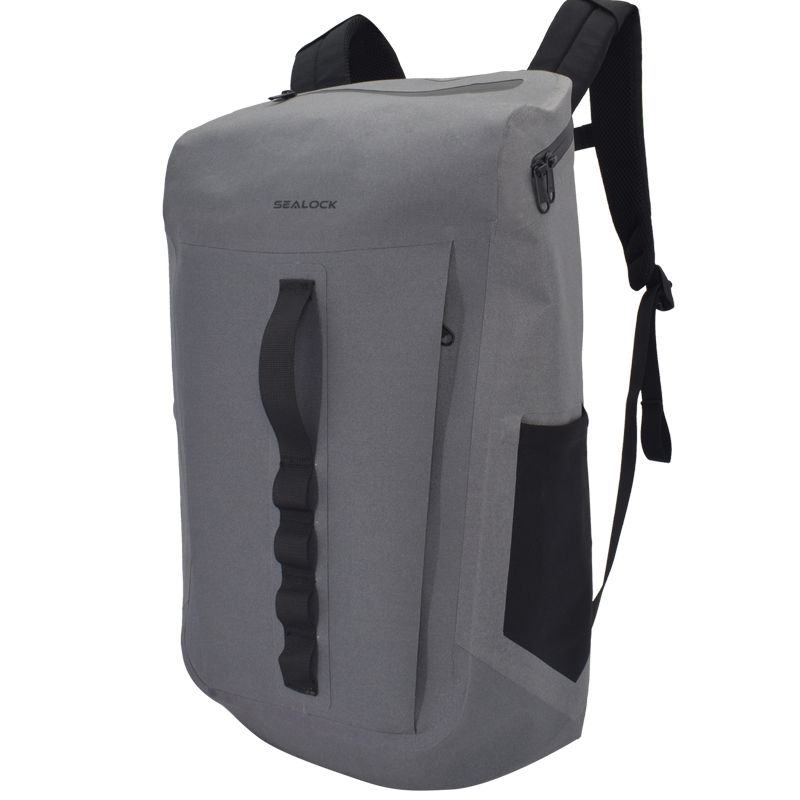
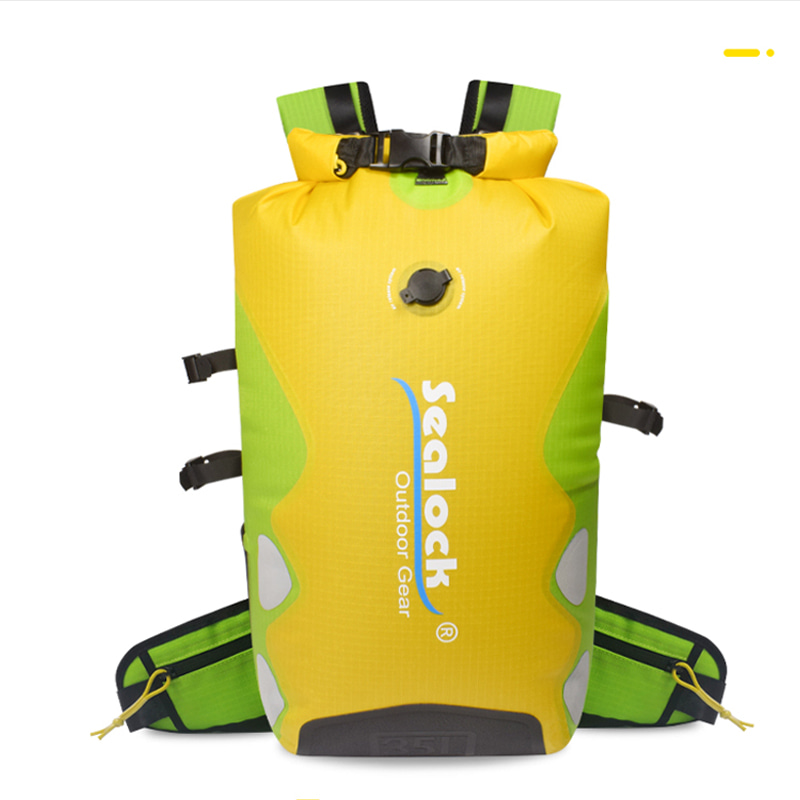
SL-E120 Roadbike Backpack — 25L (L31×W14×H52 cm); 420D or 210D TPU; airtight zipper at the top; front zip pocket; side bottle pocket; internal laptop pocket; physiological curve back; eight colours.
Airtight zipper on a welded body — fast access for commuting
300–500
Capacity, mounting system, closure, reflective layout, external pockets, daisy chain and harness-mount versions, colourway and branding are all specifiable per order, or a bag can be developed from a sketch. MOQ runs from 200 pieces, typically 300–500; samples 7–15 days; production 30–45 days after approval, from Dongguan or Ho Chi Minh City.
Quality Control
Production runs under an ISO 9001 quality system, gated in three tiers — IQC (incoming coated fabric for coating thickness, adhesion and weldability, plus zippers, hook-and-loop, buckles, valves, reflective film and EVA against the signed standard), IPQC (cutting tolerance, weld integrity at body seams, valve mountings, strap ports and reflective film, closure alignment and mount assembly, with peel tests on sample welds at each run start), and OQC (AQL sampling, water-jet and heavy-rain testing to the declared rating, and gold-sample comparison, with SGS or QIMA inspection available). A pre-production sample is approved before mass production and a final inspection is carried out before every shipment.
For this category the lab weights toward the failure modes that belong to cycling: vibration testing, hook-and-loop cycle testing with contamination, salt and road-grime exposure, reflective retention after abrasion and UV, cold flex, closure band fatigue at the roll lines, valve seal testing, and bonding strength under peel load.
FAQ: Sourcing Waterproof Bike Bags
Q: Why does a bag that handles rain fail on a bike?
A: Because rain is the least of it. Tire spray arrives from below and in front, wind pressure drives moisture into small gaps, grit and water form an abrasive slurry in zipper tracks, and sustained vibration pumps water along stitch lines. Welded seams remove the last of those pathways entirely.
Q: What IPX rating should a bike bag have?
A: Roughly IPX5 to IPX6 for most commuting and everyday riding — a fully waterproof fabric with sealed seams and a roll-top or sealed zipper. IPX8 is rare in this category and usually unnecessary; a bike bag gets sprayed and vibrated, not submerged. Our welded handlebar bag is rated IPX6 because a water-jet test models road spray better than a still-water dunk.
Q: Is a water-repellent bag ever acceptable?
A: Yes, in sheltered positions. A top tube bag sits high and sees mostly falling rain, so a water-repellent coated shell is a reasonable specification there. The mistake is using that construction in the spray zone.
Q: What is the most important test on a bike bag?
A: Vibration on the mounting system. A handlebar bag doesn't fail gradually — it holds and then it doesn't, and the consequence is a bag in a front wheel. That's why retention hardware is specified independently of the hook-and-loop, and why hook-and-loop is cycle-tested with contamination present.
Q: Why can't one frame bag fit every bike?
A: Frame bags sit inside the triangle, so frame geometry and tube length determine fit. A range needs either multiple sizes or a compact design with removable, repositionable straps — which is how one SKU covers a wider spread of frames.
Q: What are the MOQ and lead times?
A: From 200 pieces on some models, typically 300–500. Samples 7–15 days, production 30–45 days after approval, from our China or Vietnam base.
Talk to the Factory
For quotations, samples, and OEM/ODM proposals on bike bags, contact Sealock at info@sealock.com.hk or +86-769-82009361. Over twenty years of high-frequency welding and industrial sewing under one roof, ISO 9001 production, vibration-tested mounting systems, dual China–Vietnam manufacturing, and third-party inspection on request.
We use cookies to offer you a better browsing experience, analyze site traffic and personalize content. By using this site, you agree to our use of cookies.
Privacy Policy
 English
  Español
  Português
  русский
  Français
  日本語
日本語  Deutsch
  tiếng Việt
  Italiano
  Nederlands
  ภาษาไทย
  Polski
  Svenska
  magyar
  Malay
Malay  বাংলা ভাষার
  Dansk
Dansk  Suomi
Suomi  हिन्दी
  Pilipino
  한국어
한국어  Türkçe
  Gaeilge
  العربية
  Indonesia
  Norsk
Norsk  تمل
تمل  český
český  ελληνικά
  український
  Javanese
  فارسی
فارسی  தமிழ்
தமிழ்  తెలుగు
  नेपाली
  Burmese
  български
  ລາວ
ລາວ  Latine
  Қазақша
  Euskal
  Azərbaycan
  Slovenský jazyk
  Македонски
  Lietuvos
  Eesti Keel
  Română
  Slovenski
  मराठी
मराठी  Srpski језик