Sealock is a waterproof bag manufacturer and OEM supplier, GRS certified. This article is not about why sustainability matters. It is about a date: 27 September 2026, when EU Directive 2024/825 on Empowering Consumers for the Green Transition begins to apply and generic environmental claims stop being a marketing choice and become a compliance exposure. If you sell into the EU and your packaging or listing says "eco-friendly", you have a problem to fix. This guide covers what changes, the trap that catches bag brands specifically, and the evidence chain that makes a recycled claim defensible. Policy detail is summarised as at September 2026 and is not legal advice — confirm your position with counsel.
What Actually Changes
From 27 September 2026, three categories of claim become prohibited or heavily restricted across the EU:
Generic environmental claims without substantiation. Terms like "eco", "green", "sustainable", "eco-friendly" and "climate-friendly" become legally problematic unless the exact environmental benefit is clear and properly supported.
Sustainability labels that aren't backed by a scheme. A label must rest on a publicly available, transparent and verifiable certification scheme, or be established by public authorities. Self-invented logos and in-house "green" badges do not qualify.
Neutrality claims based on offsetting. "Carbon neutral" or "climate neutral" grounded in offsets rather than actual reduction is prohibited.
One clarification worth making, because it causes real confusion: the separate Green Claims Directive proposal was effectively paused after the Commission's 2025 withdrawal announcement — but that does not mean nothing is happening. The Empowering Consumers Directive was adopted in 2024 and applies regardless. Brands that read "Green Claims paused" and concluded the deadline had gone away have misread the situation.
A number you can evidence beats an adjective you can't.
The Trap That Catches Bag Brands
This is the provision most likely to affect a waterproof bag programme, and it is easy to fall into honestly.
It is prohibited to make an environmental claim about an entire product when the claim relates only to a specific component. The example regulators use is blunt: if only the packaging is recycled, you cannot market the product as environmentally friendly.
Apply that to a bag. A typical "recycled" waterproof bag might have a recycled shell fabric — while the coating, the zipper, the buckles, the webbing, the foam and the thread are conventional. Marketing that product as "sustainable" or "eco" describes the whole from one part, which is precisely what the Directive prohibits. And a further point makes the margin thinner: a claim can still be misleading even where part of it is technically accurate, because what counts is the overall impression created for an average consumer.
The fix is not to stop talking. It is to be specific about scope: name the component, state the percentage, and don't let the packaging imply more than the evidence supports.
Specific Beats Generic — Write the Number
Regulatory guidance is explicit on this, and it is also better marketing. A specific claim — "the bottle contains 80% recycled plastic" — where accurate and verifiable is preferable to a broad statement such as "eco-friendly packaging".
Translated to a bag programme, the difference looks like this:
"Body fabric and webbing GRS certified; hardware conventional"
"Green manufacturing"
"Manufactured in a Higg-assessed, GRS-certified facility"
A self-designed leaf logo
The GRS mark, used within its scheme rules
The Evidence Chain for a Recycled Claim
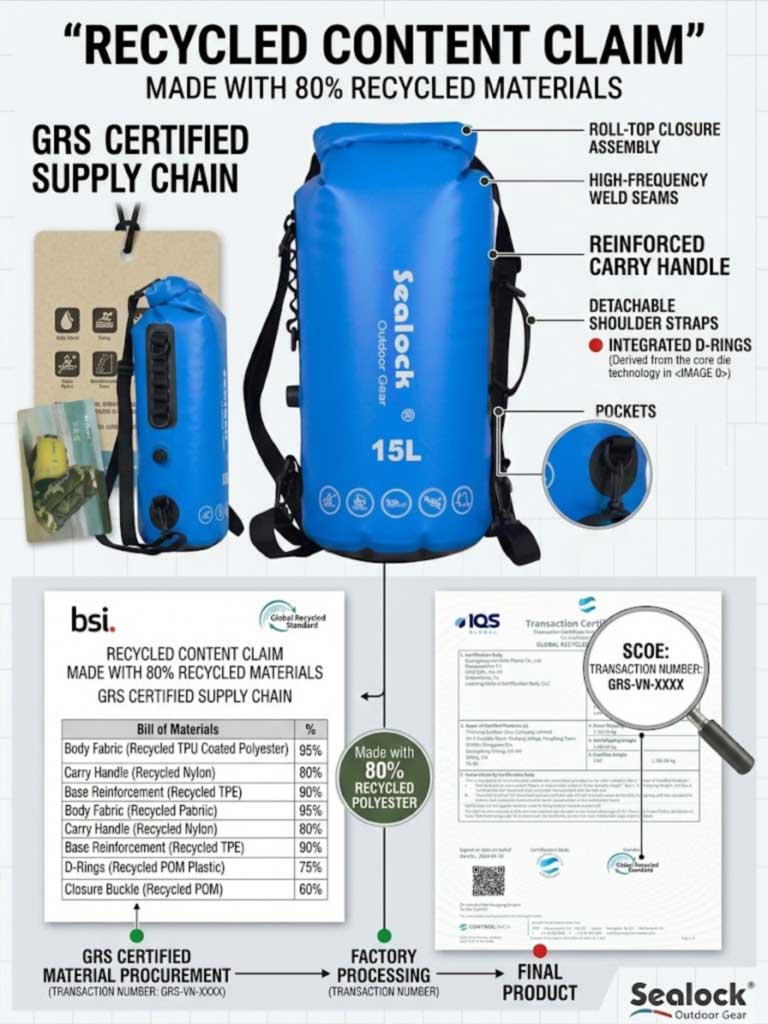
If you intend to make a recycled-content claim, three things have to line up. Two of them are routinely missed.
1. The right threshold for the claim you're making
Recycled content requirements differ by claim type: 20% is the floor for a business-to-business claim, while a product needs 50% recycled content to carry the consumer-facing GRS label. Confusing these is described as the most common honest mistake buyers make — and under the new rules the consequence sits on the wrong side of a legal line rather than merely being imprecise.
2. Scope Certificate and Transaction Certificate
A Scope Certificate proves a facility is set up to handle certified recycled material. It does not prove your order used it. The document that links certified material to a specific shipment is the Transaction Certificate, issued per shipment. Ask for both. Scope Certificates are valid for twelve months and require a fresh audit to renew, so check the date rather than the logo.
3. Component-level scope, written down
Record which components are covered: shell fabric, coating, webbing, thread, hardware, lining, packaging. That record is what lets you write an accurate claim — and it is what you produce if anyone asks for substantiation.
What Is and Isn't Straightforward in Welded Waterproof Bags
An honest account, because overstating availability is how brands end up with claims they can't evidence:
Recycled base fabrics are available and GRS-certified routes can be specified as part of the material brief.
The coating is the harder half. A waterproof bag's performance comes from the coating and the welded seams, and coating chemistry has fewer certified recycled routes than base textiles. Specify what is covered rather than assuming the whole laminate is.
Hardware, zippers and foam each have their own supply chains and their own certification status. They are separate lines in the claim, not part of a blanket one.
Component substitution changes your test position too. A REACH or EN71 report applies to the specification tested, so switching to a recycled material means rerunning the relevant testing rather than carrying the old report over.
The Claim Most Brands Underuse: Durability
Here is an argument that is both true and easy to substantiate, and welded manufacturers are unusually well placed to make it.
The largest environmental cost in this category is a bag that fails and gets replaced. Welded seams handle up to twice the stress of sewn-and-taped ones, and taped construction degrades as its adhesive ages and lifts — which is why a welded bag survives repeated immersion seasons where a taped one does not. A product that lasts three seasons instead of one has a better environmental profile than a single-season bag with recycled content in its shell.
Two reasons to lead with this alongside recycled content. First, it is specific and demonstrable — peel strength, cycle testing, a stated rating verified on the finished product — which is exactly what the new rules reward. Second, the Directive framework also pushes durability information at point of sale, so it is an argument moving with the regulation rather than against it.
Related and equally substantiable: field repairability. A bag whose buckle can be replaced rather than retiring the product is a genuine circularity argument, and on roll-top construction it is simply true.
What to Ask Your Supplier
Which specific components can be supplied GRS certified, and at what recycled percentage?
Can you provide both the Scope Certificate and a Transaction Certificate for my shipment?
What is the Scope Certificate's issue date and expiry?
Does the recycled route change the waterproof performance, and will testing be rerun against the new specification?
What documentation supports a durability claim — peel strength, cycle testing, verified rating?
Can you supply the substantiation file I would need if a claim were challenged?
A Note on Existing Stock and on Going Quiet
Two practical points. On stock already made or in distribution before 27 September 2026: the Consumer Protection Cooperation Network agreed a common approach in June 2026 — there is no general exemption, but authorities may take reasonable adaptation efforts into account, such as corrective stickers, point-of-sale information and updates to digital communications. Acting is better than waiting.
On the temptation to say nothing at all: the tightened threshold is expected to push some companies into "greenhushing" — scaling back sustainability messaging to avoid scrutiny. It's an understandable instinct and a poor outcome. The alternative is straightforward: make fewer claims, make them specific, and hold the evidence. A brand that can state a percentage and produce a Transaction Certificate is in a stronger position than either a brand making vague claims or one saying nothing.
Products and Material Routes
Image
Model
Notes
MOQ
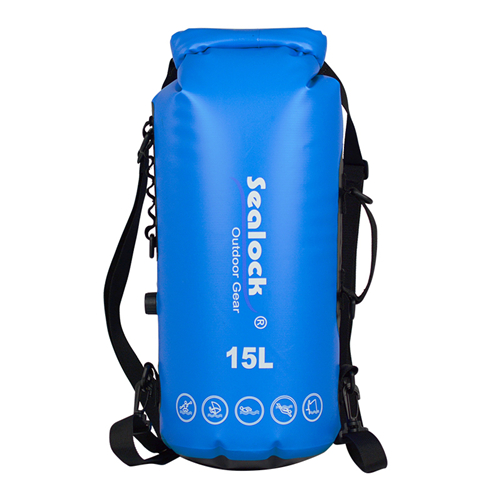
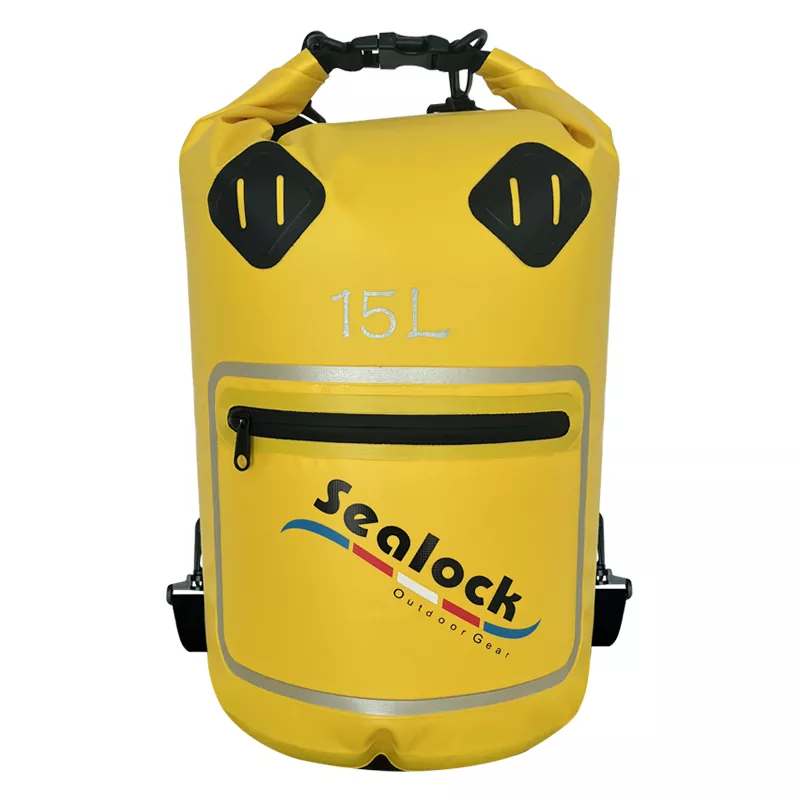
SL-D002 15L Wet/Dry Bag — dia. 20×48 cm; 500D PVC tarpaulin; one adjustable shoulder strap; floats; silk-screen; sample 3–5 days.
Recycled material route available on request — scope confirmed per component at quotation
Replaceable hardware and a detachable strap — repairability as a circularity claim
300
Recycled (GRS) routes are specified per component at quotation, with Scope and Transaction Certificate support. Where a material changes, the relevant REACH, EN71 or RoHS testing is rerun against the new specification rather than carried over.
FAQ: Recycled Materials and Green Claims
Q: Wasn't the Green Claims Directive dropped?
A: That proposal was effectively paused after the Commission's 2025 withdrawal announcement. But Directive (EU) 2024/825, the Empowering Consumers Directive, was adopted in 2024 and applies from 27 September 2026 regardless — banning generic environmental claims without proof, uncertified sustainability labels, and offset-based neutrality claims.
Q: Can I call a bag "eco-friendly" if the shell is recycled?
A: That is the specific trap. Making an environmental claim about an entire product when it relates only to one component is prohibited. Name the component and the percentage instead — and remember a claim can be misleading even where part of it is technically accurate, because the test is the overall impression on an average consumer.
Q: What recycled percentage do I need?
A: 20% is the floor for a business-to-business claim; 50% is required for a product to carry the consumer-facing GRS label. Mixing these up is the most common honest mistake in this area.
Q: Is a GRS certificate enough to say my bags are recycled?
A: No. A Scope Certificate shows the facility can handle certified material; the Transaction Certificate, issued per shipment, is what links it to your order. Request both, and check the Scope Certificate's date — it is valid twelve months.
Q: Can everything in a waterproof bag be recycled content?
A: Not straightforwardly. Base fabrics have established certified routes; coatings, hardware, zippers and foam have their own supply chains and certification status. Specify component by component rather than claiming the whole laminate.
Q: What's the strongest environmental claim I can actually evidence?
A: Often durability. Welded seams handle up to twice the stress of sewn-and-taped construction, and that is demonstrable through peel strength, cycle testing and a verified rating. A bag that lasts three seasons instead of one is a real environmental argument — and a specific, provable one.
Talk to the Factory
For GRS material routes, Scope and Transaction Certificate support, or the test documentation behind a durability claim, contact Sealock at info@sealock.com.hk or +86-769-82009361. Over twenty years of high-frequency welding and industrial sewing under one roof, GRS and Higg certified, dual China–Vietnam production, and a full customer inspection procedure on every shipment.
We use cookies to offer you a better browsing experience, analyze site traffic and personalize content. By using this site, you agree to our use of cookies.
Privacy Policy
 English
  Español
  Português
  русский
  Français
  日本語
日本語  Deutsch
  tiếng Việt
  Italiano
  Nederlands
  ภาษาไทย
  Polski
  Svenska
  magyar
  Malay
Malay  বাংলা ভাষার
  Dansk
Dansk  Suomi
Suomi  हिन्दी
  Pilipino
  한국어
한국어  Türkçe
  Gaeilge
  العربية
  Indonesia
  Norsk
Norsk  تمل
تمل  český
český  ελληνικά
  український
  Javanese
  فارسی
فارسی  தமிழ்
தமிழ்  తెలుగు
  नेपाली
  Burmese
  български
  ລາວ
ລາວ  Latine
  Қазақша
  Euskal
  Azərbaycan
  Slovenský jazyk
  Македонски
  Lietuvos
  Eesti Keel
  Română
  Slovenski
  मराठी
मराठी  Srpski језик