Almost every catastrophic bag failure a buyer ever hears about starts in the same place: the point where a strap, a handle or a D-ring meets the body panel. Fabric rarely tears in the middle. Zippers rarely split down the chain. What fails is the anchor — the few square centimetres of welded patch, bar-tack or webbing loop that has to transfer the entire weight of a loaded bag into a flexible wall, thousands of times, at loads that are never steady and never predictable. That is why a static pull test, however impressive the number it produces, is a poor predictor of field returns. A joint that survives a single 80 kg pull can still fail at 400 cycles of an 8 kg dynamic jolt, because fatigue and peak strength are different physics.
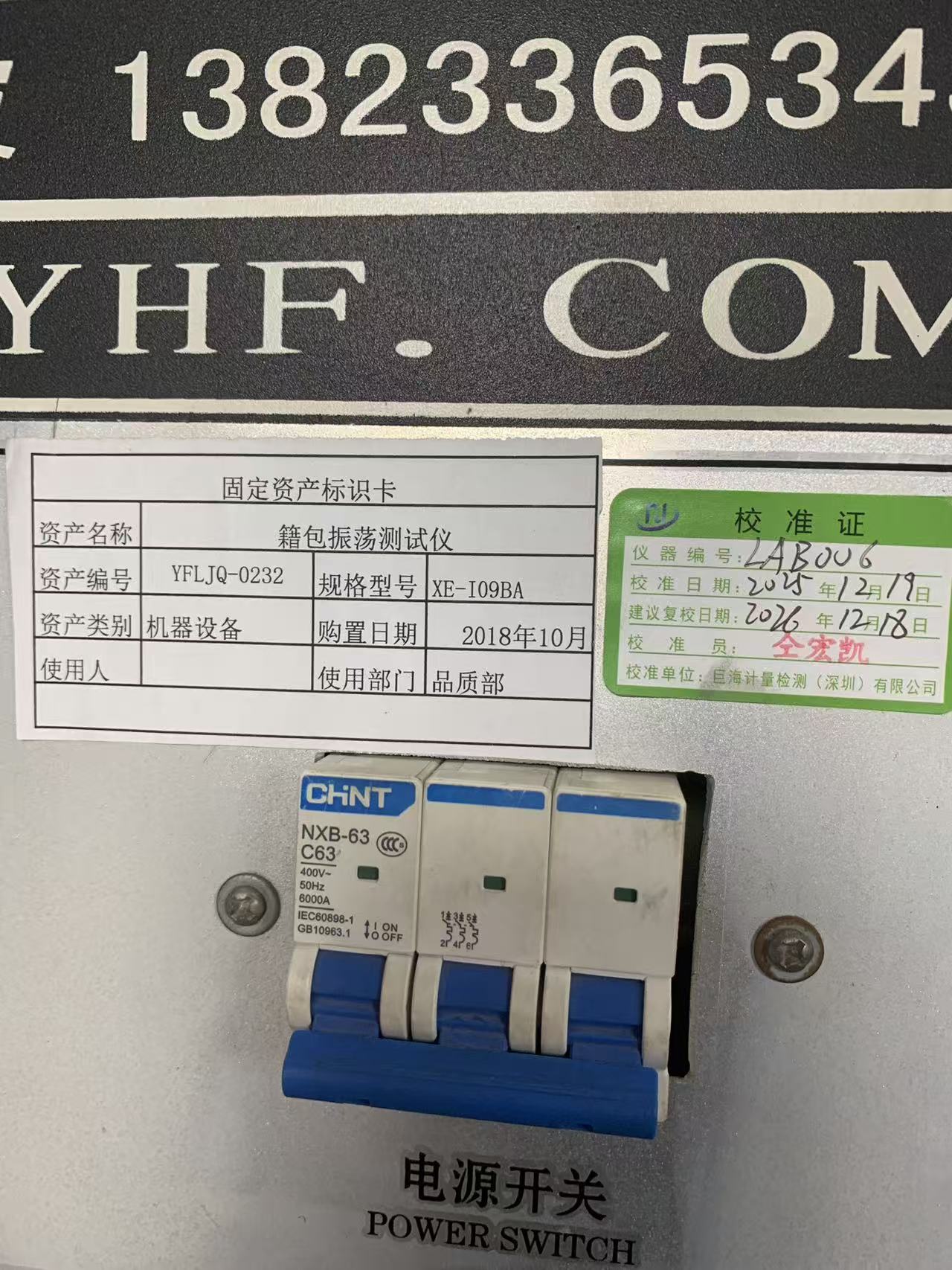
The machine that separates those two worlds in our lab is the luggage oscillation impact tester — asset YFLJQ-0232, model XE-I09BA, instrument number LAB-006, in service in our quality department since October 2018 and last externally calibrated on 19 December 2025, with recalibration due 18 December 2026. Internally it runs under standard operating procedure YFL-WI-PZ-03, revision A/0, dated 28 December 2023. This article walks through what the machine actually does, why the test matters more for high-frequency welded waterproof bags than for conventionally sewn luggage, and what a sourcing manager should ask for when they see "oscillation impact tested" on a supplier's specification sheet.
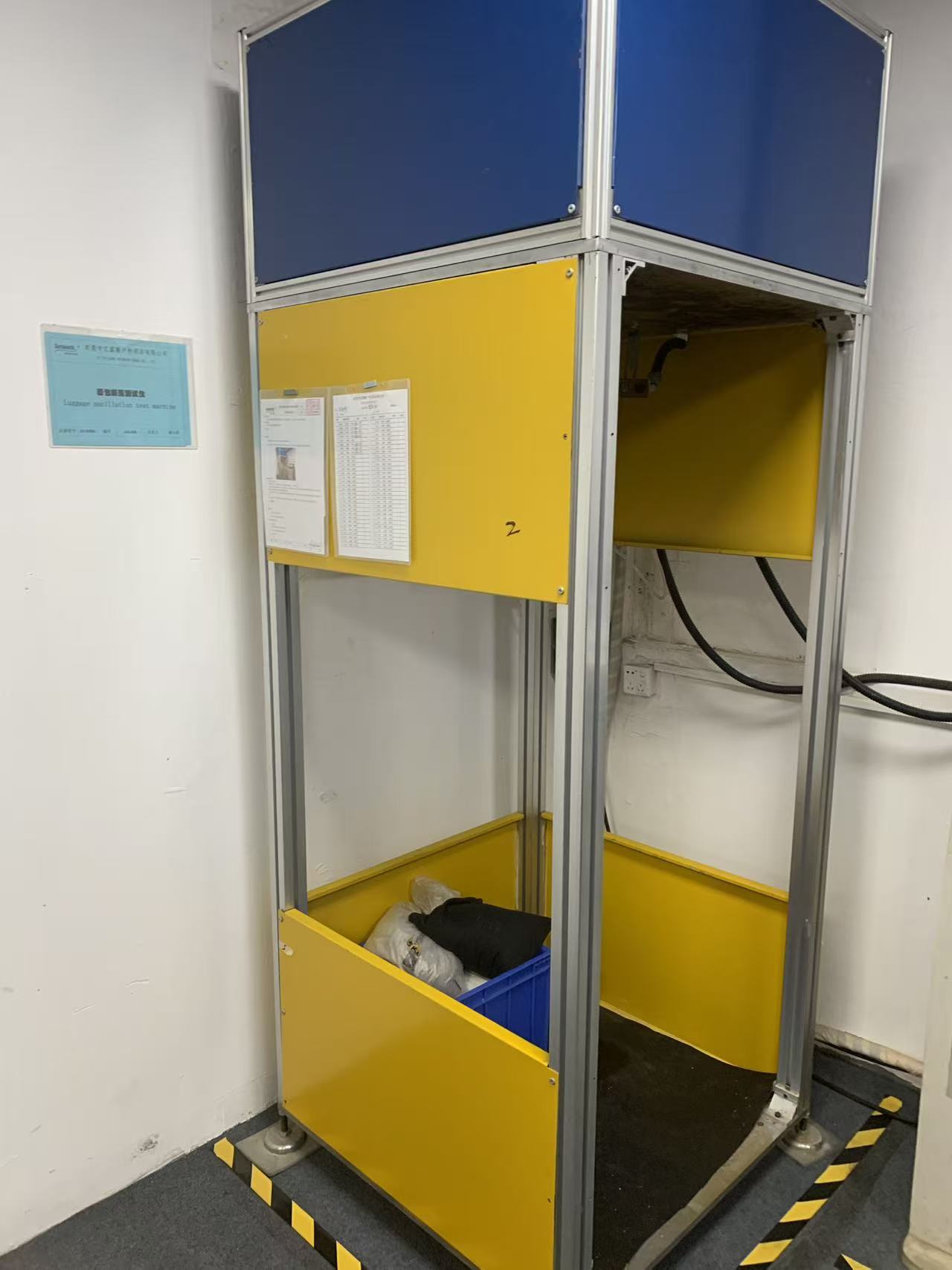
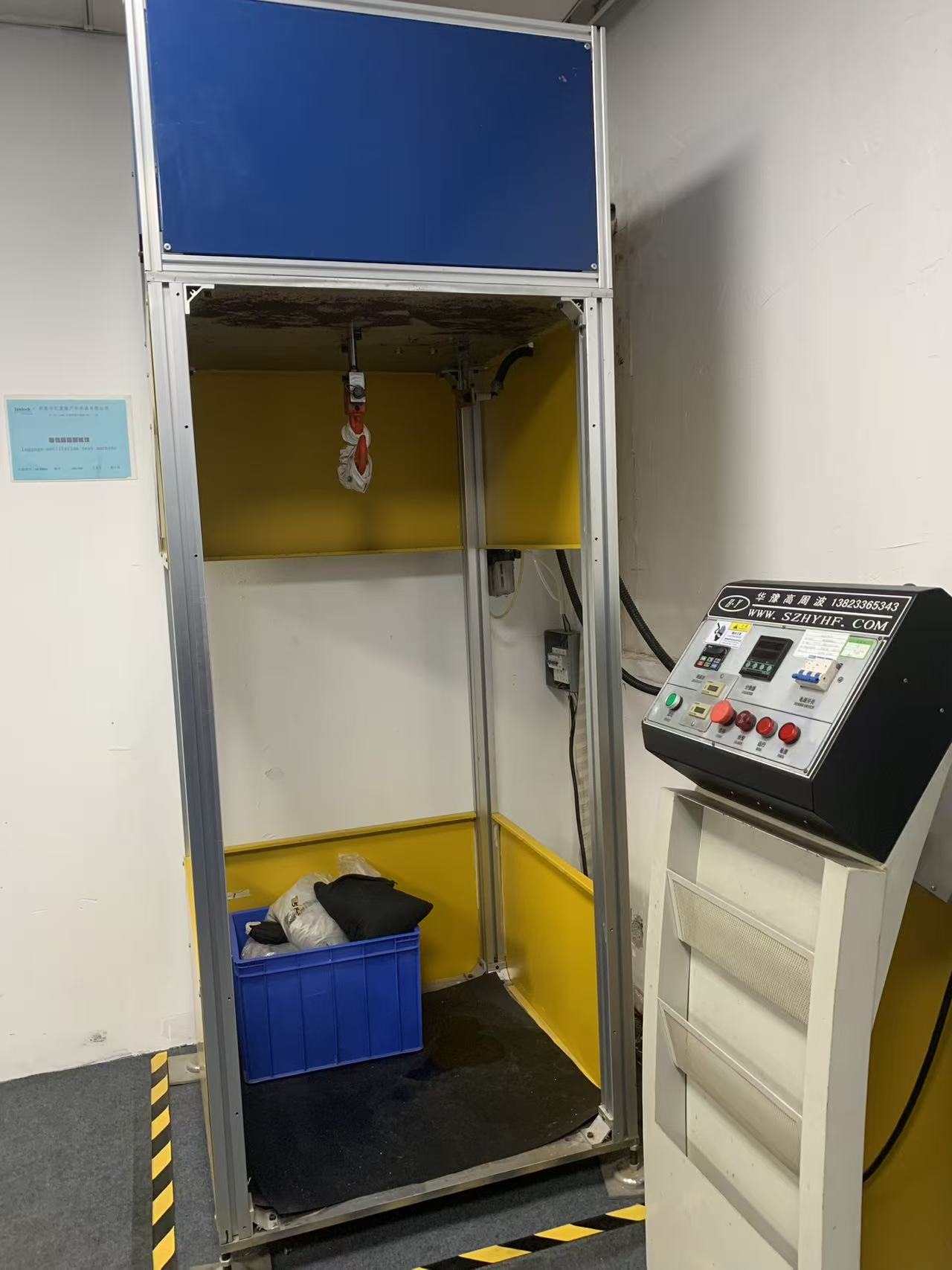
The oscillation impact tester in our quality lab: an aluminium-profile cage with an overhead impact head, a rubber-matted floor and a crate of calibrated sandbag weights used to load specimens.
What "oscillation impact" actually means
The test is deceptively simple to describe and quite hard to do well. A bag is loaded to a specified weight, then suspended from the machine by whatever component is under examination — a single top handle, a pair of shoulder straps, a haul loop, a fully extended trolley handle. The impact head lifts the loaded bag through a defined stroke, then releases it. Gravity does the rest. The bag falls, and a damped spring assembly at the top of the head absorbs and then returns the energy of the fall, so the specimen is not just dropped once but driven into a continuous rising-and-falling oscillation. Each cycle sends a shock wave down the strap and into the anchor point, then unloads it completely. Load, shock, unload, repeat.
The Chinese light industry method standard that formalises this, QB/T 2922-2018 Case and bag — Test method for shaking impact, describes the principle as loading the bag with a specified weight, lifting it by the handle, shoulder strap or fully extended trolley handle through a set stroke, letting it fall freely under gravity, and using a spring to absorb and release the impact energy so that the bag experiences repeated impact and oscillation — thereby testing the shaking-impact endurance of the handle, strap, trolley handle and body. The apparatus is tightly specified: the combined mass of the lower suction cup, upper damping block, impact rod and standard fixture is 8.1 ± 0.2 kg, the single-direction stroke is 150 ± 5 mm, and the noise-damping assembly at the upper suction cup delivers a spring force of 110 ± 10 N when compressed flush. The control system must allow the impact rate to be adjusted, allow the number of cycles to be set and recorded, and must stop the machine automatically if the specimen falls during the test.
That last clause matters more than it looks. Automatic stop on specimen drop is not a convenience feature — it is what makes the cycle count a valid data point. If a strap tears at cycle 612 and the machine keeps hammering an empty fixture until it reaches a preset 1,500, the report says nothing useful. Because the machine halts at the moment of separation, the counter reading is the fatigue life of that joint.
The machine on our floor
Our unit was built by a Shenzhen high-frequency equipment maker and is deliberately unglamorous. The test chamber is an extruded aluminium frame with yellow and blue infill panels, open on the operating side, floored with a heavy rubber mat to kill rebound. The impact head hangs from the top crossmember; below it sits the specimen and, in the crate at the base, the calibrated sandbags we use to bring a bag to its rated test load. A hinged door closes the working side before a run starts, which is the only thing standing between an operator and a 20 kg bag travelling at speed.
Inside the chamber: the impact head and fixture hang from the top crossmember; sandbag weights in the crate below are used to bring each specimen to its rated test load.
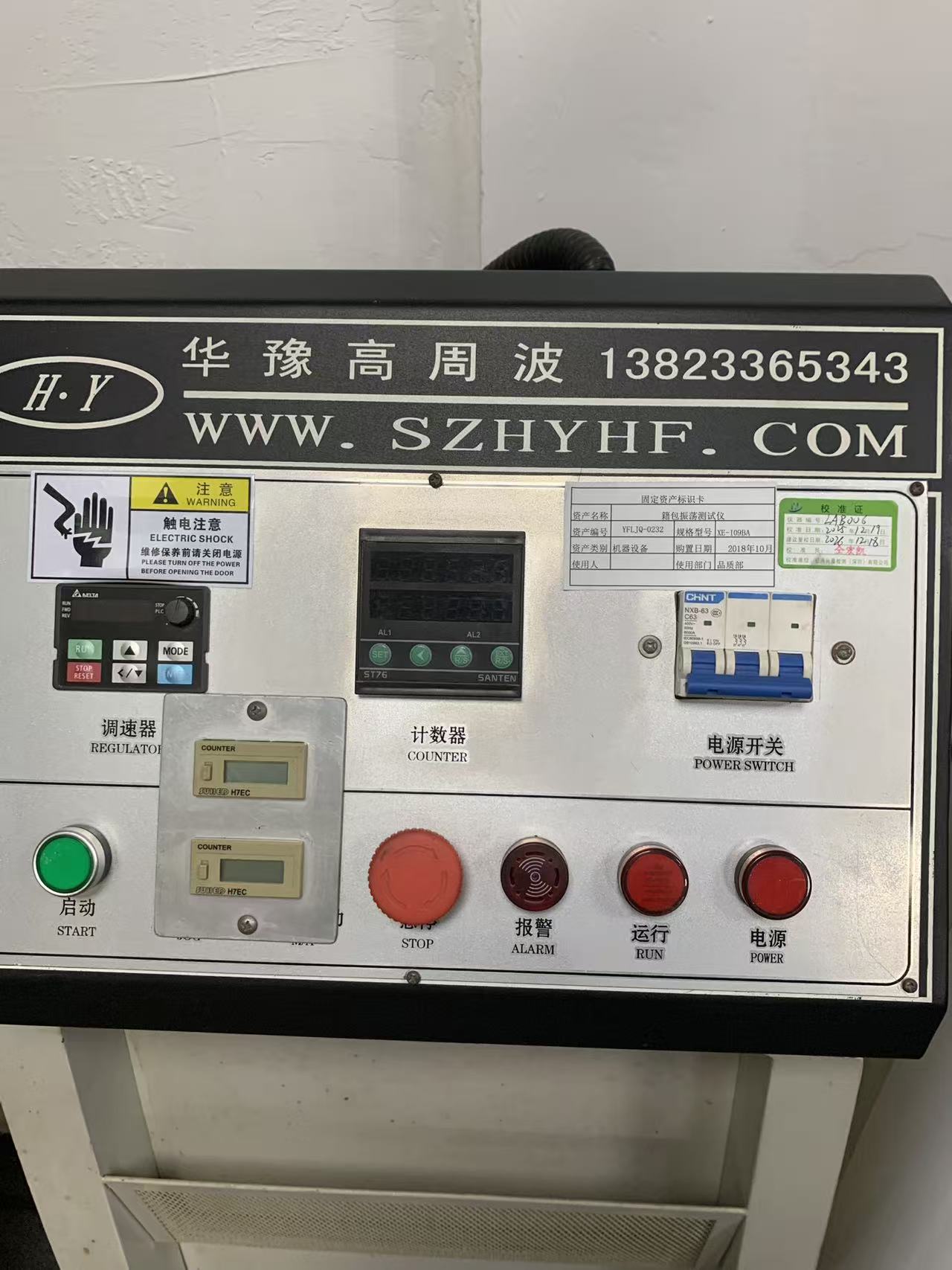
The control pedestal sits outside the cage. Its layout tells you exactly how the test is run: a Delta variable-frequency drive on the left acts as the speed regulator, a SANTEN ST76 digital counter with two alarm channels sits in the centre, two FUJI H7EC electromechanical counters record cumulative cycles independently of the programmable one, and a three-pole CHNT NXB-63 C63 breaker rated 400 V, 50 Hz with 6,000 A breaking capacity handles incoming power. Below them are the start button, an oversized mushroom-head emergency stop, and alarm, run and power indicators.
The control pedestal: variable-frequency speed regulator, programmable counter with dual alarm channels, two independent mechanical cycle counters, and the incoming breaker.
The duplicated counters are there for a reason. The programmable counter is what stops the machine at the target cycle; the mechanical counters accumulate lifetime cycles on the machine and give a cross-check if anyone questions whether a run was reset mid-test. When a customer's third-party auditor asks how we know a report reflects a complete run, this is the answer we point at.
Asset card and calibration label: asset number YFLJQ-0232, model XE-I09BA, in service since October 2018 under the quality department, calibrated 19 December 2025 with recalibration due 18 December 2026.Every instrument in the lab carries an identification placard with model, instrument number and the named person responsible for it. This one is LAB-006.
How we run it: SOP YFL-WI-PZ-03
The controlled procedure posted on the machine is short, and every clause in it exists because someone once got it wrong.
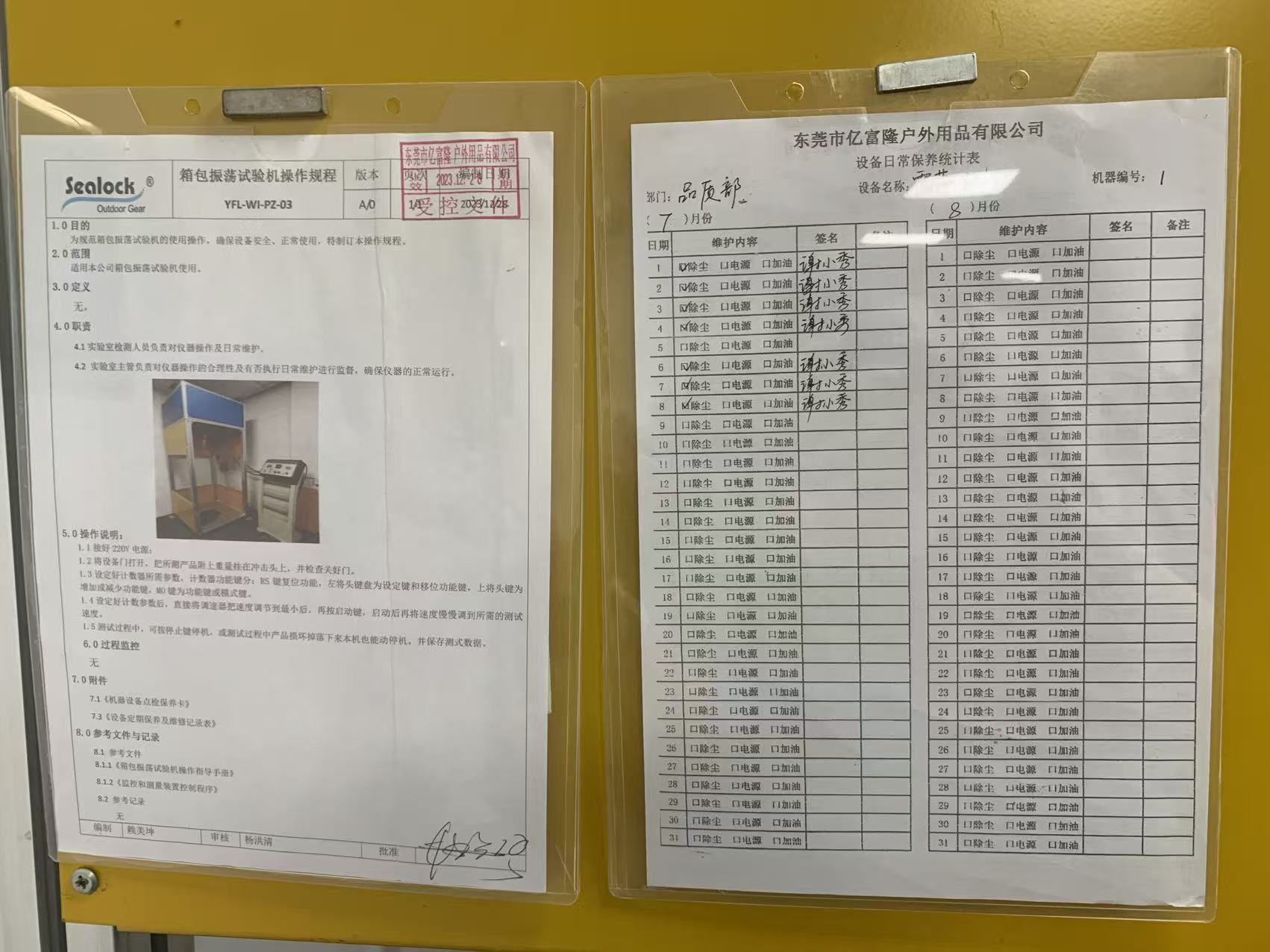
The operator connects the 220 V supply, opens the chamber door, hangs the specimen — already loaded to its rated weight — on the impact head using the appropriate fixture, and confirms the door is properly closed before anything moves. The counter is then programmed: the reset key clears the previous run, the shift and increment keys set the target cycle count, and the mode key selects the counting function. Only after the target is set does the operator turn the speed regulator down to its minimum, press start, and then slowly ramp the speed up to the required test rate. Starting at speed is prohibited, because an abrupt first stroke applies a shock the standard never intended and can produce a false early failure at the fixture rather than at the joint under test.
During the run the operator can halt the machine with the stop key at any time. If the specimen breaks and drops, the machine stops itself. The test data is then recorded. The SOP assigns operation and routine maintenance to the lab inspector and supervision of both to the lab supervisor, and it is supported by a daily upkeep log — dust removal, power check, lubrication — signed off day by day.
The controlled SOP (YFL-WI-PZ-03, rev A/0) and the daily maintenance log posted on the machine itself, signed as each day's checks are completed.
Load and cycle count: what the numbers should be
The method standard defines how to shake a bag; the product standard defines how hard and for how long. For carried bags that is QB/T 1333-2018 Handbag and knapsack, which sets the test load according to the volume of the bag body rather than, as the earlier 2010 edition did, according to product specification, and which assesses only the shoulder strap where a single handle and the shoulder strap share an overlapping stitched region. Typical commercial testing runs to 400 cycles on dual shoulder straps under a 6 kg specified load, with handles evaluated at their own load and cycle combination.
Four hundred cycles is a floor, not a ceiling, and it is calibrated to a daily-life handbag rather than to a 60-litre dry duffel that will be thrown onto a boat deck for a decade. Our internal load-carrying requirement is 1,500 cycles and above, and for expedition and marine programmes we run substantially higher counts at loads set from the bag's rated capacity rather than from the standard's volume table. When a client's own protocol specifies a different combination — a heavier load at fewer cycles to simulate baggage handling, or a lighter load at a much higher count to simulate commuting — the machine simply takes those numbers. Speed, load and cycle target are all operator-set, which is the whole point of having the instrument in-house rather than buying test slots externally.
Why this test is different for welded waterproof bags
Here is where a waterproof gear factory diverges from a conventional luggage factory. On a sewn bag, a shoulder strap anchor is a webbing loop caught in a seam and reinforced with a bar-tack. The failure mode is thread abrasion and progressive stitch pull-out, and it announces itself: stitches loosen, the loop skews, the buyer notices before it lets go.
On a high-frequency welded bag, there is no stitching at the anchor at all, or the stitching is decorative and the real load path runs through a welded patch bonded to the TPU or PVC face of the body panel. That joint fails by peel, not by abrasion, and peel failure is quiet and sudden. A weld that has been running slightly cold — insufficient dwell, contaminated surface, a die that has drifted out of parallel by a fraction of a millimetre — will pass a static pull test comfortably and then delaminate at the patch edge somewhere between cycle 300 and cycle 900, because every oscillation cycle prises at the same leading edge of the bond.
This is the failure that generates the reviews every category manager recognises: the bag that was fine for a season and then "the strap just came off the bag" with a clean, unfrayed patch outline left behind. It is also, importantly, a waterproofing failure and not only a strength failure, because a partially peeled patch opens a leak path through the face material long before it separates completely. A bag can start letting water in at the shoulder anchor while still carrying its load perfectly.
That is why the oscillation tester and the computerised tensile and peel tester are read together rather than separately. Peel testing gives us the static bond strength of a welded seam in kilograms against our internal material table; oscillation testing tells us whether that bond survives dynamic, repeated, single-edge loading in the geometry it will actually see in service. A weld can be strong and still be fatigue-poor if the patch geometry concentrates peel at one corner. Only the second test finds it.
What we look at when a run ends
A completed cycle count is a pass condition, not a pass result. When the counter stops, the specimen comes down and is examined against a written checklist: no separation or partial separation of handle, strap or anchor patch; no delamination or lifting at the edge of any welded reinforcement; no fracture, deformation or cracking of buckles, sliders, D-rings or triglides; no thread breakage at any reinforcing stitch; no distortion of the body panel around the load point; and, for bags with a trolley system, a handle that still extends and retracts smoothly and locks positively.
Anything short of separation still gets recorded. A patch edge that has lifted by two millimetres at 1,500 cycles is a passing bag and a failing process, and it goes back to engineering as a welding parameter issue rather than being signed off. Where the test is destructive or the specimen is marked, the sample is quarantined and does not re-enter saleable stock.
Where it sits in the wider QC chain
No single instrument certifies a bag. The oscillation tester covers dynamic load endurance at the anchor points, and it hands off in every direction: the zipper reciprocating life tester takes the closure through 3,000 cycles under a size-appropriate lateral and longitudinal load; the abrasion tester and the rubbing colour fastness tester address surface durability and finish transfer; the programmable temperature and humidity chamber ages the material set through hot-humid and sub-zero cycling before mechanical properties are re-checked. Then the whole assembly goes to full water-immersion testing of two hours or more for submersible products, or heavy rain and water-jet testing for products rated to resist rain rather than immersion.
Running oscillation testing after climate ageing is one of the more revealing sequences available to a buyer, and it is worth specifying explicitly. Adhesive-assisted joints and some TPU film grades lose meaningful peel strength after seventy-two hours of hot-humid exposure. A strap anchor that survives 1,500 cycles new and 600 cycles after ageing tells you something no room-temperature test ever will.
What buyers should ask for
"Oscillation tested" on a spec sheet means nothing without four numbers behind it: the load in kilograms, the cycle count, the component tested, and the acceptance criteria. Ask for all four. Ask whether the count was reached or whether the machine auto-stopped early. Ask whether the bag was tested new or after environmental conditioning. And for welded products specifically, ask whether the post-test inspection included edge-lift at welded reinforcement patches, because a supplier who only inspects for separation will report a pass on a bag that has already begun to peel.
For OEM and ODM programmes we set these parameters jointly at the development stage, run them on first articles before tooling is frozen, and repeat them during production. Where a brand's own protocol or a third-party laboratory report is required, the in-house data becomes the pre-screen: we would rather find the problem at cycle 700 on our own floor than in an SGS or QIMA report three weeks before shipment.
Frequently asked questions
Is oscillation impact testing the same as a drop test?
No. A drop test evaluates what happens to a bag and its contents in a single uncontrolled impact against a hard surface. Oscillation impact testing evaluates fatigue at the carrying points under hundreds or thousands of controlled load-and-release cycles. They find different failures, and a bag can pass one comfortably while failing the other.
Can this machine test a soft cooler or a dry bag as well as a backpack?
Yes. Anything with a defined carry point can be hung from the fixture — a single haul handle on a dry bag, dual shoulder straps on a cooler backpack, a top grab handle on a duffel. Soft-sided products are padded at the fixture contact area so the clamp does not abrade the strap and create a false failure at the grip rather than at the joint.
What load should be used if the bag has no published capacity?
The product standard derives it from the volume of the bag body. In practice, for outdoor gear we prefer to test at the rated capacity a brand will actually print on its own packaging, plus a margin, since that is the number a consumer will treat as permission.
Does a passing result guarantee the bag will not fail in the field?
It guarantees that the design and the process, as sampled, cleared a defined fatigue threshold. Field durability also depends on production consistency, which is why oscillation testing is run on production samples rather than only on the golden sample, and why in-process welding parameters are monitored independently.
Is the equipment calibrated?
Externally, by an accredited calibration house, with the certificate posted on the machine. The current certificate dates from 19 December 2025 and recalibration falls due 18 December 2026. Calibration status is part of every internal audit and is available to visiting customers on request.
Next in this series
The next instrument we will open up is the standard light source colour matching cabinet — the small, unassuming box that settles more customer disputes than any other piece of equipment in the building, because colour is the one attribute every buyer inspects personally and nearly everyone inspects under the wrong light.
Sealock has been building high-frequency welded waterproof gear for over twenty years from Dongguan, China and Ho Chi Minh City, Vietnam, for brands including OSPREY, Helly Hansen, SIMMS, AFTCO, West Marine and STANLEY. If you would like the full test protocol for a programme you are developing, or want to specify oscillation parameters into your own quality agreement, write to info@sealock.com.hk.
We use cookies to offer you a better browsing experience, analyze site traffic and personalize content. By using this site, you agree to our use of cookies.
Privacy Policy
 English
  Español
  Português
  русский
  Français
  日本語
日本語  Deutsch
  tiếng Việt
  Italiano
  Nederlands
  ภาษาไทย
  Polski
  Svenska
  magyar
  Malay
Malay  বাংলা ভাষার
  Dansk
Dansk  Suomi
Suomi  हिन्दी
  Pilipino
  한국어
한국어  Türkçe
  Gaeilge
  العربية
  Indonesia
  Norsk
Norsk  تمل
تمل  český
český  ελληνικά
  український
  Javanese
  فارسی
فارسی  தமிழ்
தமிழ்  తెలుగు
  नेपाली
  Burmese
  български
  ລາວ
ລາວ  Latine
  Қазақша
  Euskal
  Azərbaycan
  Slovenský jazyk
  Македонски
  Lietuvos
  Eesti Keel
  Română
  Slovenski
  मराठी
मराठी  Srpski језик