Sealock is a custom bike and motorcycle bag manufacturer and OEM supplier. A bag for a vehicle is really two products built into one: a sealed container, and a mounting system that has to survive sustained vibration. They are manufactured differently, they fail differently, and on this category the mount is the harder half. This guide covers how the mounting system is actually built into a welded shell, the components specific to this category, and why the production sequence is decided by the mount rather than the bag.
Why the Mount Leads the Build
On most waterproof products, the sealed body is designed first and the carry system is added. On a vehicle bag the order reverses, because every mounting point is a penetration of the barrier and its position is fixed by the bike, not by the designer. Strap positions are determined by handlebar diameter, top tube shape, seatpost length or the geometry of a pillion seat — and those positions then dictate the weld map, which dictates the die.
So the first decision in development is not the bag. It is where the straps go, and everything downstream follows from it. Moving a strap port after tooling exists is expensive; deciding it first costs nothing.
The straps go on first, while the panel is flat — everything else is built around them.
Welded Strap Ports
A strap has to reach the bike from inside or through a sealed shell, and there are two ways to do it. Wrapping the strap around the outside of the bag body is simpler and works poorly: the strap slides, the bag rotates on the bars, and the load concentrates wherever the webbing happens to grip.
The better construction is a welded port — a reinforced aperture welded into the shell through which the strap passes, so the load is carried by a purpose-built feature rather than by friction against the bag body. Three requirements follow:
The port is a penetration, so it is sealed as a separate process window with its own weld parameters and its own inspection, exactly like a valve.
It carries the entire mounted load, including shock loads over potholes, so the reinforcement behind it matters as much as the weld.
It is tested to the failure mode, not the rated load. A handlebar bag does not fail gradually — it holds and then it does not, and the consequence is a bag in a front wheel.
Load Anchors: Stitched Before the Shell Closes
As with every load-bearing point in our range, anchors are stitched to flat panels at high tension before the shell is welded, so the perforated footprint ends up beneath the welded skin. A purely welded anchor can peel under sustained shear, and shear is exactly what a strap applies.
The bike and motorcycle specifics on top of that:
Backing patches under every strap anchor, since the load is applied through a narrow webbing and needs to be spread across an area.
Box-X where there is room, bar-tack where there isn't, with density set to the load rather than maximised.
Bonded nylon or polyester thread, Tex 40 or heavier, UV-stable where it sits exposed.
Redundant retention — an independent buckle specified alongside the hook-and-loop, so retention never depends on one system.
Hook-and-Loop Is a Bonding Problem
Hook-and-loop is the default mounting interface in this category, and how it is attached decides how long it lasts. The governing principle is the one that runs through all welded construction: a weld between compatible resins is substantially more reliable than an adhesive joint between dissimilar materials. Where hook-and-loop is welded to a compatible substrate, the bond is a material fusion; where it is glued to an incompatible one, it is a glue line with its own ageing behaviour.
Two production consequences worth specifying:
Attachment method matched to substrate — welded to compatible material, or stitched with backing where the materials cannot be fused.
Cycle testing with contamination present. A strap that grips cleanly in a lab and fails with road grit embedded in it has not been tested for the environment it lives in. We cycle-test hook-and-loop dirty, because that is how it is used.
Port, webbing and reflective film — three separate welds, three separate process windows.
Welding Retroreflective Film
Reflective elements are a safety component on a vehicle bag rather than a styling one, and attaching them by adhesive or stitching creates the two failure modes buyers see in returns: film lifting at the edges, and stitch lines that let water in.
Welding the retroreflective film to the shell avoids both. It becomes part of the sealed surface, with no adhesive to age and no perforations. The production requirements are the same as any dissimilar-material weld — parameters set so the higher glass-transition material heats first and conducts into the lower — and the verification is specific: reflective retention tested after abrasion, washing and UV exposure, because a reflective element that has stopped reflecting is a safety feature that expired quietly.
Moulded Hard Shells
Some products in this category are not welded bags at all. A top tube bag with a rigid shell is thermoformed, and the process has its own logic:
Foam is laminated to fabric before moulding — typically EVA or cross-linked polyethylene bonded to the face material, then formed as a composite.
The face fabric must tolerate lamination and have some stretch, since it has to take a three-dimensional shape without wrinkling.
Tooling costs are lower than injection or blow moulding, which makes moulded shells viable at bag-industry volumes rather than only at plastics-industry volumes.
For a brand this is worth knowing because it changes the cost conversation: a moulded hard-shell product carries tooling, but not the tooling budget a rigid plastic case would need.
The Roll Line, Creased Twice a Day
On roll-top bar bags and seat packs, the closure band is folded at the start and end of every ride — thousands of cycles a year on the same few centimetres. The production responses are a reinforced roll section at each closure line and a material chosen for fold life: TPU-laminated fabric tolerates repeated folding and stays pliable in cold weather, where rigid coatings stiffen and eventually crack along the crease. Closure band fatigue testing after repeated folding is a standing item on this category's test plan for that reason.
The Production Sequence
Mount layout — strap positions fixed against the target bike geometry, before anything else.
Cutting — panels, reinforcement patches, webbing and reflective film cut to tolerance.
Anchor stitching to flat panels — box-X and bar-tack with backing patches, at high tension.
Component welding — strap ports, valve mounting, reflective film, window panels, each with its own parameter set.
Body welding — perimeter seams at 27.12 MHz, with test welds and peel tests at each run start.
Closure assembly — roll band reinforcement, zipper installation, buckles and adjusters.
Vibration and water testing, then packing.
The Product Basis
Image
Model & specs
Production capability it shows
MOQ
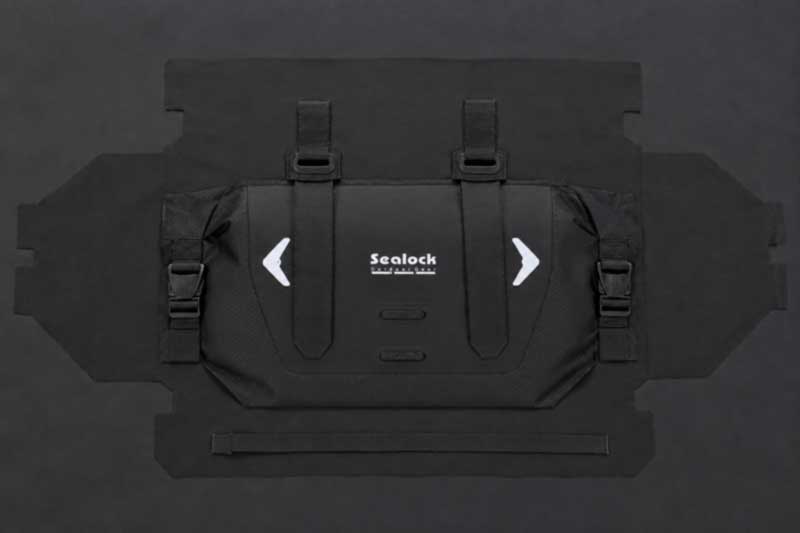
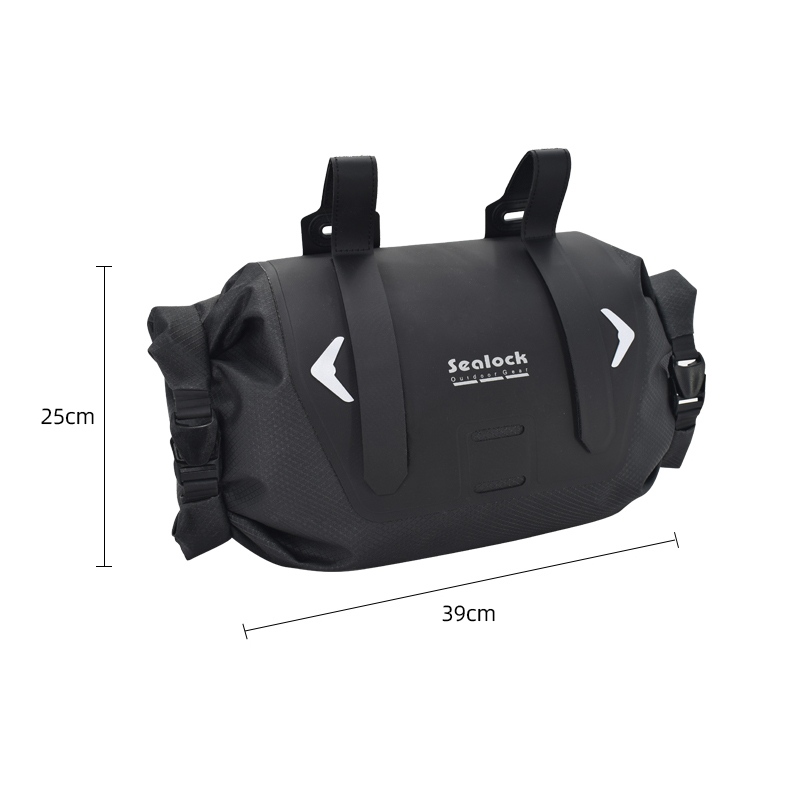
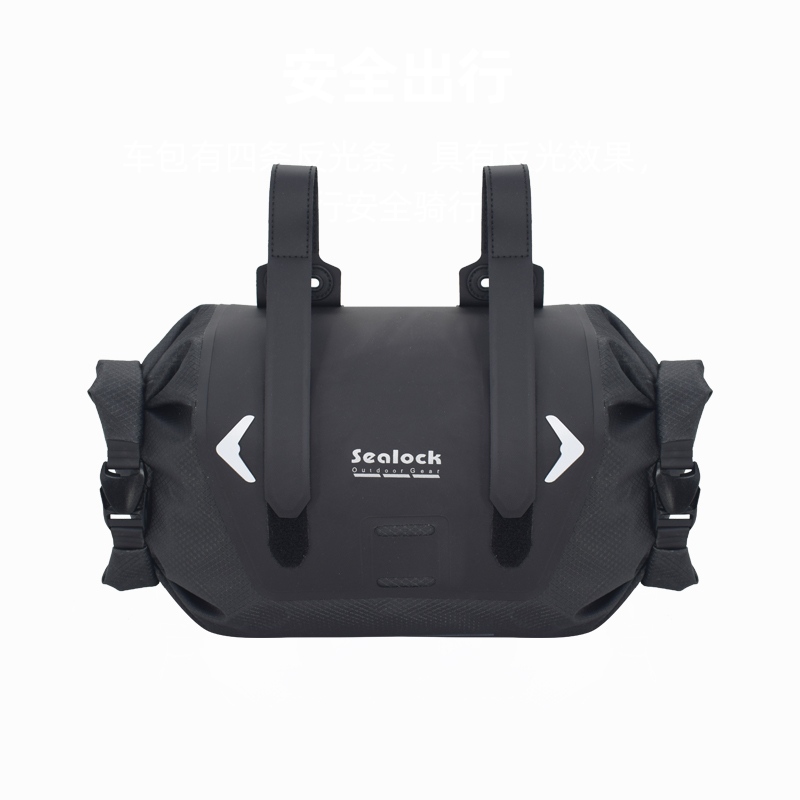
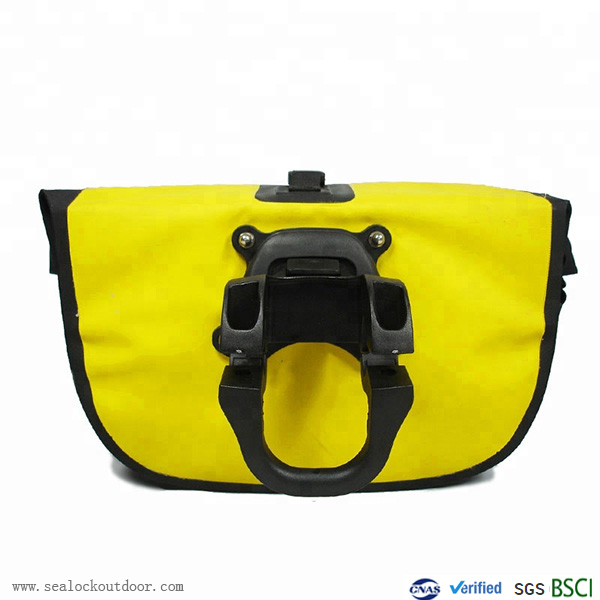
SL-K060B Roll-Top Handlebar Bag — 7L; RF-welded TPU-laminated ripstop; roll-top both ends; threaded purge valve with gasket, welded mounting; two bar straps through welded ports plus an independent retention buckle; four welded retroreflective elements; IPX6.
Welded strap ports, valve mounting and reflective film in one shell — four separate process windows
300
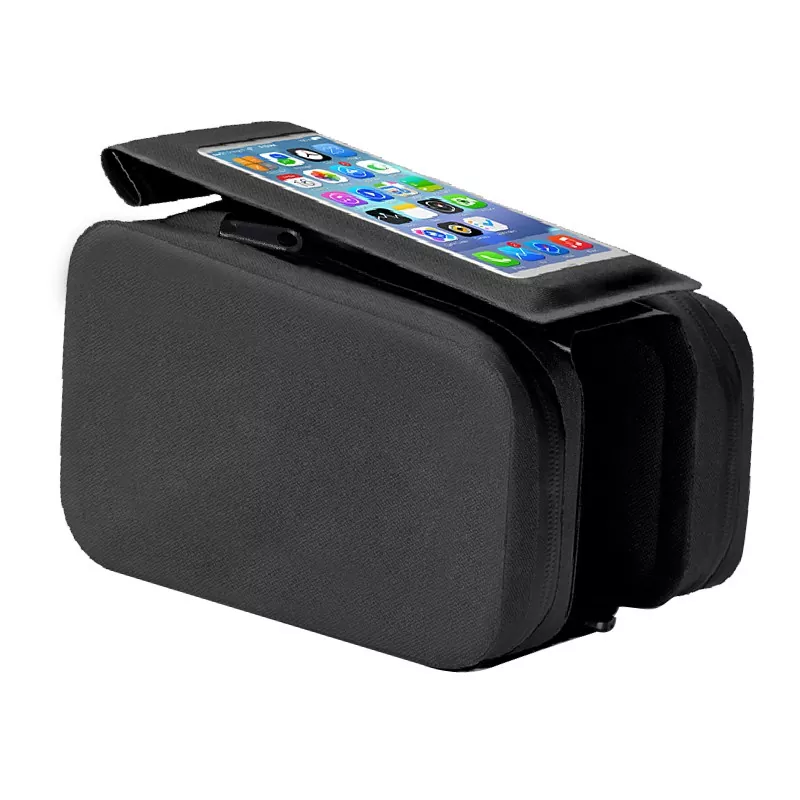
SL-K041 Top Tube Bag with Phone Window — moulded EVA hard shell; transparent touch window with flip-over flap; two zippered compartments; cable port; three hook-and-loop straps; fits round, aero and carbon top tubes.
Thermoformed shell with a clear window and a cable port — a different process from welding
500
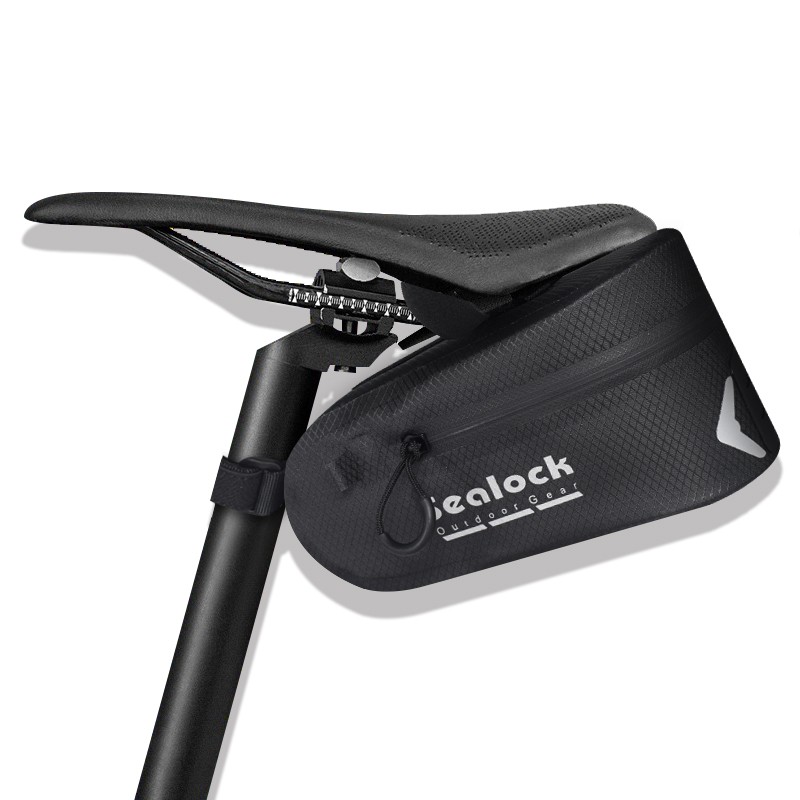
SL-K054 3D Shell Saddle Bag — 1L; TPU; 3D moulded shell with an internal wave-shaped shock-absorbing cushion; straps engineered against deflection; two stick-up straps plus a rubber buckle; reflective strap; taillight hook; ISO 9001.
Moulded 3D form with an internal cushion and anti-deflection strap engineering
300
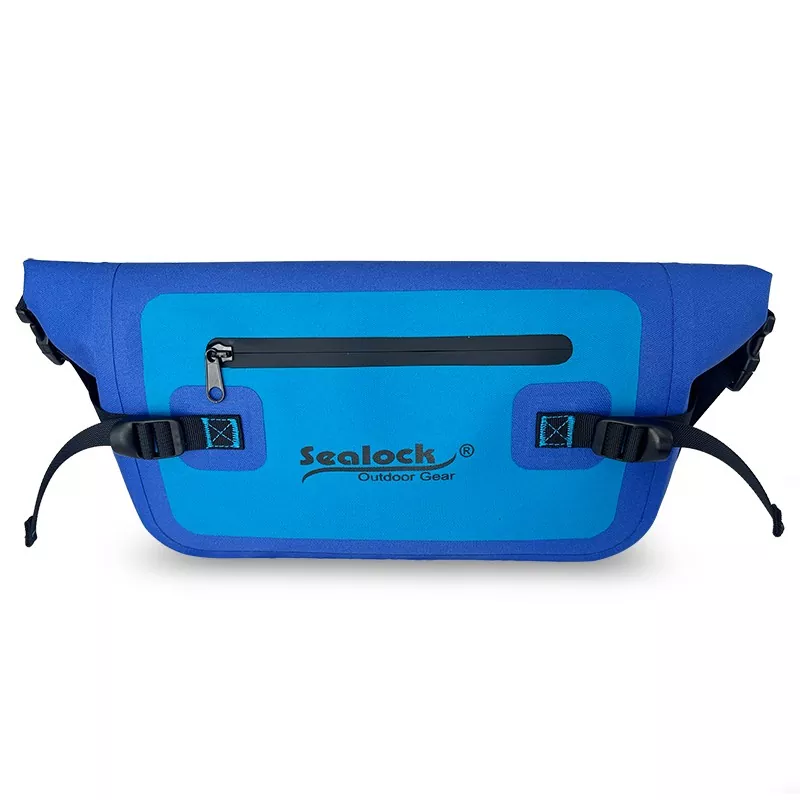
SL-K001 Welded Bicycle Front Bag — 10L; 500D PVC mesh with ABS; high-frequency welded seams; waterproof inner pocket; IPX6; BSCI, ISO 9001; sample 7–10 days.
Welded shell combined with a rigid ABS component
200
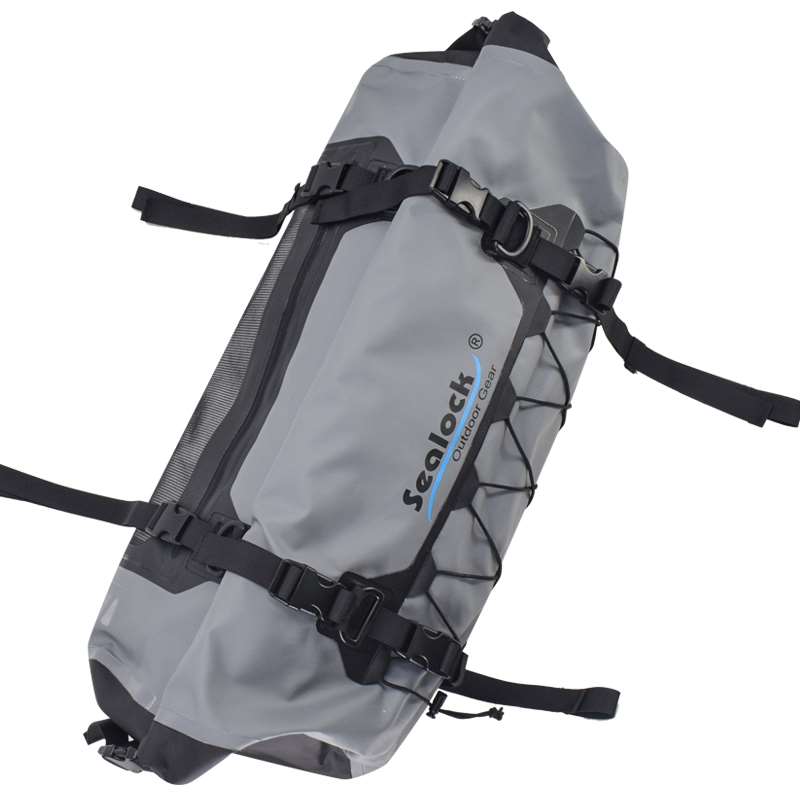
SL-C704 Motorcycle Saddlebags 80L — 80L as 40L×2; 50 kg carrying capacity; durable PVC; hook-and-loop plus two length-adjustable straps; sturdy shoulder straps; reflective signs both sides.
Anchors engineered for a 50 kg load under sustained highway vibration
300–500
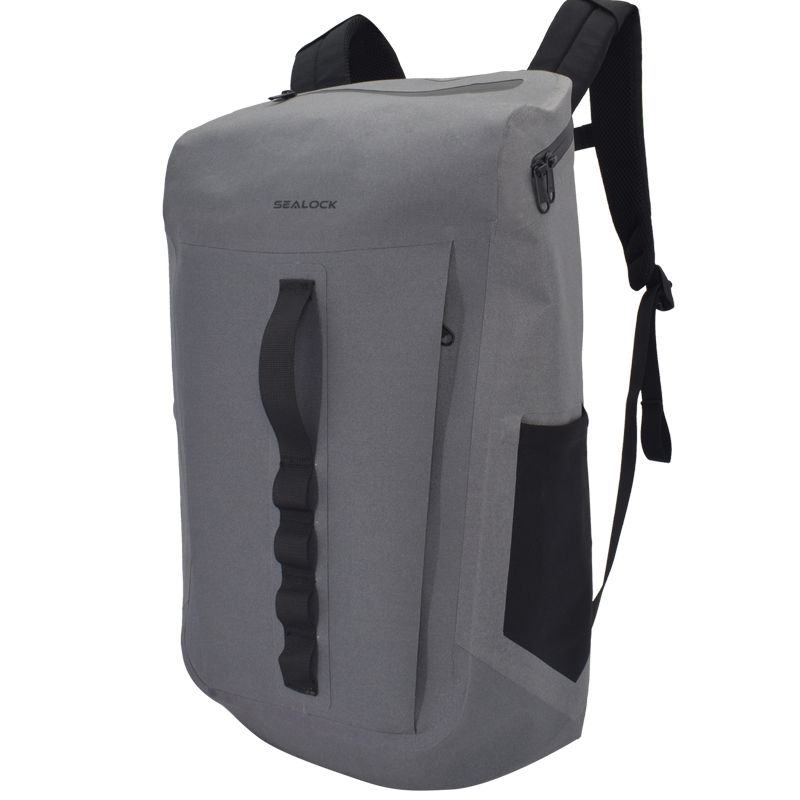
SL-C668 Backseat Bag 40L — 40L; 50 kg capacity; strong durable PVC, seamlessly welded, wipes clean; reflective logos both sides.
Seamless welded body at large scale with welded reflective elements
300–500
Mount layout, strap and port configuration, retention hardware, reflective placement, valve, shell construction and branding are all specifiable per order, or a product can be developed from a sketch. Tooling is quoted separately where a bespoke shell or moulded component is required. Samples 7–15 days, production 30–45 days after approval, from Dongguan or Ho Chi Minh City.
Quality Control
Production runs under an ISO 9001 quality system, gated in three tiers — IQC (incoming coated fabric for coating thickness, adhesion and weldability, plus webbing, hook-and-loop, buckles, valves, reflective film, EVA and ABS components against the signed standard), IPQC (cutting tolerance, weld integrity at body seams, strap ports, valve mountings and reflective film, anchor stitching with backing verification, and mount assembly, with peel tests on sample welds at each run start), and OQC (AQL sampling, water-jet testing to the declared rating, and gold-sample comparison, with SGS or QIMA inspection available). A pre-production sample is approved before mass production and a final inspection runs before every shipment.
The category-specific lab programme: vibration testing on loaded mounts, hook-and-loop cycle testing with contamination present, strap and port tensile strength at and beyond rated load with jerk-loading, closure band fatigue at the roll lines, valve seal testing after repeated cycling, reflective retention after abrasion, washing and UV, cold flex, and salt and road-grime exposure, alongside bonding strength under peel load.
FAQ: Bike and Motorcycle Bag Production
Q: Why does the mounting system determine the tooling?
A: Because strap positions are fixed by the bike's geometry, not by the designer, and every mounting point is a penetration of the sealed shell. Those positions set the weld map, which sets the die. Decide them before tooling and it costs nothing; move them afterwards and it is expensive.
Q: What is a welded strap port, and why not just wrap the strap around the bag?
A: A welded port is a reinforced, sealed aperture the strap passes through, so load is carried by a purpose-built feature. A strap wrapped around the body slides, lets the bag rotate, and concentrates load wherever it happens to grip.
Q: How should hook-and-loop be attached?
A: Welded to a compatible substrate where possible, since a weld between compatible resins is far more reliable than adhesive between dissimilar materials. Where fusion isn't possible, stitched with backing. And it should be cycle-tested with contamination present, because that's how it is used.
Q: Why weld reflective film rather than stitch or glue it?
A: Because adhesive lifts at the edges and stitching perforates the barrier. Welded film becomes part of the sealed surface, and we verify reflective retention after abrasion, washing and UV.
Q: How is a moulded hard shell made, and is tooling expensive?
A: Thermoformed — foam laminated to the face fabric, then formed as a composite. Tooling costs less than injection or blow moulding, which makes a moulded shell viable at bag volumes rather than only at plastics volumes.
Q: What is the defining test on this category?
A: Vibration on the loaded mount. A vehicle bag does not fail gradually, so the mount is tested against the consequence of failure rather than against its rated load — and retention hardware is specified independently of the hook-and-loop for the same reason.
Talk to the Factory
To put a custom bike or motorcycle bag into production, contact Sealock at info@sealock.com.hk or +86-769-82009361. Over twenty years of high-frequency welding and industrial sewing under one roof, welded strap ports and reflective film, moulded shell capability, vibration-tested mounting systems, ISO 9001 production, and dual China–Vietnam manufacturing.
We use cookies to offer you a better browsing experience, analyze site traffic and personalize content. By using this site, you agree to our use of cookies.
Privacy Policy
 English
  Español
  Português
  русский
  Français
  日本語
日本語  Deutsch
  tiếng Việt
  Italiano
  Nederlands
  ภาษาไทย
  Polski
  Svenska
  magyar
  Malay
Malay  বাংলা ভাষার
  Dansk
Dansk  Suomi
Suomi  हिन्दी
  Pilipino
  한국어
한국어  Türkçe
  Gaeilge
  العربية
  Indonesia
  Norsk
Norsk  تمل
تمل  český
český  ελληνικά
  український
  Javanese
  فارسی
فارسی  தமிழ்
தமிழ்  తెలుగు
  नेपाली
  Burmese
  български
  ລາວ
ລາວ  Latine
  Қазақша
  Euskal
  Azərbaycan
  Slovenský jazyk
  Македонски
  Lietuvos
  Eesti Keel
  Română
  Slovenski
  मराठी
मराठी  Srpski језик