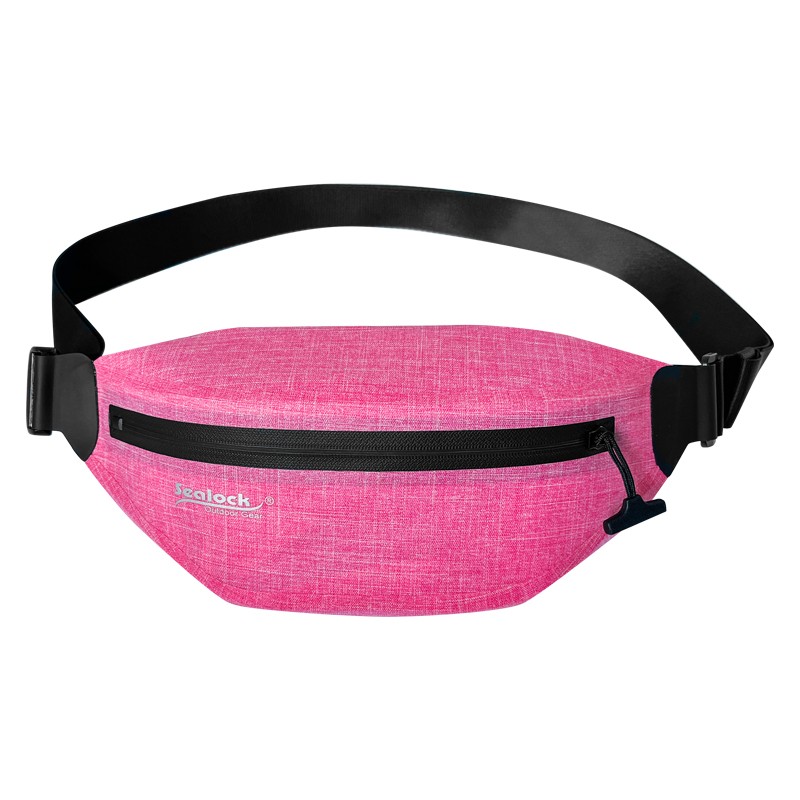
"Waterproof" is printed on fanny packs that can survive a capsize and on fanny packs that will soak through in a heavy shower. Both claims can be honest by their own standard, because the word covers three quite different levels of protection. The trouble starts when a pack built for one level is used at another: a light running belt taken kayaking, or a stiff, airtight pack bought for a city break where it is slow to open twenty times a day. Many of the complaints in reviews of waterproof fanny packs come down to that mismatch rather than to a faulty product.
This guide sorts out what each level means, which one suits paddling, wet hikes, running, fishing and days at the beach, and what to check in the closure, the pockets, the size and the fit. It is written for people buying a pack and for brands developing one, and draws on over 20 years, since 2001, of making welded and sewn waist packs at our factories in Dongguan, China and Ho Chi Minh City, Vietnam.
Three Levels of "Waterproof" on a Fanny Pack
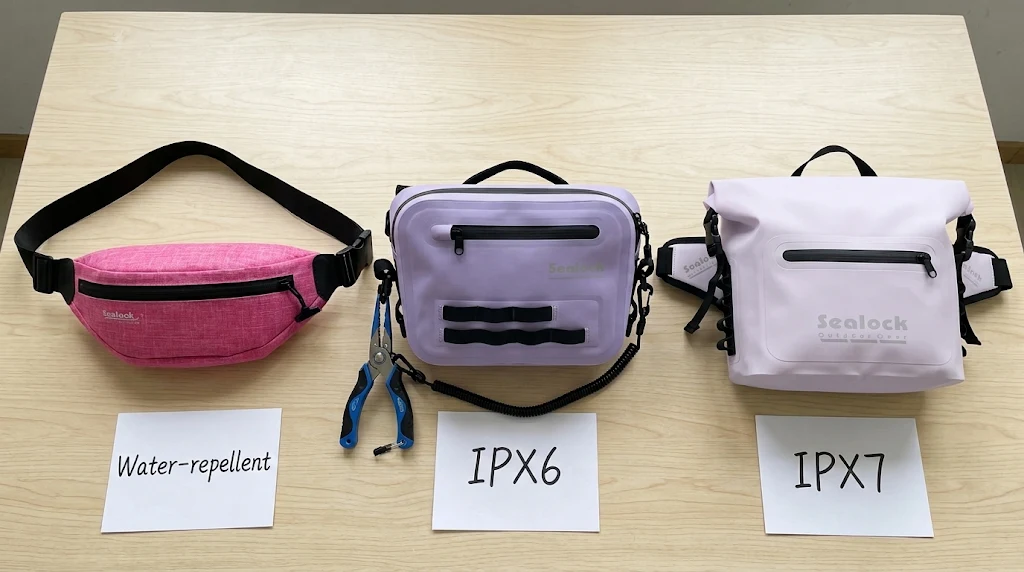
The first level is water-repellent. The pack is sewn from a coated or treated fabric with an ordinary or coated zipper. It sheds light rain and sweat, and that is what it is designed for. Water gets in through the needle holes along every seam and through the zipper teeth once the fabric is soaked or pressed under water. These packs are light, soft and quick to open, and they are the right choice for running and everyday wear. They are not the right choice for a boat.
The second level is a sealed pack rated IPX6: a welded body with a sealed waterproof zipper, built to keep out heavy rain and spray from any direction. We verify this level with a heavy rain and water-jet test. A pack like this stays dry on a wet hike, on a bike in a downpour or on the deck of a fishing boat, but it is not meant to go under water. The third level is a pack rated IPX7, with high-frequency welded seams and either a roll-top or an airtight zipper. It keeps its contents dry when it is briefly submerged, for example when a kayak rolls, and we verify it with a full water-immersion test of 2+ hours. Look for the rating rather than the word: a listing that says only "waterproof", with no rating and a sewn construction, is almost always the first level.
Match the Pack to the Day
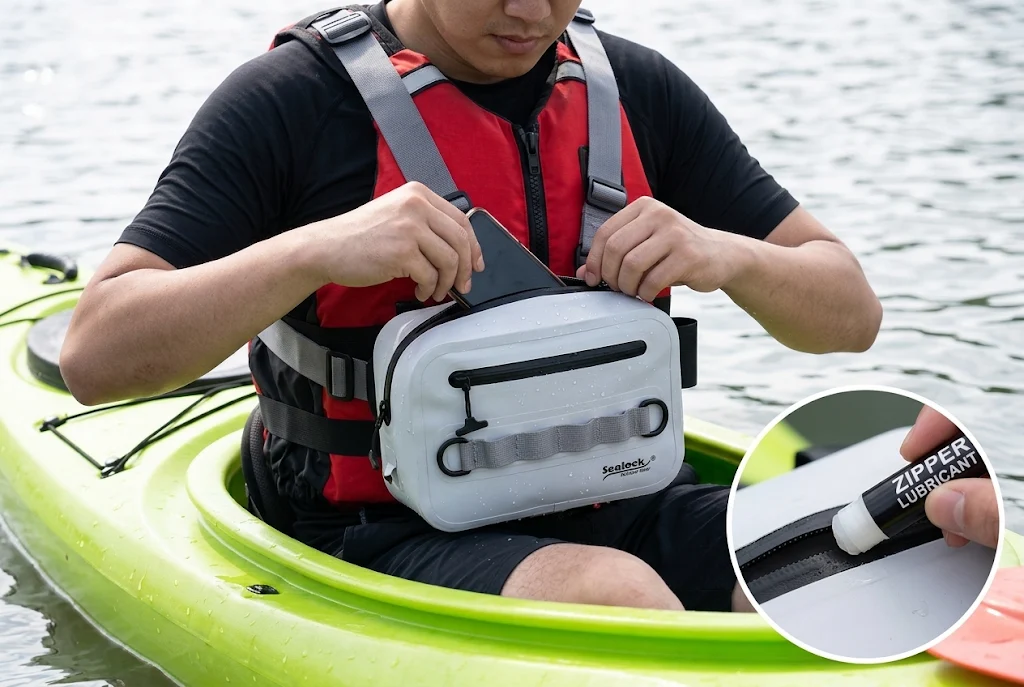
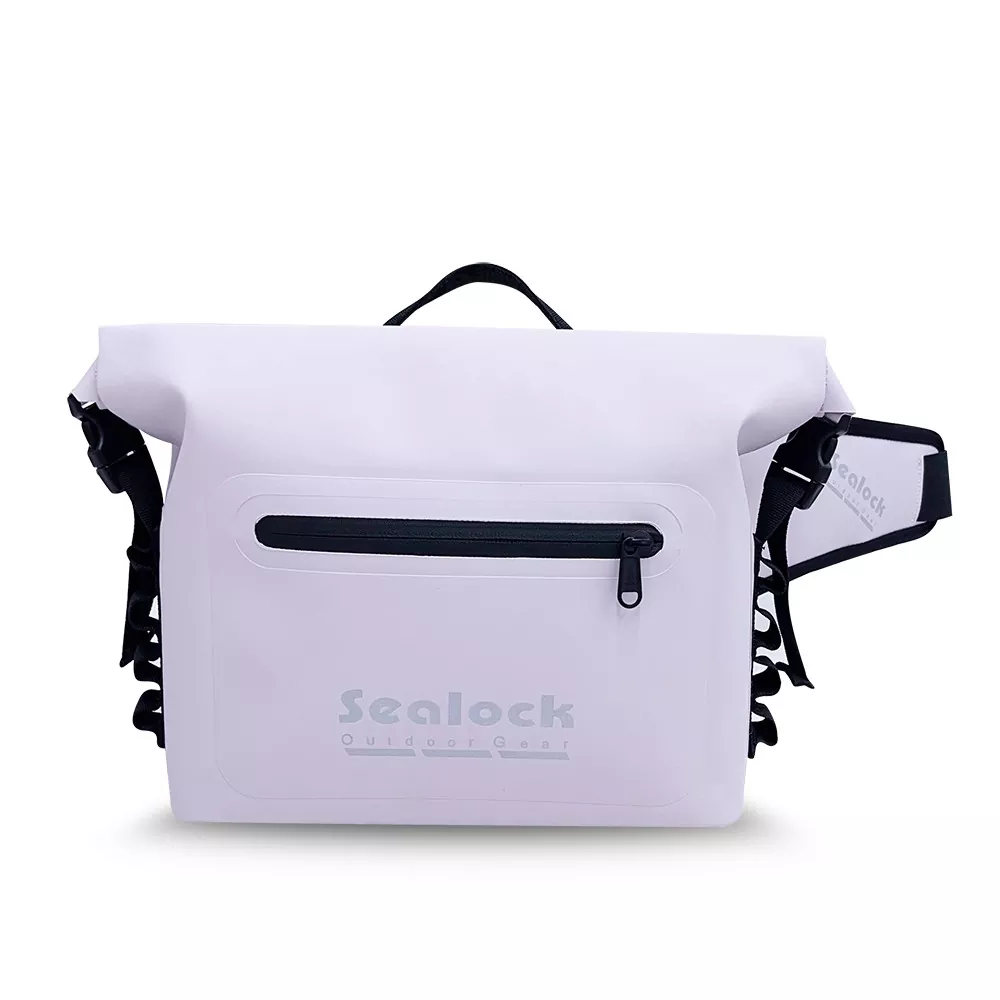
For kayaking, stand-up paddling, rafting and small boats, choose IPX7. You will be splashed constantly and may end up in the water, and a pack on your waist sits right at the waterline when you sit in a kayak. A roll-top pack has the added advantage that, rolled with some air inside, it tends to float if it comes off. Our roll-top waist packs and our airtight-zipper sling waist pack are made for this. If you plan to swim with the pack on, there is more to consider; our guide to the waterproof fanny pack for swimming covers it.
For hiking and cycling in the rain, an IPX6 pack is enough and is usually quicker to open than an IPX7 one. Fishing falls in the same range for most anglers: spray, rain and wet hands, with tools you need often. A sealed-zip pack with MOLLE loops and tool straps, like our fishing waist pack, keeps a phone and licence dry while pliers and a line cutter hang outside. Wading anglers who expect to go in above the waist should move up to IPX7.
For running, the opposite applies. A welded pack is heavier and does not breathe, and on a long run you will feel both. A light, water-repellent pack that sits close to the body and does not bounce is the better choice; carry the phone inside a small sealed pouch if you want extra protection in a storm. For beaches, water parks and festivals, decide by the wettest moment of the day. If there is a log flume or a swim in the plan, choose IPX7. If the worst case is a shower or a spilled drink, an IPX6 or even a water-repellent pack will do and will be easier to live with.
Three levels of protection: water-repellent, IPX6 sealed zip and IPX7 roll-top.
Closure: Roll-Top, Airtight Zipper or Sealed Zipper
A roll-top closes by folding the top of the pack over on itself at least three times and clipping the ends together. It is simple, very reliable and cheap to repair, and it lets you change the capacity: unrolled, the pack holds more; rolled tight, it is small and flat. The cost is speed. Opening and closing a roll-top takes a few seconds and two hands, which is fine for a phone you check twice an hour and tiresome for something you reach for constantly.
An airtight zipper gives IPX7 protection with one pull, but it is stiff by design. Its teeth press into a sealing rubber track, and that pressure is what keeps water out. Expect it to need a firm, steady pull, use both hands at first, and keep it lubricated with the silicone or wax supplied, especially after salt water. A pack that arrives with a lubricant stick is not a sign of a bad zipper; it is a sign of a real one. A sealed waterproof zipper, as used on IPX6 packs, is easier to run and a good compromise for rain and spray. Whatever the closure, check how long the opening is. A short opening on a deep pack makes it hard to reach the bottom, which is one of the most common frustrations with small packs.
The Front Pocket Problem
Many waterproof fanny packs have a waterproof main compartment and a front pocket that is not. The pocket is usually closed by an ordinary or coated zipper set into a welded panel, and it is fine for a snack or a lip balm, but it will let water in under a hose or a wave. Reviews regularly report wet keys or a wet phone in exactly this pocket. A well-labelled pack says which compartment carries the rating. Ours do: on our IPX7 and IPX6 packs, the rating applies to the main compartment, and the external pockets are described as weather-resistant. Put anything that must stay dry, a phone, car key fob, cards or medication, in the main compartment.
Size: What Actually Fits
Capacity in litres is a rough guide, because the shape matters as much as the volume. A slim 2.5-litre pack holds a phone, keys, cards and a gel or two. A 3-litre pack adds a small wallet and sunglasses in a soft case. Around 4.5 litres, you can carry a phone, wallet, keys, a snack and a compact first-aid kit. At 5.5 to 8 litres, a roll-top waist pack will take a light windproof or a small water bottle, and starts to work more like a small daypack worn on the hip. Measure your phone with its case before buying a slim pack, and check that the main compartment is wide enough front to back, not just long enough.
Comfort: Belt, Back Panel and Bounce
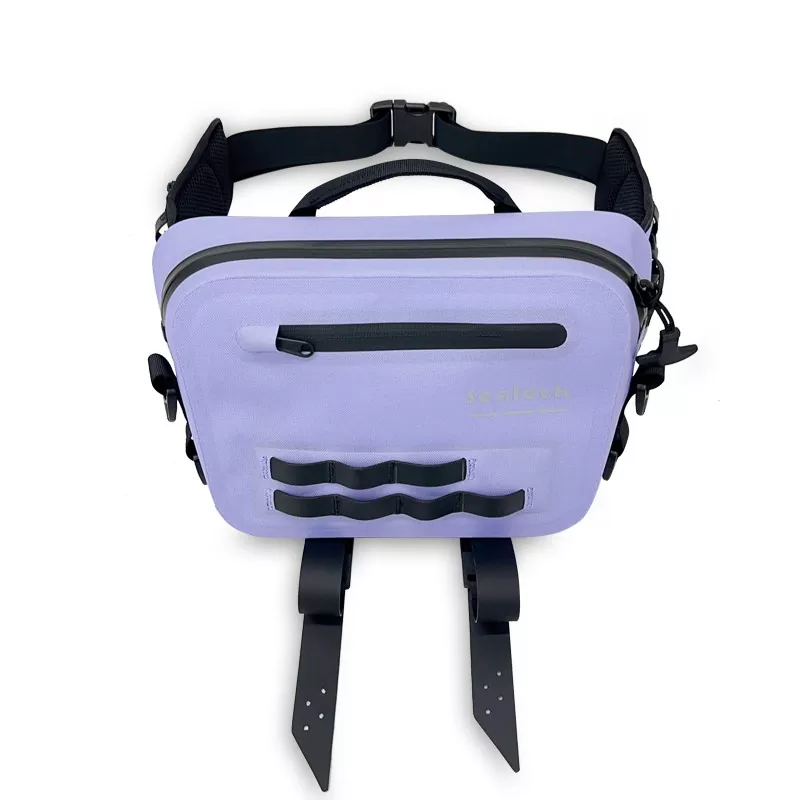
Welded TPU and PVC are what make a pack waterproof, and they also stop it breathing. On a warm day a welded pack worn tight against the lower back will make you sweat, so look for a padded mesh back panel that holds the pack slightly off the body. A wider belt spreads the load of a heavier pack, while a narrow belt with a padded section is enough for a light one. Belts that slowly loosen over a long day are a common complaint; a buckle with a locking adjuster, or a strap end that can be tucked away, helps.
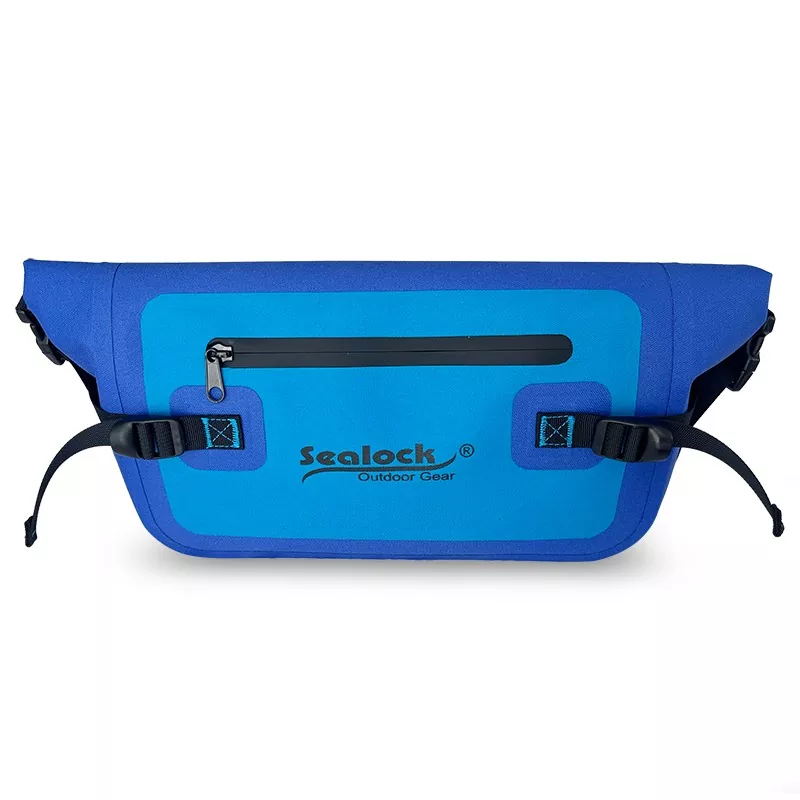
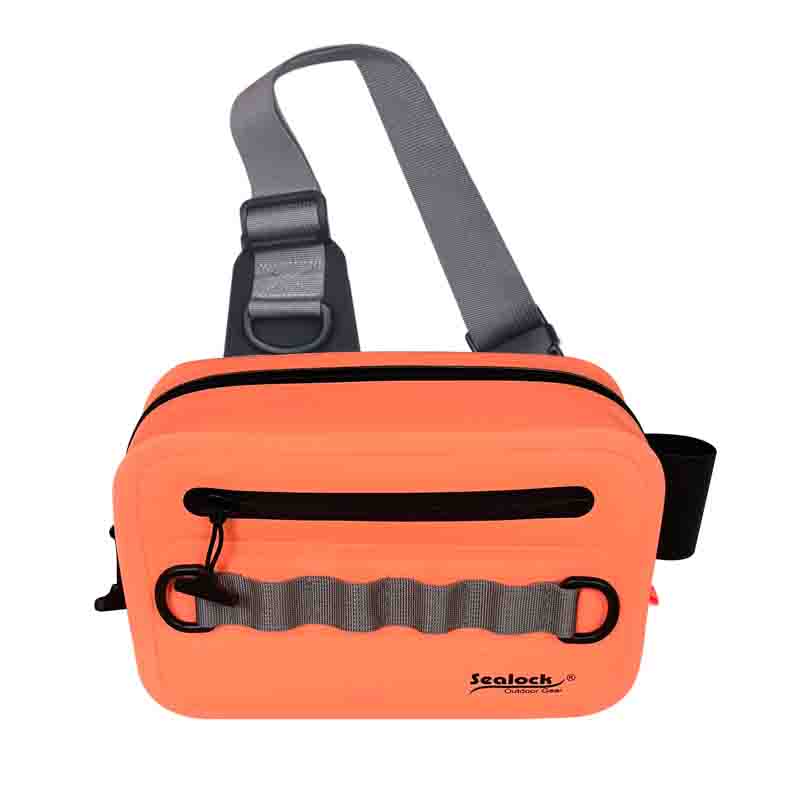
Most of our waist packs can also be worn cross-body as a sling. On a kayak, in a boat or with a hipbelt from a larger pack, a sling position keeps the pack off the waistline, out of the way of a spray deck or a buoyancy aid, and within easy reach. PVC becomes stiffer in cold weather; TPU stays more flexible, which is one reason we use it on our lighter roll-top packs.
Worn as a sling, the pack stays clear of a buoyancy aid and within reach.
Looking After a Waterproof Fanny Pack
Rinse the pack in fresh water after the sea or a pool, and run fresh water along the zipper in particular, because dried salt and sand make an airtight zipper stiffer and wear its seal. Let the pack dry open, out of direct sun, before storing it. Re-lubricate an airtight zipper every few outings. Store a roll-top pack unrolled, so the fold line does not take a permanent crease. Before an important trip, check the main compartment by putting a dry tissue inside, closing the pack and holding it under a running tap for a minute; if the tissue is dry, the closure is working.
Running and walking in light rain; not for water sports
MOQ is 300 pieces per style for the welded packs and 500 for the sewn running pack, with samples in about 7–15 days and bulk production in about 30–45 days. The running pack is in the table on purpose. It comes off our sewing lines, which work to the same standard as our welding lines, and it is a good product for its job; it simply should not be sold for water sports. Labelling each pack with the protection it actually gives is the easiest way for a brand to avoid returns. For brands developing a pack, our custom waterproof waist pack buying guide sets out the steps, our article on IPX7 vs IPX8 waist packs explains why IPX7 is the practical ceiling for this format, and our OEM waterproof waist pack guide covers production terms. You can also browse the full waterproof waist pack range.
How We Test Waterproof Fanny Packs
Every order passes through IQC on incoming fabric, TPU laminate, PVC, zippers, buckles and webbing, IPQC during welding, sewing and assembly, and OQC on finished packs, with SGS or QIMA third-party inspection available on request. Welded seams are tested for tensile and bonding strength, especially at belt anchors and zipper ends, and sewn packs for seam and anchor-point strength. Belts, buckles and anchor points go through a load test of 1,500+ cycles, and zippers, including airtight zippers, are opened and closed 3,000 times. Buckles and zipper pulls are tested in salt spray, fabric for abrasion, and colour fastness and colour difference are checked. IPX7 packs are verified with a full water-immersion test of 2+ hours, and IPX6 packs with a heavy rain and water-jet test.
Frequently Asked Questions
Is a waterproof fanny pack really waterproof?
It depends on the level. Check for a rating: IPX7 packs survive brief submersion, IPX6 packs keep out heavy rain and spray, and sewn packs without a rating are water-repellent only.
Why is the zipper on my waterproof fanny pack so stiff?
Airtight zippers seal by pressing their teeth into a rubber track, so they are stiff by design. Pull steadily with both hands and keep the zipper lubricated with silicone or wax, especially after salt water.
Is the front pocket waterproof?
Usually not. On most packs, including ours, the rating applies to the main compartment. Keep your phone, keys and cards there.
Will a waterproof fanny pack float?
A roll-top pack rolled with some air inside usually floats with light contents. Do not rely on it to keep a heavy load afloat, and attach it securely when paddling.
What is the MOQ for custom waterproof fanny packs?
300 pieces per style for welded IPX7 and IPX6 packs and 500 for sewn water-repellent packs. Samples take about 7–15 days and bulk production about 30–45 days.
How much does a custom waterproof fanny pack cost?
It depends on the protection level, material, closure, size, features, logo method and quantity. An IPX7 airtight-zipper pack costs more than a roll-top, which costs more than a sewn pack. Send us your specification or a reference pack for a quotation.
Can you add our logo and colours?
Yes. We apply logos by welded patch, silk screen or heat transfer, or on a custom zipper pull, and match colours to Pantone on PVC, TPU and polyester.
Develop a Waterproof Fanny Pack With Us
Tell us where your customers will use the pack and what it needs to carry, and we will recommend the right protection level, closure and size, make samples and plan production in China or Vietnam. Contact us at info@sealock.com.hk or call +86-769-82009361.
We use cookies to offer you a better browsing experience, analyze site traffic and personalize content. By using this site, you agree to our use of cookies.
Privacy Policy
 English
 Español
 Português
 русский
 Français
 日本語
 Deutsch
 tiếng Việt
 Italiano
 Nederlands
 ภาษาไทย
 Polski
 Svenska
 magyar
 Malay
 বাংলা ভাষার
 Dansk
 Suomi
 हिन्दी
 Pilipino
 한국어
 Türkçe
 Gaeilge
 العربية
 Indonesia
 Norsk
 تمل
 český
 ελληνικά
 український
 Javanese
 فارسی
 தமிழ்
 తెలుగు
 नेपाली
 Burmese
 български
 ລາວ
 Latine
 Қазақша
 Euskal
 Azərbaycan
 Slovenský jazyk
 Македонски
 Lietuvos
 Eesti Keel
 Română
 Slovenski
 मराठी
 Srpski језик