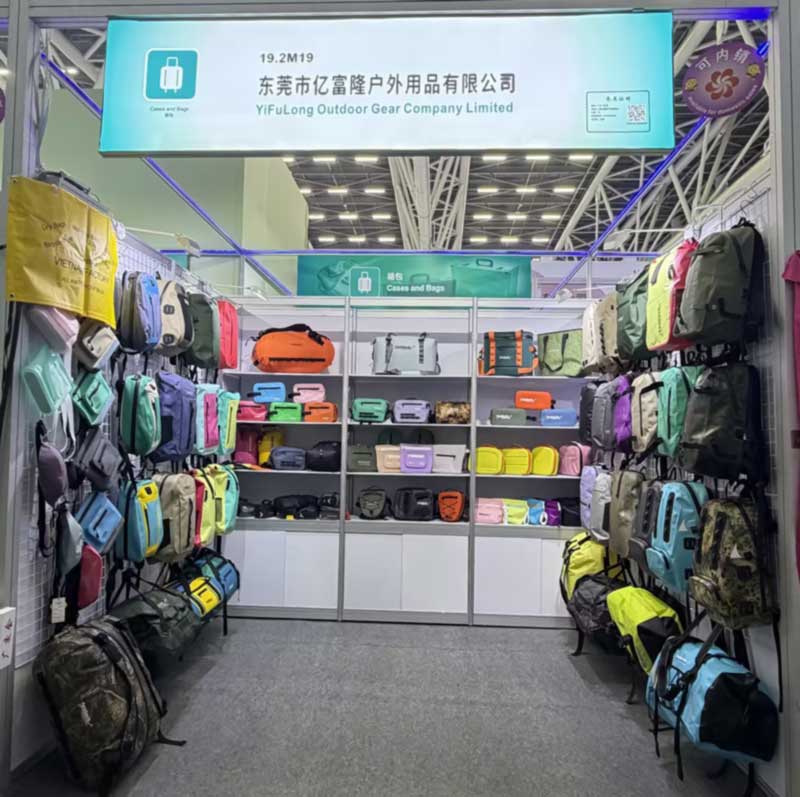
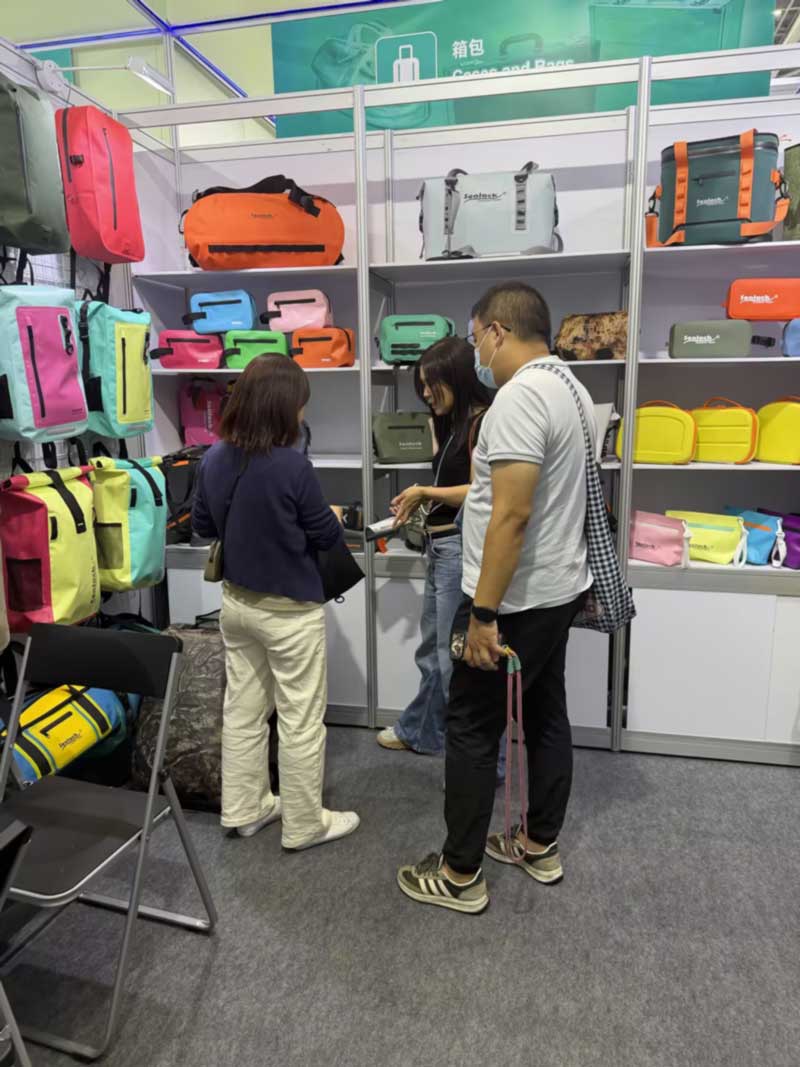
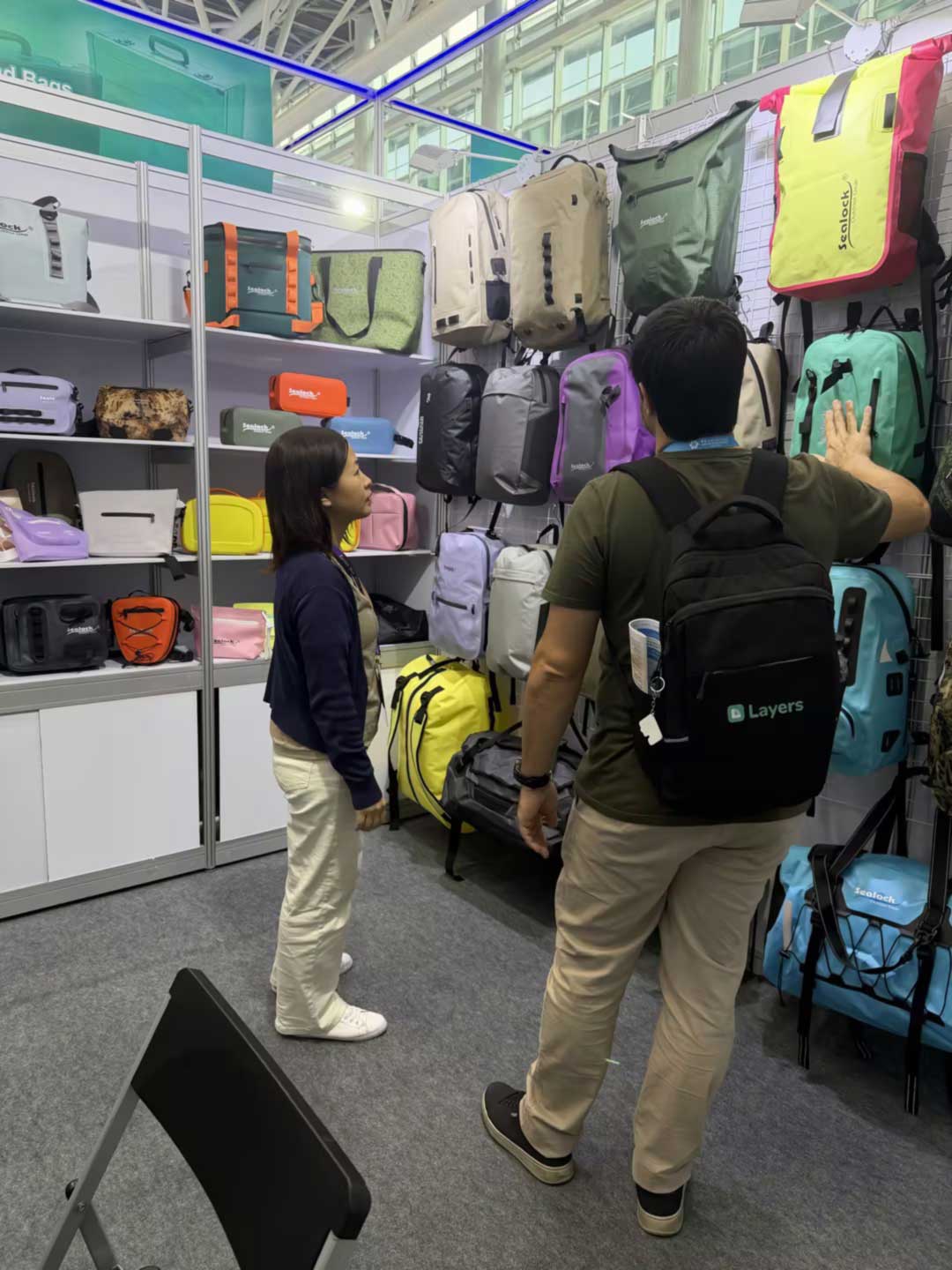
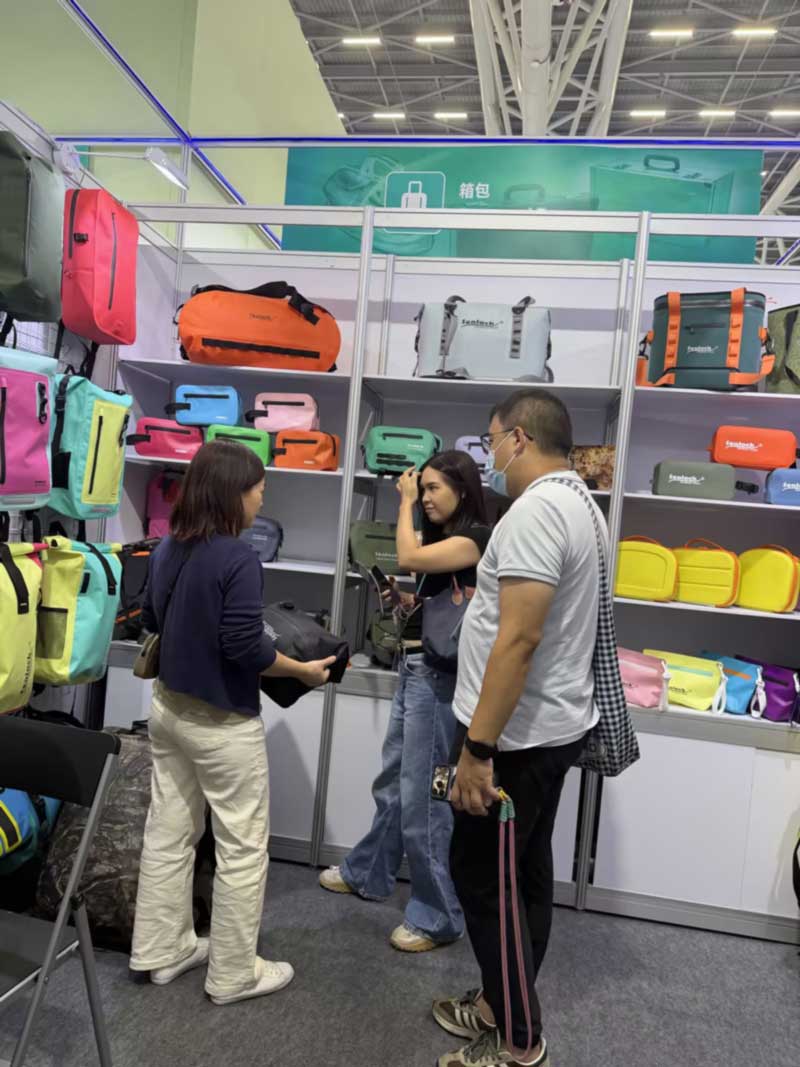
On 30 October 2026 our stand at the 140th Canton Fair was still running at full capacity — booth 19.2M19 in the Cases and Bags section, a corner unit roughly three metres deep with wall grids on both sides and three shelf bays across the back, carrying somewhere around two hundred finished products.
To a casual visitor a stand that dense looks like a waterproof bag factory emptying its sample room onto a wall. It is not. Every product on that wall was answering a sourcing question that brand owners, importers and private-label buyers ask us by email all year and that email answers badly. This is what the stand was showing about our OEM and ODM manufacturing capability, and how to read any waterproof bag supplier's booth the same way.
Booth 19.2M19, Cases and Bags, 30 October 2026. Around two hundred products across two wall grids and three shelf bays.
The colour wall is a materials statement, not decoration
The left-hand grid ran mint, lilac, powder blue, hot pink, coral, lemon, sage, graphite and black, with the same two or three silhouettes repeating across the range. Buyers walking past read that as a cheerful display. For anyone evaluating a custom waterproof backpack manufacturer it is the most information-dense object on the stand.
TPU laminated and PVC coated waterproof fabric is not piece-dyed like a woven textile. The colour sits in the film or the coating, so every colourway is a separate material lot with its own minimum, its own lead time and its own behaviour under a high-frequency welding electrode. A dry bag factory that can show nine colours of the same body, welded cleanly, in finished form, is stating three things at once: that it holds or can source that range in coated stock, that its welding window has been proven on each of them, and that the pale colourways — which scorch visibly at the seam edge where black hides everything — sit inside its process capability rather than outside it.
The same wall quietly answers the Pantone question that follows every private-label enquiry. Custom colour matching on coated fabric is real, but it is a fabric-run commitment rather than a swatch selection, so the practical path for most OEM programs is to start from a range the factory already runs and move from there. Seeing that range in the flesh is what makes the conversation concrete.
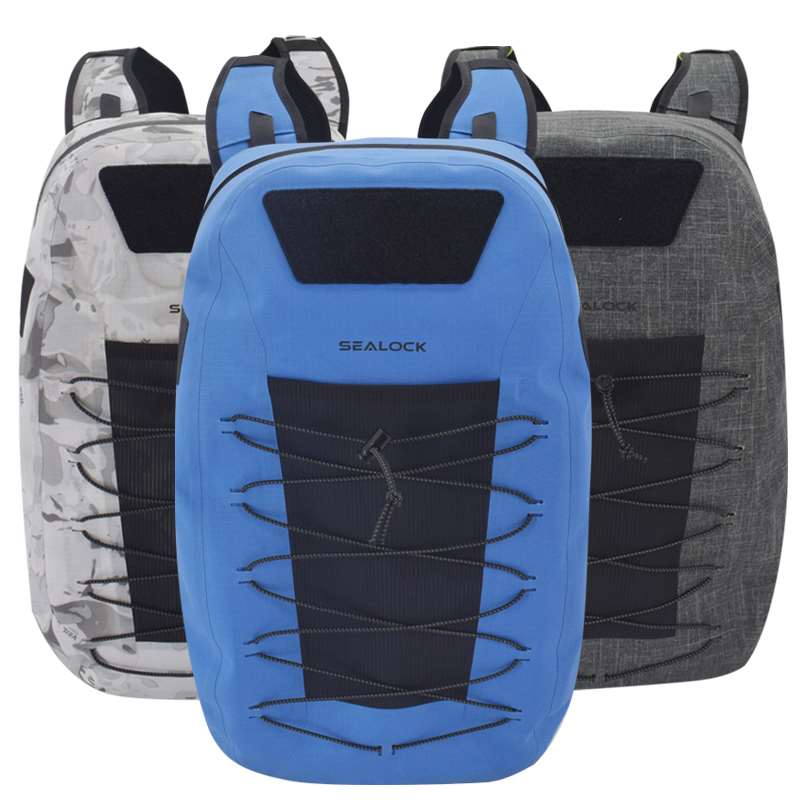
Nine colourways of a handful of silhouettes. Each colour is its own coated-fabric lot and its own welding window.
Both production lines were on the wall at once
A persistent assumption about us — and it surfaces at every trade show — is that Sealock is purely a high-frequency welding house and that anything sewn must be subcontracted. The stand was arranged to contradict that without anyone having to say it.
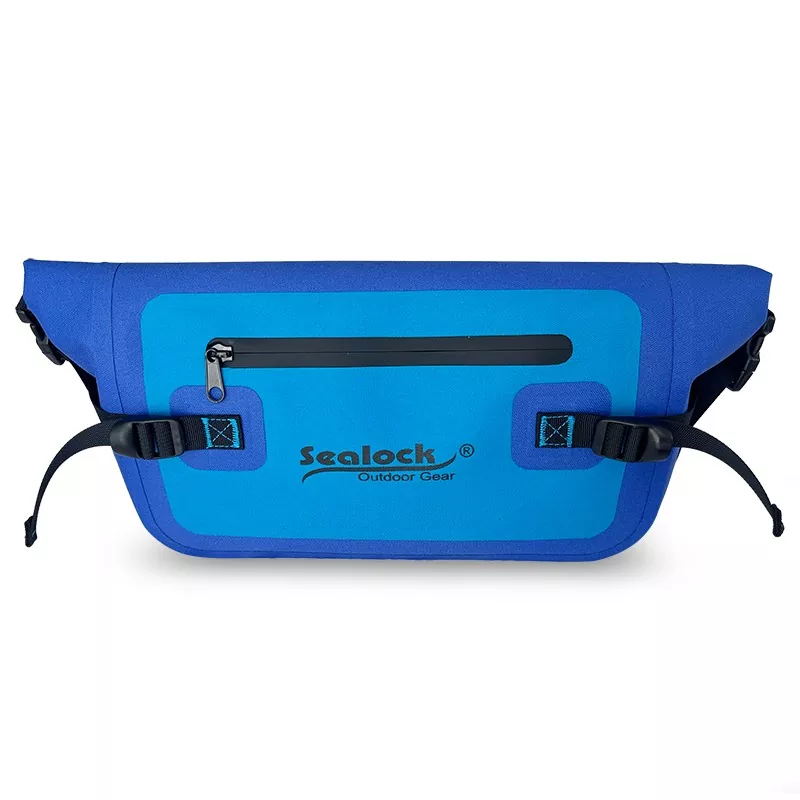
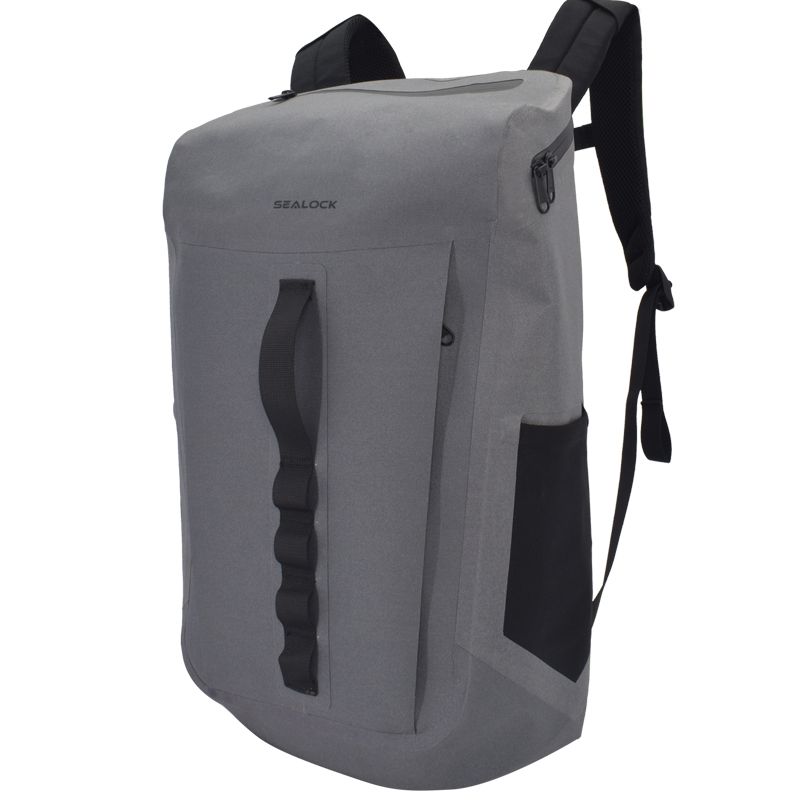
The RF welded work was obvious: roll-top waterproof backpacks, welded duffel bags, moulded-face pouches with no stitch line anywhere on the body, hard-shell camera and tech cases. Placed deliberately alongside were the sewn and bound constructions — harness assemblies, bound-edge daypacks, the camouflage hunting packs at each corner, printed and patterned bodies. Both production lines are in-house at our Dongguan factory, and on most products they interleave: welded shell, base and anchor patches, sewn harness, binding and reinforcement.
The division is not a matter of preference. Welding is correct wherever a needle hole would become a water ingress path or a tear point under load — shells, bases, strap anchor platforms. Sewing is correct wherever the joint is textile-to-textile, carries no water-tightness duty and needs the shear strength and repairability a bar tack gives. Putting both capabilities on the same wall is simpler than arguing the point in a quotation.
The moulded hard cases in the middle bays make a related point about manufacturing capability. A hard case and a soft roll-top dry bag feel like different industries to a brand, but on our floor they come off adjacent stations with different dies. What a buyer sees as a product category, a factory sees as tooling.
Welded roll-tops and moulded cases on the shelves; sewn harness packs and camo bodies on the floor and grids.
The yellow banner in the top corner
Hanging above the left grid was a plain yellow banner: dry bags, motorcycle bags, bicycle bags, Vietnam factory, all waterproof bags. It is the least designed object on the stand and it generated more conversations than anything else on it.
Importers in North America, Europe and Australia are not asking about Vietnam out of curiosity. They are asking whether a genuine second origin exists, whether it runs the same specification, and whether moving origin for tariff reasons means re-approving a product they already sell. Our answer is that the Ho Chi Minh City facility runs the same standards, the same process documents and the same signage as Dongguan — the quality banner above our packing floor is printed in Chinese, Vietnamese and English for exactly that reason — so an order can move between China and Vietnam on tariff grounds without the specification being renegotiated. That is a materially different claim from "we also have a Vietnam option", and it is the one worth testing with any dual-origin supplier.
What visitors actually asked at the booth
Across the week the questions were remarkably consistent, and they were the same three our sales team reports year-round: what is the minimum order quantity, what does it cost, and can it carry our logo.
Two of the three do not need a meeting. MOQ on most models is 300 pieces, with some running at 500 — that floor is set by die setup, first-piece approval and line changeover across the twenty-odd welding stations a single backpack passes through, not by a commercial preference. Sample lead time runs 7 to 15 days, and where a program lands in that range is almost entirely a tooling question: cutting and proving a die takes days, assembling the sample takes hours. Mass production runs 30 to 45 days, FOB Guangdong. Logo and branding options cover silk screen, welded patch, heat transfer and custom zipper pulls, and on a welded product the welded patch is usually the right answer, because it is the only method that cannot peel at the edge after a season of abrasion.
Price is the question a booth genuinely cannot answer, and experienced buyers already know why. Capacity, material weight, closure type, hardware specification, colour count and order quantity each move the number more than the silhouette does. What a stand can do is let a buyer hold three constructions and work out which of those variables they actually care about — which is why the useful part of a show visit is handling product, not collecting catalogues.
The useful part of a booth visit: handling the construction rather than collecting a catalogue.
What was not on the wall
Two categories that take a growing share of our production were barely represented, and that is worth saying plainly.
The first is compression. Vacuum and compression bags have been our fastest-rising enquiry line this year, and they display badly — a compression bag on a shelf is a flat black rectangle, and its entire value lies in something a shelf cannot show. The relevant products are the valve-only travel compression bag in three sizes, the hand-pump version that ships as ordinary air cargo with no battery documentation, and the version with the electric pump welded into the body panel. The test that matters on all three is the one we run in production and ask buyers to repeat on arrival: evacuate a unit, stand it for twenty-four hours, and see whether it has relaxed.
The second is airtight travel luggage. We manufacture the welded, valve-equipped IPX7 travel bag for Ekster, and that construction — welded shell, airtight zipper, integrated air valve, every unit inflation-tested before it leaves the line — is a different engineering problem from the roll-tops filling the booth wall. Air finds an under-welded seam that water never would, which is why that program is 100% tested rather than sampled.
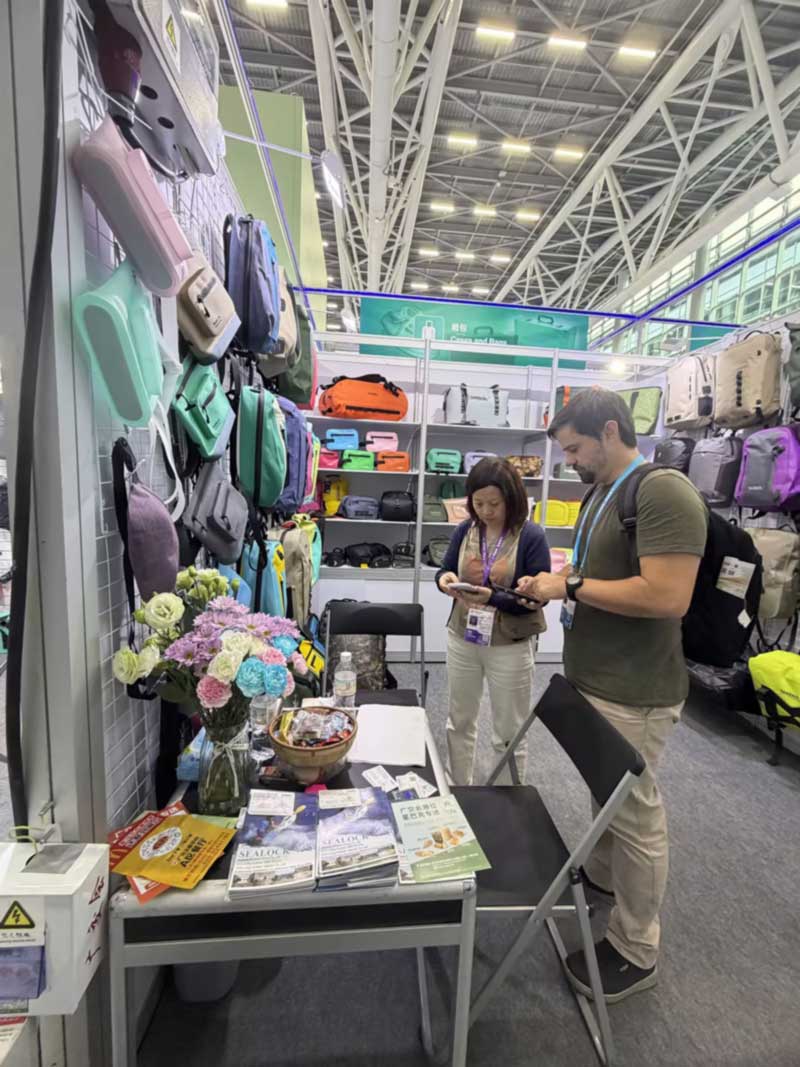
Catalogues and contact exchange at the table. Most of what follows a show happens here rather than at the wall.
If you are evaluating a waterproof bag supplier at a show
The questions that get the most out of fifteen minutes at any waterproof bag stand are narrow ones. Ask which products on the wall were high-frequency welded and which were sewn, and why each was built that way. Ask to see a pale colourway seam edge close up. Ask what the waterproof rating is verified against — a roll-top closure supports a heavy rain and water-jet protocol, while an immersion claim belongs to an airtight closure verified by full water immersion of two hours or more, and a supplier quoting the same number for both constructions is quoting marketing rather than testing. Ask what the minimum order quantity is and why it is that number.
Sealock (YiFuLong Outdoor Gear Co., Ltd.) has manufactured welded and sewn waterproof gear since 2001, with high-frequency welding and in-house sewing running side by side at our Dongguan factory in Guangdong and at our facility in Ho Chi Minh City, Vietnam. We develop OEM and ODM programs from a sketch, a competitor sample or a target specification sheet, and the most demanding custom requirements can be met, though genuinely new structures carry a longer sampling cycle. Standard terms are FOB Guangdong, 7 to 15 days for sampling, 30 to 45 days for mass production, and MOQ from 300 pieces on most models, with IQC, IPQC and OQC checkpoints through every order and third-party SGS or QIMA inspection available on request. More on the process itself is collected under our RF welding coverage, and material selection under the TPU waterproof material guide.
We use cookies to offer you a better browsing experience, analyze site traffic and personalize content. By using this site, you agree to our use of cookies.
Privacy Policy
 English
 Español
 Português
 русский
 Français
 日本語
 Deutsch
 tiếng Việt
 Italiano
 Nederlands
 ภาษาไทย
 Polski
 Svenska
 magyar
 Malay
 বাংলা ভাষার
 Dansk
 Suomi
 हिन्दी
 Pilipino
 한국어
 Türkçe
 Gaeilge
 العربية
 Indonesia
 Norsk
 تمل
 český
 ελληνικά
 український
 Javanese
 فارسی
 தமிழ்
 తెలుగు
 नेपाली
 Burmese
 български
 ລາວ
 Latine
 Қазақша
 Euskal
 Azərbaycan
 Slovenský jazyk
 Македонски
 Lietuvos
 Eesti Keel
 Română
 Slovenski
 मराठी
 Srpski језик