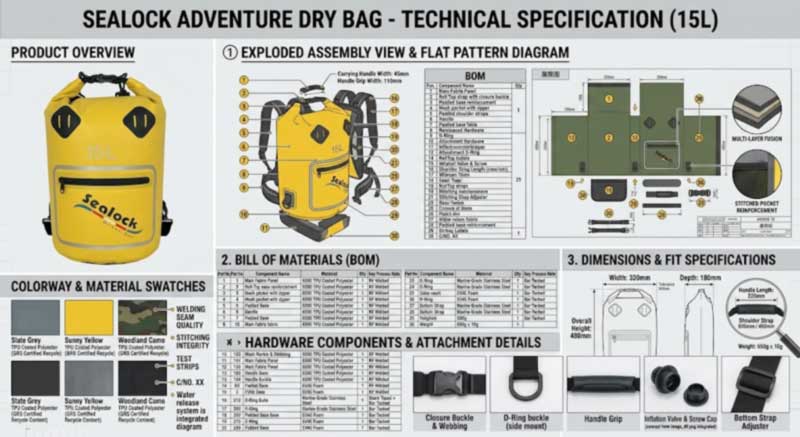
Sealock is a waterproof bag manufacturer and OEM supplier. A tech pack is not a mood board or a sketch — it is the document that lets a factory build your product without guessing, and the quality of it decides whether you approve a sample in two rounds or five. Standard tech pack templates are written for garments and conventional bags, and they are a reasonable starting point. But a welded waterproof bag needs five sections that no garment template contains, and leaving them out is why waterproof projects stall at sampling. This guide covers both layers.
The Standard Sections, Briefly
Section
What it must contain
Cover page
Style name and number, date, version number, contact
Flat sketches
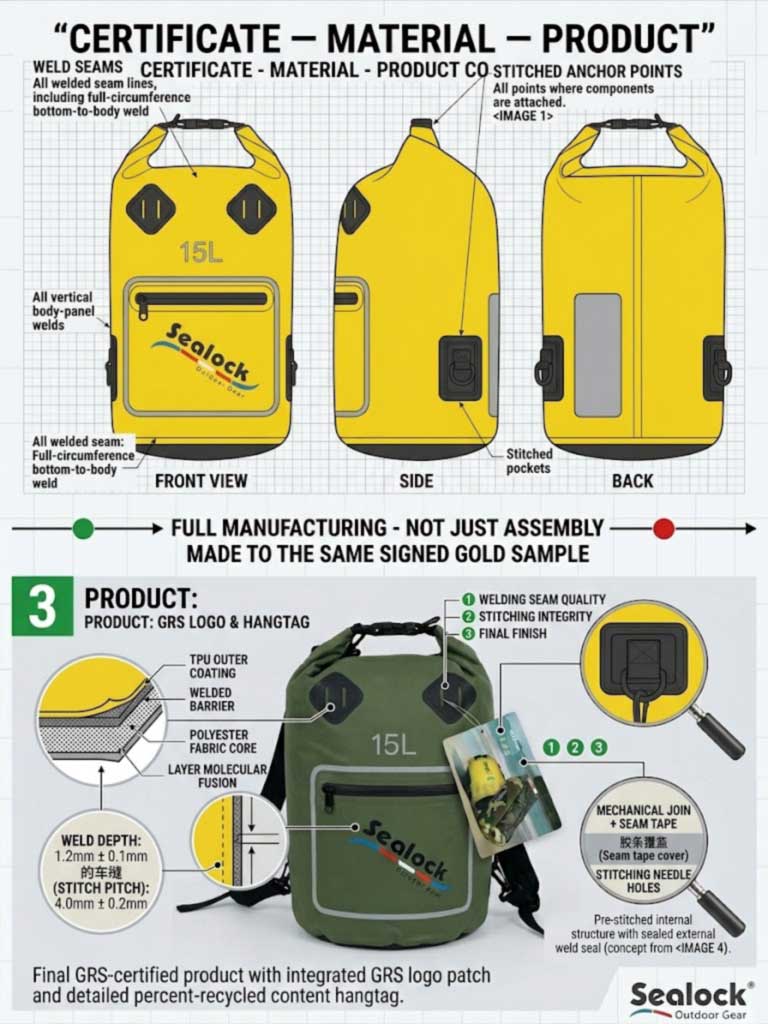
Front, back and side, with callout lines to every seam, pocket, closure and hardware position
Measurement chart
Every point of measure, in cm and inches, each with a defined measuring point and a tolerance
Bill of materials
Every component with composition, weight, thickness, colour reference, size and quantity per unit
Construction notes
How each part is joined and finished
Colourways
Pantone or signed colour card per component, not just "black"
Branding
Logo artwork, method, size and exact placement; labels and hangtags
Packaging
Polybag, box, barcode, carton quantity and carton marking
Two notes on the basics before the waterproof-specific material. Front view only is the classic beginner error — a factory cannot cut a single pattern piece without the full construction picture. And define the measuring points: is the height measured with or without the handle? An undefined point of measure produces a sample that is technically correct and wrong.
Anything the factory would otherwise have to assume belongs in the document.
Addition One: State the Rating as a Number and a Test
"Waterproof" is not a specification. It is the word that causes more disputes in this category than any other, because two parties can both use it honestly and mean different things.
Write it as three lines:
The rating — for example IPX7, which is defined as immersion at 1 metre for 30 minutes. If you specify IPX8, state the depth, because IPX8 is continuous immersion beyond 1 metre to a depth the manufacturer declares. An IPX8 claim with no depth attached cannot be verified.
Where it is verified — on the finished bag, not inferred from a fabric hydrostatic figure. A compliant fabric does not certify an assembled product.
Per compartment — and this is the one buyers miss. If the design has a sealed main compartment and a front zip pocket, they will not perform the same. Rate each separately in the tech pack, and carry that rating into your listing copy. It prevents the review that says the bag leaked when the main compartment stayed dry.
Addition Two: A Join Schedule, Seam by Seam
A garment tech pack calls out stitch type per seam. A waterproof tech pack has to call out something more fundamental first: the joining method. Every seam in the product is one of three things, and the document should say which:
High-frequency welded — the sealed barrier.
Sewn — load-bearing joints, applied to flat panels before welding.
Sewn then taped — where structural stitching must remain exposed.
Then add one construction note that governs the whole build, because it is not obvious to anyone coming from sewn production: structural stitching precedes welding. Stitching after welding perforates a finished seam and renders it pervious to water. Putting that sentence in the tech pack removes any ambiguity about sequence.
Addition Three: A Penetration Schedule
This section does not exist in any standard template and it is the one that most affects tooling cost and lead time. Every feature that passes through the sealed shell is a penetration, and each needs its own line: valve, transparent window, airtight zipper, magnet housing, pump unit, drain, and every load anchor.
For each, specify the position and the sealing method. Two reasons this matters practically:
Penetration positions affect the weld map and therefore the die. Moving a valve after tooling exists is expensive; deciding it before tooling is free.
Each penetration is a separate process window with its own parameters and its own inspection, which is part of how the quotation is built.
Addition Four: Materials Specified for Weldability
A BOM that says "waterproof fabric" is not a BOM. Vague descriptions — "strong fabric", "good zipper", "premium material" — force the factory to guess, and the guess is what you receive. For a welded product, specify four separate lines rather than one:
Base fabric and denier — 420D, 500D, 840D; nylon or polyester base.
Coating type, weight and sides — PVC tarpaulin, TPU-coated, or TPU laminated on both faces. Note that coated fabric needs a minimum coating thickness of roughly 3–5 mil to weld reliably.
Weldability — the material must be a polar thermoplastic. PVC, TPU, nylon, PET and EVA weld; polypropylene and polyethylene do not, and certain rubber-based coatings such as Hypalon can only be sewn or bonded.
Compatibility of attached components — valve flange, zipper tape and window film should be compatible with the inner surface, because bonds between similar materials are substantially more reliable than adhesive joints between dissimilar plastics.
Also state your destination market so compliance is designed in rather than discovered: for EU, UK or California, specify phthalate-free and REACH-compliant formulations in writing and require the test report against your actual specification.
Which seams are welded, which are sewn, and where the barrier is pierced — the three drawings that matter.
Addition Five: Load Points With a Tested Load
"Reinforced straps" leaves the most important decisions to the floor. For every load-bearing anchor — shoulder harness, hip belt, haul handle, D-ring, lash tab — specify:
Stitch architecture — box-X where there is room, bar-tack where there isn't. Note that bar-tack density should be set to the load rather than maximised, since over-tacking weakens the base fabric.
Thread — bonded nylon or bonded polyester, Tex 40 or heavier.
Stitches per inch and webbing insertion depth.
The load each anchor must hold, and whether it is tested statically or cycled. For attachment hardware, cycling matters more — a tab that holds a static pull can still fail under repeated dynamic loading.
Tolerances: Realistic, Not Decorative
General practice is around ±5 mm for soft bags and ±3 mm for structured ones, but the useful principle is that tolerances should not be uniform across a product. Logo position, paired handle attachment and closure alignment need tighter control than the overall width of a soft sack. Two cautions:
Don't add arbitrary tolerances to make the document look technical. Discuss realistic production variation with the factory after the first sample and set them from evidence.
Welded work runs tighter on cutting. A welded seam has no seam allowance to absorb drift, so panel accuracy is controlled more closely than in sewn production — worth knowing when you set expectations.
Put the Test Plan in the Pack
The single most useful addition a waterproof buyer can make, because the test method has to be agreed before bulk production — it determines weld width, closure and fabric, and you cannot test a bag into being submersible after it is built. Specify:
Which tests apply — real water submersion, air-inflation bubble test, negative-pressure leak determination, load cycling.
Whether they run on production samples or on production units. A perfect pre-production sample proves the design; units drawn from the run prove the batch.
AQL level, and at what packing percentage the final inspection runs.
What evidence you receive — inspection photographs and records, and whether SGS or QIMA inspection is arranged.
That a signed gold sample will be held by both parties. Without one, an inspection has nothing objective to measure against.
The Mistakes That Turn Two Sample Rounds Into Five
Reference images with no measurements, materials or construction notes. This forces the factory to guess, and guessing is what produces the sample you didn't want.
Front view only. No side or back means no pattern.
Undefined measuring points. Height with or without the handle changes the answer.
Vague BOM entries. "Good zipper" is not specifiable; "sealed waterproof zipper, moulded tooth chain, full length" is.
No per-compartment rating. The source of most "it leaked" complaints on products where the main compartment was fine.
Version control failures. Old drawings, a newer BOM and outdated logo artwork can produce an incorrect sample even when every individual file looks professional. Number every version and state which supersedes which.
Forgetting packaging and labels. The bag can be perfect while the barcode, origin label, care card or carton mark is wrong.
What Happens When the Pack Arrives
A complete pack shortens development because it removes the interpretation step. Our process from that point: we review the drawing for weldability and flag any geometry, material or penetration that will cause problems, quote unit price with tooling separately where a bespoke die is needed, then sample — typically two counter-sample rounds — and sign a gold sample held by both sides before bulk. Sampling runs 3–15 days depending on complexity, production 20–45 days after approval, from Dongguan or Ho Chi Minh City.
If you don't have a tech pack, a reference sample plus your intended use, capacity, target price and market is enough to start; we will build the specification with you rather than guess at it.
A worked example of per-compartment rating and a window penetration
300
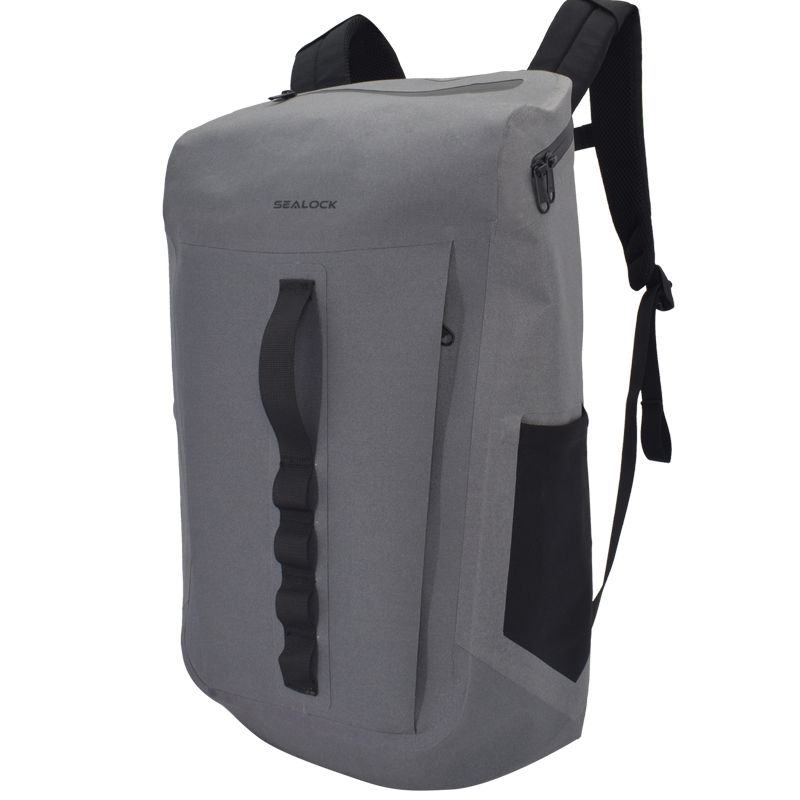
SL-J033 Waterproof Expedition Pack — 45/55/65L; TPU on 420D nylon; IPX8 rubber sealing strip, fold-over flap and compression strap; padded harness, sternum strap, padded hip belt, haul handle.
Load-point specification and a declared-depth rating
300–500
SL-P1133 Compression Bag with Hand Pump — 48×29×10 cm, 13.9L; screw-seal valve with threaded cap and gasket; welded clear TPU window; sealed waterproof zipper.
A penetration schedule — valve, window and zipper in one body
300
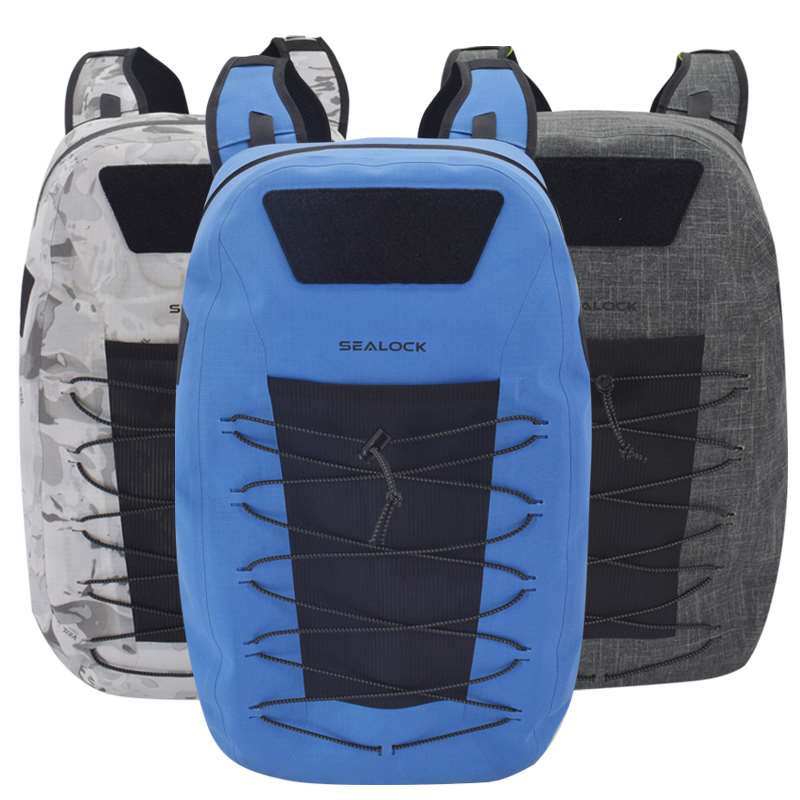
SL-E102 Dry Backpack — 15L / 20L / 30L with published dimensions per size; 500D PVC mesh; custom colours and sizes.
A size ladder on shared tooling — how to spec three SKUs efficiently
300
FAQ: Waterproof Bag Tech Packs
Q: What does a waterproof tech pack need that a normal one doesn't?
A: Five things — a rating stated as a number with a test method and per compartment, a join schedule saying which seams are welded and which sewn, a penetration schedule listing everything that passes through the shell, materials specified for weldability, and load points with a tested load.
Q: How should I write the waterproof requirement?
A: As a rating, a verification point and a scope. For example: IPX7, verified on the finished bag, main compartment only, with the front pocket rated water-resistant. That sentence prevents most disputes in this category.
Q: Why does the penetration schedule matter so much?
A: Because valve, window, zipper and anchor positions affect the weld map and therefore the die. Deciding them before tooling costs nothing; moving them afterwards is expensive.
Q: What tolerances should I use?
A: Roughly ±5 mm for soft bags and ±3 mm for structured ones, tightened where alignment matters — logo position, paired attachments, closure alignment. Don't apply arbitrary tolerances uniformly to look technical; set them with the factory after the first sample.
Q: We don't have a tech pack. Can we still start?
A: Yes. A reference sample, your intended use, capacity, target price and destination market are enough to begin, and we build the specification with you. What we won't do is guess — guessing is what costs sample rounds.
Q: What is the most common reason a project needs extra sample rounds?
A: Version control. Old drawings, a newer BOM and outdated artwork can produce an incorrect sample even when every file looks professional. Number every version and state clearly which supersedes which.
Talk to the Factory
Send your tech pack, sketch or reference sample for a weldability review and a line-by-line quotation, at info@sealock.com.hk or +86-769-82009361. Over twenty years of high-frequency welding and industrial sewing under one roof, in-house pattern and die development, dual China–Vietnam production, and a full customer inspection procedure on every shipment.
We use cookies to offer you a better browsing experience, analyze site traffic and personalize content. By using this site, you agree to our use of cookies.
Privacy Policy
 English
  Español
  Português
  русский
  Français
  日本語
日本語  Deutsch
  tiếng Việt
  Italiano
  Nederlands
  ภาษาไทย
  Polski
  Svenska
  magyar
  Malay
Malay  বাংলা ভাষার
  Dansk
Dansk  Suomi
Suomi  हिन्दी
  Pilipino
  한국어
한국어  Türkçe
  Gaeilge
  العربية
  Indonesia
  Norsk
Norsk  تمل
تمل  český
český  ελληνικά
  український
  Javanese
  فارسی
فارسی  தமிழ்
தமிழ்  తెలుగు
  नेपाली
  Burmese
  български
  ລາວ
ລາວ  Latine
  Қазақша
  Euskal
  Azərbaycan
  Slovenský jazyk
  Македонски
  Lietuvos
  Eesti Keel
  Română
  Slovenski
  मराठी
मराठी  Srpski језик