Sealock is a waterproof bag manufacturer and OEM supplier. Most supplier pages list certifications as a row of logos, which tells a buyer almost nothing. Each of these documents answers a different question, several are routinely misread, and one of the most common claims in the industry — "we are BSCI certified" — is not how that scheme works at all. This guide sets out what each certificate actually proves, where the honest mistakes happen, and how to verify any of them, including ours.
The Distinction That Frames Everything
Before the individual schemes, one structural point. Certification tells you whether a factory is qualified to make compliant products on paper. It does not tell you whether it is doing so with your order today. Certification checks a management system; verification checks a shipment. They are complementary, and relying on only one creates a blind spot that surfaces after the goods are packed.
So the correct use of a certificate is as a qualification filter at supplier selection, paired with inspection at production. A factory with perfect paperwork and no inspection regime is not a safe supplier, and a certificate has never caught a bad batch.
Certificates qualify a factory. Inspection qualifies a shipment. You need both.
What Each One Actually Certifies
Certificate
What it proves
What it does not prove
ISO 9001
A documented quality management system exists and is maintained
That any particular product or batch is good
amfori BSCI
Working conditions assessed across 13 performance areas, each graded
Product quality; and it is not a pass/fail certificate — see below
SMETA
An ethical trade audit against either 2 or 4 pillars
Anything about the product; and 2-pillar is materially narrower than 4-pillar
GRS
The facility is set up to handle certified recycled material
That your order used it — see the Scope vs Transaction point below
Higg
Self-assessed and verifiable environmental and social performance data
A pass mark; it is a measurement framework, not a threshold
SCAN
Supply chain security and facility controls
Labour conditions or product compliance
REACH, EN71, RoHS, Prop 65
A tested product meets chemical limits for a market
Anything about the factory; and the report applies to the tested specification only
Bureau Veritas / SGS reports
A specific test was performed on a specific sample
Ongoing conformity of later production
The Most Misused Claim: "BSCI Certified"
This is worth knowing precisely, because it is the single most common misstatement in supplier marketing. amfori BSCI does not issue a pass/fail certificate. Factories receive a score, graded A through E. The audit covers 13 performance areas, each graded, producing an overall rating.
Which means a claim of "BSCI compliant" is incomplete without the grade. What to ask for:
The amfori ID or audit ID, and the audit date.
The grade — A or B audits are valid for two years; a lower grade triggers a shorter follow-up cycle, which is itself a signal worth asking about directly.
Any open corrective actions that could affect approval timing.
Access as a buyer on the amfori platform, which a genuine supplier can grant.
A related point most buyers don't know: under amfori BSCI rules, only about one-third of a member's suppliers must be audited within a three-year window. A brand's membership therefore does not mean every factory in its chain is covered — and the same logic applies when you assess a supplier.
SMETA: Two Pillars or Four
SMETA is an audit methodology rather than a certification, and it can be conducted against two pillars or four. Two-pillar covers labour standards and health and safety. Four-pillar adds environment and business ethics. The difference is substantial, and a supplier stating simply "SMETA audited" has told you nothing about which scope was applied.
Sealock holds SMETA 4-Pillar, which is the fuller scope. That is a specific claim we would expect a buyer to verify rather than accept.
GRS: Where Honest Buyers Get Caught
Recycled content carries two traps, and they catch careful people.
Trap one — the two thresholds. Recycled content requirements differ by claim type: 20% is the floor for a business-to-business claim, while a product needs 50% recycled content to carry the consumer-facing GRS label. Mixing these up is described as the most common honest mistake buyers make, and it matters because your packaging and marketing copy sit on the wrong side of a legal line if you get it wrong.
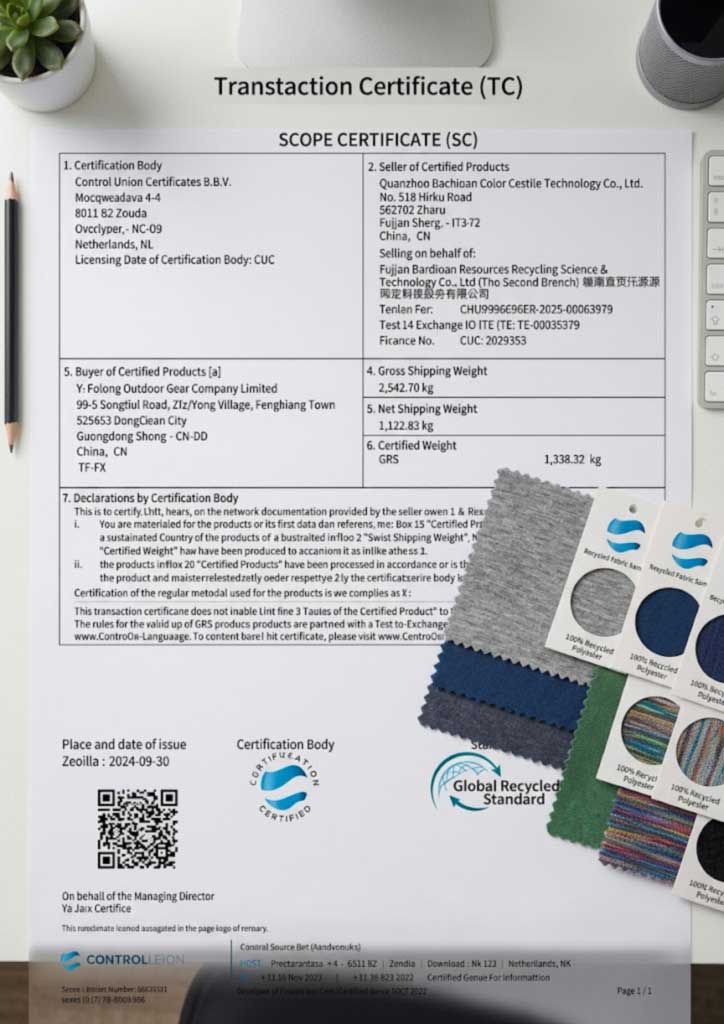
Trap two — Scope Certificate is not Transaction Certificate. A Scope Certificate proves the facility is set up to handle certified material. It does not prove your specific order used it. The document that links a certified material to a particular shipment is the Transaction Certificate, issued per shipment. Ask for the Scope Certificate and the Transaction Certificate, not one instead of the other. Scope Certificates also require annual renewal — a GRS Scope Certificate is valid for twelve months before a fresh audit is required.
The correct brief is therefore specific: which component is covered, whether the material supplier and product route fit the certificate scope, and what evidence supports the claim you intend to print.
The Scope Certificate qualifies the factory. Only the Transaction Certificate covers your shipment.
Factory-Level and Product-Level Answer Different Questions
A social audit is not a product claim. A BSCI or SMETA file supports supplier qualification; it says nothing about whether a dry bag is free of restricted phthalates. Conversely, a REACH test report says nothing about working conditions.
For a waterproof bag programme the practical split is:
Factory level — ISO 9001, BSCI, SMETA, Higg, SCAN. Use these to qualify the supplier.
Product level — Bureau Veritas, SGS, REACH, EN71, RoHS, Prop 65. Use these to clear your specification for your destination market.
Material level — GRS Scope and Transaction Certificates, where a recycled claim is being made.
And one that catches PVC programmes in particular: if you sell into the EU, UK or California, specify phthalate-free, REACH-compliant formulations in writing and require the test report against your actual specification — not a generic report on a different article.
How to Verify Any of Them
Verification is straightforward, and a supplier's reaction to being asked is itself informative.
Request the full certificate PDF, never a screenshot or photo. It must show the certifying body's name, its accreditation number, the certificate number, and the exact scope.
Check the address matches the production site. Certificates sometimes cover a head office and not the facility that will make your goods — an important check for any group operating multiple plants.
Cross-check the registration number against an official registrar rather than accepting the PDF. Note that this changed recently: the International Accreditation Forum merged with ILAC into Global Accreditation Cooperation Incorporated on 1 January 2026, so accredited-certificate verification now runs through that platform rather than the former IAF CertSearch tool.
Use the scheme's own channel. For amfori BSCI, ask the supplier to share their status and add you as a buyer. For SMETA, ask them to share the audit report through the Sedex portal.
Contact the issuing body directly with the certificate number and supplier name if anything is unclear. Certification bodies generally respond within a few working days.
Red flags
Screenshots or photos offered instead of official PDFs with checkable numbers.
A certificate in a different company name, or for a different site.
An expired date, or a scope that doesn't cover your product category.
Missing certifying body, accreditation number or report number.
Reluctance to grant platform access or to allow third-party inspection.
Forged documents are a real problem in low-cost sourcing — logos are edited, certificates are reused from other factories, and expired copies are presented as current. For context on the underlying risk: QIMA reported that one in four inspected factories received a "red" urgent-remediation rating in 2023. Verification is not paranoia.
What Sealock Holds — and How to Check It
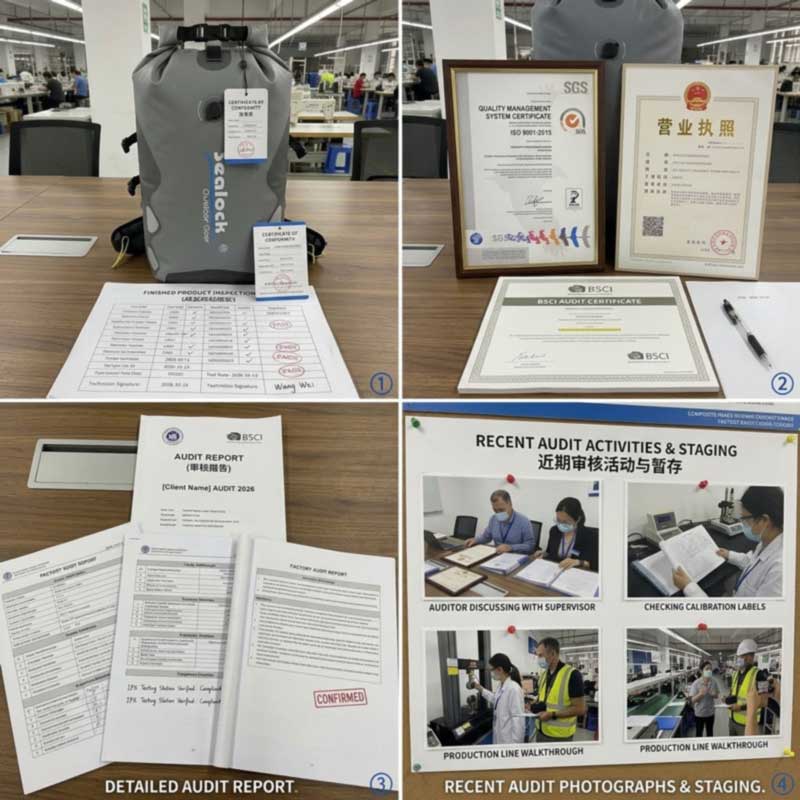
Factory level: ISO 9001, amfori BSCI, SMETA 4-Pillar, Higg, GRS, SCAN — covering both our Dongguan plant and our Ho Chi Minh City operations.
Product level: Bureau Veritas, SGS, REACH, EN71 and RoHS testing on relevant models, against the tested specification.
Verification: we provide full certificate PDFs with certificate numbers and scope, can share audit status through the relevant platforms, and welcome SGS or QIMA third-party inspection, your own inspector, or your visit in person.
Inspection, which is the other half: three-tier IQC/IPQC/OQC with ISO 2859 AQL sampling, real water-submersion batch testing, and the full customer inspection procedure — unboxing, vacuum extraction, a 24-hour static rest, and air-leak determination — on every shipment.
Test reports apply to the specification tested, so where a programme changes material, coating or hardware, the relevant testing is rerun against the new specification rather than carried over. Recycled (GRS) material routes are available with Scope and Transaction Certificate support.
FAQ: Certifications for Waterproof Bag Buyers
Q: Is "BSCI certified" a real status?
A: Not as usually stated. amfori BSCI grades factories A through E across 13 performance areas rather than issuing a pass/fail certificate. Ask for the amfori ID, the audit date and the grade, and ask to be added as a buyer on the platform.
Q: Does a GRS certificate mean my order is recycled?
A: No. A Scope Certificate shows the facility can handle certified material. The Transaction Certificate, issued per shipment, is what links certified material to your order. Request both. Also note that 20% recycled content is the B2B floor while 50% is required for the consumer-facing GRS label.
Q: Does ISO 9001 mean the product will be good?
A: It means a documented quality management system exists. It says nothing about a specific batch. Pair it with an inspection regime — certification qualifies the factory, inspection qualifies the shipment.
Q: How do I check a certificate is genuine?
A: Get the full PDF showing the certifying body, accreditation number, certificate number and scope; confirm the address matches the production site; and cross-check the registration against the official registrar — now Global Accreditation Cooperation, following the IAF and ILAC merger on 1 January 2026.
Q: What's the difference between 2-pillar and 4-pillar SMETA?
A: Two-pillar covers labour standards and health and safety; four-pillar adds environment and business ethics. "SMETA audited" without a pillar count is an incomplete claim. We hold 4-pillar.
Q: Which documents should I request before placing an order?
A: Factory level for qualification, product level against your destination market and your actual specification, and material level with Transaction Certificates if you intend to make a recycled claim — plus an agreed inspection plan, because none of the above catches a bad batch.
Talk to the Factory
For certificate documentation, audit platform access, or a third-party inspection plan, contact Sealock at info@sealock.com.hk or +86-769-82009361. Over twenty years of high-frequency welding and industrial sewing under one roof, auditable factory and product compliance, dual China–Vietnam production, and a full customer inspection procedure on every shipment.
We use cookies to offer you a better browsing experience, analyze site traffic and personalize content. By using this site, you agree to our use of cookies.
Privacy Policy
 English
  Español
  Português
  русский
  Français
  日本語
日本語  Deutsch
  tiếng Việt
  Italiano
  Nederlands
  ภาษาไทย
  Polski
  Svenska
  magyar
  Malay
Malay  বাংলা ভাষার
  Dansk
Dansk  Suomi
Suomi  हिन्दी
  Pilipino
  한국어
한국어  Türkçe
  Gaeilge
  العربية
  Indonesia
  Norsk
Norsk  تمل
تمل  český
český  ελληνικά
  український
  Javanese
  فارسی
فارسی  தமிழ்
தமிழ்  తెలుగు
  नेपाली
  Burmese
  български
  ລາວ
ລາວ  Latine
  Қазақша
  Euskal
  Azərbaycan
  Slovenský jazyk
  Македонски
  Lietuvos
  Eesti Keel
  Română
  Slovenski
  मराठी
मराठी  Srpski језик