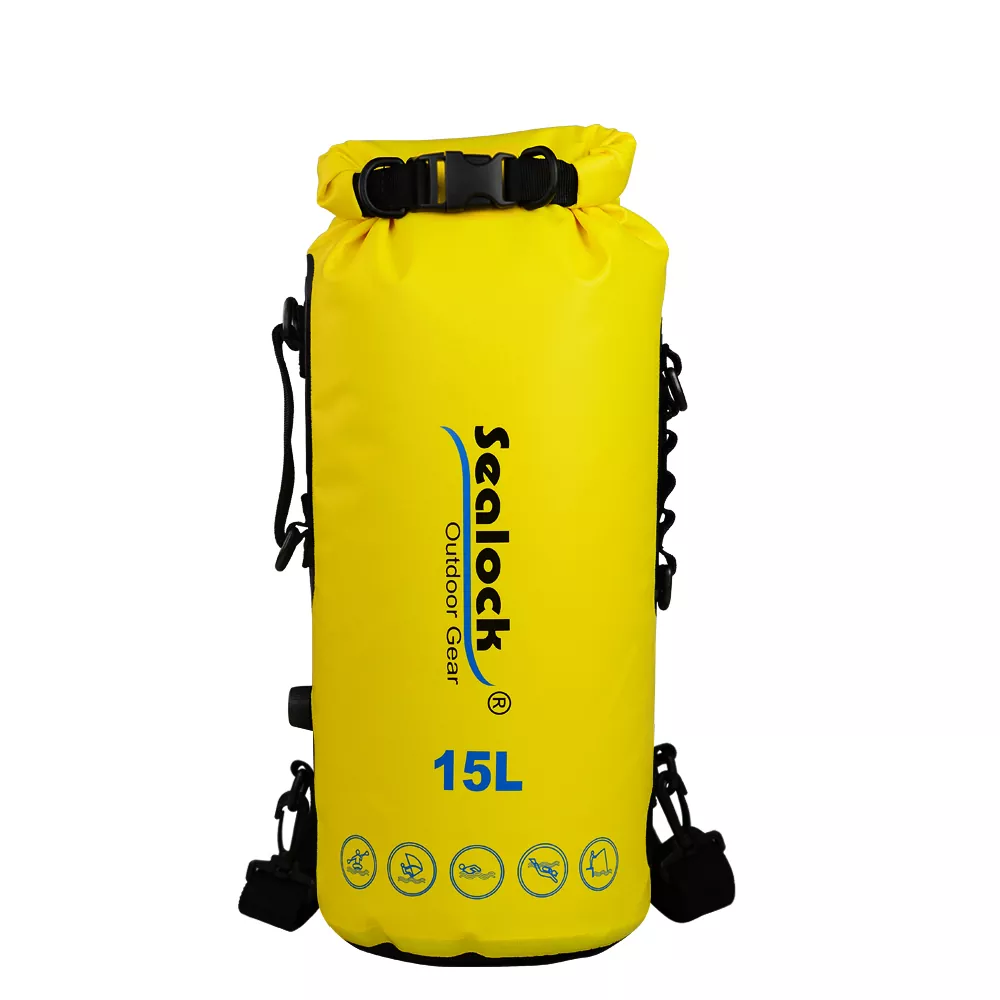
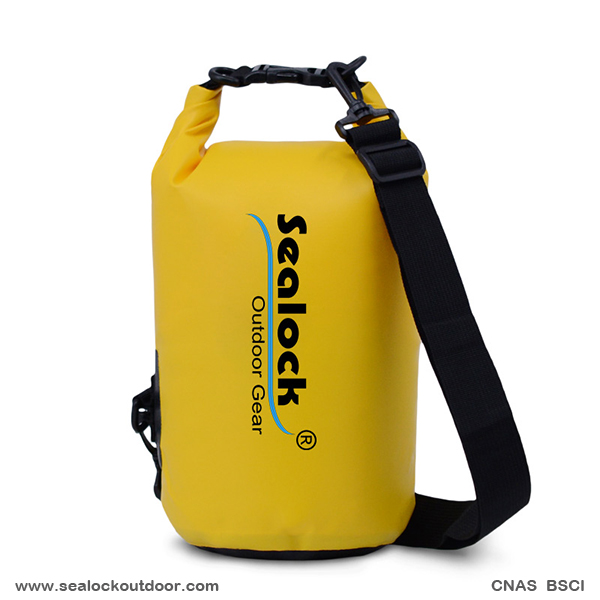
Sealock is a custom dry bag manufacturer and OEM supplier. Most sourcing guides stop at materials and minimums. This one goes onto the factory floor, because on a dry bag the production sequence is the product: a welded tube has no lining to hide a weak seam and no zipper to blame, so every decision about cutting tolerance, weld parameters, and the order operations run in shows up directly in whether the finished bag holds water. Understanding that sequence tells a buyer what to specify, what to ask to see, and where the real constraints on a custom design sit.
The Seven-Stage Line
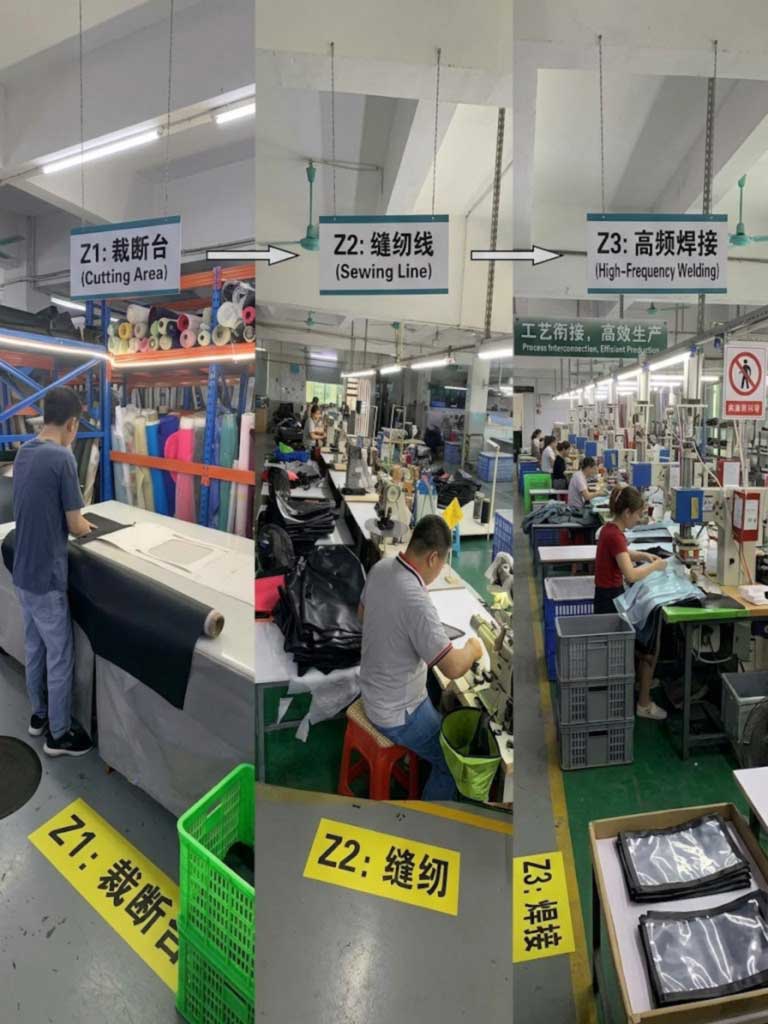
A dry bag moves through the plant in a strict linear flow, which is what keeps seams consistent across a large run:
Material staging and cutting — PVC or TPU rolls are staged and an automated cutting press stamps out panels to exact design dimensions.
Main-body sewing and pre-assembly — load-bearing elements are attached to the flat panels first.
Die setup — the custom copper electrode for that geometry is mounted and the weld pattern aligned.
HF welding — 27.12 MHz energy fuses the seams into one continuous waterproof skin with no needle penetration.
Sealing and structural assembly — roll-top closure alignment, stiffener bar binding, hardware fitting.
QC testing — three-tier inspection plus air-leak auditing.
Packing and shipping — polybag, carton, marking.
A strict linear flow — the reason a 5,000-piece run seals as reliably as the sample did.
The Detail Most Buyers Miss: Sewing Comes Before Welding
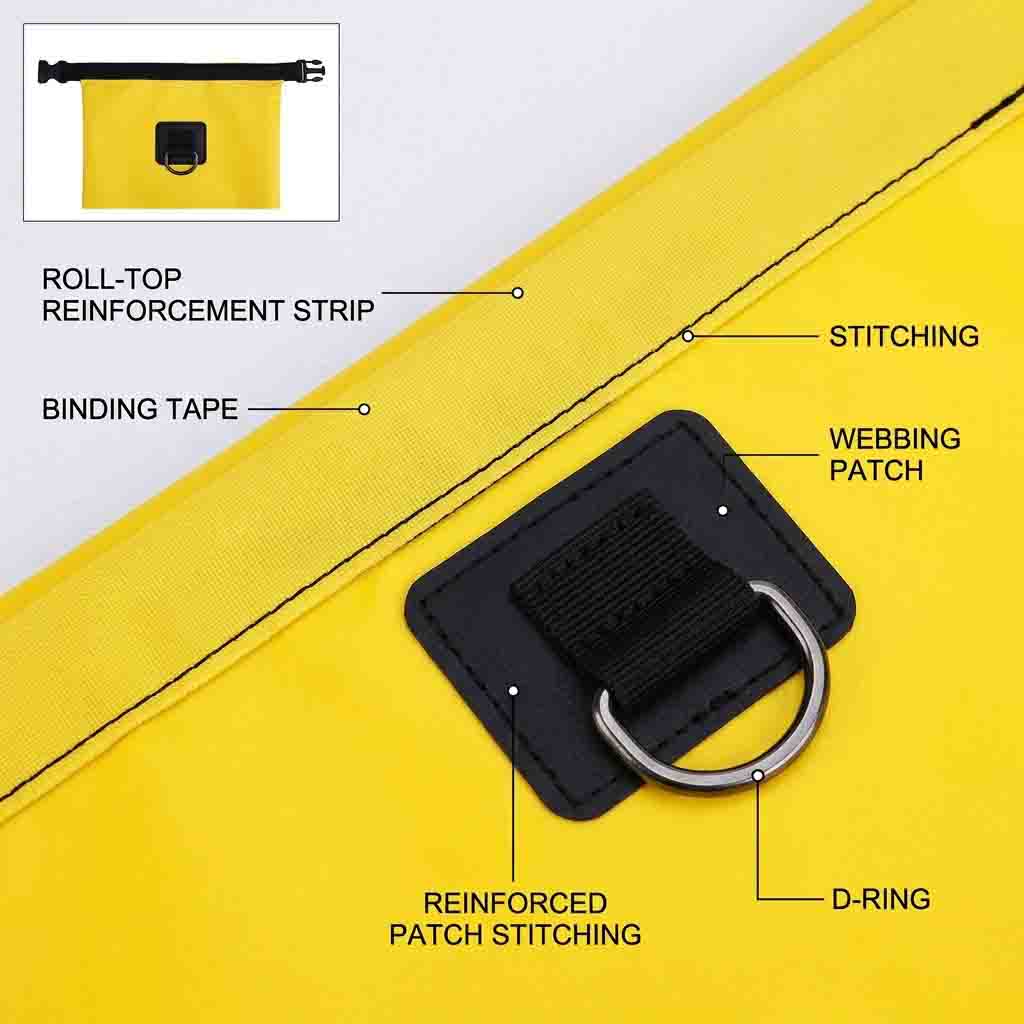
Here's the part of dry bag production that surprises people. A dry bag is not purely welded. Shoulder harnesses, heavy D-ring webbing patches, and external utility pockets are stitched onto the flat panels first, at high tension, before the body is sealed. The reason is structural: a strap that carries a loaded 30L bag has to transfer that force into the fabric across a stitched footprint. A purely welded attachment can peel under sustained shear; a stitched foundation doesn't tear or distort under real loading.
That creates the obvious question — doesn't stitching puncture the waterproof barrier? It does, and the sequence is what resolves it. The stitched foundations go on before the welding and sealing stage, so the perforated footprint is subsequently covered by the welded skin or by localised reinforcement, rather than being left as an open path. Where structural stitching must remain exposed on heavier products, the entire inside stitched perimeter is sealed with PU or PVC hot-air backing tape.
Two production points follow from this, and they're worth asking any supplier about:
Needle geometry matters. Standard round-tip needles punch oversized holes in laminated TPU or PVC and fray the inner mesh. Slim-profile wedge needles, run with digital thread-tension control, keep the material weave intact.
Tape sealing is parameter-critical. Hot-air seam sealing depends on exact calibration of air temperature, roller pressure, and feed speed. A drop of just 5°C and the adhesive fails to melt into the weave — which shows up later as delamination after cold-weather use, long after the goods have shipped.
Tooling: The Copper Die Behind Every Custom Shape
Every welded geometry needs a custom-machined copper electrode that directs RF energy exactly along the intended seam path. For a custom dry bag this is a real line item:
Tooling is quoted separately from unit price and adds lead time before the first sample can be produced.
The sequence runs CAD review, tooling quote, die fabrication, first-article sample, then final revisions.
Once made, the die is reused across the run and across repeat orders, so the cost amortises — part of why OEM minimums sit higher than rebranding a stock model.
Geometry affects weldability: long, gentle seam runs weld more consistently than tight radii and converging seams, so a factory that reviews your drawing for weldability is doing you a favour.
The Welding Stage
High-frequency welding generates heat inside the material rather than applying it from outside — the alternating field makes polar molecules vibrate, and that internal friction melts the mating surfaces, which then fuse under pressure. Done correctly the bond can be stronger than the parent material, with no needle holes and no adhesive to age.
On the floor the cycle is fixed: position the panels with consistent overlap, clamp under pneumatic pressure, energise for a set dwell, fuse, cool under pressure, then release and inspect. The cooling step is the one that gets rushed, and rushing it produces a cold weld — a seam that looks finished and peels weeks later. Test welds run at the start of each batch, with peel tests on the samples, are how that risk is controlled rather than hoped away.
The stiffener bar sets the fold; the stitched patch takes the load. Both go on in the right order.
The Roll-Top: A Manufactured Component, Not Just a Fold
The closure looks like the simplest part of a dry bag and is one of the most specified. Assembly covers roll-top closure alignment and stiffener bar binding — the bar along the top edge that gives the opening a defined fold line and lets the buckle pull the layers flat. Get the alignment wrong by a few millimetres and the two sides don't meet squarely, so the folded layers never compress evenly. Options a brand can specify here:
Fold-seal with a back-up Velcro strip — redundancy before the buckle closes, as on our SL-D135 and SL-D051.
Buckle material — POM buckles for strength and cold resistance, as on the SL-D693.
Top-edge reinforcement width — how much material is available to fold; this is what determines whether a user can get three or four folds at full load.
Assembly, Branding and Packing
With the sealed body complete, remaining components are fitted: shoulder straps or backpack harness, D-rings and lash loops, transparent window panels, gas valves, and inner zip pockets. Branding is applied by silk-screen, reflective print, or welded logo — never by any method that perforates the sealed skin. Packing follows the buyer's spec: individual polybag, carton quantity, and marking. Because dry bags are bulky, the carton count per size is worth confirming at quotation, as it drives per-unit freight.
What This Means for Your Design Brief
Specify a weldable material — PVC or TPU. A non-weldable fabric forces stitched construction and forfeits the waterproof claim.
Keep the geometry weld-friendly — gentle radii and clean seam runs.
Budget for tooling — a custom shape means a custom die, quoted separately with its own lead time.
Detail the load points — strap anchors, D-ring patches, and haul handles, so they're engineered and stitched rather than improvised.
State the rating in numbers — with a finished-product test, up to a verified IPX7 on sealed builds.
Allow for revisions — expect around two counter-sample rounds; the workflow is set out in our OEM waterproof sling bag supplier guide.
The Product Basis
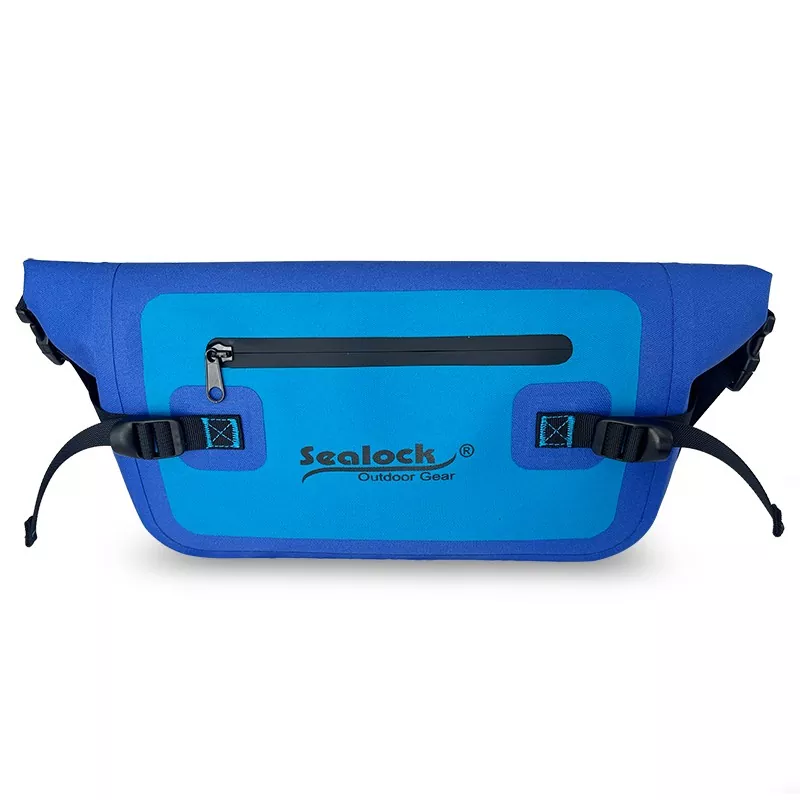
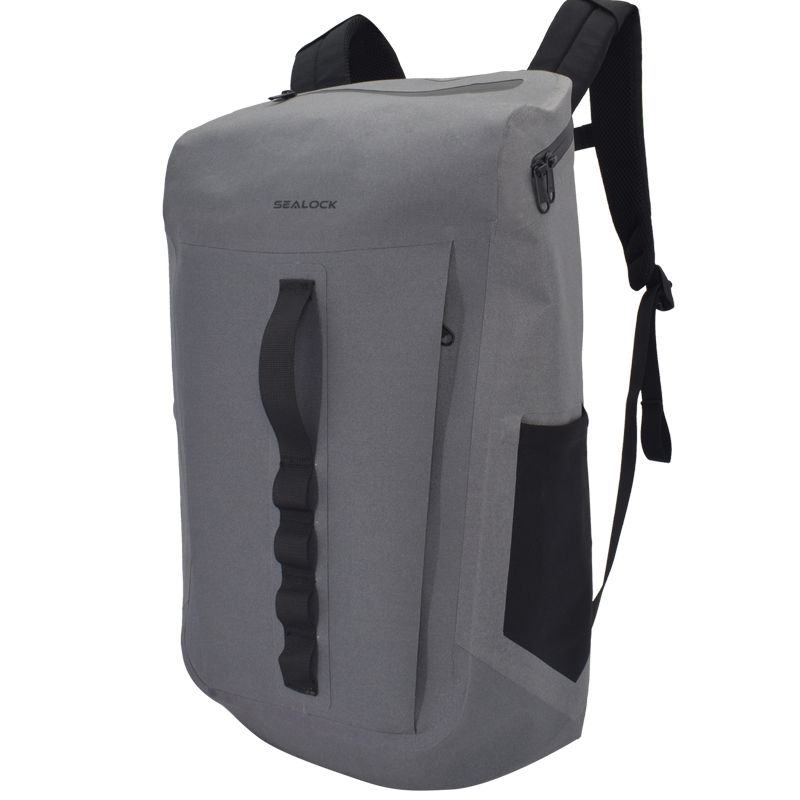
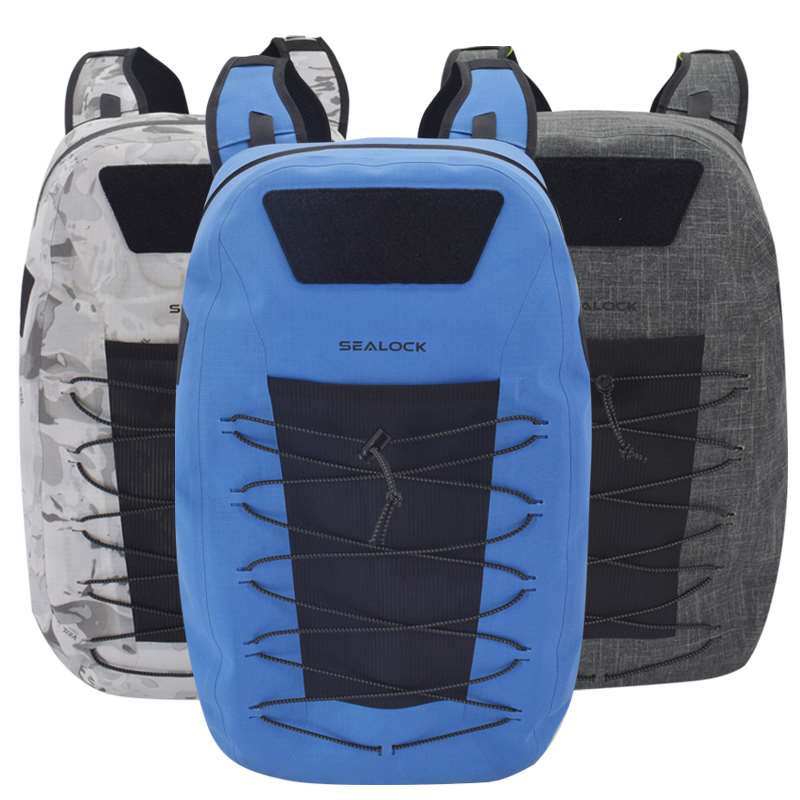
These welded bags, from Sealock's dry bag line, are equal starting points for a custom project — none is ranked above another; each shows a different production feature described above:
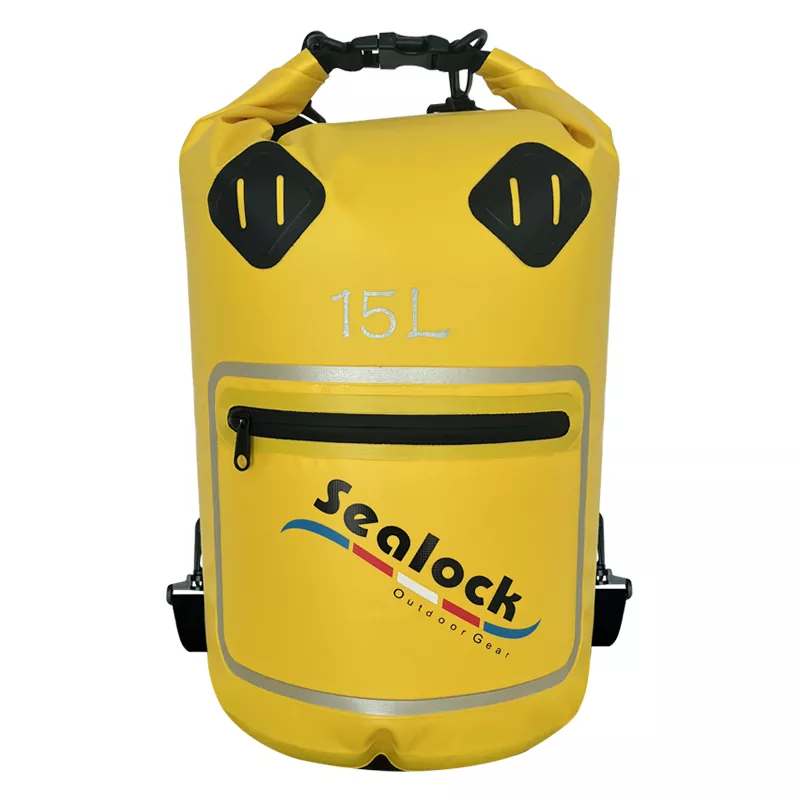
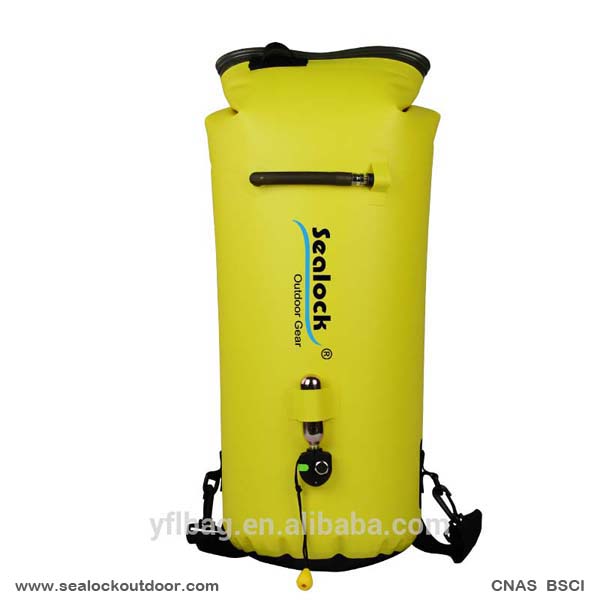
SL-E977 Kayak Dry Backpack — 28L; 500D PVC 0.5 mm; semi-circular shell; front phone window; multi-function lock for a paddle board; side inflation/deflation valve; one-piece EVA back panel.
Complex shell geometry + harness stitching + EVA back panel
300–500
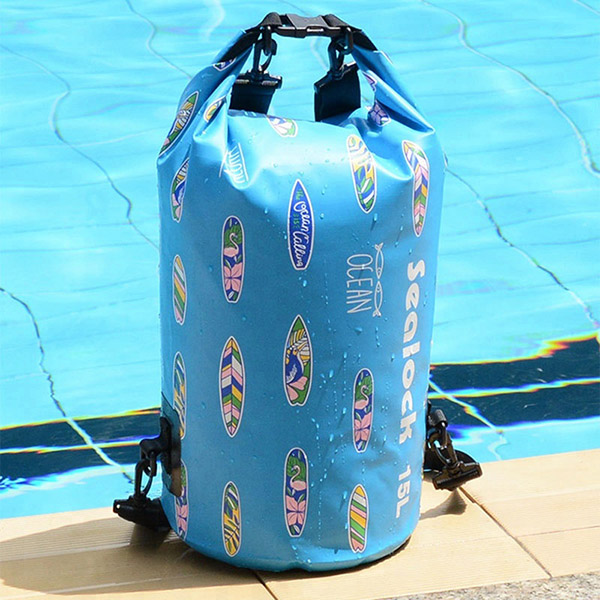
SL-E102 Dry Backpack — 15L / 20L / 30L with published dimensions per size; 500D PVC mesh; custom colours and sizes; sample 7–10 days.
One die, four capacities — efficient tooling amortisation
500
Capacity, material, colourway, closure, hardware and branding are all specifiable per order, or a bag can be developed from a sketch.
Production Terms
Item
Detail
MOQ
200–500 pcs per model
Tooling
Custom copper die quoted separately; adds lead time before first sample
Sampling
3–10 days depending on the build; typically two counter-sample rounds
Production
20–45 days after sample approval
Capacity
Nine HF welding lines; around 100,000 units/month; China or Vietnam origin
Rating options
Up to a verified IPX7 (1 m / 30 min) on sealed builds
Quality Control and the Customer Inspection Procedure
Quality is a system across stages, not a single test at the end. IQC covers incoming rolls, buckles, zippers and hardware against the signed standard, with colour difference and fastness. IPQC covers cutting tolerance, weld integrity and stitched load points in line — including peel tests on sample welds at the start of each run, which is how weld parameters are proven rather than assumed. OQC covers AQL sampling, batch immersion testing, and signed gold-sample comparison, with optional SGS or QIMA third-party inspection before shipment.
Sealock also strictly executes the complete customer inspection procedure on finished goods: unboxing, vacuum extraction, a 24-hour static rest, and air-leak determination. On a single-chamber welded bag this is the most revealing test available, because a pinhole that passes a brief dunk still bleeds vacuum over a full day. The lab additionally runs weld bond and peel strength, a 1,500+ cycle load test with jerk-loading on strap anchors and buckles, abrasion, tear, tensile, salt spray, UV, colour fastness and colour difference.
FAQ: Dry Bag Production
Q: Are dry bags fully welded, or is there stitching?
A: Both, in a specific order. Straps, D-ring patches and pockets are stitched to the flat panels at high tension first, so load points don't tear; the body is then welded and sealed, covering those foundations. Pure welding alone can peel under sustained shear at a strap anchor.
Q: Doesn't stitching compromise waterproofing?
A: Only if it's done in the wrong order or left unsealed. Structural stitching goes on before sealing, and where a stitched perimeter remains exposed it's sealed with PU or PVC hot-air backing tape — a process that depends on exact temperature, roller pressure and feed speed calibration.
Q: Why is there a tooling charge for our custom shape?
A: Every welded geometry needs a custom copper electrode to direct the RF energy along the seam path. It's a one-time cost with its own lead time, then reused for repeat orders.
Q: What is a cold weld and how do you prevent it?
A: A seam where pressure was applied but the material centre never reached temperature — it looks fine and peels later. Correct dwell time, cooling under pressure, and peel tests on sample welds at each run start prevent it.
Q: Does our bag's shape affect price and quality?
A: Yes. Long, gentle seam runs weld more consistently than tight radii and converging seams. We review a drawing for weldability up front and suggest adjustments that improve both quality and yield.
Q: Can one die serve several capacities?
A: Often, yes — a tube design like the SL-D002 runs 5 to 30L on shared tooling, which spreads the die cost across a whole size ladder.
Talk to the Factory
To put a custom dry bag into production, contact Sealock at info@sealock.com.hk or +86-769-82009361. Over twenty years of high-frequency welding, nine welding lines, a seven-stage production flow, dual China–Vietnam manufacturing, and a full customer inspection procedure on every shipment.
We use cookies to offer you a better browsing experience, analyze site traffic and personalize content. By using this site, you agree to our use of cookies.
Privacy Policy
 English
  Español
  Português
  русский
  Français
  日本語
日本語  Deutsch
  tiếng Việt
  Italiano
  Nederlands
  ภาษาไทย
  Polski
  Svenska
  magyar
  Malay
Malay  বাংলা ভাষার
  Dansk
Dansk  Suomi
Suomi  हिन्दी
  Pilipino
  한국어
한국어  Türkçe
  Gaeilge
  العربية
  Indonesia
  Norsk
Norsk  تمل
تمل  český
český  ελληνικά
  український
  Javanese
  فارسی
فارسی  தமிழ்
தமிழ்  తెలుగు
  नेपाली
  Burmese
  български
  ລາວ
ລາວ  Latine
  Қазақша
  Euskal
  Azərbaycan
  Slovenský jazyk
  Македонски
  Lietuvos
  Eesti Keel
  Română
  Slovenski
  मराठी
मराठी  Srpski језик