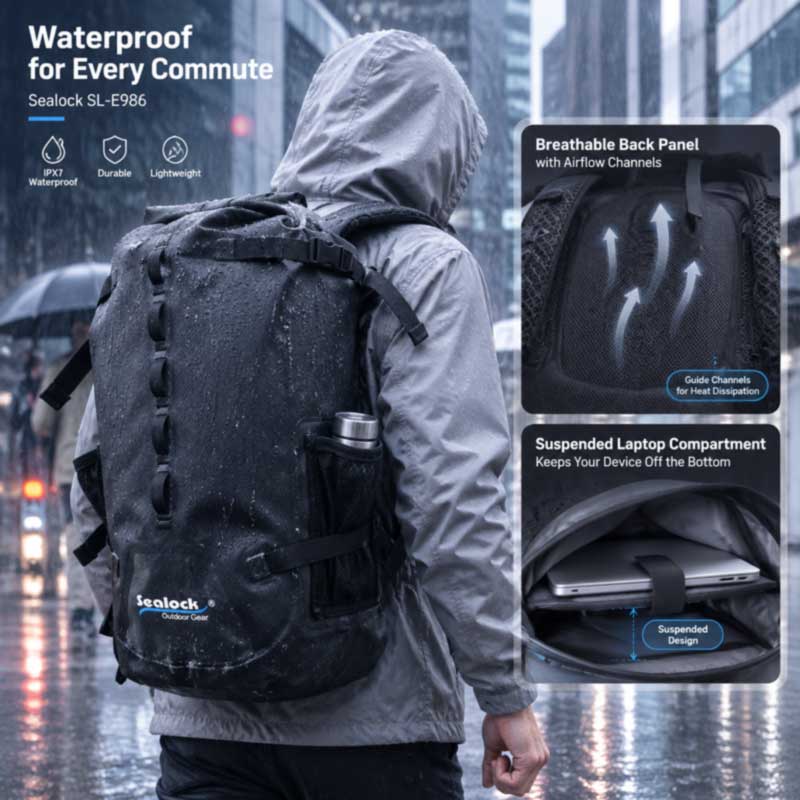
A daypack is opened more often than any other bag you own. On a hike it comes off for a layer, a snack, the map, the phone and lunch; on a commute it opens at every desk and café. That pattern is what makes a waterproof daypack harder to get right than a waterproof duffel or a dry bag. Every feature that keeps water out, a roll-top, a sealed zipper, welded seams, a smooth coated fabric, also makes the pack slower to open, warmer on the back or heavier on the shoulders. A good waterproof daypack is the one whose compromises match the way you actually use it.
This guide sets out those compromises one at a time: how the pack closes, what happens at your back, where the pockets go, how much it weighs, and whether a rain cover would do the job instead. It is written for hikers, cyclists and commuters choosing a 15 to 25 litre pack, and for brands developing one. It draws on over 20 years, since 2001, of making welded and sewn backpacks at our factories in Dongguan, China and Ho Chi Minh City, Vietnam.
Rain Cover or Waterproof Pack?
The cheapest way to keep a daypack dry is a rain cover over an ordinary pack. It works well in light or short rain, it packs small, and the pack underneath can have all the pockets and ventilation you like. Its weak points are well known. A cover protects the top, front and sides, but not the back panel or the shoulder straps, so in steady rain water runs down your back and into the pack through the side against your body. Wind lifts it, branches catch it, and it does nothing when you put the pack down on wet grass or a station platform.
A waterproof daypack makes the shell itself waterproof: a coated fabric with no needle holes in the main seams, and a closure that keeps water out. Nothing needs to be put on when the rain starts, the base stays dry on wet ground, and the back panel is part of the protected shell rather than a gap in it. If you walk or ride in the rain regularly, or your pack carries a laptop, a camera or documents, the waterproof shell is worth its compromises. If you hike mostly in dry weather and want maximum ventilation, a cover is the lighter answer. Our article on waterproof vs water-resistant backpacks explains the difference in construction, and our guide on how to waterproof a backpack covers covers and liners.
The Closure Decides How Often You Will Curse It
Most waterproof daypacks close in one of two ways. A roll-top is folded down at least three times and clipped, which seals the opening and lets you adjust the capacity: unrolled for a big shop or a jacket, rolled tight when the pack is half empty. It is simple, very reliable and cheap to repair. It is also slow, and the only way into the pack is from the top, so the item you need is usually at the bottom. That matters more on a daypack than on any other bag. Packing so that the things you need during the day sit near the top, and keeping a few small items in an outside pocket, makes a roll-top much easier to live with.
An airtight or sealed waterproof zipper opens with one pull and can run around the top of the pack in a curve, so the opening is wider and you can reach into the middle of the bag. An airtight zipper gives the highest protection, enough for an IPX7 rating, but it is stiff by design and needs occasional lubrication. A sealed waterproof zipper, as used on IPX6 packs, is lighter to pull and is a sensible compromise for rain. If the pack will be opened twenty times a day, the zipper is usually the better choice; if it will be closed in the morning and opened at lunch, the roll-top is.
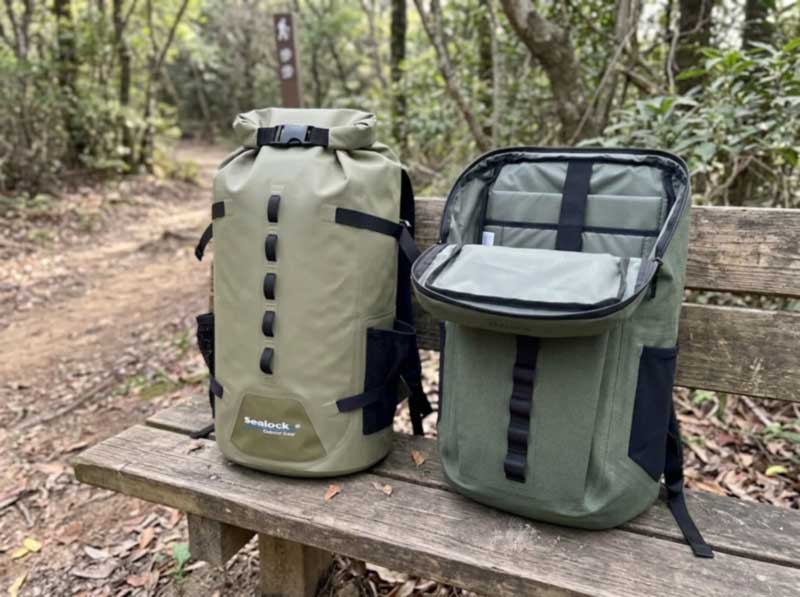
Roll-top or curved airtight zipper: the choice comes down to how often you open the pack.
Your Back: Why Waterproof Packs Feel Warmer
Waterproof fabrics do not breathe. On a sewn nylon pack some moisture passes through the back panel; on a welded TPU or PVC pack none does, so on a climb or a fast commute the sweat stays between your back and the pack. This is the most common complaint about waterproof daypacks, and it is a matter of design rather than quality. What helps is space for air: a padded back panel with channels or a raised mesh, or a suspended mesh panel that holds the pack off your back. A sternum strap and, on bigger daypacks, a light waist strap stop the pack moving, which also reduces rubbing and heat.
There is a second, less obvious benefit to a properly waterproof shell. The back panel and shoulder straps are part of the sealed construction, so they do not soak up rain and stay heavy and cold for hours afterwards, which is what happens to the foam and mesh on a covered pack. If you are choosing between two waterproof daypacks, look at the back first; it matters more to comfort than almost anything else on the pack. Our article on dry bag backpack harness design covers straps and back systems in more detail.
Pockets: Where Waterproofing Usually Stops
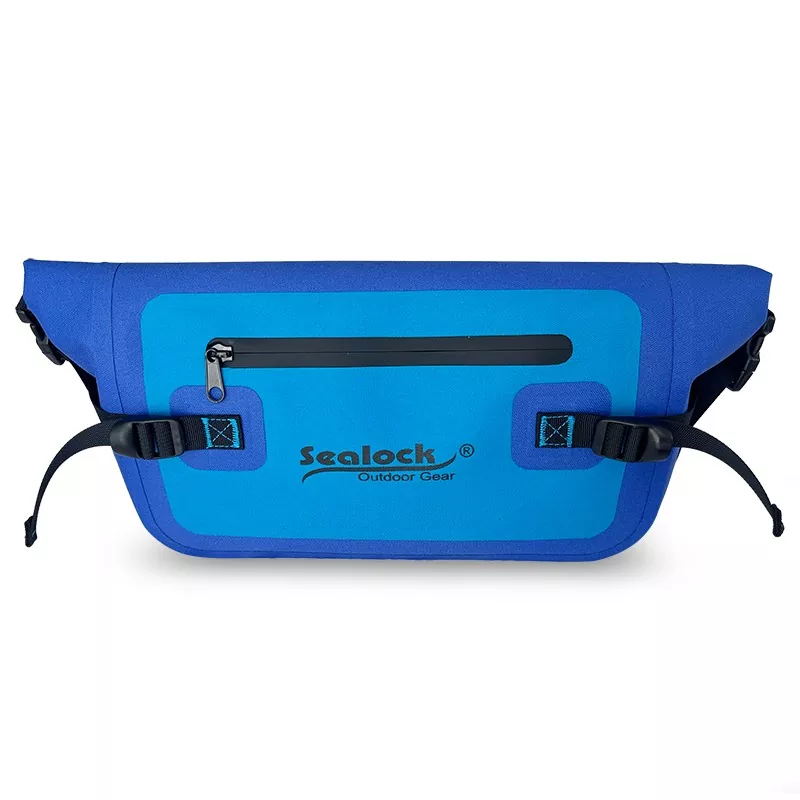
Every pocket on a waterproof pack is another opening, and in most designs the outside pockets are not as well sealed as the main compartment. Mesh side pockets drain by design. Front zip pockets are often closed with a water-resistant rather than a sealed zipper. That is a reasonable design choice, because small outside pockets are where you keep things you reach for often, but it means the rating usually applies only to the main compartment. A good product page says so. Ours do: the rating on our daypacks refers to the main compartment, and external pockets are described as splash-proof or weather-resistant. Keep a phone, keys and cards in an inside pocket of the main compartment when the weather turns.
For commuters, a padded laptop sleeve inside the main compartment is the feature that justifies a waterproof pack. Check that it holds the laptop off the bottom of the pack, so a hard set-down does not land on the corner of the computer, and check the size it fits. Our 20 litre roll-top daypack takes laptops up to 15.6 inches.
Weight and Capacity
A welded waterproof daypack weighs more than a sewn nylon one of the same size, because coated fabric is heavier and the pack needs a firmer structure to hold its shape. Our own 20 to 25 litre daypacks weigh between 0.75 and 1.2 kg, depending on the fabric, the closure and the back system. A lightweight sewn pack of the same size can weigh half a kilo or less. On a day walk the difference is hardly noticeable; on a long trail it is worth counting.
For capacity, 15 litres holds a waterproof jacket, food, water and small items. Around 20 litres adds an extra layer, a first-aid kit and a laptop for a commute. At 25 litres there is room for a lunch, two layers and a camera, or a change of clothes for the gym. Remember that a roll-top's stated capacity is often measured with the top unrolled; rolled down three times to seal it, the pack holds noticeably less, so choose a little larger than you think you need. Our waterproof backpack capacity guide goes into sizes in more detail.
Looking After a Waterproof Daypack
Empty the pack and let it dry open after a wet day, because water that gets in when you open it in the rain has no way out once it is closed. Wipe mud and sand off the closure; grit on a roll-top's sealing strip or in the teeth of an airtight zipper is what slowly wears the seal. Lubricate an airtight zipper every few months. Store the pack unrolled and out of direct sun. To check it before a trip, put a dry towel inside, close the pack and stand it under a shower for a couple of minutes, then check the towel.
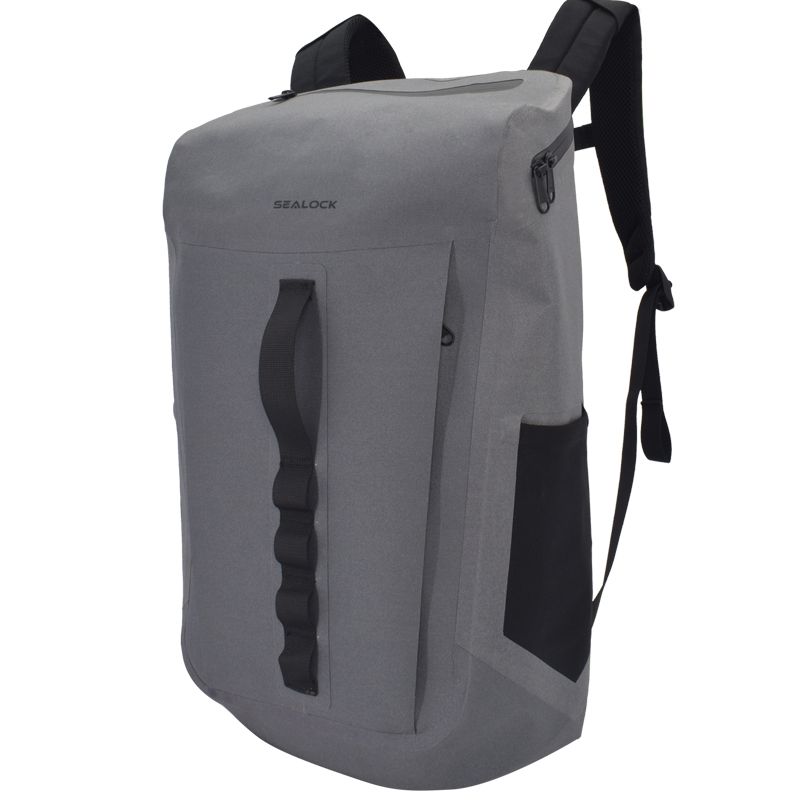
A welded shell keeps a laptop dry in the rain; the air-mesh back panel helps with the heat.
City and outdoor use with one-pull access; side zip pocket, padded back
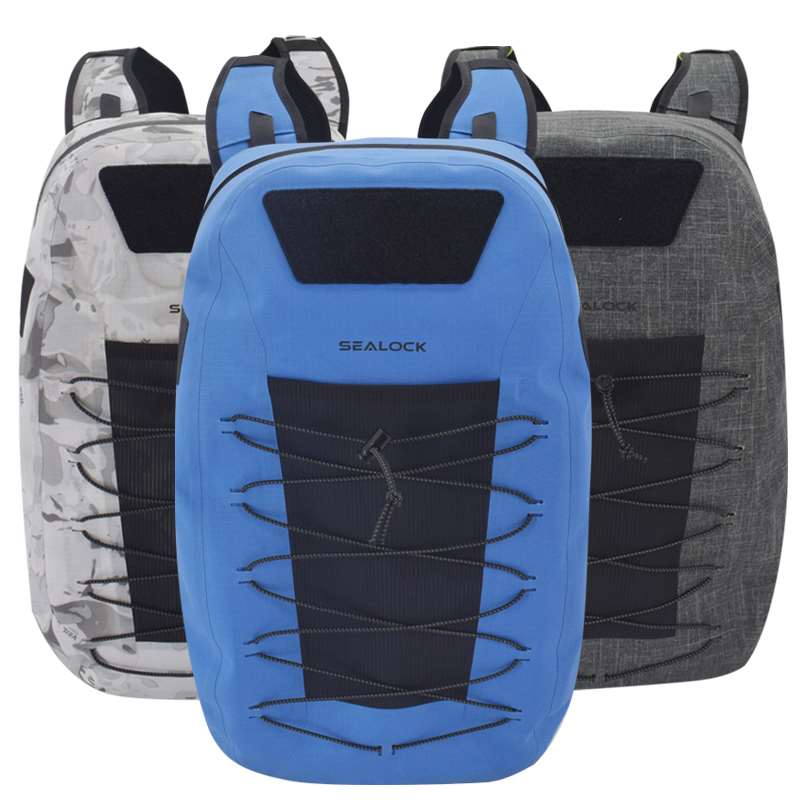
MOQ is 300 pieces per style, with samples in about 7–15 days and bulk production in about 30–45 days. Every pack can be developed in other sizes, from about 15 to 30 litres, in TPU, PVC tarpaulin or recycled fabric, with a roll-top or an airtight zipper, a laptop sleeve of the size you need, and your own colours. Our sewing lines, which work to the same standard as our welding lines, make the harnesses on our welded packs and sewn water-resistant daypacks for brands that want a lighter, more breathable pack at a lower price. For the development process, see our custom waterproof backpack production guide, and for materials, our waterproof backpack material guide. You can also browse the full waterproof backpack range.
How We Test Waterproof Daypacks
Every order passes through IQC on incoming TPU and PVC fabric, zippers, buckles and webbing, IPQC during welding, sewing and assembly, and OQC on finished packs, with SGS or QIMA third-party inspection available on request. Welded seams are tested for tensile and bonding strength, with attention to the shoulder strap anchors and the base, where a loaded daypack puts the most stress. Shoulder straps, grab handles and buckles go through a load test of 1,500+ cycles, and zippers, including airtight zippers, are opened and closed 3,000 times. Buckles and zipper pulls are tested in salt spray, fabric for abrasion, and colour fastness and colour difference are checked. IPX7 packs are verified with a full water-immersion test of 2+ hours, and IPX6 packs with a heavy rain and water-jet test.
Frequently Asked Questions
Is a waterproof daypack better than a rain cover?
For regular rain, yes. A cover leaves the back panel and straps exposed and does not protect the base on wet ground. For occasional showers on a lighter, better-ventilated pack, a cover is enough.
Why does my back get so sweaty with a waterproof backpack?
Waterproof fabrics do not breathe. Choose a pack with a channelled or mesh back panel that holds it off your back, and use the sternum strap to stop it moving.
Are the outside pockets waterproof?
Usually not. On most packs, including ours, the rating applies to the main compartment. Keep valuables inside it in heavy rain.
Can I submerge a waterproof daypack?
Only if it is rated IPX7 or higher. Roll-top daypacks rated IPX6 are built for heavy rain and spray, not for going under water.
What is the MOQ for custom waterproof daypacks?
300 pieces per style. Samples take about 7–15 days and bulk production about 30–45 days.
How much does a custom waterproof daypack cost?
It depends on the fabric, closure, size, back system, laptop sleeve, logo method and quantity. An airtight-zipper pack costs more than a roll-top. Send us your specification or a reference pack for a quotation.
Can you add our logo and colours?
Yes, by welded patch, silk screen, heat transfer or custom zipper pull, with colours matched to Pantone.
Develop a Waterproof Daypack With Us
Tell us how your customers will use the pack, on the trail, on a bike or on the way to work, and we will recommend the closure, back system and size, make samples and plan production in China or Vietnam. Contact us at info@sealock.com.hk or call +86-769-82009361.
We use cookies to offer you a better browsing experience, analyze site traffic and personalize content. By using this site, you agree to our use of cookies.
Privacy Policy
 English
 Español
 Português
 русский
 Français
 日本語
 Deutsch
 tiếng Việt
 Italiano
 Nederlands
 ภาษาไทย
 Polski
 Svenska
 magyar
 Malay
 বাংলা ভাষার
 Dansk
 Suomi
 हिन्दी
 Pilipino
 한국어
 Türkçe
 Gaeilge
 العربية
 Indonesia
 Norsk
 تمل
 český
 ελληνικά
 український
 Javanese
 فارسی
 தமிழ்
 తెలుగు
 नेपाली
 Burmese
 български
 ລາວ
 Latine
 Қазақша
 Euskal
 Azərbaycan
 Slovenský jazyk
 Македонски
 Lietuvos
 Eesti Keel
 Română
 Slovenski
 मराठी
 Srpski језик