Sealock is a waterproof backpack manufacturer and OEM supplier. Capacity looks like the simplest line in a specification and is one of the most misleading. A litre figure on a waterproof pack conceals three separate numbers: the volume as measured, the volume actually usable once the pack is sealed, and the weight a human can carry in it — and the third is the one that decides whether the product works. This guide covers how to specify capacity so the number on your listing means something to the customer.
Number One: Volume Isn't Measured the Same Way Everywhere
There is no universal standard for stating backpack volume, and the difference between methods is large enough to make cross-brand comparison unreliable. Most major manufacturers total the closed storage — main compartment, zippered pockets and hip-belt pockets. Many smaller makers also count open pockets such as side bottle sleeves and rear mesh, which inflates the figure against a competitor measuring only sealed space.
For a brand, that has two consequences. Decide your measurement method and apply it consistently across the range, and state it — a buyer comparing your 30L against a competitor's differently-measured 30L is being asked to compare two different things. On a waterproof pack this matters more than usual, because most of the volume is inside a sealed compartment where the honest measurement is straightforward.
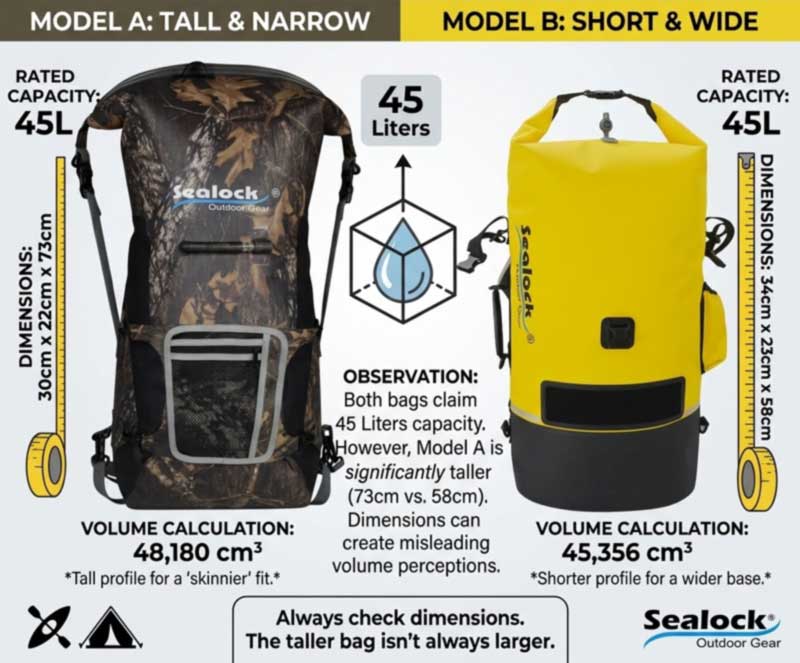
Same number on the label, different bags — capacity is only meaningful with a stated method.
Number Two: A Sealed Roll-Top Is Smaller Than Its Rating
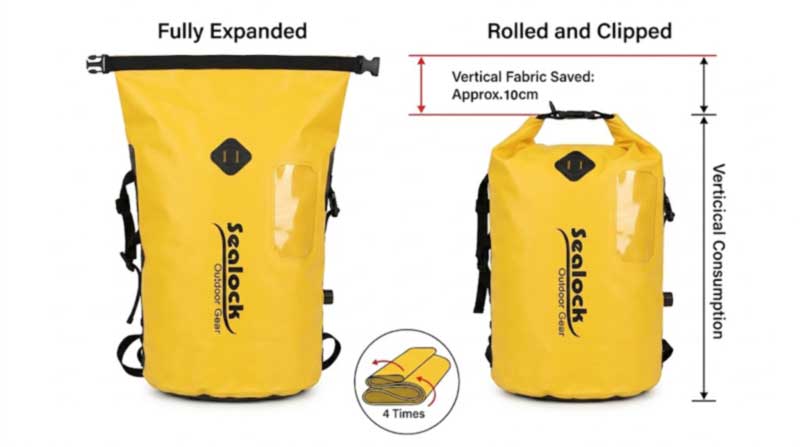
This is specific to waterproof packs and it generates a steady stream of complaints across the category. A roll-top only seals when the opening is folded down three to four times, and those folds consume material: roughly 15–20 cm of vertical fabric, about 4–5 cm per fold, which removes around 4–6L of usable volume compared with the unrolled state. A 30L roll-top pack, correctly sealed, does not carry 30L of gear.
Two things follow. First, state it in your listing copy — explaining that volume varies with the number of folds heads off returns and is what credible brands do. Second, size up rather than down when specifying, because overfilling is the leading cause of "my waterproof pack leaked": a stuffed pack has no slack left to fold, so the seal never forms properly. Printing the closure instruction on the product prevents more negative reviews than any specification upgrade.
Number Three: Weight Capacity, Which Nobody Puts on the Label
Volume describes the space; weight capacity describes what the structure and the wearer can actually handle, and it's a function of the frame, the padding, and whether there's a real hip belt. The two are routinely confused — a 60L pack is not a claim that anyone should carry 60 kilos.
The engineering thresholds worth knowing:
Above roughly 20 lb (9 kg) of load, a hip belt stops being optional. A 30L daypack without a real hip belt punishes the shoulders after about four hours; a 35L pack with a padded belt and load lifters rides on the hips instead.
On a properly fitted pack the hip belt carries 80% or more of the load. That transfer is the whole point of the belt, and it can't happen without a frame or framesheet behind it.
A framesheet or stay becomes necessary above about 20L — it stops the pack collapsing into a shapeless sack and is what makes weight transfer to the belt possible, supporting comfortable loads in the 9–11 kg range.
The sensible load is about the user, not the pack. A large framed pack may be structurally capable of more than its wearer should carry; a minimalist 20L pack can show strain well before a quarter of body weight if treated as a rucksack.
The practical brief point: specify a tested load for the harness anchors, and match the frame and belt to it. A capacity without a load rating is half a specification.
Capacity Bands by Use
Capacity
Use
Carry system it needs
10–15L
Minimal day use, paddling, cycling essentials
Simple shoulder straps
15–25L
Day hiking, commuting, laptop plus layers
Padded straps; framesheet from ~20L up
25–40L
Full-day, winter day trips, one to two nights
Padded hip belt becomes important, load lifters help
40–55L
Weekend and overnight with a sleep system
Frame plus a proper padded hip belt, non-negotiable
55–70L
Multi-day; food volume is what drives this band
Full load-bearing suspension
70L+
Expedition, winter, carrying for others
Full suspension with adjustable torso
One nuance worth designing around: the reason the 50–70L band exists is food volume. Three or more days of trail food takes real space, which is why trip length drives capacity more than gear count does. And a useful guideline to pass on: choose the smallest adequate capacity, because a larger pack invites overpacking.
Four folds seal it — and cost 15–20 cm of height, roughly 4–6L of usable volume.
The Ceiling Buyers Forget: Airline Limits
For any commuter, travel or crossover waterproof pack, capacity has a hard external constraint. US carry-on allowances of roughly 22 × 14 × 9 inches cap volume at about 45L, while budget and many international carriers restrict overhead bins to 35–40L, and under-seat personal items to around 18 × 14 × 8 inches. If your customer flies to their destination, a 50L pack is a checked bag whether you intended that or not.
Two spec implications: keep travel-positioned packs at or below the 40L band, and specify the dimensions alongside the litres, since airlines measure the box, not the volume.
Shape Matters as Much as Volume
Two packs of identical litre rating can behave completely differently depending on proportion. A tall, narrow pack carries weight closer to the spine and higher, which suits hiking; a shorter, wider pack sits lower and more stably, which suits cycling and paddling where a high centre of gravity is a liability. On a welded waterproof pack the shape also affects manufacturability — gentle curves and clean seam runs weld more consistently than tight radii.
Specify the finished dimensions, not only the volume. It's the dimension set that determines whether the pack fits a hatch, a locker, a bike rack or an overhead bin.
How to Specify Capacity Properly
State the measurement method — closed storage only, or including open pockets.
Give both figures on a roll-top — nominal volume and approximate usable volume when sealed.
Publish finished dimensions in cm, not just litres.
Specify a tested load for the harness and hip-belt anchors.
Match the carry system to the band — framesheet above ~20L, padded hip belt above ~20 lb of intended load.
Check the channel ceiling — airline limits for travel packs, hatch size for paddling packs.
The Product Basis
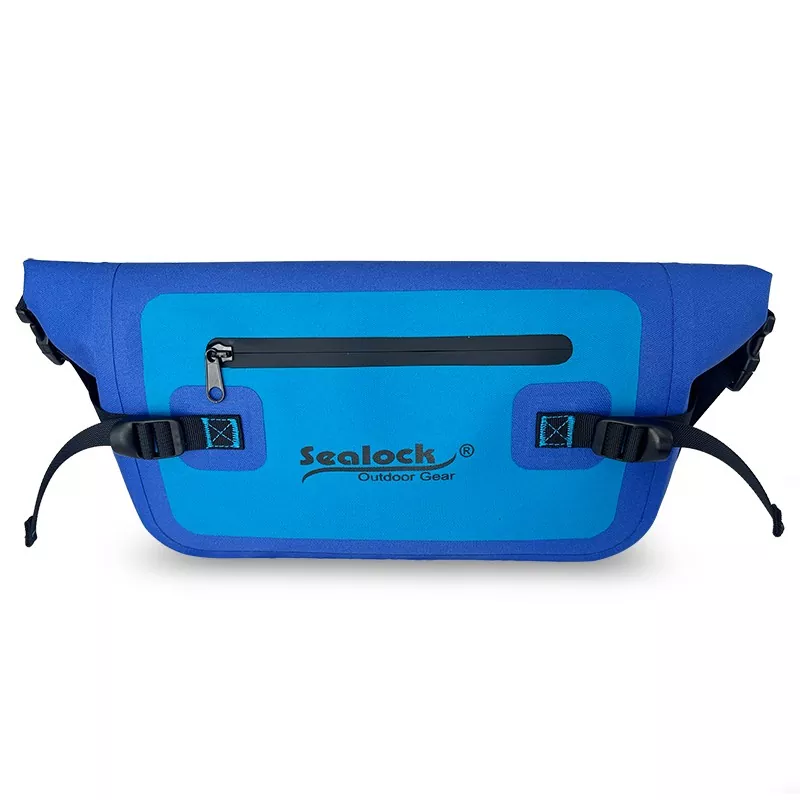
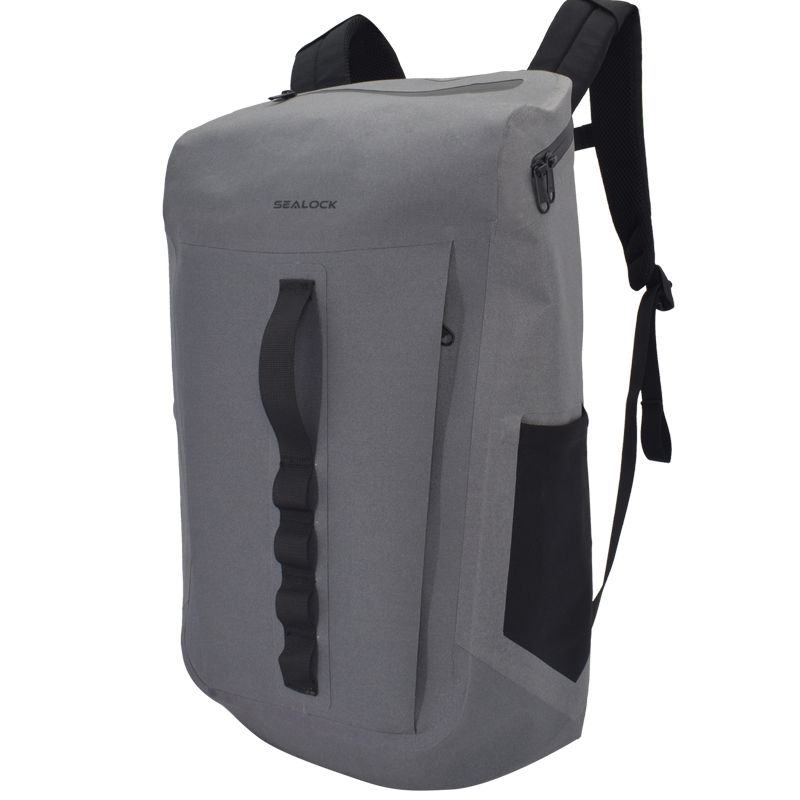
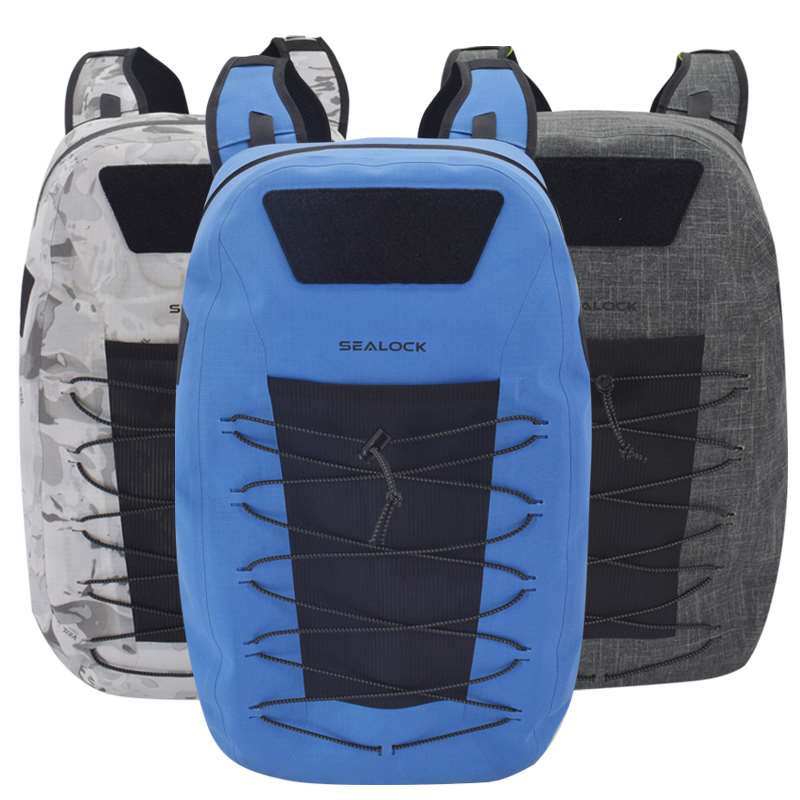
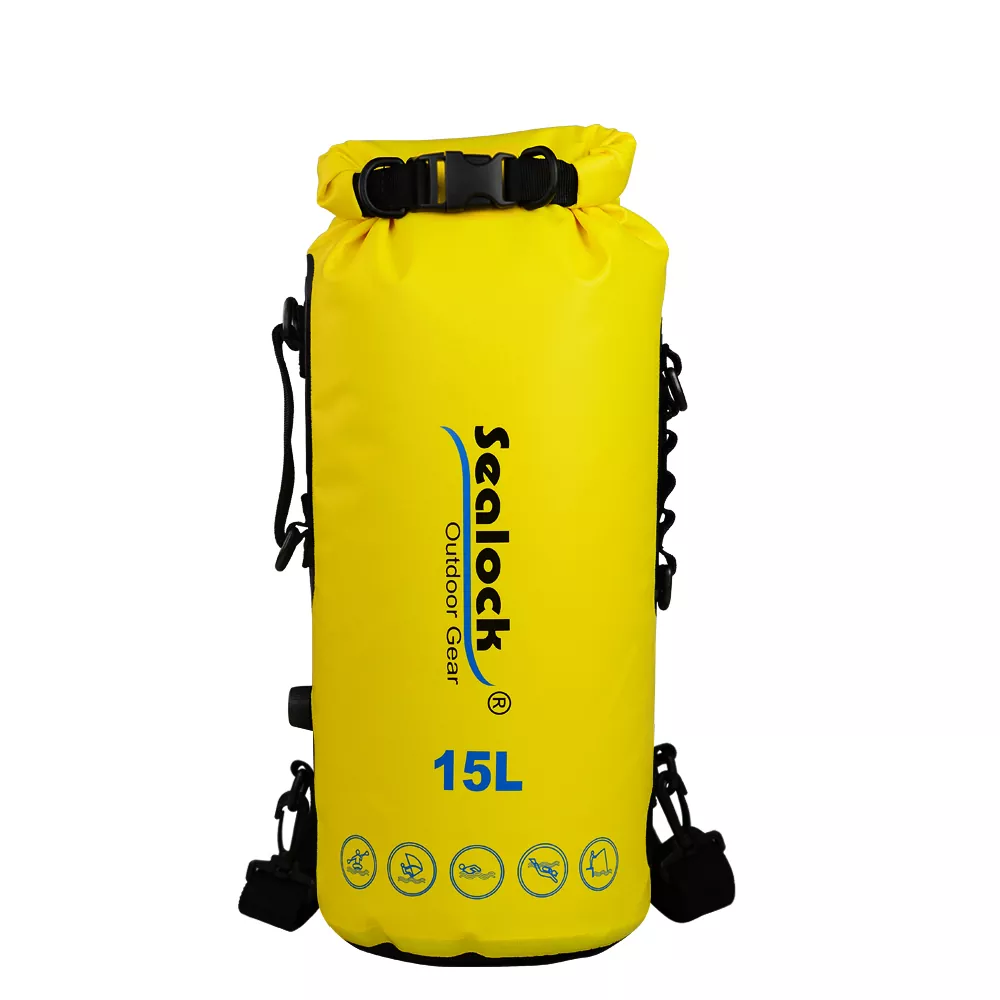
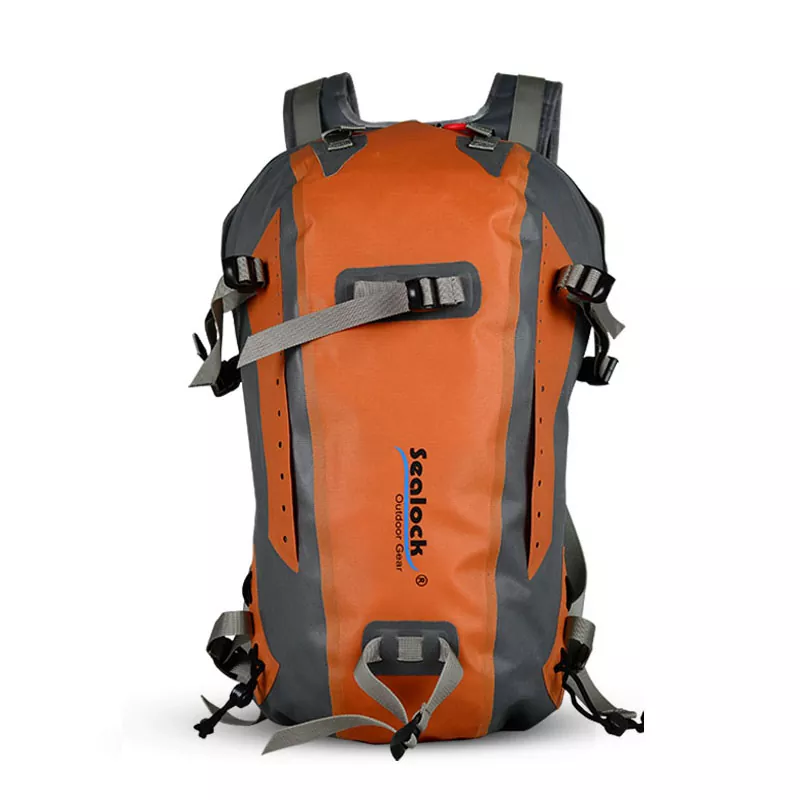
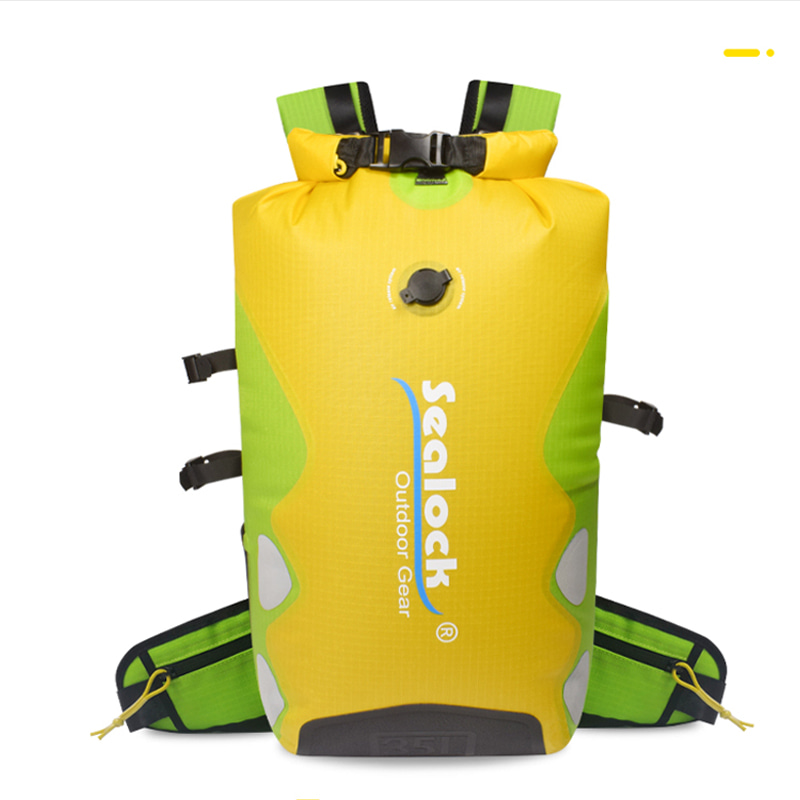
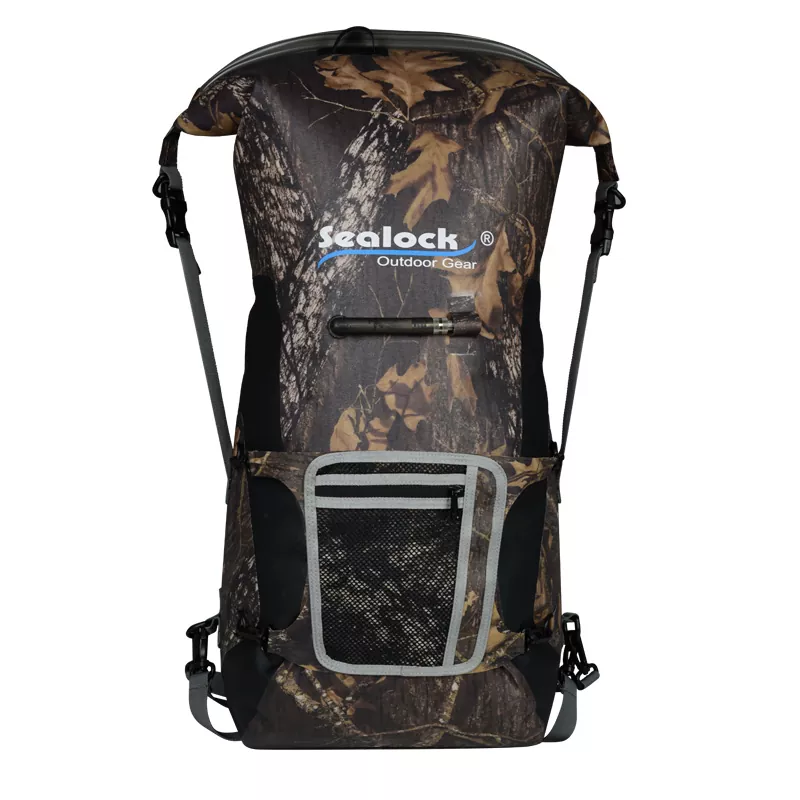
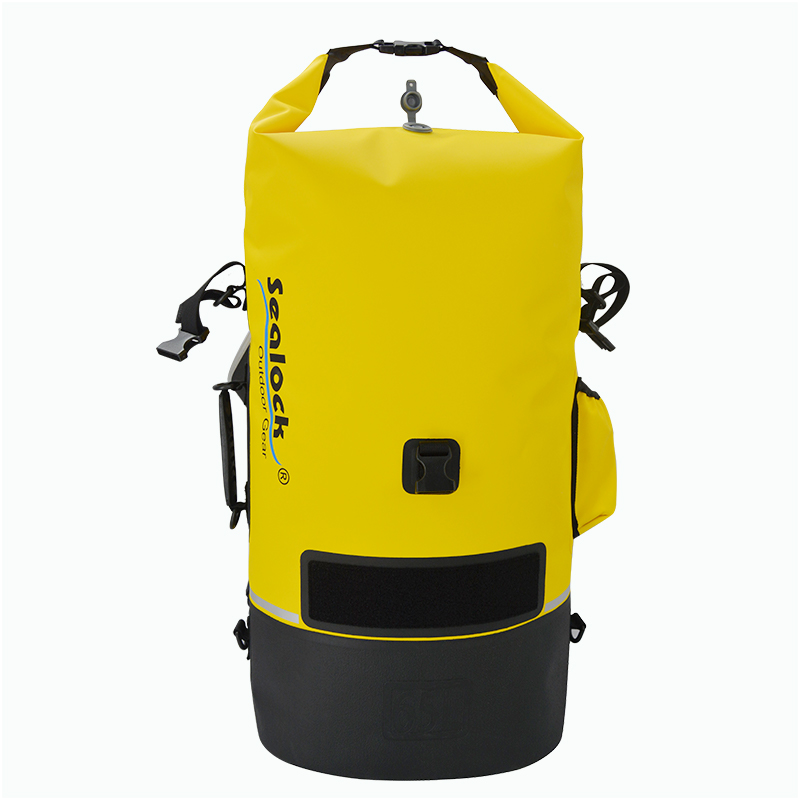
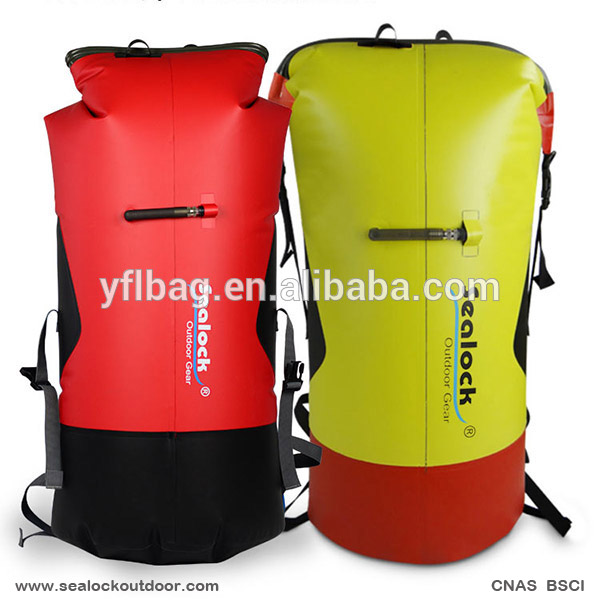
These welded packs are equal starting points for an OEM order — none is ranked above another; between them they cover every capacity band:
Note the planning advantage in the range: the SL-E102 covers 15/20/30L and the SL-J033 covers 45/55/65L, each on one pattern with dimensions published per size — so a brand can build a full capacity ladder without commissioning several separate developments.
Verifying Capacity and Load
Quality is gated in three tiers — IQC (incoming shell fabric, webbing, foam, framesheet and hardware against the signed standard, with colour difference and fastness), IPQC (cutting tolerance to finished dimensions, weld integrity, harness and hip-belt anchor assembly, with peel tests on sample welds at each run start), and OQC (ISO 2859 AQL sampling, dimensional and volume verification against the approved sample, real water-submersion batch testing, and gold-sample comparison, with SGS or QIMA available). Sealock also strictly executes the complete customer inspection procedure on finished goods: unboxing, vacuum extraction, a 24-hour static rest, and air-leak determination. Because capacity and load are linked, the lab programme includes a 1,500+ cycle load test with jerk-loading on shoulder, sternum and hip-belt anchors, plus foam compression recovery, weld bond and peel strength, seam strength, abrasion, tear, tensile, salt spray, UV, colour fastness and colour difference.
FAQ: Specifying Backpack Capacity
Q: Why do two 30L packs look different sizes?
A: Because volume isn't measured to a single standard. Most large brands count only closed storage; many smaller ones also include open side and mesh pockets. Fix your method, apply it across the range, and state it.
Q: How much capacity does sealing a roll-top cost?
A: About 4–6L, since folding the top three to four times consumes roughly 15–20 cm of fabric. Publish both the nominal and the sealed usable figure, and advise customers to size up rather than overfill — overfilling is the main cause of reported leaks.
Q: When does a pack need a hip belt and a frame?
A: A framesheet becomes worthwhile above roughly 20L, and a padded hip belt becomes necessary once intended loads exceed about 20 lb. On a well-fitted pack the belt carries 80% or more of the weight, but only if there's a frame to transfer it.
Q: Should we publish a weight rating as well as a volume?
A: It's worth doing. Volume describes space; weight capacity describes what the frame, belt and anchors can handle. We test harness anchors to a stated load, so the figure can be substantiated rather than estimated.
Q: What's the maximum capacity for a travel-positioned pack?
A: Around 40L to stay within most airline overhead limits — US carry-on dimensions cap roughly 45L and many budget and international carriers restrict to 35–40L. Publish dimensions as well as litres, because airlines measure the box.
Q: Can one pattern cover several capacities?
A: Yes, and it's the efficient route. Our SL-E102 runs 15/20/30L and the SL-J033 runs 45/55/65L on shared tooling, which spreads die cost across a whole ladder.
Talk to the Factory
To specify capacity, dimensions and load rating for your waterproof backpack programme, contact Sealock at info@sealock.com.hk or +86-769-82009361. Over twenty years of high-frequency welding and industrial sewing under one roof, capacity ladders from 10L to 65L, load-tested harness systems, dual China–Vietnam production, and a full customer inspection procedure on every shipment.
We use cookies to offer you a better browsing experience, analyze site traffic and personalize content. By using this site, you agree to our use of cookies.
Privacy Policy
 English
  Español
  Português
  русский
  Français
  日本語
日本語  Deutsch
  tiếng Việt
  Italiano
  Nederlands
  ภาษาไทย
  Polski
  Svenska
  magyar
  Malay
Malay  বাংলা ভাষার
  Dansk
Dansk  Suomi
Suomi  हिन्दी
  Pilipino
  한국어
한국어  Türkçe
  Gaeilge
  العربية
  Indonesia
  Norsk
Norsk  تمل
تمل  český
český  ελληνικά
  український
  Javanese
  فارسی
فارسی  தமிழ்
தமிழ்  తెలుగు
  नेपाली
  Burmese
  български
  ລາວ
ລາວ  Latine
  Қазақша
  Euskal
  Azərbaycan
  Slovenský jazyk
  Македонски
  Lietuvos
  Eesti Keel
  Română
  Slovenski
  मराठी
मराठी  Srpski језик