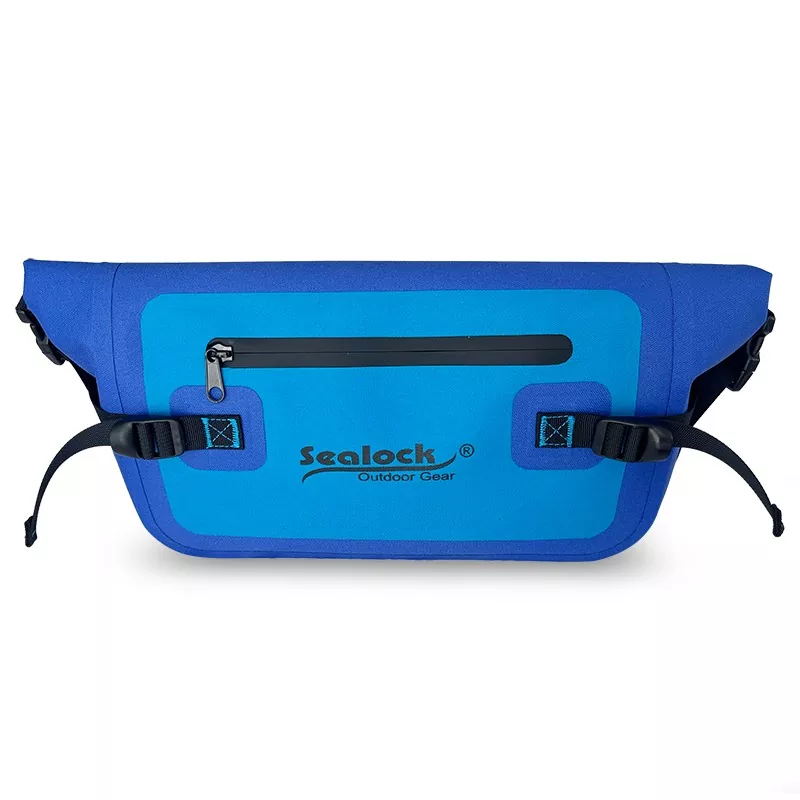
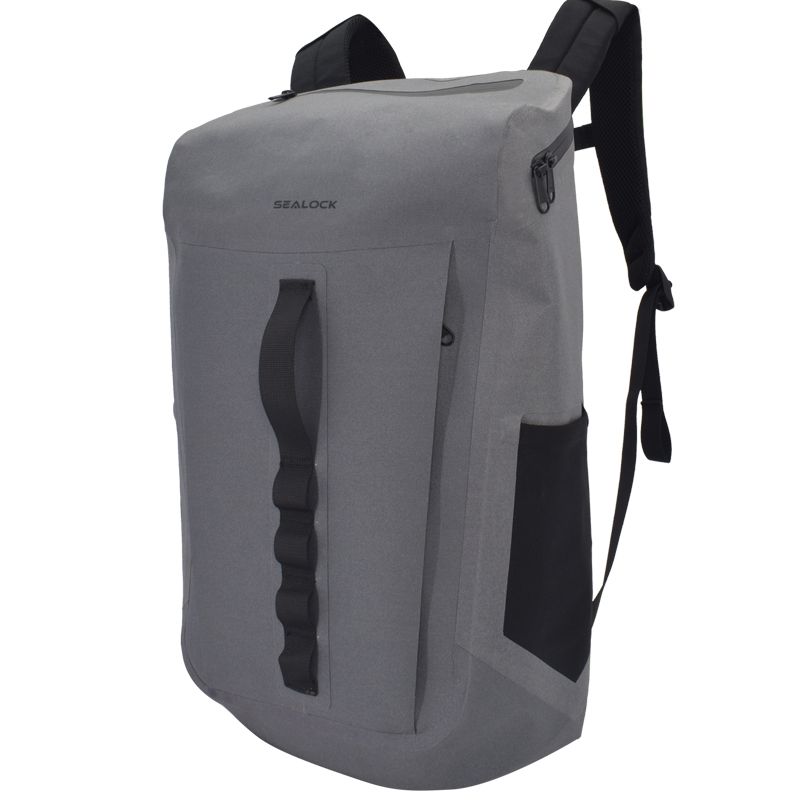
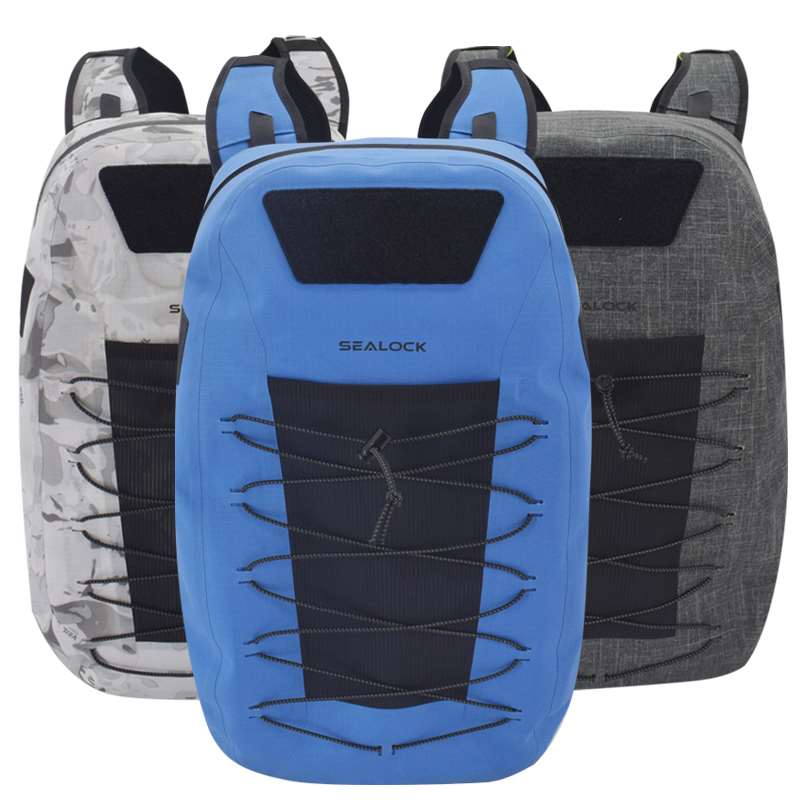
A 50-litre dry bag holds roughly a sleeping bag, a tent and a change of clothes, or a week of clothing for one person. It is the size rafting outfitters, boat owners, expedition teams and camping retailers buy most when they need one bag to carry a whole load. It is also the size where the design rules that work for a 10- or 20-litre dry bag start to fail. A 50L bag is heavy when full, hard to dig through, and carried in very different ways from a small one, so it has to be built differently.
This guide is for importers, outfitters and brands sourcing 50L dry bags in volume. It covers what 50 litres really holds, why large dry bags fail, which shape and build to choose, and what drives price, MOQ and lead time. It is based on over 20 years of making welded dry bags at our factories in Dongguan, China and Ho Chi Minh City, Vietnam.
What a 50L Dry Bag Holds
Fifty litres is the point where a dry bag stops being an accessory and becomes the main piece of luggage. A synthetic sleeping bag, a two-person tent body and a night's clothing fit comfortably. So does a week of clothes in summer, or the shared food and cooking kit for a small group on a river trip. In practice, a roll-top closure needs at least three full rolls to seal, so the usable volume of a 50L roll-top bag is somewhat less than the label, and outfitters who pack to the brim are the ones who report leaks.
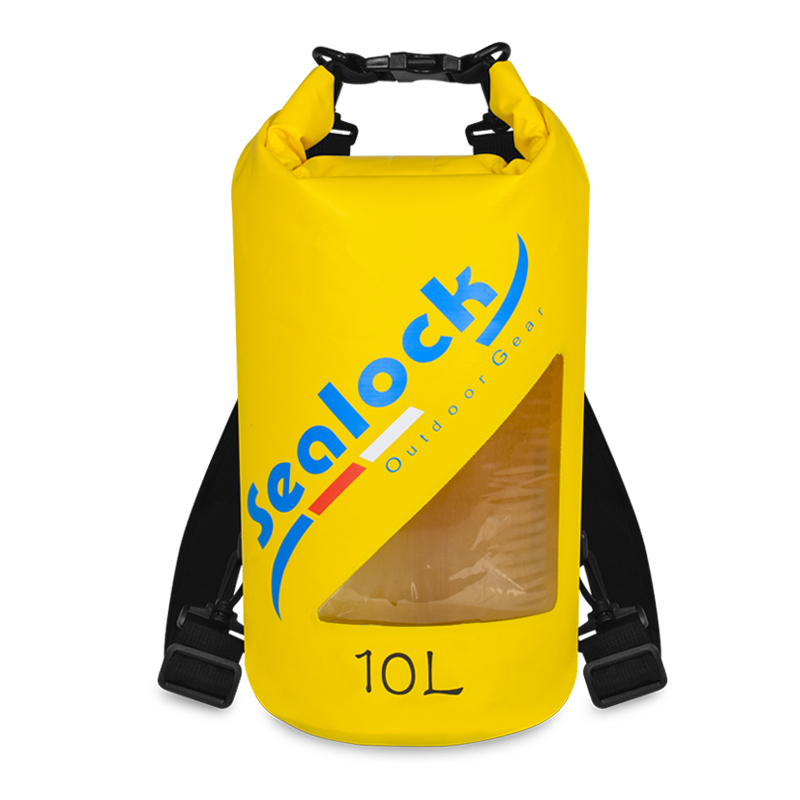
For comparison, a 40L dry bag in our SL-D110 range measures about 36 × 66 cm flat and a 60L about 40 × 78 cm flat, so a 50L sits between them. A tube of that size is long, which matters for how it is packed and carried. Our dry bag capacity guide sets 50L in the context of the full size range.
Why Large Dry Bags Fail Differently
A full 50L dry bag can weigh 10–15 kilograms. That weight changes what fails. On a small bag, the closure and seams carry very little load, and failures are mostly about how the bag was closed. On a 50L bag, the roll-top buckle, the strap anchors and the base carry real weight every time the bag is lifted, thrown onto a raft or dragged across rocks. The most common failure points are strap anchors pulling away from the body, worn-through bases, and roll-top buckles that crack under load.
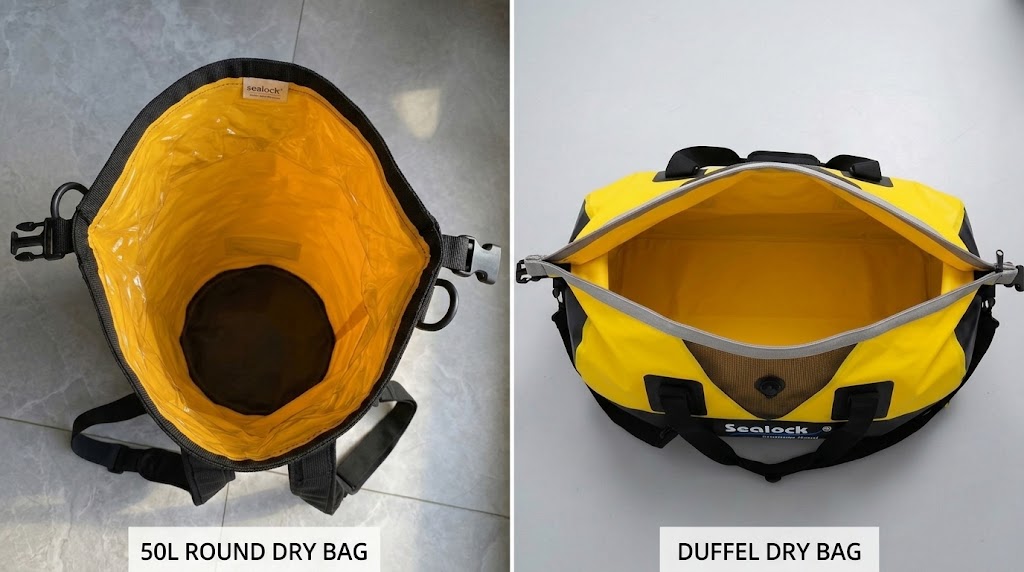
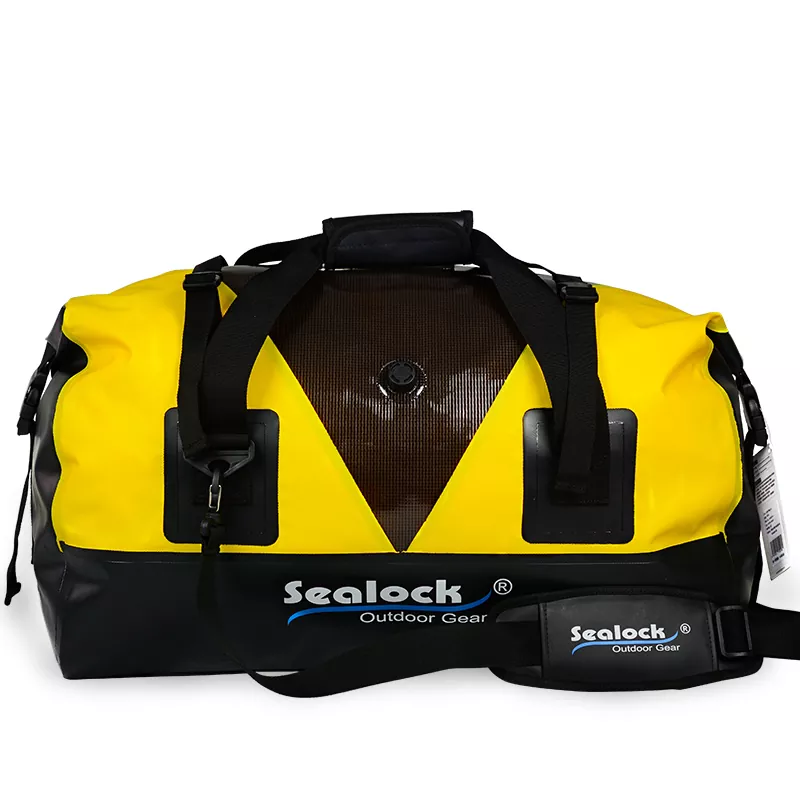
Access is the other problem. Reviewers of large tube dry bags repeatedly describe the same frustration: the item you need is always at the bottom, so the bag has to be emptied and repacked. A single tie-down loop is also less secure on a boat than several attachment points. This is why many outfitters choose a wide-mouth duffel-style dry bag at 50L and above, which opens along its length and sits flat, rather than a long tube.
At 50 litres, a wide-mouth duffel shape is far easier to pack and unpack than a long tube.
Tube, Duffel or Backpack: Choosing the Shape
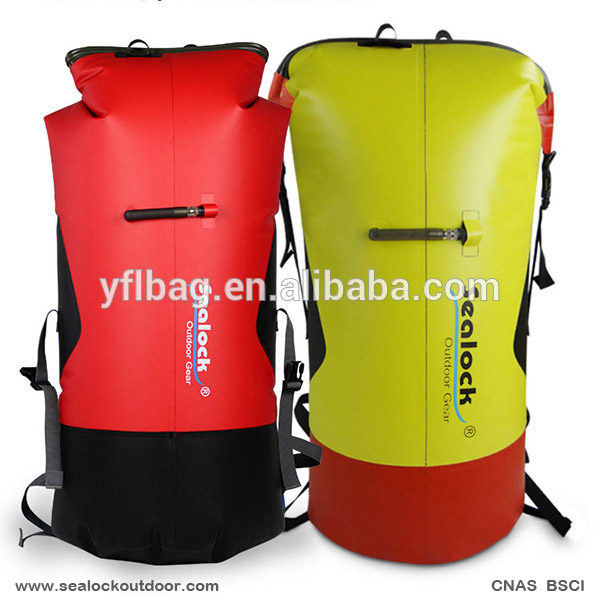
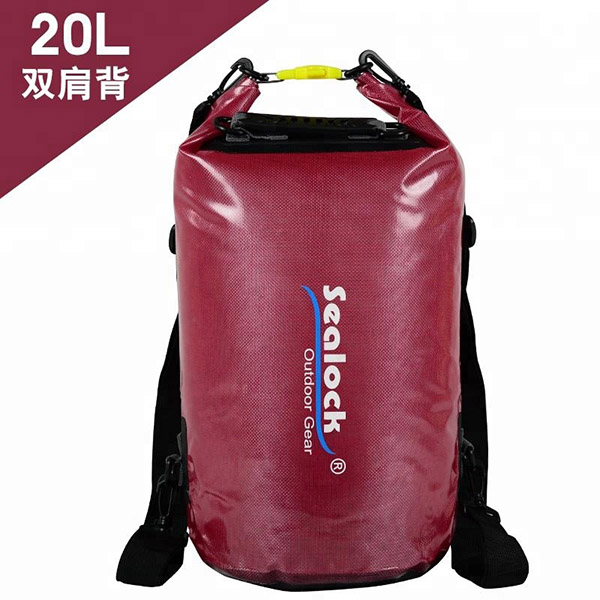
A tube dry bag is the simplest and most economical shape, and it packs well into kayak hatches and the corners of a raft. At 50L it is best for gear that is packed once and unpacked at camp, such as sleeping bags and tents. A duffel-shaped dry bag, with a wide roll-top or an airtight zipper along its length, is easier to load and unload, sits stable on a deck and can carry four tie-down points. It suits outfitters and boat owners who open the bag many times a day. A dry backpack, with shoulder straps and ideally a back panel, is the right choice when the bag must be carried on portages or from the vehicle to the water. Our article on dry bag backpacks explains what the harness changes.
How a 50L Dry Bag Should Be Built
Material comes first. 500D PVC tarpaulin is the workhorse for large dry bags: tough, easy to clean and cost-effective, and it welds reliably. TPU-laminated fabric is lighter and stays flexible in cold weather, which matters on a bag that is rolled shut many times a day in cold water. Lighter 70D or 210D coated fabrics save weight but are better suited to smaller bags; at 50L they can puncture and abrade quickly under load. Our dry bag material guide compares the options in detail.
Construction matters more at this size than at any smaller one. Every seam should be a high-frequency welded seam. Strap anchors should be sewn to reinforcing patches that are then welded to the body, never stitched through the shell. A reinforced or double-layer base resists dragging. Roll-top buckles should be specified for the load, and side compression straps help a partly filled bag hold its shape. If the bag may go overboard, leaving air in the sealed bag helps it float, and a purge valve lets users control that; see our guide to floating dry bags.
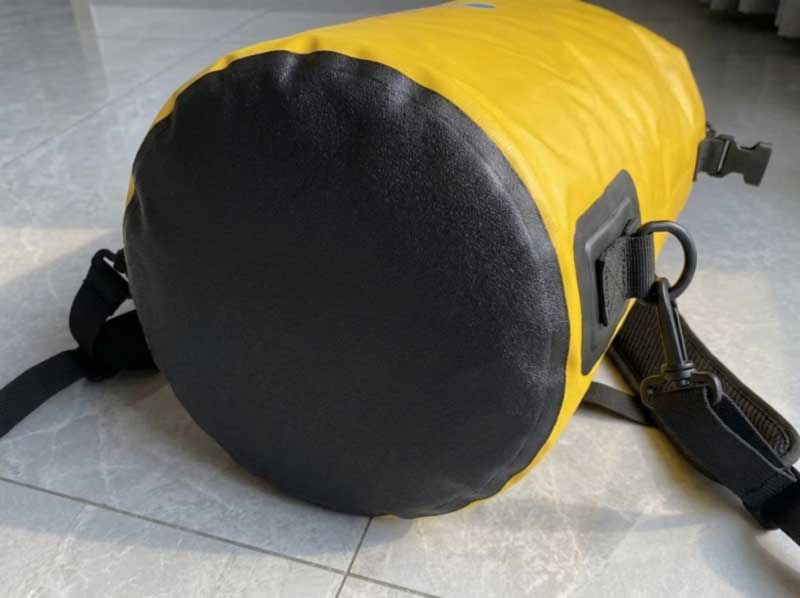
At 50 litres, the base and the strap anchors carry the load; both need reinforcement.
What Drives the Price of a 50L Dry Bag
The largest cost in a 50L dry bag is fabric. A 50L bag uses considerably more material than a 20L bag, so the choice between PVC and TPU, and the fabric weight, has a big effect on unit price. Construction is next: a simple tube with one strap costs less than a duffel with a full-length airtight zipper, a harness or four tie-down points. Hardware, such as heavy-duty buckles, D-rings and valves, adds a smaller amount. Decoration, packaging and order quantity complete the picture.
Freight also matters more at this size. Dry bags ship flat, but a carton of 50L bags holds fewer pieces than a carton of 20L bags, so freight cost per unit rises with size. For buyers in markets where tariffs on Chinese-origin goods are significant, we can produce the same bag in Vietnam. Our breakdown of what drives the cost of a waterproof bag explains each cost in more detail.
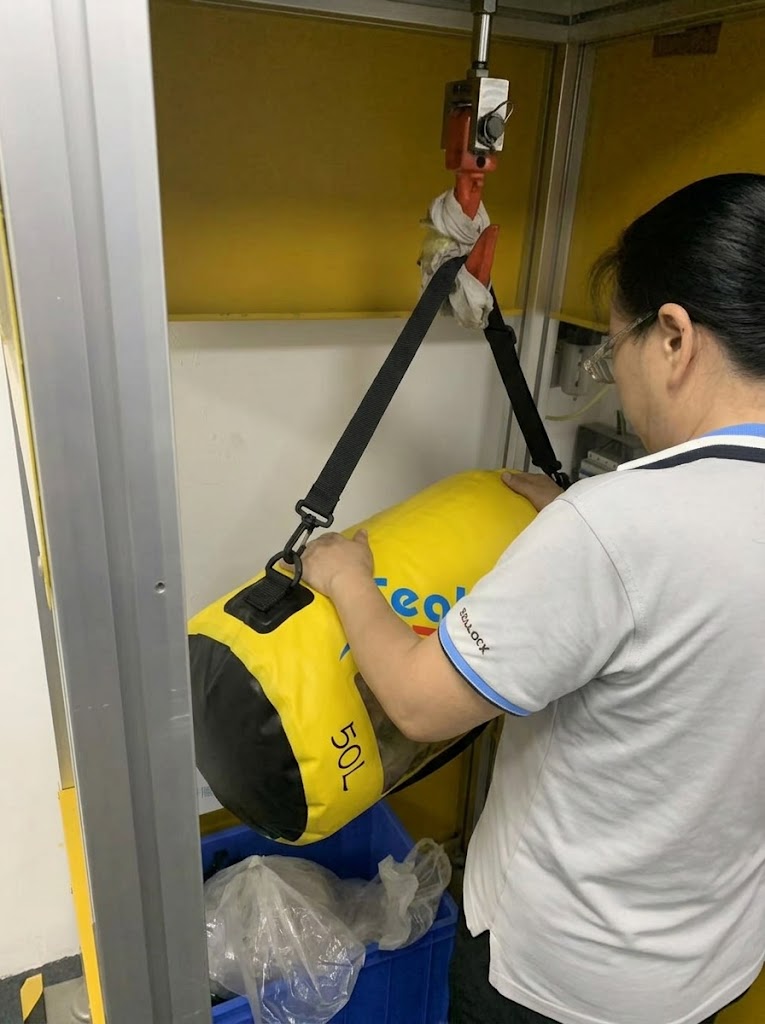
Every order passes through IQC on incoming fabric and hardware, IPQC during welding and sewing, and OQC on finished bags, with SGS or QIMA third-party inspection available on request. Because a 50L bag carries real weight, tensile and bonding strength tests on seams and strap anchors and a load test of 1,500+ cycles are especially important. Buckles and D-rings go through salt spray testing, fabrics are tested for abrasion resistance, and colour fastness and colour difference are checked against the approved sample. Waterproofing is verified against the rating: a full water-immersion test of 2+ hours for IPX7 bags and a heavy rain and water-jet test for IPX5 and IPX6 bags. For sealed bags, buyers can follow our customer inspection procedure: unboxing, vacuum extraction, a 24-hour static rest and air-leak determination.
A loaded 50 L bag is hung by its anchors and cycled to simulate seasons of lifting.
Frequently Asked Questions
What is the MOQ for 50L dry bags?
From 200 to 500 pieces per style depending on the model. Colours can usually be split within an order, with a minimum per colour confirmed in the quotation.
How much does a 50L dry bag cost from a factory?
The price depends mainly on the fabric, the shape and the closure. A 500D PVC tube with a single strap is the most economical; a TPU duffel with an airtight zipper and harness costs considerably more. We quote several builds side by side so you can choose against your retail price.
How long does production take?
Samples take about 7–15 days and bulk production about 30–45 days after sample approval, with China or Vietnam origin available.
Can a 50L dry bag be carried as a backpack?
Yes, with a harness. Clip-on straps suit occasional carrying; for portages and longer walks, a dry backpack with a back panel and sternum strap is much more comfortable.
Is a 50L dry bag waterproof enough to go underwater?
Only if it is rated and tested for immersion. Roll-top bags rated IPX7 and closed with at least three rolls pass a full water-immersion test; large bags should not be packed so full that they cannot be rolled properly.
Can you print our logo on 50L dry bags?
Yes. Large bags give plenty of space for screen printing, heat transfer or welded patches, placed below the roll-top fold so they do not crack.
Source 50L Dry Bags With Us
Tell us how the bags will be used, how they will be carried and how often they will be opened, and we will recommend a shape, material and closure and prepare samples. Contact us at info@sealock.com.hk or call +86-769-82009361.
We use cookies to offer you a better browsing experience, analyze site traffic and personalize content. By using this site, you agree to our use of cookies.
Privacy Policy
 English
 Español
 Português
 русский
 Français
 日本語
 Deutsch
 tiếng Việt
 Italiano
 Nederlands
 ภาษาไทย
 Polski
 Svenska
 magyar
 Malay
 বাংলা ভাষার
 Dansk
 Suomi
 हिन्दी
 Pilipino
 한국어
 Türkçe
 Gaeilge
 العربية
 Indonesia
 Norsk
 تمل
 český
 ελληνικά
 український
 Javanese
 فارسی
 தமிழ்
 తెలుగు
 नेपाली
 Burmese
 български
 ລາວ
 Latine
 Қазақша
 Euskal
 Azərbaycan
 Slovenský jazyk
 Македонски
 Lietuvos
 Eesti Keel
 Română
 Slovenski
 मराठी
 Srpski језик