




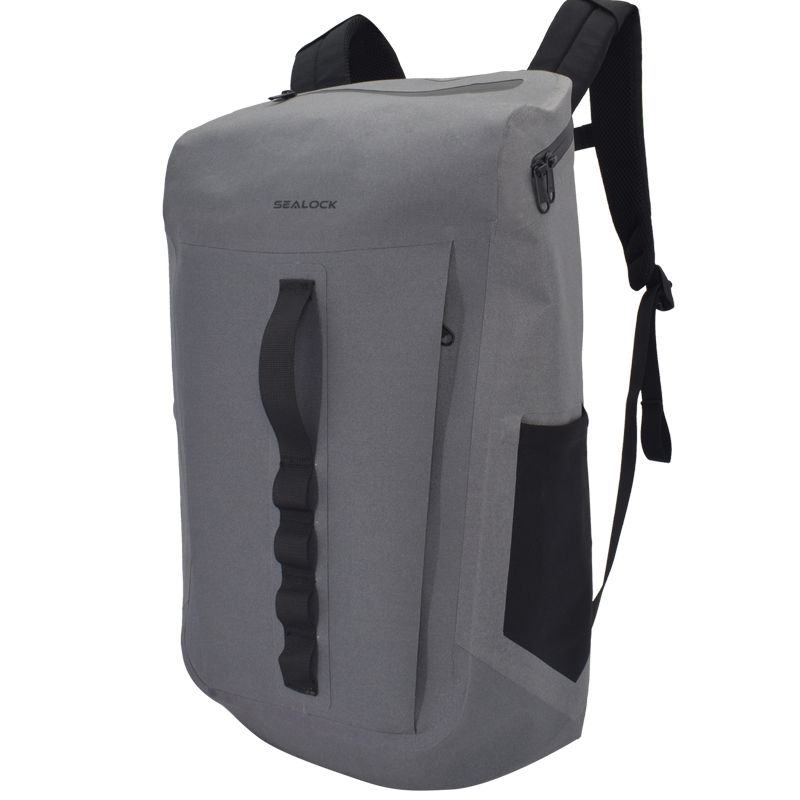

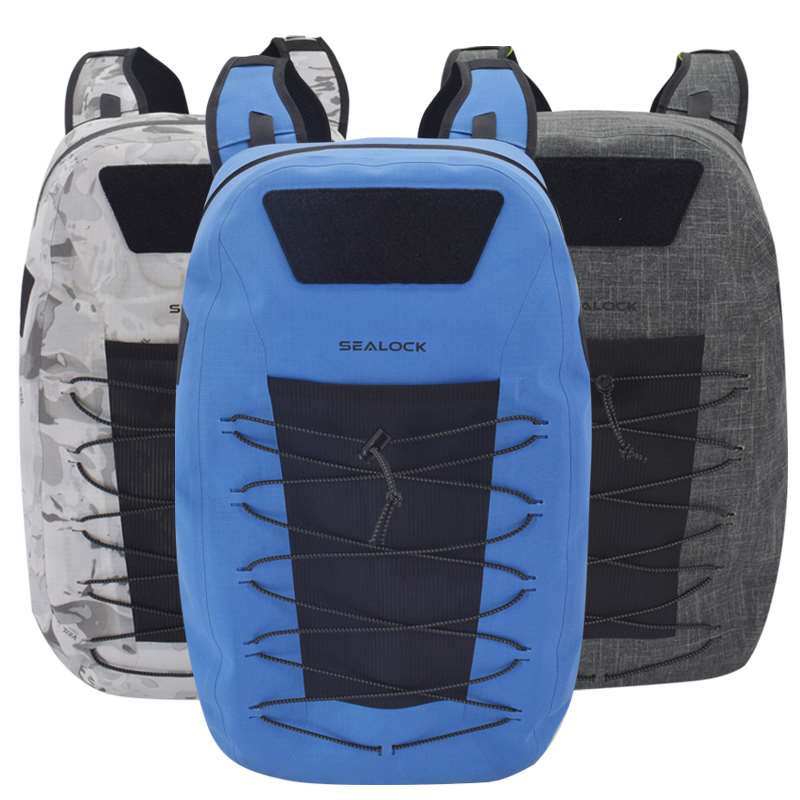
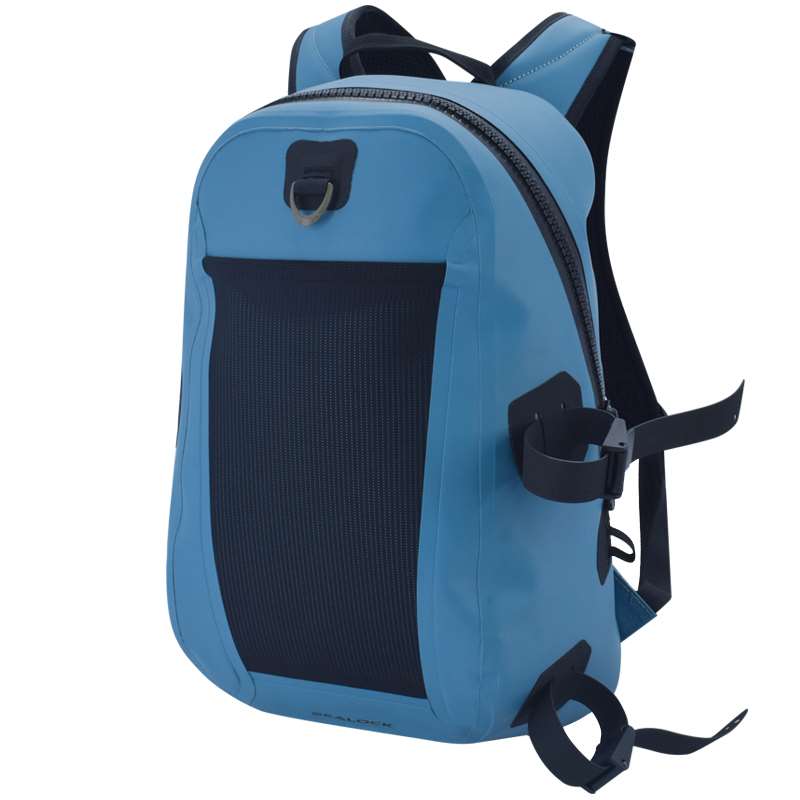
A motorcycle saddlebag fails in ways an ordinary bag never does — vibration, road grit, exhaust heat, and rain driven at it at highway speed. Choosing a waterproof motorcycle luggage manufacturer means judging both the product spec and the factory behind it. This guide covers our production capability, the engineering decisions that matter, and exactly how to brief a supplier.
- Sealock at a glance: factory capability & certifications
- Format and capacity: choosing what to source
- Mounting systems — the most common failure point
- Material, abrasion, and exhaust heat
- Waterproofing: closure, seams, and IPX rating
- Reflective safety features
- Four sourcing comparisons buyers ask about
- Customization, MOQ, and the tariff question
- Case study: European distributor
- The RFQ checklist
- FAQ
1. Sealock at a glance: factory capability & certifications
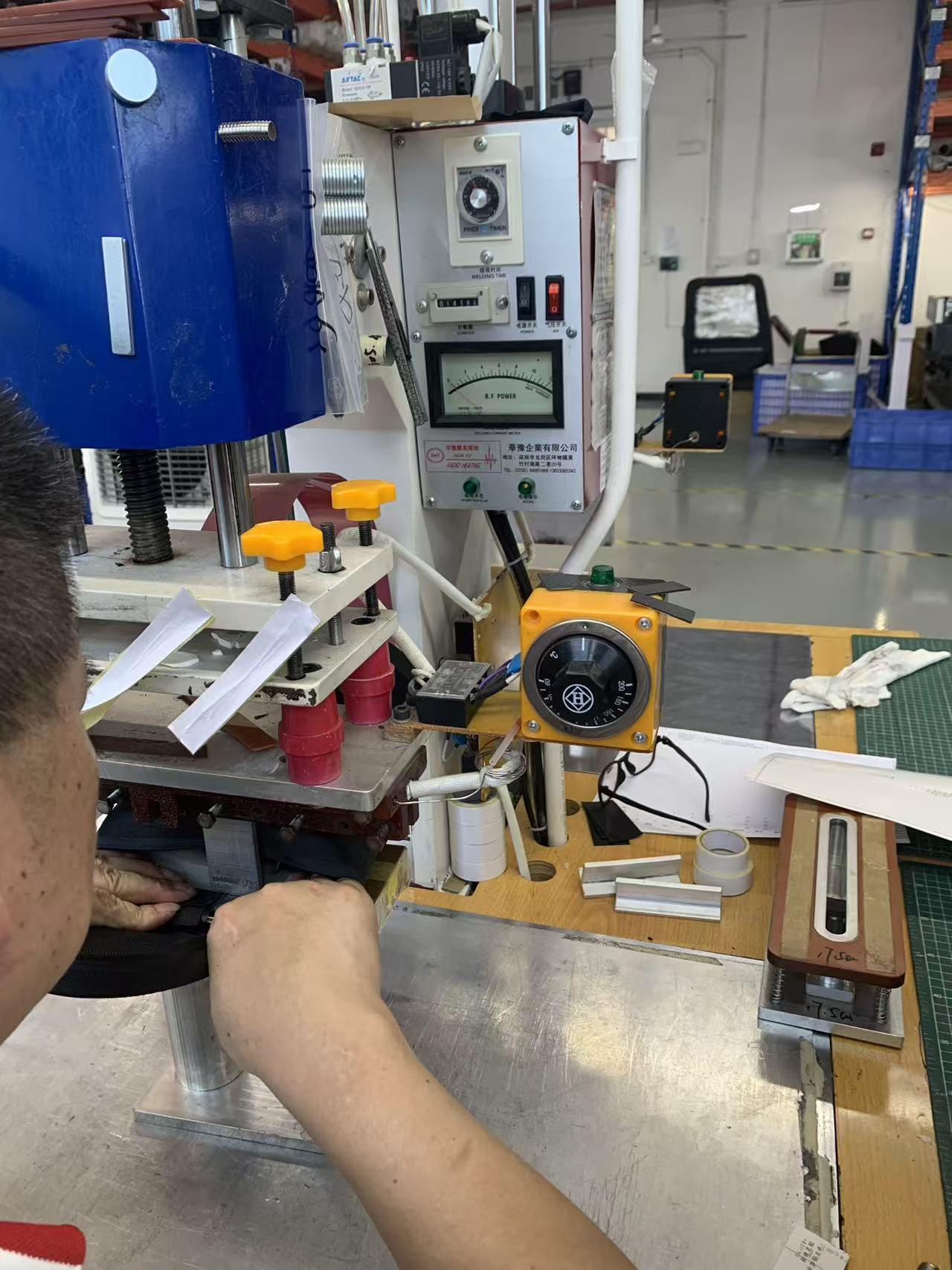
Before the spec, the factory. A waterproof motorcycle saddlebag is only as reliable as the line that welds it, so any serious B2B buyer should vet the manufacturer's capability before discussing price. As a direct-factory motorcycle luggage manufacturer — not a trading company — Sealock operates its own RF welding, lamination, and QC under one roof:
Compliance is documented, not claimed. Our facilities and products are covered by BSCI :156-005207-000/ ISO 9001 :50826Q00038R153/ SGS test report25-0354245 / REACH :TC.26.05.002453, and audit logs are traceable by production batch. Buyers onboarding a new motorcycle bag factory typically require exactly these certifications as a condition of approval; the broader QA framework is detailed in our OEM manufacturer overview.
2. Format and capacity: choosing what to source
"Motorcycle saddlebag" — also called a pannier — covers several formats. State which you're sourcing first, because they differ in tooling, strapping, and capacity logic:
- Throw-over pair (panniers): two bags joined by a bridge over the seat or rack, one per side. The traditional touring format.
- Single side bag: one bag on a specific side, often quick-release; popular for commuters and smaller machines.
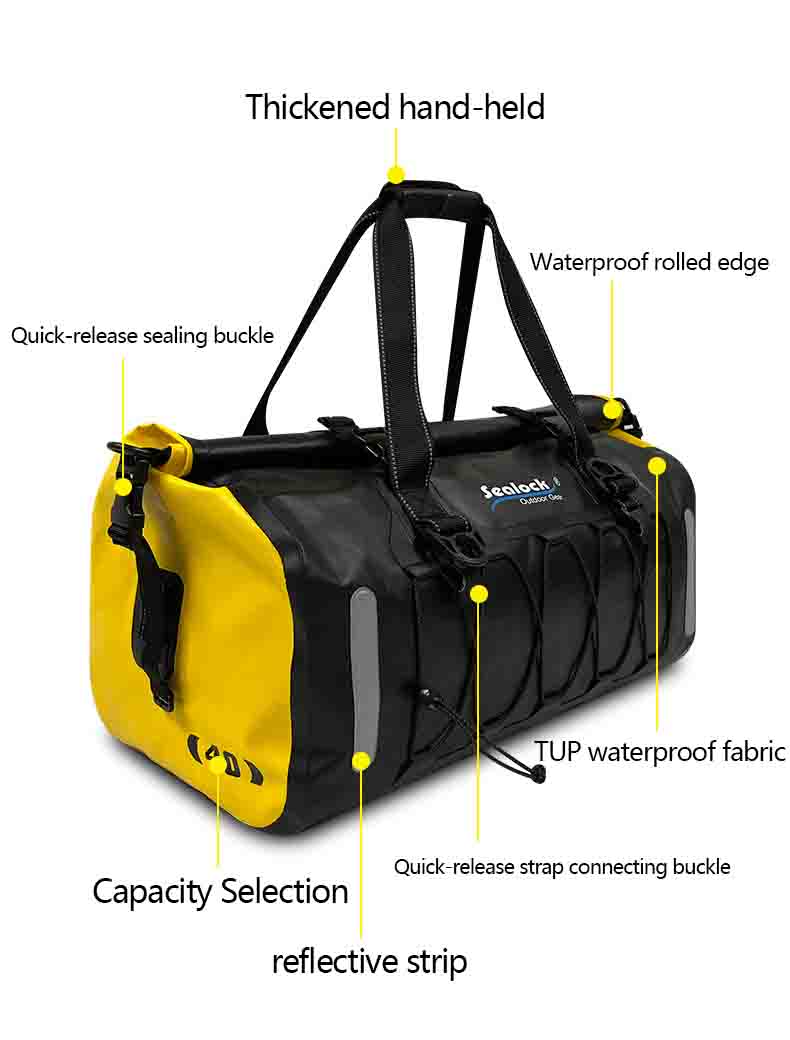
- Tail / backseat bag: a single bag strapped to the passenger seat or rack. Our backseat waterproof bag line covers this fast-growing segment.
Capacity is stated in liters, but the useful framing is "what trip is this for":
| Capacity | Typical use | Example Sealock model |
|---|---|---|
| 40 L | Weekend touring, one rider | SL-C668 or SL-C624 |
| 50 L | Multi-day touring, adventure | SL-C807 |
| 60–80 L | Long-haul, two-up, expedition | SL-C704 |
For a throw-over pair, state whether the capacity figure is per side or combined — otherwise you risk a sample half the size you expected. Volumes of 50 L and up load the mounting system heavily, the next and most failure-prone decision.
3. Mounting systems — the most common failure point
Mounting is where waterproof motorcycle luggage most often fails, and where buyers most often under-specify. A bag that won't stay put — or slips toward the wheel — is a safety problem, not just a quality complaint. Three systems dominate:
- Throw-over bridge: the panel between paired panniers drapes over the seat. Simple and universal; bridge width, grip, and secondary tie-downs decide how much it slides.
- Universal strap mount: adjustable straps wrap the rack or subframe — the most flexible way to fit many bike models from one SKU. Strap webbing strength and reinforced anchor points are what matter.
- Quick-release / model-specific: a plate or clip locks the bag to a dedicated bracket. Premium and convenient, but ties the SKU to specific bikes and adds tooling cost.
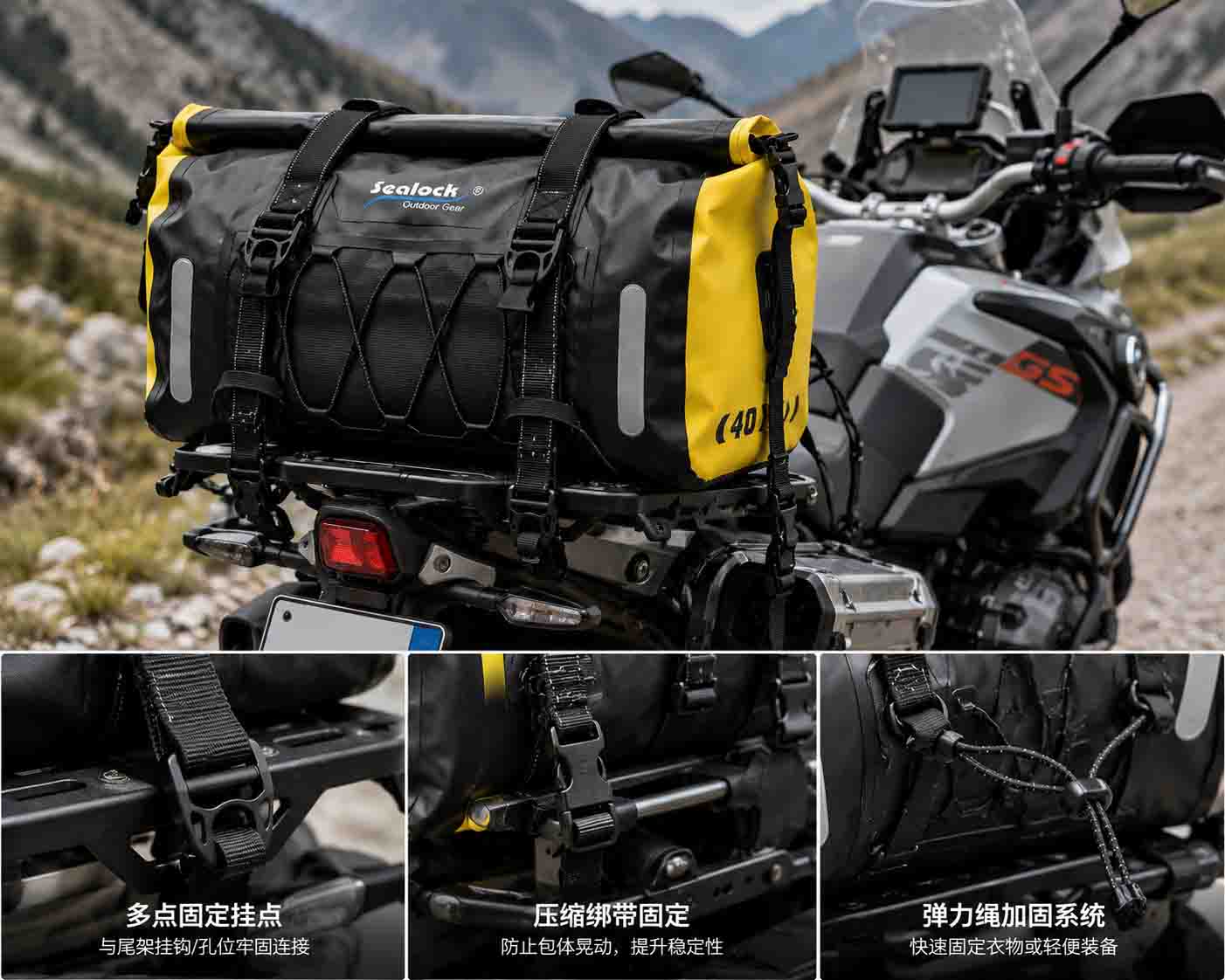
Spec tip: Decide between universal fit (one SKU, many bikes via straps) and model-specific fit early — it drives tooling cost, SKU count, and marketing. Most new lines start universal to prove the market, then add model-specific variants once volume justifies the tooling. Whichever you pick, require reinforced welding or stitching at every strap anchor — vibration concentrates stress there, and anchor failure is the top field complaint on moto luggage. Our reinforced models use.
4. Material, abrasion, and exhaust heat
Saddlebags see more abrasion than almost any bag category — bodywork rub, being set down on gravel, road spray carrying grit. The two workhorse materials differ here:
| Property | 500D PVC Tarpaulin | 420D Nylon TPU |
|---|---|---|
| Abrasion resistance | Excellent, rugged hand-feel | Very good, lighter weight |
| Unit cost | Lower — strong value at volume | Higher — premium positioning |
| Cold-weather flexibility | Can stiffen in the cold | Stays pliable |
| Best fit | Rugged touring, value lines | Premium adventure, weight-conscious lines |
For most motorcycle luggage programs, 500D PVC tarpaulin delivers the abrasion resistance and landed cost the category rewards; premium adventure lines justify 420D nylon TPU. For example, our backseat bag is built from RF-welded 500D PVC tarpaulin with reinforced base panels. The full material trade-off is in our TPU waterproof material guide. Either way, specify reinforced abrasion panels on the base and any face that contacts bodywork — that's where saddlebags wear through first.
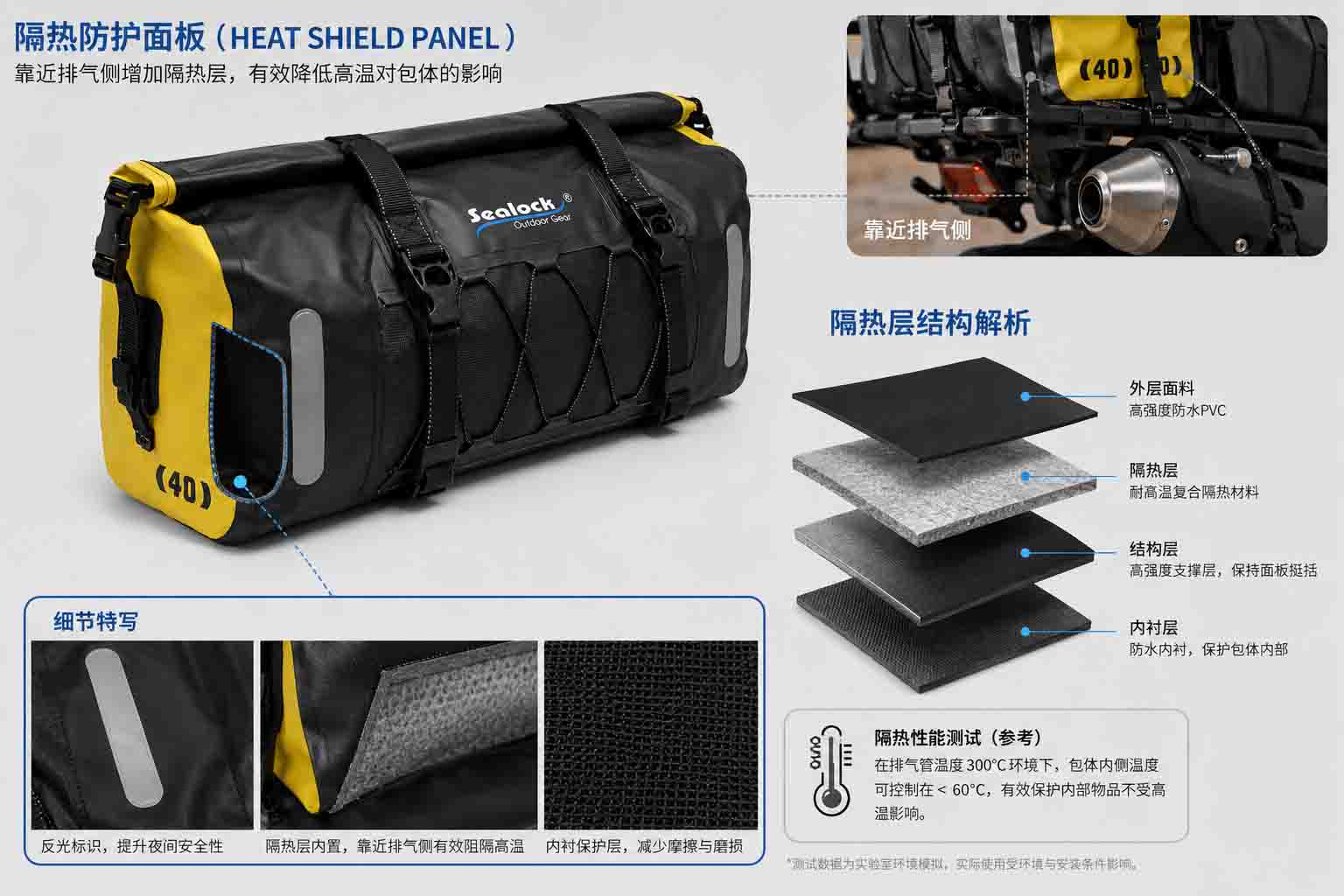
One issue is unique to motorcycles: exhaust heat. A bag mounted low can sit near the muffler, and unprotected fabric will scorch or deform over a season. If your target bikes run low-slung exhausts, specify a heat-shield panel or a mounting standoff. This failure surfaces months after launch, long after the sample passed inspection — so it belongs in the brief, not in a warranty claim.
5. Waterproofing: closure, seams, and IPX rating
Rain at highway speed is a pressure test, not a sprinkle. Three things decide whether the bag keeps gear dry:
- Closure: a roll-top is economical, reliable against driven rain, and glove-friendly — right for most touring SKUs. A welded waterproof zipper adds quick access at higher cost, for premium SKUs.
- Seams: specify RF-welded seams for any motorcycle dry bag claiming real protection. Welding fuses the fabric with no needle holes, the failure point of stitched bags under driven rain. The durability comparison is in our RF welding vs stitching analysis; our seams are pressure-validated to 1.0 bar per the 1.0 bar testing note.
- IPX rating: target IPX6 (resistance to powerful water jets) — a realistic match for highway rain. Over-speccing to submersion-grade IPX8 adds cost the application never sees.
6. Reflective safety features
A saddlebag sits exactly where a following driver looks, making it valuable conspicuity real estate — and increasingly a feature riders expect. Specify placement and grade, because "add reflective trim" without detail produces inconsistent samples. Common options: reflective piping or tape on rear-facing panels, high-visibility color panels, or a reflective brand logo that turns branding into a night-visibility feature. For commuter and adventure markets it's a low-cost, high-perceived-value differentiator that also photographs well in listings.
7. Four sourcing comparisons buyers ask about
Most motorcycle luggage sourcing decisions come down to four trade-offs. Here they are side by side:
PVC vs TPU saddlebags
| 500D PVC Tarpaulin | 420D Nylon TPU | |
|---|---|---|
| Position | Value & rugged lines | Premium & lightweight lines |
| Cost | Lower | Higher |
| Cold flex | Stiffer | Better |
Roll-top vs waterproof zipper
| Roll-top | Welded zipper | |
|---|---|---|
| Cost | Lower | Higher |
| Access | Unroll to open | Quick access |
| Best for | Most touring SKUs | Premium SKUs |
Universal mount vs quick-release
| Universal straps | Quick-release | |
|---|---|---|
| Fit | Many bikes, one SKU | Specific bikes |
| Tooling cost | Lower | Higher |
| Best for | New / broad lines | Platform-specific lines |
Trading company vs direct factory
| Trading company | Direct factory (Sealock) | |
|---|---|---|
| Price transparency | Marked-up middle layer | Factory-direct pricing |
| Engineering control | Outsourced, indirect | In-house RF welding & QC |
| Customization & QC | Slower, relayed | Direct line to engineering |
8. Customization, MOQ, and the tariff question
Customization variables to define before quoting: color (Pantone reference), branding method (silk-screen, heat transfer, welded patch, reflective logo), hardware (buckle grade, D-rings, bungee net points, rain-cover pocket), mounting configuration, and internal organization. Each adds a minimum-order and sometimes a tooling implication. MOQ scales with that customization:
| Order type | Indicative MOQ | Why |
|---|---|---|
| Stock shape, logo print | 300 pcs | No new tooling; print plate only |
| Stock shape, custom color + reflective | 300 pcs | Tied to dyed-fabric and trim minimums |
| Custom shape / model-specific mount | 500pcs | New welding and mounting tooling |
On lead time, plan in stages — spec confirmation, sampling with one revision, your approval, mass production, then QC and freight — and the stage you control most is how fast you approve samples. For motorcycle luggage buyers, the tariff question is now part of sourcing strategy: our dual-base setup (engineering and tooling in Dongguan, scaled assembly in Ho Chi Minh City) lets the same validated spec be produced from either base to manage tariff exposure without re-qualifying a supplier. The rationale is in our China–Vietnam dual-base strategy.
9. Case study: European motorcycle accessories distributor
A practical example of how the tariff strategy plays out in a real program:
| Country / market | Europe |
| Product | 50L、60L、80L SysBag WP L/L system waterproof motorcycle bag |
| Order quantity | 50000pcs |
| Material | HypalonLaser-cut mounting plate and 800D High-strength nylon base fabric |
| Challenge | import tariff pressure on China-origin goods |
| Solution | Developed by the Dongguan Development Department in China, the order production process has been transferred to the factory in Ho Chi Minh City, Vietnam for manufacturing. |
| Result | ~26% landed-cost reduction, on-time delivery |
10. The RFQ checklist
Copy this into your inquiry for accurate, comparable quotes on the first pass:
- Format: throw-over pair / single side bag / tail bag
- Capacity in liters (state if per-side or combined)
- Mounting system: universal straps / model-specific
- Material & denier (500D PVC / 420D nylon TPU) + reinforced abrasion & heat panels
- Closure: roll-top / welded zipper
- Target IPX rating + RF-welded seams
- Reflective spec: placement + grade
- Color (Pantone) + branding method
- Hardware & internal organization
- Order quantity + target ship date & destination
- Preferred production base (China / Vietnam) if tariff-sensitive
Bottom line: A motorcycle saddlebag is judged on whether it stays mounted, stays dry at speed, and survives abrasion and heat — and a supplier is judged on whether it can prove it builds to that standard. Specify mounting, seams, heat protection, and reflective safety explicitly, and vet the factory's capability before price, and you move from being quoted at to negotiating from control.
11. Frequently asked questions
The terms are largely interchangeable — "pannier" is the common British/European term for a side-mounted motorcycle bag, while "saddlebag" is more common in North America. Both usually refer to a throw-over pair or single side bag. A tail bag, by contrast, is strapped to the passenger seat or rear rack.
IPX6 is the realistic target — it covers powerful water jets, which is effectively what highway rain is. Achieve it with RF-welded seams and a quality roll-top or welded zipper. Submersion-grade IPX8 is unnecessary for road use and adds cost.
A direct factory gives you factory-direct pricing, in-house engineering and QC control, and a faster line to the people who actually weld your product. A trading company adds a markup and an extra relay between you and production. For customized motorcycle luggage where spec control matters, a direct manufacturer is generally the stronger choice.
500D PVC tarpaulin offers the abrasion resistance and value the category rewards and suits most lines. 420D nylon TPU is lighter and more cold-flexible, justifying its premium for adventure lines that compete on weight.
Yes. With engineering and tooling in Dongguan and assembly in Ho Chi Minh City, the same validated spec can be produced from either base, letting buyers manage tariff exposure without re-qualifying a new supplier.
Ready to spec your saddlebag program?
Browse the Sealock motorcycle saddlebag range and backseat bag line to see standard formats, then send your completed RFQ through our contact page. As a direct motorcycle luggage manufacturer with dual China–Vietnam production, we can return an accurate quote and a realistic timeline on the first reply.