The True Mechanics of Flotation Failure: Kayaking Capsizes
A standard 3-second submersion during a lateral kayak roll exposes an onboard gear bag to an instantaneous hydraulic pressure spike. Traditional stitched-and-taped bags fail here. When a kayak capsizes in moving water, the hull forces the bag against riverbed rocks or static structural mounts. This localized shearing action deforms the bag’s geometric opening. Inside the bag, the ambient air pocket shifts rapidly, creating an internal pneumatic counter-pressure against the closure system.
[Hydraulic Shockwave: Water Entry] ---> [Stitched Seams Shift] ---> [Seam Tape Delamination] ---> [Water Intrusion]
If your bag relies on standard sewing needles, the needle punctures have already physically compromised the base fabric. When water pressure rises during a capsize, these microscopic puncture zones stretch. The internal waterproof polyurethane tape delamination begins within 400 milliseconds of exposure to a high-energy water impact.
Your DSLR camera, drone battery, or electronic lure transmitter does not drown in an open pool; it ruins because a compromised seam allows a localized spray of pressurized, high-salinity water to compromise the internal circuit boards. Absolute air-tight encapsulation is a mechanical necessity, not a marketing luxury.
RF Welding vs. Stitched Seams: Micro-Tolerance Engineering
To eliminate the systemic failure points of needle holes, Sealock completely bypasses traditional mechanical sewing and adhesive seam tapes. The entire structure relies on 500D TPU laminated fabric joined via Radio Frequency (RF) Welding. (For a comprehensive breakdown of dielectric parameters and machine calibrations, refer to our core technical documentation: The Ultimate Guide to Seamless Waterproof Construction & RF Welding).
The Molecular Fusion Principle
⚡ RF Welding Principle: High-frequency electromagnetic energy (27.12 MHz) directly excites the molecular structure of the 500D TPU lamination, forcing the overlapping fabric layers to fuse into a single, seamless solid weld line.
In our production cell, we do not tolerate parameter drift. A deviation of just 0.5mm in tool-die alignment or a 0.3-second drop in dwell time under high-frequency pressure results in an incomplete molecular bond, leading to catastrophic field failure under structural load.
-
Our Manufacturing Limit: Sealock locks the RF welding pressure at a precise 6.5 bar to ensure zero material thinning along the weld perimeter.
-
The Material Integrity: The base 500D TPU laminated fabric retains structural flexibility at -20°C. Under severe drop-impact forces, the fused seam zones exhibit zero layer delamination—the welded joint behaves like a continuous piece of the original material.
🛠️ The Audit Kill-Shot (B2B Procurement Defense)
When auditing a waterproof gear manufacturer, demand to see their historical dielectric output logs and real-time press-force digital readouts. If a vendor cannot show you the automated pressure-retention variance records for their last three production runs, they are estimating bond consistency instead of engineering it.
Product Anatomy & Kinetic Breakdown
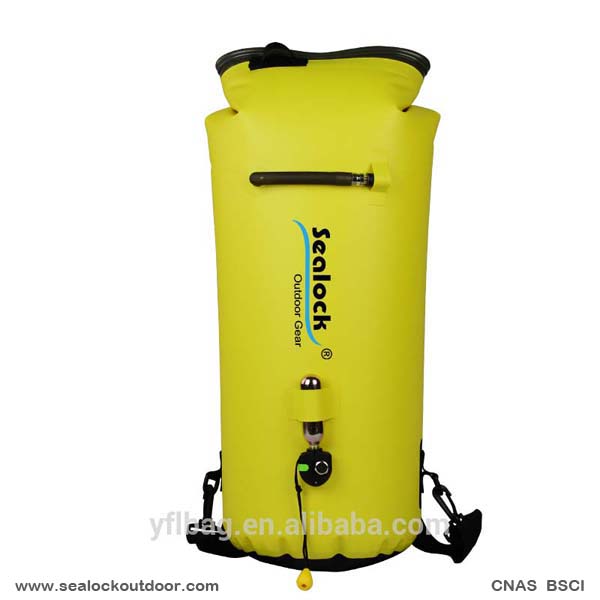
A high-performance dry duffel functions as an active pressure vessel during an outdoor emergency. These precise micro-tolerance engineering principles are fully integrated into our standard production line, specifically within the Sealock 40L TPU Marine-Grade Duffel (Model: SL-D045).
+-------------------------------------------------------------+
| [ Roll-Top Closure Area ] ---> 3-Fold Mechanical Seal |
| [ Air Valve (One-Way) ] ---> Pneumatic Compression Control |
| [ Heavy-Duty MOLLE ] ---> High-Load Laser Cut Anchors |
| [ Dry/Wet Separation ] ---> Internal TPU Barrier Wall |
+-------------------------------------------------------------+
-
Air Valve (One-Way Control): This rotary compression valve purges trapped interior air post-closure without compromising the bag's integrity. The valve body is directly RF-fused into the 500D TPU wall, completely avoiding glue deterioration.
-
Heavy-Duty MOLLE System: Laser-cut patch anchors are perimeter-welded onto the exterior shell. This allows users to lash critical communications gear externally without running any mounting hardware through the internal dry chamber.
-
Dry/Wet Separation & Waterproof Zipper: An internal TPU barrier wall segregates saturated river gear from sensitive electronics. The primary access hatch utilizes a specialized high-clearance gas-tight zipper engineered to withstand heavy linear pulling forces without tooth separation.
Standard Technical Specifications
The following mechanical data defines the baseline performance metrics for Sealock's 40L technical duffel production runs. When evaluating substrate durability against extreme cold environments for your product line, see our comparative failure analysis on TPU vs PVC Waterproof Bags.
|
Engineering Parameter
|
Industrial Specification Data
|
|
Material Base
|
500D Polyester Core + Dual-Sided TPU Lamination
|
|
Volumetric Capacity
|
10~100 Liters (Optimized for marine/kayak cargo bays)
|
|
Waterproof Rating
|
IPX7 (Submersible up to 1 meter for 30 consecutive minutes)
|
|
Minimum Order Quantity (MOQ)
|
300 Pieces per custom manufacturing run
|
|
Sample Development Cycle
|
5 to 10 Business Days (Includes technical CAD and pattern cutting)
|
B2B Procurement Action: To validate these manufacturing tolerances on your own QA test bench, Request a Custom 40L Technical Duffel Sample Run directly from our engineering team.
Factory Verification & Empirical QA
Real engineering requires transparent, empirical validation. We do not evaluate waterproof performance with simple splash tests. Every single production batch is subjected to a rigorous internal QA sequence.
[Factory Production] ---> [100% Inflation Test] ---> [30-Min Hydrostatic Submersion] ---> [Zero Leak Clearance]
We subject sample units to a 30-minute hydrostatic submersion test inside our dedicated pressurized testing tanks. Technicians completely submerge inflated duffels under 1 meter of water to monitor for microscopic pneumatic bubbling.
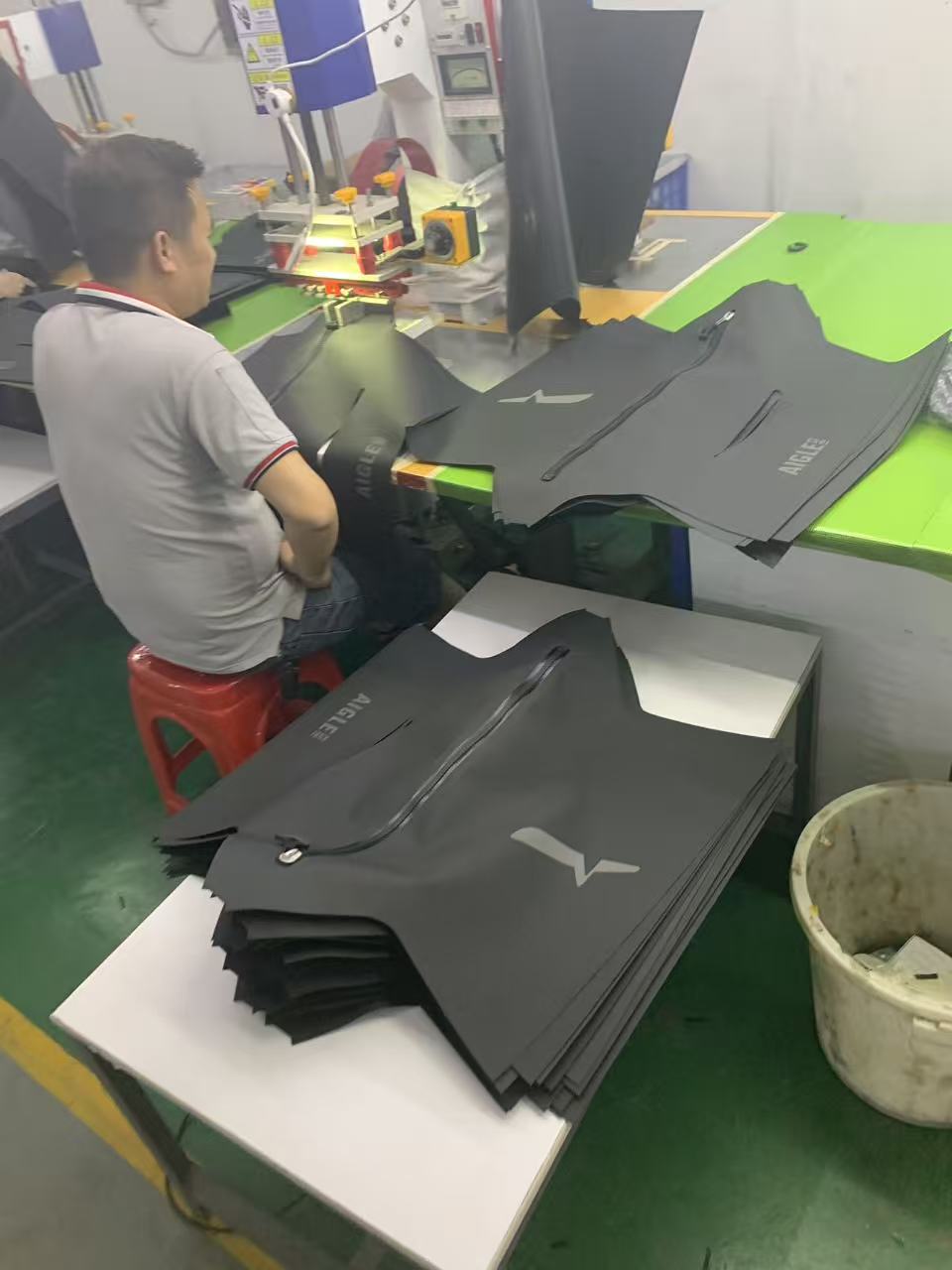
Our production floor uses automated laser-cutting stations alongside specialized computer-monitored RF welding platforms to guarantee that every single weld line retains its rated shear strength before final packaging.
Problem-Solving FAQ
Q: How long can an IPX7 dry bag stay underwater?
A: Under standard testing protocols, an IPX7-rated enclosure prevents water ingress at a depth of 1 meter for up to 30 continuous minutes. In real-world kayak accidents, survival times depend directly on the dynamic pressure of the water current. If a bag is pinned against an obstacle in swift, moving water, the local dynamic pressure can quickly exceed the structural limitations of the seal, leading to rapid water intrusion.
Q: Does the TPU material crack when exposed to extreme UV rays or saltwater over time?
A: Unlike cheap polyvinyl chloride (PVC) which degrades rapidly under ultraviolet exposure due to plasticizer migration, industrial-grade 500D TPU uses an unplasticized polyether structure. This specialized compound is highly resistant to saltwater hydrolysis and UV degradation, meaning it won't harden, peel, or crack even after months of continuous deployment in marine environments.
 English
  Español
  Português
  русский
  Français
  日本語
日本語  Deutsch
  tiếng Việt
  Italiano
  Nederlands
  ภาษาไทย
  Polski
  Svenska
  magyar
  Malay
Malay  বাংলা ভাষার
  Dansk
Dansk  Suomi
Suomi  हिन्दी
  Pilipino
  한국어
한국어  Türkçe
  Gaeilge
  العربية
  Indonesia
  Norsk
Norsk  تمل
تمل  český
český  ελληνικά
  український
  Javanese
  فارسی
فارسی  தமிழ்
தமிழ்  తెలుగు
  नेपाली
  Burmese
  български
  ລາວ
ລາວ  Latine
  Қазақша
  Euskal
  Azərbaycan
  Slovenský jazyk
  Македонски
  Lietuvos
  Eesti Keel
  Română
  Slovenski
  मराठी
मराठी  Srpski језик