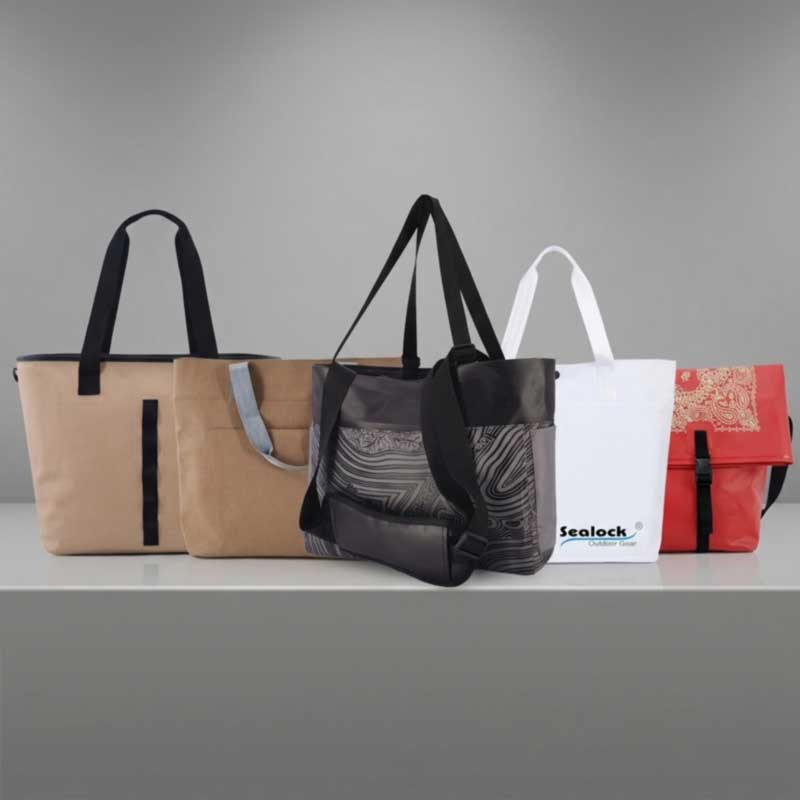
Sealock is an OEM waterproof tote bag manufacturer and supplier. A tote looks like the simplest bag to customize, and that's exactly why it's easy to get wrong: the shape is familiar, so buyers under-specify it, and small decisions — handle drop, gusset depth, closure type — quietly decide whether the finished bag is usable, brandable, and waterproof. This guide walks through every part of a waterproof tote a brand can customize, with the real numbers behind each choice, so a spec goes to the factory complete.
Start With Size and Gusset
Size begins with length, width, and height, but the measurement buyers most often forget is the gusset — the depth of the base and sides that gives a tote its capacity and lets it stand up. Two points matter for a brand:
A deeper gusset holds more and helps the bag stand upright, but it reduces the flat print area — a 4.5″ gusset can cut usable logo width by 1–3″, so decide the branding and the gusset together.
A flat, broad welded base gives the best standing structure on sand or a boat deck — a real advantage of a welded tote over a soft canvas one.
Confirm capacity in litres as a project requirement, then prove it on the sample rather than assuming it from dimensions alone.
Every part is a decision — specify them together, not one at a time.
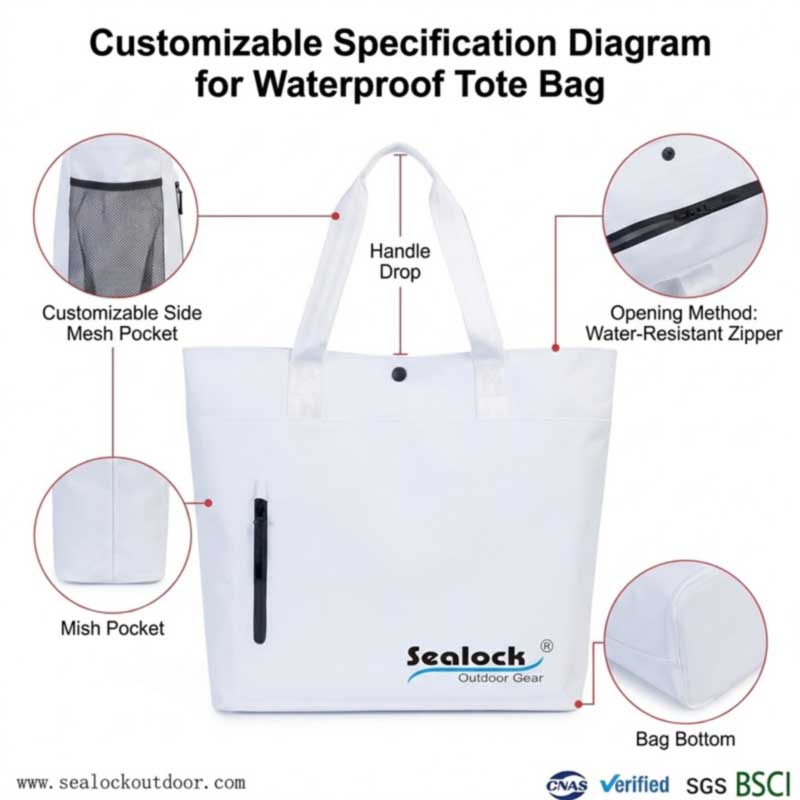
Handle Drop: The Most Under-Specified Detail
Handle length decides how — or whether — a tote gets carried, and it's the detail buyers most often overlook. The numbers are well established:
Carry style
Handle length / drop
Best for
Hand / forearm carry
Short handles ~35–45 cm (12–16″)
Small totes, gifts, cosmetics, boutique
Shoulder carry
Long handles ~60 cm; drop ~22–30 cm (9–12″)
Beach, shopping, everyday, events
Shoulder over a jacket
20–22″ handles
Trade shows, conferences, cold-weather
The practical warning: a short-handled bag that can't go over the shoulder gets set down and left behind. If the tote is a giveaway meant to keep circulating a logo, the handle has to clear a shoulder — with a jacket on. Adjustable or dual-length straps widen the audience. And because the handle anchors take the whole load on a tote, they need reinforcement, which on a welded bag means welded-in anchors, not stitched-on straps.
Closure: Open, Zip, Magnetic, or Drawcord
The opening is the biggest single decision for a waterproof tote, because an open top is the category's main weakness — sand, rain, and spills get in, and contents can fall out. The options:
Open top — convenient and casual, easiest to load, but insecure and not sealable.
Zip top — the most secure and the best for keeping water and sand out; the right default for a genuinely waterproof tote.
Magnetic snap or hook-and-loop — a quick semi-closure, tidier than open but not sealed.
Drawcord / roll-down — a dry-bag-style top for a sealed, submersion-capable tote.
Match the closure to the promise: if the tote is sold as waterproof rather than just water-shedding, it needs a zip or roll-top, not an open mouth. The trade-offs between sealed closures are compared in our guide to roll top vs waterproof zipper camping bags for oem projects.
Pockets, Lining, and Wet/Dry Separation
Front zip pocket — for keys, cards, phone, and the small items that otherwise sink to the bottom.
Inner mesh or slip pocket — organization inside the main compartment.
Wet/dry pocket — a sealed internal or external pocket that keeps wet swimwear away from dry clothing, a feature beach and pool buyers increasingly ask for.
Bottle pocket, key hook, card slot — specify by the real contents the tote must carry.
On a welded waterproof tote, any internal pocket that pierces the sealed shell has to be engineered so it doesn't compromise the barrier — another reason to state pocket placement in the brief rather than leaving it to the floor.
Material and Denier
500D PVC tarpaulin — tough, wipe-clean, cost-effective; the workhorse for beach and shopping totes. A 0.52 mm tarpaulin gives a substantial, structured feel.
420D TPU-coated nylon / TPU tarpaulin — lighter, softer, low odour, and flexible in the cold; the premium and cold-weather choice.
TPU-coated canvas — the look of canvas with a genuine waterproof coating, for a retail-fashion tote that still wipes clean.
Insulated 840D TPU — for a cooler tote that keeps food and drinks cold.
Recycled (GRS) options — for a documented sustainability story, which a majority of consumers now weigh in branded products.
Denier sets strength and weight, not waterproofing — the coating and the welded seams do that. Specify the base denier, the coating, and the seam method separately; the fuller comparison is in our waterproof sling bag material comparison guide.
Branding on a Sealed Shell
Because a waterproof tote's shell is a sealed barrier, every branding method must decorate the surface without perforating it:
Silk-screen — bold, colourful, cost-effective at volume; specified with a catalysed ink that resists cracking on a flexible shell.
Welded logo — a patch fused into the body; clean, durable, fully waterproof.
Hot-pressing / embossing — a subtle tonal mark.
Woven label and custom hardware — side label, branded zipper pulls, and buckles for a finished retail feel.
Remember the gusset-and-print interaction: confirm the logo size against the flat printable panel after the gusset is set, and against the handle position so nothing overlaps.
Packaging and Carton Efficiency
Totes are larger than small bags and crease or deform if packed poorly, so packaging is part of the spec, not an afterthought. Decide the fold or roll for shipping, the individual polybag, and — for retail — the hangtag, care card, barcode, and inner/master carton marking, so bags arrive shelf-ready and in good condition. Carton quantity per size drives per-unit freight, so confirm it at quotation.
The Customization Checklist
Element
What to specify
Size & gusset
L×W×H, gusset depth, target capacity in litres
Handle
Drop length, webbing width, reinforcement, hand vs shoulder
Rating in numbers, which pockets sealed vs water-resistant
Packaging
Polybag, hangtag, care card, barcode, carton
The Product Basis
These welded totes, from Sealock's waterproof tote bag line, are equal starting points for a custom programme — none is ranked above another; each shows a different combination of the choices above:
Model & specs
Closure & carry
Material
MOQ
SL-H052 Waterproof Welded Tote — 500D PVC tarpaulin (or 420D TPU); 38×52×16 cm; folding; front zip pocket + inner mesh pocket; nine colours; sample 3–5 days.
Any of these can be re-spec'd against the checklist above — a different handle drop, a sealed closure, a wet/dry pocket, a recycled fabric, or a new colourway — or a tote can be developed from a sketch. The workflow and timeline are set out in our OEM waterproof sling bag supplier guide.
One welded platform, many configurations — specified to each brand's use case.
Quality Control: IQC / IPQC / OQC
Quality is gated in three tiers — IQC (incoming fabric and webbing against the signed colour card, with colour difference and fastness), IPQC (cutting tolerance, weld integrity, handle-anchor assembly, and pocket installation on the line), and OQC (AQL sampling, a real water-submersion batch test on sealed types, and gold-sample comparison, SGS/QIMA optional). For totes the handle anchors get a 1,500+ cycle load test and jerk-loading, since handles tearing off is a leading complaint; the lab also runs weld bond/peel strength, abrasion, tensile, salt spray, colour fastness, and colour difference — colour control mattering on a retail shelf item. Sealed totes are rated up to a verified IPX7 and proven on the finished bag.
FAQ: Waterproof Tote Customization
Q: What handle length should we choose?
A: Short 35–45 cm handles for hand-carried small totes and gifts; longer ~60 cm handles with a 22–30 cm drop for shoulder carry; 20–22″ for wearing over a jacket. If the tote must go over the shoulder — especially a giveaway — don't under-size the handle, or it gets set down and left behind.
Q: Open top or zip — which for a waterproof tote?
A: If it's sold as waterproof, a zip or drawcord/roll-top, because an open top lets sand, rain, and spills in and contents out. Open is fine for a casual water-shedding tote but can't be sealed.
Q: Does the gusset affect our logo?
A: Yes — a deeper gusset reduces the flat print panel, so a 4.5″ gusset can cut usable logo width by 1–3″. Decide the gusset and the branding together, and confirm the logo size against the flat panel and handle position.
Q: How do you keep the handles from tearing off?
A: On a welded tote the handle anchors are fused into the shell rather than stitched on, then load- and jerk-tested at QC. Handles detaching is a leading tote complaint and a construction issue.
Q: Can we add wet/dry separation?
A: Yes — a sealed internal or external wet pocket keeps wet swimwear away from dry items, popular for beach and pool totes.
Q: Do you offer recycled materials?
A: Yes — recycled (GRS-certified) options, which matter now that a majority of consumers weigh recycled or reusable materials in branded products.
Talk to the Factory
To customize a waterproof tote bag to your spec, contact Sealock at info@sealock.com.hk or +86-769-82009361. Over twenty years in welded waterproof bags, welded-in handles, every closure and material option, recycled fabrics, and finished-product submersion testing.
We use cookies to offer you a better browsing experience, analyze site traffic and personalize content. By using this site, you agree to our use of cookies.
Privacy Policy
 English
  Español
  Português
  русский
  Français
  日本語
日本語  Deutsch
  tiếng Việt
  Italiano
  Nederlands
  ภาษาไทย
  Polski
  Svenska
  magyar
  Malay
Malay  বাংলা ভাষার
  Dansk
Dansk  Suomi
Suomi  हिन्दी
  Pilipino
  한국어
한국어  Türkçe
  Gaeilge
  العربية
  Indonesia
  Norsk
Norsk  تمل
تمل  český
český  ελληνικά
  український
  Javanese
  فارسی
فارسی  தமிழ்
தமிழ்  తెలుగు
  नेपाली
  Burmese
  български
  ລາວ
ລາວ  Latine
  Қазақша
  Euskal
  Azərbaycan
  Slovenský jazyk
  Македонски
  Lietuvos
  Eesti Keel
  Română
  Slovenski
  मराठी
मराठी  Srpski језик