Sealock is a waterproof sling bag manufacturer and OEM supplier. Material is the decision every other spec depends on — it sets the weight on the shoulder, the feel in the hand, the cold-weather behaviour, the abrasion life, the price, and even the environmental story. For a sling worn across the body all day, those trade-offs are felt directly. This guide compares the real options — TPU-coated fabric, PVC tarpaulin, and the denier and coating choices underneath — with the numbers behind each, so a brand can match the material to the use rather than to a catalogue name.
The Two Main Contenders
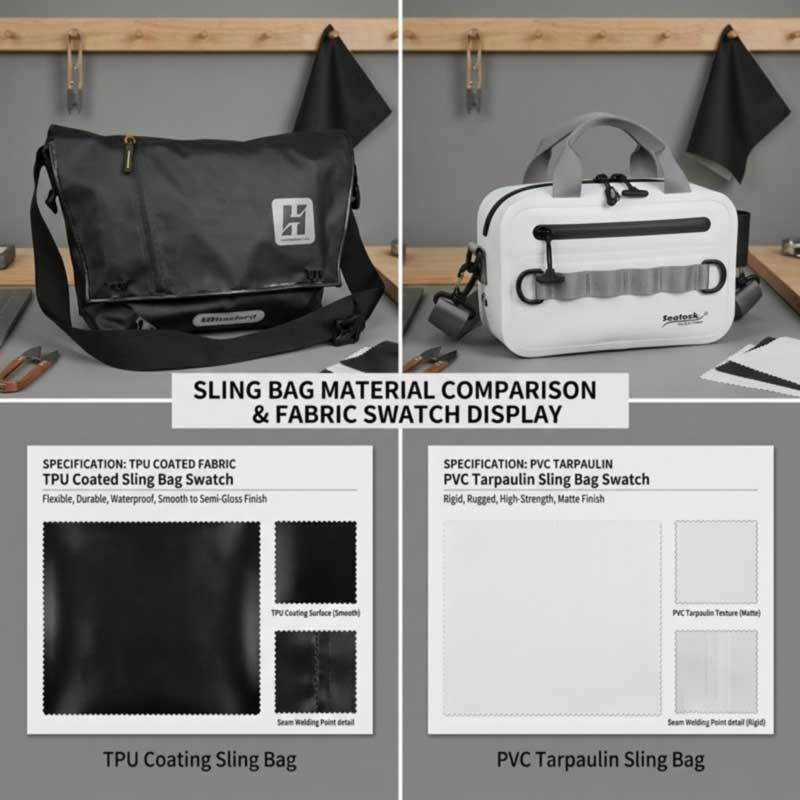
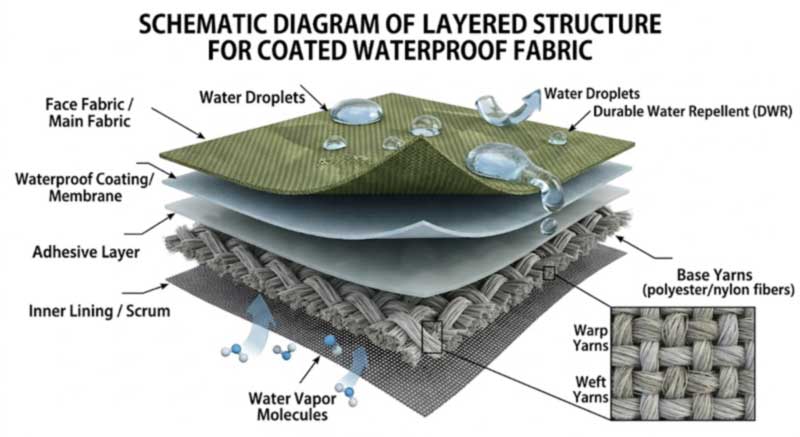
Both TPU-coated fabric and PVC tarpaulin are composites: a coating bonded to a polyester or nylon base. The base gives strength; the coating makes it waterproof; and both are weldable, so both can build a genuinely sealed sling. Where they differ is in almost every property that follows.
Property
TPU-coated fabric
PVC tarpaulin
Weight
Lighter
Heavier
Flexibility
Stays supple; springs back
Stiffer; holds shape
Cold-weather
Flexible to around −50°C
Turns brittle below about −20°C
Tear strength
Higher (roughly 50–100 N/mm)
Lower (roughly 20–40 N/mm)
Surface abrasion
Very good in heavy denier
Excellent; thick coating
UV endurance
2,000+ hours
Begins to break down at 500–1,000 hours
Odour
Low
Can have a stronger smell
Cost
Higher
Lower
Eco positioning
Recyclable; PVC-free story
Harder to position as green
Same waterproof job, different trade-offs — the right material depends on the use.
Where TPU Wins
Weight and flexibility — TPU is naturally elastic, so it bends and springs back without cracking, and stays supple through thousands of roll cycles. On a sling worn all day, lighter and softer against the body is a real advantage.
Cold-weather performance — it stays flexible to around −50°C, while PVC relies on plasticizers that migrate out over time and stiffen the fabric. For winter and shoulder-season lines, this alone can decide the material.
One-handed sealing — testers consistently report TPU dry bags are easier to close one-handed, which matters when the wearer is paddling or moving.
UV and longevity — it holds up far longer in sunlight and typically lasts several years outdoors, versus a shorter service life for PVC.
Low odour and recyclability — important for premium and eco-positioned lines.
Where PVC Wins
Abrasion and rigidity — a thick PVC coating resists surface scraping extremely well and gives a structured body that holds its shape — useful where a bag takes constant rubbing.
Cost — PVC tarpaulin is the value baseline, which is why brands often launch a line on PVC and add TPU for higher-end versions.
Waterproof pressure resistance — a good PVC tarpaulin blocks water under high pressure, well suited to rugged dry-bag-style slings.
Proven and consistent — it welds cleanly and predictably, making it a dependable choice for large runs.
PVC is not automatically the “cheap” option: good tarpaulin still needs stable coating, strong adhesion, clean welding behaviour, low odour, and consistent thickness. Low-grade PVC is what cracks, smells, or delaminates — the grade matters as much as the material.
Denier and Coating: Read Past the Number
Buyers often specify a material by denier — 420D, 500D, 840D — but the number alone doesn't tell the whole story. Denier measures the thickness of the base yarn: it drives strength and weight, not waterproofing. What actually keeps water out is the coating and the welded seams. A useful way to think about the layers:
The base (denier) — the polyester or nylon backbone; higher denier means more tear and load strength, and more weight.
The coating — TPU or PVC; this is the waterproof layer, and its thickness and adhesion decide durability as much as the denier does.
Heavy-denier TPU — an 840D TPU laminate matches the abrasion resistance most outdoor use needs while keeping TPU's weight and flexibility advantages, which is how a TPU bag closes the gap with PVC on toughness.
The practical rule: never approve a material on the name or the denier alone. “PVC tarpaulin” and “TPU fabric” each span many quality levels, and the best spec on paper fails if the coating adhesion or welding behaviour is poor. The deeper material science is in our TPU waterproof material guide.
Denier is the base yarn; the coating is what keeps water out — specify both.
Matching Material to the Sling's Use
Sling use case
Recommended material
Everyday / urban-outdoor, premium feel
TPU-coated nylon (420D+) — light, soft, low odour
Cold-climate / winter lines
TPU — stays flexible where PVC stiffens
Rugged fishing / marine, abrasion-heavy
500D PVC tarpaulin, or heavy 840D TPU
Value / entry lines, volume
500D PVC tarpaulin — the cost baseline
Eco-positioned / premium brand
Recycled (GRS) TPU-based fabric
Many ranges carry both: PVC for the rugged and value pieces, TPU for the light, cold-weather, and premium ones. The right answer is the material that fits the use, which is why a capable factory specifies both rather than pushing one.
The Product Basis
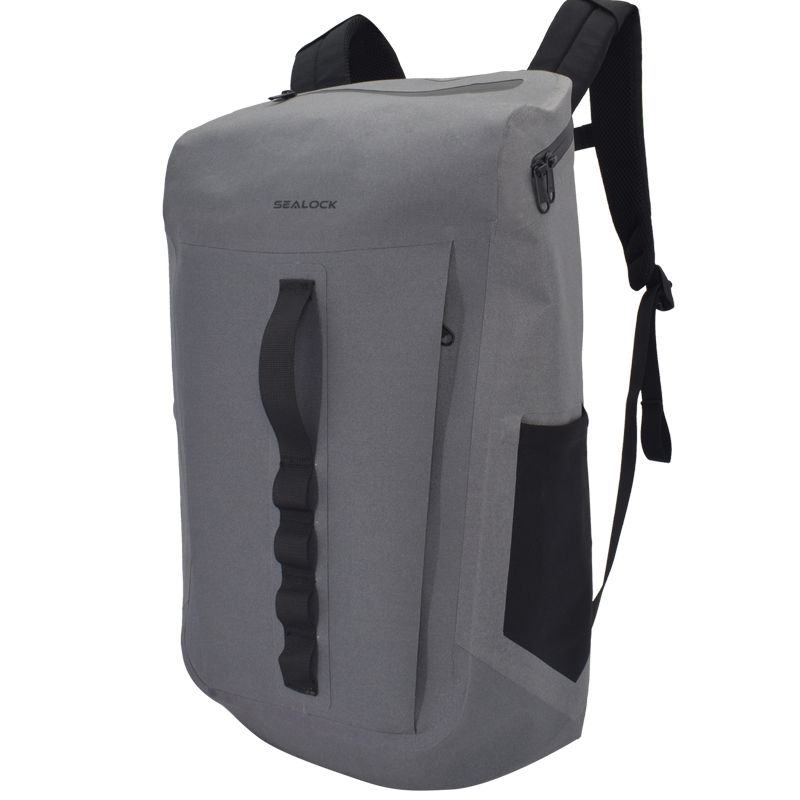
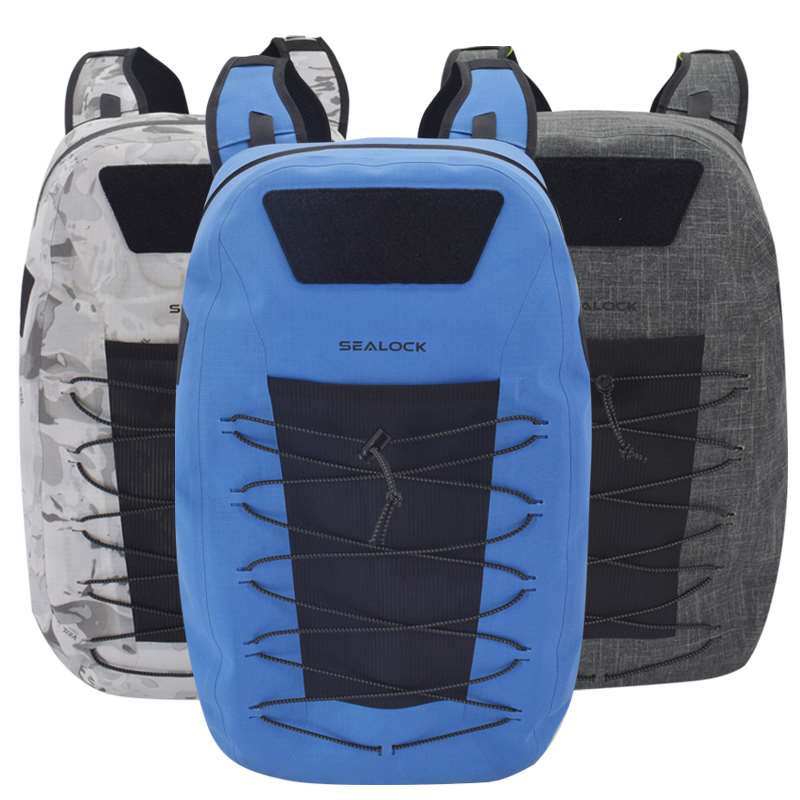
These welded bags, from Sealock's waterproof sling bag line, show the material options in practice and serve as equal starting points for an OEM order — none is ranked above another:
Model & specs
Material & why
MOQ
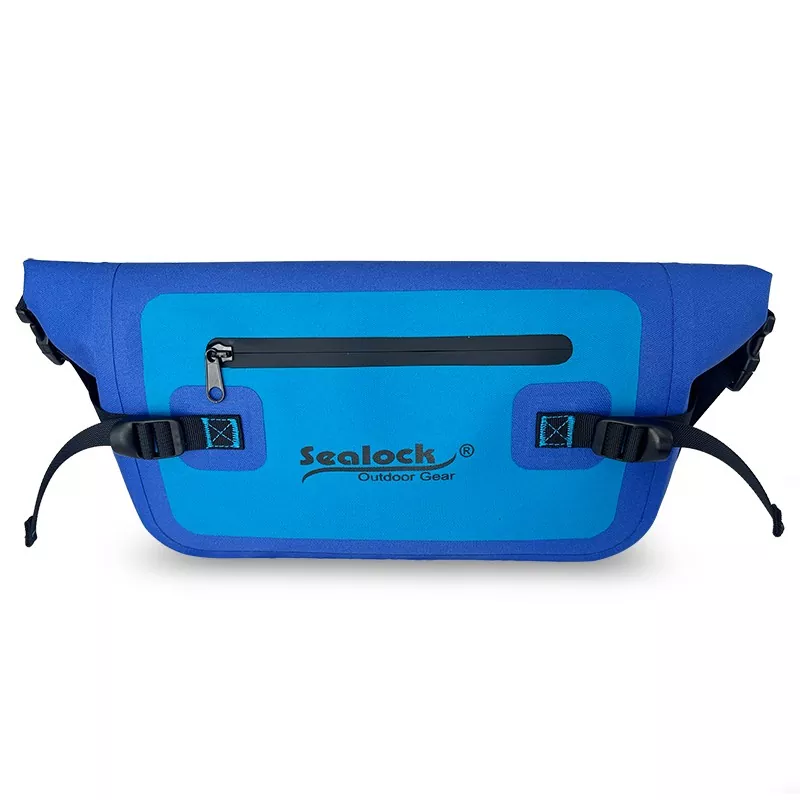
SL-F115 Waterproof Sling Waist Pack — approx. 3L (24×8×15.5 cm), 0.56 kg; IPX7; airtight main zipper + water-resistant front pocket; breathable padded back panel; adjustable removable strap.
500D PVC — rugged, structured, cost-effective for a sealed active pack
300
Waterproof Messenger & Sling Dry Bag — sample size 9L (L31×W10×H31 cm), custom sizes; black, blue, orange, yellow, grey, red and more; silk-screen; sample 7–10 days.
Waterproof Sling Bag with TPU — welded TPU tarpaulin construction; sizes, colourway, pocket layout, and strap system specifiable per order.
TPU tarpaulin — flexibility and UV endurance for a premium line
300–500
Material, denier, colourway, closure, and branding are all specifiable per order, including recycled (GRS) options and heavy-denier TPU where a brand needs TPU's feel with PVC-level toughness.
Both materials, several deniers — specified to the use, not to a default.
Quality Control Across Materials
Whichever material a project uses, quality is gated in three tiers — IQC (incoming fabric checked for coating adhesion, thickness, colour difference, and fastness against the signed card), IPQC (weld integrity, which differs by material, checked in line), and OQC (AQL sampling, a real water-submersion test, and gold-sample comparison, SGS/QIMA optional). The lab runs weld bond/peel strength, a 1,500+ cycle load test with jerk-loading on strap anchors, abrasion, tear, tensile, UV, salt spray, colour fastness, and colour difference — the abrasion and UV tests being where the PVC-versus-TPU difference shows up most.
FAQ: Sling Bag Materials
Q: Is TPU or PVC better for a sling bag?
A: It depends on the use. TPU wins on weight, cold-weather flexibility, low odour, UV endurance, and eco positioning; PVC wins on abrasion resistance, rigidity, and cost. For an everyday or cold-climate sling, TPU; for a rugged, value, or abrasion-heavy one, PVC.
Q: Does a higher denier mean more waterproof?
A: No. Denier is the thickness of the base yarn — it drives strength and weight. Waterproofing comes from the coating and the welded seams. Specify the denier, the coating, and the seam method separately.
Q: Is TPU as tough as PVC?
A: In a heavy denier such as 840D, TPU matches the abrasion resistance most outdoor use needs while keeping its weight and flexibility advantages. For the most abrasion-heavy uses, thick PVC still leads.
Q: Why does my PVC bag stiffen over time, especially in the cold?
A: PVC relies on plasticizers to stay flexible, and those migrate out gradually, stiffening the fabric — an effect the cold accelerates. TPU is naturally elastic and doesn't depend on plasticizers, so it stays supple.
Q: Which material is better for an eco-positioned brand?
A: TPU, and especially recycled (GRS) TPU-based fabric, is easier to position as sustainable and PVC-free, in step with where the outdoor market has moved.
Q: Can we mix materials across one product range?
A: Yes — a common approach is PVC for rugged and value models and TPU for light, cold-weather, and premium ones, all built to the same welded, submersion-tested standard.
Talk to the Factory
To choose the right material for your waterproof sling bag, contact Sealock at info@sealock.com.hk or +86-769-82009361. Over twenty years in welded waterproof bags, both TPU and PVC construction, recycled-material options, and finished-product submersion testing on every design.
We use cookies to offer you a better browsing experience, analyze site traffic and personalize content. By using this site, you agree to our use of cookies.
Privacy Policy
 English
  Español
  Português
  русский
  Français
  日本語
日本語  Deutsch
  tiếng Việt
  Italiano
  Nederlands
  ภาษาไทย
  Polski
  Svenska
  magyar
  Malay
Malay  বাংলা ভাষার
  Dansk
Dansk  Suomi
Suomi  हिन्दी
  Pilipino
  한국어
한국어  Türkçe
  Gaeilge
  العربية
  Indonesia
  Norsk
Norsk  تمل
تمل  český
český  ελληνικά
  український
  Javanese
  فارسی
فارسی  தமிழ்
தமிழ்  తెలుగు
  नेपाली
  Burmese
  български
  ລາວ
ລາວ  Latine
  Қазақша
  Euskal
  Azərbaycan
  Slovenský jazyk
  Македонски
  Lietuvos
  Eesti Keel
  Română
  Slovenski
  मराठी
मराठी  Srpski језик