Sealock is an OEM fly fishing backpack manufacturer and supplier. Most fly fishing pack content is written about slings, because a sling covers the majority of fishing situations. The backpack tier is different, smaller, and worth building deliberately: it exists for the days when the fishing starts a long way from the truck, and it answers a set of problems a sling structurally cannot. This guide covers when a fly angler actually needs a backpack, the access problem that comes with it, and the combo architecture that solves it.
The Threshold: When a Sling Stops Being Enough
The line is fairly clear in practice. When the fishing starts well beyond the truck — hiking three miles or more into the backcountry — a real backpack becomes necessary, because the trip requires things the other carry systems simply cannot hold: a first aid kit, serious rain gear, extra layers, sometimes a stove.
Three capabilities are exclusive to the backpack tier:
A genuine hip belt. It transfers the load onto the hips and off the shoulders. This is the single biggest reason a backpack beats a large sling on a long approach — anglers consistently report one-shoulder fatigue from slings by the end of a full day.
Rod tube carry. A dedicated sleeve or lash straps for a rod tube keeps hands free on the trail, and matters equally on long boat rides where a spare rod travels with the angler.
Real capacity. Layers, food, water, safety kit and an extra reel or spool, without the bag becoming an unstable weight hanging off one shoulder.
Beyond the backcountry, the same tier serves remote flats travel, alpine lake hikes, and multi-day or destination trips where the pack doubles as the travel bag.
Three miles from the truck is where the backpack tier begins.
The Backpack's One Real Weakness
It is worth stating plainly, because designing around it is the whole opportunity: a backpack has to come off to be opened. To reach anything buried inside, the angler stops, removes the pack, and sets it down — which is exactly what you cannot do while standing in current with a fish rising.
That single limitation shapes how backcountry anglers actually operate: most pair a backpack with a small chest pouch or a lanyard for the handful of items they need constantly — tippet, nippers, a working fly box. The pack carries the day; the chest unit carries the next five minutes.
The Combo Architecture
The strongest answer in this tier is a backpack with a chest unit that buckles into it, giving what the market describes as the best of both worlds. It suits precisely the anglers who need a backpack in the first place — those putting in miles, fishing remote flats, working the backcountry, or hiking to an alpine lake — because it allows two modes:
Full carry on the approach, with everything in the pack and the chest unit attached.
Pack off, fish on — drop the backpack at the head of a run and wade off with the chest unit holding the essentials.
That second mode also addresses a quieter concern anglers raise: leaving a full pack unattended on a bank is uncomfortable, so being able to carry the valuables forward matters.
Sealock builds this architecture. Our 24L fly fishing pack carries a detachable front extended vest that functions as a standalone chest pack, with its own separate airtight pouch for a phone and batteries — so the critical items stay sealed and on the body when the main pack is set down.
The Wet-Wading Detail Worth Specifying
One requirement that separates a fly pack from a general hiking pack: wet wading means no wader pockets. An angler in shorts and boots has nowhere to put car keys, a phone or a licence. The pack must therefore include a secure, sealed, zippered home for keys and small valuables — not a mesh pocket, not an open slip.
On a welded waterproof pack this is straightforward to build well, and it is a detail worth calling out in your listing copy because anglers look for it.
Pack down, chest unit on — the architecture that fixes the backpack's access problem.
The OEM Specification Checklist
Element
What to specify
Capacity
20–25L for backcountry day trips; more for multi-day and destination travel
Carry system
Padded harness plus a genuine load-bearing hip belt, not a token strap
Chest unit
Detachable, usable standalone, with its own sealed pouch
Rod tube carry
Sleeve or lariat straps, positioned clear of the casting arm
Quick-access pocket
An external pocket makes a backpack viable without removing it
Key security
A sealed zippered compartment for keys and valuables — essential for wet wading
Tool matrix
Suspension system for tools, net attachment, fly patch, retractor stations
Hydration
Side bottle storage — a common reason anglers move up from vest or chest pack
Closure & rating
Airtight waterproof zipper on a welded body, verified on the finished pack
Why Welded Construction Matters in This Tier
Backcountry fly fishing is the use case that punishes water-resistant construction hardest — long exposure, no shelter, no way to dry out, and consequences if a layer or a first aid kit gets soaked miles from the car. The premium end of this market has moved decisively to submersible, sealed-zipper builds for that reason.
Our fly packs use high-frequency welded seamless bodies with airtight waterproof zippers — no needle holes in the barrier, water, dust and mud kept out even in deep stream sections. The harness, hip belt, tool stations and vest components are sewn, at high tension, onto flat panels before the shell is welded, so load points are engineered rather than glued on. It's the same welding and sewing platform we run for brands including ORVIS, SIMMS and PENN.
The Product Basis
Image
Model & specs
Tier it serves
MOQ
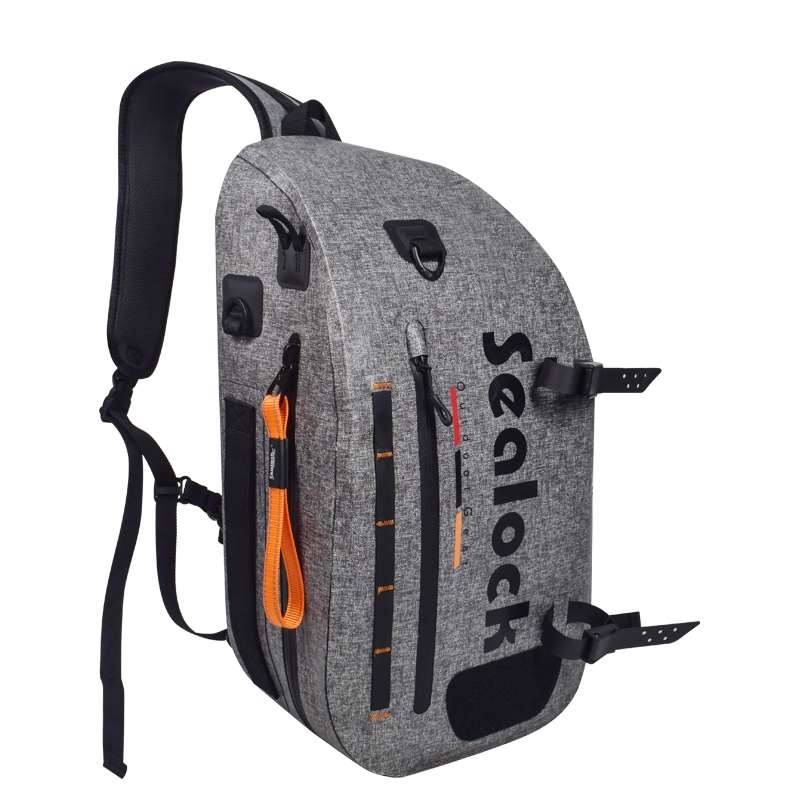
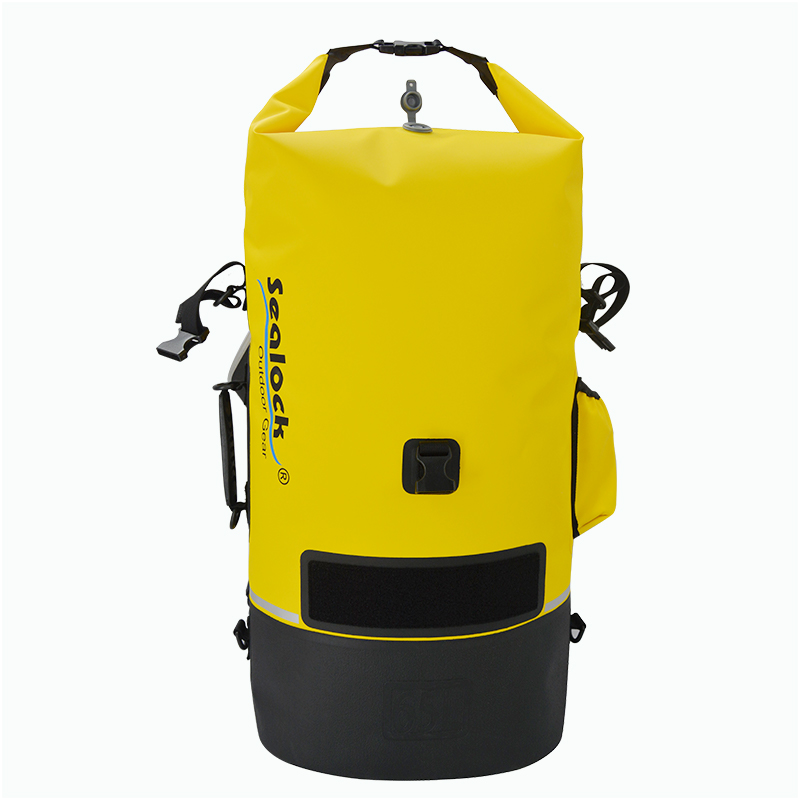
SL-E008-1 Fly Fishing Pack 24L — 840D TPU double-sided lamination; seamless airtight construction; waterproof zipper with strong vapour tightness; front fly fishing tool suspension system; side bottle storage; internal storage for small electronics; detachable front extended vest usable separately, with its own airtight pouch for phone and batteries; external knife accessory system.
The full backcountry tier — backpack plus chest unit in one product
300–500
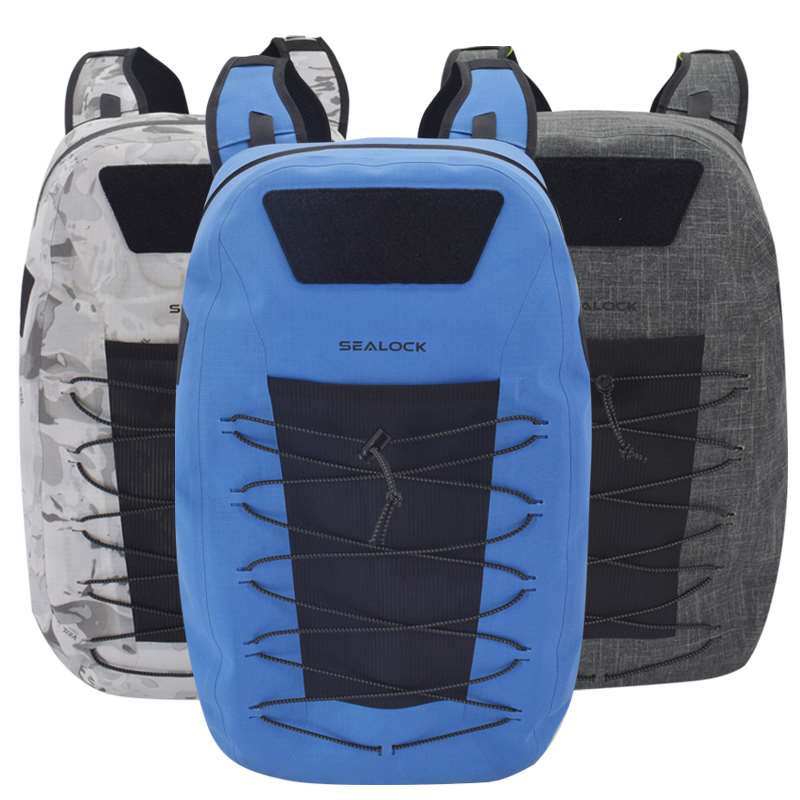
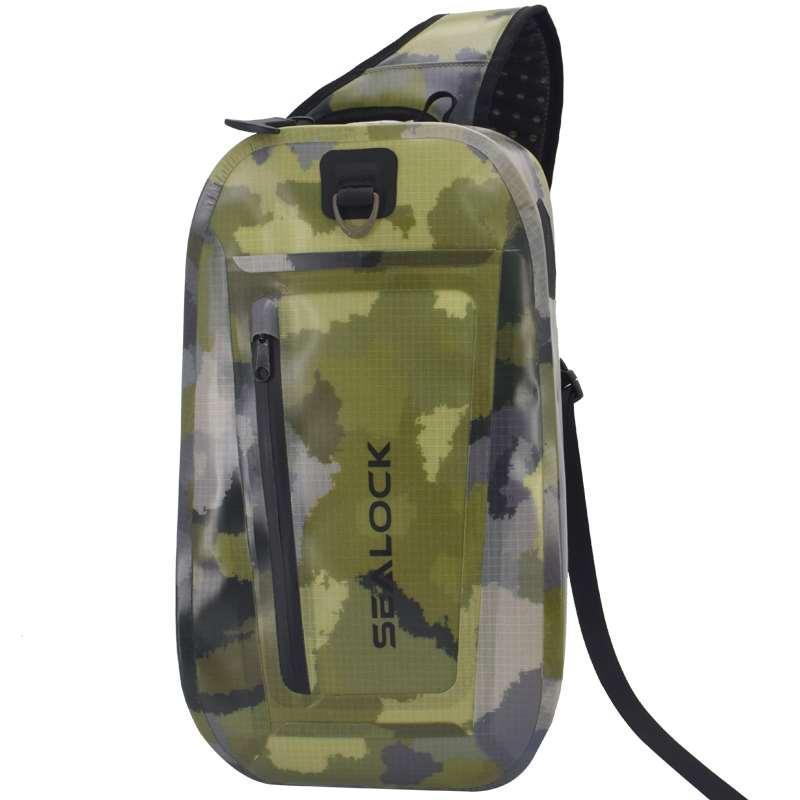
SL-E217B 14L Stream Fly Fishing Pack — 840D TPU composite with internal reinforced fabric and TPU coating both sides; seamlessly fused body; airtight waterproof zipper; pull rings, buckles and hook-and-loop patch panel; single-shoulder design; water, dust and mud proof.
The step below — heavier weather and saltwater-tier kit without full pack volume
300–500
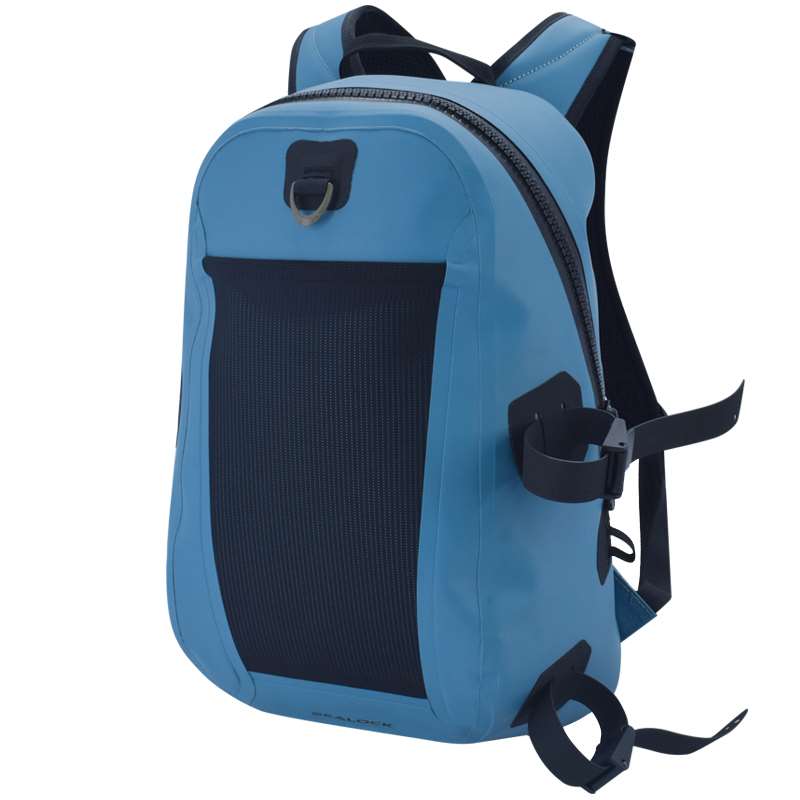
SL-E548 Lightweight Fly Fishing Shoulder Bag — 10L; 420D TPU waterproof layer; seamless welded construction; airtight waterproof zipper; handheld net holder on the front; multiple hanging system.
Walk-and-wade days where the truck is close
300–500
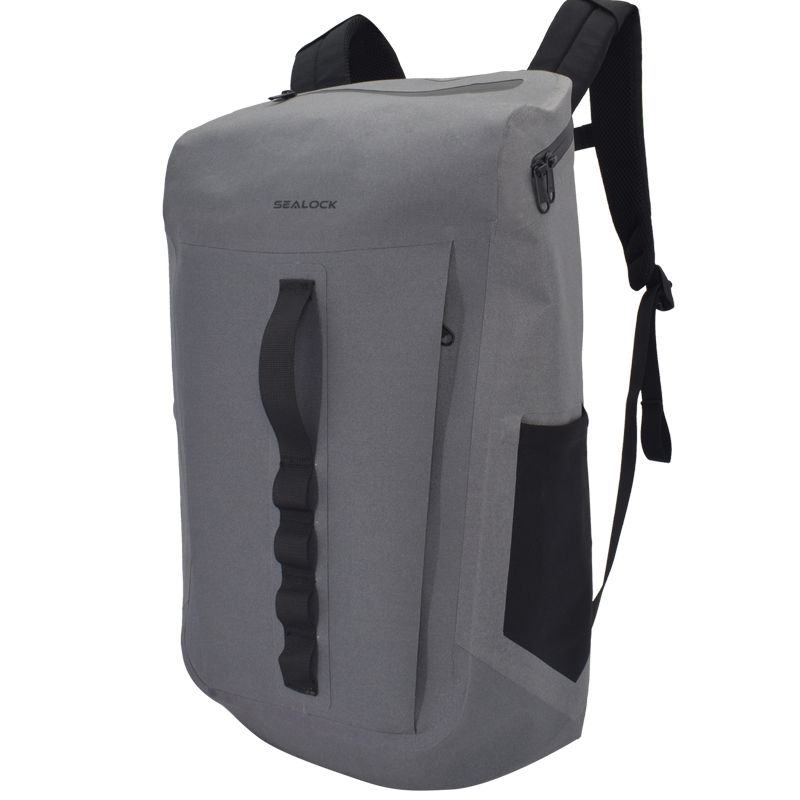
SL-J033 Waterproof Expedition Pack — 45/55/65L; TPU on 420D nylon; IPX8 rubber sealing strip, fold-over flap and compression strap; reinforced abrasion base; side lash cords; padded harness, sternum strap, padded hip belt, haul handle.
Multi-day and expedition — full load-bearing suspension for long approaches
300–500
Capacity, harness and hip-belt configuration, chest unit, rod tube carry, tool matrix, internal organisation, colourway and branding are all specifiable per order — or a pack can be developed from a sketch or reference sample. MOQ is 300–500 pieces per model, samples run 7–15 days, and production 20–45 days after approval, from Dongguan or Ho Chi Minh City.
Quality Control
Quality is gated in three tiers — IQC (incoming TPU-laminated fabric for coating thickness, adhesion and weldability, plus airtight zippers, webbing, foam and hardware against the signed standard, with colour difference and fastness), IPQC (cutting tolerance, weld integrity, airtight-zipper installation, and harness, hip-belt and tool-station anchor assembly in line, with peel tests on sample welds at each run start), and OQC (ISO 2859 AQL sampling, real water-submersion batch testing, and gold-sample comparison, with SGS or QIMA available). Sealock also strictly executes the complete customer inspection procedure on finished goods: unboxing, vacuum extraction, a 24-hour static rest, and air-leak determination. For this tier the lab adds a 1,500+ cycle load test with jerk-loading on hip-belt and harness anchors and cold-hand zipper operability checks, alongside weld bond and peel strength, seam strength, abrasion, tear, tensile, salt spray, UV, colour fastness and colour difference.
FAQ: OEM Fly Fishing Backpacks
Q: When does an angler actually need a backpack rather than a sling?
A: When the fishing starts well beyond the truck — roughly three miles or more of hiking — and the trip needs a first aid kit, serious rain gear, extra layers or a stove. A genuine hip belt transfers that load off the shoulders, which a sling cannot do.
Q: What's the main drawback of a backpack for fly fishing?
A: Access. The pack has to come off to reach anything inside, which isn't possible mid-run. That's why most backcountry anglers pair a backpack with a chest pouch or lanyard for the items they need constantly.
Q: Can you build a backpack with a detachable chest pack?
A: Yes — our 24L model carries a detachable front vest that works as a standalone chest pack with its own airtight pouch. It lets an angler leave the main pack at the head of a run and wade off with the essentials sealed and on the body.
Q: Why does key storage matter so much on a fly pack?
A: Because wet wading means no wader pockets. Specify a sealed, zippered compartment for keys, phone and licence — not a mesh pocket. Anglers actively look for this.
Q: Should the pack carry a rod tube?
A: For this tier, yes. A sleeve or lariat straps keep hands free on the trail and let a spare rod travel on long boat rides. Position it clear of the casting arm.
Q: What are the MOQ and lead times?
A: Typically 300–500 pieces per model, samples in 7–15 days, and production 20–45 days after approval, from either our China or Vietnam base.
Talk to the Factory
For quotations, samples, and OEM/ODM proposals on fly fishing backpacks, contact Sealock at info@sealock.com.hk or +86-769-82009361. Over twenty years of high-frequency welding and industrial sewing under one roof, OEM production for leading fishing brands, dual China–Vietnam manufacturing, and a full customer inspection procedure on every shipment.
We use cookies to offer you a better browsing experience, analyze site traffic and personalize content. By using this site, you agree to our use of cookies.
Privacy Policy
 English
  Español
  Português
  русский
  Français
  日本語
日本語  Deutsch
  tiếng Việt
  Italiano
  Nederlands
  ภาษาไทย
  Polski
  Svenska
  magyar
  Malay
Malay  বাংলা ভাষার
  Dansk
Dansk  Suomi
Suomi  हिन्दी
  Pilipino
  한국어
한국어  Türkçe
  Gaeilge
  العربية
  Indonesia
  Norsk
Norsk  تمل
تمل  český
český  ελληνικά
  український
  Javanese
  فارسی
فارسی  தமிழ்
தமிழ்  తెలుగు
  नेपाली
  Burmese
  български
  ລາວ
ລາວ  Latine
  Қазақша
  Euskal
  Azərbaycan
  Slovenský jazyk
  Македонски
  Lietuvos
  Eesti Keel
  Română
  Slovenski
  मराठी
मराठी  Srpski језик