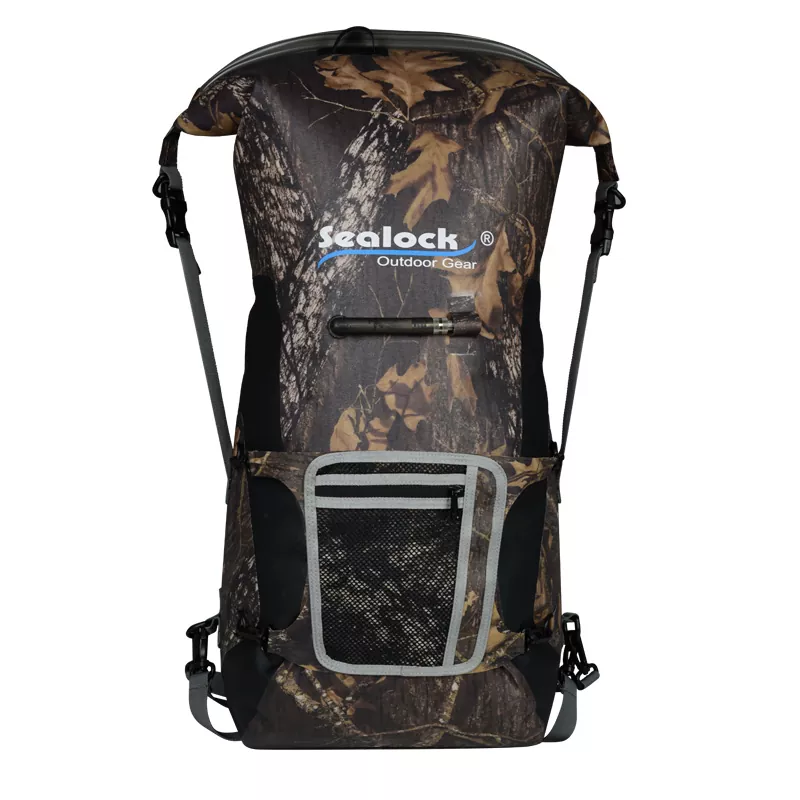
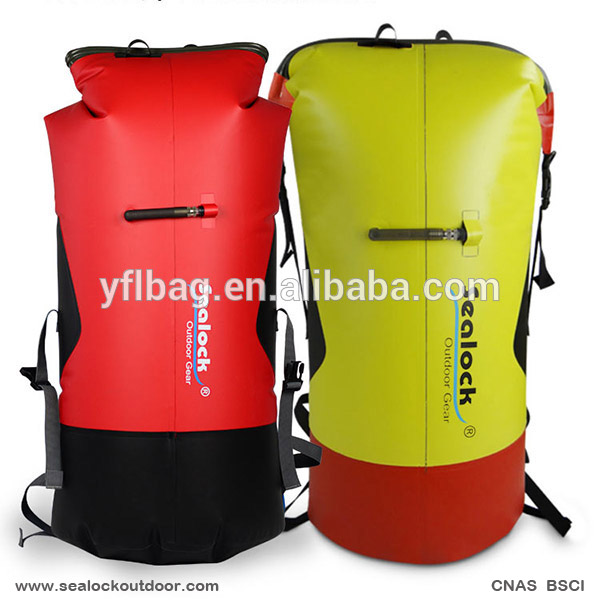
Sealock is an IPX8 waterproof backpack manufacturer and OEM supplier. Reaching IPX8 on a phone pouch is a precision problem on a small sealed volume. Reaching it on a 65-litre load-bearing backpack is a different discipline entirely: metres of seam instead of centimetres, a wide opening that has to seal evenly across its whole width, a body that flexes under load while submerged, and enough trapped air to put real pressure on the closure from the inside. This guide covers how an IPX8 pack is actually built, and the engineering numbers behind the closure that makes it possible.
Why Scale Changes the Problem
IPX8 means continuous immersion beyond one metre, to a depth and duration the manufacturer declares. Meeting that on a large soft-sided pack introduces four factors a small sealed pouch never faces:
Seam length. A 65L pack carries many times the welded seam of a pouch. Every additional metre is another opportunity for a marginal weld, so process consistency matters more as volume grows, not less.
Internal air volume. A sealed 65L pack traps a large volume of air. Submerged, that air is compressed and pushes outward against the closure and seams — the pack is under pressure from both directions at once.
Flexing under load. A loaded pack deforms as it is carried, dropped and pressed against a hull or a rock. A pouch sits still; a pack works its seams constantly.
Load-bearing penetrations. Harness, hip belt and haul handle anchors all carry weight on a body that must stay sealed. A pouch has one lanyard point; a pack has eight or more.
Metres of seam, litres of trapped air, and a body that flexes — IPX8 at scale is a different problem.
Why a Roll-Top Alone Doesn't Get There
A roll-top is an excellent closure and the right choice for most waterproof packs. What it is not is a pressure-rated seal. It creates a labyrinth path that defeats rain, spray and short immersion, but its sealing force comes from the user's hands and a buckle — it isn't a controlled, engineered compression. For a declared IPX8 rating the closure has to apply a measurable, repeatable clamping force onto a compliant gasket.
Our IPX8 pack construction does that with three elements working together: a natural rubber sealing strip along the opening, a fold-over flap that closes onto it, and a central compression strap that clamps the assembly down. The rubber provides the elasticity; the flap provides the geometry; the strap provides the force.
The Gasket Engineering Behind It
Compression seals live or die on a number that is rarely discussed in bag manufacturing, and it is narrower than most people assume.
The compression band. A rubber gasket has to be squeezed by a percentage of its original thickness to seal. The ideal is around 40%, the practical maximum is 50%, and the minimum is roughly 10–15%. Under-compress it and there is no seal; over-compress it beyond 50% and the rubber may not rebound at all — leaving a permanent gap where the seal used to be. Designing the closure means designing for that band, not simply clamping as hard as possible.
Compression set. Rubber's ability to push back is measured by compression set, tested to ASTM D395. A compound with poor compression set behaves well on day one and progressively stops sealing. This is a material specification, not a design assumption.
Relaxation. A compressed gasket's restoring force falls measurably soon after installation — within an hour it can be around three-quarters of its original value. Outright failure is unlikely, but leakage becomes possible if the design had no margin. So the clamping system is specified with headroom rather than to the theoretical minimum.
The Hardest Part: Even Clamping Across a Wide Opening
This is where a large pack differs most from a small sealed product. A central compression strap applies its greatest force in the middle of the opening and progressively less towards the ends. Gasket engineering has a name for the resulting problem — force concentration at the clamping point, with under-compression away from it — and the classic answers apply:
Compression stops that prevent the gasket being crushed past its rebound limit where the strap pulls hardest.
A stiffened flap, so the closing force spreads along the opening rather than dissipating a few centimetres either side of the strap.
Gasket profile and durometer chosen for the force curve the closure actually delivers, not for a uniform ideal.
Fold geometry at the ends, since a fold-over flap has to turn a corner at each end of the opening — the same corner-bunching issue that affects any wide folded closure.
Uneven clamping is the classic failure mode of this closure type: a seal that holds in the centre and gapes at one end will pass a casual dunk and leak under sustained pressure. Verifying evenness across the full width, not just at the strap, is a required inspection step.
Rubber for elasticity, flap for geometry, strap for force — and the ends have to compress as hard as the middle.
The Shell: More Seam, Less Tolerance
Material. TPU laminated on 420D nylon is the right shell for this class — the nylon base carries tear and abrasion strength, the TPU delivers hydrolysis resistance, UV stability, cold flexibility and weldability. TPU also tolerates the constant flexing a loaded pack imposes far better than a rigid coating.
Welding at 27.12 MHz with no needle holes anywhere in the barrier. On a large pack, weld parameter stability across an entire production run is the single largest determinant of whether the batch holds its rating.
A reinforced abrasion base. The base panel is dragged and set down more than any other surface, and on an IPX8 product a worn-through base is a sealing failure, not just cosmetic damage.
Load anchors sewn before welding. Harness, hip belt and haul handle anchors are stitched to flat panels at high tension first, so the perforations end up beneath the welded skin and the load spreads across a stitched footprint. Welded-only anchors peel under sustained shear.
The Production Sequence
Material staging and cutting — panels cut to tight tolerance, since a welded seam has no allowance to absorb drift.
Sub-assembly sewing — harness, hip belt, back panel, side pockets and lash cord anchors built as modules.
Load-point stitching to flat panels — anchors applied at high tension before the shell closes.
Die setup and HF welding — the shell fused into a continuous sealed skin, covering the stitched footprints.
Gasket bonding — the natural rubber sealing strip bonded true along the full length of the opening. Any deviation here becomes an uneven compression band later.
Flap and compression strap assembly — flap geometry set to fold squarely onto the gasket, strap and hardware anchored.
Closure verification — compression checked across the full width, not just at the strap.
Leak determination and packing.
The Product Basis
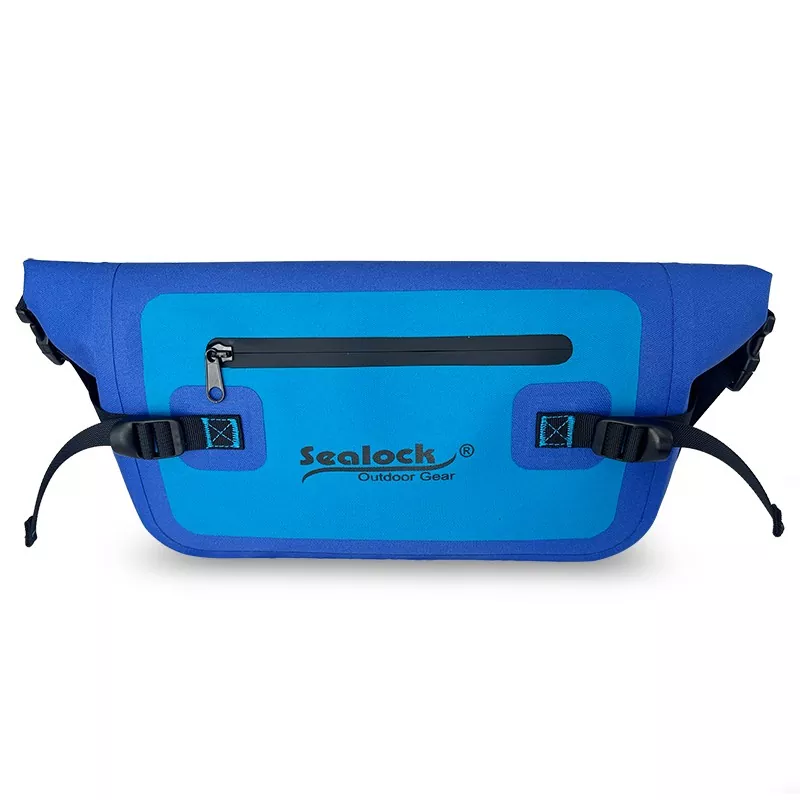
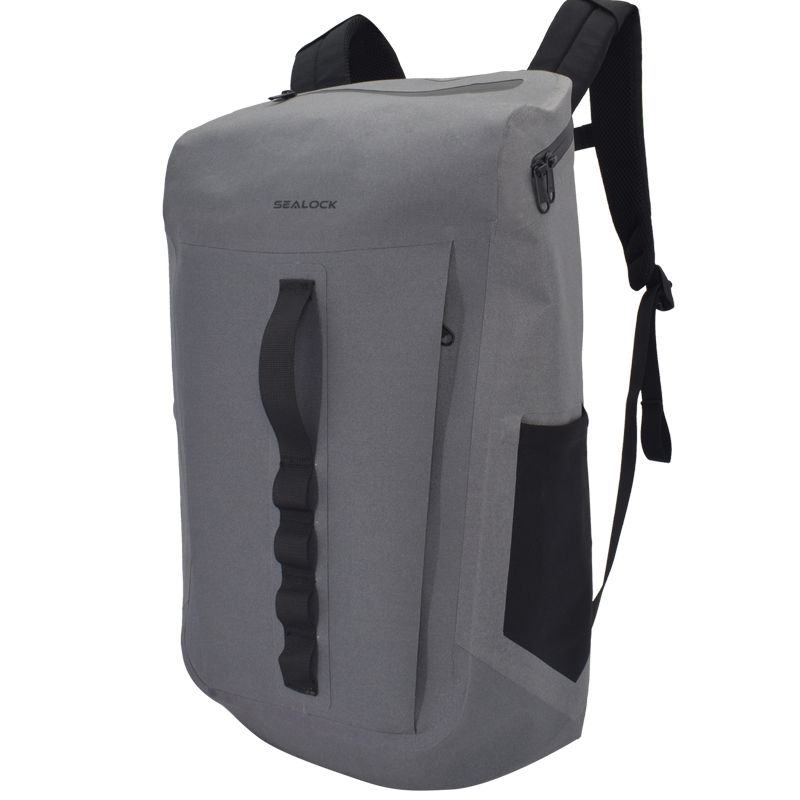
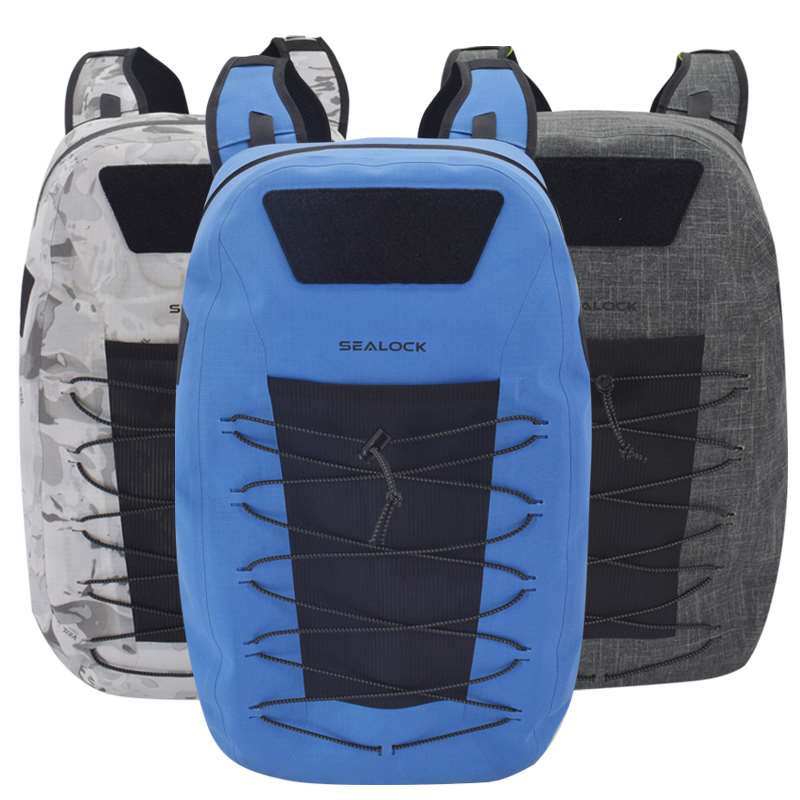
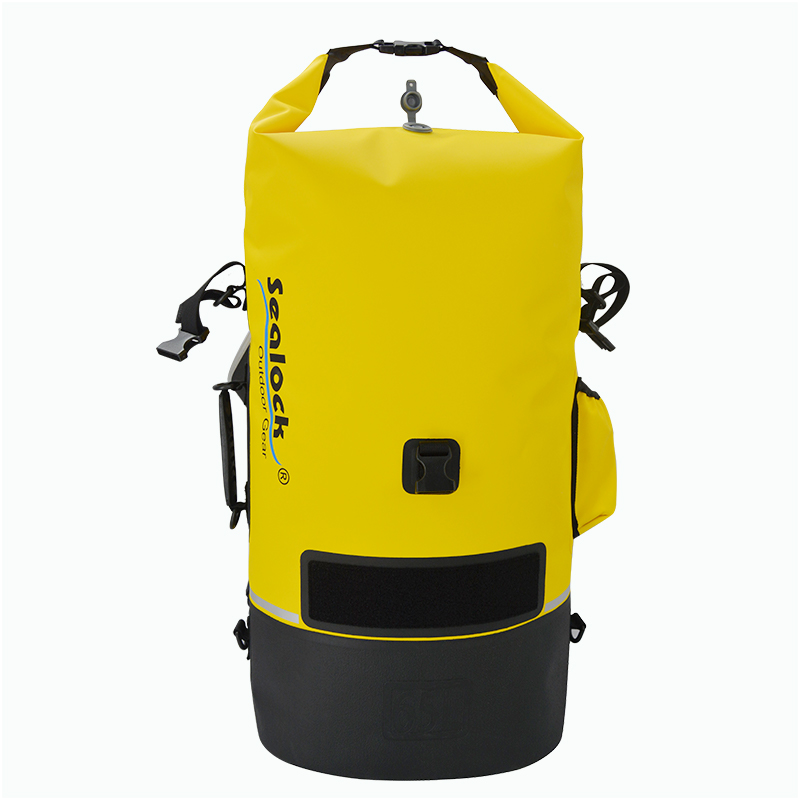
These welded packs are equal starting points for an OEM order — none is ranked above another; the IPX8 build sits alongside verified IPX7 roll-top and airtight-zipper constructions:
Roll-top — large trapped air volume, buoyancy by design
300–500
SL-E039 TPU Dry Backpack — 25L; 420D nylon coated with TPU; two adjustable shoulder straps and a waist button; sample 3–5 days.
Roll-top — verified IPX7 on a welded TPU shell
300–500
SL-E977 Kayak Dry Backpack — 28L; 500D PVC 0.5 mm; semi-circular shell; phone window; multi-function lock; side inflation/deflation valve; EVA back panel.
Roll-top with a valve — controlled air management on a sealed body
300–500
Sealing system, gasket specification, capacity, shell material, harness configuration, hardware and branding are all specifiable per order, or a pack can be developed from a sketch. Note that the SL-J033 runs three capacities on one sealing platform, so an IPX8 programme can cover 45–65L without three separate closure developments.
Quality Control for an IPX8 Pack
Quality is gated in three tiers. IQC covers incoming TPU-laminated fabric for coating thickness, adhesion and weldability, plus gasket stock for durometer and compression set, and webbing, foam, buckles and hardware against the signed standard. IPQC covers cutting tolerance, weld integrity and weld width, gasket bonding trueness along the opening, flap and strap assembly, load-anchor stitching, and compression verification across the full width of the closure — with peel tests on sample welds at the start of each run. OQC covers ISO 2859 AQL sampling, immersion testing to the declared depth and duration, and gold-sample comparison, with SGS or QIMA certification available — and for an IPX8 claim, buyers should expect a test report stating the depth, not just the rating.
Sealock also strictly executes the complete customer inspection procedure on finished goods: unboxing, vacuum extraction, a 24-hour static rest, and air-leak determination. This matters more on a large pack than anywhere else in the range: a slow leak that a big sealed volume can mask during a short immersion still bleeds vacuum measurably over a full day. The lab additionally runs weld bond and peel strength, gasket compression set, closure cycle testing, seam strength with a 1,500+ cycle load test and jerk-loading on harness and hip-belt anchors, abrasion, tear, tensile, salt spray, UV, colour fastness and colour difference.
FAQ: IPX8 Backpack Production
Q: Why can't a roll-top pack be rated IPX8?
A: Because a roll-top's sealing force comes from how the user folds and clips it, not from an engineered compression. It's excellent against rain, spray and short immersion — which is why our roll-top packs are rated to a verified IPX7 — but a declared IPX8 needs a gasket compressed by a controlled, repeatable clamping force.
Q: How much should the sealing gasket be compressed?
A: Into a fairly narrow band: around 40% of original thickness is ideal, 50% is the practical maximum, and below roughly 10–15% there's no reliable seal. Compressing past 50% risks the rubber not rebounding, which creates a permanent gap.
Q: How do you know the gasket will still seal in two years?
A: By specifying compression set — tested to ASTM D395 — rather than assuming it. A compound with poor compression set seals on day one and progressively stops. Gasket stock is checked for durometer and compression set at incoming inspection.
Q: What's the hardest part of an IPX8 pack to get right?
A: Even clamping across a wide opening. A central compression strap concentrates force in the middle and delivers less at the ends, so the closure needs a stiffened flap, compression stops, and a gasket profile matched to the actual force curve — then compression verified across the full width during inspection.
Q: Does an IPX8 pack float?
A: A sealed pack traps air and floats, which is useful — but that same trapped air pushes outward on the closure when submerged, so the shell and seal have to be built for pressure from both directions.
Q: What should we ask for to substantiate an IPX8 claim?
A: The declared depth and duration, and a finished-product test report. IPX8 without a stated depth is not verifiable, and it is the most common overclaim in waterproof gear.
Talk to the Factory
To develop an IPX8 waterproof backpack, contact Sealock at info@sealock.com.hk or +86-769-82009361. Over twenty years of high-frequency welding and industrial sewing under one roof, gasket-sealed IPX8 construction, declared-depth testing, dual China–Vietnam production, and a full customer inspection procedure on every shipment.
We use cookies to offer you a better browsing experience, analyze site traffic and personalize content. By using this site, you agree to our use of cookies.
Privacy Policy
 English
  Español
  Português
  русский
  Français
  日本語
日本語  Deutsch
  tiếng Việt
  Italiano
  Nederlands
  ภาษาไทย
  Polski
  Svenska
  magyar
  Malay
Malay  বাংলা ভাষার
  Dansk
Dansk  Suomi
Suomi  हिन्दी
  Pilipino
  한국어
한국어  Türkçe
  Gaeilge
  العربية
  Indonesia
  Norsk
Norsk  تمل
تمل  český
český  ελληνικά
  український
  Javanese
  فارسی
فارسی  தமிழ்
தமிழ்  తెలుగు
  नेपाली
  Burmese
  български
  ລາວ
ລາວ  Latine
  Қазақша
  Euskal
  Azərbaycan
  Slovenský jazyk
  Македонски
  Lietuvos
  Eesti Keel
  Română
  Slovenski
  मराठी
मराठी  Srpski језик