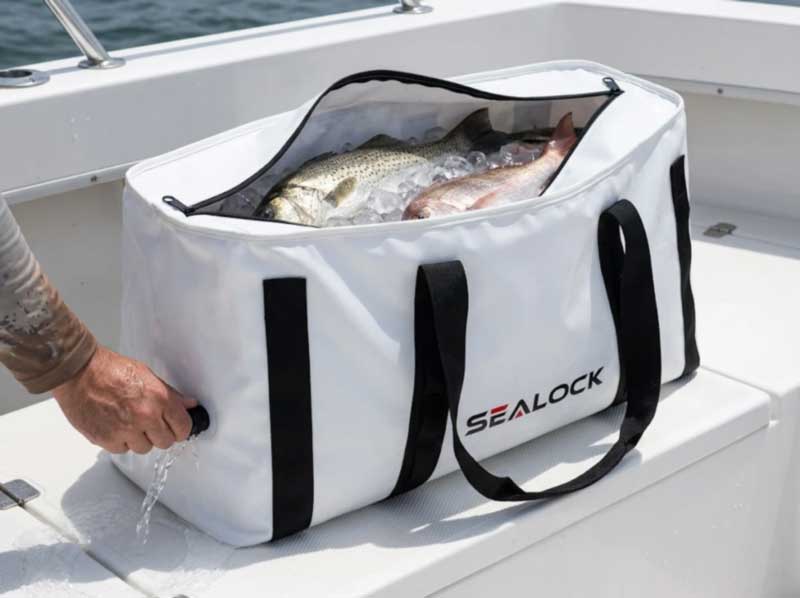
A fish kill bag is a soft, insulated bag that keeps a catch on ice from the moment it comes aboard until it reaches the cleaning table. Anglers also call it a fish cooler bag, a fish bag or a catch bag. Compared with a hard cooler it takes long fish without bending them, lies flat on a deck or in a kayak well, and rolls up when it is empty. Charter boats, tournament anglers and kayak fishermen use them for the same reason: fish that are chilled quickly and kept cold are worth more and taste better.
Read the reviews of kill bags, though, and the same complaints come up again and again. Bloody meltwater leaks from the bottom corners onto the deck or into the car. The zipper corrodes and jams after a season in salt water. Spines and gill plates puncture the liner. Ice is gone by midday. This guide explains what causes each of those problems and what to look for instead. It is written for anglers choosing a bag and for tackle brands, marine retailers and charter operators sourcing one. We have made welded waterproof and insulated bags since 2001, over 20 years, at our factories in Dongguan, China and Ho Chi Minh City, Vietnam.
Why Most Kill Bags Leak, and How a Welded One Doesn't
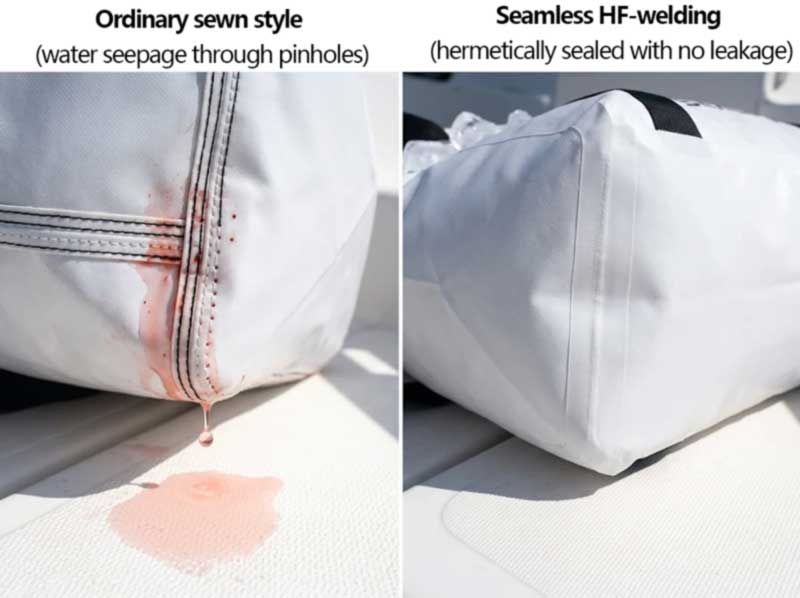
Most kill bags are sewn. The outer shell is stitched together, and a separate liner is stitched in at the top. Every stitch is a hole, and a kill bag spends its working life half full of water, because ice and fish quickly become a slurry of meltwater, blood and slime. That liquid finds the needle holes along the bottom seams and corners and seeps out. Many sellers say openly that their bags are not watertight. The liquid that soaks into the stitching and foam is also what makes an old kill bag smell, however well it is rinsed.
A welded kill bag is built differently. The liner panels are joined by high-frequency welding, which fuses the material into one continuous piece with no needle holes, so the liner holds water like a tub. The drain valve is welded into the wall rather than sewn in. The outer shell is welded as well, so water and blood cannot get into the insulation between the two layers. This is the single most important thing to check on any kill bag: ask whether the liner seams are welded or sewn. Our kill bags use welded liners and welded scrim-reinforced PVC tarpaulin shells, and the bags are rated IPX6 on the outside: sealed against spray and deck washdown, though not made to be submerged.
Sewn seams leak through the needle holes; a welded liner holds an ice slurry like a tub.
What Size Fish Kill Bag Do You Need?
Choose the size by the longest fish you expect to keep, not by the number of fish. A fish should lie straight in the bag; one that has to be bent takes up more room, chills unevenly and can split the zipper as it stiffens. Then allow for ice. A good working ratio is two parts ice to one part fish by volume, so a bag that looks generous when it is empty fills up quickly.
Capacity
Bag length
Typical fish
Typical use
30 L
About 50 cm (20 in)
Trout, panfish, small snapper, a few inshore fish
Kayak, pier, bank and beach fishing; one angler
90 L
About 100 cm (39 in)
Salmon, striped bass, redfish, snapper, cod
Bay boats and small charter boats; two or three anglers
120 L
About 120 cm (47 in)
Mahi-mahi, kingfish, wahoo, school tuna
Offshore and tournament boats
If you are between two sizes, take the larger one; "size up" is the most common advice in buyer reviews. For big pelagic fish, bags of 150 cm and longer are made to order. Remember that a full kill bag is heavy. A 120-litre bag loaded with fish and ice can weigh well over 80 kg, so it needs handles that wrap right around the body and base, and it will usually be moved by two people.
Insulation: How Long the Ice Lasts
Ice retention depends on the thickness and type of foam, and on whether the base is insulated at all. A bag with a thin or uninsulated base loses ice quickly when it sits on a hot deck, which is why some bags are empty of ice by midday. Closed-cell foam is the right material: it does not absorb water, so it keeps insulating when the bag is wet and does not hold smells. Our fish cooler tote uses 20 mm closed-cell foam and holds ice for a full fishing day in moderate conditions; our kill bags use 25 mm foam and are built to carry a catch from a full day into a second day.
How the bag is used matters as much as how it is built. An ice slurry, ice with a little sea water, chills a fish to the core much faster than dry ice layered around it, and a welded liner is what makes a slurry possible. Pre-chill the bag with a little ice before the trip, keep it out of direct sun where you can, and open it as little as possible.
The Zipper: Where Salt Water Does Its Damage
The zipper is the part of a kill bag that fails most often. Metal sliders and coil zippers corrode in salt water and jam; overloaded bags pull the zipper apart at the ends. Look for a moulded plastic tooth zipper, which does not corrode, with a large pull that can be worked with wet hands or gloves. An airtight zipper goes one step further: it seals the opening, so meltwater does not run out when the bag tips over in a truck bed, and cold air stays in. Our kill bags use a full-length airtight moulded-tooth zipper; our lighter cooler tote uses a standard full-length moulded-tooth zipper.
Whatever the zipper, rinse it with fresh water after every trip and lubricate it from time to time. Do not force a bag closed over a fish that is too long for it.
Liner, Drain Valve and Handles
The liner has to resist fin spines, gill plates and teeth. Thin liners are punctured within a trip or two, and once the liner is holed, water gets into the insulation. A thick, food-grade, non-absorbent liner with welded seams resists punctures, does not hold odour and can be scrubbed and sanitised. A light-coloured liner makes it easy to see when the bag is clean.
A drain valve lets meltwater out without opening the bag or tipping it over, which keeps the remaining ice colder and makes the bag lighter to carry at the dock. It should be a threaded plug with a gasket, welded into the wall. Handles should be webbing that runs right around the bag and under the base, so the weight is carried by the webbing and not by the shell. A detachable shoulder strap is useful on smaller bags, and tie-down points matter on a kayak or a small boat. An empty bag should roll flat and strap up for storage.
A side drain valve releases meltwater without opening the bag or losing the ice.
Looking After a Kill Bag
After each trip, drain the bag, rinse it inside and out with fresh water, and wash the liner with mild soap or a dilute sanitiser. Then leave it open, upside down and out of direct sun until it is completely dry. Storing a kill bag closed and damp is what causes mildew and smell. Rinse and lubricate the zipper, and store the bag loosely rolled with the drain valve open.
As SL-C379, with wrap-around webbing under the base for a two-person lift; rolls flat when empty
Offshore and tournament boats; mahi-mahi, kingfish, school tuna
Standard colours are white and black, with blue and yellow on the 30-litre tote. You can see the full range in our fish cooler bag category, and tackle bags, sling packs and waist packs for anglers in our waterproof fishing bag category.
Custom Fish Kill Bags for Brands, Retailers and Charter Fleets
Most of the kill bags we make are sold under our customers' brands. Our OEM partners in fishing and marine include AFTCO, PENN and West Marine, and the same welding lines produce kill bags for tackle brands, marine retailers and charter operators of any size. What can be specified:
Size: any length from about 50 cm to over 150 cm, sized to the species your customers target, in a range of two to five sizes.
Insulation: 20 mm, 25 mm or thicker closed-cell foam, with an insulated base.
Shell and liner: PVC tarpaulin or TPU, in white, black or any Pantone colour; liner thickness chosen for the species.
Closure: airtight zipper or standard moulded-tooth zipper, with a custom pull.
Features: one or two drain valves, a printed fish ruler, tie-down loops, mesh pockets, a shoulder strap, roll-up straps.
Logo: silk screen, heat transfer or a welded logo patch, in a large size on the white shell where it photographs well on a boat.
MOQ is 300 pieces per size and colour. Samples take about 7–15 days and bulk production about 30–45 days, from either China or Vietnam, which gives buyers a choice of origin for tariff planning. A completely new shape or an unusual size needs a longer sampling stage. Many buyers pair a kill bag with waterproof gear for the same angler; our guide to the waterproof fanny pack covers one such product, and our sewing lines make the sewn tackle bags and straps that complete a fishing range to the same standard as our welded products.For drinks and food coolers with your logo, see our guide to custom cooler bags.
How We Test Fish Kill Bags
Every order passes through IQC on incoming PVC and TPU, foam, liner film, zippers, valves and webbing, IPQC during welding and assembly, and OQC on finished bags, with SGS or QIMA third-party inspection available on request. Welded seams on the liner and shell are tested for tensile and bonding strength, with attention to the bottom corners and the drain valve mount, where sewn bags leak. Handles and strap anchors go through a load test of 1,500+ cycles, and zippers are opened and closed 3,000 times. Zipper pulls, buckles and valve parts are tested in salt spray, the shell is tested for abrasion, and colour fastness and colour difference are checked so that white stays white across a production run. The sealed shell is verified with a heavy rain and water-jet test.
Frequently Asked Questions
What is a fish kill bag?
An insulated soft bag that keeps caught fish on ice aboard a boat or kayak and on the way home. It is also called a fish cooler bag or fish bag.
Do fish kill bags leak?
Sewn ones usually do, through the needle holes in the bottom seams and through the zipper. A bag with a welded liner and an airtight zipper holds meltwater until you open the drain valve.
How long does a kill bag keep fish cold?
With 20 mm foam, a full fishing day in moderate conditions; with 25 mm foam, a day and into the next. Use two parts ice to one part fish, and an ice slurry for the fastest chilling.
How do I stop a kill bag from smelling?
Rinse and wash it after every trip and dry it fully, open and upside down. A non-absorbent welded liner does not hold odour the way stitching and absorbent foam do.
What is the MOQ for custom fish kill bags?
300 pieces per size and colour. Samples take about 7–15 days and bulk production about 30–45 days.
How much does a custom fish kill bag cost?
It depends on the size, insulation thickness, zipper type, shell material, features, logo method and quantity. Size and the airtight zipper are the largest cost factors. Send us your sizes and target quantity for a quotation.
Can you print our logo and a fish ruler on the bag?
Yes. Logos are applied by silk screen, heat transfer or welded patch, and a ruler can be printed along the side in inches, centimetres or both.
Source Fish Kill Bags From the Factory
Tell us the species your customers target, the sizes you need and your quantity, and we will recommend a construction, make branded samples and plan production in China or Vietnam. Contact us at info@sealock.com.hk or call +86-769-82009361.
We use cookies to offer you a better browsing experience, analyze site traffic and personalize content. By using this site, you agree to our use of cookies.
Privacy Policy
 English
 Español
 Português
 русский
 Français
 日本語
 Deutsch
 tiếng Việt
 Italiano
 Nederlands
 ภาษาไทย
 Polski
 Svenska
 magyar
 Malay
 বাংলা ভাষার
 Dansk
 Suomi
 हिन्दी
 Pilipino
 한국어
 Türkçe
 Gaeilge
 العربية
 Indonesia
 Norsk
 تمل
 český
 ελληνικά
 український
 Javanese
 فارسی
 தமிழ்
 తెలుగు
 नेपाली
 Burmese
 български
 ລາວ
 Latine
 Қазақша
 Euskal
 Azərbaycan
 Slovenský jazyk
 Македонски
 Lietuvos
 Eesti Keel
 Română
 Slovenski
 मराठी
 Srpski језик