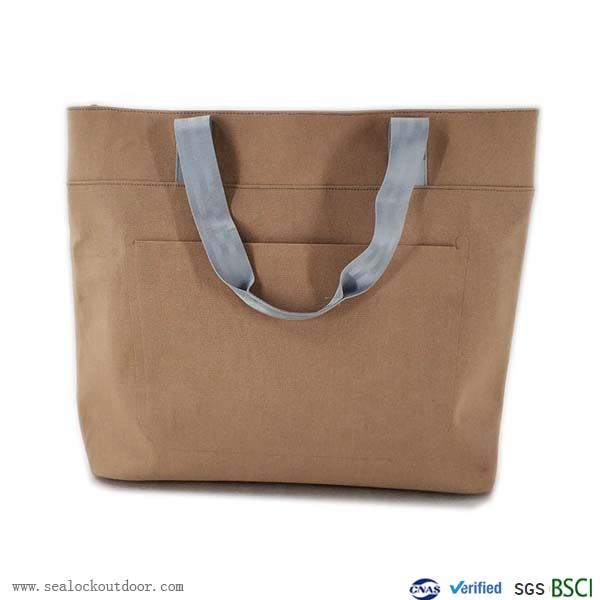
Sealock is a waterproof beach tote manufacturer and private-label supplier. A beach tote is not a regular tote with a summer print on it — it's a bag built for sand, sunscreen, chlorine, saltwater, wet towels, and hours of direct sun, and those conditions break products that look perfect in a sample photo. For a private-label seller, that's the opportunity: the category has clear seasonality, real room for design differentiation, and margins that reward a genuinely better bag. This guide covers what a beach tote must do, how to spec one for your own label, and how to make a waterproof claim you can defend.
What Makes a Beach Tote Different From a Regular Tote
A beach bag is a large-capacity bag built around a specific scenario: it handles sand, moisture, sun exposure, and bulkier items far better than an everyday tote. Beach users carry more than daily essentials — towels, sunscreen, hats, water bottles, snacks, books, a change of clothes — and everything comes home damp and gritty. The failures that follow are predictable, and each is a spec decision:
Sand gets everywhere and stays — the single most common beach-bag complaint.
Seams rip — a frequent durability complaint on high-volume beach totes, where buyers report seams failing before long.
Nothing is secure — an open top leaves valuables exposed while you're lying on the sand or in the water.
The bag won't stand up — a slumping tote tips over and spills; shoppers specifically praise totes that stand on their own and can be set on wet ground without worry.
Sunscreen, oils, chlorine and saltwater — these attack surfaces and stain fabrics that aren't wipe-clean.
Wet towels soak everything — wet-dry separation is what stops a damp swimsuit ruining a dry change of clothes.
Sand, sun, sunscreen and wet towels — the four things a beach tote must survive.
The Features That Sell a Beach Tote
Reviewers and editors converge on a consistent list — these are what a private-label seller should be speccing, because they're what buyers rate:
A zip top — secures contents while you swim or lie in the sand, and keeps sand and rain out. Repeatedly praised in reviews.
A structured base that stands upright — so the bag doesn't tip on sand or by the pool, and can be set down on wet ground.
A wipe-clean surface — PVC or TPU wipes down after sunscreen and rinses free of salt; uncoated canvas stains and holds sand.
A secure zip pocket — for phone, keys, cash; a key leash is a small touch buyers notice.
Straps that lie flat — a detail shoppers explicitly cite when choosing between competing totes.
Generous capacity plus organization — enough room for towels and gear without everything sinking to the bottom.
Wet-dry separation — a sealed pocket for wet swimwear.
Colour that survives the sun — a beach bag spends more hours in UV than in water, so UV-stable coatings and dyes matter as much as the waterproofing.
Make a Waterproof Claim You Can Defend
This is where private-label sellers get into trouble, because "waterproof" is used far too loosely in this category. There are genuinely different products behind the same word:
Water-resistant — a coated fabric that sheds splashes and rain, with stitched seams. Water can still enter at stitching and closure points.
Wet-dry — a bag with a sealed compartment for wet items, the rest of it water-resistant.
Genuinely waterproof — welded seams and a sealed closure, verified on the finished bag. This is a different construction with a different cost.
Choose the claim that matches the construction, and word your listing accordingly — a welded, sealed tote can be sold as waterproof; a coated tote with an open top should be described as water-resistant or wet-dry. Overclaiming is what generates returns and one-star reviews. The distinction is set out fully in our guide to waterproof vs water-resistant laptop bag construction, and it applies exactly the same way here.
Speccing for Your Own Label
Element
Beach-specific guidance
Material
500D PVC for structure and value; TPU for lighter weight and better UV/colour retention; mesh where sand is the priority
Closure
Zip top for security; open only if sold as casual/water-resistant
Handle drop
Long enough for shoulder carry over a loaded bag; straps that lie flat
Base
Broad welded base so it stands loaded on sand
Pockets
Secure zip pocket, inner mesh, wet-dry pocket, key leash
Colour
UV-stable dyes; seasonal palette refreshed each year
Branding
Silk-screen, welded logo, or embossing — never perforating the shell
Packaging
Hangtag, care card, barcode — retail-ready for marketplace or shelf
Zip top, a secure pocket, wet-dry separation — the features reviews actually reward.
Build a Collection, Not a Single SKU
A beach tote gets stronger commercially when it's part of a set. A private-label range can pair the tote with matching cooler bags, wet-dry pouches, and smaller accessories in one colour story, which makes the product story look more convincing in store and online, raises average order value, and gives repeat customers something to add. It also lets one seasonal palette do more work across several SKUs.
Equally, don't assume one structure fits every channel. A resort gift shop, a marketplace seller, a lifestyle brand, and a supermarket promotion shouldn't all sample the same bag — the price point, the durability expectation, and the packaging differ. Decide your channel first, then spec to it.
Seasonality: Plan Backwards From the Season
Beach is a strongly seasonal category, which is both its advantage and its trap. Stock has to land before the season, not during it, and peak-season factory capacity tightens exactly when everyone is ordering. Working back from a spring launch: allow sampling of 7–15 days per round (usually two rounds), then 30–45 days production after approval, plus shipping and inspection. Brief in autumn or early winter for a summer launch, and lock the colour palette early — it's the piece that most often delays a private-label programme.
The Product Basis
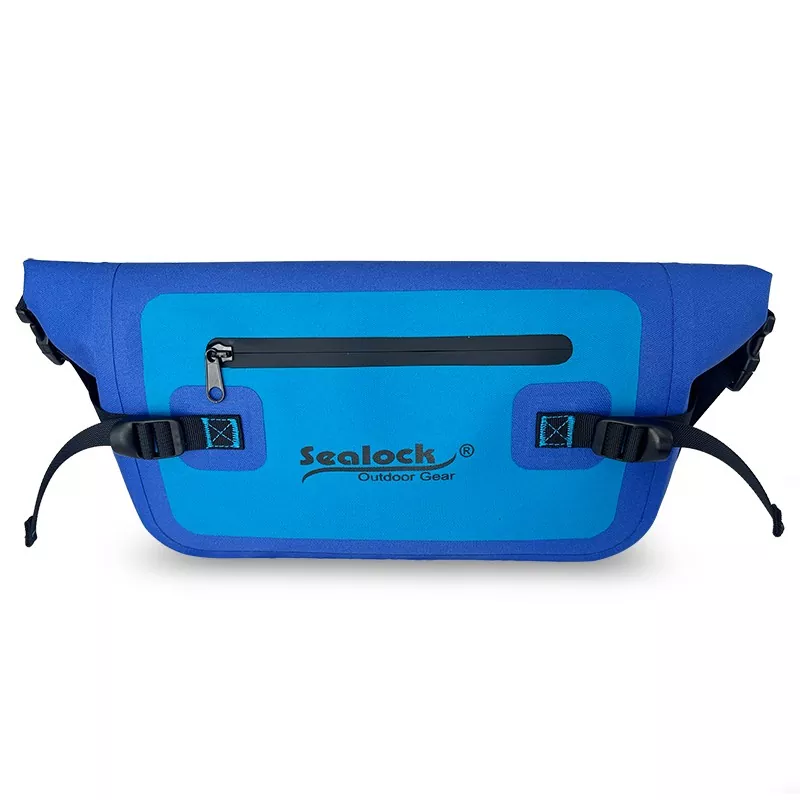
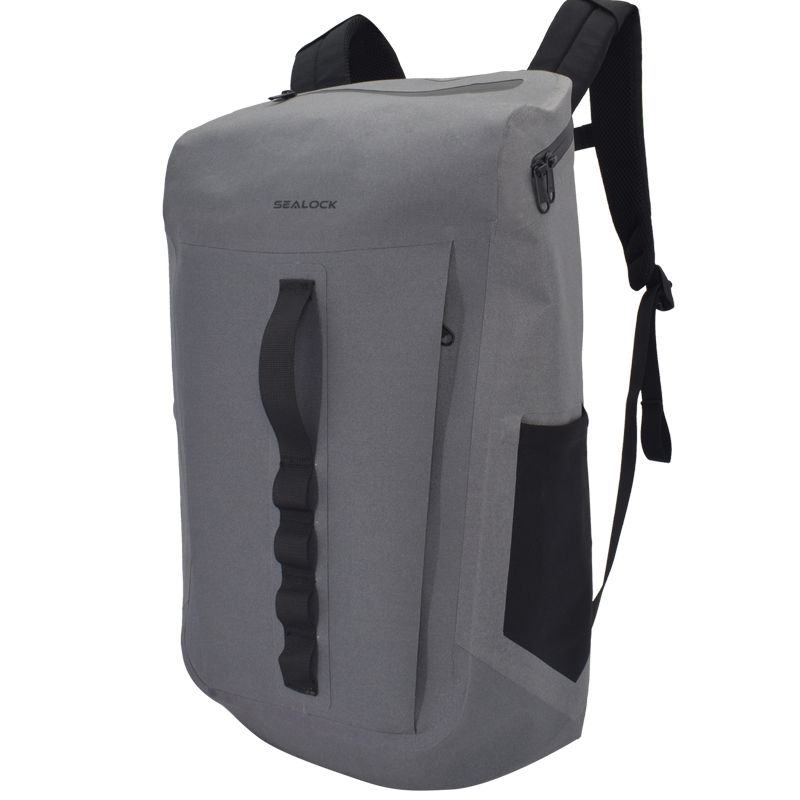
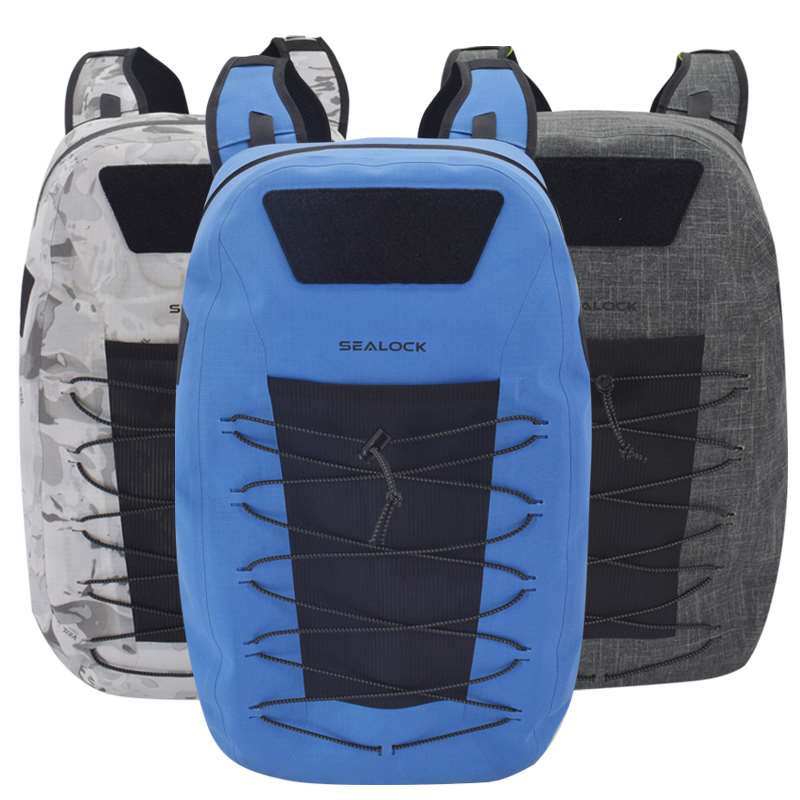
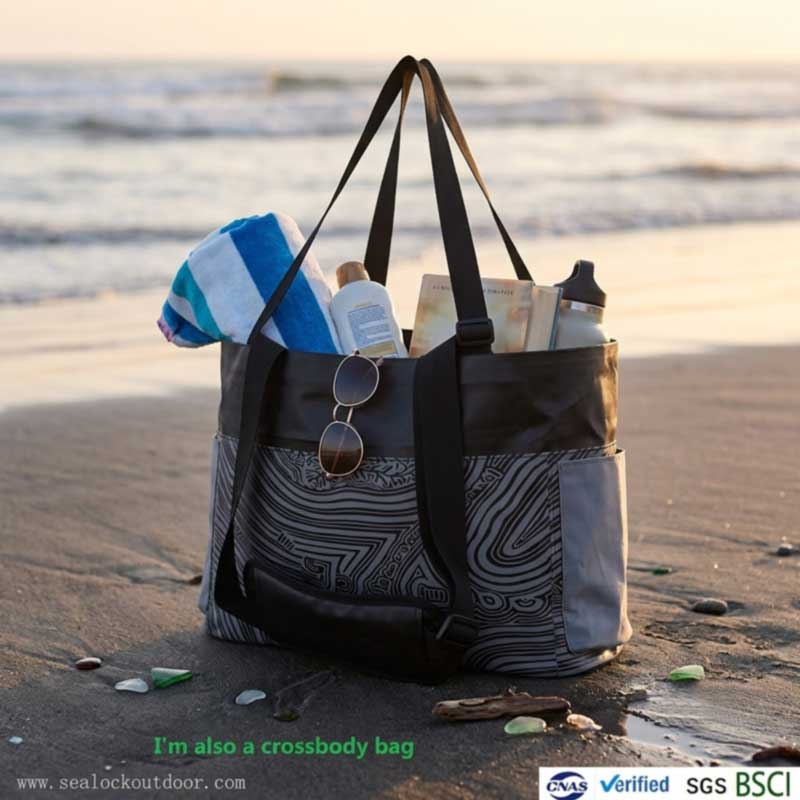
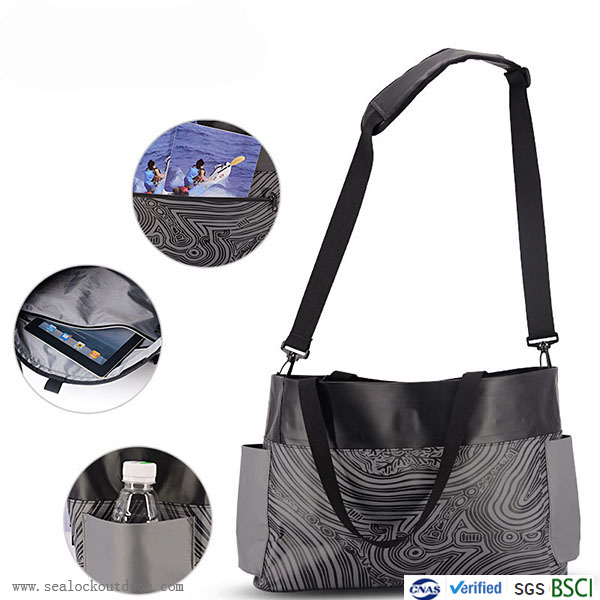
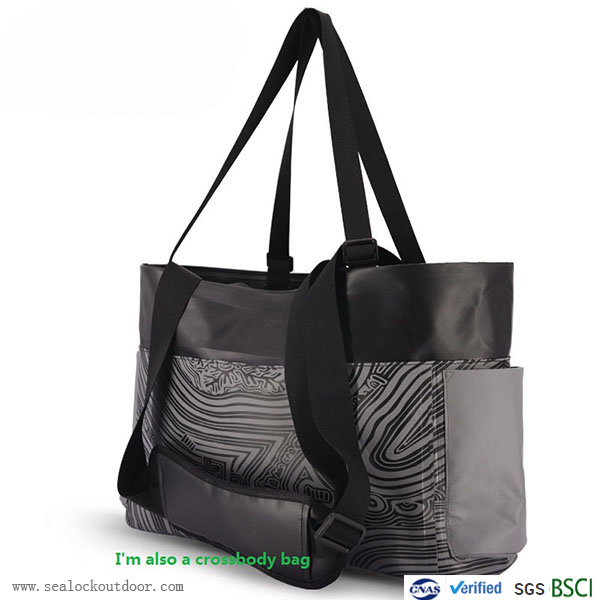
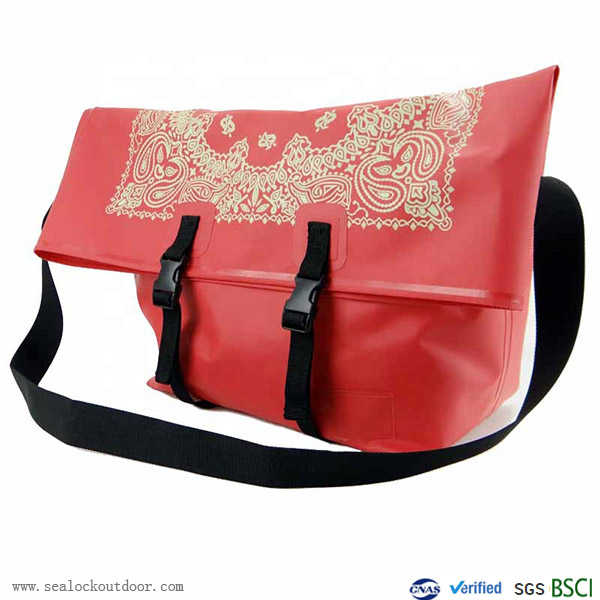
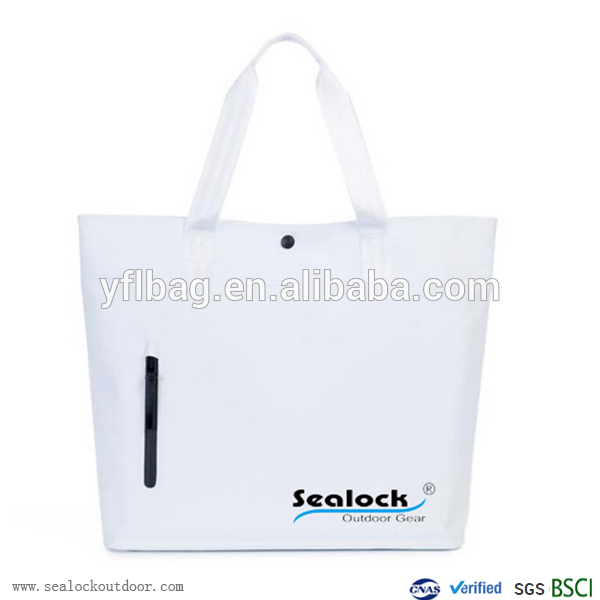
These welded totes, from Sealock's waterproof tote bag line, are equal starting points for a private-label beach programme — none is ranked above another; each answers a different beach brief:
Quality Control and the Customer Inspection Procedure
Most beach-bag problems never show in a nice sample photo — they appear after wet towels, sunscreen, sand, chlorine, saltwater, and repeat carrying. That's why specification control and testing matter more here than in most categories. Quality is gated in three tiers — IQC (incoming fabric and webbing against the signed colour card, with colour difference and fastness), IPQC (cutting tolerance, weld integrity, handle-anchor assembly in line), and OQC (AQL sampling, water-immersion testing, and gold-sample comparison, SGS/QIMA optional). Sealock also strictly executes the complete customer inspection procedure on finished goods: unboxing, vacuum extraction, a 24-hour static rest, and air-leak determination — a vacuum held undisturbed for a full day exposes slow, microscopic leaks at welds, corners, and closures that a short immersion test can miss. The lab additionally runs weld bond and peel strength, a 1,500+ cycle load test with jerk-loading on the handle anchors (seams and handles being the top beach-tote failure), abrasion, tensile, salt spray, UV, colour fastness and colour difference. Sealed builds are rated up to a verified IPX7, proven on the finished bag.
FAQ: Private-Label Beach Totes
Q: Can I legitimately list my beach tote as "waterproof"?
A: Only if the construction supports it — welded seams and a sealed closure, verified on the finished bag. A coated tote with stitched seams or an open top should be listed as water-resistant or wet-dry. Matching the claim to the construction is what keeps returns and bad reviews down.
Q: What single feature most improves reviews?
A: A zip top. Reviewers consistently reward being able to secure valuables while swimming or lying on the sand, and it keeps sand and rain out. A structured base that lets the bag stand upright is a close second.
Q: Mesh or sealed for a beach tote?
A: Mesh solves the sand complaint by letting it fall through, but protects nothing valuable — pair it with a sealed pouch. A sealed welded tote protects contents but doesn't drain. Many labels carry both.
Q: Why do beach totes fade before they leak?
A: Because they live in UV and sand far more than in water. Specify UV-stable coatings and dyes; TPU generally holds colour better, and standard PVC grades can yellow under prolonged sun.
Q: When should I place a private-label beach order?
A: Work backwards: two sample rounds at 7–15 days each, 30–45 days production after approval, plus shipping and inspection. Brief in autumn or early winter for a summer launch, and lock the palette early.
Q: Can you make a matching collection, not just the tote?
A: Yes — a tote plus cooler bag, wet-dry pouch, and accessories in one colour story. A collection presents better in store and online and lifts average order value.
Talk to the Factory
To develop a private-label waterproof beach tote, contact Sealock at info@sealock.com.hk or +86-769-82009361. Over twenty years in welded waterproof bags, welded-in handles, matching collections, retail-ready packaging, and a full customer inspection procedure on every shipment.
We use cookies to offer you a better browsing experience, analyze site traffic and personalize content. By using this site, you agree to our use of cookies.
Privacy Policy
 English
  Español
  Português
  русский
  Français
  日本語
日本語  Deutsch
  tiếng Việt
  Italiano
  Nederlands
  ภาษาไทย
  Polski
  Svenska
  magyar
  Malay
Malay  বাংলা ভাষার
  Dansk
Dansk  Suomi
Suomi  हिन्दी
  Pilipino
  한국어
한국어  Türkçe
  Gaeilge
  العربية
  Indonesia
  Norsk
Norsk  تمل
تمل  český
český  ελληνικά
  український
  Javanese
  فارسی
فارسی  தமிழ்
தமிழ்  తెలుగు
  नेपाली
  Burmese
  български
  ລາວ
ລາວ  Latine
  Қазақша
  Euskal
  Azərbaycan
  Slovenský jazyk
  Македонски
  Lietuvos
  Eesti Keel
  Română
  Slovenski
  मराठी
मराठी  Srpski језик