Hydrodynamic Impact Waves and Hull-Crush Forces During White-Water Capsizes
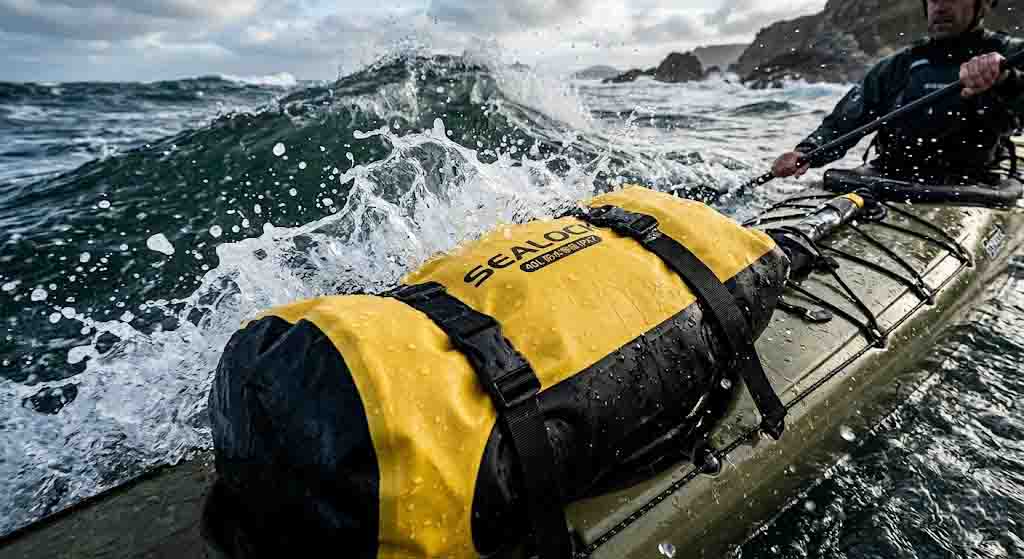
When a kayak capsizes in high-energy white water, the physical stress applied to an onboard gear duffel escalates from passive submersion into a violent kinetic event. A kayak hull filled with water weighs dozens of kilograms. Driven by a 4-knot river current, this massive fluid weight frequently forces the rigged duffel directly against underwater granite rocks or static metal mounting bars. This impact acts as a hydraulic hammer, creating a high-energy hydrodynamic shockwave across the bag's surface fabric.
This localized compression forces the bag to undergo extreme geometric deformation. The internal air pocket is trapped and compressed instantly, forcing air outward against the sealed seams. Simultaneously, the raging exterior river current forces water inward at high velocity. If a manufactured seam contains a microscopic void or weld gap as narrow as 0.1 mm, the combination of internal pneumatic pressure and external fluid pressure will trigger an immediate micro-burst. This allows water to flood the interior chamber within milliseconds, destroying electronic tackle systems and backup satellite gear.
The Hidden Threat of Sea Salt Fog: Micro-Crystallization Friction
In saltwater marine environments and coastal tidal zones, dry packs face continuous exposure to ocean spray and salt fog. When salt water splashes across a bag and evaporates under the wind, it leaves behind dense blankets of sharp, high-hardness sodium chloride crystals. These micro-crystals wedge themselves deep inside zipper tracks, material creases, and fabric seams.
As the user opens the zipper track or tightens down the closure panels during repetitive packing cycles, these microscopic crystals behave like sharp, jagged serrated knives. This micro-abrasion cuts directly into the exterior polymer layer of cheap PVC or layered fabrics. Under this continuous friction, low-tier marine vinyl experiences rapid molecular chain scission. The material flakes, cracks, and forms tiny hidden pinhole tracks that draw moisture straight through the core textile layer via capillary wicking. To analyze how different textiles resist this salt-brine chemical breakdown over extended deployment fields, see our technical breakdown: TPU vs PVC Dry Bags Performance Comparison.
Solar Thermal Expansion: Dealing with Internal Hoop Stress
Duffel bags used in open-deck kayak rigging sit exposed to direct sunlight and intense ultraviolet radiation for hours. The sealed interior air pocket absorbs solar radiation, causing rapid thermal expansion. This expanding air turns the duffel bag into an active high-pressure vessel, subjecting every millimeter of the joint seams to continuous hoop stress.
Conventional contract manufacturing relies on sewing fabric panels together with nylon thread and melting a thin waterproof tape over the internal hole line. Under prolonged heat-driven pressure, this interior glue matrix softens and stretches. The internal pressure pushes the tape away from the structural stitch holes, causing delamination. Once the bag cools down when hitting cold river water, the resulting internal vacuum sucks water straight through the exposed stitch holes. Sealock eliminates this vulnerability completely across the Sealock 40L Waterproof Travel Dry Bag Duffel (Model: P-001-001) by replacing stitched seams with threadless radio frequency (RF) molecular welding.
🛠️ The Audit Kill-Shot (B2B Procurement Defense)
When auditing an OEM factory for technical marine gear production, reject passive water-bucket immersion claims. Demand to see the automated dielectric logs tracking real-time press force and high-frequency wattages at 27.12 MHz. If a vendor cannot show digital records verifying a continuous tool die clamping pressure of 6.5 bar with sub-second electronic tracking across the last production batch, they are guessing at fusion consistency instead of engineering it. Uncalibrated processing causes microscopic sandhole gaps that fail under field pressure. Review our automated machine calibration protocols on our technical log: The Ultimate Guide to Seamless Waterproof Construction & RF Welding.
Chassis Architecture: Dual-Layer Strain Patches and Hermetic Sealing Teeth
A technical marine duffel must function as an absolute submersible vault while handling high tensile tie-down loads on open watercraft decks.
+-------------------------------------------------------------+
| [ Gas-Tight Tooth Track ] ---> 100% Submersion Sealing |
| [ Dual-Layer Stress Matrix ] -> Disperses Bungee Pull Loads |
| [ Polyether TPU Shell ] ---> Resists Salt Hydrolysis/Mold |
+-------------------------------------------------------------+
-
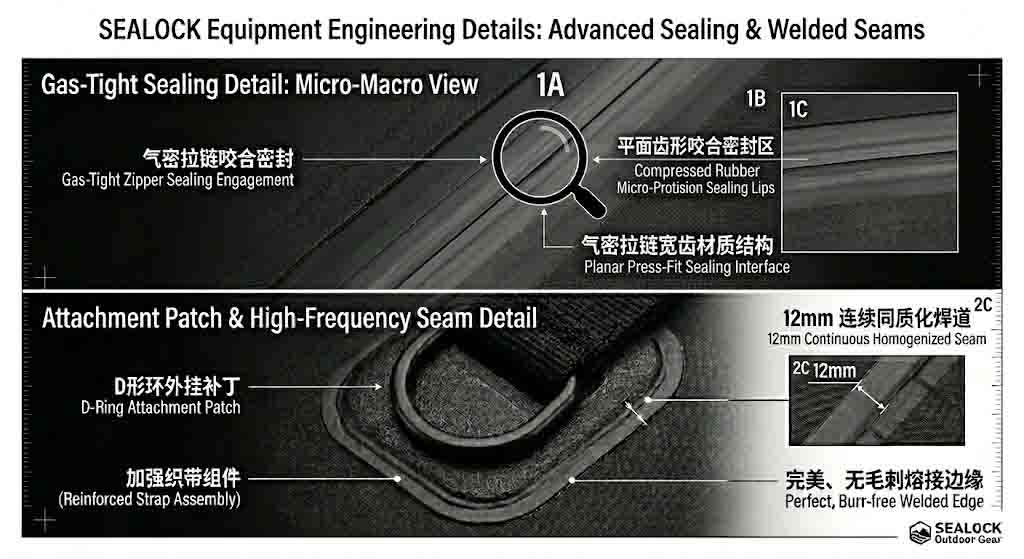
Gas-Tight Sealing Zipper: The primary closure track avoids standard water-resistant sliders. It utilizes interlocking thermoplastic teeth that mechanically lock a heavy rubber-lipped sealing profile into solid compression, stopping water migration even under prolonged deep immersion.
-
Dual-Layer Base Stress Matrix: Cinching a heavy cargo duffel onto a kayak deck using bungee cords or heavy-duty cam straps applies tremendous pulling force to the attachment patches. Cheap bags rip open along the patch perimeter because the strain concentrates on a single layer of fabric. Sealock welds a high-density TPU reinforcement patch underneath each D-ring anchor, distributing the dynamic pulling forces across a wider footprint to protect the main interior chamber from tearing under load.
-
Hydrolysis-Resistant Polyether TPU: Cheap PVC fabrics add migratory plasticizer oils to stay soft, but these chemicals wash away in salt water, leaving the bag stiff and brittle. Sealock builds the chassis out of 100% unplasticized Polyether TPU. This molecule features an inert ether backbone that resists microbial attack and water hydrolysis, ensuring the fabric never peels or smells rotten when wet clothes are sealed inside for 72 consecutive hours.
Technical Engineering Specifications (Model: P-001-001)
The following physical and structural data outlines the manufacturing metrics for this technical 40L submersible platform. For lighter, roll-top carry applications optimized for single-day mountain use, review our ultralight Waterproof Hiking Backpack Roll Top Guide.
|
Engineering Property Item
|
Industrial Production Specification Standards
|
|
Substrate Fabric Base
|
500D High-Tenacity Core + Dual-Sided Polyether TPU Skin
|
|
Internal Storage Volume
|
40 Liters (Configured for multi-day marine expedition cargo)
|
|
Waterproof Testing Metric
|
IPX8 Certified Submersible (1.5 Meters immersion for 60 minutes)
|
|
Fusion Seam Specifications
|
12mm Wide Continuous Homogeneous Radio-Frequency Weld Bead
|
|
Minimum Order Quantity (MOQ)
|
300 Pieces per custom brand production contract run
|
B2B Procurement Action: To acquire a custom pattern sample build configured with your brand's colorway and tactical mounting matrix, contact our marine luggage development department to coordinate with our pattern technicians.
Pressurized Fluid Inspection: Pinhole Leak Verification
We do not qualify deep-water seal integrity by spraying water over a closed bag. Microscopic pinholes along heavy fabric fold lines easily pass spray simulations while leaking severely under water pressure. Sealock subjects every production batch to pneumatic inflation testing.
Completed P-001-001 hulls are fully sealed and inflated with air to an internal static pressure of 2.5 PSI, rendering the TPU frame rock-hard. The pressurized duffel is then forced completely underwater inside a clear-walled inspection tank. Quality technicians inspect all 12mm weld lines and the zipper teeth track for escaping air bubbles. Because escaping air expands instantly under water, this test identifies tiny void trails long before water ingress becomes visible to the human eye, ensuring total reliability on the water.
Defeating Marine Field Failures: Engineering FAQ
Q: Why do welded D-rings and anchor patches snap off the duffel bag body when fully cinched onto a kayak deck?
A: Anchor failure occurs when budget factories apply direct heat straight to the mounting patch edge, thinning the single layer of base fabric and creating a narrow stress concentration point. When a kayak moves through waves, the tied-down cam straps generate heavy pulling forces that snap the weakened material boundary. Sealock uses a Dual-Layer Base Matrix. We weld an independent high-density TPU reinforcement patch onto the shell before fusing the final D-ring anchor, spreading the load across a broader structural surface to safely handle over 35kg of pulling force.
Q: Many retail marine duffels claim to be waterproof but leak during brief kayak capsize recoveries. Is your IPX8 rating verified?
A: Most commercial duffels use roll-top systems or polyurethane-coated coil zippers that are only rated to IPX6, which means they resist rain but leak under dynamic water columns. During a roll recovery, water pressure easily bypasses these closures. Sealock’s P-001-001 platform is a true IPX8 certified submersible vessel. It utilizes a continuous Gas-Tight Zipper track with compressed rubber profiles that seal out water under depth pressure, keeping internal cargo dry even during extended water recoveries.
Q: Reviewers note that internal TPU coatings on generic travel bags start smelling rotten and peeling after being stuffed with wet gear. How does Sealock pass this?
A: Standard dry bags use low-cost PVC or Polyester-grade TPU formulations. When damp clothes or wetsuits are sealed inside a warm kayak hatch, the trapped moisture causes a chemical reaction called ester hydrolysis. This breaks down the chemical bonds, causing the coating to peel away, turn sticky, and rot. Sealock uses premium Polyether-grade TPU, which features a chemical backbone immune to water molecule cleavage. This prevents material breakdown and odor accumulation even after prolonged damp storage fields.
Q: How does water slowly seep into internal compartments of seam-taped duffels even when the outer fabric shows no visible punctures?
A: This occurs due to the capillary wicking trail inherent to stitched construction. Even if the inside is covered with tape, the external sewing threads remain exposed to water. The woven fibers function like a mechanical pump, absorbing water and drawing it along the thread channel underneath the adhesive tape. Once salt crystals form underneath, the tape peels away invisibly. Sealock’s high-frequency welding process liquefies the overlapping TPU layers into a single homogeneous layer without threads, completely destroying the physical paths required for capillary water transport.
 English
  Español
  Português
  русский
  Français
  日本語
日本語  Deutsch
  tiếng Việt
  Italiano
  Nederlands
  ภาษาไทย
  Polski
  Svenska
  magyar
  Malay
Malay  বাংলা ভাষার
  Dansk
Dansk  Suomi
Suomi  हिन्दी
  Pilipino
  한국어
한국어  Türkçe
  Gaeilge
  العربية
  Indonesia
  Norsk
Norsk  تمل
تمل  český
český  ελληνικά
  український
  Javanese
  فارسی
فارسی  தமிழ்
தமிழ்  తెలుగు
  नेपाली
  Burmese
  български
  ລາວ
ລາວ  Latine
  Қазақша
  Euskal
  Azərbaycan
  Slovenský jazyk
  Македонски
  Lietuvos
  Eesti Keel
  Română
  Slovenski
  मराठी
मराठी  Srpski језик