




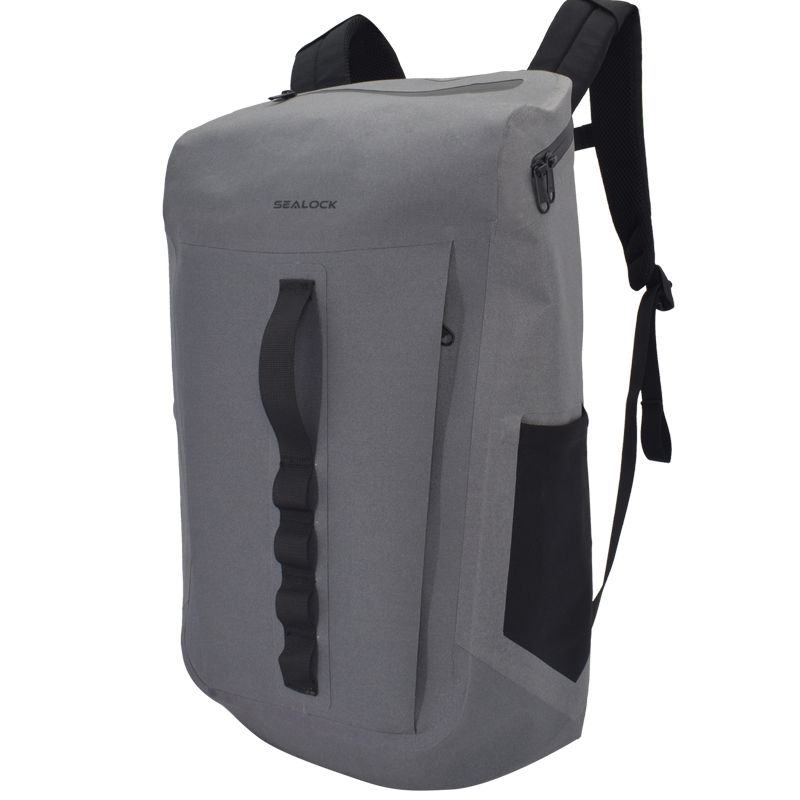

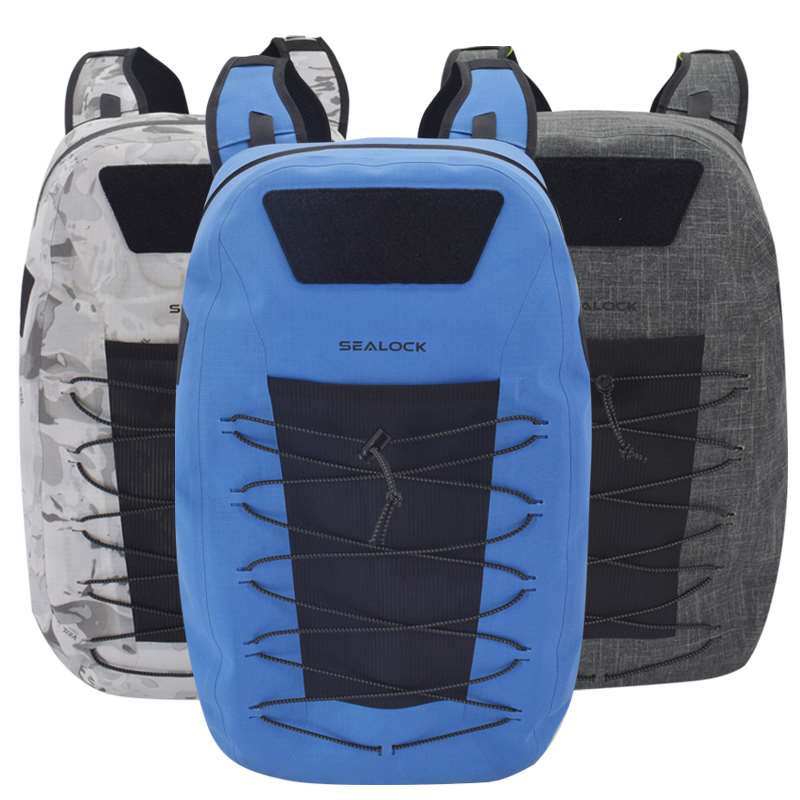
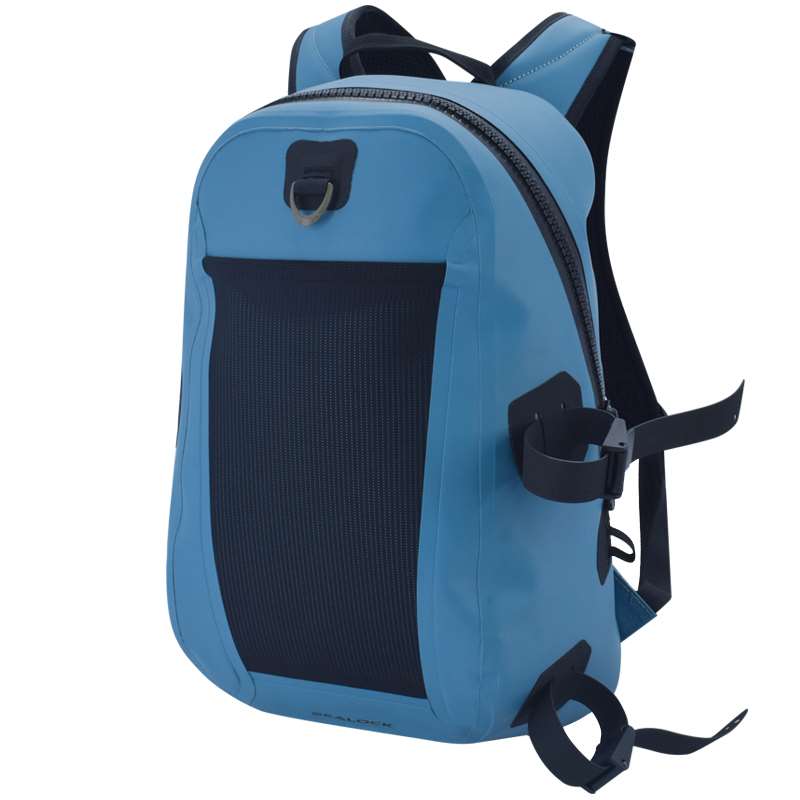
Most dry bag sourcing problems don't start at the factory — they start in a vague RFQ. This guide walks B2B buyers through every specification that actually changes the price, durability, and lead time of a wholesale dry bag order, so you can brief a manufacturer precisely instead of guessing.
- Why a precise spec sheet protects your margin
- Material: 500D PVC tarpaulin vs 420D nylon TPU
- Capacity tiers and what each size is actually for
- Closure type: roll-top vs airtight zipper
- How to specify an IPX waterproof rating
- Seam construction: why RF welding matters
- Customization variables to lock down before quoting
- What actually drives the unit price
- Compliance and certifications buyers should specify
- The five most common dry bag spec mistakes
- MOQ reference by specification complexity
- Lead time: sample to mass production
- The one-page RFQ checklist
- FAQ
1. Why a precise spec sheet protects your margin
When a buyer sends a request like "I need 2,000 waterproof dry bags, please quote," a factory has to make assumptions about material weight, closure, print method, and test standard. Each assumption is a place where the sample arrives wrong, the revised quote climbs, and the launch date slips. In a category as physically simple as a dry bag, the difference between a profitable program and a problem order is almost always written into the specification — not discovered later on the production floor.
The good news: a dry bag has a finite, knowable set of decisions. Lock down the eight variables below and you can compare quotes from multiple suppliers on equal terms, and any competent manufacturer can hit your target without a guessing game. This guide is written from the production side — it reflects what our engineering team in Dongguan and our two assembly facilities in Ho Chi Minh City actually ask buyers before opening a tooling sheet. (If you're evaluating which factory to place the order with, our companion piece, OEM outdoor gear manufacturer overview, covers supplier vetting; this guide is about getting the product spec right first.)
2. Material: 500D PVC tarpaulin vs 420D nylon TPU
Material is the single biggest driver of both unit cost and the way a dry bag feels in a buyer's hand. The two workhorses of the category are PVC tarpaulin and nylon-backed TPU. They are not interchangeable, and choosing the wrong one for your end use is the most common spec mistake we see.
| Property | 500D PVC Tarpaulin | 420D Nylon TPU |
|---|---|---|
| Typical weight | Heavier, stiffer hand-feel | Lighter, more flexible |
| Unit cost | Lower — best value at volume | Higher — premium positioning |
| Abrasion resistance | Excellent for rugged use | Very good, with less bulk |
| Cold-weather flexibility | Can stiffen in freezing temps | Stays pliable in the cold |
| Chemical / PFAS profile | Standard PVC | Available PFAS-free |
| Best fit | Boat bags, rugged duffels, value lines | Premium kayak/expedition lines |
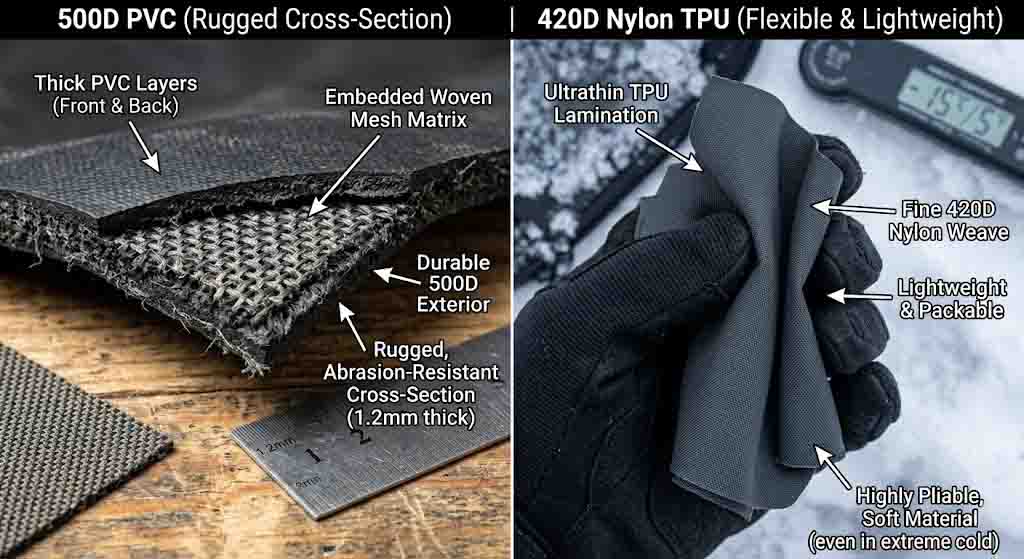
If your program is positioned on value and durability — rental fleets, marine supply, entry-level outdoor retail — 500D PVC almost always wins on landed cost. If you're building a premium or technical line where pack weight and cold-weather behavior matter, 420D nylon TPU justifies its premium. For a deeper material breakdown including how each behaves at sub-zero temperatures, see our TPU vs PVC in freezing conditions analysis and the broader TPU waterproof material guide.
Spec tip: Always state the denier and the coating on your RFQ — "500D PVC tarpaulin" or "420D nylon with TPU coating" — not just "waterproof fabric." A factory cannot quote accurately against an undefined material, and the cheapest quote you receive against a vague brief is usually the one cutting fabric types you didn't authorize.
3. Capacity tiers and what each size is actually for
Dry bag capacity is measured in liters, but the number alone tells a factory little about the shape and gusset you need. Buyers get cleaner samples when they pair a target volume with the intended use case and Specific dimension data. The tiers below reflect the volumes that move in wholesale programs:
| Capacity | Typical end use | Notes for buyers |
|---|---|---|
| 2–5 L | Phone, wallet, keys; paddleboard add-on | Often sold as multipacks; low material cost, print area limited |
| 10–20 L | Day kayaking, beach, commuting | The volume sweet spot for most retail dry bag SKUs |
| 30–40 L | Multi-day kayak, rafting, expedition | Shoulder strap / backpack straps frequently added here |
| 50–100 L | Boat storage, gear haul, base camp | Crosses into boat bag and duffel territory |
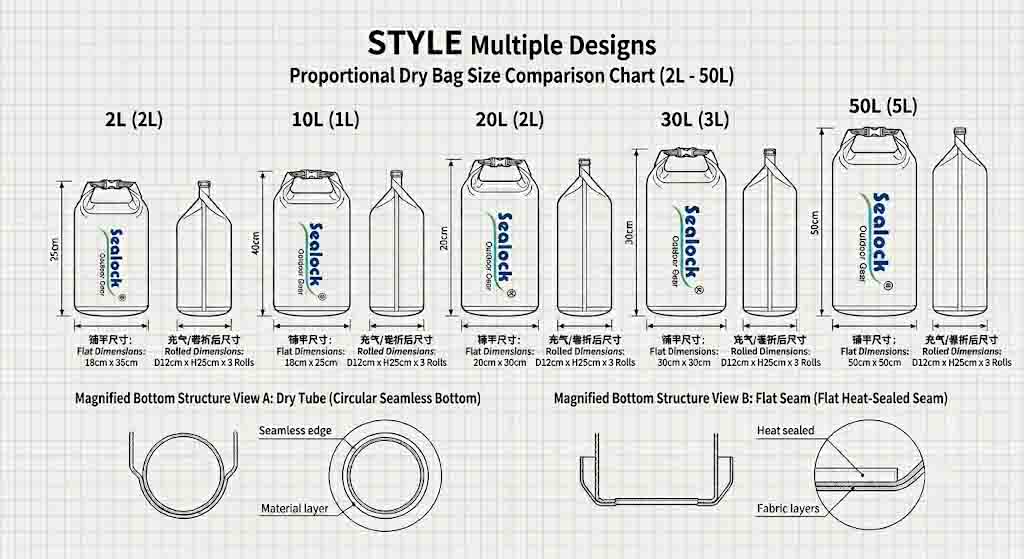
If you're sourcing a multi-size range, tell the factory up front — shared tooling and a common closure across sizes lowers per-unit cost and keeps your line visually consistent. Our full dry bag product range shows the standard size ladder we tool for, and the cylindrical dry tube bag format if you need a roll-and-clip silhouette rather than a flat seam.
4. Closure type: roll-top vs airtight zipper
The closure defines both the waterproof rating and the price point. Two systems dominate wholesale dry bags:
Roll-top closure
The classic dry bag closure: roll the open end three or more times and clip the buckle. It's economical, field-repairable, and reliably keeps splash and rain out. It is not designed for full submersion under pressure — the roll is a fold, not a seal. For the vast majority of paddling, beach, and commuting SKUs, roll-top is the correct and cost-effective choice.
Airtight zipper
A welded airtight zipper delivers a true sealed closure that holds up under submersion and pressure, at a meaningfully higher unit cost. Specify it only when your end use genuinely demands it — diving accessory bags, full-immersion rescue gear, or premium SKUs where the closure is part of the story. For most buyers, putting an airtight zipper on a casual beach bag adds cost the shelf price can't recover.
If you're weighing the trade-off across a whole product line, our forthcoming closure comparison goes deeper, but the rule of thumb is simple: roll-top for splash and rain protection at scale, airtight zipper for submersion-grade SKUs. For backpack-style dry bags specifically, the roll-top hiking backpack guide covers strap and harness integration.
Where the closure quietly changes your cost
Buyers often treat the closure as a binary choice, but it cascades into other line items. An airtight zipper needs a reinforced weld around the zipper track, a heavier base fabric to support the seal, and tighter QC tolerances — so the cost gap between roll-top and airtight is wider than the zipper component alone suggests. When you compare two quotes and one is dramatically cheaper on an "airtight" bag, confirm both the zipper grade and the surrounding weld. A budget zipper welded into a thin fabric will pass an initial inspection and fail in the field, which is the most expensive kind of saving.
5. How to specify an IPX waterproof rating
"Waterproof" is a marketing word; IPX is a measurable standard. The IPX scale (the X means dust ingress isn't being rated) runs from IPX0 to IPX8, and stating the right target on your RFQ tells the factory exactly which closure and seam construction to build.
| Rating | Protection level | Typical dry bag match |
|---|---|---|
| IPX4 | Splashing water from any direction | Light-duty roll-top, commuter pouches |
| IPX6 | Powerful water jets | Standard RF-welded roll-top dry bags |
| IPX7 | Immersion up to 1 m, 30 min | Quality roll-top with welded seams |
| IPX8 | Continuous immersion beyond 1 m | Airtight-zipper submersion bags |
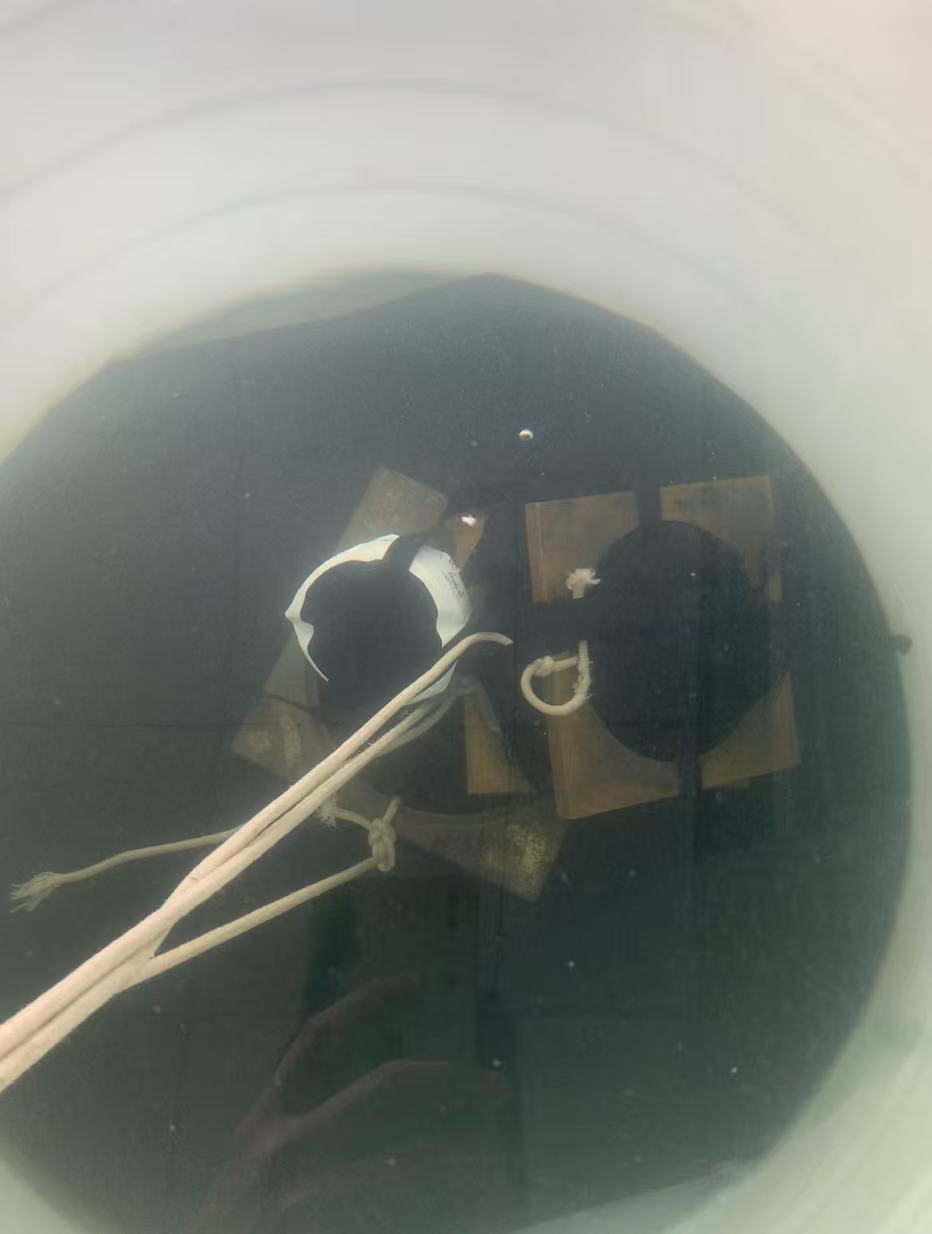
In practice, most wholesale dry bag programs target IPX6–IPX7, which a properly welded roll-top bag achieves. IPX8 requires the airtight-zipper construction described above and a higher budget. Importantly, look for a supplier who can actively verify these claims. Our factory implements professional IPX waterproof rating testing as a core QC standard, including pressure-testing welded seams to 1.0 bar (detailed in our 1.0 bar testing and HF welding note).
Spec tip: Don't over-specify. Asking for IPX8 when your product is a beach bag inflates cost without adding shelf value. Match the rating to the realistic worst case your end user will face.
6. Seam construction: why RF welding matters
A dry bag is only as waterproof as its weakest seam. There are two ways to join waterproof fabric: stitching (with taped seams) and radio-frequency (RF / high-frequency) welding. Welding fuses the two fabric layers into a single homogeneous bond with no needle holes — which is exactly why it's the standard for serious dry bags.
Our welding runs at 27.12 MHz, the industrial frequency for this process; the engineering reasoning is covered in our 27.12 MHz high-frequency welding explainer, and the durability comparison against stitching is in RF welding vs stitching. For a buyer, the practical takeaway is short: for any dry bag claiming IPX6 or above, your spec should say "RF-welded seams." If a quote comes back unusually low, check whether the supplier quietly substituted stitched-and-taped seams, which fail sooner at the seam line.
7. Customization variables to lock down before quoting
These are the line items that turn a stock dry bag into a branded SKU. Define each one in your RFQ so the quote you receive is the quote you pay:
- Color: Provide a Pantone reference, not "blue." Solid colors are standard; custom Pantone matching may carry a fabric MOQ.
- Logo / branding: Silk-screen print, heat transfer, or welded patch. Each has a different cost and minimum.
- Hardware: Buckle type, D-rings, lash points, shoulder strap or backpack straps.
- Window / valve: A clear TPU window for visibility, or an air-purge valve for compression.
- Size ladder: Single SKU or a multi-size family sharing tooling.
Every added feature has a minimum-order implication, which leads directly to the next section.
8. What actually drives the unit price
Buyers comparing quotes side by side often can't see why two numbers differ. Understanding the cost stack lets you read a quote critically and spot where a supplier has cut a corner you didn't ask them to cut. For a wholesale dry bag, the unit price is built from roughly these components:
- Fabric — the largest single input, driven by denier, coating, and color. A lower fabric types is the most common hidden saving in a suspiciously cheap quote.
- Welding & labor — RF welding is efficient at volume but still a real line item; intricate shapes and airtight closures add weld time.
- Hardware — buckles, D-rings, straps, valves, and windows each add component and assembly cost.
- Branding — print plates, transfer film, or welded patches carry setup costs amortized across the run, so larger orders dilute them.
- Tooling — a one-time charge for custom shapes or sizes, recovered over the order quantity.
- Testing, QC & packaging — pressure testing, inspection, and retail-ready packaging.
Two takeaways for buyers. First, volume lowers the per-unit impact of the fixed costs (plates, tooling), which is why MOQ and price are linked. Second, when one quote undercuts the others by a wide margin, the gap almost always traces back to fabric types or seam construction — the two things hardest to see in a photo and easiest to verify by asking for the exact spec in writing.
9. Compliance and certifications buyers should specify
For dry bags entering regulated markets, the right certifications aren't optional extras — they're customs and liability requirements that belong in the spec, not in a scramble after the goods are made. The ones that matter most for this category:
- REACH — the EU chemical regulation governing substances in the fabric and coating; essential for any goods sold in Europe.
- PFAS-free — increasingly required as regions legislate against per- and polyfluoroalkyl substances. We offer PFAS-free TPU; the background is in our PFAS-free TPU note. State it explicitly if your market demands it, because a standard coating may not qualify.
- California Prop 65 (CA65) — relevant if you're selling into the US; governs warning requirements for certain chemicals.
- Factory-level audits (BSCI / SMETA / ISO 9001) — these certify the manufacturer's social and quality systems rather than the product. Many retail buyers require them as a condition of onboarding a supplier.
The practical move is to confirm which certifications your destination market and your retail partners require before sampling, then put them on the RFQ. Discovering a PFAS restriction after mass production is the kind of error that turns a finished order into unsellable inventory.Check our international qualification certifications
10. The five most common dry bag spec mistakes
After enough RFQs cross an engineering desk, the same avoidable errors recur. Watching for these will save you a sampling round:
- Specifying "waterproof" with no IPX target. The factory has to guess the closure and seam, and the sample rarely matches your intent.
- Choosing material by price alone. A cheaper fabric types can mean a stiffer bag, a shorter service life, or a coating that won't pass your market's chemical rules.
- Over-specifying the rating. Asking for submersion-grade construction on a splash-protection product loads cost the retail price can't recover.
- Leaving color as a word. "Navy" varies by factory; a Pantone reference removes the ambiguity and the rework.
- Underestimating sample-approval time. Buyers control this stage and routinely lose weeks here, then blame the production lead time.
11. MOQ reference by specification complexity
MOQ (minimum order quantity) on dry bags scales with how much customization the order requires. The figures below are indicative ranges for planning — confirm exact numbers against your specific spec, because a single-color stock-shape order behaves very differently from a custom-tooled multi-size program.
| Order type | Indicative MOQ range | Why |
|---|---|---|
| Stock shape, logo print only | Lower | No new tooling; print plate is the only setup |
| Stock shape, custom Pantone color | Moderate | Tied to dyed-fabric minimums |
| Custom size / shape, custom color | Higher | New welding tooling plus fabric minimum |
| Multi-size custom family | Highest aggregate | Multiple tools; allocate volume across sizes |
If your launch quantity is below a factory's stated MOQ, two levers usually help: start from a stock shape (eliminating tooling minimums) or consolidate colors into one across a size range. We discuss how MOQ is actually built up in the broader OEM manufacturing overview.
12. Lead time: sample to mass production
Lead time is where launch dates live or die, and it's almost always underestimated in early planning. A realistic timeline for a customized dry bag program runs in stages:
- Spec confirmation & quotation — fastest when your RFQ is complete (which is the whole point of this guide).
- Sampling — physical sample produced and shipped for approval; allow a sampling round and time for one revision.
- Sample approval — the stage buyers control. Fast, decisive feedback here protects your ship date.
- Mass production — scales with order quantity and how many sizes/colors are in the run.
- QC & shipping — pre-shipment inspection, then sea or air freight transit.
The dual-base setup — engineering and tooling in Dongguan, scaled assembly in Ho Chi Minh City — exists specifically to give buyers options on lead time and tariff exposure; the rationale is in our China–Vietnam dual-base strategy. The single biggest lever you control over lead time is turning sample approvals around quickly.
13. The one-page RFQ checklist
Copy this into your next inquiry and you'll get accurate, comparable quotes on the first pass:
- Material & denier (e.g. 500D PVC tarpaulin / 420D nylon TPU)
- Capacity in liters + intended use
- Closure type (roll-top / airtight zipper)
- Target IPX rating + required test method
- Seam construction (RF-welded)
- Color (Pantone reference)
- Branding method + artwork
- Hardware & strap configuration
- Order quantity (and size split, if a range)
- Target ship date & destination port
- Required certifications (REACH, PFAS-free, etc.)
Bottom line: A dry bag is a simple product with a small number of decisions that fully determine cost and quality. Specify those decisions yourself, and you move from being quoted at to negotiating from a position of control.
14. Frequently asked questions
"Waterproof bag" is a broad category; a dry bag is a specific format — typically a roll-top sack designed to keep contents dry during water activities. All dry bags are waterproof bags, but not all waterproof bags are dry bags.
Neither is universally better. 500D PVC tarpaulin offers the best landed cost for value and rugged lines; 420D nylon TPU is lighter, more flexible in cold, and suits premium or technical positioning. Match the material to your price point and end use.
Most programs target IPX6–IPX7, achievable with a properly RF-welded roll-top bag. Reserve IPX8 (and its airtight-zipper cost) for genuine submersion SKUs.
Often yes, by starting from a stock shape to remove tooling minimums or consolidating to a single color. Discuss your launch quantity openly — a good factory will tell you which spec choices unlock a lower minimum.
Plan in stages: quotation, sampling and one revision, your approval, mass production, then QC and freight. The variable you most control is how fast you approve samples.
Ready to spec your order?
Browse the Sealock dry bag range to see standard shapes and sizes, then send your completed RFQ through our contact page. With a complete spec in hand, we can return an accurate quote and a realistic timeline on the first reply.